Buyer Fit Snapshot
| Best fit | custom logo boxes with die cutting design for packaging buyers comparing material specs, print proof, MOQ, unit cost, freight, and repeat-order risk where brand print, material, artwork control, and repeat-order consistency matter. |
|---|---|
| Quote inputs | Share finished size, material target, print colors, finish, packing count, annual reorder estimate, and delivery region. |
| Proofing check | Approve dieline scale, logo placement, barcode or warning zones, color tolerance, and any recyclable or compostable wording before bulk production. |
| Main risk | Vague material claims, crowded artwork, or missing packing details can create delays even when the unit price looks attractive. |
Fast answer: Custom Logo Boxes with Die Cutting Design: Dieline, Finish, Proof, and Buyer Review should be specified like a repeatable production item. The safest quote includes material, print method, finish, artwork proof, carton packing, and reorder notes in one written spec.
What to confirm before approving the packaging proof
Check the product dimensions against the actual filled item, not only the sales mockup. Ask for tolerance on folds, seals, hang holes, label areas, and retail display edges. If the package carries a logo, QR code, warning copy, or legal claim, reserve that space before decorative graphics fill the panel.
How to compare quotes without losing quality
Compare board or film grade, print process, finish, sampling route, tooling charges, carton quantity, and freight assumptions side by side. A lower quote is only useful if the supplier can repeat the same color, closure quality, and packing count on the next order.
Custom Logo Boxes with Die Cutting: Design That Sells
Custom Logo Boxes with die cutting can change a buyer's judgment before the product is even touched. Put a plain carton next to a box with a window, a thumb notch, or a reveal flap, and the second one feels more deliberate almost instantly. That reaction is not magic. It is structure acting like a sales signal. Custom logo boxes with die cutting combine print with a precise cut path so the packaging itself helps communicate value, guide the eye, and make the product look worth the price tag.
Packaging teams often talk about color first, then graphics, then finishing. Fair enough. But the cut line usually does more work than people expect. In custom logo boxes with die cutting, the opening style, perforation, insert, cutout, and fold sequence become part of the brand message. A smart dieline can frame the logo, reveal the product at the right angle, and reduce the amount of filler material inside the pack. A weak one can make a beautiful print job feel cheap the second it arrives on a pallet. I've seen that happen more than once, and it is always a little painful.
This matters because customers do not separate structure from appearance. They experience the whole object in one glance, one touch, one opening. That means custom logo boxes with die cutting need to do more than look attractive in a mockup. They have to survive production, shipping, handling, and the split second when someone decides whether the brand feels premium or merely decorated.
The promise is simple. Custom logo boxes with die cutting are not a cure-all, but they are one of the fastest ways to make printed packaging feel considered instead of generic. The catch lives in the planning. The product, the budget, the shipping method, and the assembly step all have to line up. Miss one piece and the box turns into a clever idea that costs too much to build, too much to ship, or too much to assemble. That is how a good concept goes sideways, kinda unfairly, right at the finish line.
Why Custom Logo Boxes with Die Cutting Get Noticed
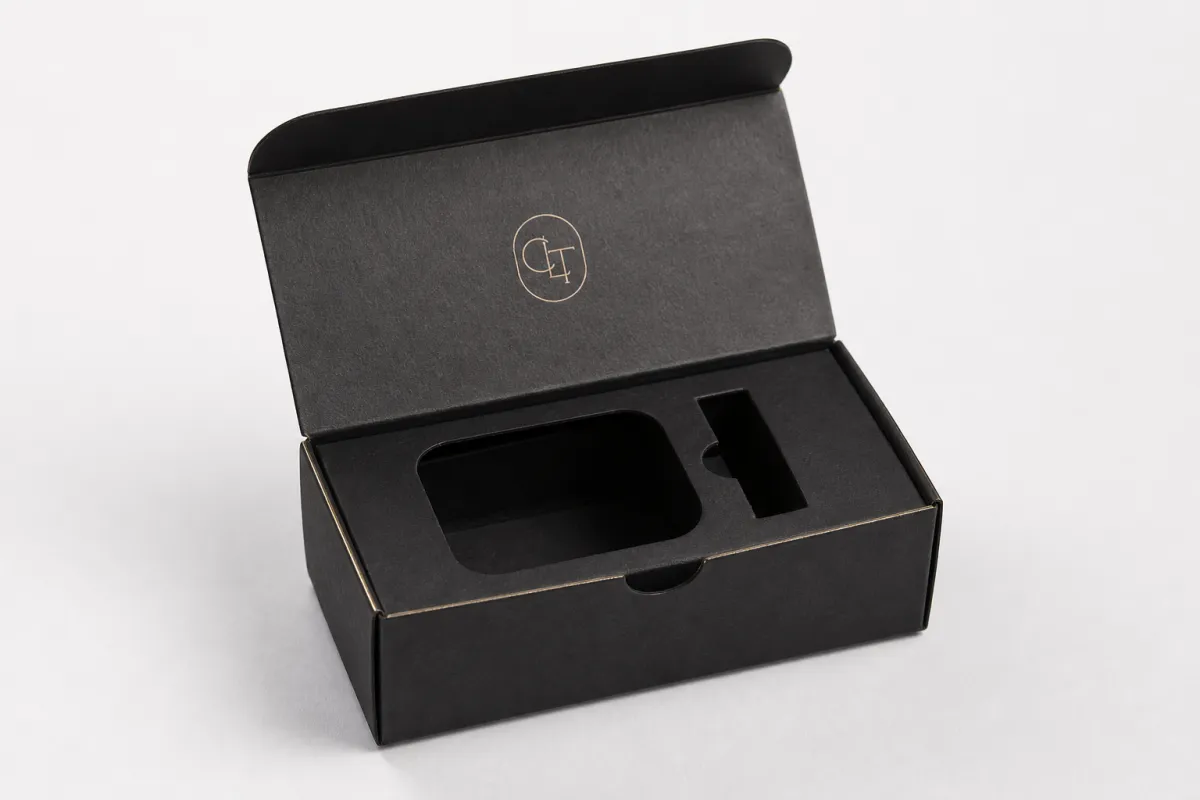
Stand near a retail shelf for long enough and the pattern becomes obvious. Most cartons disappear into the background because they only promise containment. Custom logo boxes with die cutting interrupt that habit. A window gives the product a voice. A handle suggests motion and portability. A reveal flap slows the opening moment just enough to create anticipation. That is packaging design doing a job that plain cardboard cannot.
Custom logo boxes with die cutting are printed boxes cut into a specific shape so they can include windows, inserts, perforations, tabs, or unconventional opening styles. The idea sounds technical because it is. The impact is visual, but the benefit is practical. A cosmetics box might use a narrow cutout to show a bottle silhouette. A gift set can open like a stage curtain. A snack pack may use a tear strip that opens cleanly instead of ripping the whole face of the box. Those details change how the product feels before anyone reads the copy.
Branding improves because the structure starts doing some of the storytelling. The cut line frames the logo instead of competing with it. The opening path can hide the product, then reveal it in stages. In custom logo boxes with die cutting, that rhythm matters for retail packaging and direct-to-consumer shipments alike. Buyers do not divide a box into separate categories for structure and appearance. They react to the entire object at once.
Too many brands obsess over color swatches and ignore the shape sitting under them. That is a costly blind spot. Custom logo boxes with die cutting let the geometry carry some of the emotional weight. A well-planned opening can lift a mid-range item into a more premium bracket without adding a mountain of extra material. It can also reduce the need for extra display props or bulky inserts. In practical terms, the box is either helping sell the product or quietly fighting it.
There is another layer here that gets missed: trust. A cutout that reveals the actual product can reduce uncertainty for a first-time buyer. That does not mean every box needs a big window. Sometimes the smarter move is a small, controlled reveal. Too much exposure and the pack starts looking busy. Too little and the product disappears. The sweet spot depends on category, channel, and how much risk the customer is willing to take.
How Custom Logo Boxes with Die Cutting Work
Every die-cut job starts with a dieline. That flat template maps the cut lines, score lines, glue tabs, waste areas, and any special features such as windows or tear strips. In custom logo boxes with die cutting, the dieline is not a side note. It is the blueprint. If it is off by even a little, the artwork can look perfect on screen and still fail the moment the board gets folded.
The process usually follows a clear sequence, though each step carries its own risks. Artwork goes onto the board layout first. Then the shape is cut and scored. After that, the box is folded, glued, checked, and packed. Custom logo boxes with die cutting often include an extra finishing pass, which may mean matte lamination, gloss varnish, foil, embossing, or a window patch. Each add-on increases perceived value. Each add-on also adds Cost, Lead Time, and another chance for a mistake.
High-volume runs usually rely on a steel rule die. A custom metal die is built to the required shape and pressed through the board to cut and crease it in one motion. That setup becomes efficient at scale, which is one reason custom logo boxes with die cutting make more economic sense as quantities rise. Digital cutting serves a different purpose. It works well for samples, prototypes, mockups, and smaller orders because there is no hard tooling charge in the same way. The tradeoff is straightforward: flexibility and speed versus unit cost.
Structural add-ons matter more than most people expect. A window opening changes visibility and can reduce print coverage on the front panel. A thumb notch makes opening easier. Hanging tabs support peg display. Inserts keep delicate items from shifting during transit. Perforated Tear Strips improve the opening experience for subscription packaging or ship-ready cartons. In custom logo boxes with die cutting, each feature changes how the box behaves in the hand, on the shelf, and in a warehouse.
Artwork preparation is where many teams lose time. Vector files are usually the safest choice because the lines stay sharp at any size. Bleed often needs to extend at least 0.125 in, though some suppliers ask for more depending on board type and finish. Safe zones matter because anything too close to the edge can get clipped during cutting. Line naming matters too. Cut, crease, perforation, and glue areas should be labeled clearly so production does not have to guess. Great branding still fails if the production file is messy.
One detail that separates a polished job from a frustrating one is how the design handles the fold sequence. A logo sitting across a score line can crack after a few openings. A window that lands too close to a fold can warp the front panel. I have watched teams approve attractive mockups that fell apart under actual handling, and the fix was never glamorous. It was usually a few millimeters, a revised notch, or a calmer print layout.
For teams comparing structures, it helps to think about control and complexity rather than just appearance. Custom logo boxes with die cutting can range from a simple display sleeve to a more intricate folding carton with internal supports. If shipping performance matters, the ISTA packaging testing standards provide a useful technical reference. If certified fiber sourcing matters, the Forest Stewardship Council is the place to verify chain-of-custody options.
Custom Logo Boxes with Die Cutting: Cost, Pricing, and MOQ
If someone asks whether custom logo boxes with die cutting are expensive, the only honest answer is: compared with what? Compared with a plain stock carton, usually yes. Compared with a printed retail box that actually helps sell the product, the answer gets less obvious. Price depends on the board, size, cut complexity, print coverage, finishing, insert style, and quantity. Packaging loves to look simple right up until the quote lands in someone's inbox.
Costs split into two buckets. Fixed costs include die setup, plate setup if offset printing is used, and proofing. Variable costs include the per-unit material, print, finishing, and assembly charges. Custom logo boxes with die cutting often become more efficient as quantity rises because the setup cost spreads across more units. That is why a 500-piece order can feel painful while a 5,000-piece order suddenly looks reasonable.
For rough planning, these are typical ranges, not guarantees carved into stone. Simple custom logo boxes with die cutting in folding carton board may land around $0.20-$0.45 per unit at 5,000 pieces, depending on print coverage and finishing. More involved structures with windows, inserts, or specialty coatings can move into the $0.55-$1.20 range or higher. Rigid boxes, magnetic closures, and presentation packaging often sit higher still, usually $1.50-$4.00+ per unit depending on materials and assembly. Those numbers shift with volume, and shipping can erase a tidy quote if the boxes are bulky.
MOQ is less about philosophy and more about math. A digitally cut sample can be made at very low quantity, sometimes even one unit for approval. Custom die-cut tooling usually starts making more sense around 500-1,000 units and up, depending on the size and structure. If the design is simple, a supplier may support smaller runs. If the structure is complex, the economics often improve sharply at 2,500 pieces or more.
When you request a quote, send the facts that actually change the price. That means dimensions, product weight, quantity, board preference if you have one, finish goals, insert needs, and delivery location. If the box must arrive flat, say so. If it needs to ship pre-assembled, say that too. A vague brief leads to a vague estimate, and then everyone spends a week pretending the missing details do not matter.
For a quick comparison, this table helps teams see where the money usually goes:
| Option | Typical Setup | Approx. Unit Cost | Best For | Tradeoff |
|---|---|---|---|---|
| Simple folding carton with one cutout | Low-to-moderate die setup | $0.20-$0.45 | Retail launches, cosmetics, light consumer goods | Less structural drama, but efficient to produce |
| Carton with window, insert, and finish | Die, insert tooling, coating or laminate | $0.55-$1.20 | Gift sets, specialty foods, accessories | Better presentation, higher assembly cost |
| Rigid presentation box | Thick board wrapped with printed sheet | $1.50-$4.00+ | Premium product packaging, kits, VIP sets | Excellent feel, heavier shipping cube |
Saving money on board strength can work, but only if the product is light and the handling is gentle. Simplifying the cut can also help. A cleaner shape, fewer special openings, and a more standard glue pattern often lower cost without hurting the brand. If the whole point of custom logo boxes with die cutting is to create a premium reveal, stripping the structure too far can erase the effect you were paying for in the first place.
If you need help narrowing the spec, compare options through Custom Packaging Products and review the production range on Manufacturing Capabilities. That makes the quote conversation less abstract, which tends to save time on both sides.
Design Factors That Make or Break the Box
Fit comes first. If custom logo boxes with die cutting are even slightly wrong on the inside dimensions, the product rattles, bows the panels, or makes assembly irritating enough that staff start forcing the closure. That is how a premium box starts feeling like a bad lunch container. Leave room for board thickness, coating build, the insert, and the product itself. A few millimeters matter more than most marketing teams want to admit.
Structural style changes the impression immediately. Tuck-end cartons are efficient and familiar. Sleeve boxes create a layered reveal and work well for product packaging that benefits from a slower opening. Rigid boxes feel more substantial and are common for high-value retail packaging. Tray-and-lid structures create a deliberate unboxing rhythm. Window styles build trust because the product is visible before purchase. In custom logo boxes with die cutting, the structure should support the buying decision instead of making it harder to read.
Logo placement should follow the opening sequence. If the front panel is the first face a customer sees, that is usually where the strongest branding belongs. If the product is revealed through a window, the artwork should frame the opening rather than crowd it. If the box opens upward, the inside print can carry part of the story. Custom logo boxes with die cutting work best when the branding and the reveal moment are planned together, not patched together at the last minute.
Material choice is not a taste-only decision. Kraft board gives a natural look and supports earthy branding. SBS artboard gives a cleaner white print surface and sharper color. Corrugated board adds protection and is useful for mailers or heavier items. A 16pt or 18pt folding carton board is common for lighter retail goods, while rigid presentation boxes often use chipboard around 1200gsm wrapped with printed paper. Soft-touch lamination can make a box feel more expensive, but it also changes how the print reads under light. Foil and embossing can raise the logo, though too much finish can make the box feel crowded instead of refined.
Sustainability should be part of the brief from the start, not a patch added after the art is done. If the box has to ship flat, reduce waste, or support recycling claims, that needs to be built into the structure. Custom logo boxes with die cutting can often reduce material by removing unnecessary panels or by turning a cutout into a visibility feature. For broader packaging and recycling context, the EPA recycling guidance is a useful reference point for teams thinking beyond the mockup.
One trap catches newer buyers again and again: too many features can make the box weaker, not better. A window, a handle, a tear strip, a heavy gloss finish, and a complex insert may sound impressive in a meeting. In practice, that mix can raise cost and create a fragile structure that is harder to assemble. Custom logo boxes with die cutting should feel deliberate. Not overloaded.
"The box should do one job extremely well: protect the product while making the customer feel like the brand thought this through."
Production Steps, Timeline, and Lead Time
A clean project follows a predictable path. First comes the brief: product dimensions, quantity, target market, and any special features. Then comes dieline review, quote approval, proofing, sample build, bulk production, finishing, packing, and shipment. Custom logo boxes with die cutting run smoothly when each step is settled before the next one starts. Skip the sample stage or treat the dieline like paperwork, and the cost shows up later in rework and delays.
Sample timing and bulk lead time are not the same thing. A digital prototype might be ready in a few days if the files are clean. A structural sample with printed proofing can take longer. Once bulk custom logo boxes with die cutting start, tooling, press scheduling, finishing, and packing all enter the calendar. A simple folding carton order may take 10-15 business days after proof approval. More involved projects with specialty coatings, multiple insert parts, or rigid construction can stretch to 15-25 business days or more. Shipping adds another clock, and freight delays do not care about your launch date.
What slows projects down? Usually not the machine. It is the back-and-forth. Artwork changes after approval. Missing dimensions. Product weights guessed instead of measured. A request to add a window after the dieline has already been signed off. Custom logo boxes with die cutting depend on precision, and precision does not respond well to moving targets.
Planning extra time is not pessimism. It is how you avoid a mess. Build one revision round into the schedule. Build in time for a white sample if the closure is tricky. Build in shipping time if the boxes are going to a warehouse that needs appointment delivery. If the launch date matters, start earlier than feels comfortable. Packaging always looks quick until a proof correction lands on Friday afternoon.
Quality control is where a decent run becomes a dependable one. A good supplier checks cut accuracy, glue alignment, print consistency, fold performance, and whether the insert actually holds the product as intended. For direct-to-consumer brands, it also makes sense to ask whether the box has been tested against a shipping profile such as ISTA 3A or a similar distribution method. That kind of testing does not make the box prettier, but it does make the box survive the trip, which is the point.
Custom logo boxes with die cutting also benefit from a packed-case check before full shipment. Look at how many units fit in a master carton, how much space they take on a pallet, and whether the flat-pack stack is easy to handle in a warehouse. A box that looks elegant on the table can still be awkward in a fulfillment center. Packaging is not only a design exercise. It is a logistics object with branding on it.
That is the part many brands only learn once. A box can look excellent in a studio and still create headaches on the floor if the opening sequence takes two extra motions or the folded stack catches on itself. The best production plan is the one that respects both the eye and the hands.
Common Mistakes That Wreck Die-Cut Box Projects
The first mistake is overcomplication. People sketch something dramatic on a screen, then discover the box tears at the cut edge, folds badly, or costs too much to assemble. Custom logo boxes with die cutting reward restraint more often than spectacle. A cleaner shape usually prints better, ships better, and feels more premium because the brand is not wrestling the structure.
The second mistake is ignoring tolerance. Board thickness, coating build, and product movement all affect fit. If the inside dimensions are too tight, the product scuffs the edge or the box refuses to close cleanly. Too loose, and the item feels cheap the second someone picks it up. Custom logo boxes with die cutting need enough breathing room for the real world, not just the CAD file.
The third mistake is visual clutter. Too many finishes, too many copy points, and too many cut features can make the box feel busy instead of elevated. The better move is usually one strong idea. A window, a clean logo, and a restrained finish can do more for package branding than a front panel crammed with every selling line the team could find.
The fourth mistake is approving graphics before the final dieline is fixed. That is an expensive habit. Once the artwork is locked to the wrong template, reprints and delays follow. Custom logo boxes with die cutting should be treated as a structural project first and a print project second. The design has to fit the fold path, the closure, and the cutout before anyone starts polishing the color palette.
The fifth mistake is forgetting the boring stuff. Flat-pack storage. Assembly labor. Shipping cube. Master carton count. The time needed to pop the boxes open and load them. If a custom box requires three extra seconds per unit, that sounds harmless until a fulfillment team is handling 10,000 units. That is how a nice idea turns into a line item nobody enjoys.
A useful rule of thumb applies more often than people like to admit: if a feature does not support display, protection, or the opening moment, question why it exists. Custom logo boxes with die cutting are strongest when every cut has a job. Decorative excess tends to age badly, and the bill never gets prettier.
Expert Tips and Next Steps Before You Order
Start with the outcome, not the shape. Decide whether the box should reveal, protect, carry, display, or simply elevate the product story. Once that job is clear, custom logo boxes with die cutting become much easier to design because the structure has a purpose. Without that purpose, teams start adding features because they can, and that is a fast route to an awkward quote.
Order a physical sample or a white prototype before bulk production. Screen mockups hide too much. They do not show whether the flap catches, whether the window is centered in real life, or whether the logo sits too close to a score line. A real sample makes custom logo boxes with die cutting easier to approve because you can handle the object instead of only studying the render.
Ask for two quote paths if the supplier can support it: one optimized for budget and one optimized for presentation. That comparison is useful because it shows where the cost actually lives. Sometimes the premium version adds only a little money for a much stronger result. Sometimes it adds a lot. Either way, the decision gets clearer. Nobody enjoys choosing between "cheap" and "nice" without actual numbers in front of them.
Build a launch checklist before you place the order:
- Product dimensions and weight
- Exact quantity and replenishment expectations
- Insert or divider requirements
- Print method and color targets
- Finish choices such as matte, gloss, foil, embossing, or soft-touch
- Flat-pack or pre-assembled delivery
- Warehouse destination and shipping method
- Approval owner for art and structural sign-off
That list feels basic because it is basic. It also prevents a surprising number of problems before they become expensive. Custom logo boxes with die cutting are easier to buy when the brief is tight and the product goal is specific. If you know what the box needs to do, the structure tends to stay cleaner and the budget tends to stay saner.
For brands building a broader program, custom logo boxes with die cutting can sit inside a larger branded packaging system. That may include shipping mailers, inserts, labels, or retail packaging that all share the same visual language. If you want to see how those pieces fit together, the broader options on Custom Packaging Products and the in-house Manufacturing Capabilities are useful starting points before you lock the dieline.
My practical advice is direct: revise the brief, confirm the dieline, approve the sample, and only then move forward with custom logo boxes with die cutting. Do that, and the box has a real chance of looking sharp, shipping well, and earning its keep instead of becoming a pretty mistake with a purchase order attached.
The clearest takeaway is this: custom logo boxes with die cutting work best when the cut supports the product, the print supports the story, and the budget supports the quantity. Get those three aligned, and the packaging stops acting like decoration and starts functioning like a real sales tool.
FAQ
Are custom logo boxes with die cutting more expensive than standard boxes?
Usually yes at the start, because the die setup, proofing, and structural prep add cost. At higher quantities, the per-unit gap often shrinks, especially on simpler designs. The real question is whether custom logo boxes with die cutting earn that extra spend through better shelf impact, protection, or conversion.
What do I need to request a quote for custom logo boxes with die cutting?
Send box dimensions, product weight, estimated quantity, and whether you need windows, inserts, or special finishes. Artwork files help, but a rough sketch and a packaging brief can still move the quote process forward. If shipping matters, include the destination and whether the boxes must arrive flat or pre-assembled.
How long does production usually take for custom logo boxes with die cutting?
Sample timing can be fast, but bulk production usually takes longer once tooling, print, and finishing are included. Simple jobs move faster than orders with complex cuts, multiple finishes, or a long proof cycle. In most cases, approval lag causes more delay than the press itself.
Can I order custom logo boxes with die cutting in a small run?
Yes, especially if the design is simple or the supplier offers digital cutting for prototypes and smaller quantities. Small runs are common for launches, seasonal products, influencer kits, and test markets. The tradeoff is that the unit cost usually stays higher until the order reaches a more efficient volume.
What products work best with custom logo boxes with die cutting?
Products that benefit from a reveal moment, a display window, or a better fit usually perform well. Common examples include cosmetics, specialty foods, gift sets, electronics accessories, and subscription boxes. If the packaging has to carry, protect, and show the product at the same time, custom logo boxes with die cutting are usually worth serious consideration.

