Most shoppers do not study clothing tags line by line. They notice them when something feels itchy, cheap, or unfinished. That is why Custom Logo Clothing Tags private label matters more than many brand owners expect: the label is a small piece of branded construction that either supports the garment or quietly drags it down.
If you are building a clothing line, the tag is not just a compliance box to check. It sits in the same ecosystem as packaging, folding, inserts, and the way the product arrives in the mailer. Get it right and the garment feels considered. Get it wrong and customers notice friction before they notice fit.
That matters because apparel buyers are fast judges. A hoodie can be well cut, the fabric can be good, the stitching can be clean, and one bad neck label still makes the piece feel less finished. The reverse is true too: a modest garment can feel more valuable when the labeling is tidy and consistent.
Custom logo clothing tags private label: what they are and why brands care
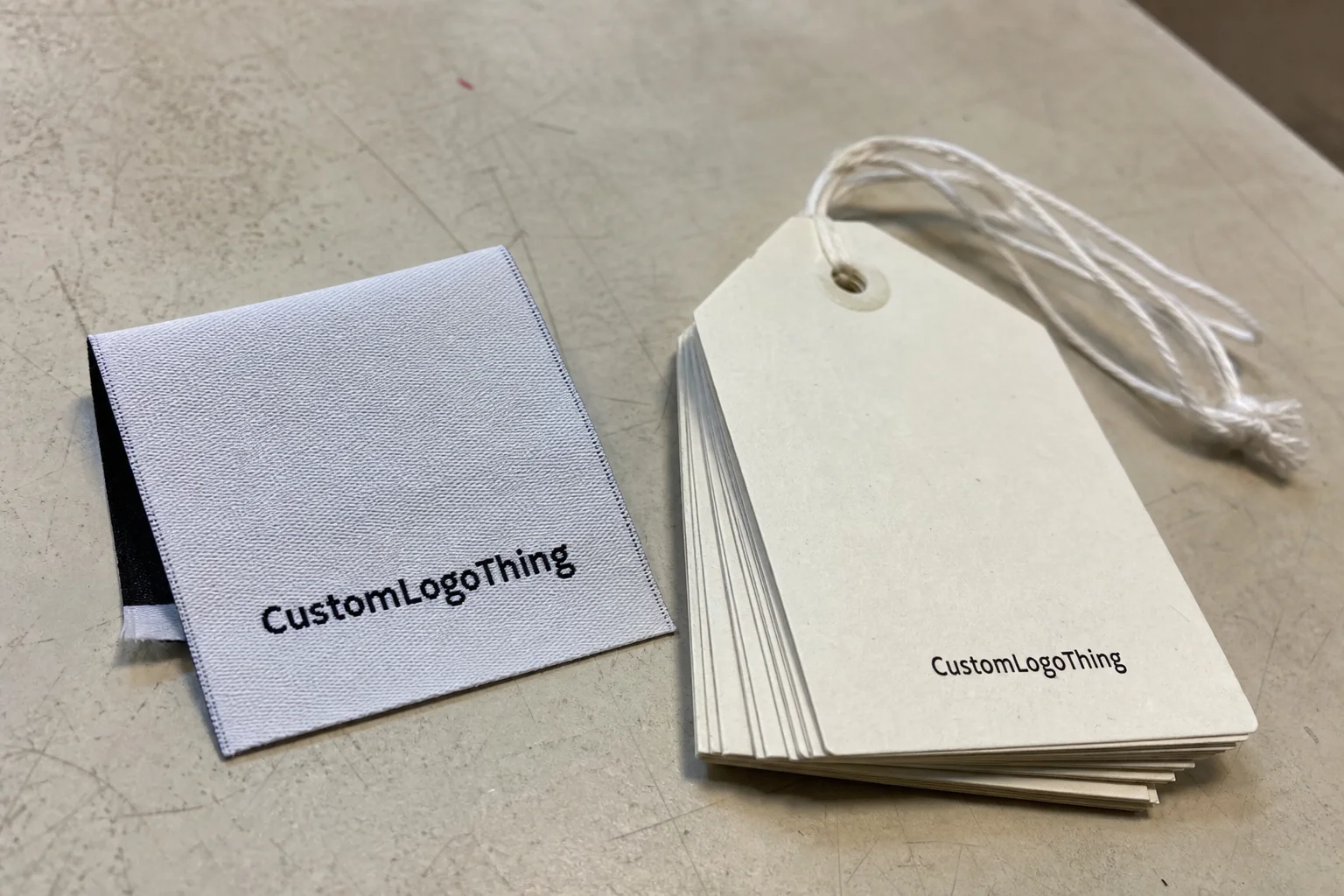
In plain terms, Custom Logo Clothing Tags private label means branded labels made for your apparel line, so the garment carries your name instead of a blank or generic tag. That can include a woven neck label, printed satin label, heat transfer label, size tab, care label, or hang tag. Same purpose, different formats.
Most brands use a mix rather than one all-purpose tag. Woven labels are common for a premium look and good wash durability. Printed satin labels work when softness and fine text matter. Heat transfer labels are popular for no-sew applications or when the customer should not feel a tag at all. Hang tags help with retail presentation. Size labels keep production, sorting, and fulfillment from becoming guesswork.
Private label is different from generic labeling because it gives you control over identity. Logo, typography, color, finish, fold, placement — all of it shapes how the garment reads in hand. That consistency should carry across product packaging, apparel inserts, and the garment itself. If your hoodie arrives in a polished mailer with clean Custom Packaging Products but the neck label looks temporary, the brand feels less credible even if the fabric is excellent.
These tags show up everywhere: tees, hoodies, activewear, baby clothes, boutique apparel, and wholesale collections. Comfort matters more than decoration for baby and skin-contact items. Streetwear often uses the label as part of the brand story. Activewear usually prioritizes wash resistance, stretch recovery, and low irritation over visual flourish. Different use cases, different specs.
A clothing tag is small. The brand signal is not.
If your apparel line also uses custom printed boxes or other branded packaging, the label should feel like part of the same system. Mismatched finishes, clashing colors, or a luxury package paired with a flimsy interior tag can make a product feel underbuilt even when the construction is sound.
How the private label clothing tag process works
The process is manageable when the spec is clear. Most delays start with vague requests like “need Labels for Shirts.” That leaves too much room for assumptions about fabric, fold, sizing, and attachment method.
The usual workflow is straightforward: artwork prep, label type selection, size confirmation, proofing or sampling, approval, production, and shipping. A decent supplier will ask for garment type, quantity, attachment method, material preference, fold style, and color details before quoting. If they do not ask, you should provide those details anyway.
What buyers need to submit
- Logo file in vector format if possible, usually AI, EPS, or PDF
- Label dimensions or a size target based on the garment
- Material preference such as woven, satin, cotton, nylon, or heat transfer
- Fold type like center fold, end fold, loop fold, or straight cut
- Colors with Pantone references if color matching matters
- Text for care instructions, fiber content, country of origin, or size
- Attachment method sewn in, heat applied, adhesive-backed, or shipped loose
Woven labels fit premium basics, outerwear, and higher-priced garments because the detail feels built in rather than added later. Printed labels are better for very fine text and a softer feel. Satin works well for lightweight garments and babywear. Heat transfer labels are clean on technical fabrics and useful when you want to remove the scratch factor entirely. The tradeoff is simple: some options feel more premium, while others prioritize comfort or cost.
Sampling is the step too many people skip because they want to save a few dollars. That is usually false economy. A small sample can catch a color issue, fold mistake, or size mismatch before you order thousands and discover the error at scale.
Labels may ship flat, rolled, or pre-cut. The right format depends on your factory setup and how the garment will be assembled. If the apparel manufacturer applies labels during sewing, the delivery format should match that process. If labels are added later, the fulfillment team needs a clean, simple system for intake and application.
Cost and pricing factors that change your quote
Pricing for custom logo clothing tags private label depends on more than quantity. Material, size, color count, fold style, finish, and attachment method all change the final number. Buyers often compare quotes as if woven labels, printed satin labels, and heat transfer labels were interchangeable. They are not. A quote that looks lower may simply be quoting a different construction.
For small runs, unit pricing is usually higher because setup costs and production overhead are spread across fewer pieces. For larger quantities, unit cost drops. That is normal, and it is why a 500-piece quote and a 5,000-piece quote can look dramatically different on a per-unit basis.
| Label type | Typical use | Common price range | Best for |
|---|---|---|---|
| Woven label | Neck labels, hem labels, premium branding | $0.08-$0.25 per unit at higher quantities | Durable branding, refined finish |
| Printed satin label | Care labels, fashion basics, babywear | $0.06-$0.20 per unit | Soft hand feel, fine text |
| Heat transfer label | No-sew branding, athleticwear, minimal irritation | $0.12-$0.35 per unit | Clean interior, smooth comfort |
| Hang tag | Retail display, pricing, storytelling | $0.05-$0.30 per unit | Retail packaging, shelf presentation |
Those ranges are broad, not absolute. Small orders can be much higher per piece. Add setup fees, tooling, custom folds, or specialty finishing and the total climbs quickly. Woven labels often have minimums, especially for specific folds or detailed logos. Metallic thread, soft-touch finishes, special backings, and custom die cuts can also increase cost.
There are also hidden costs that catch people off guard: rush production, artwork revisions after proof approval, non-standard materials, and last-minute quantity changes. If you want a reliable quote, ask for the cost at your exact quantity and spec, then ask what happens if volume changes by 20%. That is usually the fastest way to tell whether the quote is grounded or just optimistic.
For brands building a larger labeling system, it helps to price labels alongside garment cost and packaging. A label that saves two cents but makes the garment look less finished is not really a savings. It is a downgrade with a spreadsheet attached.
As a rough planning range, a small custom label run may total a few hundred dollars, while larger private label runs spread setup costs enough to bring the unit price down materially. The exact total depends on quantity, color count, print method, and how many SKUs you are juggling. More SKU variation means more coordination and more chances to miss something.
Timeline, lead time, and turnaround planning
Lead time depends on label type and order complexity. Simple printed labels are usually faster than woven labels or specialty cuts. If artwork is approved quickly and materials are in stock, production can move at a reasonable pace. If not, everything slows down.
Separate production time from transit time. A factory quote may say 10 to 15 business days for production, but that does not mean the labels arrive in that window. Shipping, customs if applicable, and revisions all add time. International orders need a wider buffer, especially when a launch date is fixed.
For planning, a realistic range often looks like this:
- Simple printed labels: often 7-12 business days after proof approval
- Woven labels: often 10-18 business days after proof approval
- Specialty or custom-cut labels: often 15-25 business days or more
That is production only. Transit may add a few days to several weeks depending on destination and shipping method. If you are launching a seasonal collection or replenishing wholesale accounts, build in extra time for revisions and resubmits.
Many delays come from poor coordination, not from the factory itself. If your garment line needs labels before sewing, send them early. If labels are applied after production, make sure the finishing team knows the sequence. Packaging, garment assembly, and labeling should be planned together instead of treated as separate last-minute tasks.
Quality and transit planning also matter when you are moving larger runs. Apparel brands often look at shipping test references from ISTA when they want a more disciplined way to think about product handling, and FSC when paper-based hang tags or inserts are part of the package. Those standards do not dictate your label design, but they help frame how the finished product will hold up in real distribution.
Key specs to lock in before you request a quote
If you want accurate pricing and fewer revisions, lock in the core specs before asking for a quote. Not afterward. Not “roughly.” Before.
The most important choices are label size, fold type, edge finish, material feel, print method, and attachment method. Those decisions affect how the label looks, how it feels, and how it holds up after repeated washing. A tiny label with thin lettering can disappear on fabric. A low-contrast logo may look clean on screen and unreadable on the garment. Fabric does not forgive weak contrast.
Specs that matter most
- Size: should fit the garment without crowding the seam
- Fold type: center fold, end fold, or straight cut changes placement and readability
- Material: woven, satin, cotton, nylon, or heat transfer
- Print method: woven jacquard, screen print, thermal transfer, or digital print
- Finish: soft edge, clean cut, heat sealed, or stitched
Comfort and compliance also belong on the checklist. If your apparel needs care instructions, fiber content, size information, or country of origin details, build that into the label plan early. That matters for retail packaging and wholesale apparel, where buyers expect professional presentation and consistent product data. For skin-contact garments, comfort should sit ahead of visual complexity.
Durability should not be guessed. Ask whether the label is designed to remain legible after multiple wash cycles and repeated abrasion. If the print fades, the edges fray, or the label curls quickly, the garment looks older than it is. That becomes a brand trust issue, not just a production issue.
Choose specs based on the garment, not ego. A luxury woven label on a basic cotton tee can be overkill. A flimsy printed tag on a high-end hoodie can feel cheap immediately. Most good decisions sit in the middle: enough quality to support the brand, not so much complexity that the labeling job becomes difficult to control.
Step-by-step guide to ordering custom logo clothing tags private label
- Define the garment and use case first. A baby bodysuit, a performance legging, and a heavyweight hoodie do not need the same label spec.
- Choose the label type. Match the feel, budget, and branding goal. Softness, durability, and premium appearance do not always come from the same material.
- Prepare clean artwork. Simplify tiny details that will not survive weaving or printing. If a line is too thin to read at actual size, remove it.
- Request a quote with exact details. Send quantity, size, material, fold, color count, and finish. Ambiguity leads to vague pricing, and vague pricing is rarely useful.
- Approve the proof or sample carefully. Check spelling, fold orientation, color match, and how the logo sits in the available space.
- Confirm packaging and shipping. Make sure labels arrive before garment production or fulfillment. A good label that shows up late is still a problem.
For brands building a fuller package branding system, the label order should sit beside hang tags, boxes, inserts, and outer mailers. That keeps the visual language consistent from unboxing to wear. If you need more than labels, it can be more efficient to plan the entire set of Custom Packaging Products together instead of ordering pieces separately under pressure.
One practical step is to request a short proof run before bulk production, especially for a first order or a supplier change. Even a small test can reveal whether the label feels too stiff, reads too dark, or clashes with the garment color. That check costs far less than redoing a full batch later.
Common mistakes that make labels look cheap or cost more later
The first mistake is choosing the wrong label type for the fabric. A rough label on a soft tee feels wrong. A delicate label on a rugged hoodie may wear out too quickly. The second mistake is sending artwork that is too detailed or too small. If the logo relies on tiny type or thin lines, it may not reproduce cleanly in woven or printed form.
Another common problem is ignoring wash durability. Some labels look fine on day one and embarrassing after a few cycles. If the print cracks, the edges fray, or the label curls, customers often assume the garment quality is also questionable. Fair or not, that is how apparel is judged.
- Wrong material choice: scratchy, stiff, or visually mismatched labels
- Overly complex artwork: detail that gets lost in production
- No durability check: fading, fraying, or curling after washing
- Ordering too early or too much: dead stock and wasted cash
- Chasing the cheapest quote: watered-down specs and lower perceived value
Another classic mistake is treating the cheapest quote as the best quote. Sometimes the low price exists because the material is thinner, the finish is simpler, the ink coverage is lighter, or the minimum quality is lower than you expected. Ask what changed. If a quote is dramatically below the others, there is usually a reason.
Expert tips for better private label results and a cleaner launch
Match the label style to the brand position. Premium apparel, streetwear, athleticwear, children’s clothing, and value-focused basics each need a different label strategy. A polished woven neck label can make sense for a premium collection. A soft printed satin label may be the better choice for babywear or lightweight garments. For activewear, a heat transfer label often reduces friction in high-contact areas.
Keep the logo simple enough to reproduce consistently across sizes and materials. Clean artwork is easier to control for line weight, spacing, and contrast. That matters when one logo has to work across woven labels, printed care labels, and hang tags.
Bundle label planning with garment production. That sounds basic because it is basic. Yet brands still wait until inventory is sewn, packed, and boxed before realizing the label system is incomplete. Then they scramble. Then they pay more. Then they blame timing. The issue was the sequence.
A workable internal system usually includes:
- Main brand label for identity
- Size label for sorting and fulfillment
- Care label for washing and material info
- Hang tag for retail storytelling if needed
That structure keeps the garment readable and the interior uncluttered. It also plays better with retail packaging and wholesale fulfillment because each element has a clear job. You do not need one oversized label trying to say everything at once.
If you are launching a new line or changing suppliers, ask for a sample run. It is a small cost compared with a full production mistake. Keep a single spec sheet if your team is coordinating branded packaging, custom printed boxes, and apparel tags at the same time. Version control is boring, and it saves money.
For brands that want more responsible material choices, consider paper sourcing and recyclable components where appropriate. Industry references such as the Association of Plastic Recyclers and FSC can be useful when hang tags or inserts include paper-based materials. Not every apparel label needs to be built around sustainability messaging, but the materials should still make sense for the product and market.
Bottom line: good custom logo clothing tags private label work comes down to fit, comfort, and consistency. Choose the Right Label type, lock the specs early, and plan the timing carefully. The result is a garment that feels finished from the first touch to the last wash.
What are custom logo clothing tags private label labels used for?
They identify your brand on apparel instead of leaving garments generic. They also help create a more retail-ready presentation, and they can carry brand identity, size, care, and compliance details depending on the format.
How much do private label clothing tags usually cost?
Price depends on material, size, folds, color count, and quantity. Smaller runs usually cost more per unit, larger orders lower unit cost, and special finishes, rush production, or complex artwork can raise the total quote.
What is the best tag type for soft clothing?
Printed satin or heat transfer labels are often best for softness against the skin. Woven labels can still work if placed carefully and specified with a soft-edge finish. The garment fabric and wearer sensitivity should drive the choice.
How long does it take to produce private label clothing tags?
Simple printed labels are usually faster than woven or specialty labels. Proof approval, quantity, and shipping destination affect turnaround time, so build in extra time if your launch date is fixed and you cannot afford delays.
What should I send when ordering custom logo clothing tags private label?
Send your logo file, preferred label size, material choice, fold type, colors, and quantity. Include garment type and whether the label must be sewn in, heat applied, or shipped loose. The clearer the spec, the less likely you are to get a quote that misses the point.


