Buyer Fit Snapshot
| Best fit | custom logo on belly bands for packaging buyers comparing material specs, print proof, MOQ, unit cost, freight, and repeat-order risk where brand print, material, artwork control, and repeat-order consistency matter. |
|---|---|
| Quote inputs | Share finished size, material target, print colors, finish, packing count, annual reorder estimate, and delivery region. |
| Proofing check | Approve dieline scale, logo placement, barcode or warning zones, color tolerance, and any recyclable or compostable wording before bulk production. |
| Main risk | Vague material claims, crowded artwork, or missing packing details can create delays even when the unit price looks attractive. |
Fast answer: Custom Logo on Belly Bands: Design, Cost, and More should be specified like a repeatable production item. The safest quote includes material, print method, finish, artwork proof, carton packing, and reorder notes in one written spec.
What to confirm before approving the packaging proof
Check the product dimensions against the actual filled item, not only the sales mockup. Ask for tolerance on folds, seals, hang holes, label areas, and retail display edges. If the package carries a logo, QR code, warning copy, or legal claim, reserve that space before decorative graphics fill the panel.
How to compare quotes without losing quality
Compare board or film grade, print process, finish, sampling route, tooling charges, carton quantity, and freight assumptions side by side. A lower quote is only useful if the supplier can repeat the same color, closure quality, and packing count on the next order.
Custom Logo on belly bands are one of those packaging details that do a lot without looking busy. A printed strip wraps part of a carton, pouch, or sleeve, puts the logo where people can actually see it, and makes a plain package feel finished without turning the whole thing into a full print job. For brands that care about shelf appeal, gift presentation, or keeping multiple SKUs under control, that small band pulls more weight than it gets credit for.
From a buyer's point of view, the appeal is practical. One base package can support different promotions, flavors, bundle sets, or seasonal versions, and the belly band becomes the variable layer. That keeps inventory cleaner while still giving the product a custom printed look. It also improves the unboxing moment, because the customer sees structure and intent before they open anything.
At Custom Packaging Products, the strongest projects usually start with three questions: how should the band fit, what should it be made from, and how much branding does the package really need? Answer those honestly, and the rest gets a lot less messy.
Why custom logo on belly bands make plain packaging feel designed
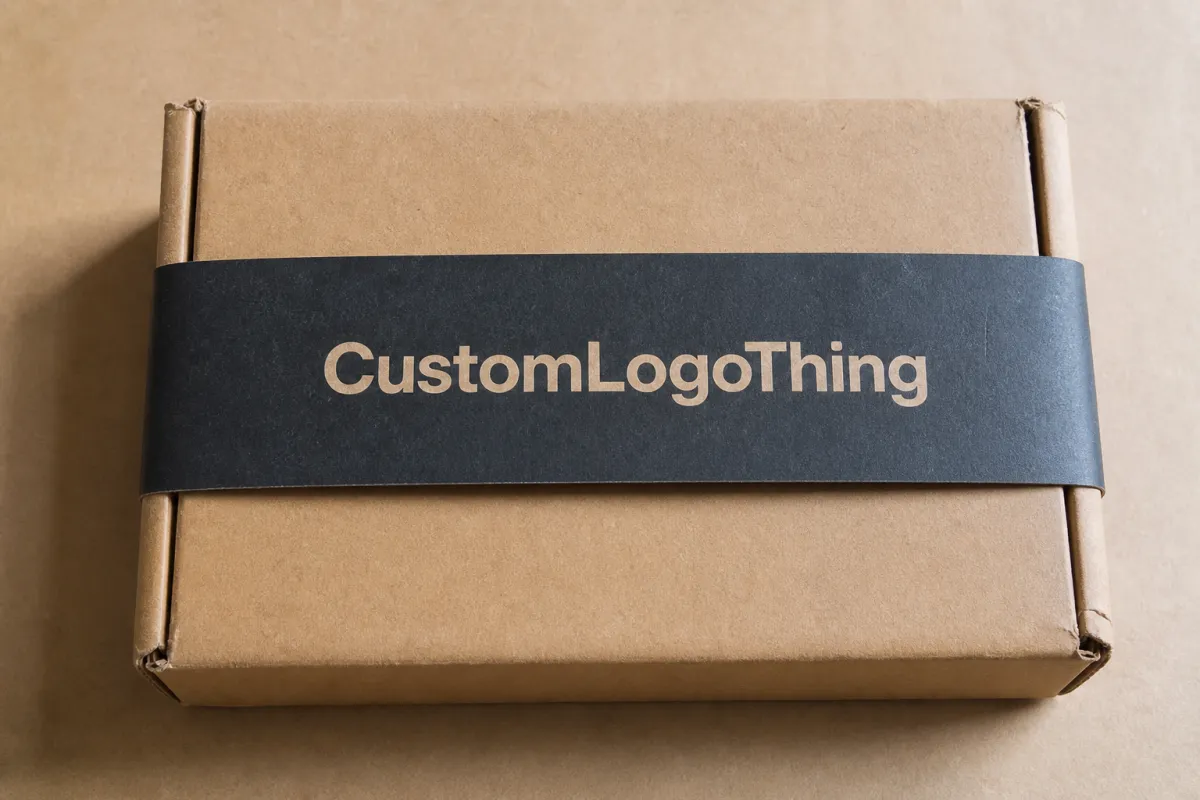
A plain box stops looking plain the second a belly band wraps around it. The strip creates a visual anchor. Sized well and placed with intent, the logo reads as part of the package instead of something slapped on at the last minute. That matters on retail shelves, in subscription mailers, and in gift sets where first impressions carry real weight.
The best custom logo on belly bands do not fight the package. They frame it. That can mean a matte kraft wrap with a single strong logo, a crisp white band on a darker carton, or a textured paper strip with a bit of foil used sparingly. The goal is not to cover every surface. The goal is to create package branding that feels deliberate, restrained, and easy to recognize.
This approach works especially well when product packaging changes often. If your line includes limited editions, holiday kits, or region-specific SKUs, printing a full box for every version ties up inventory and adds cost. A plain base package plus different belly bands gives you a cleaner system. One carton, one pouch, or one sleeve can serve many versions, and the band tells the customer which one they are holding.
It also helps when launch schedules are tight. A brand may not want to wait on a full custom printed box run just to get a product moving. Belly bands can bridge that gap, either as the main branded element or as a temporary format while larger print volumes are being finalized. For small and mid-size runs, that is often the sweet spot.
Where do they shine most?
- Product launches that need a fast branded presentation without redesigning the whole pack.
- Seasonal kits and gift sets that need quick artwork changes.
- Subscription packaging where the same base box carries different monthly themes.
- Multi-SKU programs where one package format serves many products.
- Retail packaging that needs a clean, premium look without a full print buildout.
A small band also gives buyers a little breathing room. If a design changes, only the wrap changes. The box structure, dimensions, and assembly flow stay the same. In production terms, that is a gift. Fewer moving parts usually means fewer surprises.
A belly band is not just a wider label. Used well, it becomes part of the design system. It gives the package structure, hierarchy, and enough distinction to feel branded on purpose.
How custom logo on belly bands are made and applied
A belly band is usually a printed paper or paperboard strip that wraps around part of a package and closes with a tuck, adhesive dot, friction fit, or a small amount of glue. The seam often lands on the back or underside of the package, where it will be least visible. That matters, because the logo and any important text should stay away from fold lines, wrap edges, and the exact point where the band closes.
The substrate changes the final look more than many first-time buyers expect. Uncoated paper gives a softer, more tactile appearance and works well for handmade or natural positioning. Coated paper usually gives sharper print detail and stronger color density. Kraft stock creates an earthy, less polished look that can suit organic, artisanal, or eco-conscious branding. Heavier paperboard can improve stiffness if the band needs to hold shape or carry a more substantial visual feel.
Application methods vary by line speed and assembly style. Hand assembly is common for short runs and custom kits, especially when the packaging team is already inserting products manually. Glue dots and light adhesive help when the band must stay aligned during packing and shipping. Tuck tabs and friction-fit wraps are useful when removability matters or when the brand wants to keep adhesive use down. For higher-volume programs, machine-assisted wrapping can keep labor consistent, but only if the band size, stock, and fold behavior are designed for the equipment.
Designing only to the flat dieline is a classic mistake. The real package is never just the flat file. A box with inserts, a pouch filled to a different height, or a shrink-wrapped item can change the final perimeter enough to matter. Even a few millimeters can make the band sit cleanly or twist as it is applied. The filled product, not the empty shell, should drive the layout.
Finishing is where many brands try to add a premium note. Matte finishes soften glare and work well for understated branding. Soft-touch coating adds a velvety feel, though it can show scuffs if the band is handled a lot. Foil stamping can make a logo stand out, but it works best with some breathing room around it. Spot gloss creates contrast by highlighting specific parts of the design, which can be effective for logos or pattern accents. The tradeoff stays the same: decorative finishes can improve shelf appeal, but they also raise cost and can be more sensitive in handling.
Practical fitting details matter too:
- Allow enough overlap for the seam, usually a small but deliberate amount depending on stock thickness.
- Keep the logo away from fold points so it does not split or skew.
- Test the wrap against the filled package, not just the empty shell.
- Confirm whether the band needs to survive shipping compression before it reaches the end customer.
For brands building custom printed boxes and paper wraps across a full line, it helps to treat the belly band as one part of the system rather than an isolated strip of paper. It should support the package, not wrestle with it.
Cost, pricing, and MOQ factors to compare before you quote
Pricing for custom logo on belly bands usually comes down to the same handful of variables: band size, quantity, number of printed colors, paper grade, finish, die cutting, and any special effects. The more complex the visual and structural requirements, the more likely the price will rise. That sounds obvious, but the real cost often hides in setup, finishing, and extra handling time rather than the ink itself.
Short runs usually carry a higher unit price because setup and prepress costs are spread across fewer pieces. Larger quantities generally pull the unit cost down, and they make premium finish choices easier to justify. A buyer comparing a 1,000-piece run to a 10,000-piece run may see a big price swing per unit, even when the artwork barely changes. That is normal. It is also why the minimum order quantity should match the launch plan, not the wish list.
MOQ should track actual usage. If the band will support one campaign, a short run may be fine. If the artwork is going to be reused across a product family, ordering enough to smooth out the price makes more sense. For brands with multiple SKUs, the smartest move is often to standardize the band size and structure so only the graphics change.
Printing method also affects price and timing. Digital printing is often the better route for shorter runs, frequent artwork changes, or projects with personalization. Offset printing usually makes more sense at higher volumes because it handles color consistency and unit cost well at scale. Neither one is automatically better. The right choice depends on quantity, color expectations, and the schedule.
A fair quote should clearly separate these items:
- Material and paper grade.
- Print method and number of colors.
- Finishing, such as matte, gloss, soft-touch, foil, or spot UV.
- Proofing and sample charges.
- Die cutting, scoring, or special structural work.
- Freight, packaging, and any rush or revision fees.
When those pieces are lumped together, comparing vendors gets fuzzy fast. Two quotes may look close, then one includes proofing and the other does not. One may include freight, while the other leaves it hanging. Purchasing teams know how that ends: a budget that looks fine on paper and starts bleeding once the real charges show up.
The table below gives a practical comparison of common options. The numbers are directional, because exact pricing depends on size, volume, color coverage, and finishing, but they reflect the kind of ranges buyers often see in real packaging procurement.
| Option | Best For | Typical Cost Behavior | Notes |
|---|---|---|---|
| Uncoated paper band | Natural, tactile branding | Often lower to moderate | Good for simple logos and minimal print coverage. |
| Coated paper band | Sharper artwork and stronger color | Moderate | Useful when fine detail and contrast matter. |
| Kraft stock band | Eco-friendly or artisanal presentation | Moderate | Artwork needs strong contrast to stay readable. |
| Foil or spot gloss finish | Premium shelf appeal | Higher | Best on selective design elements rather than full coverage. |
| Digital short run | Fast changes and lower volume | Higher unit cost, lower setup pressure | Useful when artwork changes often or quantities are modest. |
| Offset larger run | Stable artwork and higher quantity | Lower unit cost at scale | Often preferred for repeat programs with steady demand. |
One useful benchmark: if a quote looks suspiciously cheap, check what is missing. It may not include proofing, freight, or the finishing detail you assumed was standard. A lower sticker price is not the better buy if it just moves the cost into a later line item.
For sourcing guidance, industry references such as the ISTA packaging test standards and the sustainability resources at EPA can help teams think beyond price and toward transport performance and material choice. If a supplier also offers FSC-certified paper options, that can matter for brands with documented sustainability goals.
Process and timeline: from artwork file to finished shipment
The process for custom logo on belly bands usually starts with a brief, then moves into dieline setup, artwork placement, proof review, sample approval, production, inspection, and shipment. That sounds tidy on paper. Real life is less obedient. The timeline can move back and forth depending on artwork readiness and internal approvals. A quote is not production. A quote says what is possible; production begins only after the layout, specs, and sample decisions are locked in.
Lead time tends to shift for a few predictable reasons. Missing logo files slow artwork cleanup. Multiple revision rounds add time to prepress. Specialty finishes may need more coordination. Substrate shortages can push the schedule back, especially on unusual paper grades or finishes. Internal delays can be just as painful, particularly when marketing, operations, and procurement all need to sign off separately.
The fastest projects usually arrive with the following information already prepared:
- Final package dimensions, including the filled state if relevant.
- A physical sample of the product or carton if alignment is important.
- Target quantity and expected reorder plan.
- Print requirements, including finish and color expectations.
- Final artwork in the correct file format, with fonts outlined and images embedded.
- Shipping destination and required in-hand date.
Even a simple band still needs room for proofing and transit. If a team wants the first printed run on site before assembly starts, the production calendar should include buffer time. That buffer is not wasted time. It keeps a launch from sliding because a logo was shifted, a seam landed too close to copy, or the approved sample got signed off too late for a freight booking.
A realistic timeline can look like this:
- Brief and specs: 1-2 business days if the dimensions are ready.
- Dieline and artwork setup: 1-3 business days depending on complexity.
- Proof review: 1-2 business days, longer if multiple stakeholders are involved.
- Sampling or short proof run: a few days to a week, depending on method.
- Production: often 5-15 business days depending on quantity and finish.
- Shipping: varies by destination and freight method.
That range is broad on purpose. Some programs move faster. Some need more care. A project with foil, tight registration, and Custom Die Cutting will not run on the same clock as a plain one-color strip. Saying that clearly saves trouble later.
Step-by-step guide to planning your belly band artwork
Artwork is where the project either gets easy or gets expensive. The shape of the design, the hierarchy of information, and the alignment with the package all matter. Good packaging design is not just decoration. It is a decision about what the customer sees first, what they read second, and what can be left off entirely.
Step 1: Measure the package accurately
Start with the actual product, not a guessed carton size. Measure the wrapped perimeter of the finished package and account for overlap, flap thickness, inserts, and anything else that changes the outer shape. If the band must travel around a box, a sleeve, or a pouch, the measurement needs to reflect the real assembled state, not just the flat component.
Step 2: Decide what the band should communicate
The logo is usually the first job, but not the only one. The band may also need to carry the product name, flavor, variant, promotional message, or regulatory text. Keep the hierarchy simple. A logo that can be read at arm's length is usually more useful than a crowded strip trying to say everything at once. For retail packaging, clarity usually beats noise.
Step 3: Build the design on the printer's dieline
Use the supplied dieline, not a rough rectangle. Fold lines, bleed, safe zones, and seam placement all affect the final appearance. Keep key elements away from the edges where trimming may clip them. Avoid placing important text where it will land on a fold. If the seam sits on the back panel, design the reverse side to stay visually calm so the closure does not steal attention from the front.
Step 4: Choose stock and finish with purpose
Paper choice should support the tone of the brand. A natural stock feels different from a coated one, and a heavy paperboard strip reads differently than a thin wrap. Finish should also match handling conditions. If the band will be touched often in packing or on shelf, a finish that looks beautiful in a digital mockup may not wear as well in the real world. That is why samples are worth the money.
Step 5: Test on the actual package
Before approving full production, request a physical sample or short proof run and place it on the actual item. Check the seam, the visual alignment, the scuff resistance, and the way the band behaves after shipping-like handling. Does the logo stay centered? Does the band shift when lifted? Does the finish fingerprint or catch light in a way that hides the copy? Those are real questions, and they matter more than a perfect screen render.
A few design choices usually separate ordinary from polished:
- Use one strong logo placement instead of repeating it too many times.
- Leave breathing room around the mark so the band looks intentional.
- Match the color to the substrate rather than forcing a color that fights the paper tone.
- Keep the message readable under warehouse lighting, store lighting, and camera flash.
Handled well, custom logo on belly bands deliver a finished, professional impression without turning the package into a heavy print exercise.
Common mistakes that hurt fit, print quality, and branding
One of the most common problems is sizing the band too loosely or too tightly. Too loose, and the wrap slides, twists, or lands with an awkward seam. Too tight, and the band can bow, crease, or pull the artwork out of alignment. Either way, the result looks less polished and can create rework during packing.
Another issue is overcrowding. Belly bands are narrow by nature, so trying to cram too much copy onto them usually makes the piece feel busy and hard to read. A strong logo, a short message, and a clear product cue usually do more than a wall of text. In package branding, restraint tends to read as confidence.
Mockups can also lie about finish. A gloss or soft-touch effect may look elegant on screen, then show fingerprints, scuffs, or scratches once the band gets handled in production. That is especially true for bands that pass through several hands before the customer ever sees them. If the band is meant for retail display or shipping through a fulfillment center, durability has to be part of approval.
Testing only the empty package is another trap. Once inserts, filler, protective wrap, or product weight are added, the package shape can change enough to affect how the band sits. I have seen bands look perfect on a flat carton and fail after the product was loaded because the corners bulged or the height changed just enough to move the seam.
Buyers should also stop comparing quotes only by headline price. Two offers that look similar may differ in paper weight, print method, proofing, finishing, or shipping terms. One vendor may include a structured proof review; another may charge separately. One may quote freight to the dock; another may not. If the comparison is not apples to apples, the final spend will not be either.
Common errors to watch for:
- Ignoring the filled package dimensions.
- Letting the seam land on a logo or critical text.
- Using thin stock when the band needs more structure.
- Choosing a finish that looks good in theory but fails in handling.
- Skipping a real-world sample test before the full run.
These look small on paper. In production, they turn into extra labor, delays, and avoidable complaints.
Expert tips and practical next steps for a better rollout
If you want the project to move smoothly, build a one-page spec sheet before you ask for a quote. Include the package dimensions, the artwork files, the quantity, the desired finish, the closure method, and the shipping deadline. When every vendor gets the same information, quotes become easier to compare and misunderstandings drop fast.
Order a sample or a short proof run whenever the package will be handled, shipped, or displayed under demanding conditions. Paper feel, opacity, color balance, and scuff resistance are all easier to judge with a physical piece in hand. A mockup shows proportion. A sample shows behavior.
It also helps to test the band in two states: one on a packed unit and one on a shipped unit. Vibration, compression, and temperature changes can alter alignment in ways that do not show up on a desk. If the band still looks clean after a short transit test, you have a much better chance of avoiding complaints later.
For brands managing more than one SKU, think in variants from the start. A single core structure can support seasonal artwork, regional messaging, bundle promotions, or event-specific graphics. That approach keeps the packaging system organized and makes future updates much easier. It is one reason belly bands stay popular in product packaging programs that need agility without giving up presentation.
Some useful planning habits:
- Keep a master dieline file with version control.
- Save print-approved artwork separately from concept files.
- Document the exact stock, finish, and closure used on each run.
- Retain one approved sample for future reorders.
The final step is straightforward: measure the package, gather the logo files, decide the finish, compare quotes carefully, and move ahead only after fit and appearance have been confirmed. That is the most reliable way to get custom logo on belly bands that improve shelf appeal without creating avoidable production headaches.
For brands weighing branded packaging against a full custom box program, belly bands often offer the best balance of flexibility, cost control, and visual impact. Once the dimensions and finish are locked, custom logo on belly bands can become a dependable part of the packaging toolkit, especially when the goal is to present a product cleanly and consistently without overcomplicating the run.
FAQ
What size should custom logo belly bands be for my package?
Measure the actual wrapped perimeter of the finished package, not just the flat box size, so the band lands with a clean seam and proper overlap. Leave room for inserts, fillers, or closures that change the final shape, because even a small thickness shift can affect fit. If the band must line up with a logo, window, or fold, ask for a printed sample or mockup before approval.
Do custom logo on belly bands need adhesive?
Not always. Many belly bands use tuck tabs, friction fit, or a tight wrap that stays in place without permanent glue. Glue dots or light adhesive can help when speed matters on the packing line or when the band needs extra security during shipping. The closure method should reflect assembly speed, recyclability goals, and whether the end user should remove the band easily.
What material works best for belly bands with a custom logo?
Uncoated or premium textured stock works well when the brand wants a natural, tactile look. Coated stock is often better when fine logo detail, solid color coverage, or sharper contrast is the priority. Kraft can support an earthy or handmade feel, but the artwork should be checked carefully for contrast and legibility.
How long does the process take for custom logo on belly bands?
Timeline depends on artwork readiness, proof approval, quantity, and whether the project uses special finishes or custom die cuts. A simple band can move quickly once the dieline is approved, while revisions, sampling, or rush requests can extend lead time. Build buffer time for internal approvals and shipping so the bands arrive before packaging starts.
Are belly bands cheaper than printing the whole box?
Often yes, especially when you need a branded look without changing the base package for every version or campaign. Full box printing can become cost-effective at very high volume, but it reduces flexibility if artwork changes often. Belly bands usually lower inventory risk because one plain package can serve multiple products with different printed wraps.

