Buyer Fit Snapshot
| Best fit | Custom Luxury Boxes with Foil projects where brand print, material claims, artwork control, MOQ, and repeat-order consistency need to be specified before quoting. |
|---|---|
| Quote inputs | Share finished size, material target, print colors, finish, packing count, annual reorder estimate, ship-to region, and any compliance wording. |
| Proofing check | Approve dieline scale, logo placement, barcode or warning zones, color tolerance, closure strength, and carton packing before bulk production. |
| Main risk | Vague material claims, crowded artwork, missing packing details, or unclear freight terms can make a low unit price expensive after revisions. |
Fast answer: Custom Luxury Boxes with Foil: Design, Cost, and Use should be specified like a repeatable production item. The safest quote records material, print method, finish, artwork proof, packing count, and reorder notes in one written spec.
Production checks before approval
Compare the actual filled-product size with the drawing, then confirm tolerance on folds, seals, hang holes, label areas, and retail display edges. Reserve space for logos, QR codes, warning copy, and material claims before decorative graphics fill the panel.
Quote comparison points
Review material grade, print process, finish, sampling route, tooling charges, carton quantity, and freight assumptions side by side. A quote is only useful when the supplier can repeat the same color, closure quality, and packing count on the next order.
A plain rigid carton can sit on a shelf and say almost nothing. Add one strip of foil, and Custom Luxury Boxes with foil start doing the kind of work that changes buying behavior: they catch light, raise the perceived value, and make the product inside feel more considered before anyone even touches it. I have watched buyers pick up two boxes that were nearly identical in size and structure, then choose the one with the sharper metallic accent. That kind of reaction happens fast, and it is usually emotional before it is rational.
Foil earns its place by creating contrast. It breaks up a flat surface, gives the eye a point to land on, and signals that the brand spent money on product packaging, not just the product. Used with restraint, custom luxury boxes with foil feel precise. Used badly, they can look like a loud trade-show banner dressed for a black-tie dinner. That is the line, and it is a thin one.
The question is not whether custom luxury boxes with foil look premium. They do. The real question is how to balance structure, board stock, foil color, and run size so the packaging feels intentional instead of expensive for its own sake. Start with the Custom Packaging Products catalog if you are comparing formats, then match the box style to the launch plan before the artwork gets locked. That small order of operations saves a lot of backtracking later.
What are custom luxury boxes with foil?
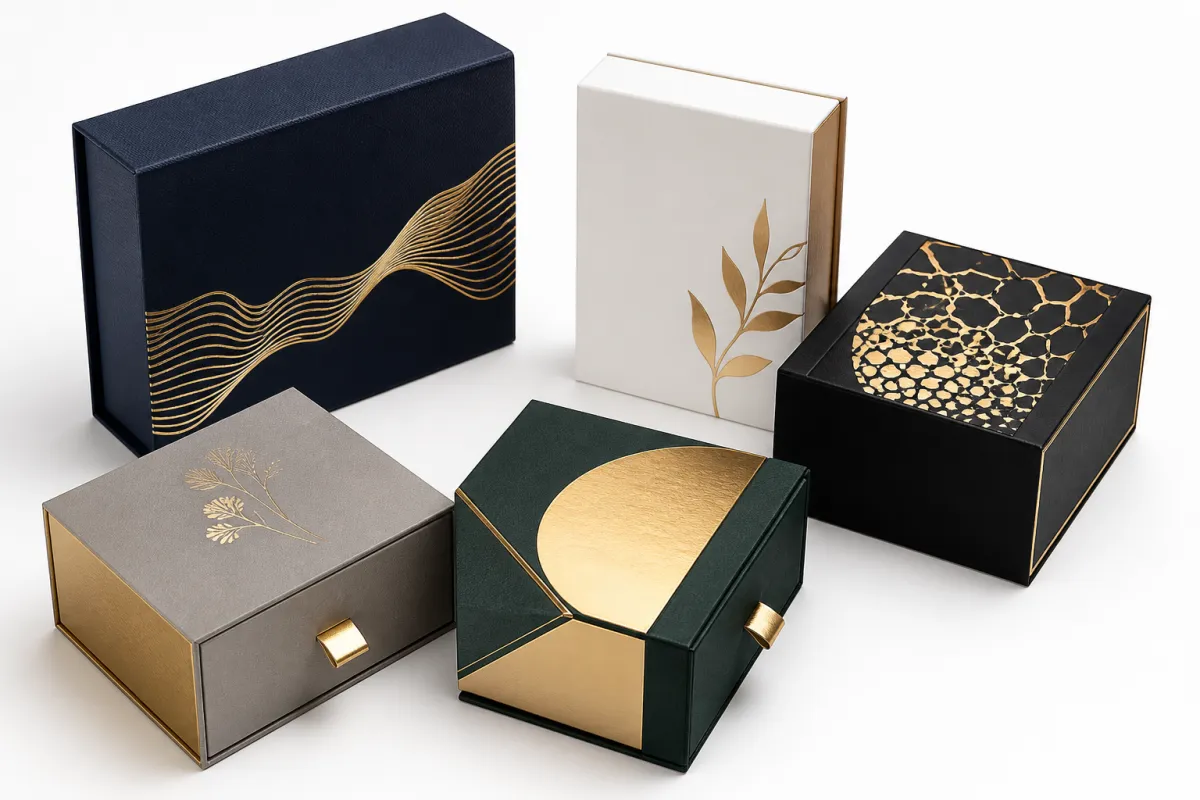
Custom luxury boxes with foil are premium boxes finished with foil stamping, a process that transfers metallic foil onto specific areas of the package using heat and pressure. The result is a bright logo, border, monogram, or pattern that adds contrast and polish without covering the entire box. Brands often use this finish on rigid presentation boxes, gift packaging, beauty sets, and jewelry boxes because it creates a stronger first impression in hand and on camera.
"Foil should behave like jewelry, not wallpaper." That rule has saved more packaging decisions than any trend deck I have seen. One strong accent usually outperforms three crowded ones, and it does so with less risk of the whole box feeling busy.
There is also a practical reason foil keeps showing up in premium packaging: it translates well across categories. A perfume box, a candle launch, and a corporate gift set all need the same basic thing from packaging, which is trust. Not fake luxury, not noisy decoration, just a clear signal that the contents were handled with care.
Custom Luxury Boxes with Foil: Why the Finish Matters
On a crowded shelf, the difference can be tiny. A plain rigid box can disappear beside gloss-heavy competitors, while custom luxury boxes with foil catch a single flash of light and suddenly read as deliberate. The finish matters because it creates a visual anchor before the buyer even lifts the lid.
Foil is not only about shine. It gives branded packaging a clear signal without covering every surface in decoration. A small logo stamped in gold, silver, copper, or matte black can communicate price point faster than a full-panel illustration. Beauty brands, jewelry labels, candle makers, and corporate gifting teams rely on custom luxury boxes with foil because the box needs to feel gift-like before the reveal begins.
Good package branding knows where to stop. The strongest custom luxury boxes with foil guide attention to the logo, a border, or one motif that carries the message. The weakest versions fight the product for the spotlight. When the foil is louder than the item inside, the packaging has lost the plot. That sounds harsh, but it is true.
Buyers often make judgments in seconds. Retail packaging has to deliver trust, category fit, and a bit of theater at the same time. Custom luxury boxes with foil work when they support the product story instead of turning into decoration with no job to do. I have seen a simple cosmetic carton outperform a more expensive one because the metallic detail was disciplined and the typography had room to breathe.
Picture a gift set on a counter. A thin foil line across the flap can make the whole box feel edited. Picture a candle launch. A single metallic mark can make the jar seem more collectible. Picture a corporate kit. Custom luxury boxes with foil can turn a standard mailer into something closer to a presentation case, which matters when the box is part of the message.
The point is not to make everything shiny. The point is to create a controlled moment. In good custom luxury boxes with foil, the finish does not try to do the whole job. It opens the door and lets the product look more valuable than the base carton could manage alone.
How Custom Luxury Boxes with Foil Are Made
Start with structure, not shine. Rigid set-up boxes, drawer boxes, folding cartons, and magnetic closures all react differently to heat and pressure, so custom luxury boxes with foil need the box style chosen before the art gets fancy. A rigid lid-and-base box can support a heavier visual treatment. A thin folding carton needs a lighter touch, otherwise the finish starts working against the structure.
Foil stamping is straightforward in principle. A metal die is heated, pressed against the surface, and the foil transfers only where the die makes contact. That is why custom luxury boxes with foil need clean vector art and a dieline that is actually accurate. If the file is fuzzy, the foil will be fuzzy in real life. Print finishing does not reward guesswork. It rewards prep.
The artwork should separate the foil layer from the print layer. Keep text outlined, use the correct spot color name, and make sure small details are thick enough to stamp cleanly. Tiny script text and hairline borders usually trigger warnings from a good supplier. If they do not, that is not a compliment. It is a warning in disguise. A press operator is trying to save you a headache there, not slow you down.
- Vector artwork: Use editable paths for the foil area so the die can follow the shape precisely.
- Clear spacing: Leave enough room around logos and borders so the stamp does not blur into the background.
- Realistic detail: Fine lines and tiny text can fail on textured stock or heavy coverage.
- Separate finishes: Foil, embossing, spot UV, and soft-touch lamination each need their own setup plan.
Embossing and debossing can add depth, while soft-touch lamination or spot UV can make custom luxury boxes with foil feel layered in a way that plain print rarely achieves. That pairing works especially well on rigid presentation boxes, though it demands more tooling and more proofing. For a quiet luxury look, a matte wrap with one foil hit often beats a highly reflective full panel. Not every brand needs a showy finish, and some do better when the box speaks in a lower voice.
There are limits, and they matter. Very thin type, hairline rules, textured papers, and large foil areas can produce uneven stamping. On uncoated stock, foil may look softer and less mirror-like; on laminated boards, it can look crisp but sometimes less tactile. A supplier worth listening to will point out those tradeoffs before approval, because a pretty mockup is not the same thing as a usable box.
One more production detail: foil color can shift slightly depending on paper shade, coating, and lighting. Gold on warm white stock reads differently than gold on a cool gray wrap. That sounds obvious once you have seen it, but people still get surprised by it. A decent proof should show the finish on the actual substrate, not just on a screen rendering.
Key Design Factors for Custom Luxury Boxes with Foil
Foil color should follow the brand story, not the habit of choosing gold because it feels safe. Gold reads classic, silver feels cooler and more minimal, copper adds warmth, matte black signals restraint, and holographic foil is a loud choice that only works when the brand voice can carry it. With custom luxury boxes with foil, color choice is a branding decision, not a decoration afterthought.
Box style changes the whole reading of the package. A heavy rigid carton can hold more visual drama, while a folding carton needs cleaner spacing and a more restrained layout. With custom luxury boxes with foil, the same logo can feel luxurious on a magnetic box and awkward on a flimsy tuck-end carton. That is not the foil failing. That is structure doing its job, or not doing it.
Layout matters more than many buyers expect. Logo size, whitespace, alignment, and foil placement all affect whether the package feels edited or crowded. In practice, a single centered mark with generous margins often looks more expensive than a busy all-over pattern. That is especially true for Custom Printed Boxes where print and foil are competing for attention.
Material compatibility changes the result more than most people predict. Coated stock gives the sharpest transfer. Uncoated paper, textured wraps, and laminated boards each alter edge quality. If the artwork depends on tiny details, ask for a sample on the actual material. Screen work on a monitor is cheap. A bad physical result is not.
Interior design matters too. Inserts, printed liners, and the reveal sequence tell the buyer how to feel when the lid opens. A good interior can make custom luxury boxes with foil feel intentional, not merely decorated. The foil on the outside should connect to the inside, not end the experience at the outer wall. A box that opens into plain corrugate after a shiny outer shell can feel a bit off, kinda like a formal jacket with gym shorts underneath.
The strongest custom luxury boxes with foil usually make one promise and keep it. That promise can be elegance, restraint, collectability, or a little bit of theater. It should not be all four at once. When the box tries to do everything, it ends up saying very little.
If you are matching a launch color, ask for a physical foil swatch board before you approve production. Digital files can make silver look white, gold look flat, and black foil look like a printer error in dim light. A sample board removes the guesswork and shows what the finish actually does in daylight, under retail lighting, and near a phone flash.
If you need matching inserts, sleeves, or presentation trays, the Custom Packaging Products page is a practical place to compare structures before you lock the artwork. That saves time later, which is cheaper than reworking a quote after approvals.
Cost and Pricing for Custom Luxury Boxes with Foil
Cost starts with size and structure. A small drawer box with one foil logo might run about $0.45-$0.90 per unit at 1,000 pieces, while a larger rigid gift box with full-wrap foil can land closer to $1.50-$4.00+ per unit, depending on board grade, print coverage, and insert complexity. Those numbers are not universal. They describe the shape of the market for custom luxury boxes with foil.
Setup is where buyers get surprised. A foil die, press setup, sample run, and color matching can add a few hundred dollars before production starts. On a large run, that cost gets spread out. On a short run, it lands hard. This is why custom luxury boxes with foil often look cheaper per piece at 5,000 units than at 500. Physics has a way of making itself known.
Spot foil versus full-panel foil is the biggest swing. A small logo hit uses less foil, fewer press passes, and less risk. Full-wrap foil looks dramatic, but it raises waste, alignment time, and reject rates. Add embossing or a soft-touch lamination, and cost climbs again. The quote also changes if you choose custom inserts, rigid trays, magnetic closures, or printed sleeves.
| Option | Typical Use | Setup Burden | Approx. Unit Cost at 1,000 pcs | Approx. Unit Cost at 5,000 pcs |
|---|---|---|---|---|
| Spot foil logo on rigid box | Beauty kits, jewelry, candles | Low to moderate | $0.45-$0.90 | $0.22-$0.55 |
| Foil + embossing | Premium gifts, corporate sets | Moderate to high | $0.70-$1.35 | $0.35-$0.80 |
| Full-panel foil coverage | Limited editions, statement launches | High | $1.50-$4.00+ | $0.80-$2.20+ |
Minimum order quantities matter because tooling and labor are fixed. A supplier quoting 300 units may be using digital metallic effects instead of true foil stamping, or the unit price will be steep enough to surprise you later. That is not a scam. It is math. Custom luxury boxes with foil reward volume because the setup work stops hurting once it is spread across enough boxes.
Hidden costs can move the budget quickly. Inserts add material and assembly time. Shipping weight matters because rigid boxes are heavy. Rush production can trigger overtime or a second press slot. Special coatings can improve the look but increase the finish stack. If a quote does not show those pieces, ask for them line by line.
One more budget point: if sustainability matters, ask whether the board is FSC-certified and whether the finish stack still fits the brief. You can check the certification language directly at FSC-certified paper standards. The cheaper quote is not always the smarter one if the board quality, coating, or foil setup weakens the final package.
For many brands, the real cost question is not "How cheap can this get?" It is "Which version of custom luxury boxes with foil supports the margin without making the box feel thin?" That is the better question because premium packaging has to live inside a real budget, not a fantasy spreadsheet.
There is also a hidden cost in revision cycles. If the structure is not decided early, the art gets revised, then the dieline changes, then the foil layer needs another pass, and suddenly everybody is on round three of the same conversation. That time is expensive even if nobody puts it on the invoice.
Process and Timeline for Custom Luxury Boxes with Foil
Start with the brief. Before anyone opens a design file, define the product size, target quantity, budget range, and the exact unboxing effect you want. Custom luxury boxes with foil move faster when the supplier knows whether the box is for retail packaging, a subscription drop, a gift set, or a short promotional run.
The design phase should include dieline review, artwork setup, foil layer separation, and pre-press checks. That is not busywork. It is the part that keeps the rest of the project from falling apart. If the line work does not match the structure, the finished custom luxury boxes with foil will not match the mockup. Once the dieline is approved, changes to structural dimensions usually cost time and money.
Sample approval is worth the wait. Digital mockups are useful for direction, but they do not show how foil catches light, how the board flexes, or how the lid closes after assembly. A physical prototype or sampled box tells the truth. With custom luxury boxes with foil, the difference between "looks good on screen" and "looks right in hand" can be wide.
- Brief and quote: Confirm box type, finish stack, quantity, and target budget.
- Dieline and art: Build the layout, separate foil areas, and verify margins.
- Prototype or sample: Check color, foil clarity, and fit before the full run.
- Production: Print, stamp, cure or dry, die cut, assemble, and inspect.
- Packing and transit: Box the finished order and confirm shipping damage controls.
Typical timing for straightforward custom luxury boxes with foil is often 12-15 business days from proof approval once tooling is ready. Complex structures, multiple finishes, or large-volume assembly can extend that to 18-30 business days. Add more time if the order needs overseas freight, because shipping is not a magic trick. It is freight.
Schedule risks usually come from the same places. Last-minute artwork changes force a new proof. Multiple finishes need extra setup. Complex inserts slow assembly. Overseas shipping adds customs and transit time. If the box is going into a retail launch or a seasonal campaign, ask for the timeline in writing and make sure it includes sampling, production, and delivery. Those are three different clocks.
For shipping performance, it can help to ask for a basic transit test protocol. The ISTA testing guidance is useful if the box has to survive distribution, not just look good on a table. A luxury box that arrives dented is not luxury. It is an expensive disappointment.
Good suppliers also watch assembly tolerance closely. Magnetic closures need alignment. Drawer pulls need consistent fit. Inserts need enough clearance to avoid scuffing. Custom luxury boxes with foil only feel premium if the mechanism works smoothly every single time. A box that sticks or scrapes loses points fast.
If your timeline is tight, ask one direct question early: "What has to be approved before production can start?" That sounds simple, but it exposes the actual bottleneck. Usually it is not the foil. It is a missing sign-off, an incomplete art file, or a structural revision that somebody hoped would slide by.
Common Mistakes with Custom Luxury Boxes with Foil
The biggest mistake is overusing foil. Too much shine can make premium packaging look cheap, crowded, or like a cosmetics aisle clearance bin. Custom luxury boxes with foil work best when the metallic finish has a clear job. It should point to the logo, frame the shape, or create a deliberate reveal. It should not cover every surface just because the budget allows it.
Poor file setup causes a lot of avoidable pain. Tiny text, hairline details, and weak contrast are common reasons foil ends up muddy or uneven. If a design depends on very thin lines, it may need simplification before production. A supplier can usually tell you where the limit is, but the art should be built with the press in mind from the start.
Substrate choice matters more than many buyers expect. Some papers and coatings simply do not hold fine detail well, no matter how good the design looks on screen. If the goal is sharp reflectivity, a coated board usually performs better. If the goal is a softer, tactile look, a textured wrap can work beautifully. The point is to match the stock to the finish, not hope the finish fixes the stock.
Another common mistake is confusing foil stamping with metallic ink or digital metallic effects. They can look similar in a mockup and very different in hand. Foil stamping gives a physical sheen and a crisp edge when the setup is right. Metallic ink is printed. Digital effects can help on short runs, but they are not the same thing. Buyers who want custom luxury boxes with foil should ask exactly which process is being quoted.
- Skipping samples: A physical proof catches foil transfer issues that a PDF cannot show.
- Ignoring inserts: A loose product in a beautiful box still feels unfinished.
- Forgetting transit: If the box cannot survive shipping, the finish does not matter much.
- Overprinting the surface: Too many effects turn a premium box into visual noise.
Transit mistakes are the quiet killers. Rigid boxes are strong, but corners can crush if the packing method is sloppy. If the product is heavy, sharp, or fragile, ask how the inner tray will hold it in place. A simple test works well: if the box shakes in transit, it will also look sloppy in the buyer's hands.
Custom luxury boxes with foil also fail when brands try to cram too many messages onto one panel. A logo, a tagline, a website, a pattern, a foil border, and a printed texture all fighting for space usually end up looking busy. The cleaner route is not lazy. It is disciplined.
And yes, a little restraint can feel less exciting in the mockup phase. But the mockup is not the shelf, and it is not the customer's hand. The final package has to perform in real light, at real speed, with real scrutiny.
Expert Tips and Next Steps for Custom Luxury Boxes with Foil
Pick one hero element. One logo, one monogram, or one clean line pattern usually looks stronger than trying to foil every available surface. That is the simplest way to keep custom luxury boxes with foil looking premium instead of crowded. A buyer's eye needs a place to land.
Test under real conditions. Retail lighting, natural daylight, and phone camera flash all change how foil reads. A finish that looks rich under warm showroom lights can turn harsher under bright white LEDs. If the box will be photographed for ecommerce or social media, take test shots before you approve the final run. That costs less than correcting a whole shipment after the fact.
Ask for a physical swatch board or prototype. You need to judge shine, texture, and color in hand, not on a screen. For custom luxury boxes with foil, a sample board is often the difference between confident approval and a nervous guess. Guessing is not a strategy. It is a way to pay twice.
Create a simple spec sheet before you request final quotes. List the foil color, board material, finish stack, tolerance notes, and file version. State whether the box includes inserts, sleeves, or magnetic closures. When everything is written down, quoting gets faster and revisions become less annoying. That is good for everyone involved.
Compare two or three suppliers and ask each one to itemize the same details. A quote without setup costs, sample charges, and shipping assumptions is just a number floating in space. For custom luxury boxes with foil, the best supplier is not always the cheapest. It is the one who tells you what actually affects the result.
If you are still deciding on structure, the Custom Packaging Products page can help you compare rigid boxes, drawer styles, and presentation formats before you commit to a finish stack. That keeps you from designing a foil effect around the wrong box type, which sounds minor until it costs a week.
Then do the boring part: approve one sample, confirm the timeline, check the packing method, and only then scale the order. Custom luxury boxes with foil reward patience in the setup stage. The good version of the box is usually the one that gets tested, measured, and corrected before production. Not after.
My practical rule, after enough press checks to lose count, is simple: if a box still feels strong when you strip away the foil, it will probably age well. If the finish is carrying all the weight, the design needs another round. That is the real filter.
Are custom luxury boxes with foil expensive?
They usually cost more than plain printed boxes because of tooling, setup, and the extra production step. Spot foil on a small logo is far cheaper than large-area foil coverage or multiple foil colors. Unit price drops as quantity increases, so short runs are the most expensive per box. If you are pricing custom luxury boxes with foil, ask for an itemized quote so you can see where the money actually goes.
What foil color works best for custom luxury boxes with foil?
Gold is the safest premium choice, but silver, rose gold, copper, and matte black can fit specific brand styles better. Choose the foil color based on the product category, brand palette, and lighting where the box will be seen. The best-looking foil is the one that supports the brand, not the one that shouts the loudest.
Can custom luxury boxes with foil be made with eco-friendly materials?
Yes, many suppliers can use recycled board, FSC-certified paper, and lower-waste box structures. Ask whether the foil, coating, and adhesive choices still fit your sustainability target, because not every finish combination is equal. Eco-friendly does not have to mean dull; it just means the material stack needs to be chosen carefully.
How long does it take to produce custom luxury boxes with foil?
Simple projects can move quickly, but sample approval, tooling, and finish testing usually add time. Expect the timeline to lengthen if the box has multiple finishes, inserts, or a complex structure. Always confirm whether the quoted timeline includes sampling, production, and shipping, because those are not the same thing.
What files do I need for foil stamping artwork?
Use clean vector artwork whenever possible, with the foil area separated as its own layer. Keep lines, text, and fine details thick enough to stamp cleanly; ultra-thin elements are risky. A good supplier will usually review the dieline and flag anything that could fail in production.
How do I know if the sample is good enough to approve?
Check three things: the foil edge, the fit of the structure, and the way the box reads in real light. If the metallic area is crisp, the closure works without forcing it, and the finish still looks strong in daylight and under indoor lighting, you are in a good place. If one of those fails, keep adjusting before production starts.
If you want custom luxury boxes with foil to look sharp in real life, not just on a screen, the formula stays pretty simple: Choose the Right structure, keep the design disciplined, check the sample, and confirm the timeline before you scale. Pick one hero detail, test it on the real material, and approve only after the box has proven itself in hand. That is how premium packaging stays premium.


