Buyer Fit Snapshot
| Best fit | Custom Luxury Boxes with Embossing projects where brand print, material claims, artwork control, MOQ, and repeat-order consistency need to be specified before quoting. |
|---|---|
| Quote inputs | Share finished size, material target, print colors, finish, packing count, annual reorder estimate, ship-to region, and any compliance wording. |
| Proofing check | Approve dieline scale, logo placement, barcode or warning zones, color tolerance, closure strength, and carton packing before bulk production. |
| Main risk | Vague material claims, crowded artwork, missing packing details, or unclear freight terms can make a low unit price expensive after revisions. |
Fast answer: Custom Luxury Boxes with Embossing: Design, Cost, and Craft should be specified like a repeatable production item. The safest quote records material, print method, finish, artwork proof, packing count, and reorder notes in one written spec.
Production checks before approval
Compare the actual filled-product size with the drawing, then confirm tolerance on folds, seals, hang holes, label areas, and retail display edges. Reserve space for logos, QR codes, warning copy, and material claims before decorative graphics fill the panel.
Quote comparison points
Review material grade, print process, finish, sampling route, tooling charges, carton quantity, and freight assumptions side by side. A quote is only useful when the supplier can repeat the same color, closure quality, and packing count on the next order.
Custom Luxury Boxes with Embossing: Design, Cost, and Craft
Custom Luxury Boxes with embossing turn packaging from forgettable to premium in one glance. The raised detail catches light, throws shadow, and gives the hand something real to register before the product even opens. That matters. A box should earn its keep the second someone touches it, not after a polite paragraph of explanation.
Used well, custom luxury Boxes with Embossing work best on a structure that already has backbone. The emboss should add pressure, depth, and restraint, not carry a weak package on its own. When the box is built correctly, the raised detail reads as confident instead of decorative noise. And yes, buyers can tell the difference faster than most teams expect.
Brands that care about branded packaging usually notice the difference right away. A rigid box with a clean logo emboss can make custom printed boxes feel sharper, strengthen package branding, and make product packaging look worth the price before the lid even lifts. That is the whole point: the box should say something before the copy does.
What Are Custom Luxury Boxes with Embossing?
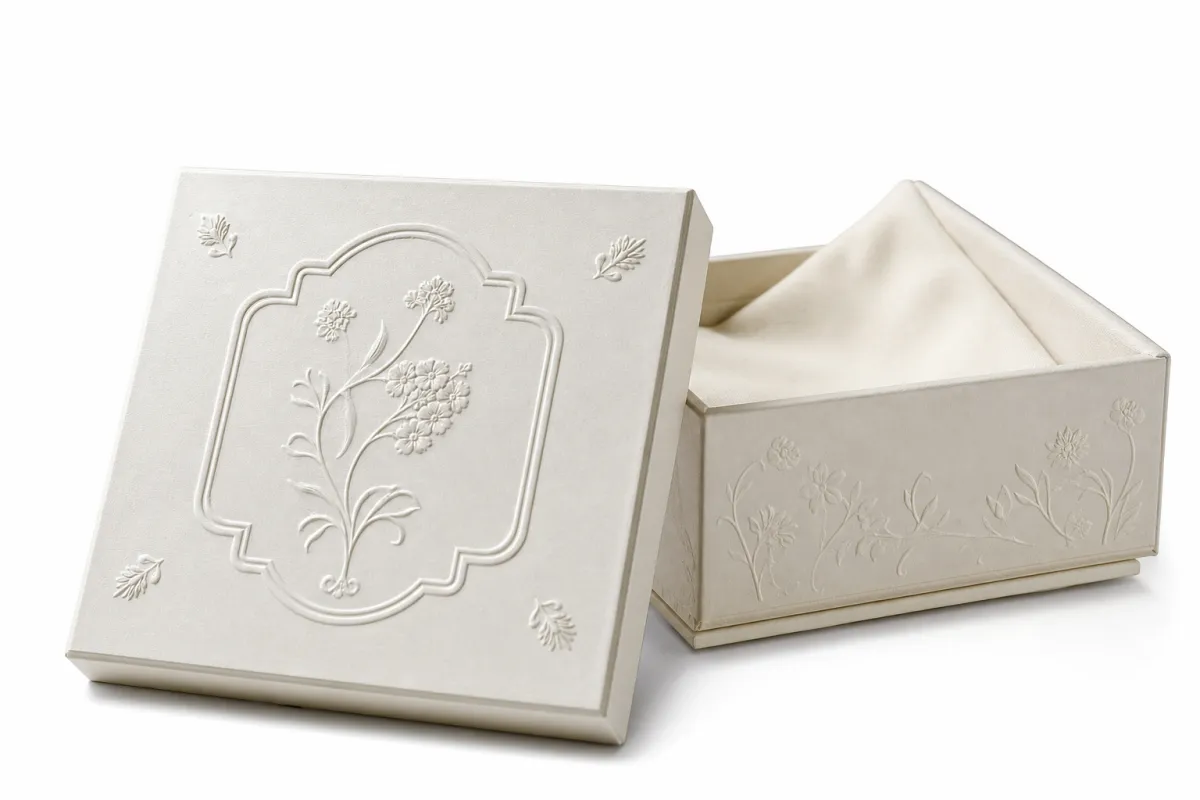
Custom luxury boxes with embossing are premium packaging structures that use raised artwork to give a logo, monogram, pattern, or brand mark real depth. The process presses the design into the material so the chosen area lifts above the surface. That tactile shift lands fast. People notice it almost immediately, which is why embossing shows up so often in fragrance, cosmetics, jewelry, apparel, gifting, and high-end subscription packaging.
Picture a rigid box wrapped in paper and pressed with a matched tool set. That is the basic idea. The emboss can be subtle and refined, or it can be deeper and more sculptural if the board, wrap, and layout can handle it. Either way, custom luxury boxes with embossing do more than decorate. They create a physical cue that says the packaging was handled with care.
Embossing is not the same as debossing or foil stamping. Embossing raises the design. Debossing sinks it into the surface. Foil stamping adds metallic or pigmented film with heat and pressure. These can be used alone or together, but they do different jobs. If texture is the goal, custom luxury boxes with embossing may be enough. If the box needs stronger contrast and shelf presence, embossing with foil can hit harder without becoming loud.
Most strong designs keep the focus tight. A centered logo, a crest, a product nameplate, or a repeating brand motif usually works better than a box that tries to show off every graphic trick at once. That restraint gives embossing room to breathe. In custom printed boxes, it often separates a thoughtful package from one that just looks busy.
The real question is not whether embossing looks good. It does. The real question is whether custom luxury boxes with embossing match the product value, the shelf plan, and the unboxing moment the brand wants to create. When those pieces line up, the box feels memorable without acting precious about it.
How Custom Luxury Boxes with Embossing Are Made
Tooling comes first, and tooling quality matters more than many buyers expect. A raised detail is created with a die and a matching counter die, and both need to align cleanly so the pressure lands exactly where the artwork sits. If the tools are off, the result can look blurry, shallow, or uneven across the panel. Under light, the mistake shows fast.
Artwork prep is the next step. Vector files are usually the safest choice because they keep edges crisp when the die is built. Very thin strokes, tiny serif details, and crowded texture patterns often fail once they move from screen to board. The design needs spacing, realistic detail size, and a respect for how the substrate will behave under pressure. Custom luxury boxes with embossing work best when the artwork is built for the material, not just for a display mockup.
The substrate changes everything. A rigid board wrapped in coated paper usually holds a cleaner impression than thin carton stock. Soft-touch lamination can reduce glare and make the raised area feel richer. Textured paper wrap can add character, but it can also eat detail. That is why custom luxury boxes with embossing should never be planned as if the finish is an afterthought. Board, wrap, adhesive, print method, and coating all shape the final result.
Two common approaches come up often: blind embossing and registered embossing. Blind embossing leaves the raised area uninked, which creates a quiet tactile effect. Registered embossing aligns the raised area with print, foil, or another visual element so the texture supports a specific brand mark. Blind embossing usually feels calmer. Registered embossing gives more control over emphasis and contrast. Custom luxury boxes with embossing can use either, but the choice should fit the story the box needs to tell.
Production usually runs in sequence: print, dry or cure, emboss, then convert or assemble depending on the structure. In rigid box manufacturing, the wrap may be printed and finished before it is wrapped onto board. In folding carton work, embossing may happen after print and before die cutting and gluing. The order changes with the equipment and structure, but the logic stays the same: custom luxury boxes with embossing come from coordinated steps, not one magic finish pass.
Pressure, registration, and testing matter more as the emboss gets deeper or the finish stack gets more layered. A good production partner will check whether the tool depth reads clearly without crushing fibers or weakening corners. That balance is the difference between polished custom luxury boxes with embossing and packaging that only photographs well from one angle. I have seen plenty of samples that looked great on a screen and then fell flat in the hand. The hand is less forgiving. Good for it.
A well-made emboss should feel intentional, not decorative for its own sake. If the raised logo is fighting the structure, the material, or the finish, the box is trying too hard.
For brands building a broader packaging program, comparing options across Custom Packaging Products and other rigid box packaging options helps narrow the field fast. The right structure makes the emboss feel expensive. The wrong one makes it look tired.
Key Design Factors for Embossed Luxury Packaging
Material thickness is one of the first things to get right with custom luxury boxes with embossing. A thicker rigid board, often around 1000 to 1800 micron depending on the box style, usually holds a sharper impression than thin stock. Too soft, and the raised image turns mushy. Too brittle, and the wrap can crack near folds and edges. Strong packaging starts with a structure that can physically support the finish the brand wants.
Artwork complexity matters just as much. Large logos, simple monograms, and broad line art emboss cleanly far more often than tiny text or dense decorative fills. Fine texture patterns may look great on a screen and still fall apart in production. That is why experienced buyers keep the emboss focal point simple. Custom luxury boxes with embossing usually gain more value from one bold mark than from a crowded layout trying to show everything at once.
Finish selection changes how the emboss reads. Soft-touch lamination creates a velvety surface that makes the raised area pop by contrast. Matte wrap keeps reflections low and gives the box a quiet, controlled look. Light texture can add warmth, but heavy texture often blurs detail, especially on smaller logos. For custom luxury boxes with embossing, the finish should support the texture, not compete with it.
Placement deserves real attention. Put the emboss too close to a fold, lid edge, hinge, magnetic closure, or glued seam and the pressure will not land evenly. The raised area can distort, and the structure may weaken right where it needs strength. A flat, stable panel with enough margin around the art usually gives the cleanest result. That is especially true in retail packaging, where the box gets handled over and over before it reaches the customer.
Brand strategy sits underneath all of this. Custom luxury boxes with embossing work best when the hierarchy is clear. One focal point. One message. One reason for the tactile effect. A luxury box does not need every surface to do a different job. Often the best result comes from restraint: a clean logo, a confident typeface, a soft finish, and an emboss that catches light without begging for applause.
There is a useful difference between packaging that looks expensive and packaging that feels expensive. Customers judge both, and the hand usually wins the argument. Custom luxury boxes with embossing add a physical cue that the product was treated with care, which matters a lot in skincare, watches, fine stationery, and gift sets. In those categories, the box is part of the product story.
For teams building custom printed boxes with a raised finish, testing fewer effects first usually gets better results. A single embossed logo on a calm surface often beats a busy composition with foil, spot coating, and texture all fighting for space. Cleaner design tends to age better. It also photographs better. Funny how that works.
One practical rule I keep seeing hold up: if the finish can explain the brand in two seconds, it probably does enough. If it needs a paragraph, it is already overdesigned. That is not a moral judgment. It is just production reality with a nicer jacket on.
Cost Factors for Custom Luxury Boxes with Embossing
Cost is usually the first practical question about custom luxury boxes with embossing. The answer depends on a few moving parts. Tooling is one major driver because the emboss die and counter die must match the artwork precisely. Material choice comes next, since rigid boards, specialty wraps, and coated papers behave differently on press. Run size matters too, because setup work gets spread across fewer units in a short order and becomes more efficient as quantity rises. Add print coverage, assembly labor, foil, lamination, inserts, and quality control, and the range widens quickly.
Short runs usually carry higher unit costs because the make-ready time stays close to the same whether the order is small or large. A 500-piece run may require nearly the same design review, tool setup, and sampling effort as a 5,000-piece run, but the cost gets divided differently. That is why custom luxury boxes with embossing often make more economic sense when a brand is planning a launch, a seasonal push, or a repeated line rather than a one-off idea that will never come back.
Rigid boxes cost more than folding cartons, but they also create a heavier and more premium presentation. That weight is part of the value. A rigid setup with wrapped board, magnetic closure, insert, and embossing may be the right fit for jewelry, fragrance, gift sets, or premium apparel accessories. A folding carton with blind emboss may be enough for smaller retail items that still need a refined look. Custom luxury boxes with embossing should be priced against the product and the customer experience, not against a random box target.
Here is a practical comparison that buyers often find useful:
| Box Style | Typical Finish Stack | Approximate Unit Cost at 1,000 | Approximate Unit Cost at 5,000 | Best Use |
|---|---|---|---|---|
| Folding carton with blind emboss | Printed board, emboss, matte coating | $0.90 to $2.10 | $0.45 to $1.20 | Retail packaging, lighter products |
| Rigid setup box with blind emboss | Rigid board, wrapped paper, emboss | $3.50 to $8.00 | $1.80 to $4.50 | Gifting, cosmetics, accessories |
| Rigid box with emboss and foil | Rigid board, foil stamp, emboss, specialty wrap | $4.50 to $10.00 | $2.20 to $5.80 | Luxury retail, presentation sets |
| Rigid box with insert and custom print | Printed wrap, emboss, foam or paperboard insert | $5.00 to $12.00 | $2.80 to $6.50 | Premium unboxing, protected items |
Those ranges are illustrative, not promises. Final quotes depend on dimensions, artwork coverage, board thickness, liner stock, and finishing complexity. Still, they show the basic math. Custom luxury boxes with embossing are usually less about the price of one effect and more about how the whole stack of decisions fits together. A clean emboss on a strong structure often gives better value than piling on extra finishes that do not help the brand.
There are hidden budget items smart buyers plan for early. Sampling can add cost if multiple versions are needed. Freight gets overlooked often, especially when rigid boxes take up more cube space than flat cartons. Proof revisions slow the schedule and can create extra labor. Quality control matters more as the finish stack gets more delicate, and that can affect production time. If the box will be tested under ISTA test methods or a similar transport protocol, the packaging may need more material strength or corner protection, which changes the budget again.
The useful way to think about custom luxury boxes with embossing is in value terms. Better presentation may support a higher product price, reduce the sense of commodity, and strengthen the customer’s memory of the brand. That does not mean every embossed box pays for itself immediately. It does mean the packaging should be judged by the experience it creates, not just the unit cost.
On the material side, buyers who care about responsible sourcing often ask about FSC-certified paper. That choice can support sustainability goals and still deliver a high-end finish, provided the wrap and board work with the emboss detail. FSC does not change the embossing mechanics, but it can align the packaging with broader brand values.
There is one more cost angle worth mentioning: reorders. If the tooling is stored cleanly and the specs are documented properly, repeat production gets easier. If not, the second run becomes a scavenger hunt. Nobody needs that kind of surprise.
Timeline and Production Process for Embossed Boxes
Timelines for custom luxury boxes with embossing are usually longer than for simple printed packaging because there are more decisions and more chances for something to need adjustment. A typical project moves from brief to dieline, from dieline to artwork review, then to proofing, tooling, production, finishing, assembly, and shipment. Each stage has a gate. The first round of feedback often decides whether the job stays on track or slips by several business days.
Tool creation is one of the longest lead items. Once the emboss die gets approved, the shop still needs to build, test, and align it with the counter die before production starts. Depending on complexity, that can take several business days on its own. Sampling is another timing factor, especially when the team is checking depth, clarity, and registration on the real substrate. Custom luxury boxes with embossing almost always benefit from a physical sample. A digital mockup cannot show how shadow, pressure, and paper grain behave together.
Late changes cost time and money. If the artwork shifts after the die has been built, or if the board thickness changes after proofing, the tooling may need rework. If the brand adds foil after sample approval, the process may need another round of registration checks. That is why buyers should lock in the structure early and keep feedback focused. In real production, every revision has a ripple effect, and custom luxury boxes with embossing feel that ripple more than a basic printed carton does.
Scheduling works best when the packaging is treated like a small production project instead of an afterthought. Confirm dimensions, insert needs, product weight, and closure style before the art is locked. Make sure the emboss area has enough margin from folds and seams. Decide whether the box will be tested for shipping durability under ISTA or internal drop-test standards. Those decisions sound small. They save the schedule later.
For brands with multiple SKUs, standardizing the structure where possible helps a lot. A common base size with different printed wraps or different embossed panels can reduce complexity while still giving each product line its own identity. That approach often makes custom luxury boxes with embossing easier to reorder, easier to warehouse, and easier to keep consistent across a broader packaging program.
I like to tell teams to treat the sample as the real decision point, not the pretty mockup. The mockup sells the idea. The sample tells the truth. That is usually where the right choices become obvious, and the awkward ones become expensive.
Common Mistakes to Avoid with Luxury Boxes and Embossing
One of the biggest mistakes with custom luxury boxes with embossing is trying to emboss artwork that is too fine or too crowded. Details that look clean on screen can break down once pressure, paper grain, and board stiffness get involved. Thin lines may disappear. Tiny text may lose legibility. The best emboss designs usually stay simple and let texture do the heavy lifting.
Poor placement causes trouble too. Put the emboss too close to a fold, lid edge, hinge, or closure and the material may not press evenly. The structure can weaken right where it needs strength. A box that opens and closes repeatedly needs room to flex. The emboss should support the form, not fight it. On custom luxury boxes with embossing, ignoring the structure usually looks fine in the proof and disappointing in the finished box.
Finish conflict can flatten the effect. A heavily textured wrap may hide the embossed detail, while an overly glossy surface can throw back so much light that the raised area becomes hard to read. The wrong lamination can make the impression feel slick instead of premium. The best custom luxury boxes with embossing balance contrast carefully so the raised area stays visible and the package still feels calm.
Skipping samples is another trap. A digital rendering may look convincing, but it cannot show how high the panel rises, whether the logo edges are crisp, or whether the wrap is resisting the tool. A sample is the best chance to make small corrections before a full run starts. For premium branded packaging, that step is cheap insurance compared with fixing an entire production batch.
Embossing should not be used just because the brand wants "something special." That usually leads to clutter. A good embossed design has a reason. It might identify the logo, reinforce a monogram, support a launch, or build continuity across a product line. If the effect is not helping the brand story, it is probably stealing space from something more useful. Custom luxury boxes with embossing are strongest when they feel earned.
Communication matters too. Buyers sometimes assume the supplier can infer exact depth, tool style, and visual intent from a PDF alone. That is rarely enough. Notes about the desired tactile feel, acceptable size tolerance, and whether the emboss should be subtle or dramatic help the production team avoid guesswork. Clear direction keeps custom luxury boxes with embossing aligned with brand intent instead of drifting into a generic finish.
Another common miss: forgetting how the box will be photographed. Strong embossing can look underwhelming in flat product photography if the lighting is wrong. That does not mean the finish failed. It means the visual system did not account for it. Kinda annoying, but fixable. Build the image plan with the finish in mind and the packaging starts working harder for the brand.
Expert Tips and Next Steps for Better Results
Start with one focal element. A logo mark, a nameplate, or a simple crest usually gives custom luxury boxes with embossing the strongest result because the eye has one place to land. Once that element is right, the rest of the package can stay restrained. That is not a lack of imagination. It is discipline.
Ask for a sample or prototype early, then inspect it under different lighting. A raised area can look soft in diffuse light and much deeper under directional light, so check it the way a customer would actually see it on a desk, shelf, or unboxing table. This matters with custom luxury boxes with embossing because the finish depends partly on shadow, not just shape. Natural light, warm store lighting, and camera flash all tell slightly different stories.
Pair the emboss with a finish strategy that has a job. If the goal is elegance, soft-touch plus blind emboss is often a strong combination. If the goal is contrast, emboss plus foil can work well as long as the foil is not fighting the structure. If the goal is understated premium positioning, a matte wrap with a small embossed logo may do more than a heavily decorated surface ever will. The point is to make the elements pull in the same direction.
Measure the product, the insert, and the closure carefully before the structure is locked. A box that looks beautiful but squeezes the product too tightly will fail in use. A box with too much internal movement can damage the item or make the presentation feel loose. Custom luxury boxes with embossing should protect the product as well as present it, especially when the item is fragile, weighty, or meant to be gifted.
Think ahead about replenishment. If the box will be reordered, the tooling should be stored and documented, the artwork should be version controlled, and the finish stack should be recorded so the next run matches the first. That kind of discipline matters in custom printed boxes and even more in luxury programs where consistency shapes trust.
Before production begins, gather the brand assets, set the quantity, define the budget range, request material samples, and build a schedule that leaves room for proofing. That is the clearest path to custom luxury boxes with embossing that feel premium without turning chaotic or overdesigned. The best results usually come from simple decisions made early, not complicated fixes made late.
For teams comparing options, browsing Custom Packaging Products can help frame the structure, finish, and presentation choices before artwork gets locked. A few well-chosen options often make the design discussion much clearer.
If there is one practical takeaway, it is this: choose one strong visual idea, build the structure around it, and sample it before you spend money on a full run. That is how custom luxury boxes with embossing stay elegant instead of muddy, and useful instead of expensive for no reason.
What makes custom luxury boxes with embossing different from standard printed boxes?
Embossing adds a raised tactile detail, while standard printed boxes rely mostly on color and ink for impact. On custom luxury boxes with embossing, that raised surface changes the first impression because the hand feels the texture before the eye has fully processed the graphics. It is often used to highlight logos, monograms, or other key design elements instead of covering the whole box.
How do I choose the right material for embossed luxury packaging?
Choose a board or wrap that is stiff enough to hold the raised impression without cracking or softening. Heavier rigid board usually gives a cleaner, more dramatic result than thin packaging stock, although the exact outcome depends on the artwork and finish. Always test the material with your exact design, because texture and coating can change the final depth on custom luxury boxes with embossing.
Do custom luxury boxes with embossing need a long production timeline?
They usually take longer than simple printed packaging because tooling, sampling, and finishing all add steps. The first round of proofs and physical samples is often the biggest timing variable, especially if the emboss depth or registration needs fine tuning. Planning early and approving artwork quickly helps keep the schedule realistic for custom luxury boxes with embossing.
What affects the price of embossed luxury boxes the most?
Tooling, quantity, material choice, and whether you add foil, lamination, or other finishes are the biggest drivers. Short runs tend to have higher unit costs because setup is spread across fewer boxes, while larger quantities usually improve efficiency. A more complex structure or stricter quality control can also raise the budget for custom luxury boxes with embossing.
Can embossing be combined with other finishes on premium boxes?
Yes, embossing is often paired with foil stamping, debossing, spot coating, or specialty wraps. The best combinations are planned so each finish has a clear job instead of competing for attention, which is especially true in Luxury Retail Packaging. A good sample will show whether the layers work together visually and physically on custom luxury boxes with embossing.
Well-planned custom luxury boxes with embossing usually look simple at first glance and feel rich in the hand, which is exactly why they stay memorable. If the structure, artwork, and finish all pull in the same direction, the box does the quiet work of making the product feel worth opening.


