Buyer Fit Snapshot
| Best fit | Custom Matte Laminated Cartons projects where brand print, material claims, artwork control, MOQ, and repeat-order consistency need to be specified before quoting. |
|---|---|
| Quote inputs | Share finished size, material target, print colors, finish, packing count, annual reorder estimate, ship-to region, and any compliance wording. |
| Proofing check | Approve dieline scale, logo placement, barcode or warning zones, color tolerance, closure strength, and carton packing before bulk production. |
| Main risk | Vague material claims, crowded artwork, missing packing details, or unclear freight terms can make a low unit price expensive after revisions. |
Fast answer: Custom Matte Laminated Cartons: Board, Finish, Dieline, and Unit Cost should be specified like a repeatable production item. The safest quote records material, print method, finish, artwork proof, packing count, and reorder notes in one written spec.
Production checks before approval
Compare the actual filled-product size with the drawing, then confirm tolerance on folds, seals, hang holes, label areas, and retail display edges. Reserve space for logos, QR codes, warning copy, and material claims before decorative graphics fill the panel.
Quote comparison points
Review material grade, print process, finish, sampling route, tooling charges, carton quantity, and freight assumptions side by side. A quote is only useful when the supplier can repeat the same color, closure quality, and packing count on the next order.
Custom Matte Laminated Cartons: What to Know Before Buying
If a carton needs to look sharp on shelf, survive a few ugly knocks in transit, and still feel restrained in the hand, Custom Matte Laminated cartons are usually a smart place to start. They give you a low-glare finish that looks clean and controlled, then add a useful layer of protection over the printed surface. That matters more than most buyers admit, especially for branded packaging that has to get from the packing line to the customer without looking battered.
From a packaging buyer’s point of view, the appeal is pretty simple. Matte reads calm. It reads premium. It reads like somebody made a decision instead of just picking the loudest option in the room. It can deepen color, soften harsh reflections under retail lights, and hide fingerprints or light scuffs better than glossy finishes. If you are comparing custom printed boxes for cosmetics, wellness products, apparel accessories, or specialty foods, the finish can change the whole tone of the package without turning it into a billboard.
The finish is only part of the job. Board grade, print quality, folding tolerances, glue area, and carton structure all shape the final result. A beautiful laminate on a weak carton is still a weak carton. Good packaging starts with the product, then works outward to the board, the dieline, and the finish. That order matters.
If you are comparing options across our Custom Packaging Products, start with use case and stop pretending decoration is the first decision. A retail display box, a subscription insert, and a mailer-style carton all take different kinds of abuse. Custom matte laminated cartons can handle all three, but only when they are specified with real handling in mind.
Custom Matte Laminated Cartons: What They Are and Why They Stand Out
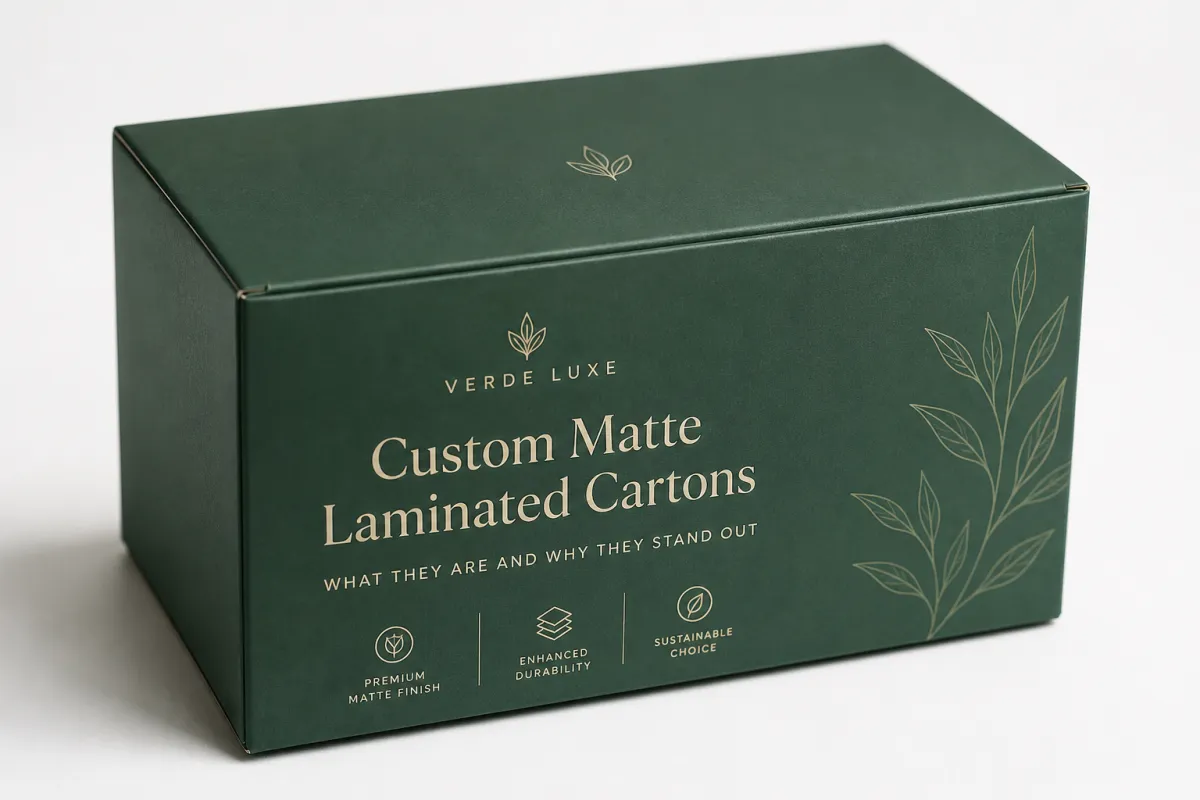
At the simplest level, custom matte laminated cartons are printed paperboard or folding cartons finished with a matte film or matte coating. The goal is not shine. It is a soft, low-reflective surface that gives artwork a more deliberate, understated look. Less glare under store lighting. Less visual noise in product photography. Fewer ugly fingerprints showing up on every panel.
That forgiving surface is one reason matte finishes keep showing up in Premium Product Packaging. I have seen cartons where the graphics were nothing special, yet the matte finish made the whole thing feel calmer and more expensive. The effect is subtle, but it is real. Dark solids look more controlled. Neutrals read cleaner. Fine typography feels more disciplined when the reflection is knocked down.
Custom matte laminated cartons also shift the emotional read of a design, depending on stock and artwork. A minimalist layout on white board can feel modern and clinical. A textured kraft-inspired design with matte lamination can feel natural and grounded. A deep black carton with a matte surface can feel technical and high-end, especially with a foil accent or light embossing. The finish does not write the brand story for you, but it absolutely changes how the story lands.
There is a practical upside too. Matte surfaces do a better job hiding small rub marks, fingerprints, and the faint whitening that can show up on folded edges after handling. That does not make them indestructible. It just means they are less annoying in shipping and retail environments where cartons get touched, stacked, slid, and restacked by people who do not care about your brand guidelines.
Buyers sometimes assume matte automatically means premium. Not quite. The board, structure, and print quality still need to support the claim. If the panels bow, the glue seam opens, or the artwork is muddy, the finish will not save the package. Good custom matte laminated cartons are built from the inside out.
A matte finish can hide a lot of handling wear, but it cannot fix weak structure, bad dielines, or low-grade board. The carton spec matters as much as the surface look.
Brands that care about package branding usually get the best result by balancing restraint with clarity. Matte gives you a quieter canvas, which works well for luxury skincare, supplements, apparel, candles, or any product where the carton should suggest trust and control instead of noise. If that sounds close to your brief, custom matte laminated cartons are probably already on the table for a reason.
How Custom Matte Laminated Cartons Are Made
The production flow is more straightforward than many people think, but each step can still go sideways. A typical run starts with artwork setup and dieline review, then moves into printing, lamination or coating, die cutting, folding, gluing, and final packing. Every stage affects the next one. Carton work is never just “print and fold.” That idea has caused enough headaches already.
First comes the structural dieline. That file shows every panel, flap, crease, glue zone, and bleed area. If the layout is off by even a small amount, the carton can close poorly or the artwork can land in all the wrong places. With custom matte laminated cartons, alignment matters because the finish makes edges, folds, and seams look cleaner and more noticeable when the box is handled up close.
After printing, the surface gets the matte treatment. Film lamination uses a thin plastic film bonded to the printed sheet. Matte coating works more like a liquid layer that dries onto the surface. Film usually gives stronger surface protection and a more consistent texture. Coating can be lighter and less expensive, depending on the press setup and the look you want. Neither one wins every time. They just behave differently.
Once the finish is on, the sheets are die cut into flat blanks. Those blanks are then creased, folded, and glued into finished cartons. That sequence is why dielines matter so much. The carton is not built as a box first and decorated later. It is printed flat, then converted into a box. Every window, tuck flap, and panel break has to be planned early.
Custom matte laminated cartons can also include spot UV, embossing, foil stamping, or soft-touch lamination. Those extras can look excellent. They also add tooling, setup, inspection, and usually more lead time. My advice is boring because it works: decide what the package needs to do first, then add embellishment only where it actually helps the product story.
For brands that want a clearer sense of how finishing choices compare, the industry resources at packaging.org are a solid reference point. You do not need to become a materials engineer to make a good choice, but it helps to know the difference between a surface that looks nice and a surface that can survive production.
Key Factors That Affect Custom Matte Laminated Cartons Pricing
Pricing for custom matte laminated cartons depends on a handful of variables, and the biggest mistake buyers make is acting like every carton should cost the same. It does not. A small tuck-end carton with simple graphics is a very different job from a large retail box with foil, inserts, and a custom window. Same category. Very different bill.
Size is the first driver. Bigger cartons use more board and more print coverage, which pushes material cost up right away. Board thickness comes next. A 14pt or 16pt sheet behaves differently from heavier 18pt SBS or 350gsm board, and heavier stock usually costs more to buy, print, cut, and convert. Finish type matters too. Matte film lamination generally costs more than a simple aqueous coating because it adds another material layer and another application step.
Quantity changes the math in a very normal way. With custom matte laminated cartons, setup costs are spread across the run, so a 10,000-piece order usually has a better unit price than a 1,000-piece order, even if the total invoice is higher. That is not a trick. It is just how press, die, and gluing setup work.
Complexity also changes the numbers. Inserts, windows, custom tooling, multi-panel artwork, and specialty embellishments all add labor. If a carton has odd folds or needs manual assembly, cost climbs again. Freight and storage matter too. Oversized cartons eat pallet space, and cubic volume is not free. I have seen buyers obsess over unit price, then act shocked when freight changes the actual landed cost. Basic math still applies, annoying as that is.
| Finish Option | Look and Feel | Surface Protection | Typical Cost Impact at 5,000 Units | Best Use Case |
|---|---|---|---|---|
| Matte film lamination | Soft, low-glare, refined | Strong abrasion resistance | About $0.04-$0.12 per unit | Retail cartons that need better scuff resistance |
| Matte aqueous coating | Subtle, lighter texture | Moderate protection | About $0.02-$0.06 per unit | Budget-conscious runs with clean presentation |
| Soft-touch matte lamination | Velvety, premium, tactile | Very good surface protection | About $0.06-$0.15 per unit | High-end product packaging where feel is part of the brand story |
Those ranges are planning figures, not promises. Carton size, print coverage, board selection, and regional labor rates all move the numbers around. They still help because they show the tradeoff clearly: custom matte laminated cartons usually cost more than plain cartons, but the upgrade often buys a cleaner retail look and better wear resistance.
If you are specing a new packaging line, compare finish options against the launch budget before you commit. You can also review our custom packaging products to see how different structures pair with different surface treatments. The finish should support the product and the channel, not fight them.
For brands that ship through parcel networks, shipping test references from ISTA can help frame expectations for drop resistance, vibration, and compression. That does not replace carton engineering, but it gives you a practical way to think about what the box will face. Custom matte laminated cartons still need proper structure, no matter how good the surface looks.
Step-by-Step Process and Timeline for Custom Matte Laminated Cartons
The timeline usually starts with a quote request and a basic spec review. That means dimensions, board grade, finish type, quantity, print sides, and shipping destination. Leave those details vague and the quote will come back vague too. Once the numbers are in place, the printer confirms or prepares the dieline, and the artwork team starts checking panel placement and bleed.
Proofing comes next. A digital proof catches layout issues. A physical sample tells you a lot more about fit, finish, and tactile feel. For custom matte laminated cartons, that sample step matters because matte changes how art reads under light. A color that looks fine on screen may print darker, flatter, or more elegant once it is on board and laminated.
Production usually follows this rough sequence:
- Confirm structure, dimensions, and carton style.
- Approve artwork and finish direction.
- Review printed proof or sample.
- Run printing and matte application.
- Die cut, crease, fold, and glue.
- Pack, palletize, and arrange freight.
Simple custom matte laminated cartons can move in about 10-15 business days after proof approval if the artwork is ready and the structure is standard. More complex cartons, especially those with foil, embossing, windows, or hand assembly, often land in the 15-25 business day range. Add a new die, a new insert, or several rounds of proof changes and the schedule stretches again. Production has a memory. It remembers indecision.
Most delays come from a few predictable places. Artwork changes after proofing are common. Dieline revisions and late material substitutions show up a lot too. Waiting for sample approval can slow everything down, especially if several people need to sign off on color and finish. The best way to keep custom matte laminated cartons moving is to lock the important decisions early and stop redesigning the box after the file is already in production.
Freight method matters as well. Air shipping shortens delivery time but can drive landed cost up fast. Sea freight is usually cheaper for larger programs, but it needs more lead time and a buffer for customs or port delays. A buyer planning a launch should work backward from the shelf date, not forward from the purchase order date. That seems obvious until someone misses the launch window.
Material Choices, Structure, and Print Details That Matter Most
The surface gets the attention. The board does the real work. Paperboard choice affects stiffness, crease quality, ink appearance, and how the finished carton feels in the hand. For custom matte laminated cartons, common options include 14pt to 18pt SBS, CCNB, and other coated boards depending on brand goals and product weight. Heavier products need stronger board and usually a more supportive structure.
The carton style matters just as much. Straight tuck, reverse tuck, auto-lock bottom, and display-ready designs all solve different problems. A light cosmetic serum may fit neatly in a tuck-end carton. A heavier wellness product may need an auto-lock bottom or reinforced base. If the carton is going on shelf, panel hierarchy and front-facing readability become more important than a long back-panel paragraph nobody will read.
Custom matte laminated cartons also need careful print planning. Dark solids, high-contrast art, and thin type can shift visually under matte lamination because the surface reduces reflection and can make edges appear softer. That is not a defect. It just means the artwork should be checked on the actual material, not only on a monitor. Fine lines, small legal text, and barcode areas need extra care so they stay crisp after conversion.
Design details matter around the folds and glue zones. Critical text should stay clear of score lines. Barcodes need a quiet, uncluttered background. Seam allowance should be considered early so the front panel does not lose visual balance once the box is assembled. These are the little things that separate a carton that only looks good on screen from one that actually works in production.
Packaging teams often save money in the wrong place. They spend time on the front panel art, then rush the structural planning. With custom matte laminated cartons, structure and finish should be developed together because the final box is only as strong as the weakest decision. If the product is heavy, fragile, or sold in a crowded retail aisle, the structure should lead the design. Not the other way around.
For buyers managing broader branded packaging programs, standardizing a few things across SKUs helps a lot: board family, logo placement rules, barcode location, and allowed finish types. That keeps the family of boxes consistent without forcing every carton into the same mold. It also makes future reorders less painful, which is a nice change.
Common Mistakes to Avoid With Custom Matte Laminated Cartons
The first mistake is picking matte only because it looks premium. Yes, it often does. That does not mean the carton can survive rough handling, tight stacking, or long shipping routes without help. A surface finish can improve the job, but it will not make a flimsy carton durable. Custom matte laminated cartons need to perform and look good. Both parts matter.
The second mistake is sending artwork before the dieline is locked. That sounds minor until a logo lands across a fold or a line of copy disappears into a glue flap. Once that happens, revisions cost time and usually money. The better move is to confirm the structural file first, then build the artwork around it. That is basic packaging discipline, and it saves a lot of unnecessary drama.
The third mistake is assuming every matte finish feels the same. It does not. Matte film, matte coating, and soft-touch all create different tactile results. Some feel dry and paper-like. Some feel smooth and restrained. Some have a velvety finish that practically begs to be touched. If the package needs to support premium product packaging, test the tactile story before full production.
The fourth mistake is under-specifying board strength. Heavy jars, dense supplements, stacked mailers, and thicker retail products can crush a carton that looked fine on paper. Corner strength, panel rigidity, and bottom support all matter. If the product is heavy, ask for a carton spec that reflects actual weight, not just outside dimensions. Custom matte laminated cartons look far better when they stay square after handling.
A prototype is often cheaper than a correction run. One sample can reveal fit issues, texture surprises, color drift, and closure problems before the full order is locked.
The fifth mistake is skipping samples because the schedule feels tight. That is understandable. It also backfires more often than people like to admit. A quick proof may confirm the file is technically correct, but it will not tell you whether the finish feels right or whether the closure sits properly. If the finish is part of the brand promise, samples are not optional decoration. They are insurance.
There is another point buyers overlook: lamination can affect recyclability claims and sustainability messaging, depending on the board, adhesive system, and local recycling infrastructure. If your brand is making environmental statements, review the full package specification, not just the surface treatment. FSC-certified paper options may be part of the discussion too, and the Forest Stewardship Council provides useful background at fsc.org. Strong packaging programs should be honest about materials, not vague and self-congratulatory.
Expert Tips and Next Steps for Custom Matte Laminated Cartons
Start with the product itself. Measure the actual item, not the marketing sample. Include inserts, labels, droppers, closures, and any protective wrap. Then think about the shipping path. Will the carton sit in a warehouse for weeks? Will it move through a parcel network? Will it live on a retail shelf under bright lights? Those questions shape the right spec for custom matte laminated cartons better than any trend report ever will.
My second recommendation is simple: ask for three things early, every time. A structural dieline, a finish sample, and a printed proof. The dieline tells you whether the carton functions. The finish sample tells you whether the matte tone matches the brand. The proof tells you whether the artwork lands where it should. Together, those three pieces cut risk in a way no sales brochure can match.
It is smart to compare matte lamination against a few alternatives before settling on the final spec. Gloss can create stronger visual pop. Soft-touch can elevate tactile appeal. Matte aqueous may fit a tighter budget. There is no universal winner. The right choice depends on how the carton is handled, how the product is sold, and how much brand polish the package needs to carry. In some projects, custom matte laminated cartons are the obvious front-runner. In others, a lighter finish makes more sense.
Before you request quotes, build a simple spec sheet with carton size, board grade, finish type, print sides, quantity, insert needs, and target delivery date. That one sheet cuts through a lot of back-and-forth. It also makes it easier to compare vendors on equal terms. If you are already reviewing your packaging lineup, our Custom Packaging Products page is a useful reference for sorting out what you have now and what needs to change.
One last practical move: inspect your current cartons with a buyer’s eye. Look for crushed corners, whitening on folds, scratched surfaces, weak closures, poor shelf stance, or artwork that feels too shiny or too loud for the brand. Those weak points tell you whether the upgrade should be structural, visual, or both. If the box is doing its job but the finish looks tired, custom matte laminated cartons may be the cleanest upgrade you can make.
For teams building broader branded packaging programs, comparing a few sizes and finish styles side by side before locking the spec is usually the fastest way to see what is really driving the premium feel. Sometimes it is the board. Sometimes it is the print. Sometimes it is the matte surface. Usually, it is the combination, and pretending otherwise is how bad decisions get dressed up as strategy.
If you need more options to review, our custom packaging products page can help you narrow down structure and finish choices before you ask for pricing. The more clearly you define the job, the easier it is to get a quote that reflects reality instead of guesswork.
Final Takeaway
Custom matte laminated cartons are a strong choice when a brand needs packaging that looks refined, resists everyday wear, and supports a calm, premium presentation. They are not magic, and they are not right for every product, but they do offer a practical mix of appearance and durability. If the structure is sound, the board is appropriate, and the artwork is planned around the dieline, the results can be excellent.
The cleanest path is usually the best one: define the product, Choose the Right carton style, decide how much surface protection you need, and verify the look with a sample before placing the full order. That keeps custom matte laminated cartons grounded in actual production needs instead of wishful thinking. Which, frankly, is how packaging should be specified in the first place.
Are custom matte laminated cartons better than gloss cartons for premium products?
Often, yes, if the brand wants restraint instead of shine. Matte usually gives a softer, more controlled look, while gloss pushes color contrast and reflection harder. I would not call one universally better. They just tell different stories. Gloss can work well for loud retail packaging, but matte usually wins when the goal is quiet premium positioning and fewer visible scuffs. That said, if the artwork depends on punchy saturation or high visual energy, gloss may be the stronger fit.
Do custom matte laminated cartons work for shipping, or are they mainly for shelf display?
They work for both, as long as the structure is built for the job. Matte lamination helps with scuff resistance and keeps the carton looking cleaner during handling, but it does not replace proper board strength or box design. For parcel shipping, I would pay close attention to corner crush, closure style, and carton fit around the product. If the box is too loose or the board is too light, the finish will not save it. Simple as that.
Can matte laminated cartons be recycled?
Sometimes, but the answer depends on the board, the laminate type, and local recycling systems. Paperboard with a light coating may be easier to process than cartons with heavier plastic film, but recycling rules are not identical everywhere. If sustainability claims matter to the brand, check the full material stack before printing them on the box. Honest specs beat fuzzy promises every time.
What board thickness is best for custom matte laminated cartons?
There is no single best thickness. Lightweight cosmetics often do fine with 14pt or 16pt board, while heavier products may need 18pt SBS or another stronger stock. The actual product weight, insert design, and shipping path matter more than the category label. If a carton holds glass, dense contents, or multiple components, I would lean toward stronger board and test the closure before signing off. A carton that feels nice but sags under load is not doing its job.
What should I request before placing a full order?
Ask for a locked dieline, a printed proof, and a physical sample with the matte finish applied. Those three items catch most of the avoidable problems: panel misalignment, finish differences, color drift, and closure issues. If the supplier cannot provide them, that is a sign to slow down and ask why. The extra step costs less than correcting a bad run, and usually a lot less than explaining the mistake to your team later.

