Buyer Fit Snapshot
| Best fit | Custom Molded Pulp Inserts Bulk projects where brand print, material claims, artwork control, MOQ, and repeat-order consistency need to be specified before quoting. |
|---|---|
| Quote inputs | Share finished size, material target, print colors, finish, packing count, annual reorder estimate, ship-to region, and any compliance wording. |
| Proofing check | Approve dieline scale, logo placement, barcode or warning zones, color tolerance, closure strength, and carton packing before bulk production. |
| Main risk | Vague material claims, crowded artwork, missing packing details, or unclear freight terms can make a low unit price expensive after revisions. |
Fast answer: Custom Molded Pulp Inserts Bulk: Pricing, Specs, Process should be specified like a repeatable production item. The safest quote records material, print method, finish, artwork proof, packing count, and reorder notes in one written spec.
Production checks before approval
Compare the actual filled-product size with the drawing, then confirm tolerance on folds, seals, hang holes, label areas, and retail display edges. Reserve space for logos, QR codes, warning copy, and material claims before decorative graphics fill the panel.
Quote comparison points
Review material grade, print process, finish, sampling route, tooling charges, carton quantity, and freight assumptions side by side. A quote is only useful when the supplier can repeat the same color, closure quality, and packing count on the next order.
Custom Molded Pulp Inserts bulk do one job well when they are designed right: they keep the product still. Not “mostly protected.” Still. Movement is what chips corners, scuffs coatings, and turns a decent pack into a return. A product that rattles in the box is already losing.
People love to ask whether pulp is eco-friendly. Fine, ask it. The better question is simpler: does the insert fit the product, protect the fragile bits, and hold up across repeated orders without turning packaging into a headache? That is the real test. That is also where custom Molded Pulp Inserts bulk make sense.
Buying in bulk changes the whole equation. Unit price drops. Reordering gets less chaotic. The same insert can support launches, seasonal runs, and retail refreshes without making every order feel like a fresh science project. If you already use Custom Packaging Products, the insert stops being a patch job and becomes part of the packaging system.
Why custom molded pulp inserts bulk are worth it
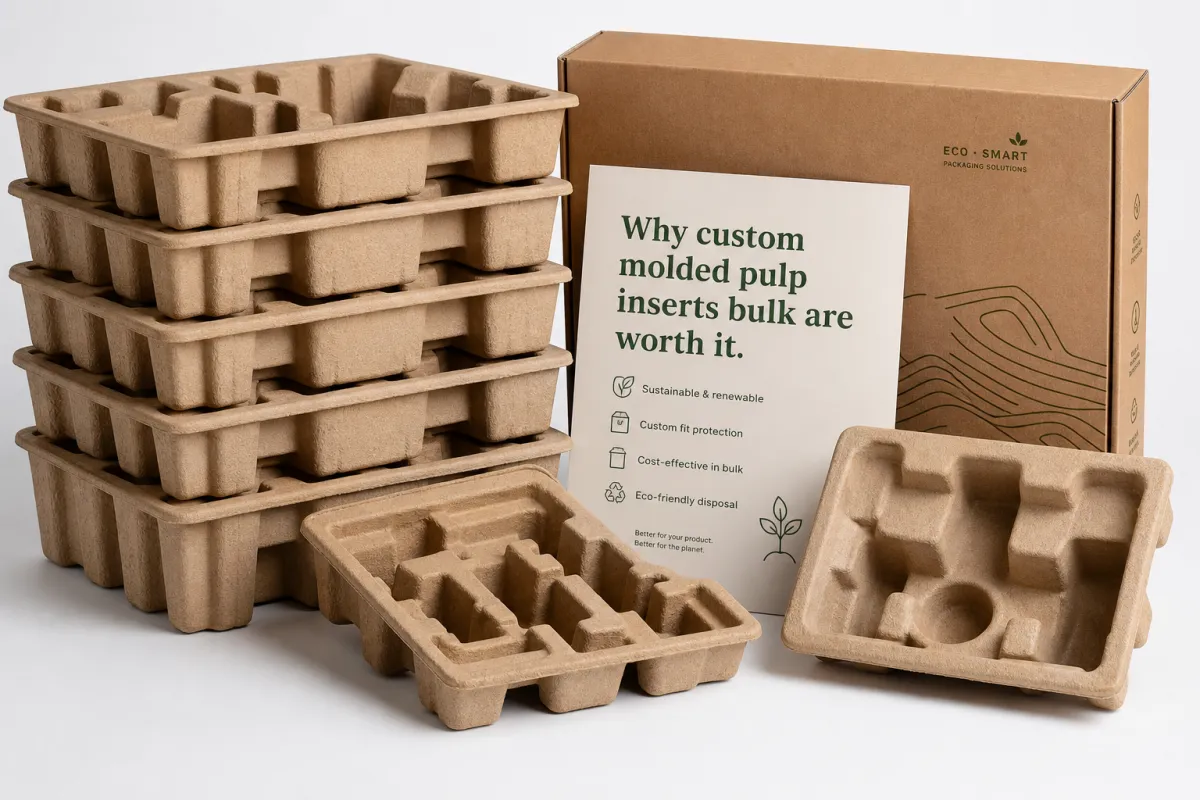
Damage usually shows up in boring ways. A bottle shifts. A glass piece taps the carton wall three hundred times on the way to the customer. A corner gets bruised because the cavity had too much empty space around it. custom molded pulp inserts bulk cut down that kind of movement by matching the product instead of asking the carton to do all the work.
That matters for fragile products. It also matters for presentation. A molded pulp tray makes the box feel intentional. The product lands where it should, instead of sliding around with loose paper or foam peanuts doing their usual sad impression of “packaging.” Buyers notice. Retailers notice. Returns teams definitely notice.
Bulk buying is not only a unit-price play. It makes replenishment less annoying. Once the tray, cradle, or end cap is approved, you are not rethinking product packaging every time a reorder comes up. You already know the spec. That kind of boring is good.
There is a real sustainability angle here, and it does not need to be dressed up. Recycled fiber content, less plastic, and easier end-of-life handling are all easier to explain when the insert is molded pulp. If your sourcing policy calls for FSC-certified fiber or documented recycled content, ask for the paperwork. Do not take a line on a sales sheet as gospel. For buyers who care about standards, the useful conversations usually sit next to ISTA transport testing and sourcing documentation from FSC.
Molded pulp tends to beat foam or loose paper in a few specific situations. Odd-shaped products with fragile edges are one. Consistent shipping across large runs is another. Retail-ready presentation is the third. In those cases, the insert should support the package instead of looking like random filler shoved in at the last minute.
That said, custom molded pulp inserts bulk are not magic. Sloppy product geometry, thin walls, or a cavity designed without carton clearance will sink the result fast. Good packaging starts with the object, not the artwork. The insert has to answer the product, the box, and the shipping method at the same time.
If the insert moves, it is not protecting anything.
Simple, but true. custom molded pulp inserts bulk are worth it when they reduce movement, reduce void fill, and reduce guesswork. If they do none of that, they are just another line item with a nicer story.
What custom molded pulp inserts bulk actually include
“Insert” sounds like one thing. It is not. custom molded pulp inserts bulk can mean trays, end caps, clamshell-style retainers, nested kits for multiple parts, or molded cradles built for bottles, candles, cosmetic jars, and electronics components. The shape follows the product and the carton. Anything else is just decorative optimism.
Fiber choice changes the result too. Recycled fiber is common. Mixed recycled content shows up a lot. Virgin fiber blends appear when cleaner surfaces or tighter detail matter. Some parts are pressed smoother, some stay more utilitarian, and some get die-cut edges for speed or appearance. None of that is mystical. It just affects price, finish, and strength.
Buyers usually care about use before chemistry. Electronics need anti-rattle restraint. Cosmetics need presentation plus scratch protection. Bottles need support at the shoulder and base. Glassware needs edge control. Candles need spacing so labels do not rub. Home goods and subscription kits need nesting logic so the box closes the same way every time.
custom molded pulp inserts bulk also handle multi-piece packaging better than a lot of people expect. If the kit includes a main product, an accessory, a card, and a charger or refill component, the insert can be built with separate pockets and stack allowance so each part stays put. That keeps assembly faster and the unboxing cleaner.
Structure matters. A good insert is not just a cavity. It is a system with a product pocket, buffer zones, anti-rattle features, carton tie-ins, and sometimes a little extra overhang so the item does not pop out during packing. Retail packaging asks more from surface finish and visible edges. Internal shipper packaging cares more about pure protection. Same material. Different job.
One-piece and two-piece designs each have a place. A one-piece tray may be cheaper and faster to pack. A two-piece set may hold irregular products better or provide stronger top-and-bottom support. If the insert is visible to the customer, the finish needs to look clean. If it lives only inside a secondary carton, the design can stay lean. custom molded pulp inserts bulk should be built for the real use, not a stock photo fantasy.
For brands focused on package branding, molded pulp can sit quietly inside the box and still carry the experience. That is the point. It does not need to shout. It needs to fit, protect, and stay consistent from run to run.
Specifications that control fit and protection
Good quotes start with good measurements. For custom molded pulp inserts bulk, the numbers that matter are product length, width, height, weight, fragile zones, and the inside dimensions of the carton. Leave one out and the sample may look right while still failing in production. Close enough is not a spec.
Tolerance causes plenty of headaches. A cavity that is too loose lets the product slide and scuff. A cavity that is too tight slows packing and pushes operators to force the item in, which is a great way to create defects nobody wants to explain later. The sweet spot gives a little working room for assembly and still stops movement in transit.
Wall thickness and compression strength matter just as much. Thin pulp can reduce cost, but if the product stacks badly or the warehouse pile gets heavy, the insert can deform. Thicker walls and smart ribbing help the part hold shape. Corner support matters more than many buyers expect, especially for rectangular products and palletized cartons.
Surface finish is another choice with consequences. A smoother face feels more premium and may shed fewer fibers. Raised edge rolls can improve stiffness. Moisture is the annoying variable that never leaves. If the product travels through humid warehouses or wet freight lanes, ask how the insert behaves there. Pretty is fine. Functional is mandatory.
custom molded pulp inserts bulk should be tested the way the final pack will actually live. That means drop tests, shake tests, orientation changes, and a look at what happens after the insert is loaded into the carton. A tray that passes flat drops can still fail once the box rotates or gets stacked. Testing is not glamorous. It just saves money.
Most buyers use a simple checklist before approving a sample:
- Does the product sit centered without forcing?
- Does the item rattle when the carton is shaken?
- Do the edges stay clear of pressure points?
- Can the pack survive the intended transit method, whether parcel, pallet, or retail handling?
- Does the insert fit the final carton with enough clearance for closing, sealing, and labeling?
If you want a formal testing reference, custom molded pulp inserts bulk should be judged against the same transit logic used in common industry checks. Many teams use ISTA procedures as a practical baseline, especially for parcel shipment and distribution testing. The goal is not ceremony. The goal is fewer claims.
The carton spec and the insert spec need to agree. If the box shifts by even a few millimeters, the insert may stop fitting the same way. Packaging should be engineered as one system, not as a box from one vendor and an insert from another. That split is where small problems turn into expensive ones.
Custom molded pulp inserts bulk pricing and MOQ
Pricing is never just one number. It hides a stack of costs inside one quote. For custom molded pulp inserts bulk, the biggest drivers are cavity complexity, tooling, fiber type, drying method, finish quality, and order volume. A simple recycled-fiber tray is not the same thing as a deep, tight-tolerance retail insert with crisp walls and a smoother face.
MOQ exists for a reason. Tooling is the gate. Once a mold is built, the supplier needs enough volume to spread that cost across a run that makes sense. Lower quantities usually mean higher unit prices until the mold cost gets absorbed. Not a trick. Just production math.
Here is the pricing framework buyers should ask for before a quote turns fuzzy:
- Prototype or sample cost: often a one-off charge for trial forming and fit checks.
- Tooling charge: the mold or form cost, usually the biggest upfront expense.
- Per-piece production price: the unit cost at your target quantity.
- Packaging and packing method: how the inserts are nested, stacked, or boxed for freight.
- Freight terms: ex-works, FOB, or landed pricing can change the final picture fast.
Real-world ranges help buyers stop pretending every quote is comparable. A simple prototype may land around $120-$350 depending on detail and sample count. Tooling can run roughly $500-$2,500 or more for complex forms. Production pricing for custom molded pulp inserts bulk often sits around $0.12-$0.38 per unit at higher volumes for simple shapes, while complex or premium-finish inserts may land closer to $0.28-$0.65 per unit in smaller production bands. Those numbers are guideposts, not promises.
| Order stage | Typical quantity | What you are paying for | Approx. cost range | Best use |
|---|---|---|---|---|
| Prototype sample | 1-20 pcs | Trial forming, fit checks, hand finishing | $120-$350 | Early design validation |
| Low-volume pilot | 1,000-3,000 pcs | Tooling amortization, setup, packing | $0.28-$0.65 each | Launches and seasonal runs |
| Bulk production | 5,000-20,000+ pcs | Efficient forming and repeat production | $0.12-$0.38 each | Ongoing replenishment |
Volume improves economics, but not forever. Storage and cash flow start to matter before the unit price stops moving. If you are filling a warehouse for six months just to save a cent or two per piece, that is not smart buying. That is expensive clutter with a spreadsheet on top.
custom molded pulp inserts bulk quotes should also be checked for hidden assumptions. Is the price ex-works or landed? Are samples included or billed separately? Does MOQ apply per mold, per SKU, or per shipment batch? Is the first revision included, or does it turn into a new charge? Those are dull questions. They also keep invoice surprises from showing up later like they own the place.
For buyers comparing molded pulp with foam, the unit price tells only part of the story. Freight, storage, damage claims, and whether the pack supports the brand all matter. Foam can look cheap until the package feels wrong or the sustainability team starts asking why a recyclable product is sitting in plastic. custom molded pulp inserts bulk often win because the total package makes more sense, not because one line item is always lower.
Wholesale programs matter for the same reason. If the packaging needs repeat runs across several SKUs, a supplier that understands replenishment can save you from re-quoting the same insert every quarter. That is where Wholesale Programs actually earn their keep.
Process and timeline for custom molded pulp inserts bulk
The production path is pretty straightforward when the inputs are clean. For custom molded pulp inserts bulk, the usual flow is product review, CAD or sample review, mold approval, pilot sample, revisions, and then mass production. The steps are simple. The delays usually are not.
Week one is about facts, not vibes. Product dimensions. Carton inside dimensions. Product photos. Target quantity. Any special handling notes. If the item has fragile corners, a coated surface, or a weird center of gravity, say it out loud. “It should fit like the old one” is not a spec. It is a complaint waiting to happen.
After the first review, the supplier builds a sample or pilot run. Simple shapes move faster. Deeper cavities, multiple components, and tight retail fit usually need more iteration. A realistic timeline is often 12-15 business days from proof approval for simpler projects, while more complex custom molded pulp inserts bulk jobs may need a few rounds of adjustment before the part is stable enough for production.
Most delays come from the same tired list. Missing dimensions. Blurry photos. Carton specs that keep changing. Late approval on the first sample. A product redesign that starts after the insert quote has already gone out. None of that is rare. It happens constantly.
Here is a practical timeline buyers can use:
- Days 1-3: share product dimensions, box size, photos, quantity, and performance needs.
- Days 4-7: receive initial concept, pricing, and sample plan.
- Days 8-15: sample formation and first fit check for straightforward shapes.
- Days 16-20: revise cavity depth, clearance, or edge support if needed.
- After approval: production booking, bulk forming, drying, inspection, packing, and freight scheduling.
custom molded pulp inserts bulk also need a handoff plan. Who approves fit? Who signs off on finish? Does the carton need a specific packing method? Are you shipping parcel, pallet, or mixed freight? If those pieces are not settled before the run starts, days disappear just syncing internal opinions.
For testing and transit validation, buyers often use industry references such as ISTA because it gives the discussion some structure. That matters when the package needs to survive repeated handling instead of only looking decent on a bench. Good testing does not guarantee perfection, but it does expose the weak spots before the customer does.
The cleanest projects treat packaging design and production scheduling as one job. The carton spec, insert geometry, print plan, and freight booking should move together. custom molded pulp inserts bulk are not difficult to produce when the brief is clear. They get difficult when the brief keeps changing every time someone opens another spreadsheet.
Why choose us for custom molded pulp inserts bulk
Buyers do not want a speech about sustainability. They want a part that forms consistently, fits the product, and shows up when promised. That is why custom molded pulp inserts bulk should be judged on repeatability first. Stable forming, controlled moisture, and predictable cavity dimensions matter more than a flashy claim that sounds nice in a deck.
Quality control is where the real work shows up. Incoming fiber should be checked. Mold calibration should be verified. Sample dimensions should be compared with the approved spec before production starts. Randomly pulled pieces should be measured again before shipment. If a supplier cannot explain that process in plain language, the buyer is carrying the risk.
The sustainability angle only holds up when the paperwork is real. Recycled content claims should be supportable. Waste reduction should show up in material use and nesting efficiency. If the project needs FSC-linked sourcing, the documents should prove it. Package branding works better when the story is factual instead of theatrical.
custom molded pulp inserts bulk also benefit from fast, clear engineering communication. Direct feedback saves days. Honest comments about cavity depth, edge clearance, and tolerance keep rework down. Vague answers do the opposite. Buyers do not need poetry. They need an insert that protects the product, supports retail packaging, and does not create drama once production starts.
Another advantage is fit support across related packaging lines. If the product family uses multiple carton sizes or seasonal packaging refreshes, a supplier who understands Custom Packaging Products can keep the inserts aligned with the rest of the box system. That matters when you are trying to keep branded packaging consistent without redesigning the shelf presence every few months.
The best supplier is the one who can explain tradeoffs. If a wall thickness change raises cost but improves stack strength, say it. If a smoother surface improves presentation but slows drying or adds price, say that too. Buyers will pay for better. They do not like learning about it after the invoice lands.
That is the point of custom molded pulp inserts bulk: fit, protection, and dependable supply. Not hype. Not vague green language. Just a part that does its job and keeps doing it when the order repeats.
Next steps to quote custom molded pulp inserts bulk
If you want a quote that can actually be used, send the right inputs. For custom molded pulp inserts bulk, the minimum set is product dimensions, product weight, carton inside dimensions, photos from multiple angles, target quantity, destination, and any drop-test or anti-scratch requirement. Without that, the quote is guesswork wearing a tie.
Better still, include a dieline, rough sketch, 3D file, or a sample of the current pack. If the product has assembly steps, note them. If packing speed matters, note that too. A tray that saves two seconds per unit can matter more than a tiny unit-cost change once thousands of pieces are running through the line.
Here is the decision path I would use if I were comparing suppliers:
- Confirm fit with a sample before discussing bulk pricing.
- Compare sample cost against the unit savings from volume.
- Lock MOQ, tooling, and revision terms before pushing for production pricing.
- Ask what changes the quote: depth, finish, fiber type, moisture tolerance, or carton size.
- Get the sample lead time in writing so your launch date does not drift.
custom molded pulp inserts bulk buyers should compare how each supplier handles revisions. Small adjustments to edge clearance or cavity depth are normal. Big changes to the footprint are not. If the product is still moving, say so early. That avoids the awkward moment where everyone pretends a late-stage redesign was “minor” while the tooling team quietly starts over.
Before you send a request, gather the following:
- Product dimensions and weight
- Carton inside dimensions
- Photos or a sample pack
- Target order quantity and reorder expectations
- Transit method: parcel, pallet, or mixed freight
- Any special needs for retail packaging, anti-scratch support, or presentation quality
Once those pieces are in place, the quote gets sharper and the sample cycle gets shorter. That is the part a lot of buyers miss. Better input does not just improve the answer. It usually improves the timing too.
Send the dimensions, carton size, quantity, and product photos if you want a real starting point for custom molded pulp inserts bulk. If you are still comparing options, start with fit, then price, then freight, because that order saves more money than chasing the cheapest line item ever will.
What is the typical MOQ for custom molded pulp inserts bulk?
MOQ usually depends on tooling complexity, not just raw material cost. Simple shapes may start lower than high-detail or multi-cavity inserts, but the real gate is whether the mold cost can be spread across enough units to make production sensible. Ask whether the MOQ applies per mold, per SKU, or per shipment batch before you compare quotes for custom molded pulp inserts bulk.
How much do custom molded pulp inserts bulk cost compared with foam?
At scale, molded pulp can be very competitive, especially if it replaces extra void fill or simplifies the carton structure. Foam may look cheaper on paper for tiny runs, but molded pulp often wins on recyclability, presentation, and package branding. The real comparison should include tooling, freight, storage, and how many damage claims the packaging prevents.
How long do samples take for custom molded pulp inserts bulk?
Simple sample cycles can move quickly when the product shape is straightforward and the carton size is fixed. Expect more time if the insert must pass drop tests, hold multiple components, or fit tightly into a retail box. The fastest way to slow sampling is sending incomplete dimensions or waiting too long to approve revisions on custom molded pulp inserts bulk.
What information do you need to quote custom molded pulp inserts bulk?
Provide product dimensions, weight, photos from several angles, and the inside dimensions of the carton. Include target quantity, destination, and any performance requirement like drop testing or anti-scratch protection. If you already have a sample or dieline, send it. That usually tightens the quote and cuts down the back-and-forth for custom molded pulp inserts bulk.
Can custom molded pulp inserts bulk be changed after the first sample?
Yes, but every change can affect tooling, cost, and lead time. Small tweaks like cavity depth or edge clearance are easier than major changes to the overall footprint. If the product design is still moving, say so up front and expect a more flexible sample plan. That honesty helps more than pretending the design is frozen when it is not.
custom molded pulp inserts bulk are worth the spend when they fit the product, protect it in transit, and support the rest of the packaging without wasting material. Send product dimensions, carton size, quantity, and photos if you want a quote that can actually be used instead of one that only sounds cheap. If you are still deciding, start with fit and transit requirements first, then compare pricing. That order keeps the project honest and usually saves a lot of backtracking.

