Buyer Fit Snapshot
| Best fit | Molded Pulp Inserts Wholesale projects where brand print, material claims, artwork control, MOQ, and repeat-order consistency need to be specified before quoting. |
|---|---|
| Quote inputs | Share finished size, material target, print colors, finish, packing count, annual reorder estimate, ship-to region, and any compliance wording. |
| Proofing check | Approve dieline scale, logo placement, barcode or warning zones, color tolerance, closure strength, and carton packing before bulk production. |
| Main risk | Vague material claims, crowded artwork, missing packing details, or unclear freight terms can make a low unit price expensive after revisions. |
Fast answer: Molded Pulp Inserts Wholesale: Pricing, Specs & Supply should be specified like a repeatable production item. The safest quote records material, print method, finish, artwork proof, packing count, and reorder notes in one written spec.
Production checks before approval
Compare the actual filled-product size with the drawing, then confirm tolerance on folds, seals, hang holes, label areas, and retail display edges. Reserve space for logos, QR codes, warning copy, and material claims before decorative graphics fill the panel.
Quote comparison points
Review material grade, print process, finish, sampling route, tooling charges, carton quantity, and freight assumptions side by side. A quote is only useful when the supplier can repeat the same color, closure quality, and packing count on the next order.
A product can look fine in the lab and still turn into a freight mess the second it leaves the warehouse. Buyers see that split pretty fast. Molded Pulp Inserts Wholesale often changes the math because it can reduce cube, cut void fill, and eliminate the mixed-material headache that shows up later in disposal and recycling. That is why more packaging teams judge molded fiber on total landed cost instead of the per-piece line item alone.
From a procurement angle, the quote is only one piece of the puzzle. Molded Pulp Inserts wholesale has to protect the product, keep pack-out moving, and still look decent when the customer opens the box. Save a few cents on the insert and then eat damage claims, rework, or complaints about the packaging experience, and the savings disappear fast. I have seen that mistake more than once, usually after someone got too excited about the lowest quote on the page.
The structure here is intentional. First, which insert shape fits the product. Then, which specs need to be locked before quoting. Then, what MOQ really means in a production run. Finally, how a wholesale program moves from sample to shipment without wandering around for six weeks. If you are comparing suppliers, start with fit, then economics, then proof.
Good packaging does more than survive transit. It trims labor, supports the brand story, and keeps the supply chain less annoying at scale.
For repeat orders, molded pulp inserts wholesale is less about buying a commodity and more about buying control. Control over fit. Control over nesting. Control over freight density. Control over how the next order behaves when the calendar gets ugly and the launch date does not move. That is where wholesale starts to matter, because tooling, volume, and pallet efficiency shape the result just as much as the fiber itself.
Molded Pulp Inserts Wholesale: What Buyers Notice First
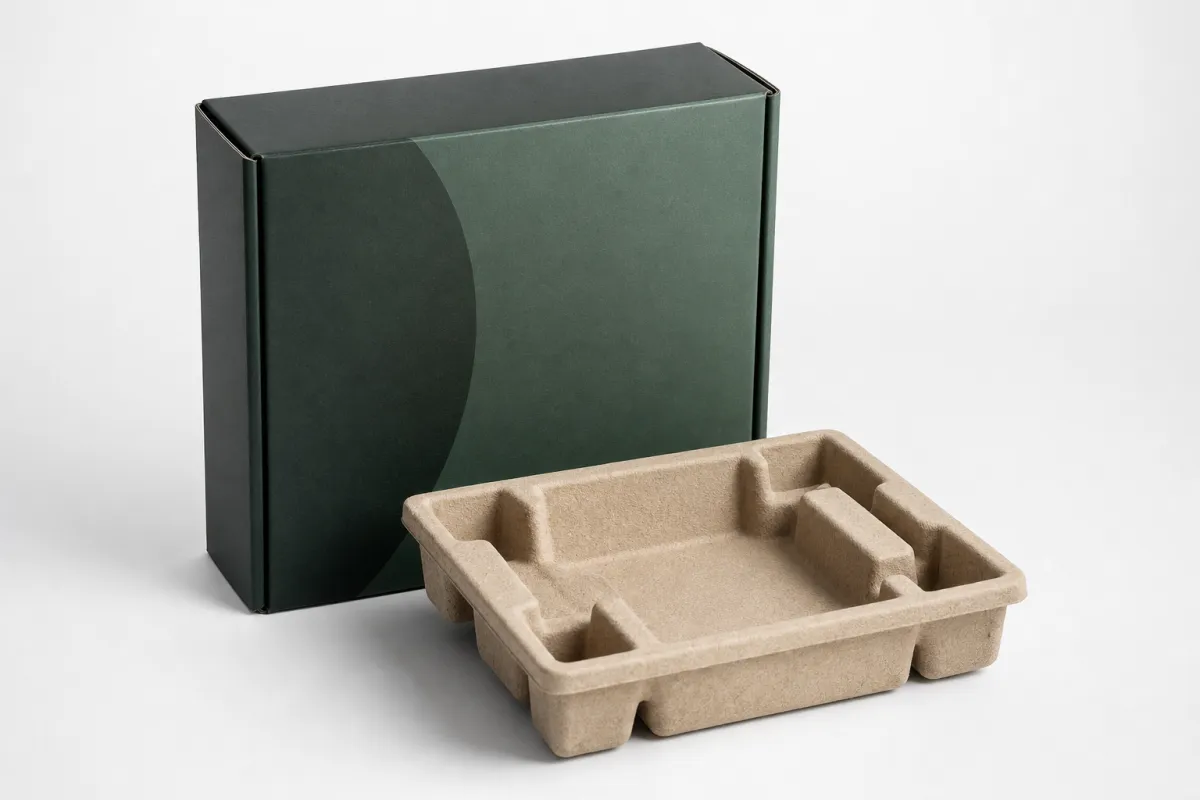
The first thing buyers notice is usually not the insert itself. It is the result of the insert. A product that used to ride safely in foam may still arrive intact, but the carton is bigger, the shipping cube is worse, and the customer has a harder time sorting the materials for recycling. Procurement teams remember that kind of detail. Molded pulp inserts wholesale can improve the whole package system, not just one part.
Cost per unit matters. No argument there. If molded pulp inserts wholesale lets the product nest tighter inside the shipper, the box can shrink. Smaller box, lower freight charge, less dunnage, cleaner pack-out. On a run of 25,000 units, a few grams saved per pack and a little less air in the carton can turn into real money. That is not theory. It shows up on invoices.
Buyers also watch line speed. A good insert should drop into the carton cleanly, hold the item without fiddling, and survive the handoff from filling station to seal line. If the operator has to press, twist, or re-seat the product, the line is gonna complain. The insert may pass a lab test and still slow the floor. In molded pulp inserts wholesale programs, labor is part of the bill.
The customer-facing side matters too. Unboxing is not decorative fluff. It changes how the product feels in the hand, how premium the kit looks, and whether the packaging feels intentional or lazy. A well-designed fiber insert reads as structured, not flimsy. That matters in cosmetics, electronics, beverage gift sets, and subscription kits where first impressions carry a lot of weight.
Wholesale buyers also care about repeatability. A sample can look great. A 30,000-piece run can behave differently if the tool is unstable or the fiber mix shifts. That is why molded pulp inserts wholesale needs a program mindset. The goal is not one approved sample. The goal is an insert that runs the same way in the second order, the fifth order, and the holiday panic order.
At a strategic level, the question gets pretty plain: does the insert support the product, the packaging line, and the sustainability claim at the same time? If not, the price is lying to you. If yes, molded pulp inserts wholesale starts to look cleaner than foam or loose-fill alternatives.
Product Options for Molded Pulp Inserts Wholesale Orders
There is no single molded pulp format that fits every product. Tray inserts, corner blocks, end caps, cavity supports, lid liners, and full cradles each solve a different problem. In molded pulp inserts wholesale buying, the shape should follow the product geometry first, then the shipping profile, then the brand presentation.
Tray inserts work well for flat or stable items. Corner blocks handle edge protection and show up often in electronics or framed products. End caps are handy when a product needs shock isolation at both ends, like bottles or handled tools. Full cradles are the most product-specific option, and they usually make sense when the item is expensive, fragile, or visually central to the package. If the product is doing heavy lifting for the brand, the insert should not look like an afterthought.
Fiber selection matters just as much as shape. Recycled fiber can fit well when the buyer wants a utility finish, lower raw material intensity, and a straightforward sustainability story. Virgin fiber usually gives better surface consistency, a cleaner look, and a more uniform wall profile. In molded pulp inserts wholesale projects, recycled and virgin fiber are not moral trophies; they are performance and appearance choices.
| Insert Type | Typical Wholesale Unit Range | Best Fit | Practical Notes |
|---|---|---|---|
| Dry-formed recycled tray | $0.08-$0.16 | Simple products, utility packaging, nested cartons | Good for volume, but finish and edge detail are more limited |
| Wet-pressed premium cradle | $0.16-$0.32 | Cosmetics, electronics, gift sets, retail-facing kits | Smoother surface, tighter detail, stronger presentation value |
| Custom cavity support with ribs | $0.14-$0.28 | Fragile glass, jars, small appliances, value-added sets | Better load distribution when the product has clear pressure points |
| End cap or corner block system | $0.10-$0.22 | Ship-ready protection for larger secondary cartons | Often easier to pack than a full cradle, especially for multiple SKUs |
Wet-pressed and dry-formed pulp follow different manufacturing paths. Wet-pressed parts usually deliver a smoother finish, sharper detail, and better dimensional precision, which is why they show up in premium retail packaging more often. Dry-formed parts are generally faster to produce and can be more economical for higher volume utility work. For molded pulp inserts wholesale, that manufacturing split affects both price and fit.
Product category should drive the design. Glass bottles need impact absorption and stable contact points. Cosmetics need presentation and a surface that does not pick up lint or shed fiber. Electronics need snug fit and clear cable or accessory separation. Subscription kits need stackability and a pack-out sequence that lets operators work quickly. The right molded pulp inserts wholesale design is less about a generic tray and more about how the product moves under handling.
Custom features can push the design further without making it fussy. Buyers often request deeper cavities, raised ribs, product nesting channels, molded branding, carton-specific contours, or a slightly offset pocket to speed insertion. Those details look small on paper, but they affect line speed and customer perception. In practice, molded pulp inserts wholesale programs improve most when the insert is tailored to the carton, not just the product.
For buyers managing a broader packaging mix, it helps to review Wholesale Programs alongside the insert spec. That keeps the packaging strategy aligned with the carton, any outer protection, and the order volume forecast instead of treating each piece like it lives alone.
Molded Pulp Inserts Wholesale Specifications That Matter
Before quoting molded pulp inserts wholesale, the supplier needs hard dimensions. Product length, width, height, weight, and the fragile zones all matter. So does the carton size. A design that protects a product in a 260 mm box may fail in a 245 mm box because the clearance and compression profile change. Buyers who send only a product photo usually get vague pricing back. Not because suppliers are being difficult, but because the missing data leaves too much room for guesswork.
The best specs tie back to performance, not just appearance. Compression resistance, vibration control, drop protection, humidity tolerance, and acceptable product movement should be discussed early. If the item can shift more than a few millimeters in transit, field damage risk climbs. For molded pulp inserts wholesale, tolerance is not a footnote; it is a cost factor.
That said, not every project needs aerospace precision. Some products are fine with a little more give, especially if the outer shipper is strong and the transit lane is short. Other products need a tighter cavity because the failure point is not the carton wall but a glass neck, a printed finish, or an internal component that cannot take load. The right molded pulp inserts wholesale spec depends on the product, the route, and the damage tolerance.
Quality and appearance checks should be written down too. Buyers usually want to know about edge integrity, dust or fiber shedding, color consistency, odor, stackability, and whether the part needs a utility finish or a premium retail look. If the insert will sit in a visible opening box, the surface has to look intentional. If it will live inside a corrugated shipper, finish can be more functional. In both cases, molded pulp inserts wholesale should be defined by the end use, not by a generic material description.
Documentation is another place where good programs separate from guesswork. Ask for material composition, recycled content claim, sampling photos, test results, and the recycling guidance you may need for retail partners. If a customer-facing sustainability claim matters, it is better to support it with recognized documentation than with broad language that sounds nice but cannot be verified. For fiber sourcing, many buyers also ask whether a chain-of-custody claim is available through FSC.
Testing standards help frame expectations. Many teams rely on current transit testing methods from ISTA when they want a more structured drop or vibration plan, especially for e-commerce and mixed distribution paths. That does not mean every insert must pass the same level of testing. It means the test should match the shipping risk. A carton riding parcel networks does not face the same hazards as a palletized B2B lane.
If you want a practical shortlist, lock these items before you request a formal quote for molded pulp inserts wholesale:
- Product dimensions, weight, and center of gravity
- Carton internal dimensions and wall style
- Fragile points that must never take direct load
- Target order quantity and reorder forecast
- Required look: utility, retail, or premium
- Testing target, if any, such as drop, vibration, or compression
Molded Pulp Inserts Wholesale Pricing, MOQ, and Quotes
Pricing for molded pulp inserts wholesale is driven by more than raw fiber. Tooling complexity, cavity count, press method, wall thickness, finish level, and part size all affect the number on the quote. A simple nested tray with existing tooling will usually price better than a new wet-pressed cradle with multiple deep pockets and molded branding.
The MOQ is usually not arbitrary. It reflects setup time, mold amortization, line efficiency, and the need to palletize and ship product without wasting freight space. If a supplier says the floor is 5,000 pieces, that usually means the economics below that point are thin. In molded pulp inserts wholesale, lower quantities are possible, but they often bring a higher unit cost or a tooling surcharge.
Buyers should compare quotes on a landed basis, not a headline basis. A low unit price can get eaten by expensive tooling, higher freight, slower lead time, or added sample fees. The fairest comparison is total program cost: unit price, tooling, freight, approval cycles, and the cost of changes. Molded pulp inserts wholesale gets much easier to manage when all of those numbers sit on the same sheet instead of floating around in separate emails.
Here is a practical pricing view that many buyers use as a starting point, not a promise. Exact numbers move with volume and complexity, but the range helps anchor expectations:
| Program Type | Typical MOQ | Tooling Range | Indicative Unit Range | Notes |
|---|---|---|---|---|
| Standard shape, existing tool | 3,000-10,000 | $0-$800 | $0.07-$0.15 | Fastest path if the geometry already exists |
| Modified standard tool | 5,000-15,000 | $800-$2,500 | $0.10-$0.22 | Good when fit needs adjusting but the base design is close |
| Fully custom mold | 10,000-30,000 | $1,500-$8,000+ | $0.12-$0.35+ | Best for fragile, branded, or highly specific product formats |
Those ranges matter because they show the tradeoff clearly. A fully custom insert may cost more upfront, but it can reduce damage, trim packing labor, and improve the carton size. That is where molded pulp inserts wholesale often beats a cheaper-looking option. The cheapest insert is not always the cheapest package.
As volume rises, unit cost usually falls, but only if the design stays stable. A reorder with the same carton, same product, and same spec can be very efficient. A reorder with a different bottle cap height, a new accessory, or a carton redesign can force a new cavity or a tool adjustment. In molded pulp inserts wholesale, stability is savings.
Watch for hidden costs too. Rush production can add a premium. Re-sampling after a dimensional change can create extra charges. Artwork or embossing changes may require a revised mold face. Even a small shift in carton size can trigger a redesign if the clearance is too tight. The more a buyer treats molded pulp inserts wholesale as a controlled specification, the fewer surprises show up later.
One more point many teams miss: freight and pallet density can matter as much as the insert price. If a design nests efficiently, the supplier can ship more parts per pallet and inbound economics improve. If the insert has deep cavities that trap air, freight cost rises. Molded pulp inserts wholesale should be judged by what it does to the whole carton program, not just the insert line.
From Sampling to Shipping: Process and Timeline
The process usually starts with an RFQ, but the best projects do not really start there. They start with clean inputs: product dimensions, carton size, weight, photos from multiple angles, forecast volume, and any drop or transit requirements. The more complete the brief, the faster molded pulp inserts wholesale moves through design review.
A typical workflow looks like this:
- Request for quote and technical review
- Fit check or design recommendation
- Prototype or sample development
- Buyer approval and revision cycle, if needed
- Mold build or tool adjustment
- Pilot run and dimensional check
- Production and shipment
Timing depends on whether tooling already exists. If the insert is a minor adaptation of an existing shape, the path can move quickly. If a new mold is required, a reasonable planning window is often several weeks longer. For molded pulp inserts wholesale, simple projects can sometimes move from approval to production in roughly 12-15 business days once the proof is signed off, while fully custom builds may take 25-45 business days or more depending on sampling and queue position.
What slows things down? Unclear dimensions. Last-minute product changes. Waiting too long to approve the sample. A carton that is still being redesigned while the insert is already in motion. These are the usual delay points because they force the supplier to pause or rework the tool path. In molded pulp inserts wholesale, speed comes from disciplined inputs, not from pressure alone.
Good suppliers will also talk about nesting efficiency and pack-out method before the run goes live. That sounds basic, but it saves a lot of trouble. If the insert stacks poorly, the packing team pays for it. If the sample passes visually but not under load, the buyer pays for it later. Molded pulp inserts wholesale should be validated as a production process, not only as a sample approval. A pretty prototype is nice. A repeatable one is better.
For programs that need a broader packaging plan, it often helps to align the insert schedule with the larger purchasing cycle through custom wholesale packaging programs. That keeps the carton, insert, and outer shipper moving together instead of forcing one component to sit around waiting on another.
Why Choose Us for Custom Packaging Programs
Custom Logo Things works like a packaging partner, not just a part seller. That matters because molded pulp inserts wholesale usually touches more than procurement. Operations cares about line speed. Finance cares about landed cost. Quality cares about damage rates. Marketing cares about how the package feels in the hand. A useful supplier has to keep those conversations pointed in the same direction.
The big advantage of a well-run wholesale program is consistency. When specs are clear and the supply plan is repeatable, the buyer spends less time explaining the same requirements over and over. That lowers rework and cuts friction across teams. For molded pulp inserts wholesale, consistency is not a nice extra; it is part of the value.
Quality control should be built into the process. Sample approval, dimensional checks, and load or drop validation protect the buyer from field problems that are expensive to fix later. The exact test plan depends on the product, but even a simple drop sequence can reveal whether the cavity support is centered correctly or whether the item has too much play. In molded pulp inserts wholesale, a good sample is not enough if the production lot cannot match it.
There is also a real difference between a direct packaging team and a low-touch broker model. When engineering and production are easier to reach, questions get answered faster and design mistakes surface earlier. That matters on a launch schedule. A buyer trying to coordinate carton art, assembly instructions, and insert fit does not need more handoffs. Molded pulp inserts wholesale programs work better when communication is direct and specific, with fewer games and fewer surprises.
From a buyer’s perspective, the business case often comes down to risk. The right design can cut damage claims, make warehouse labor more predictable, and support a better presentation without pushing the package into over-engineered territory. That is why smart teams treat molded pulp inserts wholesale as an operational improvement, not just a material swap.
If you are weighing packaging suppliers, ask for three things: a clear spec response, a realistic timeline, and a quote that separates tooling from unit pricing. Those details show how much control the supplier really has over the program. For buyers who want a structured starting point, molded pulp inserts wholesale is easier to approve when the numbers are transparent.
Next Steps to Order Molded Pulp Inserts Wholesale
The fastest way to get an accurate quote is to send a complete package brief. That should include product dimensions, weight, carton size, quantity forecast, target ship date, and any drop or transit expectations. If possible, include CAD files, a product sample, or at least photos from several angles. Molded pulp inserts wholesale pricing gets tighter when the supplier can measure against something real instead of trying to guess from a single product photo.
Decide early whether standard tooling or custom tooling makes more sense. That choice Drives the Cost structure, the timeline, and the room you have for design tweaks. If the product is still changing, a highly specific tool may be premature. If the product is stable and high value, custom design can pay back quickly. In molded pulp inserts wholesale, the right tool strategy is usually the one that matches the launch stage, not the one that sounds most impressive in a meeting.
Compare at least three quotes using the same specification set. Do not mix one supplier’s recycled fiber tray with another supplier’s premium wet-pressed cradle and call it a fair comparison. Ask each supplier to quote the same dimensions, same quantity, same finish expectation, and same test target. Then look at unit price, tooling, lead time, freight, and reorder stability together. That is how molded pulp inserts wholesale becomes a rational buying decision instead of a guess.
Request a sample or pilot run before committing to full volume, especially for fragile, premium, or newly redesigned products. A good sample should tell you more than whether the item fits. It should show how the part nests, how it stacks, how it feels during pack-out, and whether the carton still closes cleanly. If the sample reveals a problem, fix it before the wholesale order locks in. That is the cheapest time to make a change.
Here is the shortest possible buyer checklist for molded pulp inserts wholesale:
- Send product dimensions, weight, and fragile points
- Share carton size and expected ship method
- State the quantity forecast and reorder pattern
- Specify whether the look must be utility or retail-ready
- Request timing for samples, tooling, and first shipment
For Custom Logo Things, the next step is straightforward. Send the product details, carton dimensions, and forecast volume, and ask for a quote built around your actual packaging line. If the program is a fit, molded pulp inserts wholesale can tighten freight, simplify packing, and give the product a cleaner presentation without turning the package into a science project.
FAQ
What is the typical MOQ for molded pulp inserts wholesale?
The MOQ depends on whether the design uses existing tooling, a modified standard tool, or a fully custom mold. Smaller runs are usually easier when the geometry is already close to an existing part, while custom programs often need a higher starting quantity to offset setup and tooling costs. The best way to compare options is to ask for tiered pricing so you can see how the unit cost changes at 5,000, 10,000, and 25,000 pieces. That gives you a much clearer picture than a single number in isolation.
Are molded pulp inserts wholesale orders strong enough for fragile products?
Yes, if the design is engineered around the product's weight, drop risk, and carton size. Fit is the deciding factor. The product should be cradled, not floating, and the vulnerable points should be supported by the cavity design. For glass, electronics, and premium kits, ask for sample testing before approving production so the insert can be checked under realistic handling conditions.
How long does a custom molded pulp inserts wholesale project take?
Timing depends on whether tooling already exists and how many approval rounds are needed. Projects move fastest when product dimensions, carton size, and target quantity are ready at the start. If new tooling or performance testing is required, build extra time for sample review, revisions, and production scheduling. A simple adaptation may move in a few weeks; a fully custom program usually needs more planning room.
Can molded pulp inserts wholesale orders be branded?
Yes. Branding options often include embossing, debossing, molded-in logos, or labels added at pack-out. Bring that request up early because branding can affect tooling design and sample approval. If the package needs a premium look, ask for finished sample photos before production starts so the surface detail and logo placement can be checked in advance.
What should I send for an accurate molded pulp inserts wholesale quote?
Send product dimensions, weight, carton size, quantity, shipment destination, and photos from multiple angles. Include any drop-test, transit, or retail presentation requirements so the supplier can quote the right structure. If possible, share CAD files or a sample part so fit can be checked before pricing is finalized. The more concrete the brief, the fewer surprises in the quote.
For buyers who want packaging that protects the product, supports the line, and keeps the supply chain cleaner, molded pulp inserts wholesale is a serious option. The best results come from clear specs, realistic timing, and a quote that reflects the whole program, not just the insert itself. Send the dimensions, carton size, and forecast now, then compare the sample, the lead time, and the landed cost side by side. That is the practical way to buy it.