Buyer Fit Snapshot
| Best fit | Custom Mushroom Fiber Inserts for Sustainable Packaging projects where brand print, material claims, artwork control, MOQ, and repeat-order consistency need to be specified before quoting. |
|---|---|
| Quote inputs | Share finished size, material target, print colors, finish, packing count, annual reorder estimate, ship-to region, and any compliance wording. |
| Proofing check | Approve dieline scale, logo placement, barcode or warning zones, color tolerance, closure strength, and carton packing before bulk production. |
| Main risk | Vague material claims, crowded artwork, missing packing details, or unclear freight terms can make a low unit price expensive after revisions. |
Fast answer: Custom Mushroom Fiber Inserts for Sustainable Packaging should be specified like a repeatable production item. The safest quote records material, print method, finish, artwork proof, packing count, and reorder notes in one written spec.
Production checks before approval
Compare the actual filled-product size with the drawing, then confirm tolerance on folds, seals, hang holes, label areas, and retail display edges. Reserve space for logos, QR codes, warning copy, and material claims before decorative graphics fill the panel.
Quote comparison points
Review material grade, print process, finish, sampling route, tooling charges, carton quantity, and freight assumptions side by side. A quote is only useful when the supplier can repeat the same color, closure quality, and packing count on the next order.
Custom Mushroom Fiber Inserts for Sustainable Packaging have attracted serious attention for a practical reason: they can protect fragile products without relying on plastic-heavy dunnage, and they give brands a sustainability story that survives contact with operations, not just a slide deck. The strongest case for custom mushroom fiber inserts is not simply the material itself. It is the way the insert can be grown and shaped around a specific product, which changes how a package behaves in transit and how it feels when a customer opens the box.
I have seen packaging teams underestimate that difference more than once. A carton can look perfectly composed on a sampling table and still fail after a vibration test, a corner drop, or a week in a warehouse with uneven humidity. In one audit I reviewed, a cosmetic set that passed visual checks still came back with scuffed caps because the insert allowed just enough movement to turn a short shipment into a long problem. Custom mushroom fiber inserts deserve the same scrutiny as any engineered component.
That matters whether the shipment contains a glass bottle, a premium cosmetic jar, or a compact electronic device. For brands comparing Custom Packaging Products, the useful question is not whether this can replace foam in theory. The better question is where it fits, what it protects, and what the full cost looks like once returns, damage, labor, and presentation are counted together.
What Are Custom Mushroom Fiber Inserts?
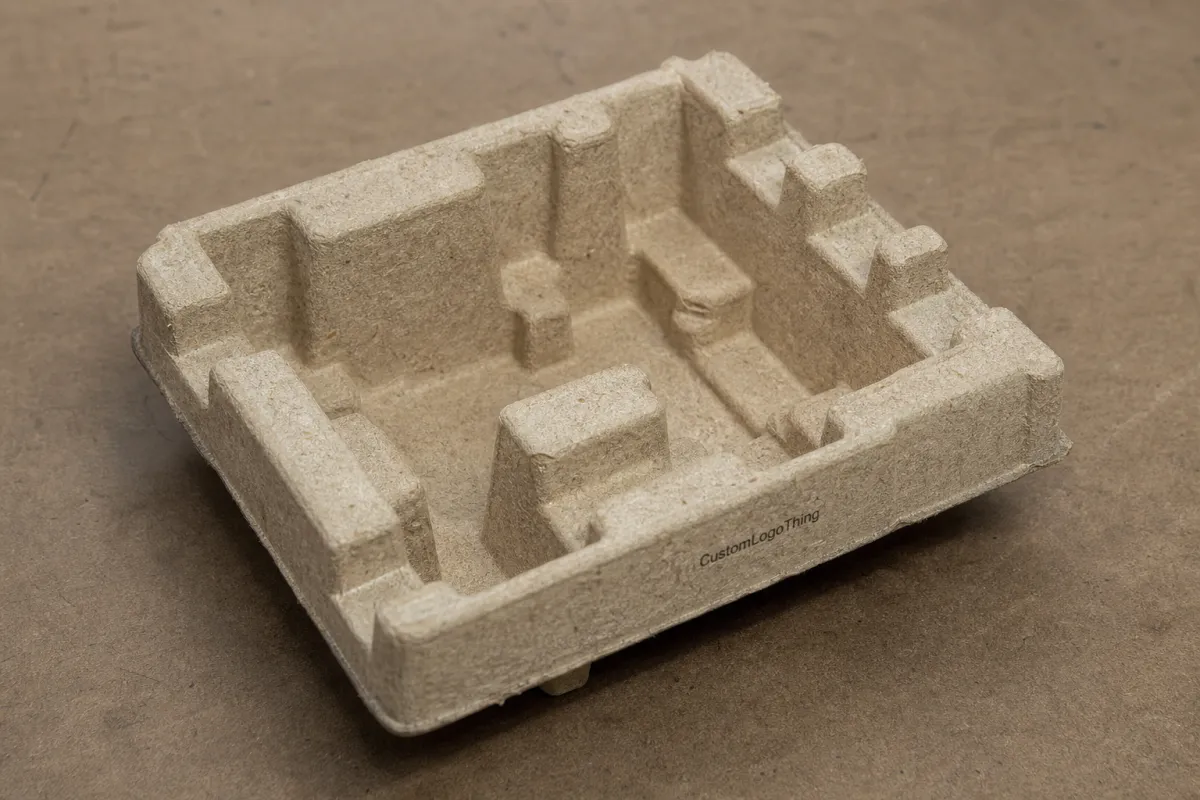
Custom mushroom fiber inserts are usually made from mycelium, the root-like network of fungi, combined with a natural substrate such as hemp hurd, sawdust, or other agricultural byproducts. The material grows inside a mold, which means the finished part takes on the shape needed to cradle a specific product instead of being cut down from a generic sheet later. That distinction is not cosmetic. It changes how the insert carries load, manages impact, and fits into the carton.
Strictly speaking, the material is not "mushroom fiber" in the way people talk about cotton or cellulose. It is a mycelium-based composite. The term has become common in packaging, but the underlying process matters more than the label. Mycelium acts as a natural binder, and the substrate provides the body. After growth, the part is dried or heat-cured so the structure becomes rigid enough for shipping.
Fit drives performance. A loose insert can look tidy and still let a bottle chatter inside the box. A well-made set of custom mushroom fiber inserts holds the product where it belongs, especially around shoulders, corners, lids, and other weak points. Sometimes that secure fit is more valuable than adding extra bulk.
Molded pulp is the closest material comparison. Both use natural feedstocks, and both can support sustainability goals. Custom mushroom fiber inserts often have a more sculpted, grown structure and can be tuned for presentation as well as protection. They sit in an interesting middle ground in sustainable packaging: less plastic, a stronger natural-material signal, and a tactile finish that feels intentional rather than generic.
That tactile quality should not be dismissed. Premium retail packaging often wins or loses attention in the first few seconds. A plain EPS block may protect well, but it communicates a very different message than custom mushroom fiber inserts placed inside a printed carton with restrained graphics and a clear package branding system. The same product can feel commodity-grade or carefully engineered depending on the insert and the surrounding pack.
Here is the test I keep returning to: if a product is fragile, dense, or visually expensive, the insert has to do three jobs at once. It needs to immobilize the item, absorb shock, and carry part of the brand story without shouting. Custom mushroom fiber inserts can do that when the geometry is right. They are not the answer for every shipper, but they are a serious option when unboxing matters almost as much as transit performance.
If you are comparing options across branded packaging and product packaging programs, think of these inserts as a protective component with a material signal attached. They sit between molded pulp and foam, offering more shape control than standard loose-fill and a better eco narrative than many plastic-based alternatives. That is why they keep showing up in conversations about retail packaging and premium Custom Printed Boxes.
How Custom Mushroom Fiber Inserts Work
The mechanics behind custom mushroom fiber inserts are straightforward once you separate them into stages. Mycelium grows through the substrate and ties the material together. A mold defines the outer shape and the internal cavities. After growth, the insert is dried or cured so it becomes stable enough for shipping and handling.
The mold stage is where most of the value is created. Weak designs start with a vague "close enough" cavity. Strong designs start with the product's real failure points: the shoulder of a glass container, a protruding lens, a sealed cap, a fragile base, or a charging port that cannot tolerate pressure. That is where custom mushroom fiber inserts outperform generic filler. They are built around the product, not around a guess.
Finishing comes next. The insert may be trimmed, cleaned, and inspected for consistency. That sounds routine, yet it separates a prototype from a production-ready part. A few millimeters of variation in cavity depth or edge density can change how securely the item sits. In a tight carton, that difference is not cosmetic.
Protection comes from controlled contact. Custom mushroom fiber inserts limit movement, spread compression over a wider surface area, and absorb impact forces before they reach the product. Compared with foam, which can rebound differently depending on density, or corrugated partitions, which rely heavily on carton rigidity, mushroom fiber behaves like a molded shell with a natural texture and a more organic crush profile.
For a standards-based view, this is where testing matters. Packaging teams often refer to ISTA protocols or ASTM distribution methods because a drop from 90 cm does not care how elegant the insert looks on the bench. The International Safe Transit Association offers a practical testing framework, and that mindset matters here: appearance is not proof. Performance under vibration, edge drop, and compression is proof.
Put differently, custom mushroom fiber inserts only work as part of a system. If the outer carton is oversized, the insert has too much travel to manage. If the carton walls are weak, the insert cannot save the package alone. If the product is top-heavy, the center of gravity can work against the design. Insert, carton, and closure need to be designed together.
That is why many packaging engineers compare these inserts to molded pulp and foam, but not as equals. Molded pulp is often economical and familiar. Foam can be light and precise. Custom mushroom fiber inserts sit in a different category: they are chosen when the brand wants a lower-plastic alternative with a tactile finish, a premium feel, and a story rooted in materials rather than copywriting.
Key Factors That Shape Fit, Protection, and Sustainability
Good custom mushroom fiber inserts start with product data, not taste. The most useful inputs are weight, dimensions, fragile zones, finish sensitivity, center of gravity, and the actual carton size. A product that measures 120 mm tall on a spec sheet can behave very differently once you add a cap, sleeve, or accessory that shifts the balance point upward.
One common design mistake is treating fit as a simple dimensional exercise. It is not. The real challenge is identifying where the product will fail if the box is dropped on an edge, compressed in a pallet stack, or shaken repeatedly over a long lane. Custom mushroom fiber inserts should be designed from the failure points inward. That may mean reinforcing corners more than flat faces, or creating a deeper nest at the base than around the shoulders.
Climate matters too. Humidity can affect natural fiber materials, especially in storage or on humid shipping routes. Compression can also change performance if the pack sits under load before use. Custom mushroom fiber inserts are not magic, and they should not be treated that way. They still need realistic conditioning, especially if they will sit in a warehouse for weeks before assembly or travel into high-humidity regions.
Sustainability claims need the same discipline as protection claims. If the insert is marketed as compostable, ask where that claim is valid and what certification supports it. The EPA recycling and materials guidance is a useful reminder that end-of-life outcomes depend on local infrastructure, not on intent alone. Backyard compostability, industrial compostability, and recyclability are not interchangeable terms, even when marketing copy tries to blur them.
For brands using custom mushroom fiber inserts in premium retail packaging, the visual effect can be a real advantage. A natural surface can make the unboxing feel warmer and more deliberate, especially when paired with custom printed boxes, restrained graphics, and a clear package branding system. The insert becomes part of the narrative, not a hidden engineering detail.
There is a risk in romanticizing the material too much. If the product is delicate but inexpensive, the sustainability narrative may matter less than damage control and unit economics. If the insert looks beautiful but adds too much clearance or too much cost, it stops being a smart choice. The right answer depends on the product, the shipping lane, and customer expectations.
A practical way to sort the use cases looks like this:
- Fragile glass or ceramics: prioritize immobilization and corner support.
- Cosmetics and skincare: prioritize presentation, finish protection, and leak control.
- Electronics: prioritize shock absorption, anti-movement fit, and accessory organization.
- Gift and retail sets: prioritize the unboxing experience and package branding.
Once those variables are mapped clearly, custom mushroom fiber inserts stop looking like a trendy substitute and start acting like a precise tool. That difference separates a good packaging decision from a costly experiment that looks clever until the first damage report lands.
Process and Lead Time: From Brief to Production
The process for custom mushroom fiber inserts usually begins with a product brief. A strong brief includes finished dimensions, product weight, fragile zones, the desired carton size, and the shipping method. If the item has a final retail sleeve or accessory set, include that too. The more exact the inputs, the fewer revision rounds you will need.
From there, the supplier or packaging engineer typically moves into CAD review, mold planning, and sample development. Depending on the cavity complexity, the insert may require a new tool or a modified existing one. That is where lead time starts to diverge. Repeat orders can move quickly. New custom projects usually take longer because the geometry has to be proven.
In a typical new project, the sequence looks like this:
- Receive the final product sample or a precise CAD file.
- Review the carton size and closure method.
- Design the cavity and support ribs.
- Produce prototype samples for fit testing.
- Run drop, vibration, and compression checks.
- Approve the production mold and begin the run.
- Inspect, trim, pack, and ship.
Turnaround is often faster when the buyer provides a real product sample instead of a placeholder. That sounds obvious, but it saves time because custom mushroom fiber inserts depend on exact contour data. A product that looks simple in a drawing can hide taper, raised edges, or an uneven base that changes the insert geometry.
Delays usually show up in predictable places. Teams send incomplete measurements. The product changes after sample approval. The shipping carton gets resized halfway through the project. Or the packaging team and the product team work from different spec sheets. Each of those can add days, sometimes weeks. For custom mushroom fiber inserts, the simplest path is to lock the product and carton first, then test the insert against both.
A realistic timeline depends on complexity and capacity, but buyers often think in two phases: sample development and full production. Sample development may take a few rounds if the cavity is intricate, while production becomes steadier once the mold is confirmed. If the supplier already has a similar mold and the order size is healthy, lead time becomes more predictable. If everything is new, plan for extra review time.
I would also add one caution from experience: do not approve a sample based only on a hand fit. A product that slips in beautifully on a workbench can still fail once the outer carton is taped, stacked, and shipped. The full pack matters more than any one part of it. That is a small lesson with expensive consequences if ignored.
Cost and Pricing for Custom Mushroom Fiber Inserts
Pricing for custom mushroom fiber inserts is shaped by a short list of variables: mold complexity, unit size, material volume, finishing requirements, and order quantity. If a new tool must be made, that cost sits up front. If the geometry is simple and the order is large, unit price usually improves. That pattern holds in most custom packaging, but it matters more here because growth, curing, and trimming all need tight control.
As a planning range, many buyers will see sample or prototype costs in the low hundreds to low thousands depending on tool requirements, while production units can vary widely by size and volume. For a mid-sized retail insert in a run of 5,000 units, a realistic range might land around $0.18-$0.45 per unit, with simpler forms near the lower end and more intricate cavities near the upper end. That is not a quote. It is a working bracket. Custom mushroom fiber inserts are sensitive to geometry and order size, so every project needs a real estimate.
The trap many teams fall into is comparing insert price alone. That misses the full pack cost. If custom mushroom fiber inserts reduce damage, cut return rates, or improve presentation enough to support a higher conversion rate, the unit price stops being the right metric. A slightly more expensive insert can still lower total cost if it prevents breakage or strengthens the retail packaging experience.
| Option | Typical Unit Cost Range | Protection Profile | Sustainability Story | Best Use Case |
|---|---|---|---|---|
| Custom mushroom fiber inserts | $0.18-$0.45 | Strong shape-specific support, good immobilization | Low-plastic, natural fiber narrative, compostability depends on formulation | Premium retail packaging, fragile products, brand-led launches |
| Molded pulp | $0.12-$0.30 | Good general protection, especially for standard shapes | Well-known fiber solution, often strong recycling story | High-volume shipping and simpler product geometries |
| EPE foam | $0.10-$0.22 | Light, resilient, good shock absorption | Plastic-based, weaker sustainability narrative | Cost-sensitive protection where material weight matters |
| Corrugated inserts | $0.08-$0.20 | Works well when the carton is rigid and the product is stable | Recyclable in many markets, simple material stream | Flat-pack, modular, or lower-fragility products |
The table is useful, but it still leaves out freight, warehousing, and assembly. If an insert arrives nested efficiently, stores easily, and speeds up pack-out, that can matter as much as per-unit cost. A packaging line that saves thirty seconds per pack across 20,000 units creates real labor value. Custom mushroom fiber inserts can help there if the shape is efficient and the fit is consistent.
Presentation is another cost variable. Premium packaging often justifies a higher insert cost because the insert is visible at the moment of unboxing. If the product is sold through direct-to-consumer channels, package branding and product packaging carry more weight than they do in a bulk shipment. In that setting, custom mushroom fiber inserts can be part of the perceived value of the product itself.
When you request pricing, ask for a quote that separates sample cost, tooling, per-unit cost, freight, and any assembly charges. If the supplier can also state what testing is included, even better. Comparing quotes becomes far easier when the numbers are not buried in a single lump sum.
I keep seeing packaging teams ask the wrong question. They ask, "What is the cheapest insert?" The better question is, "What is the lowest-risk total system that still matches the brand?" That is where custom mushroom fiber inserts become interesting, because they can support protection and perception at the same time when the project is scoped properly.
Common Mistakes When Specifying Mushroom Fiber Inserts
The biggest mistake is measuring only the product, not the full shipping system. The outer carton, the closure, the secondary wrap, and the headspace all affect final fit. If the product sits perfectly in the insert but the insert floats in the box, the system still fails. Custom mushroom fiber inserts need to be designed against the actual carton, not just the object in isolation.
Another mistake is assuming that compostable means universally disposable. It does not. Disposal depends on local facilities, contamination, and the exact material blend. Many brands want simple sustainability messaging, but simple messaging can turn misleading quickly. If you are going to use custom mushroom fiber inserts in customer-facing packaging, give end-of-life instructions that are accurate and specific.
Testing is often underdone. Teams approve a sample because it looks beautiful on a desk, then discover that the item shifts under vibration or the insert compresses too much after a drop. That is why ISTA or ASTM-style testing is so useful: it replaces guesswork with repeatable evidence. If your packaging line includes custom printed boxes or other branded packaging elements, test the complete pack, not just the insert by itself.
Overbuilding is another subtle problem. Too much cavity clearance creates movement, and movement creates damage. A designer can make the insert look airy and premium while quietly increasing risk. With custom mushroom fiber inserts, the sweet spot is usually a snug fit with enough tolerance to handle production variation, not a loose nest with a lot of visual margin.
Some teams also underestimate documentation. Sustainability claims need records, not just intent. If the insert is described as compostable, recyclable, or made from agricultural waste, those claims should be backed by supplier data, certifications, or material statements. That matters even more when the insert appears in product packaging copy or retail packaging signage.
One more mistake shows up in meetings rather than on the line: treating packaging as a last-step decoration. Once the shipping method is fixed, the carton is chosen, and the insert is already late to the conversation, the options narrow fast. A better sequence is to design the protective interior at the same time as the outer pack. That is where custom mushroom fiber inserts can do their best work.
"A beautiful insert that breaks in transit is just expensive decoration. A plain insert that protects every shipment is often the smarter package."
That quote matters because packaging decisions often turn emotional fast. Brand teams want elegance. Operations teams want reliability. Finance wants predictable unit cost. Custom mushroom fiber inserts can satisfy all three only when the requirements are defined clearly before tooling starts.
Expert Tips and Next Steps for Your Packaging Line
Start with a product spec sheet that includes dimensions, weight, finish sensitivity, fragile zones, carton size, and shipping method. If you have a target drop test or compression requirement, put that in writing too. Custom mushroom fiber inserts work best when the brief is specific enough to remove guesswork early.
Ask for a sample built around the final product, not a placeholder. A placeholder can hide problems, especially around tight corners or uneven surfaces. Once the real item is in the cavity, fit issues show up fast. If the product is going into premium retail packaging, the sample should also reflect the actual presentation condition, not only the transit version.
Run a small pilot before you scale. A good pilot usually includes a handful of units, warehouse handling checks, and at least one drop and vibration test. The point is not to prove the insert is flawless. The point is to find out whether custom mushroom fiber inserts are the right architecture for the job. If the system performs in a small batch, you can move toward a larger rollout with less risk.
Compare two or three design directions if the product has multiple weak points. Sometimes a slightly larger insert with better immobilization beats a tighter one that leaves one fragile component exposed. In packaging design, the cheapest concept is often not the lowest-risk option. That lesson usually arrives after returns start showing up.
If you need a broader packaging supplier conversation, use the product line as the starting point and ask how the insert will integrate with the rest of the pack. The best results usually come when the insert, the carton, and the branding are shaped together from the start. That is why custom mushroom fiber inserts can be so effective in package branding: they are functional, visible, and easy to align with a natural, premium position.
For teams building a line from scratch, a practical workflow is this: lock the product spec, select the carton format, test the insert, and only then finalize graphics. That order prevents expensive redesigns. It also keeps custom mushroom fiber inserts from becoming an afterthought when they should be one of the central engineering decisions in the pack.
If the project is high-volume, think about repeatability. If it is low-volume but high-value, think about presentation and protection together. If it is both, the conversation gets more interesting, because custom mushroom fiber inserts may justify a premium if they reduce breakage and lift the customer experience at the same time.
One more practical tip: compare the insert against your full packaging portfolio. If you already use molded pulp in one line and corrugated in another, do not assume the same logic applies here. Different products need different support systems. A strong packaging strategy usually mixes materials based on risk, cost, and brand expectation instead of forcing one material to do everything.
If you want to explore more formats, start with Custom Packaging Products and see how inserts, cartons, and branded packaging components can be paired more intelligently. That approach usually leads to better product packaging decisions than sourcing each piece separately.
For most brands, the next step is not blind commitment. It is gathering the right data, testing one or two prototypes, and asking whether custom mushroom fiber inserts solve a real shipping or presentation problem. If they do, the material earns its place. If they do not, you have learned that before scaling, which is exactly how packaging should work.
FAQ
How strong are custom mushroom fiber inserts for fragile products?
They work well for items that need shape-specific support, especially when the cavity is designed around the product's weak points. Strength depends on thickness, geometry, and how much movement the outer carton allows during transit. They should be tested with the actual product, not judged by appearance or material type alone.
How do I get an accurate quote for custom mushroom fiber inserts?
Share final product dimensions, weight, carton size, and any fragile zones that need extra support. Include your target order quantity, expected annual volume, and whether you need tooling or only sample development. Ask the supplier to separate tooling, unit cost, freight, and test samples so the pricing is easy to compare.
What is the typical lead time for custom mushroom fiber inserts?
Lead time usually depends on whether the mold already exists, how complex the cavity is, and how quickly samples are approved. Simple repeat orders can move faster than new custom projects because the design and tooling steps are already done. A clear brief and final product sample can shorten delays more than any production shortcut.
Are custom mushroom fiber inserts actually compostable?
They are designed to be compostable under the right conditions, but real-world disposal depends on local facilities and the exact material blend. Do not assume every insert can go in a backyard compost bin without checking the supplier's guidance and certifications. The safest approach is to give customers clear end-of-life instructions rather than relying on vague sustainability language.
What do manufacturers need before designing custom mushroom fiber inserts?
They usually need the product itself or a precise sample, plus dimensions, weight, and the areas that must not be crushed or scratched. They also need to know the carton size, shipping method, and whether the insert must support retail display as well as transit protection. The better the input data, the fewer revision cycles you will need before production.
For brands weighing sustainability against performance, custom mushroom fiber inserts are worth a serious look because they sit at the intersection of protection, presentation, and lower-plastic packaging strategy. The best results come from treating them as engineered components, not decorative fillers. A clean workflow helps: lock the product spec, test the insert in the real carton, verify the claims with supplier documentation, and only then approve production. If the fit is right, the test data holds, and the messaging is honest, custom mushroom fiber inserts can change how a product ships, sells, and feels in the hand.

