Buyer Fit Snapshot
| Best fit | Custom Mylar Pouches With Logo projects where brand print, material claims, artwork control, MOQ, and repeat-order consistency need to be specified before quoting. |
|---|---|
| Quote inputs | Share finished size, material target, print colors, finish, packing count, annual reorder estimate, ship-to region, and any compliance wording. |
| Proofing check | Approve dieline scale, logo placement, barcode or warning zones, color tolerance, closure strength, and carton packing before bulk production. |
| Main risk | Vague material claims, crowded artwork, missing packing details, or unclear freight terms can make a low unit price expensive after revisions. |
Fast answer: Custom Mylar Pouches With Logo: Design, Cost & Steps should be specified like a repeatable production item. The safest quote records material, print method, finish, artwork proof, packing count, and reorder notes in one written spec.
Production checks before approval
Compare the actual filled-product size with the drawing, then confirm tolerance on folds, seals, hang holes, label areas, and retail display edges. Reserve space for logos, QR codes, warning copy, and material claims before decorative graphics fill the panel.
Quote comparison points
Review material grade, print process, finish, sampling route, tooling charges, carton quantity, and freight assumptions side by side. A quote is only useful when the supplier can repeat the same color, closure quality, and packing count on the next order.
Custom Mylar Pouches With Logo: Design, Cost & Steps
A pouch can win or lose a sale in a few seconds, and the logo is only one part of that decision. Custom mylar Pouches with Logo need to do three jobs at once: protect the product, look credible from arm's length, and hold their shape well enough to signal quality before anyone even touches it. For brands selling through retail packaging, that balance matters more than a clever graphic.
I have seen plenty of strong brands stumble here. Two pouches can carry nearly identical artwork and still perform very differently on shelf. One feels crisp, seals cleanly, and has a zipper that closes with a firm, even pull. The other wrinkles at the corners, sags after filling, and makes the brand look cheaper than it is. That is why custom mylar pouches with logo are not just a print project. They are a packaging system, and the logo is only one layer of the decision.
Why custom mylar pouches with logo matter on crowded shelves
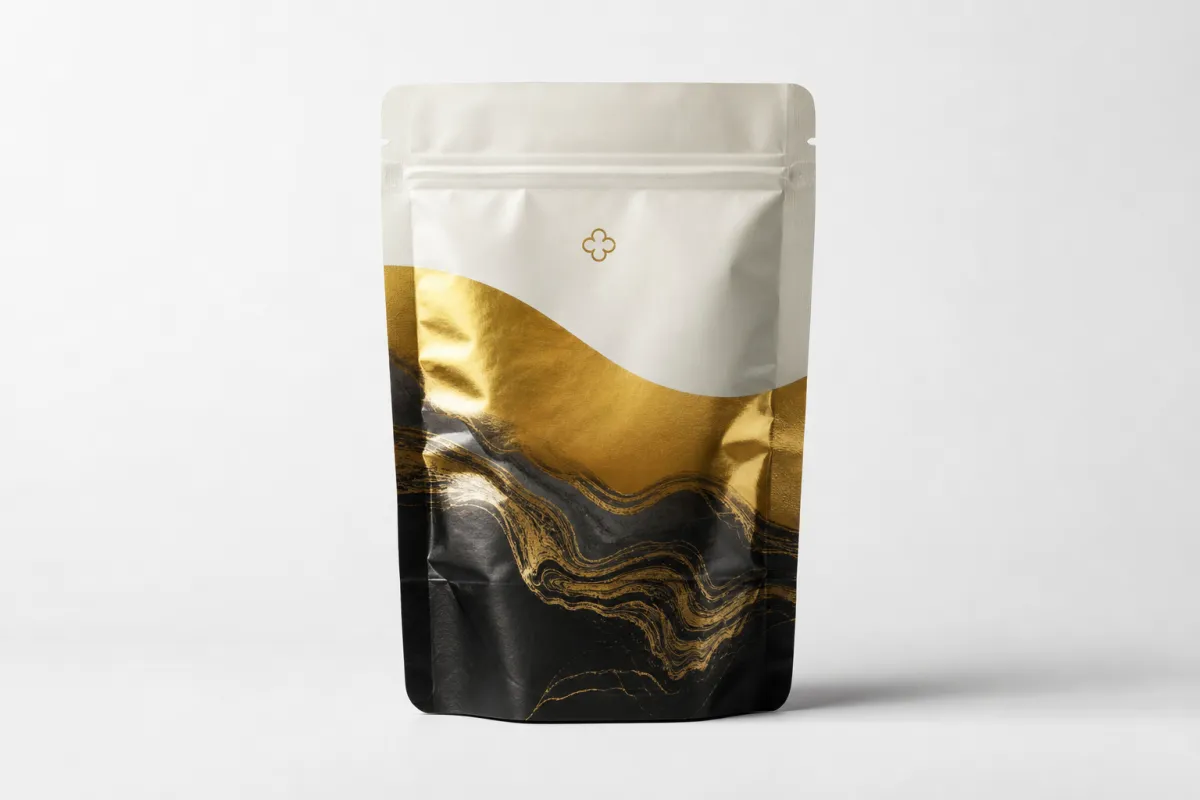
Custom mylar pouches with logo matter because shoppers do not read packaging in a calm, deliberate way. They scan. They compare silhouettes, color blocks, zipper lines, and the way a pouch stands up beside competing products. That first impression is usually built in three layers: brand recognition, structural confidence, and perceived freshness. If any one of those feels weak, the shopper hesitates.
From a packaging buyer's point of view, the logo is only the headline. Barrier protection, film feel, seal quality, and shelf shape can matter just as much. A pouch made with the wrong laminate may look fine in a mockup but flop once it is filled. A good structure can make a modest design look premium. A poor structure can make expensive artwork look flat. That is the part many teams miss when they compare custom mylar pouches with logo only on visual appeal.
Think about two snack brands with similar typography and nearly the same color palette. If one uses a thin pouch that slumps and the other uses a stand-up pouch with a crisp bottom gusset, the second brand usually wins the shelf battle. The reason is simple: package branding is not only print coverage. It is how the pack behaves in the hand, in transit, and in a retail display. A strong pouch architecture can support product packaging far better than graphics alone.
That is why I like to treat custom mylar pouches with logo as both branding and function. The pouch should protect contents from oxygen, moisture, and light as needed, while also supporting the brand story. For food, supplements, coffee, cosmetics, and specialty retail items, that balance can change the buyer's view of the product before the customer ever opens it.
A logo cannot rescue a weak pouch structure. Good packaging design starts with protection, then builds the visual story on top of that.
There is also a cost angle. Buyers sometimes assume the prettiest pouch is the most expensive one, but that is not always true. A well planned format with the right print method can outperform a more elaborate pouch that was over-specified. In practice, custom mylar pouches with logo are a purchase decision, a branding decision, and a supply chain decision all at once.
How custom mylar pouches with logo work from artwork to shelf
The basic structure of custom mylar pouches with logo usually starts with a laminated film stack. A common build might include PET on the outside for print performance, a barrier layer in the middle, and PE on the inside for sealing. Depending on the product, a supplier may swap in foil, metallized film, or a specialty layer that improves oxygen barrier or moisture resistance. If the product is sensitive to light, that outer layer matters more than many buyers realize.
One small clarification helps here: "mylar" is often used as shorthand for flexible barrier pouches, but suppliers may actually be quoting a PET/foil/PE laminate or another film combination rather than a true Mylar brand film. That does not make the pouch any less useful, but it does mean the spec sheet deserves a close read. A buyer who understands the stack-up is less likely to overpay for a feature that does not help the product.
Those film layers are only part of the story. Seal width, tear notches, zipper style, and gusset depth all affect how the pouch works in the field. A press-to-close zipper can improve repeat use, but it also adds cost and another production step. Tear notches help with opening, yet they need proper placement so the pouch opens cleanly without damaging the seal. If you are planning custom mylar pouches with logo, the structure should be specified before the artwork is finalized.
Artwork prep is where many projects stay organized or drift into avoidable revisions. Designers usually need a dieline, bleed area, safe zone, and file format that supports sharp edges. Vector artwork is best for logos because it scales cleanly; raster files can work for photos or textures if the resolution is high enough. If the brand marks include fine lines, small text, or metallic effects, those details should be tested against the pouch size, not just viewed on a screen. A mockup can flatter a design that will not print well at actual size.
Print method matters too. Digital print is often a better fit for shorter runs and faster artwork changes. Flexographic print can be more efficient as volumes rise, but it usually needs more setup. Gravure is used less often for small custom jobs because the tooling burden is heavier. That choice affects color range, sharpness, and the minimum order quantity. With custom mylar pouches with logo, print method is not a back-end technicality. It is one of the main reasons a quote looks low or high.
If the pouch will sit in a broader branded packaging system, the design should also match cartons, labels, or Custom Packaging Products used elsewhere in the line. Consistency helps package branding feel deliberate instead of pieced together. Even small choices, like repeating a matte finish across formats, can make a brand look more polished.
There is a useful way to think about the path from file to shelf. The logo file does not go straight to print. It passes through a technical translation step where the pouch shape, seal zones, zipper hardware, and color limits all shape the final result. That is why custom mylar pouches with logo often benefit from a proof cycle that includes more than a flat JPEG. A proper proof should show the front, back, side gussets if applicable, and any warning or ingredient panels that must stay readable.
That is also where standards and testing enter the picture. If a brand plans to ship nationwide, transit testing can matter almost as much as retail appearance. Many teams refer to ISTA methods for distribution testing, while sustainable sourcing discussions often touch on FSC for paper-based components or secondary packaging. The pouch itself may be plastic film, but the full package system still needs a compliance mindset.
Custom mylar pouches with logo pricing, MOQ, and quote variables
Price is rarely a single number because custom mylar pouches with logo are built from several moving parts. Size is the first one. A 4 x 6 inch pouch costs far less than a large coffee pouch because the film usage, print area, and sealing burden are all different. Material thickness matters too. A 3.5 mil build is not the same as a heavier 5 mil structure, and the difference shows up in both feel and unit price.
Print complexity is another big driver. A simple one- or two-color design can be easier to produce than a full-coverage photo print with metallic accents and multiple ink layers. Then there is finish. Matte, gloss, soft-touch, or metallic effects can all shift the cost. Add a zipper, hang hole, tear notch, clear window, or custom valve, and the budget moves again. That is why two quotes for custom mylar pouches with logo may look close at first glance but diverge sharply once the spec sheets are compared line by line.
MOQ, or minimum order quantity, is not just sales language. It is a planning issue. Lower MOQ orders usually carry a higher unit price because setup costs are spread across fewer pouches. Larger orders can reduce the per-unit cost, but they also raise inventory risk. If a brand is still testing flavor variants, label copy, or retail response, a 10,000-piece run may be too aggressive. If the product is stable and sell-through is predictable, the economics can make more sense. With custom mylar pouches with logo, the right MOQ depends on how much uncertainty the brand can carry.
Here is a simple way to compare common options. These numbers are illustrative, not universal, but they are close enough to help a buyer frame a conversation.
| Option | Typical MOQ | Typical Unit Cost | Best For | Main Tradeoff |
|---|---|---|---|---|
| Standard stand-up pouch, matte finish, simple logo print | 3,000-5,000 units | $0.18-$0.32 | Launches, test runs, small retail programs | Lower feature set, fewer premium cues |
| High-barrier pouch with zipper and full-coverage print | 5,000-10,000 units | $0.24-$0.45 | Food, coffee, supplements, longer shelf life | Higher setup and material cost |
| Custom pouch with window, soft-touch finish, and premium graphics | 10,000+ units | $0.30-$0.55 | Premium retail packaging and gift-ready product packaging | More complex print and finishing steps |
| Short-run digital pouch for seasonal or rotating artwork | 500-2,000 units | $0.45-$0.90 | Limited releases, market tests, specialty batches | Higher unit cost, usually fewer finishing options |
For apples-to-apples pricing, ask for a landed quote. That means shipping, proofing, and any add-on features are included in the comparison. Too many buyers compare a factory price on one line and a delivered price on another. That creates false savings. A pouch that looks cheaper can become more expensive once freight, samples, plate fees, or rush charges are added. On paper, custom mylar pouches with logo should be judged by total cost per sellable unit, not by the cheapest line item.
There is also a useful comparison with other packaging formats. A pouch can be cheaper than a rigid container, but if the product needs premium shelf presentation, it may still need extra finishing. In some programs, brands pair the pouch with Custom Packaging Products like printed cartons or display boxes to complete the retail packaging story. That can improve the shelf block, but it also changes the budget. The best quote is the one that reflects the full packaging design, not just the pouch shell.
Production steps, process, and turnaround for custom mylar pouches with logo
The production path for custom mylar pouches with logo usually follows a fairly predictable sequence. First comes the discovery brief: product type, fill weight, storage conditions, target market, and any compliance or finish requirements. Then artwork setup begins, including dieline placement and color checks. After that, the supplier sends a proof or sample for review. Once approved, production moves into printing, lamination if needed, curing, slitting, pouch forming, inspection, and shipment.
Where do delays usually happen? Artwork approval. That is the bottleneck more often than the press line itself. Small changes to copy, barcode placement, or legal text can trigger another proof cycle. If the logo is being resized for a new pouch shape, that can also create extra rounds. With custom mylar pouches with logo, every revision should be treated like a schedule decision, because it usually is.
Turnaround depends on complexity, volume, and how quickly the brand responds to proofs. A straightforward digital run may move in roughly 10-15 business days after approval, while more involved laminated structures can take longer, especially if specialty materials are involved. Shipping time is separate. That difference matters. A buyer who hears only "two weeks" may forget that transit can add several more days, depending on destination. For launch planning, always ask for the full calendar, not just the factory window.
Packaging complexity changes the schedule in small but important ways. A clear window means another inspection point. A zipper needs an additional functionality check. A matte soft-touch finish can require tighter handling because scuffs show differently than on gloss. Even seal placement can affect throughput if the pouch format is unusual. That is why custom mylar pouches with logo with extra features are worth planning earlier than a plain bag.
Communication speed is not a soft issue; it affects the schedule in a measurable way. If a proof comes back with two days of silence, the calendar slips. If a brand responds the same day with clear edits, the run tends to stay on track. A practical production team will keep a single approval owner, a clean file folder, and a checklist for measurements, barcode scans, and copy. That is usually the difference between a predictable launch and a fire drill.
For buyers evaluating vendors, it helps to ask what the inspection step includes. Some suppliers check visual print quality only. Others verify seal integrity, pouch dimensions, and zipper function. If the product is sensitive, ask about transit testing and whether the team follows a standard such as ISTA 3A for distribution simulation. A pouch that survives printing is not yet ready for the supply chain. Custom mylar pouches with logo should be judged as finished packages, not as printed film alone.
Key design factors that shape print quality and usability
Logo placement is the first design issue buyers usually notice, but it should not be the first one they solve. The real sequence starts with readability. If the logo sits too close to a zipper line or bottom gusset, the pouch can look cramped. If the artwork is too small, the shelf impact disappears. For custom mylar pouches with logo, the goal is not to cover every inch. The goal is to make the brand readable at arm's length and on a phone screen.
Contrast matters just as much. A metallic logo on a dark matte background can look rich, but only if the type remains legible. Likewise, a soft pastel design may feel elegant online and then disappear in a busy retail aisle. Matte finishes usually create a calmer, more premium feel; gloss can make colors pop; metallic film can suggest high energy or indulgence; soft-touch finishes can feel upscale, but they also need careful handling because fingerprints and scuffs show differently. The best finish depends on the product story, not on a trend cycle. That is one reason custom printed boxes and pouch formats are often designed together in a broader packaging design system.
Usability features can help or hurt depending on the product. A resealable zipper is valuable for snacks, coffee, and supplements because it supports repeat use. Tear notches help accessibility, especially for smaller pouches. Hang holes can be useful for peg displays. Windows help shoppers see the contents, but they also reduce barrier area, so they are not right for every formulation. In specialty retail packaging, the pouch should feel intentional in the hand, not just attractive in a mockup. That is one of the practical tests for custom mylar pouches with logo.
Category also changes the design brief. Food pouches need freshness and maybe grease resistance. Supplement pouches often need strong tamper cues and ample label space. Beauty or personal care pouches may care more about premium feel and color accuracy than reseal frequency. A coffee pouch may need a degassing valve and a stronger structure to hold weight. The same logo can live on all of them, but the architecture should not be copied blindly. Good product packaging respects what the contents actually need.
For buyers trying to align multiple packaging elements, it can help to review Custom Packaging Products alongside the pouch specs. That makes it easier to keep the line consistent across shippers, outer cartons, and shelf-ready units. In practice, package branding gets stronger when all the touchpoints tell the same visual story.
Common mistakes when ordering custom mylar pouches with logo
The most common mistake is designing before the fill weight is confirmed. A pouch that looks great empty may not work once the product is inside. Density changes the visible body of the pack, and so does how fine or bulky the contents are. Granola, coffee, powders, gummies, and pet treats do not all occupy the same volume. If the size is guessed too early, the finished custom mylar pouches with logo can feel either overstuffed or underfilled.
Another error is choosing the lowest quote without checking barrier level, print method, or hidden fees. A bargain price is not useful if the pouch cannot meet shelf-life needs or if there are charges for proofs, plates, or rush production. Some quotes also leave out freight, which makes the final landed cost look much higher than expected. A smart buyer asks for line-item detail. That does not mean the cheapest option is always wrong. It means the comparison needs real numbers, not assumptions. Custom mylar pouches with logo should be bought like a production asset, not like a casual print job.
File prep creates more trouble than many brands expect. Blurry logos usually come from low-resolution artwork. Misaligned text often comes from a missing dieline or an incorrect safe zone. Small legal notes can turn unreadable when shrunk to fit. If the brand uses special effects like foil, spot gloss, or metallic ink, the art team needs to understand what the press can actually reproduce. That is why a strong packaging design workflow reduces proof cycles and keeps the schedule under control.
Compliance is another area where shortcuts cost more later. Food, cosmetics, and regulated products can require ingredient statements, warnings, batch codes, or child-resistant considerations depending on the product category and market. Even when the pouch itself is simple, the copy on it may not be. A supplier who knows product packaging rules can help catch mistakes before print. A supplier who does not may approve something that later has to be reworked. With custom mylar pouches with logo, a clean layout is not the same as a compliant one.
Inventory planning is the last big miss. Brands often underestimate demand and then discover that reorders will not arrive before stock runs low. Or they overbuy and end up storing boxes of pouches for longer than expected. Neither outcome is ideal. This is where MOQ planning becomes more than a price question. The right order size should fit the sales forecast, warehouse space, and cash flow. That is the part of custom mylar pouches with logo sourcing that can quietly determine whether a launch feels controlled or chaotic.
- Confirm product volume first so the pouch size matches actual fill weight and density.
- Compare landed cost instead of comparing factory price alone.
- Check the proof carefully for bleed, safe zones, barcode size, and legal copy.
- Match the structure to the product so barrier needs and usability needs are covered together.
Expert tips and next steps for custom mylar pouches with logo
Start with a clean specification sheet. List the product type, target fill weight, pouch dimensions if known, finish preference, zipper needs, window needs, and any claims that must appear on pack. That gives the supplier a real brief instead of a guess. If a brand is still refining the concept, gather three things first: logo files, brand colors, and the copy that must appear on the pouch. With custom mylar pouches with logo, the faster the inputs are organized, the fewer revisions you usually see.
Ask for a physical sample or at least a close mockup before approving a full run. A screen proof can hide problems that become obvious in hand. Gloss can feel too flashy. Matte can mute the brand. A zipper can feel great or annoying depending on how stiff it is. The pouch should be judged the same way a customer will judge it: in the hand, under real light, next to competing product packaging. That check is especially useful for retail packaging that has to stand out on shelf and still ship efficiently.
A comparison sheet helps buyers stay objective. Rate each supplier on material specs, print method, barrier claims, MOQ, lead time, inspection process, and landed cost. If a quote is vague, ask for clarification. If a supplier cannot explain the structure, that is a warning sign. A clear answer should include more than "good quality." It should name the laminate, the finish, the closure type, and the expected turnaround. Good branded packaging decisions are made from specs, not slogans.
If the launch will expand later into cartons, mailers, or shelf-ready outer packs, keep the visual language aligned from the beginning. That is where Custom Packaging Products can help create a fuller package branding system rather than a one-off pouch. It also makes future line extensions easier because the design rules are already set.
One final practical test: review shelf appearance, sealing performance, and reclosability before you place a bigger order. Those three checks tell you more than a mockup ever will. If the pouch looks strong, seals correctly, and survives handling, it is probably ready to scale. That is the real payoff of custom mylar pouches with logo: not just a printed bag, but a package that supports the product from warehouse to retail display to repeat use.
Custom mylar pouches with logo work best when the artwork, structure, and supply plan are treated as one decision. Get those three pieces aligned, and the pouch does more than carry a brand name. It helps the product earn trust every time it lands on a shelf.
What file do I need for custom mylar pouches with logo?
A vector logo file is usually best because it scales cleanly without losing sharpness. Outlined fonts and a proper dieline help avoid placement mistakes during proofing. High-resolution support artwork is useful for photos, icons, and background textures. For custom mylar pouches with logo, clean source files often save time during the first proof cycle.
How much do custom mylar pouches with logo usually cost?
Price depends on size, print complexity, barrier material, and special features like zippers or windows. Unit cost usually drops as order volume increases because setup costs are spread across more pouches. Ask for a landed quote so shipping, proofing, and add-ons are included in the comparison. That gives a much clearer picture of custom mylar pouches with logo cost than a factory number alone.
What is the typical MOQ for custom mylar pouches with logo?
MOQ varies by supplier, print method, and pouch construction, so there is no universal number. Simpler specs and standard sizes often allow lower minimums than specialty finishes or complex formats. If volume is uncertain, ask whether the supplier can offer staged orders or sample-friendly quantities. That flexibility can matter a lot when testing custom mylar pouches with logo for a new product line.
How long does production take for custom mylar pouches with logo?
Timeline usually includes artwork approval, production, finishing, inspection, and shipping. Complex features, corrections, or material sourcing can extend lead time. Always ask for the full calendar, not just the factory time, so you can plan launches accurately. For custom mylar pouches with logo, proof approval speed often has a bigger effect than buyers expect.
Can custom mylar pouches with logo include windows, zippers, or matte finishes?
Yes, these features are common, but each one can affect cost, appearance, and turnaround. The best choice depends on product type, shelf goals, and how customers will use the pouch. Test the final combination before a large order so the pouch performs as expected in real use. That is especially true for custom mylar pouches with logo that need to balance premium shelf appeal with practical handling.

