Buyer Fit Snapshot
| Best fit | Custom Packaging Dunnage Bags projects where brand print, material claims, artwork control, MOQ, and repeat-order consistency need to be specified before quoting. |
|---|---|
| Quote inputs | Share finished size, material target, print colors, finish, packing count, annual reorder estimate, ship-to region, and any compliance wording. |
| Proofing check | Approve dieline scale, logo placement, barcode or warning zones, color tolerance, closure strength, and carton packing before bulk production. |
| Main risk | Vague material claims, crowded artwork, missing packing details, or unclear freight terms can make a low unit price expensive after revisions. |
Fast answer: Custom Packaging Dunnage Bags: How They Protect Freight should be specified like a repeatable production item. The safest quote records material, print method, finish, artwork proof, packing count, and reorder notes in one written spec.
Production checks before approval
Compare the actual filled-product size with the drawing, then confirm tolerance on folds, seals, hang holes, label areas, and retail display edges. Reserve space for logos, QR codes, warning copy, and material claims before decorative graphics fill the panel.
Quote comparison points
Review material grade, print process, finish, sampling route, tooling charges, carton quantity, and freight assumptions side by side. A quote is only useful when the supplier can repeat the same color, closure quality, and packing count on the next order.
A trailer can look packed tight from the dock, right up until the first hard stop sends freight sliding into a gap nobody gave much thought. I have watched a mixed-SKU load make a short city run, then arrive with crushed corners and scuffed cartons because the voids were bigger than anyone realized. That small stretch of empty space is often the difference between a clean arrival and a claim. The practical value of custom packaging dunnage bags sits right there in that gap: they brace the load, reduce shift, and turn open space into controlled support instead of hidden risk. Companies that spend time and money on branded cartons, custom printed boxes, and polished package branding sometimes treat freight stability as an afterthought. That mistake shows up later in damaged edges, loose stretch wrap, and avoidable rework.
From a buyer's standpoint, custom packaging dunnage bags are straightforward tools. They are inflatable void fillers placed between pallets, cartons, drums, or other cargo and the wall of a trailer or container. Once inflated, the bag presses the load into a steadier position and keeps it from walking across the floor during transit. Fit matters more than most people expect. Bag size, valve style, material construction, and inflation target all have to match the lane and the cargo. A generic bag can fill a space, but it may still leave the load free to move if the dimensions or pressure are off. That is the part a lot of teams miss when they rush the spec.
The real questions are practical ones. How do custom packaging dunnage bags behave once the wheels start turning? Which load conditions make them work well, and which ones create trouble? What does the price mean once labor, claims, and repacking are part of the calculation? Those are the questions worth answering before a purchasing team signs off on a quote. Otherwise, the cheapest option can turn into the most expensive one pretty fast.
Custom Packaging Dunnage Bags: Why Empty Space Costs More Than You Think
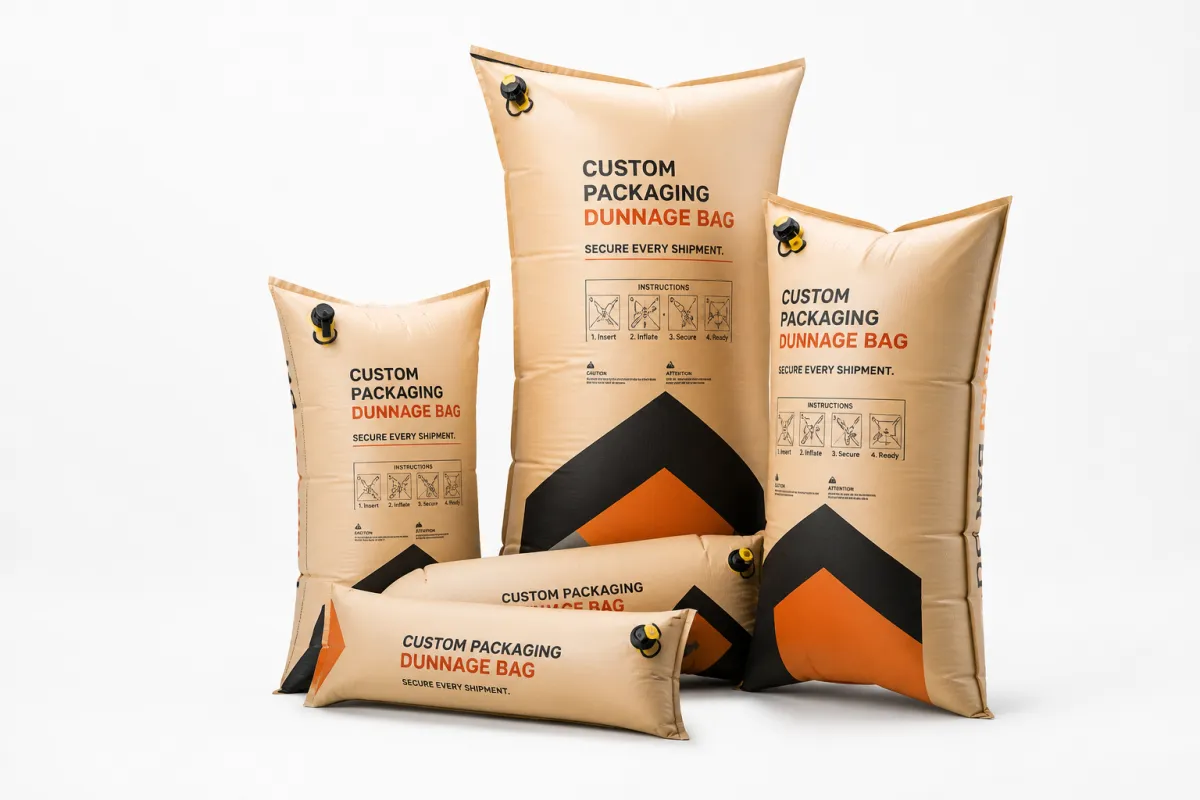
Empty space in a shipment is not harmless. It is stored motion waiting for a reason to show up. If a pallet leaves the dock with a four-inch void on one side and a six-inch void on the other, the load can accelerate inside the trailer until it strikes something solid. That impact is usually enough to dent product, crush corners, or break seals. I have seen teams spend hours improving stretch wrap and still miss the larger issue, which is the void behind the pallet stack. Stretch wrap holds layers together. It does not keep a full load from shifting forward or sideways under braking and vibration.
Custom packaging dunnage bags address that problem by filling the gap and spreading pressure across a wider surface. Instead of a narrow point of contact taking the full force, the bag pushes against the load in a broad, controlled way. That helps when freight includes mixed carton sizes, irregular footprints, or a tall stack with a high center of gravity. It also matters on long routes where vibration keeps working the load for hours. A small slack space may survive a short local trip. Put the same shipment into a multi-stop linehaul or export route, and the risk rises quickly.
Empty space has a second cost that gets missed often: it creates uncertainty after delivery. Receiving teams slow down when damage appears. Claims are filed. Product packaging gets blamed even when the root problem was freight restraint. The box is not always at fault. The product may have been packed correctly, the cartons may have been sound, and the load still moved because the trailer had room to spare. That kind of damage is frustrating because it feels random until you trace the load path and see the gap.
That is why custom packaging dunnage bags are about more than plugging a hole. They are about matching the restraint method to the load. A bag sized for a narrow gap between two pallets is not the same thing as a bag meant to brace cargo against a container wall. A kraft paper unit for one-way use is different from a woven construction built for repeat handling. A dry van shipment behaves differently from a humid export lane where moisture can affect paper performance. If the material choice ignores the lane, the bag may look right on paper and still underperform where it counts.
A pallet can look steady on the dock and still have enough internal slack to fail in transit. The warehouse sees compression; the road sees movement.
The lesson for buyers is simple. Think beyond the carton and the pallet wrapper. Think about the whole freight system. That is where custom packaging dunnage bags earn their place. They support the load structure, not only the item inside the box.
How Custom Packaging Dunnage Bags Work in Real Shipments
The mechanics are easy to follow. Place custom packaging dunnage bags into the void, connect the inflation tool, and fill the bag until it braces the load against a solid surface. Once it is inflated correctly, the bag behaves like a controlled spring. It resists forward, backward, and side-to-side movement by pressing cargo into position while spreading force over a larger area than loose filler ever could.
That broad pressure distribution is the point. A carton edge can take only so much concentrated force before it crushes or scuffs. A dunnage bag spreads that force, which helps reduce corner damage, label abrasion, and the small repeated impacts that grow into larger failures. Freight does not need to slam into a wall to be damaged. Repeated micro-movement is enough to loosen tape, wear through print, and weaken packaging before the load reaches the customer. Even a ride that feels smooth to the driver can be rough on the freight inside.
Material choice changes the way the bag performs. Kraft Paper Bags are common for lighter-duty or one-way applications, especially where cost and recyclability matter. Woven polypropylene bags are tougher and often better for repeated use or harsher lanes. Multi-use models cost more up front, yet they can make sense on repeated routes where handling conditions stay fairly consistent. There is no universal winner. The right fit depends on the shipment profile and the damage history of the lane. If a route keeps chewing up paper bags, that is your signal to step back and reevaluate.
Custom packaging dunnage bags are common in truckloads, ocean containers, rail shipments, mixed-SKU pallets, and partial loads that do not fill the trailer cleanly. They are especially useful when the freight is too valuable to risk and too variable for a fixed blocking-and-bracing routine. In that setting, the bag becomes a repeatable control point. Dock teams know where it belongs. Load planners know which void it fills. Procurement knows what to order next time. That kind of consistency saves a lot of back-and-forth later.
There is a packaging design angle here that gets overlooked. Businesses that invest in retail packaging and package branding often want the inside of the shipment to feel as disciplined as the outside. That does not mean overbuilding every load. It does mean understanding that a polished brand experience can be undone by freight damage. A shipment can leave the building looking premium and arrive looking careless if it shifts during transit. Customers do not separate those two experiences nearly as neatly as internal teams do.
For teams comparing custom packaging dunnage bags with foam, bubble wrap, or other cushioning materials, the comparison should stay at the right level. Foam and bubble wrap protect individual products. Dunnage bags stabilize the freight structure as a whole. Many operations need both layers: cushioning inside the carton, then restraint outside the carton. That combination is usually more realistic than hoping one material can do every job. It is also a better way to explain the system to warehouse staff without making the process feel overcomplicated.
For readers who want to compare related packaging options, the Custom Packaging Products page is a useful place to review formats and think about how freight protection fits into the larger packaging system.
Key Factors That Decide Performance and Fit
Void size is the first variable. A bag that is too small slips out of contact and does little. A bag that is too large can bulge, seat poorly, or push cartons apart in ways that create new stress points. Measuring only the pallet footprint is not enough. The actual gap at the restraint point matters more: width, height, and depth. For a side void between pallets, even a three-inch difference can be the dividing line between stable and loose. In container freight, usable space changes once pallets are centered or shifted for balance, so the measured gap on paper may not match the real one on the dock.
Load profile comes next. Dense cartons behave differently from lightweight bulk packaging. Fragile products need gentler restraint. Tall stacks with high centers of gravity need more care because they can tip even if the lower layers stay intact. Irregular packaging creates another challenge. A square, uniform pallet is easy to brace. A mixed-SKU pallet with overhangs, odd carton heights, or uneven weight distribution needs a more deliberate setup. Custom packaging dunnage bags work best when the bag shape and inflation target fit that reality instead of fighting it.
Transport conditions matter just as much. Braking force is not the same thing as vibration. Long-haul routes, temperature swings, humidity, and repeated transfers all change how a load behaves. Paper-based bags can perform well in dry conditions, yet moisture exposure may affect strength and handling. In humid lanes or export shipments, some buyers choose woven or multi-use constructions because they tolerate rougher conditions better. That does not make paper the wrong choice. It means the lane should drive the decision. If a supplier glosses over that part, I usually slow the conversation down and ask for a real lane example.
Operational fit is the fourth variable, and it is easy to overlook. Does the dock team have the right inflation tool? Is there enough time for careful installation, or does the lane move too quickly for trial-and-error? Will the bag be reused, or is it meant for one trip? Where will the bags be stored, and how much rack space will they take? Those questions sound ordinary, yet they decide whether the product gets used correctly. The best custom packaging dunnage bags still fail if the warehouse cannot deploy them consistently.
Standards are worth paying attention to as well. Teams that audit freight protection against recognized methods often reference ISTA test sequences for packaging performance, ASTM methods for material or compression checks, and FSC sourcing for fiber-based materials. If you want to review transport test guidance, the International Safe Transit Association publishes resources at ISTA. For paper-based sourcing questions, FSC is a useful reference point. Standards do not replace real-world testing, but they give everyone a shared language.
Custom packaging dunnage bags should be treated as a fit-and-function decision, not a commodity line item. Two bags can look nearly identical on a quote and behave very differently on the floor. The real comparison is bag size plus lane conditions plus loading habits plus claim history. Once that is clear, the purchase becomes a lot easier to defend.
Custom Packaging Dunnage Bags Process: From Dimensions to Delivery
The strongest buying process starts with actual measurements. Photograph the voids. Record pallet or container dimensions. Note product weight, carton count, stack height, and any fragile zones. If the lane uses mixed SKUs, capture the worst-case configuration rather than the easiest one. A quote built around a perfect pallet can fail the first time a different SKU enters the order cycle. Good custom packaging dunnage bags specs are built around the difficult edge cases, because that is where damage usually starts.
The next step is specification. Choose the bag dimensions, material strength, valve type, and inflation target based on the route and the load pattern. If the shipment moves in a dry van with controlled handling, a lighter construction may be enough. If it moves in export container freight or goes through repeated transloading, a tougher bag may be justified. The valve deserves attention too. A valve that is awkward to use slows the dock. A valve that seals poorly causes rework. A bad install is not always the bag's fault, yet a better valve makes consistency easier for the people doing the work.
Testing should happen before a large order. Ask for a sample or prototype and run it against a live pallet or a representative load. Watch for bulging, slipping, or a bag that only looks tight before the trailer door closes. That test should answer one question: does the bag brace the load without forcing cartons apart? For custom packaging dunnage bags, a live test often teaches more than the datasheet, because freight does not live on paper. It lives in a warehouse with forklifts, shift changes, and the pressure to get shipments out the door.
Lead time should be broken into pieces rather than treated as one number. Quote turnaround may take a day or two. Sample approval can add several more days depending on internal review. Production lead time varies by order size, customization level, and print complexity. If custom branding is involved, or if the bags need special sizing, add time for proof review. A buyer who understands the timeline avoids the common trap of confusing a quick quote with a quick delivery. That mix-up is common, and it usually creates avoidable pressure on the dock.
Here is a simple way to map the process:
- Measure the void and document the load.
- Select the bag type and target inflation range.
- Test on a live load and check restraint quality.
- Approve the sample and confirm the lead time.
- Roll the spec into the regular shipping SOP.
That sequence turns custom packaging dunnage bags from a one-off purchase into part of the shipping system. The value starts to compound once the dock team has a standard spec. Training gets easier. Variability drops. Freight stops behaving like a guessing game, which is honestly what everybody wants.
Custom Packaging Dunnage Bags Cost: Pricing, MOQ, and Quote Basics
Cost is where many buyers get stuck, because the lowest quote can look attractive until the freight starts failing. Custom packaging dunnage bags are priced by size, material grade, valve style, custom dimensions, printing, and whether the product is disposable or reusable. Order volume matters too. A higher MOQ can lower unit cost, but it also raises inventory exposure and storage needs. That tradeoff is easy to miss if procurement only looks at the per-piece number. A cheap bag that lives in the wrong place is not cheap for long.
For rough planning, stock kraft-style bags in common sizes may land around $0.45-$0.95 per unit at larger runs, while Custom Printed Kraft versions often move into $0.65-$1.25 depending on coverage and size. Reusable woven polypropylene models can run roughly $1.20-$3.50 or more, especially if the construction is heavy-duty or the order is small. Those figures are only planning numbers. Actual pricing depends on dimensions, materials, freight terms, and the amount of customization requested. They still help frame a budget conversation and keep the discussion grounded.
That is where many teams make a false economy mistake. They buy the cheaper bag, then spend more on repack labor, rework, delays, and claims handling. One damaged pallet can erase the savings from dozens of low-cost bags. From a packaging buyer's point of view, the real question is not “What is the lowest unit price?” It is “What is the total cost of getting the freight there intact?” Custom packaging dunnage bags often win that comparison because they reduce the failure rate, not because they are the cheapest item on the invoice.
| Option | Best Use | Typical Unit Cost | Notes |
|---|---|---|---|
| Stock kraft dunnage bag | Standard voids, dry van moves, lower handling risk | $0.45-$0.95 | Fast to source, usually single-use, good for repeat lanes with consistent gaps |
| Custom printed kraft bag | Branded programs, documented lanes, controlled packout | $0.65-$1.25 | Supports package branding and internal standardization, but print adds cost |
| Reusable woven polypropylene | Rougher lanes, export freight, repeated cycles | $1.20-$3.50+ | Higher upfront cost, often better durability and multiple-use potential |
MOQ is another lever. Small runs usually carry a higher per-unit cost because setup and material waste are spread across fewer pieces. Larger orders reduce unit cost, but they also require more careful planning for storage, forecast accuracy, and lane consistency. If your freight profile changes often, a large MOQ can become a burden instead of a savings. If the lane is stable and the same void shows up week after week, bulk purchasing can make a lot of sense.
Quote comparison should be strict. Check the dimensions, pressure or performance rating, material thickness, package count, freight charges, and replacement policy. Do not assume two quotes are equivalent because the numbers look close. A slightly smaller bag or a weaker valve can change field performance in a hurry. Good buyers compare custom packaging dunnage bags the same way they compare primary packaging: by spec, not just by the headline price.
There is also a branding angle here. A company investing in branded packaging may want consistency across the customer-facing package and the freight-facing materials. That does not mean every dunnage bag needs a logo. It does mean the sourcing process should be disciplined enough to support the overall packaging design strategy. The outer freight solution and the inner product packaging should not be managed as separate worlds, because the customer experiences them as one shipment.
Common Mistakes Buyers Make With Dunnage Bags
The first mistake is underestimating the void. A two-inch gap can still move a pallet enough to create damage if the load is heavy or tall. Buyers often measure the carton footprint and stop there. That is not enough. Measure the actual clearance after the load is staged, not the theoretical clearance from the spec sheet. Custom packaging dunnage bags only work well when they are sized to the real gap.
The second mistake is overinflation or underinflation. Too little air leaves room for movement. Too much air can stress the load apart, especially if the cartons are weak at the corners or the stack is uneven. The right inflation point is often bag-specific. That is why supplier charts and test runs matter. A good dock team treats inflation like a setting, not a guess.
The third mistake is using the bag without thinking through blocking, bracing, and load planning. A dunnage bag is not a replacement for sound load design. If the pallet stack is unstable or the freight is badly arranged, the bag may only reduce the problem instead of solving it. I have seen teams blame the bag when the real issue was the load plan. Custom packaging dunnage bags are part of a restraint system. They are not the entire system.
The fourth mistake is comparing price only. That sounds obvious, yet it happens constantly. Buyers see a low unit number and stop there. They do not ask about pressure performance, lead time, supplier support, or whether the product fits the route they actually ship. That is a mistake in any category, and it is especially expensive in freight protection, because the failure shows up after the truck has already left. By then, the accounting is already messy.
The fifth mistake is failing to standardize the spec after the first success. If one bag size works on a key lane, document it. Build a short operating guide. Add photos. Note inflation level and placement. Store the information with the purchasing record so the next buyer does not start from zero. Custom packaging dunnage bags become more valuable when the organization turns one good test into a repeatable process. That part is not glamorous, but it saves a lot of trouble.
Some operations also overlook packaging sustainability. If the company has a public commitment to source responsibly, paper-based options with FSC-linked fiber can support that story better than ad hoc material choices. That does not make paper right for every lane. It does mean the sustainability conversation should be tied to the actual shipping method, not left as a separate marketing claim. Good product packaging decisions and good freight decisions should reinforce each other.
One more practical point: if your team already uses a strong mix of custom printed boxes, protective inserts, and retail packaging variants, do not let the freight side drift into a generic purchasing habit. Custom packaging dunnage bags should be specified with the same care as the rest of the packaging stack. Otherwise, the weakest link stays hidden until the customer opens the shipment. That is a hard lesson, and it usually lands after the damage report is already on someone's desk.
Expert Tips and Next Steps Before You Order
The smartest buyers build a lane-specific sizing guide. That means documenting which custom packaging dunnage bags work for each route, pallet size, and product family. A guide like that saves time at the dock because the team does not have to measure every shipment from scratch. It also cuts down on variation from one operator to the next. One person's “tight enough” is another person's “too loose.” A written guide narrows that gap and makes the process a lot less fuzzy.
Second, test a small number of shipments before scaling. A trial run should not only confirm that the bag fits. It should show whether the bag stays in place after acceleration, braking, and handling transfers. Track what happened at the receiving end too. Did the cartons show corner wear? Did the wrap loosen? Was there any visible bag migration? Those details matter more than a simple pass/fail result. Good custom packaging dunnage bags buying is evidence-based.
Third, create a short RFQ checklist. Keep it simple. Include dimensions, photos, freight mode, annual volume, expected lead time, and any print or branding needs. If the company wants the bag to align with branded packaging or package branding goals, say so. If the goal is purely functional, say that too. The clearer the brief, the cleaner the quote. The cleaner the quote, the easier it is to compare suppliers without hidden assumptions.
Fourth, tie freight protection into the broader packaging strategy. Teams that manage product packaging, retail packaging, and shipping materials separately often miss efficiency opportunities. A packaging design decision on the carton side can change the void size on the freight side. A change in pallet pattern can alter the required bag size. A switch from one SKU family to another can change the entire load profile. Custom packaging dunnage bags work best when someone is watching the system, not only the part number. That system view is where a lot of savings hide.
Here is the practical next step: gather measurements from the current lane, request a sample quote, and specify custom packaging dunnage bags in the next shipment plan so the buying decision is tied to real freight conditions instead of a guess. If you are reviewing broader packaging needs at the same time, the Custom Packaging Products catalog is a useful starting point for thinking about the full system, not just one item.
The better freight protection usually starts small. Not with a huge budget. Not with a perfect spec on day one. It starts with one measurable lane, one honest test, and one standard the warehouse can repeat. Custom packaging dunnage bags then become more than a purchase; they become a controlled part of your shipping process, which is how freight damage starts to fall. That is the real win: fewer claims, fewer surprises, and a dock team that knows exactly what to do next time.
FAQ
What size custom packaging dunnage bags do I need for a pallet load?
Measure the exact void width, height, and depth between the load and the restraint point, not just the pallet footprint. Choose a bag that fills the gap at the intended inflation level without forcing cartons apart or leaving visible slack. If the load varies by SKU, standardize two or three sizes instead of trying to make one bag handle every shipment. That approach is usually more reliable for custom packaging dunnage bags than trying to make a single size work everywhere.
How do custom packaging dunnage bags compare with foam or bubble wrap?
Foam and bubble wrap protect individual products, while dunnage bags stabilize the load as a whole during transit. For shipping voids inside pallets or containers, custom packaging dunnage bags are usually faster to install and more effective at stopping shift. Many operations use both: product-level cushioning inside the box, then freight-level restraint outside the box. That split is often the most sensible route.
What is the typical production timeline for custom packaging dunnage bags?
Simple stock-based customization can move quickly, while fully custom dimensions, printing, or special materials add lead time. Ask for sample approval timing separately from production timing so you do not confuse quote turnaround with manufacturing time. If the shipment is urgent, confirm whether the supplier can support partial fills, phased delivery, or a rush order for custom packaging dunnage bags.
What drives custom packaging dunnage bags pricing the most?
The biggest drivers are size, material strength, valve type, and order volume. Custom print, special handling, and low MOQ orders can raise unit cost quickly. The cheapest option is not always the best value if it increases damage claims or slows down loading. That is especially true for custom packaging dunnage bags used on repeat freight lanes.
Can custom packaging dunnage bags be reused safely?
Some reusable models are built for multiple trips, but only if the film, valve, and seam quality are intended for repeated use. Inspect for punctures, weak seams, or valve wear before every reuse cycle. If your route is rough or your handling is inconsistent, a single-use option may be more predictable than a damaged reusable one. Reuse makes sense only when the lane and the bag are both suitable for it, which is why custom packaging dunnage bags should be chosen with care.

