Buyer Fit Snapshot
| Best fit | printed kraft paper bags with logo for sustainable packaging for packaging buyers comparing material specs, print proof, MOQ, unit cost, freight, and repeat-order risk where brand print, material, artwork control, and repeat-order consistency matter. |
|---|---|
| Quote inputs | Share finished size, material target, print colors, finish, packing count, annual reorder estimate, and delivery region. |
| Proofing check | Approve dieline scale, logo placement, barcode or warning zones, color tolerance, and any recyclable or compostable wording before bulk production. |
| Main risk | Vague material claims, crowded artwork, or missing packing details can create delays even when the unit price looks attractive. |
Fast answer: Printed Kraft Paper Bags With Logo for Sustainable Packaging should be specified like a repeatable production item. The safest quote includes material, print method, finish, artwork proof, carton packing, and reorder notes in one written spec.
What to confirm before approving the packaging proof
Check the product dimensions against the actual filled item, not only the sales mockup. Ask for tolerance on folds, seals, hang holes, label areas, and retail display edges. If the package carries a logo, QR code, warning copy, or legal claim, reserve that space before decorative graphics fill the panel.
How to compare quotes without losing quality
Compare board or film grade, print process, finish, sampling route, tooling charges, carton quantity, and freight assumptions side by side. A lower quote is only useful if the supplier can repeat the same color, closure quality, and packing count on the next order.
Printed Kraft Paper Bags with logo do a lot more than move a purchase from the counter to the car. In a boutique, at a farmers market, in a bakery, or across a food-service pickup shelf, they keep carrying the brand after the money has changed hands. A bag that feels solid in the hand, folds cleanly at the seams, and presents the logo with good contrast sends a clear signal that the business paid attention to the small things.
The reason Printed Kraft Paper Bags with logo keep showing up in retail and hospitality is pretty simple: they combine usefulness, visibility, and a material look that feels honest rather than overworked. The paper base can be brown or white, the print can be minimal or more expressive, and the whole piece can stay cost-conscious while still feeling deliberate. That balance is part of the appeal. It is practical packaging, but it can still look polished.
Packaging buyers often notice that these bags deliver a lot of presence without a complicated build. A clean structure, a well-placed logo, and a clear layout usually do more for the brand than a busy design trying to say everything at once. Kraft paper helps there too. Its natural texture gives the print a grounded, tactile character, and if the artwork is handled well, the result feels calm, confident, and not a bit flashy.
The sustainability conversation matters here, but it should stay grounded in facts instead of slogans. Paper may be chosen for recycled content, fiber sourcing, or recyclability goals, yet the real value comes from matching the bag to the product, the weight it needs to carry, and the way it will move through the business. A bag that tears early, uses the wrong coating, or creates disposal headaches is not a good environmental choice just because it is made from paper. That part gets glossed over too often.
What follows breaks down how printed kraft paper bags with logo are made, what shapes cost, how to choose dimensions and construction, and where ordering mistakes usually creep in. If you are comparing suppliers or building a new packaging program, these details will help you ask sharper questions and avoid the usual headaches.
Printed Kraft Paper Bags With Logo: Why They Stand Out
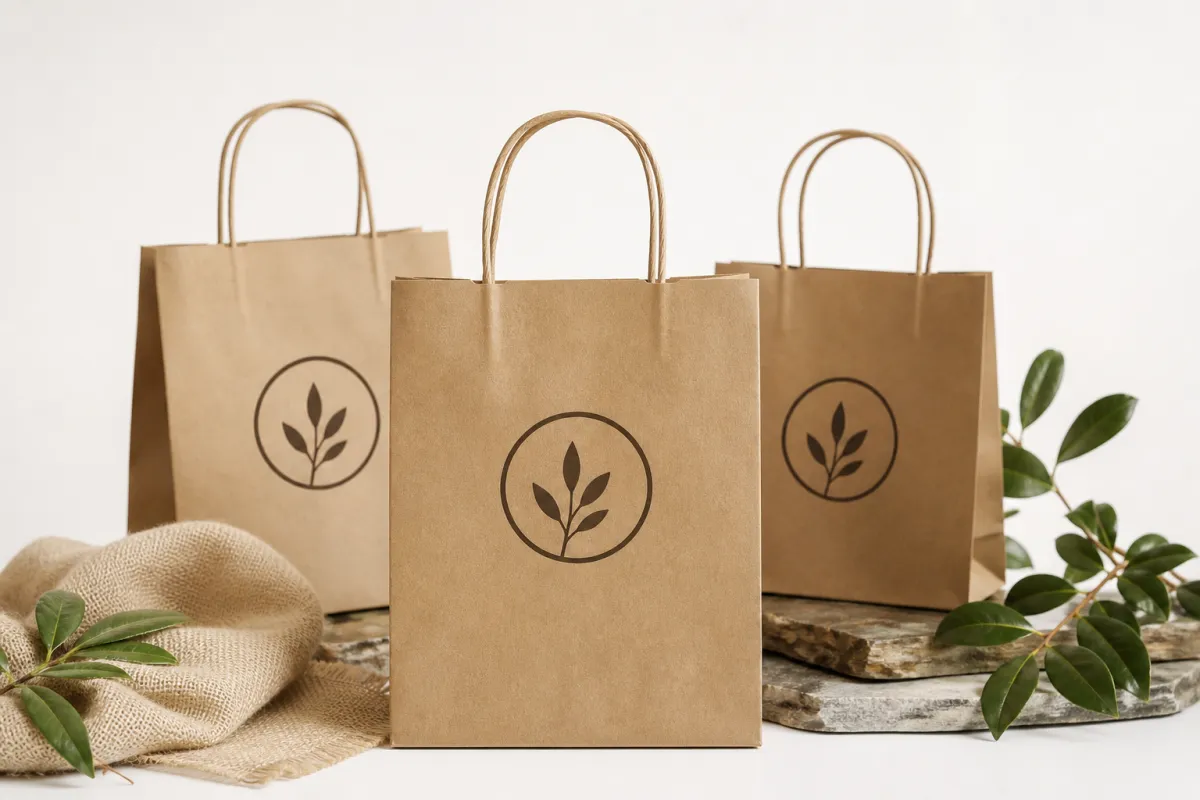
A plain bag gets the product out the door. Printed kraft paper bags with logo do that too, but they keep working after the customer leaves. Every time someone carries one through a parking lot, into an office, down a sidewalk, or back into another store, the logo gets another chance to register. That repeated exposure has value, and it is usually cheaper than buyers expect.
The format is easy to understand, which helps it work across a lot of channels. Kraft paper serves as the base, the logo becomes the brand marker, and the printing process turns a generic carrier into a custom piece of packaging. The bag can use twisted handles, flat handles, or die-cut grips, and the artwork can sit on a single panel, both sides, the gussets, or across a repeat pattern. The structure stays familiar, but the identity becomes unmistakable.
What still surprises some buyers is how premium a paper bag can feel when the details are right. A well-built carrier with reinforced handles, the right gusset depth, and crisp print registration often feels more thoughtful than a thin plastic alternative, and in some settings it looks more refined than a rushed carton. I have watched printed kraft paper bags with logo outperform more expensive packaging simply because the spec was disciplined and the artwork was clean.
The sustainability angle deserves a practical lens. Brands often choose paper-based carriers because they can be made with recycled materials, post-consumer waste content, or FSC certified fiber, and the visual message is usually cleaner than a mixed-material package. Even so, the bag still has to fit the actual load, the actual workflow, and the actual store environment. Good packaging looks responsible, but it also needs to survive a busy day. If it does not, the message falls apart pretty fast.
That is why printed kraft paper bags with logo show up across apparel, food service, cosmetics, books, gift retail, and event programs. They sit right between practical and presentable, which is a useful place for a brand to be. For many buyers, the bag is the first thing a customer touches after checkout, so it makes sense to treat it as part of the product experience instead of an afterthought.
A paper bag earns its place when it is easy to pack, strong enough for the merchandise, and clean enough to make the brand look deliberate instead of improvised.
Think of the bag as a small package with several jobs at once. It carries the item, signals quality, and acts like a walking advertisement. That is a lot of responsibility for one piece of packaging, which is why the specification deserves close attention.
How Printed Kraft Paper Bags With Logo Are Made
The production path for printed kraft paper bags with logo has more steps than many buyers expect. It starts with paper selection, moves into printing, then continues through cutting, folding, gluing, handle attachment, inspection, and final packing. Each stage affects performance in a small but meaningful way, and a weakness at any point can show up later as tearing, poor registration, or a bag that sits crooked on the counter.
Paper grade comes first. Kraft paper is valued for fiber strength, and it comes in a range of weights depending on how much durability the bag needs. A lighter retail bag may use a lower basis weight, while a grocery-style carrier or a bag meant for heavier merchandise may need thicker stock with better tear resistance. That choice influences shape retention, edge stiffness, and how well the bag stands once filled. In press checks, the difference between “looks fine” and “holds up” usually comes down to this part.
Printing method comes next. Flexographic printing is common for larger runs and straightforward artwork because it moves quickly and handles simple logos well. Other print processes may be selected when the design needs finer detail, tighter color control, or a more exact visual match. On printed kraft paper bags with logo, the goal is often clarity rather than photographic richness. A sharp, bold logo placed in the right spot can do more for the brand than a crowded image trying to carry too much. That is not just a design preference; it is a production reality.
The bag surfaces also affect the final result. Front panels are the most visible location, though side gussets can hold secondary marks, taglines, or repeated motifs. That extra surface area can be useful, but it has to be planned around folds, seams, and handle positions. A logo that looks perfect in a flat art file can end up partly hidden in a crease if the printable area was not mapped carefully. I have seen that happen, and it is one of those avoidable problems that makes everybody sigh a little.
Handle style matters as well. Twisted paper handles are common because they balance strength and cost, while flat handles often suit food service or high-volume retail. Die-cut grips have their own place, especially on lighter presentation bags. Each choice changes the way the bag carries, the comfort in the hand, and the perceived value of printed kraft paper bags with logo.
Finishing details carry more weight than they usually receive. Clean fold lines, strong glue joints, and consistent trim make a bag feel professional right away. Some programs add coatings or liners, but those should only be used when they serve a clear purpose. If the product needs moisture resistance, a food-safe barrier, or extra surface protection, the finishing makes sense. If not, a simpler paper build is often the better route.
For buyers who want a quick comparison, the table below shows how common bag styles tend to behave during production and in day-to-day use.
| Bag style | Typical strength | Print visibility | Common use | General cost level |
|---|---|---|---|---|
| Twisted-handle kraft bag | Good for medium retail loads | Strong front-panel branding | Apparel, gifts, specialty retail | Moderate |
| Flat-handle kraft bag | Good for lighter to medium loads | Good, with practical style | Food service, quick-serve programs | Lower to moderate |
| Die-cut kraft bag | Best for lighter items | Large print area on the face | Events, cosmetics, light retail | Lower |
| Heavy-duty kraft carrier | Strongest option here | Good branding space, more structure | Boutiques, premium packaging, heavier goods | Higher |
One detail is easy to miss: a bag that looks simple in a photo can still be a fairly complex manufacturing item if the print coverage is high, the handles are reinforced, or the tolerances are tight. That is why good suppliers ask a lot of questions early. They are not slowing the process down; they are trying to make sure the bag performs properly once it reaches the customer.
Key Factors That Shape the Right Bag Specification
Choosing the Right specification for printed kraft paper bags with logo starts with the product, not the artwork. That may sound obvious, but ordering conversations often drift toward color choices and logo placement before the dimensions are settled. The cleaner approach is to measure the product first, then size the bag around that real load. That one shift solves a lot of problems before they even start.
Width, depth, and height all matter. A folded shirt in packaging needs a very different footprint from a candle set, bakery items, or a bundle of merchandise. The bag also needs enough handle clearance so a hand can fit comfortably without squeezing the contents. If the bag is too tight, packing slows down and customers may overstuff it. If it is too loose, the contents can slide around and the bag loses its crisp shape.
Paper weight should match the load. Lightweight boutique items can work well in a lighter kraft construction, while heavier goods need more structure and often reinforced bottoms. This is where a buyer should be honest about real use. A bag that looks elegant during sampling can fail in daily operations if the paper is too thin or the handle attachment was not designed for the weight.
Branding choices are practical too. A one-color logo on kraft paper often looks very strong because contrast does the heavy lifting. Two colors can still be economical and clean. Full coverage patterns, multiple inks, and more elaborate layouts are possible, but they increase setup complexity and can make the bag feel more promotional than premium. With printed kraft paper bags with logo, restraint usually gives the better result.
Sustainability choices should be specific. If the brand wants a paper-based program, ask whether the bag can include recycled materials or a certain percentage of post-consumer waste. Ask whether the fiber source is FSC certified. Ask whether the bag is designed to stay recyclable in local streams and whether any coating or laminate would make sorting more difficult. Those questions are more useful than vague claims because they connect the packaging decision to how the bag will actually be handled after use.
Usability is the final filter. The best printed kraft paper bags with logo stack neatly, open quickly at the register, and feel comfortable in the hand. They should fold consistently for storage, stand cleanly on a shelf, and carry enough weight without showing strain. In real use, the best bag is the one that disappears into the workflow because it simply works. That is the kind of packaging nobody complains about, which is exactly the point.
What to confirm before approving a spec
- Product dimensions and expected fill weight.
- Paper grade and basis weight.
- Handle style and reinforcement method.
- Print colors, logo size, and placement zones.
- Recyclability or fiber-source requirements.
- Whether the bag needs a matte, gloss, or natural finish.
A smart spec usually reflects the channel as much as the product. A boutique bag that leaves a store with one garment is different from a delivery bag carrying several boxed items. A food-service bag may need grease resistance and flat packing. An event bag may need a strong visual and a lower per-unit cost. That is why printed kraft paper bags with logo should be designed around actual use, not a generic idea of what a branded bag should be.
Cost and Pricing for Printed Kraft Paper Bags With Logo
Pricing for printed kraft paper bags with logo comes from a handful of variables that work together. Bag size usually comes first, followed by paper weight, handle type, print colors, finishing steps, and order quantity. The more complex the build, the more setup work the job requires, and that affects the quote. It is rarely just one thing.
Quantity matters because converting and printing are more efficient at higher volumes. A setup that takes time on the press can be spread across more units when the run is larger, so unit cost tends to fall as quantity rises. That said, a very large run only saves money if the brand can store the bags properly and use them before the campaign, product line, or seasonal design changes. Nobody wants a stack of outdated packaging sitting in the back room for six months.
Minimum order quantities are common for the same reason. A supplier may set an MOQ based on printing efficiency, machine setup, carton packing, and the economics of finishing the bags. Buyers sometimes see the MOQ as arbitrary, but it usually reflects the point where the plant can keep the job efficient enough to price it fairly. In my experience, once the paper weight, handle style, and print coverage are locked in, the MOQ starts to make a lot more sense.
Here is a practical pricing view that many buyers find useful. These are broad industry-style ranges, not a formal quote, and actual numbers will vary by region, freight, paper source, and specification.
| Specification example | Typical relative price | What pushes cost up | What keeps cost lower |
|---|---|---|---|
| Small kraft bag, one-color logo, twisted handle | Lower to moderate | High print coverage, special sizing | Simple layout, standard paper grade |
| Medium retail bag, two-color print, reinforced handle | Moderate | Extra color passes, stronger paper | Common dimensions, efficient artwork |
| Large carrier, multiple print colors, premium finish | Moderate to higher | Coatings, complex graphics, higher basis weight | Lower print area, standard pack format |
| Custom-heavy spec with special handles and coatings | Higher | Nonstandard construction, detailed branding | Rarely low-cost unless volume is very high |
Design simplicity can reduce cost without weakening the brand. A strong logo, a clear wordmark, and good spacing often look better than a crowded layout packed with too many elements. That is especially true on kraft paper, where texture and contrast already bring character to the bag. I would rather see one well-printed mark on a sturdy bag than a busy layout on a weak one. The second option always ends up looking cheaper than people hoped.
Comparison shopping needs discipline too. Two suppliers may quote a bag that sounds similar, but one may use thicker paper, tighter tolerances, stronger handles, or a different print method. If the quote does not state paper grade, handle style, dimensions, and packing details, the products are not truly comparable. That is a common source of confusion with printed kraft paper bags with logo.
For budget planning, think beyond unit price. Add freight, storage, possible reorders, and the risk of overbuying. A slightly higher per-unit price can still be the smarter decision if it reduces failures, improves customer handling, or gives the brand a cleaner presentation. Packaging value is larger than the line item on the invoice, and a cheap bag that tears in the customer’s hand is never actually cheap.
Process, Timeline, and Lead Time for Printed Kraft Paper Bags With Logo
The path from artwork to finished printed kraft paper bags with logo usually follows a clear sequence: artwork review, spec confirmation, proofing, production scheduling, printing, converting, packing, and shipment. Each stage has its own timing, and one delayed step can push the next one back. That is why the first planning conversations should cover both design and production details, not just the logo.
Artwork review is not a formality. Files need to be ready at production resolution, with the logo positioned correctly and the colors set up in a way the print process can reproduce. Thin type, low-contrast marks, and overly detailed graphics are more likely to create issues than simple, well-prepared art. If a brand is starting from a marketing file rather than a packaging file, some cleanup is usually needed.
Proof approval is a real schedule driver. A factory or converter can only slot the order once the spec and artwork are confirmed, and any revision after that can shift the production window. That matters most with custom printing, where plates, checks, or setup adjustments need to be completed before the run begins. Buyers who respond quickly to proofs usually protect their launch dates, and that can save a lot of stress later on.
Lead time depends on order size, current workload, the printing method, and the bag construction. A straightforward printed kraft paper bags with logo order with standard dimensions and simple artwork will usually move faster than a custom carrier with reinforced handles, special coatings, or multiple design variations. Shipping method matters too, since transit time can be as important as production time when a deadline is tight.
In packaging programs, the real challenge is often not manufacturing alone. It is the combination of artwork approval, production queue, and freight coordination. A bag can be efficient to make and still arrive late if the buyer leaves too little room for the full cycle. That is why lead time should be treated as a schedule with buffers, not as a single number borrowed from a price sheet. If someone promises a date without seeing the spec, be a little cautious.
Here are a few ways to protect the timeline:
- Finalize the bag size before artwork is locked.
- Keep logo files clean, vector-based, and organized.
- Approve proofs quickly or request revisions in one clear round.
- Build extra time for seasonal launches and store openings.
- Confirm freight timing before production begins.
For a straightforward run, many buyers should expect roughly 12-20 business days after proof approval, with more complex jobs taking longer. That range can move in either direction depending on the plant, the paper source, and the shipping method. The safest approach is to ask for the timeline tied to the exact spec, not a generic promise. That is especially true with printed kraft paper bags with logo, because the details of the build shape the schedule.
Common Mistakes When Ordering Printed Kraft Paper Bags With Logo
The most common mistake is choosing the bag based on appearance alone. A sample may look excellent, but if the paper weight is too light, the handle attachment is weak, or the gusset depth is wrong, the bag will not hold up in real use. I have seen brands approve a beautiful sample and then run into failures as soon as the bags were packed with heavier merchandise. That kind of mismatch is avoidable, which makes it even more frustrating when it happens.
Artwork issues are another regular problem. Low-resolution files, tiny type, poor contrast, and logos placed too close to seams can all make a finished bag look less polished. On kraft paper, the natural surface already adds texture, so the artwork needs to stay clean enough to read at a glance. With printed kraft paper bags with logo, the print has to work with the material rather than fight it.
Underestimating inventory needs can become expensive too. Stores with multiple locations, seasonal traffic, or event-driven demand often use packaging faster than expected. If the run is too small, the brand can face rush reorders, freight pressure, or a temporary mismatch between packaging and volume. A more careful forecast avoids a lot of that frustration and usually costs less in the long run.
Another trap is overcomplicated design. Too many colors, gradients, or finishing steps can raise cost and stretch lead time without creating a stronger brand impression. A restrained design is not boring when the proportions are right. In fact, strong simplicity often makes printed kraft paper bags with logo look more expensive than they are.
Buyers also skip the supplier questions that matter most. Ask about paper source, tolerance ranges, handle reinforcement, packing format, and whether the bags arrive boxed or bundled in a way that suits your storage space. Those details may feel small during ordering, but they determine whether the bags are easy to receive, store, and use. Good packaging programs succeed because the practical details were checked early, not because the mockup looked nice on a screen.
Finally, do not assume every paper bag is equally recyclable just because it is paper-based. Mixed-material coatings, heavy lamination, or certain embellishments can complicate end-of-life handling. If recyclability is a priority, choose materials and finishes with that goal in mind. Paper bags can fit that strategy well, but only when the build supports the intent.
A packaging spec should answer one simple question clearly: will this bag work in the store, in the customer’s hand, and in the waste stream or recovery path the brand expects?
Expert Tips and Next Steps for Printed Kraft Paper Bags With Logo
Start with the product, then build the bag around it. Measure the width, depth, and height of the item or bundle that will go inside, and allow room for easy packing at the counter. That one step prevents a large share of sizing problems. The most polished printed kraft paper bags with logo are usually the ones sized from real use rather than guessed from a catalog description.
Keep the logo treatment simple unless the brand story truly needs more. Kraft paper already brings texture and visual warmth, so a clean mark, a strong type treatment, or a single accent color can carry the design very well. When the artwork gets too busy, the paper surface starts to feel cluttered instead of premium.
Ask for a physical sample or a close proof whenever possible. Screen images help, but the feel of the handle, the stiffness of the paper, and the way the bag opens are much easier to judge in hand. For retail, food service, and event use, that physical interaction matters. A bag that looks good but feels awkward will still disappoint the customer. That is the kind of detail that makes or breaks repeat use.
Compare total packaging value, not just unit price. A better-built bag can reduce tears, improve customer satisfaction, and strengthen the brand’s presentation every day it is used. That is a much better business outcome than saving a small amount per unit and then dealing with broken handles or weak seams later. I have seen printed kraft paper bags with logo earn their place simply by behaving better than cheaper alternatives.
If you are preparing to order, a practical sequence keeps the process moving:
- Gather logo files and basic brand colors.
- Measure the product and decide on the bag size.
- Choose handle style and paper weight.
- Decide how simple or detailed the print should be.
- Confirm whether recycled content or FSC certification matters to your program.
- Request a detailed quote that lists every construction detail.
- Plan the order around launch dates, storage space, and freight timing.
For buyers who want to reference recognized industry or sustainability organizations, these resources can help frame the conversation: EPA for waste and recycling context, and FSC for certified fiber sourcing. If you are testing transit performance or shipping durability, the testing standards group at ISTA is also useful to know about. Those organizations will not design the bag for you, but they can help anchor the packaging decisions in recognized standards and expectations.
From a buyer's standpoint, the best results usually come from a straightforward spec, clear artwork, and enough lead time to make thoughtful choices. That is how printed kraft paper bags with logo become more than a branding accessory. They become a dependable part of the customer experience, one that supports the product, reflects the brand, and holds up in daily use.
If you are comparing options for printed kraft paper bags with logo, keep the conversation focused on structure, print clarity, paper source, and real handling performance. Those are the details that matter once the bags arrive and start moving through your operation. A good next step is to lock the dimensions, handle style, and paper weight before you spend much time polishing artwork; that order of decisions keeps the project grounded and usually saves a round of revision.
Are printed kraft paper bags with logo recyclable?
They are often recyclable when they are made from paper-based materials and kept free of heavy food contamination, but local recycling rules vary by region and facility. If recyclability matters to your brand, choose paper construction and print/finish choices that avoid unnecessary plastic coatings or mixed-material elements.
What size should I choose for printed kraft paper bags with logo?
Choose the size based on the product's width, depth, and height, plus enough extra room for comfortable packing and easy customer carrying. If the bag will carry multiple items or heavier goods, confirm gusset depth and handle strength before you lock the specification.
How many colors should I use on printed kraft paper bags with logo?
One or two strong colors often work best on kraft because they keep the design clear, readable, and more cost-efficient to produce. More colors can work, but they should support the brand purpose rather than add visual noise or unnecessary production complexity.
What affects the quote for printed kraft paper bags with logo the most?
The biggest factors are quantity, bag size, paper weight, handle type, number of print colors, and any special finishing requirements. Artwork setup and production method can also influence price, so a simple print design usually keeps the quote more manageable.
How far in advance should I order printed kraft paper bags with logo?
Order as soon as your artwork and bag specifications are close to final, since proofing and production scheduling both take time. For seasonal launches or events, build in extra buffer so revisions or shipping delays do not put the deadline at risk.


