Buyer Fit Snapshot
| Best fit | Custom Packaging for Fragile Items projects where brand print, material claims, artwork control, MOQ, and repeat-order consistency need to be specified before quoting. |
|---|---|
| Quote inputs | Share finished size, material target, print colors, finish, packing count, annual reorder estimate, ship-to region, and any compliance wording. |
| Proofing check | Approve dieline scale, logo placement, barcode or warning zones, color tolerance, closure strength, and carton packing before bulk production. |
| Main risk | Vague material claims, crowded artwork, missing packing details, or unclear freight terms can make a low unit price expensive after revisions. |
Fast answer: Custom Packaging for Fragile Items: Why Every Shipment should be specified like a repeatable production item. The safest quote records material, print method, finish, artwork proof, packing count, and reorder notes in one written spec.
Production checks before approval
Compare the actual filled-product size with the drawing, then confirm tolerance on folds, seals, hang holes, label areas, and retail display edges. Reserve space for logos, QR codes, warning copy, and material claims before decorative graphics fill the panel.
Quote comparison points
Review material grade, print process, finish, sampling route, tooling charges, carton quantity, and freight assumptions side by side. A quote is only useful when the supplier can repeat the same color, closure quality, and packing count on the next order.
Custom Packaging for Fragile Items is not a padding contest. I used to see teams throw material at a problem and then wonder why returns still climbed. A two-ounce part can fail just as hard as a heavier one if vibration keeps feeding the same weak point for ten minutes at a time. This is exactly why the shipment profile, not the carton brochure, has to drive the design.
Buyers, especially those running mixed eCommerce and wholesale lanes, usually want three outcomes: fewer damage claims, fewer emergency credits, and less friction in customer support. A lot of money leaks out of all three buckets quietly. A properly engineered packaging system can plug those leaks faster than another round of “just add more foam.” In practice, the difference is between designing around one product family and designing around each actual SKU, then tuning by how people truly handle parcels.
Overview of Custom Packaging for Fragile Items
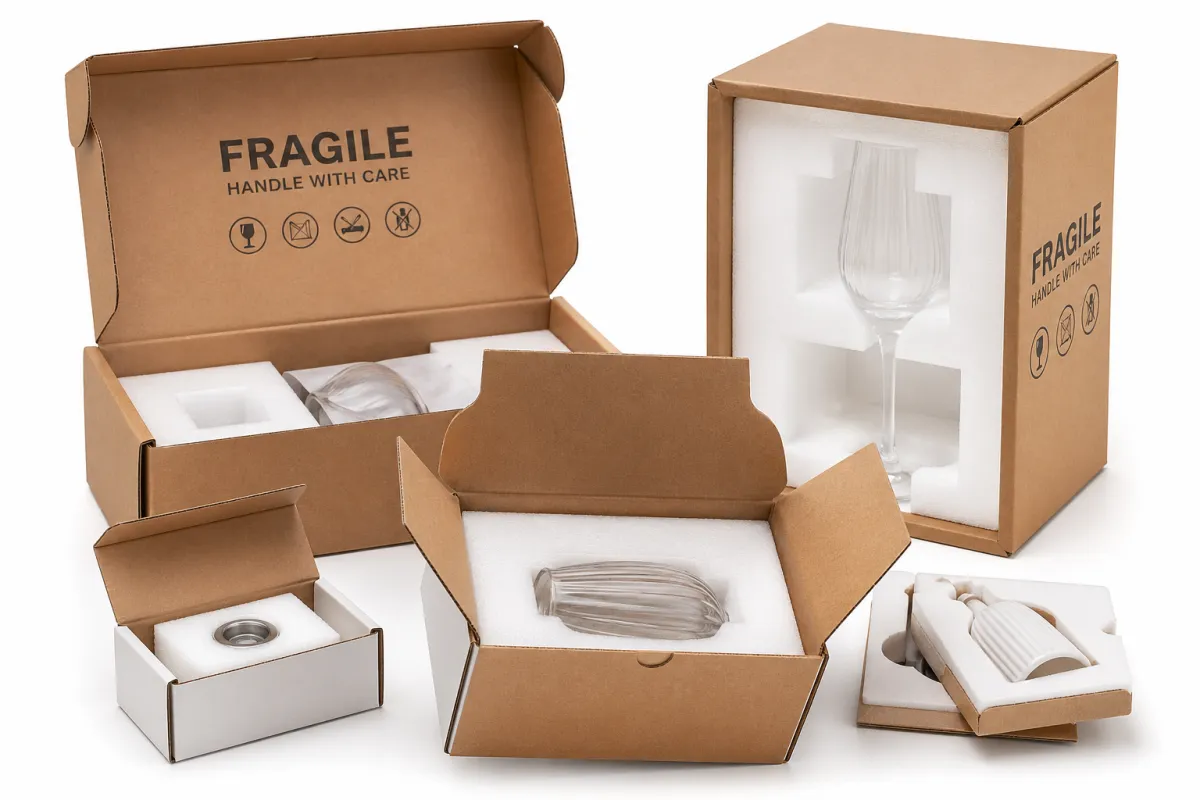
Breakage almost never starts with a dramatic 6-foot impact you can reproduce in a lab. It usually starts with tiny instabilities: a corner that floats, an edge that loses support, a panel that flexes after repeated stacking, or a lid that no longer aligns after one vibration cycle. That is why Custom Packaging for Fragile Items needs to act as a protection system, not a compliance checkbox. Every layer has to be accountable for a specific load path and a specific failure mode.
That matters because fulfillment behavior has changed. Parcels are now lifted, shifted, rerouted, and staged across more touchpoints than many designs assume. The same package may spend minutes on one conveyor, hours in a hot trailer, and then be thrown into a final belt drop sequence before delivery. One-size structures might look tidy in CAD, then unravel under those conditions. The custom route-aware design approach helps because it responds to how the box is actually treated, not how it appears on paper.
There is also a big misconception that custom equals bulky. In my experience, the successful packaging programs are often lighter in spirit, not heavier in mass. They stop movement first, then manage impact, then preserve geometry so the outer shell does not turn into a sacrificial shell. That sequence keeps a stable condition across lane stress and avoids shipping a package that is built for “looks okay” instead of “survives the route.”
Look at the outcomes you care about: less rework, fewer replacement shipments, and less reputational drag after visible damage complaints. A lab-tested but route-wrong system can still look expensive and fragile when the customer opens it. Retail Packaging That is presentable is a business outcome, not an afterthought.
The right questions for suppliers should move past thickness and print style. Ask how they capture and report failures: compression, puncture, edge instability, seam creep, humidity effects, and repeated handling stress. The suppliers worth their margin will talk about those measurements because they are already managing trade-offs between performance and cost.
Effective fragile packaging does not protect everything the same way; it reinforces the spots with the highest failure frequency, then locks the product in a repeatable orientation so the same weakness does not get re-triggered.
For a wider view of structural options, the Custom Packaging Products page is a useful launchpad for comparing shells, inserts, and print-ready formats. If your box doubles as retail packaging, the visual and opening experience matters just as much as compression performance.
What Makes Custom Packaging for Fragile Items Effective?
Custom Packaging for Fragile Items is effective when it removes uncertainty. A package should absorb energy where the impact occurs, distribute load across safer contact points, and keep the product from moving into damage geometry. If every shipment is subject to similar handling events, a good design becomes predictable instead of luck-based.
Think of it like surgery instead of construction. You do not add a bigger wall when one bolt is loose; you reinforce the bolt and adjust the load transfer. The same principle works here: fit must be controlled, shock control must be tuned to failure mode, and closure must hold under both static and dynamic stress.
Most successful designs include three coordinated elements: a shell that controls stack load, a cushioning system matched to impact profile, and an internal fit system that resists movement. Miss one of those, and the rest cannot compensate for long. You can test this quickly by running a simple failure map: where does damage repeat, and how often?
How Custom Packaging for Fragile Items Works
The beginning is never the cardboard; it is the product data. Before a dieline, I always start with the item’s mass, tolerance for orientation changes, expected temperature exposure, and whether the item can tolerate compression at one corner or on a broad face. A vacuum tube, a hand-blown vial, a sealed cosmetic jar, and a cast component all fail in different ways. That reality sets the structure.
In operation, a robust system behaves like a chain of five linked jobs. First, the outer shell absorbs and spreads coarse handling loads. Second, an inner layer catches impact energy before it concentrates in the product face. Third, void control removes free-fall movement inside geometry gaps. Fourth, the insert locks orientation and tilt. Fifth, closure and corner features prevent seam separation and edge collapse. If those five jobs are synchronized, the package protects in sequence instead of reacting by chance.
That sequence is important because package failure is usually cumulative. A single clean drop test is only one event; transit damage is repeated events plus temperature fluctuation plus handling inconsistency. If a seam creeps open on the sixth scan, the package is already functionally compromised before the next lane event. The better designs are the ones that remain functional after the first “okay” impact.
Testing has to match field use. I have seen teams pass a drop table with excellent numbers and still fail on live routes because vibration exposure was never replicated. Include quick-drop checks, vibration profiles, compression stacks, and corner-corner impact scenarios aligned with your actual carrier pattern. Without that route mapping, the testing signal is partial.
Industry standards are still useful guardrails. Teams often use ISTA methods and ASTM protocols such as ASTM D4169. Neither standard is magic on its own, but both help compare apples to apples before volume release. The practical rule is simple: calibrate against your lane, not against someone else’s benchmark data.
If sustainability sits in your spec, paper-based sourcing changes should also be validated early. For paperboard and pulp decisions, FSC-type certifications are one useful check for traceability, though they do not guarantee transit performance. Treat sustainability as a constraint, not a performance override. If the lane is damp, add moisture safeguards before declaring a “green” winner.
Some items require service features beyond impact control. Refillable products often need easy reseal and reclose behavior. High-value components need tamper evidence, maybe anti-open indicators. Cosmetic and luxury packages may demand premium finish and premium print. In all three cases, the structure protects the object; surface treatment protects the experience.
Key Factors in Fragile Packaging Design and Material Selection
Material choice is engineering, not decoration. Custom Packaging for Fragile items must balance stiffness, recovery, moisture response, and stack durability. Corrugated, molded pulp, expanded polyethylene, cross-linked foam, honeycomb paper or composite stacks each behave differently under repeated compression. One can perform beautifully in a low-drop environment and fail in humidity-heavy routes.
Material behavior is also frequency-dependent. Some foams rebound well under repeated impacts but absorb less at high temperatures. Some pulp structures hold shape with good edge distribution but can soften under humidity swings. If you ignore time-on-route conditions, your material choice may be wrong the first week it ships.
Molded pulp often makes sense for retail-facing packages that want a clean presentation and decent compression control. Expanded PE variants usually hold up well where sustained cushioning over multiple shocks is needed. Dense foam inserts can be the right move for precision products that demand strict movement control. Honeycomb trays are useful when edge support and flat load spread dominate the failure profile. The right answer is always failure-driven.
Weight and center of gravity can defeat naïve designs. A lightweight glass article can top-heavy-roll and rotate until the side wall becomes the strike face. A dense kit can be stable until it punches through a thin divider during compression. In custom Packaging for Fragile items, energy distribution is the target, not total mass of padding.
Carrier handling behavior shifts the material equation too. If your route includes rough sortation and dense stack dwell times, shell grade and closure geometry become non-negotiable. If it includes frequent deconsolidation and manual transfer, insert geometry and anti-shift features become critical. A “stronger” package is not always a thicker package; it is a better matched package.
Branding requirements can also become a failure vector if ignored. Barcode placement, reseal behavior, anti-counterfeit features, and clean outer surfaces matter for both operations and trust. I have seen otherwise good prototypes rejected by merchandising teams because they look premium but do not open well; customers read that as careless packaging, even when the product itself survives.
The table below is a starting benchmark for common configurations used in Custom Packaging for Fragile Items. Actual cost is still driven by complexity, tooling amortization, print details, and volume mix.
| Material Stack | Best Fit | Typical Unit Impact at 5,000 Units | Notes |
|---|---|---|---|
| Corrugated shell + die-cut insert | Repeatable SKUs with moderate fragility | + $0.18 to $0.42 | Balanced baseline option; good tuning range for printed boxes and retail presentation. |
| Molded pulp insert + corrugated outer | Paper-forward brands and lighter fragile goods | + $0.22 to $0.48 | Strong edge support and clean unboxing look; monitor moisture exposure in humid lanes. |
| EPE or cross-linked foam + rigid mailer | High-shock, low-weight products | + $0.25 to $0.60 | High movement control; align recycle or circular-economy policies before selecting material thickness. |
| Honeycomb tray + reinforced shell | Heavier fragile items needing edge support | + $0.30 to $0.70 | Excellent for side-wall stability and load spread where vertical cushioning is less critical. |
A rule I use constantly: fix what you can measure. If failure data says edge crush is high, reinforce corners first. If damage scans show shift marks, lock orientation and reduce void. If seam failures appear, rework closure and flange geometry before adding any extra foam. That keeps your package architecture intentional and your spend cleaner.
Process and Timeline for Custom Packaging for Fragile Items
A practical timeline starts with facts, not artwork files. I have seen projects stall for three weeks because teams approved graphics while still guessing vibration limits. Capture SKU dimensions, mass tolerance, shock sensitivity, orientation constraints, and distribution conditions before any design review begins. That one step usually saves twice the schedule.
From there, suppliers typically move through concept sample, fit check, testing, pilot release, and scale qualification. If your brief is clear and your tooling exists, you can move faster than expected. If materials are new or supply is constrained, add slack for sourcing, press calibration, and sample iteration.
Planning benchmarks still help business teams keep promises. A single-SKU adjustment with familiar materials may settle in 10 to 15 business days once proofing is done and testing is straightforward. New inserts, closure redesigns, or composite structures often push the timeline to 3 to 5 weeks with reruns. Multi-SKU redesigns with new branded packaging systems may need 6 to 8 weeks or more depending on testing gates. This is not inefficiency; it is controlled risk reduction.
Timeline control is mostly organizational, not magical. Run design and test planning in parallel, especially if your engineering and packaging vendors can exchange data quickly. Keep an approved secondary material grade ready so a missing roll or delayed board lot does not stop validation. Maintain a visible sample library, preferably physical and photographic, to avoid interpretation drift between teams.
For teams building repeatable programs, the Custom Packaging Products page is a practical comparison tool. Seeing real samples by board weight, insert depth, and closure style gives decision-makers a faster calibration base. Less debate over adjectives like “premium” usually means fewer revision loops.
Cost and Pricing for Custom Packaging for Fragile Items
True cost is not just line-item spend on carton and print. Real cost includes setup, testing cycles, scrap in trial builds, claims handling, labor for rework, carrier chargebacks, and brand trust loss from poor arrivals. If your finance team tracks those leakage points, you already know where packaging underinvestment hides.
Unit pricing is usually a curve, not a flat number. Corrugated shells with die-cut inserts can be efficient at scale. Adding molded pulp or composite trays raises upfront cost but may cut claims sharply enough to pay back. For some SKUs, a better insert geometry lowers total material use by reducing void and keeps the package lighter than a heavy-foam “safe” version.
The right decision framework is total landed impact, not cheapest bid. A simple model that works:
- Single-piece packaging cost: base cost before any protection upgrades.
- Protection investment: added spend for custom shell grade, closures, inserts, and print.
- Claim reduction value: expected savings from lower replacements and less reverse logistics.
- Operational effect: labor saved through more consistent pack-out and fewer exceptions.
- Brand effect: improved delivery quality and better retention, hard to see immediately, hard to ignore later.
Retail-facing shipments tend to show the value of structure quickly because the package is the first touchpoint of the brand. A clean-looking package with good insertion control can reduce dependence on secondary wraps and ad hoc fillers. That can trim waste while also improving perception at delivery.
A reliable approach is to define a target claims tolerance before tooling. Some teams target near-zero for high-value electronics; others tolerate one to two claims per thousand on lower-value SKUs. The important part is consistency with value at risk. I have found that a lower quote with hidden breakage penalties often costs more by month three.
To speed sourcing discussions, compare simple tiers, then match to your data.
| Option | Typical Upfront Spend | Damage Risk | Best Use Case |
|---|---|---|---|
| Generic mailer with loose fill | Lowest | Highest | Very low-value, low-fragility shipments only |
| Standard box with stock insert | Moderate | Medium | Simple products with limited handling exposure |
| Engineered custom system | Higher upfront, lower damage cost | Lowest when tested properly | High-value and highly fragile shipments |
In short: fund protection where damage probability and replacement value intersect, and keep everything else lean. A balanced design usually beats overbuilt packaging because it protects performance without bloating freight cost and warehouse labor.
Step-by-Step Guide to Designing Durable Fragile Packaging
Custom packaging for fragile items works best as a repeatable sequence. We can skip steps, but skipping usually makes the next step expensive. The sequence below is how I run teams to go from failure logs to scaled packaging with lower variance.
- Classify each SKU family. Segment by drop risk, crush risk, puncture risk, and vibration susceptibility. If variants differ only in accessory count or accessory mass, group them into protection families.
- Write a complete protection brief. Include dimensions, maximum and average weight, allowed orientations, temperature and humidity limits, shelf-time expectations, and mandatory marking requirements. The cleaner the brief, the fewer sample iterations you pay for.
- Select shell and cushioning strategy. Start with the lightest combination that can pass expected shock and stack cases. Corrugated with inserts remains a practical default, but some products need pulp, foam, or hybrid structures.
- Prototype and fit-check. Validate insertion, opening sequence, flange behavior, and closure hold. Do not release if movement is visible or if the product can tilt under minor load.
- Validate with handling evidence. Test stack compression, vibration, drop behavior, puncture response, and environmental stress where relevant. Keep a release file so engineering, operations, and customer support all review the same metrics.
- Pilot live lanes. Send controlled batches to real routes. Track damage reason by return code, not just overall claim count, and compare to baseline before scale-up.
Many teams still assume a clean lab pass is the finish line. In reality, it is a checkpoint. A design can look excellent during test but fail after lane-specific vibration and heavier stacking in peak periods. That is why this process ends only after field pilots confirm behavior over at least two operating windows.
Packaging discipline is also operational clarity. Your packing floor should know acceptable movement limits, expected item orientation, and what constitutes a good seal. A 30-second operator guide with photo references can reduce variation more than a 10-page SOP nobody reads. Consistency is cheaper than rework.
Most programs improve faster with incremental changes than with heroic redesigns. Start with the biggest measurable failure: reinforce corners, then control movement, then tune cushion density and only then consider major geometry change. You are not gonna solve five issues with one fix, and that is usually where teams lose time.
Common Mistakes in Fragile Packaging Projects
The highest-impact mistake is still “one cushion style for everything.” It seems efficient until you compare claim patterns by SKU and discover one group is drowning in returns. Custom strategies fail when they copy-paste by category instead of by failure behavior.
Orientation neglect is another classic issue. Many packages are stable only in one axis. If the item shifts during manual sorting, that design may never fail in the office test and fail twice before final outgate. Carrier handling is messy; your design has to assume inversion, side pressure, and repeated rotation.
Closure systems are often the weak link no one wants to test. Seams that look neat can open under humidity swings or after repeated handling if the flange geometry is off. If a package is resealable, test the closure after multiple close-open cycles. If not, prove its retention under stack and drop conditions. A broken seam defeats all upstream protection.
Testing shortcuts are expensive habits. A small number of perfect drops can produce a beautiful report and a weak product reality. Use route-representative scenarios, plus ongoing field checks once launch is live. The most reliable programs combine lab data, route observations, and customer-reported failure coding.
Presentation failures can be business failures. A premium printed package that arrives crushed can erode trust faster than a lower-cost plain box that arrives intact. The package is both shield and signal; the two have to perform together.
Expert Tips and Actionable Next Steps for Custom Packaging for Fragile Items
Run a 7-day damage audit with a narrow sample. Pick 10 high-risk SKUs, define one dominant failure mode each, and compare current and test-configured returns. Keep this practical: you are not overhauling everything, just verifying where custom intervention pays back first.
Set a repeatable post-launch rhythm. Weekly claim coding reveals where one lane or supplier changed. Monthly fit-and-function checks catch material lot drift and closure fatigue before issues become complaints. Quarterly supplier reviews should revalidate the assumptions in your spec as shipping routes, carrier mix, and volume mix evolve.
Upgrade in stages to control cost. First, reinforce corners. Second, improve movement control. Third, tune cushion density or wall grade if test data still shows vulnerability. This staged method usually beats full replacement because it avoids unnecessary mass and keeps freight efficient.
If your brand touches the customer directly, pair engineering and marketing early. Opening sequence, reseal behavior, and print clarity are operational details that shape trust. Clean Custom Printed Boxes and tidy inserts are not decoration; they are part of the quality signal.
Short version for teams ready to act next:
- Document baseline claims by lane and SKU before any redesign.
- Choose a target KPIs set for claims, returns, and rework rates.
- Use 2 to 3 prototype iterations, but lock each one to measured results.
- Release only after pilot data shows lower repeat failures in actual handling patterns.
Trustworthy programs stop when the package protects what matters: the item, the margin, and the relationship with customers. If you treat each package as a handling profile instead of a generic box, your next design decisions become more precise, your testing becomes more credible, and your packaging starts doing exactly what it is supposed to do for fragile shipments.
Frequently Asked Questions
How can custom packaging for fragile items reduce breakage without overpackaging costs?
Start by identifying the failure mode: edge crush, corner impact, seam split, or vibration shift. Then match cushioning and shell behavior to that failure rather than increasing volume everywhere. In many programs, one well-tuned insert plus better closure control cuts claims without materially raising weight. A practical safeguard is route-like testing before full release, which usually exposes exactly where “extra padding” was unnecessary.
What is the fastest process for custom packaging for fragile items for a pilot run?
Use known dimensions and existing materials first, then build a one-SKU pilot with a strict test script and clear acceptance thresholds. A fast path typically includes proof review, two internal handling tests, one external lane simulation, and one correction loop. Keep the pilot scope narrow and your data capture broad so scale-up decisions are based on evidence, not instinct.
How much does custom packaging for fragile items typically cost per unit?
Cost varies by geometry, tooling complexity, material choice, and testing depth. Simple repeatable inserts tend to stay nearer the lower end of the cost curve, while complex multi-material stacks and advanced branding features cost more up front. Ask suppliers for landed protection cost, because the metric that matters is reduction in total damage and labor impact, not only the bare carton price.
When is custom packaging for fragile items not worth the budget?
If current damage rates are already low, shipment value is low, and brand risk is limited, a premium engineered system may not justify the spend. In those cases, reusable protective modules, adaptive inserts, or selective reinforcement can be a better fit. Use failure data to prioritize: only the SKUs with meaningful loss exposure usually need fully customized structures.
Which materials should I choose for a custom packaging for fragile items program?
Start by locking shell geometry, then tune secondary protection layers against your measured shock and compression profile. If your product is moisture-sensitive or temperature-sensitive, include those conditions in the design brief before locking tooling. Recycled foams, paperboard, molded pulp, and hybrid systems can all work when they pass the same failure-specific tests you use in your own lanes.