Buyer Fit Snapshot
| Best fit | Forecast Packaging Scrap Rates More Accurately projects where brand print, material claims, artwork control, MOQ, and repeat-order consistency need to be specified before quoting. |
|---|---|
| Quote inputs | Share finished size, material target, print colors, finish, packing count, annual reorder estimate, ship-to region, and any compliance wording. |
| Proofing check | Approve dieline scale, logo placement, barcode or warning zones, color tolerance, closure strength, and carton packing before bulk production. |
| Main risk | Vague material claims, crowded artwork, missing packing details, or unclear freight terms can make a low unit price expensive after revisions. |
Fast answer: Forecast Packaging Scrap Rates More Accurately: Material, Print, Proofing, and Reorder Risk should be specified like a repeatable production item. The safest quote records material, print method, finish, artwork proof, packing count, and reorder notes in one written spec.
Production checks before approval
Compare the actual filled-product size with the drawing, then confirm tolerance on folds, seals, hang holes, label areas, and retail display edges. Reserve space for logos, QR codes, warning copy, and material claims before decorative graphics fill the panel.
Quote comparison points
Review material grade, print process, finish, sampling route, tooling charges, carton quantity, and freight assumptions side by side. A quote is only useful when the supplier can repeat the same color, closure quality, and packing count on the next order.
How to Forecast Packaging Scrap Rates More Accurately
If you want to understand how to forecast packaging scrap rates, start with a hard truth: a job can look profitable on paper and still leak margin once trim, setup waste, rejects, and rework hit the floor. A 3% scrap assumption feels tidy in a spreadsheet. Move that number to 6%, and the material bill can jump a lot more than most teams expect, especially with expensive film, coated board, pressure-sensitive labels, or heavily Printed Retail Packaging. That is why how to forecast packaging scrap rates belongs in quoting, purchasing, scheduling, and production review, not only in a recap that gets read once and filed away.
How do you forecast packaging scrap rates without guessing?
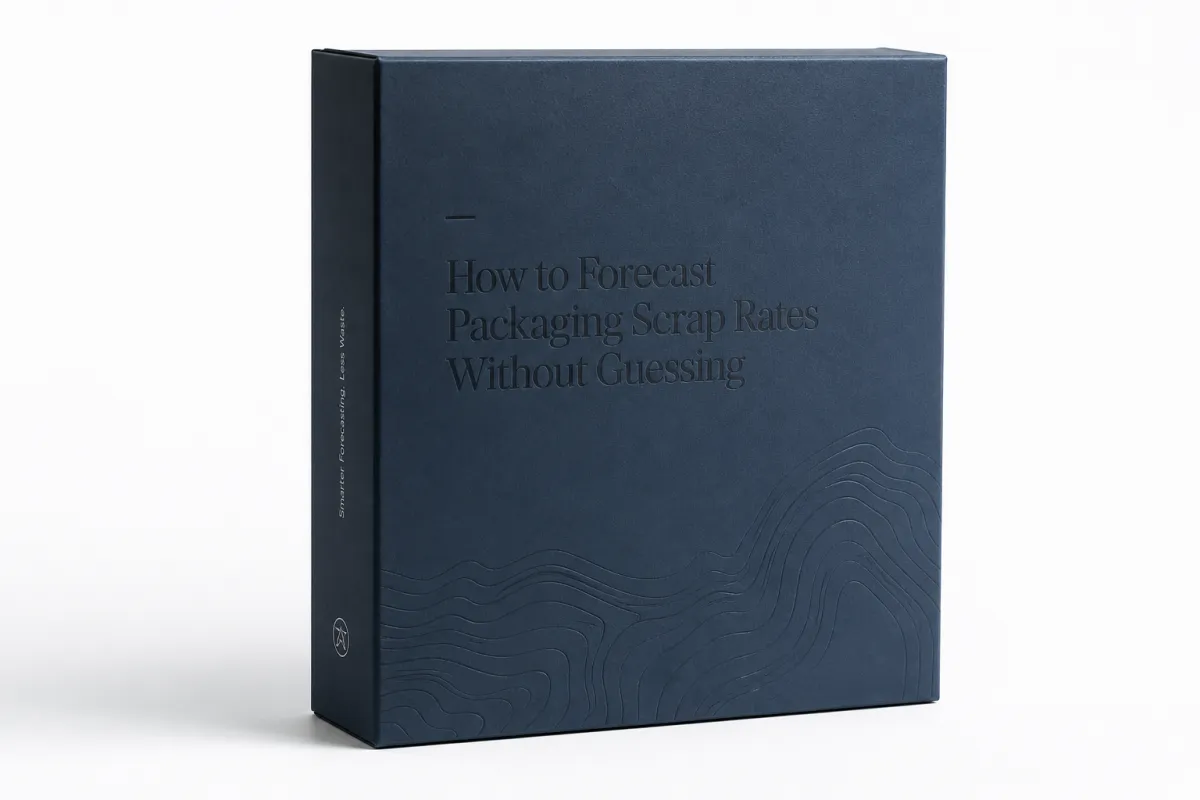
Too many teams treat how to forecast packaging scrap rates like a rough feeling pulled from the air. That approach breaks down fast. Scrap is the share of material that never becomes sellable product, and the waste can come from trim, startup sheets, threading loss, registration rejects, rework, line changeovers, or a finish that looked perfect on proof but behaved badly on press. On a folding carton run, the waste profile may be all about die-cut trim and sheet misfeeds. On flexible packaging, it may come from web setup, seal checks, and startup roll loss. For Custom Printed Boxes, the waste can shift again once foil, embossing, soft-touch coating, or heavy ink coverage enters the picture.
The fastest way to learn how to forecast packaging scrap rates is to make the waste buckets visible: startup waste, trim loss, reject rate, rework, and yield loss. The stakes are bigger than the quote. How to forecast packaging scrap rates changes material ordering, production timing, labor planning, and the conversation with the customer if the spec demands extra setup allowance. Buyers reviewing Custom Packaging Products often focus on unit price, yet the real cost lives inside the waste assumption buried underneath it. A job that runs clean at 2.5% scrap and another that runs at 5.5% may look close on paper, but the margin story is completely different once the press starts moving and the bin fills up.
That gap matters more than a small labor-rate change. On a large run, the difference can mean thousands of extra sheets, rolls, or labels. On a short run, it can decide whether the job is worth accepting at all. A method for how to forecast packaging scrap rates beats optimism every time, and it beats a blanket allowance copied from a different product line even more.
"A good scrap forecast is not a guess with nicer formatting. It is a controlled estimate based on the same substrate, same process family, and same machine behavior you expect to see on the floor."
There is also a language problem hiding in plain sight. If sales counts only finished rejects and production counts trim, startup loss, and rework, the same scrap rate can mean two different things. Numbers stop matching, meetings get noisy, and the forecast turns into an argument. The fix is not complicated: define the categories once, use them consistently, and let how to forecast packaging scrap rates become a shared tool instead of a disputed opinion.
How Packaging Scrap Rate Forecasting Works
How to forecast packaging scrap rates works best when waste is separated into clear buckets rather than mashed into one vague percentage. Startup waste covers the material consumed while the press, converter, or finishing line reaches target output. Steady-state waste captures the small losses that continue during normal running. Changeover loss includes material spent on adjustments, cleaning, reel changes, die swaps, and make-ready. Defect-related loss covers bad output caused by registration drift, adhesive failure, ink issues, or operator corrections that interrupt the run.
The formula is simple enough to fit on a sticky note: scrap percentage = waste material or waste units divided by total material used, multiplied by 100. The hard part is definition, not arithmetic. If trim is counted but setup sheets are not, or rework is counted but rejects are not, the number stops being comparable from job to job. That is why how to forecast packaging scrap rates improves sharply when the plant uses one reporting structure for similar work and refuses to improvise a new one every time the product changes.
Forecasting becomes more dependable when the data is sorted by SKU, substrate, print method, die, format, and machine condition. A 24-point flexo label on paper facestock behaves differently from a heavyweight carton with soft-touch lamination. A short-run seasonal item behaves differently from a stable, high-volume packaging program that runs the same way every month. Plants that sell across multiple categories, including retail packaging and branded packaging, usually get better results from a family-by-family baseline than from a single plant average that smooths away the real behavior.
Three views of the same job usually give the strongest forecast:
- Historical average - what similar jobs have done over the last few runs.
- Best-case run - what happened when the line was dialed in and the process behaved cleanly.
- Current condition - what has changed since that last good run, including material lots, operators, tooling, speed targets, or finishing steps.
That mix keeps the estimate grounded. Historical averages prevent wishful thinking. Best-case runs stop old problems from being baked into the model forever. Current conditions keep the forecast from pretending the machine, the operator, and the supplier have stayed frozen in time. That combination is what makes how to forecast packaging scrap rates useful instead of decorative.
Manufacturing measurement practice points in the same direction. Plants that already track waste by process can borrow the logic used in quality systems and sustainability reporting, especially where material efficiency matters. The EPA's materials management resources at EPA Sustainable Materials Management are a useful reminder that scrap is not only a cost issue. It is also a resource issue. For packaging buyers, that matters because less waste usually means less disposal, less reordering pressure, and a cleaner production story for the customer.
Key Factors That Change Scrap Rates
How to forecast packaging scrap rates correctly starts with accepting a simple fact: scrap rarely has one cause. Material behavior, machine condition, and human skill all influence the result, and the mix changes from one job to the next. A stiff paperboard holds registration differently than a flexible grade. Film with a narrow gauge tolerance can wander from lot to lot. Even ink coverage plays a role, because heavy coverage and special coatings affect drying, setoff, and handling. In packaging design, these details are often invisible in a rendering, yet they shape the waste profile on the floor.
Material variables deserve the first close look. Board caliper, film gauge, adhesive tack, surface energy, coating behavior, moisture content, and lot consistency all move the waste rate. If a supplier changes basis-weight tolerance or coating chemistry, the line may need more adjustment time before output stabilizes. That is one reason how to forecast packaging scrap rates should always reference the exact substrate family rather than the broad label of "paper" or "film."
Machine and process variables can be just as influential. A line running at 250 feet per minute can behave very differently from the same line at 400 feet per minute. Registration accuracy, web tension, die sharpness, temperature control, glue pattern, and unwind stability all matter. For Custom Printed Boxes, the same logic applies on the converting side: cutter setup, score depth, fold consistency, and print alignment can shift waste by a small amount per piece and a large amount over thousands of units. That matters when how to forecast packaging scrap rates has to account for both material and machine behavior, not just the line average.
Human variables are easy to underestimate and expensive to ignore. Operator experience, shift handoff quality, training depth, and response time during startup can swing scrap dramatically. A seasoned crew may dial in a difficult job faster than a new crew, but no forecast should pretend perfection. Any serious attempt at how to forecast packaging scrap rates has to account for who will run the job and how steady the shift pattern is likely to be.
Job characteristics change the math too. Long runs spread setup loss across more sellable units, which lowers the percentage impact. Short runs do the opposite. A job with four colors, a varnish, and a tight die-cut window nearly always needs more waste allowance than a straightforward one-color label. Customization level, finishing steps, and frequent changeovers raise the baseline. Retail packaging with heavy decoration tends to carry a different scrap profile than plain shipper cartons, and the difference is rarely subtle once production starts.
Supplier variation is the quiet variable that gets missed most often. Even when press settings stay constant, lot-to-lot differences in board stiffness, film clarity, or adhesive performance can push the waste rate up or down. If the raw material lands slightly outside the sweet spot the line was tuned for, startup waste can stretch longer than expected. That is another reason how to forecast packaging scrap rates should be refreshed when the supply base changes, not just when the product changes.
If a factor can change setup time, run speed, defect rate, or rework, it belongs in the forecast. If it can change all four, it belongs in the forecast twice: once as a risk and once as a check against the baseline. That is not overthinking. That is acknowledging how production actually behaves.
How to Forecast Packaging Scrap Rates Step by Step
There is a practical path for how to forecast packaging scrap rates without turning the estimate into a spreadsheet obsession. Start with comparable jobs, measure the waste consistently, and adjust the baseline for the variables that are already known before the run begins. Precision matters, but the goal on day one is not perfection. The goal is a forecast strong enough to quote, buy material, and schedule with confidence.
- Collect comparable history. Pull the last 10 to 20 jobs that match the same substrate family, process type, and machine class. If you are quoting custom printed boxes, use carton jobs with the same board weight, finish, and die complexity. If you are quoting labels or films, keep them in their own bucket. A useful forecast starts with comparable data, not a broad average from unrelated work.
- Separate the waste buckets. Split the data into startup waste, trim loss, rejects, rework, and changeover loss. That is where how to forecast packaging scrap rates sharpens quickly. A job with high startup waste but low steady-state waste needs a different allowance than a job with the opposite pattern.
- Adjust for known changes. Add or subtract waste for new artwork, tighter tolerances, new tooling, or a different adhesive or coating. If the job is moving from a simple single-color layout to a heavily branded packaging design with more coverage and finishing, the forecast should rise, not stay flat.
- Weight the most similar runs more heavily. A run from last month with the same die and the same press should count more than a run from last year on another machine. That one rule makes how to forecast packaging scrap rates far more realistic, because recent conditions usually matter more than distant history.
- Validate against first-run results. After the job runs, compare forecast to actual and log the difference. If the estimate was high by 1.2 points or low by 1.8 points, write down why. That feedback loop turns a one-time estimate into a living model.
Plants that need a simple starting point can also work in bands. Startup waste might sit around 4% to 8% on a complex job, while steady-state waste may settle near 1% to 3% once the line stabilizes. Those are not universal values, and nobody should copy them blindly. They are still useful for framing how to forecast packaging scrap rates without pretending every job behaves the same way.
Documentation matters more than most teams admit. If sales, operations, and purchasing are all looking at the same baseline, the forecast is easier to defend and easier to adjust. That is especially useful for product packaging programs with tight margins or retail packaging projects where the customer expects a very specific appearance standard. If the assumption changes, the price should change with it.
Plants that already use ISO-style process reviews or formal first-article checks can fold the scrap review into the same discipline. The point is not extra paperwork. The point is to keep how to forecast packaging scrap rates connected to actual run data, so the next quote is informed by the last real result rather than by memory and optimism.
Cost and Pricing Impacts of Scrap Forecasts
How to forecast packaging scrap rates has a direct impact on pricing because waste consumes material, and material is often the largest variable cost on the job. For pricing teams, how to forecast packaging scrap rates is really a margin protection exercise. That stays true whether the work is a simple shipper carton or a high-graphic branded packaging program with coatings, foil, and tight finishing tolerances. A small error in the waste assumption can snowball into a meaningful cost miss, especially when the substrate is expensive or the order size is modest.
A useful discipline is to show the waste allowance directly instead of burying it in a vague contingency line. If a carton job needs 1,000 extra sheets for setup and expected trim, say that. If a film run needs a 2.5% to 4% allowance because of threading and startup roll loss, write that in the estimate. Transparency makes how to forecast packaging scrap rates easier to review and easier to defend when purchasing asks why the material request is higher than the net order quantity.
| Forecast method | Typical use | Waste allowance shape | Main risk |
|---|---|---|---|
| Flat percentage estimate | Very early quoting or quick screen | Usually 3% to 6% on stable work | Too blunt for tight-margin or complex jobs |
| Job-family baseline | Recurring SKUs and repeat orders | Based on recent similar runs, often 2% to 5% | Can drift if tooling or suppliers change |
| Driver-based model | Mixed SKU plants and higher volume quoting | Adjusted by substrate, speed, tooling, and changeover risk | Needs disciplined data entry |
| First-run validated forecast | New launches and highly customized packaging | Split between startup and steady-state waste | Requires pilot or first-article feedback |
The table makes the tradeoff obvious. A flat percentage is fast, but it can underquote a difficult job and overquote an easy one. A driver-based model takes more discipline, yet it usually reflects actual material usage much better. If you are quoting custom printed boxes and retail packaging options, the extra precision can protect margin without making the price look padded.
Cost forecasting also reaches beyond material. Scrap eats labor time, machine time, disposal cost, and sometimes expedited freight if the overrun is large enough to force a second shipment of board, film, or inserts. In a busy plant, those ripples matter. I have seen jobs that looked fine on raw material cost but turned weak once the team counted the extra press time and the extra make-ready labor. That is why how to forecast packaging scrap rates should always sit next to a real cost model rather than floating alone as a percentage on a line item.
Used well, the forecast can improve customer conversations too. The buyer does not need every shop-floor detail, but a clear explanation helps when a tighter tolerance, a new foil pass, or a more decorative package branding requirement needs extra allowance. Customers usually respond well to process logic. They respond poorly to a surprise later. Honest forecasting tends to prevent that problem before it starts.
Waste reduction also carries an environmental angle. The EPA and organizations like FSC point to responsible material use as a practical priority, not just a message for a brochure. That is one more reason how to forecast packaging scrap rates well can support both the quote and the broader sustainability story around a packaging program.
Process and Timeline Considerations
How to forecast packaging scrap rates changes with the stage of the job. Before quoting, the forecast is a planning tool. Before purchasing, it becomes a material-order tool. Before scheduling, it becomes a capacity and labor tool. After production starts, it becomes a control tool. Each stage needs a different level of confidence, and using the same number for all four stages is a quick route to trouble.
A practical timeline usually looks like this:
- Pre-production estimate - Use historical data and a job-family baseline to set the first scrap assumption.
- Proof or pilot review - Check whether artwork changes, substrate selection, or finishing details push the forecast higher.
- First-run validation - Measure actual startup waste, reject rate, and steady-state performance.
- Post-job review - Compare forecast to actual and update the baseline before the next order.
That rhythm matters because short runs and long runs behave differently. On a short run, setup loss can dominate the percentage. On a long run, startup loss may look small relative to the full order, yet a slow drift in waste can still add up. A 10,000-piece order with a 150-piece setup loss behaves very differently from a 100,000-piece order with the same setup loss. That is why how to forecast packaging scrap rates should always be tied to order length, not just to the machine or the substrate.
Lead time changes the picture as well. If a job is quoted today but will not run for six weeks, the forecast should be checked again before release if any material or tooling shift has occurred. Operator assignments matter too. A strong night shift may run a complex line differently than a rotating crew. Even environmental conditions, such as humidity on paperboard or temperature on adhesive-backed materials, can shift the result enough to justify a quick review.
For package testing and transit validation, it helps to look at real test frameworks such as ISTA. If a package will go through drop, vibration, or compression testing, the forecast should include waste caused by rework, resampling, or prototype runs. That matters especially for shipping cartons, product packaging, and any program where testing is part of approval before full production release.
From a buyer's perspective, a regular review cadence is the most valuable habit. A forecast reviewed once a year drifts fast. A forecast updated after each major run, each supplier change, or each tooling update stays close to reality. That keeps how to forecast packaging scrap rates alive as an operating practice rather than a stale estimate sitting in a folder.
Common Mistakes in Scrap Rate Forecasting
Even careful teams miss the mark on how to forecast packaging scrap rates. The most common mistake is using a historical average without checking whether the last few jobs were distorted by maintenance issues, material defects, or unusual startup problems. An average can be mathematically correct and operationally useless at the same time. If the last three runs were affected by a broken die, a supplier issue, and a training gap, the average is no longer a clean baseline.
Another mistake is using one blanket percentage for every product family. Flexible packaging, folding cartons, labels, and corrugated work do not share the same waste pattern. Even inside one family, a simple unprinted structure behaves differently from heavily decorated branded packaging. If the forecast does not separate the families, it hides the real process behavior and creates noise in the quote.
Teams also stumble when they ignore setup waste and changeover loss. That problem is especially painful on short runs. A job can look efficient once the line is running, but if setup consumed more material than expected, the actual scrap rate ends up much higher than the estimate. Building startup allowance into the model separately avoids that trap. It also makes the estimate easier to explain when someone asks why the percentage looks higher than expected.
Another subtle mistake is forgetting to separate good-run trim from defective output. Trim is not ideal, but it is often predictable. Defects tell a different story: machine instability, ink coverage issues, seal problems, or operator response time. If those categories get mixed together, the team cannot tell whether the next fix belongs in design, tooling, maintenance, or training. That is a real risk when learning how to forecast packaging scrap rates because the wrong diagnosis leads to the wrong correction.
Forecasts also go stale when nobody updates them after a process change. New substrate, new supplier, new operator, new line speed, new tooling, new finishing step - any one of those can move the result. A forecast that was excellent six months ago can be weak today if the operating condition changed. The fix is straightforward, but it takes discipline: refresh the model whenever the process changes in a meaningful way.
"If the forecast does not change when the process changes, it is no longer a forecast. It is just an old note."
Expert Tips and Next Steps
Once the basics are in place, how to forecast packaging scrap rates improves with a few practical habits. The first habit is to use a rolling window of recent jobs and weight the most similar runs more heavily. A matching substrate, matching press, and matching finish should matter more than a generic average from another product line. That keeps the forecast current without letting a single outlier take over the model.
The second habit is to create separate bands for startup scrap, normal operating scrap, and problem-run scrap. That sounds small, yet it gives the team a clearer picture of what can be improved quickly and what needs a larger process change. Startup scrap may fall with better make-ready discipline. Problem-run scrap may require tooling or maintenance work. Once those pieces are visible, how to forecast packaging scrap rates becomes a management tool instead of a simple estimating number.
The third habit is to bring operations and estimating into the same review. The estimate team knows what the customer will tolerate and what the pricing pressure looks like. The floor knows how the machine behaves. Put those views together and the forecast gets stronger. That matters especially for custom printed boxes and other product packaging where the visual standard is strict and the material mix can shift quickly.
The fourth habit is to build a simple dashboard that shows forecast versus actual by SKU, line, and material family. You do not need a giant system to get value from this. Even a clean spreadsheet with monthly updates can reveal where the biggest misses live. Over time, the dashboard will show whether the misses are tied to one substrate, one shift, one operator group, or one vendor. That is the sort of pattern that makes how to forecast packaging scrap rates better month after month.
Here are the next steps I would recommend for most plants:
- Audit the last 10 to 20 comparable jobs and clean up the waste definitions.
- Set one baseline scrap method for the plant or for each major product family.
- Build a simple adjustment rule for startup waste, run length, and material change.
- Review the next production run against the forecast and document the difference.
- Use that result to revise the next quote instead of waiting for a quarterly review.
If your team sells through a broader packaging program, now is a good time to align the forecast with the rest of the packaging design and sourcing workflow. A cleaner specification, a better dieline, or a more suitable board grade can reduce waste before the line ever starts. That is where package branding and production reality meet. For buyers comparing options, it can help to review branded packaging solutions alongside the scrap assumptions so the design choice and the cost model tell the same story.
Most plants do not need perfection. They need a repeatable method that is honest about the real sources of waste and responsive when the process changes. That is the practical path for how to forecast packaging scrap rates without guesswork, and it is the same path that keeps pricing cleaner, schedules steadier, and customer expectations easier to manage.
Frequently Asked Questions
How do I forecast packaging scrap rates for a new product?
Start with the closest similar product and use its startup and steady-state waste as the baseline. Then adjust for new tooling, material changes, tighter tolerances, and any extra changeover steps. A pilot run or first article review is the best way to validate the estimate before pricing or material orders are locked in.
What data should I use when learning how to forecast packaging scrap rates?
Use recent job history for the same material family, process, and machine type whenever possible. Include setup waste, trim loss, rejects, rework, and maintenance-related loss if your plant tracks them separately. Keep the definitions consistent so the forecast is built from comparable numbers instead of mixed reporting.
How often should a packaging scrap rate forecast be updated?
Update it after any material change, tooling change, supplier shift, or major line adjustment. For high-value, tight-margin, or highly customized jobs, review it after each run. At minimum, refresh the baseline on a regular cadence so the model reflects current plant conditions and current process behavior.
Can scrap forecasting improve packaging pricing accuracy?
Yes. It turns waste into a visible cost instead of an implied guess, which helps estimators add the right material allowance and protect margin on competitive bids. It also gives you a cleaner explanation for customers when a job needs extra setup room or tolerance margin.
How accurate can a packaging scrap rate forecast be?
Accuracy improves when the forecast is built from similar jobs, clean data, and consistent scrap definitions. The best models separate startup waste from steady-state waste rather than blending them together. A forecast should be treated as a working estimate that gets refined after each run, not a fixed promise.
When teams take the time to build a repeatable method, how to forecast packaging scrap rates becomes far less mysterious. Material planning gets tighter. Quotes get cleaner. The floor sees fewer surprises. The real cost of a job becomes easier to read. That is the difference between a rough guess and a forecast worth trusting.


