Buyer Fit Snapshot
| Best fit | Custom Packaging Stickers with Logo projects where brand print, material claims, artwork control, MOQ, and repeat-order consistency need to be specified before quoting. |
|---|---|
| Quote inputs | Share finished size, material target, print colors, finish, packing count, annual reorder estimate, ship-to region, and any compliance wording. |
| Proofing check | Approve dieline scale, logo placement, barcode or warning zones, color tolerance, closure strength, and carton packing before bulk production. |
| Main risk | Vague material claims, crowded artwork, missing packing details, or unclear freight terms can make a low unit price expensive after revisions. |
Fast answer: Custom Packaging Stickers with Logo: Material, Adhesive, Artwork, and MOQ should be specified like a repeatable production item. The safest quote records material, print method, finish, artwork proof, packing count, and reorder notes in one written spec.
Production checks before approval
Compare the actual filled-product size with the drawing, then confirm tolerance on folds, seals, hang holes, label areas, and retail display edges. Reserve space for logos, QR codes, warning copy, and material claims before decorative graphics fill the panel.
Quote comparison points
Review material grade, print process, finish, sampling route, tooling charges, carton quantity, and freight assumptions side by side. A quote is only useful when the supplier can repeat the same color, closure quality, and packing count on the next order.
Custom Packaging Stickers with Logo: What to Know First
custom packaging Stickers with Logo are one of those packaging details that look modest on a quote sheet and then carry far more visual weight once the order is packed and shipping out. A plain mailer, kraft box, or tissue wrap can feel branded with one well-sized sticker, and that usually costs far less than adding a printed insert or redoing every carton in the run. For many brands, custom packaging stickers with logo are the fastest, lowest-risk way to make branded packaging feel deliberate without pushing the budget into uncomfortable territory.
Buyers notice the outer layer first. If the box, bag, or sleeve feels random, the rest of the package has to work harder to compensate. A closure sticker, seal, or logo mark that sits straight and prints clearly changes the reading of the whole package, even when the materials are simple. That is package branding in practical terms, not theater. I have seen a small, well-placed sticker do more for perceived value than a much pricier carton that was technically custom but visually awkward.
There is also a quiet advantage here: stickers are forgiving. If a brand is still refining its packaging system, custom packaging stickers with logo let you test scale, placement, finish, and material without locking yourself into a full redesign. That flexibility is especially useful for seasonal drops, early-stage ecommerce, and retail programs that are still settling into a stable format.
Custom Packaging Stickers With Logo: What They Actually Are
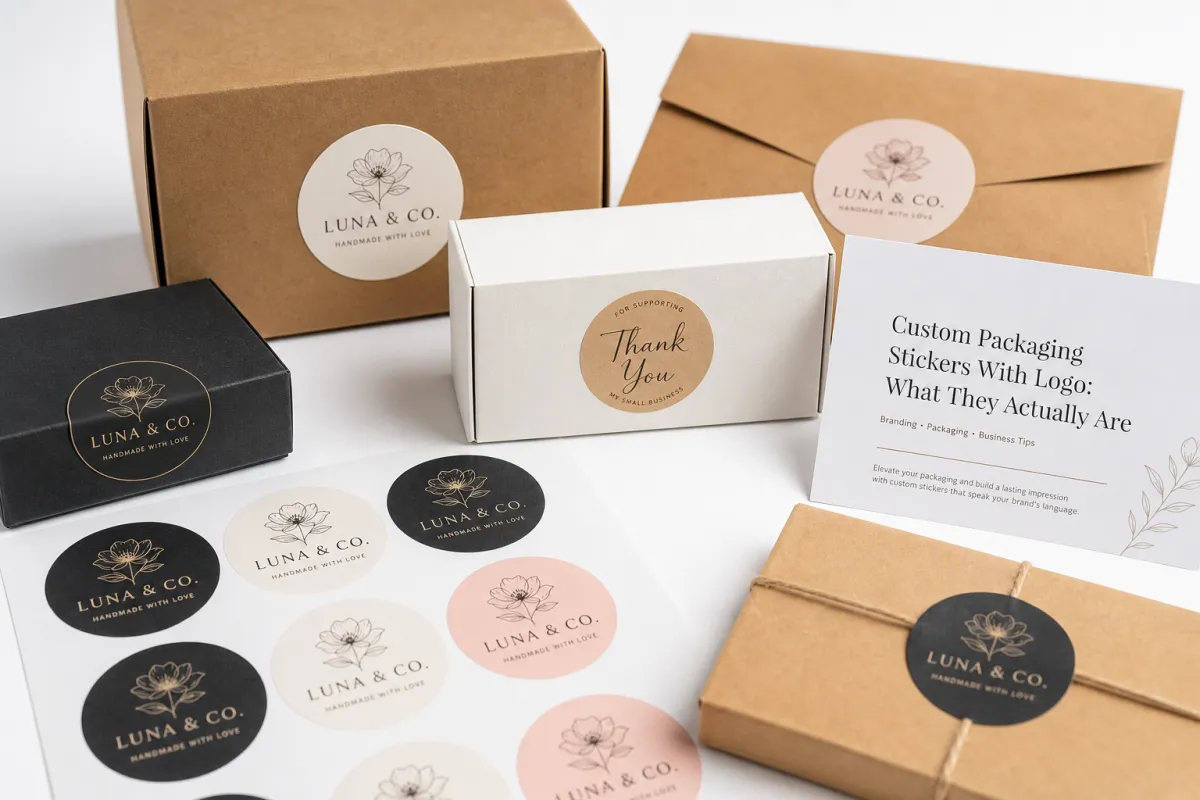
At the simplest level, custom packaging stickers with logo are adhesive brand pieces applied to packaging surfaces to identify the sender, seal a carton, decorate a bag, or support a campaign look. They can be round, square, kiss-cut into a shape, or arranged on a sheet for hand application. In everyday use, custom packaging stickers with logo do three jobs at once: they brand the package, they help close the package, and they make the entire presentation feel more finished.
You will see them on shipping boxes, kraft bags, candle jars, tissue wrap, thank-you cards, poly mailers, and sealed product sleeves. In retail packaging, they are often the easiest way to keep a collection visually tied together without changing the main carton art. For smaller launches, custom packaging stickers with logo can stand in for a more expensive print upgrade and still deliver a strong brand signal.
There is also a difference between a sticker and a label, even if buyers use the terms interchangeably. Stickers usually lean toward branding and decoration. Labels often carry more functional information such as ingredients, sizing, barcodes, or compliance details. A single design can do both jobs, but the material, adhesive, and print detail should match the use case. A sticker for a shipping box is not the same thing as a product label on a glossy jar.
From a packaging buyer's point of view, custom packaging stickers with logo are usually the cheapest visible upgrade you can make. They cost less than custom printed boxes, less than a full reprint of tissue or inserts, and far less than a packaging redesign. That does not make them disposable. It makes them smart when the goal is to improve product packaging without turning the supply chain into a mess.
Used well, they support packaging design rather than fighting it. That is the real trick. The sticker should look like it belongs to the system, not like someone slapped a logo on the corner five minutes before pickup.
How Custom Packaging Stickers With Logo Are Made
The workflow is more ordinary than most people expect, which is good news. custom packaging stickers with logo usually start with artwork review, then proofing, then print, then cutting or finishing, then packing and shipping. The part that slows orders down is rarely the printer running. It is the back-and-forth over file quality, bleed, cut lines, logo placement, and whether the final sticker will sit on a flat box or a curved surface.
Good files matter. A clean vector logo, a PDF with correct dimensions, and enough bleed around the artwork can save days. For most sticker production, a 0.125 inch bleed is common, and 300 dpi at final size is the bare minimum for raster art. Tiny type, thin outlines, and low-contrast gradients should be reviewed carefully because they can look crisp on a monitor and muddy on paper. That is where custom packaging stickers with logo either feel premium or frustrate the buyer who approved them too quickly.
Material choice changes the whole feel. Paper stocks are often enough for short-life indoor use, especially on tissue wrap, cartons, or inserts. BOPP and vinyl bring better moisture resistance and better handling if the package will be touched, stacked, or shipped. Specialty stocks can add texture or sheen for a more premium presentation. If the brand leans into sustainability, FSC-certified paper is worth asking about; FSC standards give buyers a clearer paper trail for responsibly sourced fiber.
Printing method matters too. Digital printing works well for smaller runs and faster approvals because setup is lighter and variable data is easier. Offset or flexographic printing usually makes more sense at larger quantities where unit economics improve and color consistency becomes more valuable. The right method depends on quantity, art complexity, and how strict the color match needs to be. A simple one-color logo on kraft paper behaves differently than a full-color wrap with fine gradients, and custom packaging stickers with logo should be spec'd accordingly.
Finishing is where the appearance changes fast. Matte reads softer and more understated. Gloss lifts color and contrast. Soft-touch gives a velvety feel that can make a basic sticker look more expensive. Foil and embossing add impact, though they also add cost and can complicate production. Die-cut shapes create stronger shelf appeal, while kiss-cut sheets are easier for hand-applied packing lines. In many packaging design projects, the finish does more to shape perceived value than the print method does.
Here is the basic production chain, stripped of marketing fluff:
- Design check and size confirmation
- Proof approval
- Printing
- Cutting or kiss-cutting
- Finishing and inspection
- Packing and shipping
If the shipment will travel hard, it can be worth checking the full package system against real transit conditions. The ISTA test methods are useful for understanding how packages behave under drop, vibration, and compression stress. The sticker itself is only one piece, but if the adhesive fails on a slick carton or a cold-wrap surface, the whole presentation suffers. That is the part people skip, then wonder why their custom packaging stickers with logo peel at the corner after two days in transit.
In my own review process, I like to place the sticker on the actual substrate and leave it alone for a day. If the edge lifts, if the print dulls against the surface, or if the size feels off in real light, you catch it early. That tiny bit of patience can save a lot of rework, and honestly, it is kind of a relief when a neat-looking proof also behaves in the wild.
Key Factors That Change the Look and Performance
Several variables decide whether custom packaging stickers with logo look sharp and hold up or look cheap and start failing the minute they touch a box. The biggest ones are material, adhesive strength, finish, size, shape, and the surface they will be applied to. Ignore any one of those and the result can drift from polished to sloppy pretty quickly.
Surface matters more than many buyers expect. Cardboard, coated paper, plastic, glass, and textured kraft all behave differently. A sticker that grips a glossy jar well may lift on a rough recycled mailer. A sticker that sits flat on a smooth box may wrinkle on a curved candle vessel. That is why custom packaging stickers with logo should be tested on the actual package substrate, not just approved on a white artboard mockup.
Logo complexity matters too. Tiny type, thin lines, delicate gradients, and low-contrast color palettes can get muddy fast, especially on uncoated or textured materials. A strong logo usually survives simplification better than a fragile one. If your mark has six colors and a hairline tagline, custom packaging stickers with logo may need a bigger size or a different finish just to stay legible.
Usage conditions change the spec. Cold storage, moisture, friction in transit, oily surfaces, and hand application all influence performance. A sticker for bakery packaging has a different job than a sticker sealing mailers for apparel. If the package is going into a refrigerator or a humid warehouse, paper may be the wrong call even if it looks nice on screen. BOPP or vinyl usually performs better there, though the final choice still depends on the application and budget.
Brand fit matters as much as technical fit. A matte sticker on a natural kraft box can feel warm and premium. The same matte sticker on a glossy, bright retail carton may look dull. A glossy sticker on a rustic box can feel disconnected. Good package branding is not about making every element loud. It is about making the sticker look like part of the same family as the box, tape, and insert.
A sticker cannot rescue weak packaging design. It can, however, make a sensible packaging system feel finished fast.
That is why custom packaging stickers with logo are often used as the final visual layer. They are not the foundation. They are the accent. Think of them the way you would think about closure tape, collar seals, or a clean tissue seal. Small thing, big impression.
If you are building the full package set, it helps to compare the sticker spec with the rest of the line. Our Custom Packaging Products page is a useful starting point if you are trying to match stickers with boxes, inserts, and outer mailers. If your project needs more functional identification than a sticker can handle, Custom Labels & Tags may be the better fit.
For a quick decision, this is the rough rule I use:
- Paper for dry, short-life, indoor use
- BOPP for durability, moisture resistance, and repeat handling
- Vinyl for tougher surfaces or more demanding packaging environments
- Specialty finishes for premium retail packaging where appearance drives perceived value
That does not mean the most durable option is always the best one. Sometimes the package only needs to survive a few days and still look good. Sometimes a softer stock supports the brand better than a plastic film. The right custom packaging stickers with logo are the ones that match the actual use case, not the fantasy version of it.
Cost and Pricing for Custom Packaging Stickers With Logo
Pricing is where people get surprised, usually because they ask for “stickers” as if every sticker has the same cost. custom packaging stickers with logo are priced by size, material, quantity, finish, shape, and how much setup work the order needs. Unit cost drops as quantity rises, but the cheapest quote is not always the best value if the adhesive fails or the print looks flat on the package.
For standard runs, a small paper sticker order might land around $0.03-$0.08 per unit at higher quantities, while BOPP or vinyl can sit closer to $0.06-$0.18 per unit depending on coverage and finish. Specialty pieces with foil, soft-touch, or complex die-cuts can climb into the $0.12-$0.35 per unit range or higher. Small runs can cost much more per piece, sometimes $0.25-$0.70 each, because setup has to be spread over fewer units. That is normal, not a scam.
Those figures are directional, not a universal price list. Supplier region, order size, freight method, and even how much artwork cleanup is needed can shift the final number. A buyer comparing quotes should be looking at the full spec, not just the bottom line. If one quote is lower because it uses a lighter adhesive or a less durable stock, the savings can vanish as soon as the first batch starts peeling.
The real quote is shaped by a handful of levers:
- Size - a 2 inch circle and a 4 inch custom die-cut do not cost the same
- Colors - full coverage and spot color accuracy can raise the price
- Stock - paper is usually cheaper than BOPP or vinyl
- Adhesive - standard permanent adhesive is easier than specialty low-temp or removable options
- Shape - simple cuts are cheaper than unusual outlines
- Format - sheets often suit hand packing, rolls suit faster application
- Finish - gloss, matte, soft-touch, foil, and embossing each change the quote
The table below gives a practical way to compare options without pretending every supplier prices the same way.
| Option | Typical Unit Cost | Best For | Tradeoffs |
|---|---|---|---|
| Paper, simple die-cut | $0.03-$0.08 | Short runs, dry packaging, hand packing | Less moisture resistance, lighter feel |
| BOPP, standard finish | $0.06-$0.18 | Shipping boxes, mailers, repeated handling | Higher cost than paper, plastic look on some brands |
| Vinyl, durable finish | $0.08-$0.22 | Rougher surfaces, tougher transit conditions | Usually overkill for simple branded packaging |
| Specialty finish, premium cut | $0.12-$0.35+ | Retail packaging, gift sets, higher perceived value | More setup, more proofing, more cost |
There are also costs buyers forget because they are not printed on the first quote. Sample packs, file cleanup, rush fees, shipping, and reprints from bad artwork can move the total more than a tenth of a cent here or there. If the logo file is low-resolution and the supplier has to redraw it, that can add real cost. If the finish needs a revision after proofing, the timeline and budget both stretch. custom packaging stickers with logo are cheap only when the spec is clean and the artwork is ready.
For premium boxes, I usually tell buyers to spend a little more on the finish before spending more on quantity. That sounds backward until you actually open the package. A slightly better stock, a cleaner gloss, or a nicer die-cut can do more for brand perception than ordering twice as many mediocre stickers. In other words, custom packaging stickers with logo should support the package hierarchy. If the box is already premium, the sticker should not look like the bargain bin part.
There is one more thing to remember: a sticker quote is only smart if it matches the rest of the product packaging plan. If the outer carton is custom printed, the sticker may only need to seal or reinforce. If the carton is plain, the sticker may carry far more visual weight. That difference changes the budget logic. A buyer comparing custom packaging stickers with logo against custom printed boxes should not expect the same value calculation.
Timeline for Custom Packaging Stickers With Logo Orders
Timeline is where many packaging programs get sloppy. custom packaging stickers with logo can move quickly, but not instantly, and the full schedule includes more than the print time. A normal order usually moves through artwork review, proof approval, production, finishing, inspection, packing, and shipping. If any one of those steps gets stuck, the launch date does too.
For standard runs, it is common to see 24-48 hours for proofing, then 5-10 business days for production after approval, plus shipping time. Specialty finishes, custom shapes, or large quantities can push that to 10-15 business days or more. Rush orders are possible with some suppliers, but faster service usually means fewer finish choices and a higher unit price. There is no free lunch here. There is just time, money, and the occasional panic email.
Delays usually come from the same places:
- Unclear artwork or missing bleed
- Late proof changes
- Unexpected cut-line revisions
- Specialty materials that need extra handling
- Orders placed too close to a launch date
The best move is to plan backward from the date the packaging has to be in hand. If the boxes ship on the 20th, the stickers should not be “maybe arriving around then.” They should already be in your packing area. That sounds obvious, yet people still treat custom packaging stickers with logo like a last-minute accessory instead of a supply item that can stop fulfillment if it is late.
Another practical habit is to lock the final dimensions early. If the sticker is changing from 2 inches to 3 inches after proofing, the proof, layout, and cut line may all need to be redone. If the final use surface is a different box or bag than planned, the adhesive choice may change as well. Getting custom packaging stickers with logo scheduled is much easier when the substrate, size, and quantity are already confirmed.
Small runs can actually be a better scheduling tool than large ones if the brand is still testing packaging design. You can order a short proof run, test it on the package, and then place the larger order once the spec is proven. That is a lot safer than guessing wrong and eating the cost of a full batch. A sticker reorder is annoying. A wrong sticker reorder on a launch deadline is a proper headache.
For limited drops, holiday campaigns, or product packaging tied to a promotion, I would still pad the schedule by a week if possible. Transit delays, proof edits, and reprints are not rare enough to ignore. A clean plan for custom packaging stickers with logo usually beats a “we can probably make it” plan, especially if the boxes, inserts, or retail packaging are also moving on the same timeline.
Common Mistakes When Ordering Custom Packaging Stickers With Logo
The first mistake is making the logo too small. People trim the artwork down to fit a neat layout, then act surprised when the mark disappears on a moving box, textured bag, or busy retail package. custom packaging stickers with logo need enough visual area to breathe. If the logo is supposed to be the point, give it room. If it is tiny, it becomes visual noise.
The second mistake is choosing the wrong adhesive. A permanent adhesive may be fine on a dry paper carton, but a coated surface, cold package, or dusty recycled box can need a different tack profile. A sticker that peels at the edge or slides after application is not a design problem. It is a spec problem. That is why testing custom packaging stickers with logo on the actual surface matters so much.
The third mistake is a finish mismatch. A super glossy sticker on a rustic kraft box can look off-brand fast. So can a muted matte sticker on a high-shine cosmetic carton. Package branding works best when the surface finish and print finish speak the same language. If the rest of the package is clean and polished, the sticker should not look like it wandered in from another project.
The fourth mistake is skipping a sample on the real package. A proof on white art paper is not the same as a sticker on corrugated board, coated card, or glass. Real surfaces reveal the truth about adhesive, color, and flex. If the brand is serious enough to spend money on custom packaging stickers with logo, it is serious enough to test them before ordering a full batch.
The fifth mistake is ordering the wrong quantity. Too few units create panic reorders and potential color drift between runs. Too many tie up money and storage space. A lot of buyers forget that packaging campaigns change. The logo may get updated, a seasonal message may expire, or the package system may shift to a new box size. It is usually smarter to buy based on a realistic launch window, not a dream scenario where the same sticker lives forever.
There is also a quiet mistake that shows up in teams with good intentions: treating the sticker as an afterthought. That leads to last-minute file issues, weak hierarchy, and clumsy placement. custom packaging stickers with logo should be part of the packaging system from the beginning, alongside shipping cartons, inserts, and the rest of the product packaging plan. Otherwise you get a sticker that technically exists, but does not actually help the brand.
Here is a short sanity check before you approve any order:
- Is the logo legible at the final size?
- Does the adhesive match the package surface?
- Does the finish fit the brand mood?
- Has the sticker been tested on the real packaging material?
- Is the quantity tied to an actual use window?
Expert Tips and Next Steps
If the goal is to make a smart buy, start by requesting a sample pack or at least a small proof run. That one step saves more money than people expect because it surfaces surface issues, color issues, and sizing problems before the full order is locked. custom packaging stickers with logo are simple products on the surface, but the final result depends on details that do not show up in a mockup.
Test on the real surface in the real environment. Put the sticker on the actual box, bag, jar, or sleeve. Let it sit. Press it. See how the edges behave. If the package is going into a warehouse, fridge, or delivery route, check it under those conditions too. A lot of packaging disasters are just untested assumptions in a nicer font.
Build a simple spec sheet before you ask for quotes. Include size, shape, quantity, material, finish, adhesive type, application surface, and whether the sticker is hand-applied or machine-applied. That one page makes supplier comparisons much easier. It also stops the classic “why are these two quotes so different?” confusion, because the buyer is finally comparing the same custom packaging stickers with logo spec across multiple vendors.
Compare at least two or three suppliers on the same spec. Otherwise the lowest quote may just be the weakest spec. One supplier might quote paper; another might quote BOPP. One might include setup; another might hide it. One might build in the right adhesive while another assumes a flat carton and hopes for the best. Smart buying is less about shopping hard and more about comparing cleanly.
Use the sticker as part of the wider package system. If your brand is moving into custom printed boxes, the sticker may only need to reinforce a seal or add a small branded touch. If your carton is plain, the sticker has more work to do. If your brand is retail-facing, the sticker may need stronger shelf presence. That is why custom packaging stickers with logo can be such a useful tool: they adapt to different stages of packaging maturity without forcing a full retool.
My practical order sequence looks like this:
- Confirm the use case and package surface
- Shortlist 2-3 material options
- Request quotes on the same spec
- Order samples or a small proof run
- Adjust size or finish if needed
- Lock the final production order
If you are still early in the process, it helps to think about the whole branded packaging system, not just the sticker. That may mean comparing closure seals, box decals, and other small identity pieces against the main carton. A good sticker often works best as the final layer of package branding, not the whole strategy.
Final Take
custom packaging stickers with logo are not glamorous, and that is part of the appeal. They are fast to specify, flexible to apply, and usually much cheaper than changing the whole package structure. Used well, they can lift a plain mailer, a kraft bag, or a retail sleeve and make the brand look more deliberate without turning the budget into a cautionary tale.
The buyers who get the best results are the ones who treat the sticker like a real packaging component. They test the surface, check the adhesive, match the finish to the brand, and plan the timeline backward from the launch date. That is the difference between a sticker that looks nice in a mockup and custom packaging stickers with logo that actually hold up in production.
If you are comparing options now, start with the use case, Choose the Right material, and ask for samples before you place the full order. Then lock the size, finish, and application method before production begins, because that is where the good orders stay good. A clean spec turns custom packaging stickers with logo into a reliable part of the packaging system instead of a small item that keeps causing big, avoidable problems.
FAQ
How do custom packaging stickers with logo differ from product labels?
Stickers are usually branding-focused and go on boxes, bags, tissue, or inserts. Labels often carry more functional information such as ingredients, sizing, or compliance details. A single design can do both jobs, but the material and adhesive should match the task.
What material works best for custom packaging stickers with logo on shipping boxes?
For dry, indoor use, coated paper can be enough and keeps costs lower. For rough handling or moisture exposure, BOPP or vinyl usually performs better. Test the sticker on the actual box finish before ordering a full run.
How much do custom packaging stickers with logo usually cost?
Pricing drops as quantity rises, so small runs cost more per piece than bulk orders. Size, finish, shape, and adhesive type can change the quote more than people expect. Ask for tiered pricing and include sample, setup, and shipping costs so the real total is clear.
How long does it take to produce custom packaging stickers with logo?
Most timelines include proofing, production, finishing, and shipping, so the full process is longer than print time alone. Simple orders move faster than specialty finishes or complex die-cuts. If the launch date matters, build in buffer time for proof revisions and transit.
Can I order custom packaging stickers with logo in small quantities?
Yes, especially with digital printing, which is built for flexible lower-volume runs. The per-piece price will be higher than bulk, but it is often the smarter choice for launches or limited editions. Small runs are useful when you are still testing size, finish, and placement.

