Buyer Fit Snapshot
| Best fit | Custom Packaging with Embossing projects where brand print, material claims, artwork control, MOQ, and repeat-order consistency need to be specified before quoting. |
|---|---|
| Quote inputs | Share finished size, material target, print colors, finish, packing count, annual reorder estimate, ship-to region, and any compliance wording. |
| Proofing check | Approve dieline scale, logo placement, barcode or warning zones, color tolerance, closure strength, and carton packing before bulk production. |
| Main risk | Vague material claims, crowded artwork, missing packing details, or unclear freight terms can make a low unit price expensive after revisions. |
Fast answer: Custom Packaging with Embossing: Design, Process, Cost should be specified like a repeatable production item. The safest quote records material, print method, finish, artwork proof, packing count, and reorder notes in one written spec.
Production checks before approval
Compare the actual filled-product size with the drawing, then confirm tolerance on folds, seals, hang holes, label areas, and retail display edges. Reserve space for logos, QR codes, warning copy, and material claims before decorative graphics fill the panel.
Quote comparison points
Review material grade, print process, finish, sampling route, tooling charges, carton quantity, and freight assumptions side by side. A quote is only useful when the supplier can repeat the same color, closure quality, and packing count on the next order.
Custom Packaging with Embossing: Design, Process, Cost
Custom packaging with embossing does something packaging teams spend years trying to achieve with ink alone: it makes a brand feel intentional before a customer has fully processed the logo. A raised monogram, seal, border, or wordmark changes the first touchpoint in a way that flat print cannot quite match. The effect is subtle on a spec sheet. In hand, it is not subtle at all.
I have seen plain cartons turn into keepers with one well-placed emboss. I have also seen beautifully printed packs lose their nerve because the texture was wrong, the board was too soft, or the emboss sat too close to a fold. That gap between concept and finished object is where custom packaging with embossing either earns its keep or quietly falls apart. No drama, just physics and judgment.
For brands weighing custom printed boxes, rigid presentation packaging, sleeves, or premium labels, embossing often sits in a sweet spot. It can feel restrained on a matte carton, polished on a rigid box, and quietly expensive on a sleeve. It does not need loud color or busy artwork to do its job. The surface itself carries the message, which is why this finish can feel more refined than a design crowded with effects.
And there is a practical reason buyers keep circling back to it. Custom packaging with embossing rewards planning. The board, artwork, die, press settings, coating, and finishing sequence all shape the final result. Get those aligned and the detail looks crisp. Miss one and the raised area can soften, flatten, or crack in a way that is obvious the moment someone runs a thumb across it.
What custom packaging with embossing really means
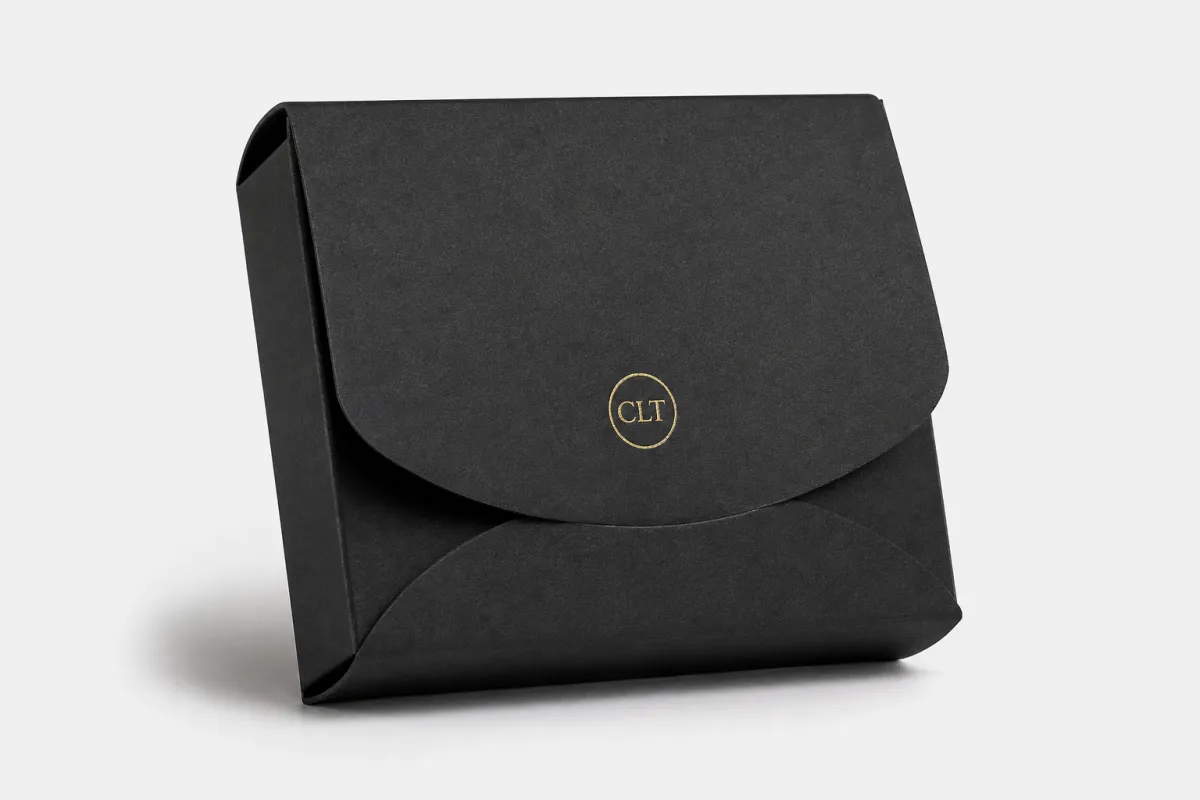
At its core, custom packaging with embossing means pressing a design into paperboard or label stock so the surface rises above the surrounding area. A matched male and female die apply pressure from opposite sides, and the material takes on a sculpted form rather than staying flat. That physical change is the whole point. Many people notice the texture before they notice the color, which is why the finish can alter first impressions so quickly.
Embossing is not a printed illusion or a coating sitting on top of the substrate. It changes the material itself. That distinction matters more than it sounds. Paper fiber structure, caliper, coating, and stiffness all influence how sharply the detail holds. Debossing pushes inward instead of upward. Flat print leaves the surface level. Each has a role, but only custom packaging with embossing gives that lifted tactile cue people tend to remember when they cannot quite recall the exact shade of the box.
You will usually see custom packaging with Embossing on Folding cartons, rigid boxes, sleeves, inserts, presentation boxes, and premium labels. That pattern makes sense. Those formats are already doing brand work before the product is opened, so the finish supports the experience from the outside in. Cosmetics, gourmet foods, candles, apparel accessories, collectibles, and gift sets all benefit from that sort of first-contact detail.
A quiet emboss can outperform a louder design. A blind emboss on a matte board may feel more expensive than a crowded layout with four inks, a foil stamp, and too many competing elements. I know that sounds almost backwards, but the sample table usually tells the story. The box does not need to shout. It needs to feel considered.
Material choice still decides how far the idea can go. Thick board gives the raised area cleaner edges. Softer stock can collapse around the image. Heavy coatings may soften the form. Those variables explain why the same artwork can look elegant on one package and disappoint on another. Custom packaging with embossing works best as a system of choices, not as a single decorative trick.
For brands comparing options across Custom Packaging Products, embossing often becomes the small detail that changes the whole read. It creates a pause point for the eye and a little proof of care for the hand.
How custom packaging with embossing works in production
Custom packaging with embossing starts with a die set, usually a metal male die paired with a matching counter-die. The sheet or assembled board passes between them under controlled pressure, and the material takes shape in the gap. Heat can help in some workflows, but pressure and alignment do the real work. A slight registration error on a logo that also uses foil or print can throw off the whole effect, even if the file looked perfect on screen.
Several embossing styles show up again and again in packaging production. Blind embossing raises the image with no ink or foil over it, which gives a clean, understated result. Registered embossing aligns the raised area with printed or foiled artwork, so the surface and the image land together. Multi-level embossing builds different heights into one design, which can look dramatic but demands tighter control of the die and the substrate response. The more dimensional variation you ask for, the more carefully the press team has to manage pressure and board recovery.
Prepress work has to be disciplined before any run starts. Vector files should be clean, line weights should match the size of the mark, and tiny serifs or hairline strokes usually need simplification. Tight letter spacing can close up under pressure. Folds and edges need safe zones because board movement and scoring can shift the image. When an artwork file looks sharp on a monitor but carries too much micro-detail for the chosen stock, custom packaging with embossing tends to expose the problem fast. Gonna sound obvious, but that is exactly why a great-looking mockup is not enough.
The order of finishing matters more than many buyers expect. Some jobs print first and emboss later. Others emboss after lamination or coating when the surface needs a certain stiffness or drag to hold definition. On some custom printed boxes, foil and emboss are run together, while spot UV may be applied before or after depending on the line and the desired look. There is no universal sequence that fits every product packaging spec. A smoother coated board can sharpen the image, while a very glossy surface may resist a deep press.
Sample pulls matter because a screen proof cannot tell the whole story. A design may look perfect in a PDF and still lose definition, crack at the edge of a heavy foil layer, or flatten if the stock is too light. Physical review changes the conversation. Hold the sample. Tilt it under light. Feel the raised area across the face of the package. That is where custom packaging with embossing proves whether the idea is actually working or just looking good in theory.
Good suppliers also think about handling and transit, because a box that looks beautiful in a studio can suffer fast if the distribution path is rough. Standards from organizations such as ISTA help frame broader pack performance, even when embossing is only one finish in the stack. For brands making fiber and sourcing decisions, certifications from groups like FSC belong in the same conversation.
Custom packaging with embossing cost, pricing, and MOQ
Cost is where custom packaging with embossing becomes very tangible. Tooling, box size, die complexity, embossed area, board thickness, and registration with foil or print all affect the number. A large panel with several depth levels needs more detail in the tool and more time on press. A mark placed near a fold or structural edge raises the risk of distortion, which increases the attention needed during production.
Minimum order quantity changes the arithmetic. Tooling and setup costs spread across fewer units on a short run, so the unit price stays higher. On larger runs, that same setup gets diluted across more boxes and the per-unit cost usually drops. Many buyers find that custom packaging with embossing lands best somewhere in the middle of the range, where the premium effect still matters and the run is large enough to absorb the tooling without strain.
A simple blind emboss on a straightforward carton may add only a modest amount per unit on a run of 5,000 pieces. A registered emboss with foil or a deep multi-level mark costs more because it asks for extra setup, closer inspection, and tighter registration. Exact numbers vary by shop, sheet size, and material, but the direction never changes: more precision means more labor and more time. Custom packaging with embossing is not expensive because it is decorative. It costs more because it is controlled.
Use the comparison below as a planning frame before requesting quotes for custom packaging with embossing.
| Embossing option | Typical tooling | Estimated unit impact at 5,000 pcs | Best use case |
|---|---|---|---|
| Blind emboss | $120-$300 | Low to moderate | Clean logos, monograms, understated retail packaging |
| Registered emboss | $180-$450 | Moderate | Print-aligned brand marks, seals, decorative panels |
| Emboss + foil | $250-$650 | Moderate to high | Premium custom printed boxes, gift packaging, presentation kits |
| Multi-level emboss | $350-$900+ | High | High-detail package branding, luxury sleeves, statement boxes |
Those ranges are directional, not fixed. They help show the relationship between complexity and cost. If a quote comes in unusually low, ask whether the tooling is reusable, whether samples are billed separately, and whether the finish is truly a registered emboss or just a shallow press effect. With custom packaging with embossing, buried details in the quote can matter more than the headline price.
Ask how repeat orders are handled. In many cases, tooling can be reused, which lowers the cost on reorders. That is one reason custom packaging with embossing becomes more attractive over time for a steady product line. The second order may carry a better unit cost than the first because the one-time setup work has already been absorbed. Also confirm the substrate. A change from 350gsm C1S artboard to a softer stock can alter the result enough to require new tooling decisions or a different production setup.
If you are comparing Custom Packaging Products from more than one supplier, make sure the embossed area, stock, and finishing sequence match. Otherwise the quotes may look similar and behave very differently once production starts.
Custom packaging with embossing process and timeline
The path for custom packaging with embossing usually starts with concept and dieline review, then moves into proofing, toolmaking, press setup, finishing, packing, and shipment. The sequence looks straightforward on paper. In practice, each step protects the one after it. Concept and dieline review confirm that the raised area lands on a safe panel. Proofing checks proportion and placement. Toolmaking turns artwork into a physical die. Press setup calibrates pressure and alignment. Finishing may include print, lamination, foil, coating, or die cutting before the boxes are converted and packed.
Lead time depends on variables people often underestimate. Artwork revisions can take a day or a week if the team keeps changing the emboss size. Die fabrication takes time because the tool has to be made accurately. Stock sourcing matters because not every board is ready immediately. Finishing queue matters because a shop may already have other runs scheduled on the same equipment. Custom packaging with embossing tends to move slower than plain print because there is more to coordinate and less room for loose assumptions.
Fast approvals help. Clean vector files help. A locked substrate helps. A simple emboss area helps. What does not help is trying to compress the process past the point where tooling and press calibration still matter. A rush order can reduce communication time, but it cannot remove physics. A simple blind emboss may move from proof approval to shipment faster than a premium multi-step box, yet both still deserve a sample review if consistency matters.
Common bottlenecks appear when custom packaging with embossing is paired with foil, special coatings, or lamination. Those additions are often worth the effort, but they add passes or demand more careful handling. If the film or coating is too slick, definition softens. If the foil is too heavy, fine detail can lose clarity around the edges. If die cutting happens too close to the embossed area, the board may shift enough to affect registration. The cleanest plan maps the order of operations before production begins.
For most buyers, the expectation should be simple: custom packaging with embossing is a premium finishing step, and premium steps need disciplined scheduling. A truthful 12-15 business day window after proof approval is better than a promise that leaves no room for sample review or rework. Clear timing saves frustration on both sides of the table.
Step-by-step guide to designing custom packaging with embossing
Start with the packaging format and the brand moment the emboss should support. Is the raised detail sitting on a rigid lid, a sleeve, a seal on a carton, or a border around the front panel? That decision matters because custom packaging with embossing should strengthen the structure of the pack, not wrestle with it. The best emboss looks built into the box, not pasted on as an afterthought.
Shape the artwork so it can survive pressure. Clean vector files are the baseline. Line weights should stay sensible. Tiny details should be reduced before they become a production problem. Small type often needs more spacing. Thin decorative strokes can vanish once the board compresses. In custom packaging with embossing, clarity usually beats delicacy. A design that looks almost too simple on screen can read beautifully in hand.
Choose the substrate and finish with the emboss in mind. Thicker paperboard and rigid stock usually give the cleanest result because they hold shape under pressure. Smooth coatings can help definition, though a surface that is too glossy or brittle may resist texture. Soft-touch lamination can work especially well with custom packaging with embossing on premium custom printed boxes because the contrast between the velvety surface and the raised mark creates a strong tactile moment. The same logic applies to matte boards paired with subtle foiling.
Request a digital mockup, then ask for a physical sample if the budget and schedule allow it. Screen renderings cannot reproduce real shadows or the way light catches the edges of a raised surface. Touch also changes the evaluation. A design that seems right in a flat mockup can feel underpowered if the stock is too soft or the embossed area is too large. This is where custom packaging with embossing separates itself from ordinary print work: the hand tells you whether the design is actually doing its job.
Approve the proof with production realities in mind. Check registration, panel orientation, fold lines, seam locations, and the distance between the emboss and any score or edge. If a fold line runs through the raised detail, the board can crack or flatten. A capable press team will protect the emboss, but the design has to support that effort. If you are still deciding among package branding options, keep the embossed element focused and let the rest of the box stay calm.
One simple rule helps a great deal: use embossing as a focal point rather than covering every panel. One strong tactile moment usually feels more premium than several weak ones. That holds especially true in retail packaging, where the customer sees the box quickly, handles it once, and decides just as quickly whether it feels worth keeping.
Common mistakes with custom packaging with embossing
The first mistake is crowding too much detail into too little space. Small type, thin strokes, dense textures, and tightly packed line work all struggle under pressure. The board fibers can only move so far before the image starts to fill in or lose edge definition. Custom packaging with embossing rewards restraint. If the artwork can be simplified without weakening the brand, the final result is usually stronger and more durable.
The second mistake is choosing the wrong stock. A board that is too thin, too soft, or too heavily coated often fails to hold a clean raised image. The press may still leave a mark, but it will not carry the crisp edge people expect from custom packaging with embossing. Buyers sometimes blame the die when the real problem is caliper or surface behavior. That is why paperboard selection belongs early in the process, not after artwork approval.
Registration errors cause another common failure, especially when embossing has to line up with foil or ink. A slight shift can make the design feel off-center or unbalanced even when the print itself looks fine. In custom packaging with embossing, the tactile element carries meaning, so alignment matters more than many first-time buyers realize. A logo that sits just a little outside the foiled shape can make the whole package feel less deliberate.
Skipping sample review is risky. A flat proof cannot show how a box feels in the hand or how the raised area behaves under light. Shallow depth, uneven pressure, or a fold line threatening the embossed panel may not show up until a physical sample arrives. With custom packaging with embossing, sample approval is not a luxury step. It is the point where the design becomes real.
Another mistake is assuming every press behaves the same. Tooling, machine settings, operator technique, and material response all affect the final result. Two suppliers can receive the same file and still produce different outcomes because one uses a different caliper, a different lamination, or a slightly different pressure profile. That is not a flaw in the process. It is simply how custom packaging with embossing works in the real world. The material is part of the design, not just the carrier for it.
Teams also overfinish. Emboss plus foil can be beautiful. Emboss plus spot UV can work. Once the design starts stacking treatments for their own sake, the tactile effect loses force. Strong packages usually have a clear hierarchy: one finish leads, the others support. That is the sweet spot for branded packaging that wants to feel premium without becoming noisy.
Expert tips and next steps for custom packaging with embossing
If you want custom packaging with embossing to feel expensive in the right way, let the emboss be the lead element. Keep the rest of the package restrained. A matte field, a quiet color palette, or a soft-touch coating gives the raised detail room to breathe, and that contrast often works harder than extra decoration ever could. The eye notices shape faster when the surrounding surface is calm.
Pairing custom packaging with embossing and foil can be striking, especially for logos, seals, and presentation lids, but the artwork should be planned so the two finishes support each other instead of competing. Spot UV can also work, though it should be used sparingly on packaging where touch is already doing a lot of the talking. Once the finish stack starts to feel crowded, the premium signal weakens instead of strengthening.
For most buyers, the most useful sequence is straightforward: gather the artwork, mark the emboss location, confirm the substrate, request a sample, review the quote, and lock the timeline before release. That order keeps rework down because each step narrows the decision space in a useful way. It is much easier to price custom packaging with embossing accurately once the board, finish, and die size are settled.
Compare sample options side by side if you can. A small shift in board stiffness or coating can change the way the raised image reads, especially on larger logos or decorative borders. The first sample is not always the winner. Sometimes the second sample, with a better substrate or a simpler emboss depth, is the one that feels right in hand. That is not indecision. That is good production judgment.
If you are evaluating Custom Packaging Products for a launch, start with the item the customer will touch most often. For a gift set, that may be the outer box. For a subscription item, it may be the sleeve. For a premium retail product, it may be the front panel of the carton. Custom packaging with embossing does its best work on the surface that creates the first physical impression, so place it where the hand will find it naturally.
A strong emboss should be felt before it is explained.
The practical takeaway is simple: lock the substrate, the emboss size, and the finishing sequence before you commit to production. That trio does more to protect quality than a fancy mockup ever will. If those choices are solid, custom packaging with embossing can move from a nice idea to a package that feels deliberate every time someone lifts the lid, turns the sleeve, or runs a thumb over the logo.
For teams ready to move from concept to quote, sample approval is usually the smartest next step because that is where the tradeoffs become visible. Once the sample confirms the material, pressure, and registration, custom packaging with embossing can be judged on real performance instead of guesswork.
What is custom packaging with embossing used for?
Custom packaging with embossing is used to create a raised, tactile brand detail That Feels Premium even when the printed design stays simple. It works especially well for logos, seals, monograms, borders, and other elements a customer should notice by touch and sight. You will see it often on cartons, rigid boxes, sleeves, and presentation packaging where first impressions matter.
Is custom packaging with embossing more expensive than standard print?
Usually yes, because custom packaging with embossing adds tooling, setup, and press time on top of the printed package. The price impact depends on size, depth, die complexity, and whether the emboss must register with foil or other finishes. Longer runs generally lower the unit cost because setup gets spread across more pieces.
What materials work best for embossed custom packaging?
Thicker paperboard and rigid stocks usually give the cleanest result because they hold shape under pressure. Smooth but not overly slick coatings tend to work better than very heavy or brittle finishes. Highly detailed custom packaging with embossing often needs a material with enough caliper to preserve definition without cracking.
How long does custom packaging with embossing take to produce?
Timing depends on artwork approval, die creation, stock sourcing, and the number of finishing steps involved. Simple jobs can move faster, while detailed or multi-process packaging usually needs more lead time for tooling and proofing. The safest planning approach is to allow time for at least one sample review before final production.
Can embossing be combined with foil or spot UV on custom packaging?
Yes, embossing is often paired with foil or spot UV to add contrast, shine, and dimension in a single design. The artwork has to be planned carefully so the finishes register correctly and the raised area still reads cleanly. Combining treatments usually increases cost and timeline, but it can create a stronger premium effect when done well.

