Buyer Fit Snapshot
| Best fit | Custom Embossing on Folding Cartons projects where brand print, material claims, artwork control, MOQ, and repeat-order consistency need to be specified before quoting. |
|---|---|
| Quote inputs | Share finished size, material target, print colors, finish, packing count, annual reorder estimate, ship-to region, and any compliance wording. |
| Proofing check | Approve dieline scale, logo placement, barcode or warning zones, color tolerance, closure strength, and carton packing before bulk production. |
| Main risk | Vague material claims, crowded artwork, missing packing details, or unclear freight terms can make a low unit price expensive after revisions. |
Fast answer: Custom Embossing on Folding Cartons: Board, Finish, Dieline, and Unit Cost should be specified like a repeatable production item. The safest quote records material, print method, finish, artwork proof, packing count, and reorder notes in one written spec.
Production checks before approval
Compare the actual filled-product size with the drawing, then confirm tolerance on folds, seals, hang holes, label areas, and retail display edges. Reserve space for logos, QR codes, warning copy, and material claims before decorative graphics fill the panel.
Quote comparison points
Review material grade, print process, finish, sampling route, tooling charges, carton quantity, and freight assumptions side by side. A quote is only useful when the supplier can repeat the same color, closure quality, and packing count on the next order.
Custom Embossing on Folding Cartons: A Practical Guide
On a crowded shelf, Custom Embossing on folding cartons can do something a color swatch cannot. It gives the eye a contour to follow, then hands the decision to the fingers. That sequence matters more than most brand teams expect. Packaging is rarely judged in a straight line from print to purchase. More often, a carton is seen, skimmed, touched, and only then does the shopper register the logo, the claim panel, or the price point. Texture changes the order of those moments. In product packaging, that is a quiet advantage with very real commercial weight.
The mechanics are straightforward, even if the outcomes are not. custom embossing on folding cartons uses matched tooling to press paperboard so selected areas rise above or sink below the surface. The effect can be delicate or pronounced, depending on the board, the design, and the press sequence. You see it in cosmetics, confectionery, supplements, wine, and limited-run retail packaging because it adds depth without demanding a new carton format. One board. One die. A very different impression.
That is the practical appeal. A brand does not always need a new structure to look more polished. Sometimes the smartest move is custom embossing on folding cartons paired with disciplined packaging design, a clean dieline, and one clear focal point. The result reads as more intentional. It feels giftable without tipping into gift-box territory. It can even make a mid-range SKU look more considered than the material change would suggest.
Embossing is never just decoration, though teams sometimes treat it that way when the schedule gets tight. It reaches into board choice, die cutting, artwork placement, print registration, and line compatibility. A strong spec keeps those pieces in the same conversation. If custom embossing on folding cartons is treated as a late-stage flourish, the project tends to pay for it in delays, tooling revisions, or an effect that looks softer than the mockup promised.
Overview: Why Custom Embossing on Folding Cartons Stops the Eye
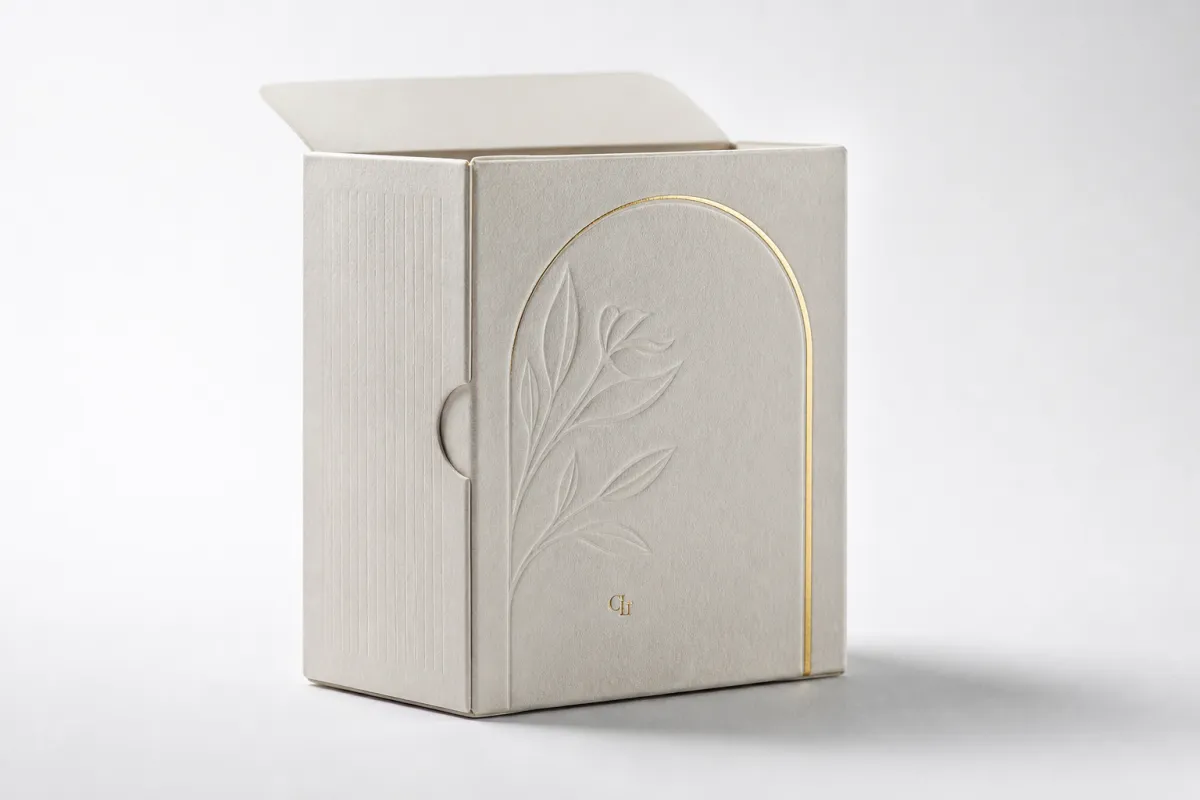
People notice raised surfaces faster than they notice a new ink color. That is a small fact with a large footprint in packaging. custom embossing on folding cartons survives because texture interrupts flatness. It creates shadow lines. It gives the eye a place to land. A printed logo can disappear in a glance; a raised logo often makes the shopper pause for a beat. In retail, that beat can matter more than a longer product description.
Embossing is not reserved for luxury labels. Confectionery brands use it to suggest occasion. Supplement brands use it to reduce the generic feel that cheapens trust. Wine and spirits teams use it to separate a core line from a seasonal release. Cosmetics buyers use it because tactile retail packaging can justify a higher shelf price without increasing carton weight or rebuilding the structure from scratch. Custom embossing on folding cartons gives the pack a physical cue that says, without shouting, that the design was planned rather than assembled.
That cue matters because packaging is often judged before the product is touched. A carton may share the same print coverage, structure, and claim set as a competitor, yet still read as more premium if it carries one well-placed embossed feature. The mistake is thinking embossing only alters appearance. It changes perception. The hand and the eye are receiving different signals, and package branding shifts with that split second of sensory input, even when no formal shelf test ever gets run.
Texture often does the first round of selling. Ink tells the story, but embossing makes the story physical.
There is a second reason brands choose custom embossing on folding cartons instead of piling on more print effects. Some briefs call for a cleaner front panel, fewer colors, and less visual noise. Embossing can carry the premium note without crowding the surface. That works especially well for Custom Printed Boxes in categories where trust, clarity, and a polished look matter more than a loud graphics system.
If the brief is still broad, start with pack architecture and end use. A carton that needs a sharper retail read may call for one approach, while a mailer or kit may need another. For broader format ideas, the Custom Packaging Products page is a useful starting point before the emboss detail is locked.
One reality check helps here: custom embossing on folding cartons can raise perceived value, but only if the substrate and artwork support it. Weak board, poor placement, or crowded art can flatten the effect quickly. The premium look comes from the full system, not the die alone. That is the part that gets missed when packaging is designed in fragments.
I still remember opening a press check carton that looked flawless on screen and kind of flat in hand. The logo was technically there, but the board was too light and the type was too tight. A one-millimeter adjustment and a better caliper would have changed the whole thing. That sort of mistake is common, and it is usually fixable if someone spots it before production is locked.
How Custom Embossing on Folding Cartons Works
At the production level, custom embossing on folding cartons is a controlled compression process. A male die and a female counter die work together to reshape the board. The chosen area is pushed upward for an embossed effect, or downward for a debossed one. Pressure, depth, and material response determine how sharp the final image looks. It is mechanical first and visual second, which is why board behavior matters so much.
Design handoff is where projects often gain or lose clarity. The artwork needs clean vector lines, enough margin from folds and trim edges, and a clear visual hierarchy. Fine type can work, but only to a point. Small serif details, hairline strokes, and tight spacing can disappear once the fibers compress. For custom embossing on folding cartons, the best results usually come from bold shapes, readable logos, seals, monograms, or simplified pattern fields. If the team wants intricate detail, the die and the board need to be selected with care.
Three common approaches show up again and again. Blind embossing uses shape alone, with no foil or spot print to frame it. Registered embossing aligns the raised image to a printed area, so the emboss lands exactly where the ink expects it to be. Embossing can also be paired with foil, which creates a strong light-catching effect that works well for premium branded packaging. In that case, the print, foil, and custom embossing on folding cartons must all register accurately or the entire surface starts to feel slightly off.
The production sequence matters too. Some cartons are printed first and embossed later. Others are embossed before print, depending on the substrate, the artwork, and the finishing plan. There is no universal rule. If a design has tight registration or uses heavy coverage, the team needs to confirm the order early. A wrong sequence can blur edges or create a mismatch between the raised feature and the printed contour. That kind of mismatch reads immediately, even to people who do not know why it feels wrong.
Board choice carries more weight than many buyers expect. Coated board can give a cleaner, sharper impression, especially when the goal is a polished retail packaging look. Uncoated stock can feel warmer and more natural, but it may not hold the same level of definition. Caliper matters too. On a lighter board, custom embossing on folding cartons may appear shallow or soft. On a heavier board, the same tooling can read much more clearly. Fiber direction matters as well, because the board responds differently along and against the grain.
If the carton will also go through die cutting, scoring, gluing, and folding, the emboss cannot be treated like a separate island. The whole converting sequence has to work together. Otherwise, the emboss can interfere with a crease or sit too close to a glue flap. That is how a premium idea turns into a production headache with a very ordinary invoice attached to it.
Key Factors That Change the Look, Feel, and Risk
Five variables control most of the outcome for custom embossing on folding cartons: board thickness, design complexity, placement, finish combination, and the intended brand story. Miss one and the result can feel underpowered or overworked. Get them aligned and the effect often looks more expensive than the change really was. That gap between cost and perception is where embossing earns its keep.
Substrate thickness usually comes first. A thin carton stock may not hold a deep impression cleanly, while a heavier paperboard can support more structure and a sharper edge. Exact board construction still matters, but as a planning rule, 18 pt to 24 pt paperboard tends to give designers more room than very light stock. That does not make thinner boards unusable. It means the emboss depth and image design need to stay more conservative.
Design complexity comes next. Large open shapes emboss beautifully because the eye can read the contour. Fine typography is harder. Dense patterns can look crowded once compressed. A brand that wants custom embossing on folding cartons for a small logo seal usually gets better results than a project trying to emboss a paragraph of copy, a thin icon cluster, and a decorative border at once. Simpler geometry also tends to age better. It stays clean across print lots, not only in a proof room.
Placement can make or break the final pack. Keep embossed elements away from major fold lines, glue areas, windows, and critical scores unless the structure was engineered for it. Near an edge, the board can distort. Near a fold, the emboss can crack or flatten during conversion. With custom embossing on folding cartons, a move of a few millimeters can change whether the effect feels crisp or awkward. Structural packaging design and decoration need to be reviewed together, not in separate meetings that never quite talk to each other.
Finish interactions deserve real attention. Soft-touch coating can make the embossed area feel even more luxurious, but it can also soften contrast if the impression is too shallow. UV varnish may add shine, while lamination can change how the board takes the impression. Foil can create a premium highlight, though it adds registration sensitivity. If the project combines several of these, the risk of mismatch grows. That does not mean the design should be avoided. It means the stack of effects should be justified by the brand story, not by habit or a wishlist.
Brand positioning is the last piece, and probably the most overlooked. The same emboss depth can feel restrained on one carton and aggressive on another. In luxury categories, a quiet raised mark often performs better than a dramatic sculptural pattern. In mass retail packaging, bolder embossing may be needed to justify the extra cost. The better question is not, "How deep can we go?" It is, "What should this carton say at three feet, and what should it say in the hand?"
When teams evaluate custom printed boxes or branded packaging concepts, it helps to compare the tactile target against real samples instead of relying on screen renderings. Texture is a physical decision. The mockup should admit that.
For structural fit and transit planning, many teams also check industry testing guidance such as the ISTA transit testing protocols. If the carton has to survive distribution, shelf handling, and possible e-commerce fulfillment, the decoration strategy needs to stay compatible with the stress profile it will actually face.
That usually means making the finish decisions with real-life handling in mind, not just the reveal moment. I have seen cartons that looked gorgeous in a presentation and then got flattened at the corner during packing because the emboss was too close to a fold. Nobody loves explaining that one to operations. Better to catch it early.
Custom Embossing on Folding Cartons: Process, Timeline, and Lead Time
The process for custom embossing on folding cartons usually starts with a brief. That brief should say what the emboss is supposed to do: signal premium quality, highlight a logo, create tactile separation on shelf, or support a limited-edition launch. A vague "make it feel nicer" note does not help much. The better the brief, the faster the supplier can recommend a practical die strategy.
After that comes dieline review. The structural carton shape must be checked before the emboss is finalized, because the emboss cannot ignore folds, tuck flaps, glue zones, or barcode panels. If the design includes die cutting changes, those should be locked as early as possible. A late revision to the panel size can force the emboss tooling to move, and that often means another sample round. For custom embossing on folding cartons, every late structural change tends to multiply into another production decision.
The next step is depth and detail discussion. A modest raised logo may need only one tooling approach. A multi-level mark or sculpted texture may require more testing. Some suppliers will propose a blind emboss first, then a registered version if the art direction calls for more contrast. Others may build a proof directly against the print plan. Either way, the sample stage is where most of the risk gets exposed.
Typical lead time varies, but a practical planning range is often 3-7 business days for tooling development, 2-5 business days for a proof or sample round, and roughly 10-15 business days for production after approval. That is not a promise. It depends on workload, substrate availability, number of revisions, and whether the emboss has to align with foil or print. Even so, it gives a useful frame for custom embossing on folding cartons projects that need a realistic schedule.
Where do delays usually come from? Three places stand out. First, artwork revisions that keep changing the focal point. Second, uncertainty about which elements should rise and which should remain flat. Third, late shifts in board, size, or finish. The more parties involved in sign-off, the more likely a small change will push the lead time. That is especially true in packaging design reviews, where brand, operations, and procurement may all want something different from the same carton.
There are a few simple ways to keep the schedule clean. Send vector art, not flattened images. Mark embossed and non-embossed areas clearly. Share the exact carton dimensions and dieline version. State whether the emboss is blind, registered, or paired with foil. If the supplier knows what matters most, they can recommend the right compromise sooner. A well-prepared custom embossing on folding cartons brief often saves more time than one more review call ever could.
It also helps to build approval margin into the project calendar. A brand may expect a proof in a few days, but internal review cycles, sample shipping, and freight variability can stretch that. If launch timing is tight, treat the decoration schedule as part of the manufacturing schedule, not as a separate admin task. That mindset keeps the packaging team honest about what can be finished safely and what needs more runway.
One small but real advantage: once the emboss direction is locked, later decisions get easier. People stop debating six slightly different logo treatments and start asking whether the board and finish can actually carry the result. That is usually where the project gets better, not worse.
Custom Embossing on Folding Cartons: Cost, Pricing, MOQ, and Quote Drivers
Pricing for custom embossing on folding cartons usually comes from five inputs: tooling, setup, board choice, run length, and the number of finishing steps layered on top. Buyers sometimes ask for "the emboss price" as if there were one fixed number. There is not. A simple blind logo on a standard board is a different job from a registered emboss with foil, a soft-touch coating, and a tight production window.
Tooling is often the first separate charge. Depending on complexity, a project might see a one-time tooling range of roughly $150-$500 for a simple emboss and $500-$1,200 or more for a more sculpted or multi-level form. Those numbers are planning ranges, not universal quotes. They shift with die size, detail level, and supplier method. In short runs, tooling can dominate the economics of custom embossing on folding cartons. In longer runs, the tooling gets spread out and the per-unit premium drops.
MOQ matters because setup costs do not scale neatly. A 1,000-piece run may carry a noticeably higher unit cost than a 5,000-piece run, even if the carton is the same size and structure. If the project is a premium launch or a seasonal test, that may be acceptable. If the goal is to support a broader retail rollout, the economics change. This is why buyers should ask for unit pricing at more than one quantity break when they request custom embossing on folding cartons quotes.
To make the tradeoffs easier to read, here is a practical comparison:
| Emboss option | Best use | Typical tooling range | Typical unit impact at mid-volume | Design risk |
|---|---|---|---|---|
| Blind emboss | Logos, seals, subtle premium cues | $150-$400 | $0.01-$0.03 | Low to moderate |
| Registered emboss | Print-aligned focal points | $250-$700 | $0.02-$0.05 | Moderate |
| Foil plus emboss | Luxury retail packaging, gift packs | $350-$900 | $0.03-$0.08 | Moderate to high |
| Multi-level sculpted emboss | Hero SKUs, limited editions | $500-$1,200+ | $0.04-$0.10+ | High |
That table is shorthand, not a promise. Actual pricing depends on carton dimensions, board selection, press method, and how much of the artwork needs to be locked to the die. Even so, it shows the basic truth of custom embossing on folding cartons: the more the effect depends on precision and multiple finishes, the more the quote reflects setup complexity.
Ask for separate line items whenever possible. Tooling, production, finishing, and freight should be visible on the estimate. That lets procurement compare apples to apples instead of guessing whether a quote is lower because the supplier used a lighter board, simplified the emboss, or omitted a finishing step that was assumed elsewhere. For a buyer, clarity is worth money.
Another question worth asking is whether a different carton specification can deliver a similar visual result at a lower total cost. Sometimes a stronger board, a cleaner print treatment, or a single foil accent can produce nearly the same shelf effect as a more complicated emboss stack. That is not a downgrade. It is packaging design discipline with a sharper pencil.
For teams that want to compare form factors or broader carton options before locking a finishing strategy, the custom packaging products collection can help frame what is structurally possible before the decoration spec gets too far along.
A fair warning: pricing conversations can get fuzzy fast if people mix unit cost, tooling, and freight into one number. If you separate them early, the decision gets a lot less emotional and a lot more useful. That is usually where the better packaging choice reveals itself.
Common Mistakes That Flatten the Emboss or Inflate Costs
The most common failure with custom embossing on folding cartons is simple: too much detail in too little space. A logo with tiny internal cutouts, thin type, and a busy border may look fine on a screen, then collapse once the board compresses. The result is not premium. It is muddy. The buyer thinks the carton feels "soft," which is not the same as luxurious. In packaging, clarity usually beats density.
Placement errors come next. Embossing too close to a crease, tuck flap, or glue area creates mechanical problems during conversion and assembly. If the carton has to fold sharply, the raised surface can crack, distort, or flatten. In some cases, the impression is still visible but no longer clean. That is especially frustrating because the print may look perfect while the tactile effect falls apart. With custom embossing on folding cartons, the structure and the finish cannot live in separate silos.
Board selection is another quiet cost trap. Buyers sometimes choose a cheaper stock to save on paperboard, then lose the premium effect they were trying to buy with embossing. An inexpensive board may not hold the detail consistently, which can lead to weaker shelf presence and more scrap if the impression varies. For product packaging meant to support a luxury price point, the board often deserves as much scrutiny as the emboss tool.
There is also a timing mistake that shows up often: embossing is treated as an afterthought. The artwork is approved, the structure is locked, and only then does someone ask whether the logo can be raised. At that point, custom embossing on folding cartons can still be done, but the options may be narrower and more expensive. It is far better to decide the tactile hierarchy during the first packaging design round than to force it in later.
Finally, overcomplication is a real cost amplifier. Emboss, foil, heavy ink coverage, soft-touch coating, and tight registration can all work together, but not every carton needs all of them. Sometimes the extra effects do not add visible value equal to their cost. Sometimes they slow production without improving the shelf read. Good package branding often comes from restraint, not from stacking every available finish just because it is available.
If the project must align with environmental claims, it is also smart to check material sourcing and recyclability assumptions early. For paperboard sourcing, the FSC certification standards are a useful reference point. The more the spec is built around real material data, the less likely the team is to make claims that are hard to support later.
One practical habit helps a lot: ask the converter where the failures usually happen on this exact style of carton. A seasoned shop will tell you if the emboss tends to pinch near the crease, or if the foil wants to walk under pressure. That kind of experience is worth more than a polished render, and it saves a few headaches too.
Expert Tips and Next Steps for a Stronger Packaging Spec
Start with the story, not the die. That sounds obvious, yet it is where many custom embossing on folding cartons jobs go sideways. Decide whether the carton should feel subtle, architectural, luxurious, playful, or tactile. Then match the emboss depth and placement to that feeling. A restrained monogram on a cosmetic carton and a deep sculpted crest on a gift pack are both valid. They are simply solving different branding problems.
Ask for a physical sample or a close comparative proof whenever you can. Screen images cannot show shadow, finger feel, or how the impression behaves across the board grain. A buyer evaluating custom embossing on folding cartons needs to know how the pack reads in hand, under store lighting, and against nearby competition. That is why sample-stage feedback is so valuable; it turns a subjective discussion into a real one.
Build a one-page spec sheet before quoting. Include carton dimensions, board caliper, finish notes, emboss target areas, artwork zones, and any production priorities. If the emboss has to align with print or foil, say so clearly. If there is a tolerance concern around die cutting, note that too. Suppliers respond better when the brief is complete, and the quote for custom embossing on folding cartons is usually cleaner when the inputs are disciplined.
- Confirm the dieline version and lock the structural format.
- Mark embossed zones clearly on the artwork file.
- Request separate tooling, production, and finishing pricing.
- Ask what board the supplier recommends, and why.
- Review sample timing before the launch schedule is finalized.
Compare supplier feedback instead of only comparing price. One vendor may quote a lower number but recommend a board that will not hold the impression as cleanly. Another may quote a little more and give a clearer path to a sharper result. That difference can matter more than a few cents per carton, especially in retail packaging where the first impression does a lot of work. In a mature packaging program, the better tradeoff is usually the one that protects the shelf story and reduces rework.
Honestly, the best custom embossing on folding cartons projects are the ones that feel almost boring on paper. The brief is clear. The board is right. The artwork is controlled. The quotes are itemized. The schedule includes time for approval. Then the finished carton arrives with the one thing shoppers notice immediately: a surface that feels deliberate. If you want that result, treat custom embossing on folding cartons as part of the packaging system, not a decorative extra, and the whole production path gets easier to manage.
The actionable takeaway is simple: lock structure, board, and tactile intent before you lock the artwork. If those three pieces agree, the emboss usually reads crisp, the quote stays easier to compare, and the finished carton does what it was supposed to do in the first place.
What is custom embossing on folding cartons, and how is it different from debossing?
Embossing raises selected areas above the carton surface, while debossing presses them inward. Both use matched tooling, but the tactile result is opposite. Brands often choose embossing for logos, seals, and premium focal points because light catches the raised edges more visibly, and shoppers feel them faster in hand.
How much does custom embossing on folding cartons usually add to pricing?
Cost depends on tooling, carton size, board selection, run length, and whether the finish is combined with foil, print, or coating. Short runs usually carry a higher per-unit premium because setup costs are spread across fewer cartons. Ask for separate tooling and production quotes so the drivers are visible.
What is the typical process and turnaround for embossed folding cartons?
The usual flow is brief, dieline review, artwork prep, tooling creation, proofing, and production approval. Lead time changes with sample rounds, design complexity, and whether the emboss must align with other finishing steps. Clean files and fast approvals are the biggest levers for keeping turnaround on track.
Which carton stocks work best for custom embossing on folding cartons?
Heavier, well-formed paperboard generally holds detail better than very thin or overly soft stock. Coated and uncoated boards can both work, but the best choice depends on the desired look and the depth of the impression. If the artwork has fine lines or tight registration, test the board first.
What are the most common mistakes brands make with embossed cartons?
Three stand out: placing embossed elements too close to folds or glue areas, using too much detail in a small area, and choosing the carton stock before the emboss design is finalized. Those mistakes usually show up as blurred detail, cracking, or a premium effect that looks weaker than planned.

