Buyer Fit Snapshot
| Best fit | Custom Packaging with Gloss Lamination projects where brand print, material claims, artwork control, MOQ, and repeat-order consistency need to be specified before quoting. |
|---|---|
| Quote inputs | Share finished size, material target, print colors, finish, packing count, annual reorder estimate, ship-to region, and any compliance wording. |
| Proofing check | Approve dieline scale, logo placement, barcode or warning zones, color tolerance, closure strength, and carton packing before bulk production. |
| Main risk | Vague material claims, crowded artwork, missing packing details, or unclear freight terms can make a low unit price expensive after revisions. |
Fast answer: Custom Packaging with Gloss Lamination: Material, Print, Proofing, and Reorder Risk should be specified like a repeatable production item. The safest quote records material, print method, finish, artwork proof, packing count, and reorder notes in one written spec.
Production checks before approval
Compare the actual filled-product size with the drawing, then confirm tolerance on folds, seals, hang holes, label areas, and retail display edges. Reserve space for logos, QR codes, warning copy, and material claims before decorative graphics fill the panel.
Quote comparison points
Review material grade, print process, finish, sampling route, tooling charges, carton quantity, and freight assumptions side by side. A quote is only useful when the supplier can repeat the same color, closure quality, and packing count on the next order.
Custom Packaging with Gloss Lamination: What to Know
Custom packaging with gloss lamination can make a plain carton look deliberate, polished, and shelf-ready without pretending the box is something it is not. It can also make a decent design look like a shiny mess if the structure, color, or print prep is sloppy. That part gets ignored way too often. The finish does not save the job. It exposes it. For brands comparing packaging finishes, custom packaging with gloss lamination is one of the fastest ways to add shelf presence without redesigning the whole box.
From a packaging buyer's point of view, the real question is not whether custom packaging with gloss lamination looks bright. It usually does. The real question is whether that brightness helps the product sell, survive shipping, and justify the extra spend. Some categories benefit immediately. Others need a quieter finish. Matte, soft-touch, and even plain kraft can be the smarter move. Custom Logo Things works with buyers who need custom printed boxes that look sharp without wrecking the budget, and gloss lamination is one of the easiest finishes to evaluate because the tradeoffs show up fast.
I have seen teams fall in love with the shine, then get annoyed when fingerprints show up on the first sample run. Not because gloss is bad. Because they skipped the part where the box has to be handled by humans. Funny how that works.
What Custom Packaging with Gloss Lamination Really Changes
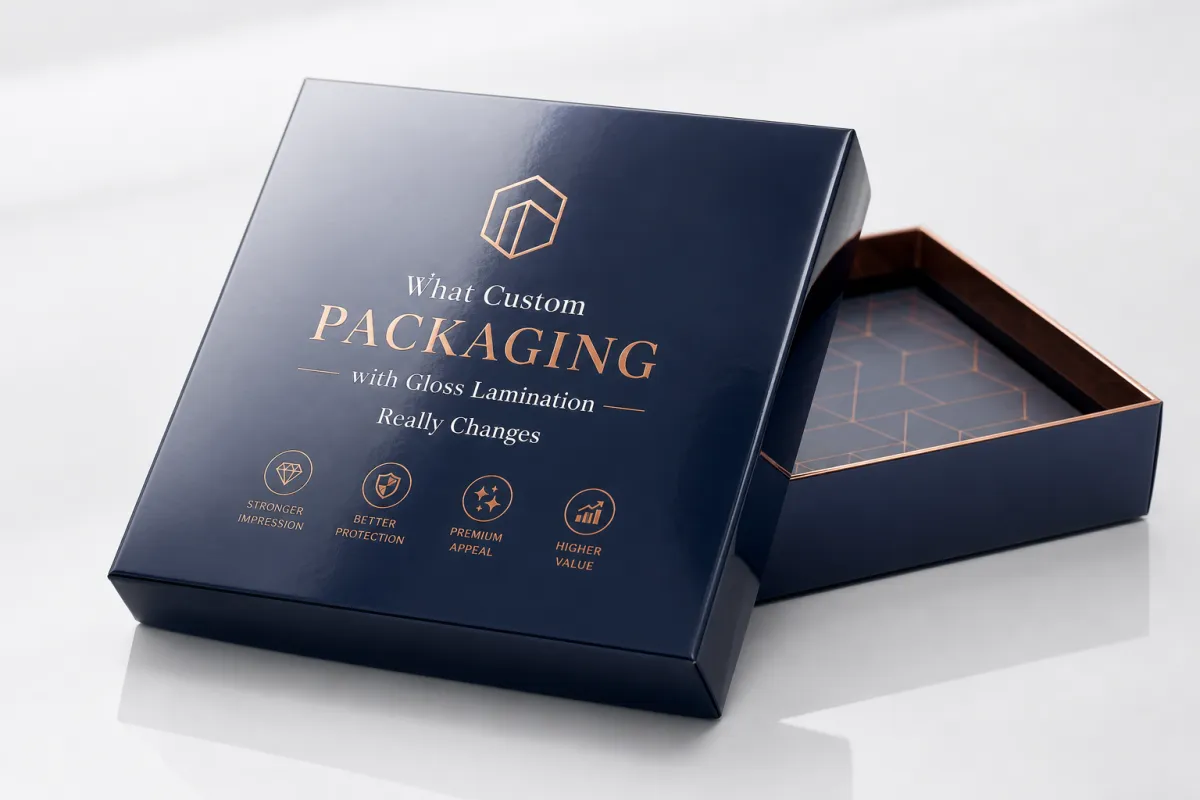
Custom packaging with gloss lamination starts with a basic process: a clear film is bonded to the printed surface so the artwork looks brighter, smoother, and better protected. Straightforward. The finish adds shine, tightens up the surface, and gives the box a cleaner face. That means deeper color, stronger contrast, and better resistance to scuffing during fulfillment, transport, and shelf handling. If you have ever held two identical cartons and thought one looked more expensive for no obvious reason, there was probably a finish decision behind it. Custom packaging with gloss lamination is often the one doing the heavy lifting there.
It works especially well on cosmetics, apparel, gift sets, subscription kits, promo packs, and retail packaging that sits under strong light. Seasonal product packaging also benefits because the goal is usually visual impact, not understatement. Bright photography, saturated brand colors, metallic accents, and bold type all read harder under gloss. That is why custom packaging with gloss lamination keeps showing up in branded packaging for launch kits and display-ready custom printed boxes.
Gloss is not magic, though. It will not fix weak packaging design, muddy color, ugly typography, or a carton that feels flimsy in the hand. If the structure is bad, the shine just makes the problems easier to see. If the artwork is overcrowded, gloss can turn the box into noise. That is where a lot of buyers get burned with custom packaging with gloss lamination. They expect the finish to do the work. It will not.
A glossy box does not rescue weak structure. It just puts the weak structure under better lighting.
Good custom packaging with gloss lamination usually pairs with clean die cutting, sensible fold lines, and artwork that respects how light moves across the carton. It can be combined with embossing or spot effects, but the base print still needs to be right. If the color match is off, no finish will hide it. If the board dents easily, the surface shine will not make it feel premium. Think of custom packaging with gloss lamination as a force multiplier, not a repair kit.
For teams comparing options, the practical test is simple: does the finish improve the sale, the shipping experience, and the perceived value of the product? If the answer is yes on at least two of those, custom packaging with gloss lamination deserves a serious look. If not, you are paying for shine that does not pay you back.
How Custom Packaging with Gloss Lamination Is Applied
Custom packaging with gloss lamination is usually applied after the printed sheets come off press and before the sheet is converted into cartons or folded boxes. A clear film is bonded to the printed surface with heat, pressure, or both, depending on the equipment and film type. The result is a sealed finish that changes how the ink looks and how the board holds up. On folding cartons, lamination usually happens while the sheet is still flat, then the box is die cut, scored, folded, and glued. On some rigid box projects, the sequence changes, but the logic stays the same.
The common film families are clear BOPP and similar packaging-grade laminates. Thickness matters. A thinner film can cost less and feel lighter. A heavier film may improve scuff resistance and surface consistency. Most buyers do not need to memorize film chemistry, but they should care about consistency. Uneven film means uneven gloss, and that is not subtle. Custom packaging with gloss lamination should look uniform across the run, not patchy, wavy, or dull in random spots.
The finish also changes how the print reads. Colors usually look deeper. Black looks blacker. Reds and blues pop harder. Photos gain contrast. That matters for retail packaging that has to compete for attention in a crowded aisle, and it is one reason custom packaging with gloss lamination shows up so often on shelf-facing custom printed boxes. It also makes the surface easier to wipe and better at resisting light scuffs from shipping trays, hand packing, and stockroom handling.
There is a limit, and it is not a tiny one. Custom packaging with gloss lamination does not eliminate edge wear, corner crush, or bad structural design. Fold scores still need to be engineered correctly. Glue zones still need to stay clean. Window placements still need to make sense. If the box uses a complex tuck pattern or a tight die line, the printer has to confirm the lamination will not cause cracking, curling, or glue failure. That gets even more important on intricate product packaging with heavy ink coverage.
Before signing off, ask direct questions. Is the finish full-sheet or selective? Will the laminate affect adhesive zones? Does it change the score depth on the board? Does it interfere with a window patch or an insert? These questions are boring. They also save money. Good custom packaging with gloss lamination is built on unglamorous production details, not guesswork.
If you want to compare structures before you spec the finish, browse Custom Packaging Products and look at how different box styles handle gloss under actual use. A real box tells you more than a mockup ever will.
Custom Packaging with Gloss Lamination: Cost and Pricing Factors
Custom packaging with gloss lamination changes pricing in a few predictable ways. Box size matters. Board type matters. Print coverage matters. Quantity matters a lot. If the artwork uses heavy ink coverage or full-bleed color, the job may need tighter process control before the lamination goes on. That does not always make the run expensive, but it can make it more sensitive. On a straight folding carton, custom packaging with gloss lamination might add a modest amount per unit. On a rigid box with multiple wraps, the finish can become a larger part of the total cost.
Here is the practical range I usually see buyers work with: on medium-volume folding cartons, gloss lamination may add roughly $0.03 to $0.12 per unit at around 5,000 pieces, depending on size, board, and coverage. On short runs, the premium can rise because setup gets spread over fewer boxes, sometimes $0.10 to $0.35 per unit or more. For rigid boxes, the difference is usually larger because the material and labor stack up faster. That is why custom packaging with gloss lamination can feel cheap at scale and irritatingly expensive in a small pilot order. Not glamorous, but true.
Do not compare quotes unless the spec is identical. Same dieline. Same board. Same print method. Same finish. Same quantity. Same shipping assumption. Anything else is just noise. A lot of pricing confusion around custom packaging with gloss lamination comes from buyers asking one vendor for a kraft carton, another for SBS, and a third for a laminated premium build, then acting surprised when the numbers do not line up. They are not the same job.
Below is a clean way to compare common finish options on custom printed boxes.
| Finish Option | Typical Add-On at 5,000 Units | Best For | Main Tradeoff |
|---|---|---|---|
| Gloss lamination | $0.03-$0.12 per box | Bold color, retail packaging, visual pop | More glare and fingerprints |
| Matte lamination | $0.04-$0.14 per box | Quiet branding, softer tone, lower glare | Less color punch |
| Soft-touch lamination | $0.06-$0.18 per box | Premium feel, high-end gift boxes | Costs more and can show wear |
| Spot gloss over matte | $0.08-$0.20 per box | Texture contrast, logo emphasis | More setup complexity |
Quotes also shift because of rush production, extra proof rounds, special coatings, and complicated carton styles. A simple straight tuck is easier than a windowed sleeve with inserts. A one-color print job is simpler than a full-coverage photographic layout. If the vendor has to redo artwork placement, fix low-res files, or adjust die lines after the first proof, that time gets priced in somewhere. In other words, custom packaging with gloss lamination is rarely expensive because of the film alone. It gets expensive because the job underneath the film is complicated.
Ask every printer about setup charges, overage policy, shipping, and whether reruns use the same tooling. If you plan repeat orders, the first run may cost more than later runs because the die, plates, or setup work gets spread across more units. That matters for product packaging programs that scale over multiple drops. It is also why Custom Logo Things often recommends requesting the quote in the exact quantity you expect to reorder, not a prettier number that only works in a spreadsheet.
For teams watching budget, custom packaging with gloss lamination is usually easiest to justify on products with healthy margins or retail-facing presentation. If the box is only there to ship something from point A to point B, the spend is harder to defend. If the box is part of the brand experience, the spend starts making sense. Pretty simple. People still overcomplicate it.
Step-by-Step Timeline From File Review to Delivery
Custom packaging with gloss lamination moves through a standard production chain, and delays usually show up in the same few places. First comes file review. Then proofing. Then print. Then lamination. Then cutting, folding, gluing, inspection, packing, and shipping. The exact sequence changes a bit based on box style and print method, but the control points are the same. Once a buyer understands those checkpoints, custom packaging with gloss lamination becomes much easier to schedule.
Prepress review often takes 1 to 3 business days if the files are clean. That stage is where the printer checks dielines, bleed, font outlines, image resolution, and color setup. Clean files save time. Messy ones burn it. Proof approval usually takes another 1 to 2 business days, longer if the team keeps changing text or tweaking the packaging design. Once approval is locked, simple short-run jobs can finish in about 7 to 12 business days. Larger offset jobs, custom structures, or rigid boxes may take 12 to 20 business days or more after approval. Custom packaging with gloss lamination sits inside that window, not outside it.
Production speed depends on more than print volume. If the board has to be sourced specially, if the lamination film needs a particular stock, or if the carton uses complex die cutting, the schedule stretches. Shipping time adds its own layer. A printer can finish on time and still miss your launch if transit is not built into the plan. That is why the timeline for custom packaging with gloss lamination should always include production and delivery, not just press time.
Here is a simple breakdown buyers can use:
- File prep: 1-3 business days if artwork is ready and dielines are correct.
- Proofing: 1-2 business days, longer if color corrections are needed.
- Print and lamination: 3-7 business days for simpler runs, longer for large orders.
- Die cutting and finishing: 2-5 business days depending on complexity.
- Shipping: 1-5 business days in many domestic lanes, more for cross-country or freight moves.
That is the clean version. The real-world version adds people. Late artwork changes. Missing sign-off. Incorrect quantity. A rush holiday schedule. A sample that looked fine until someone checked it under store lighting. Each one can add days. I have seen buyers lose more time from one sloppy email than from the entire lamination step. That is the kind of thing no glossy mockup will warn you about.
For packaged goods that ship direct to consumers, ask whether the box has been tested against ISTA transit testing standards or a similar protocol such as ASTM D4169. Glossy surfaces can still scuff in transit, and a pretty outer carton that arrives damaged is not doing its job. Custom packaging with gloss lamination should be part of the shipping system, not a decorative afterthought.
Common Mistakes That Make Gloss Lamination Look Cheap
Custom packaging with gloss lamination can look expensive in the best possible way, or it can look loud and undercooked. The difference usually comes down to design discipline. A glossy surface magnifies everything. Good color looks richer. Bad color looks muddy. Clean layout looks sharp. Clutter looks worse. If the artwork is already doing too much, custom packaging with gloss lamination can make the box feel busier instead of better.
One common mistake is ignoring fingerprints and smudges. Gloss finishes show handling marks more clearly than matte or soft-touch surfaces, especially under bright retail lighting. That matters on boxes that get picked up often by store staff, customers, or fulfillment teams. If your product packaging is handled a lot, custom packaging with gloss lamination may still be the right choice, but you should know the risk before you approve it. Some brands test for this and keep the shine. Others back away after seeing the sample under fluorescent lights. Fair enough.
Another mistake is using low-contrast type or dark, muddy palettes. Gloss tends to intensify contrast, but it also reveals weak hierarchy. Tiny text can disappear. A black background with dense photography can reflect more than it communicates. If your branded packaging uses a lot of small copy, gloss may not be the best default. The finish should support the message, not fight it.
There is also the category mismatch problem. Not every product deserves the same level of shine. Loud consumer goods, gift sets, and bright seasonal items often benefit from custom packaging with gloss lamination. Quiet luxury, wellness, and minimalist retail packaging may look better with a softer treatment. That is not snobbery. It is brand fit. A finish that works on one shelf can look wrong on another.
And then there is the classic production mistake: a flimsy box with a shiny face. That is not premium. That is a shiny flimsy box. If the board is too thin, the structure flexes, corners crush, and the whole thing still feels cheap in hand. Custom packaging with gloss lamination cannot hide structural weakness. It may actually make the problem more obvious. If the base pack is weak, fix the board first. Save the shine for after the box feels solid.
Packaging teams should also watch edge cracking, poor score alignment, and adhesive failure at folds. Those issues are not caused by gloss alone, but the finish can make them easier to spot. Good die lines, correct pressure, and proper board selection matter just as much as the film. That is why custom packaging with gloss lamination is a technical decision, not just a visual one. The box has to survive folding, shipping, and opening without turning into a mirror that sheds corners.
Expert Tips for Choosing the Right Gloss Finish
Custom packaging with gloss lamination works best when the finish is chosen on purpose, not by default. The first decision is scope. Full-coverage gloss gives the whole box a brighter, more uniform look. Spot gloss adds shine only to selected elements, which creates contrast and gives the package more depth. If the brand needs strong energy and shelf presence, full coverage makes sense. If the goal is to highlight a logo, product name, or illustration detail, spot gloss can be the smarter move. In both cases, custom packaging with gloss lamination should serve the brand story, not cover weak design.
Do not approve a sample from a lighting situation your customers will never see. Compare the box under warehouse lighting, retail lighting, and daylight if you can. The same custom packaging with gloss lamination can look elegant in one setting and painfully reflective in another. That is why sample approval should include the actual substrate, the actual print method, and a real box assembly, not just a flat sheet on a desk.
Here is a practical rule: bold color brands usually benefit more from gloss than quiet, understated ones. If the art uses saturated hues, playful imagery, or energetic typography, custom packaging with gloss lamination can support that tone. If the brand leans minimal, tactile, or earth-toned, gloss may feel off. There are exceptions. Some premium labels use gloss on a restrained design and pull it off nicely. Most buyers are safer matching the finish to the brand personality first.
Test the box, not the mockup
A digital proof hides plenty. A physical sample tells the truth. Check how the surface reflects light, how the folds behave, and whether the gloss creates visible streaks or pinholes. If your packaging design includes small icons, dense text, or fine line work, make sure those details stay readable after lamination. Custom packaging with gloss lamination should sharpen the package, not turn it into a shiny blur.
Ask for real durability signs
Request a sample that has been rubbed lightly, handled a few times, and folded where the box will actually fold. Look at edge wear. Look at the corners. Look at the glue areas. Ask whether the finish changes the fold quality or the feel of the carton. On paper, custom packaging with gloss lamination sounds simple. In production, the little defects are what separate a clean run from a headache.
It also helps to understand the role of sustainability claims. If you need FSC-certified board, ask for it early. If the project has to stay aligned with local recycling guidance, discuss how the film affects the final pack before the quote is locked. For broader packaging material context, the Packaging Machinery Manufacturers Institute has useful industry information on packaging systems and materials. Custom packaging with gloss lamination can still fit a responsible sourcing plan, but you need the right substrate and a realistic recycling conversation.
Finally, match the finish to the box style. Gloss can look great on folding cartons, sleeves, and promotional kits. On some rigid structures, it can look too hard unless balanced with embossing, foil, or a softer interior. That balance is what separates polished branded packaging from a box that just wants attention. The best custom packaging with gloss lamination feels intentional. The worst feels like the printer found an extra roll of film and decided to have fun.
What to Do Next Before You Place an Order
If you are considering custom packaging with gloss lamination, start with the basics: box dimensions, quantity, board preference, artwork files, target ship date, and any retail or shelf requirements. Those details decide far more than people expect. A 2,000-piece run on a simple tuck carton is one thing. A 20,000-piece launch kit with inserts, nested components, and display needs is something else entirely. Custom packaging with gloss lamination can work for both, but the quote and timeline will not be the same.
Next, request at least two or three quotes using the exact same specification. Do not let one vendor quote matte board, another quote gloss on lighter stock, and a third quote a different carton style. That is how people get tricked by comparison shopping. Ask for the same die line, same finish, same quantity, same shipping method. Then compare the numbers. If one quote is much lower, check whether it quietly removed something important. That happens more than anyone likes to admit.
Ask for physical samples if possible. If you cannot get a full sample, at least request swatch photos and a flat proof showing the finish effect. Better still, ask for one assembled sample and one flat sample so you can judge the gloss on the actual structure. That is especially useful for Product Packaging That will sit under bright retail lights or get handled often. Custom packaging with gloss lamination can look different once the box is folded, scored, and glued, so you want to see it in that state before approving production.
Here is a simple decision filter:
- Choose gloss if you want stronger color, higher contrast, and more shelf pop.
- Choose matte if glare and fingerprints are bigger concerns than brightness.
- Choose spot gloss if you want texture contrast without coating the whole box.
- Choose another finish if the brand story depends on a softer or more tactile feel.
If your team is still at the structure stage, review Custom Packaging Products and compare box styles before locking the finish. The right finish on the wrong structure still gives you the wrong box. That is not magic. That is just expensive packaging.
My honest advice: buy custom packaging with gloss lamination for the jobs where visual punch matters and the box will be seen, handled, and judged quickly. Skip it if your product benefits more from quiet texture or if fingerprints will drive your team crazy. The finish should make the packaging work harder, not hand operations a new problem.
So here is the practical move. Pick the structure first, print a physical sample, and check it under the light your customer will actually see. If the gloss still looks clean, the color still reads right, and the box still feels solid, you are in good shape. If not, change the finish before you place the order. That saves money, and it saves the awkward conversation later.
Custom packaging with gloss lamination is worth the extra cost when it improves color, protects the Print, and Fits the brand. It is not worth it when it only adds shine. Compare specs carefully, confirm the timeline, and ask for a real sample. That turns custom packaging with gloss lamination into a smart buying decision instead of a guess.
Is custom packaging with gloss lamination better than matte?
Gloss usually gives stronger color pop and a brighter shelf presence, while matte reduces glare and feels more subdued. If your packaging sits under harsh retail lights, matte can hide fingerprints better; if you want bold visuals, custom packaging with gloss lamination usually wins. The better choice depends on brand tone, lighting, and how much handling the box will get.
How much does custom packaging with gloss lamination add to the price?
It depends on size, board, quantity, and whether the job is short-run or high-volume. In smaller runs, the finish and setup can be a noticeable premium per box. At larger quantities, the per-unit bump drops fast. Always compare quotes using the same dieline, material, and print coverage so the pricing is apples-to-apples.
Does custom packaging with gloss lamination protect against scratches and moisture?
Yes, it improves scuff resistance and helps the surface handle normal shipping wear better than unlaminated print. No, it is not waterproof armor. Edges, seams, and structural weak points still need proper packaging design. Think of custom packaging with gloss lamination as durable surface protection, not a substitute for a solid box.
How long does custom packaging with gloss lamination take to produce?
After file approval, simple jobs can move quickly, but the exact timeline depends on print method, quantity, and box complexity. Bigger runs, custom structures, and back-and-forth proofs usually push delivery out longer. If the date matters, get the printer to confirm production time, transit time, and rush options before you approve the job.
Can custom packaging with gloss lamination be recycled?
It depends on the board, the film, and local recycling rules, so there is no one-size-fits-all answer. The laminate can make recycling less straightforward than plain paperboard, especially in mixed-material packaging. If sustainability matters, ask for recyclable board options and discuss the finish tradeoff before you lock the spec.

