Buyer Fit Snapshot
| Best fit | Branded Shipping Bags for Retail projects where brand print, material claims, artwork control, MOQ, and repeat-order consistency need to be specified before quoting. |
|---|---|
| Quote inputs | Share finished size, material target, print colors, finish, packing count, annual reorder estimate, ship-to region, and any compliance wording. |
| Proofing check | Approve dieline scale, logo placement, barcode or warning zones, color tolerance, closure strength, and carton packing before bulk production. |
| Main risk | Vague material claims, crowded artwork, missing packing details, or unclear freight terms can make a low unit price expensive after revisions. |
Fast answer: Branded Shipping Bags for Retail: Cost, Print, and Fit should be specified like a repeatable production item. The safest quote records material, print method, finish, artwork proof, packing count, and reorder notes in one written spec.
Production checks before approval
Compare the actual filled-product size with the drawing, then confirm tolerance on folds, seals, hang holes, label areas, and retail display edges. Reserve space for logos, QR codes, warning copy, and material claims before decorative graphics fill the panel.
Quote comparison points
Review material grade, print process, finish, sampling route, tooling charges, carton quantity, and freight assumptions side by side. A quote is only useful when the supplier can repeat the same color, closure quality, and packing count on the next order.
Branded Shipping Bags for Retail: Cost, Print, and Fit
Branded shipping bags for retail are often the first physical thing a shopper touches after checkout, and that first touch carries more weight than most teams admit. A bag that feels flimsy, crooked, or generic tells a story before the product is even opened. A bag that looks clean, fits properly, and feels deliberate does the opposite. It signals order, care, and a business that knows what it is doing.
That is the real appeal. Branded shipping bags for retail are not just attractive transit packaging. They sit inside order fulfillment, ecommerce shipping, and package protection for apparel, accessories, soft home goods, and other flexible products that do not need a box. Used well, they trim shipping weight, reduce packing friction, and elevate the unboxing without turning the warehouse into an art department. They also fit neatly into broader retail packaging programs, which matters when a brand ships across multiple channels.
Used poorly, they become a line item that looks smart in a presentation and painful on the packing line. Fit, material, print, and total landed cost matter more than the mockup. Those are the pieces that decide whether branded shipping bags for retail save money or quietly burn it. The difference is rarely dramatic at first. It is usually measured in returns, labor minutes, and customer impressions that are easy to miss until they pile up.
How do branded shipping bags for retail change the customer experience?
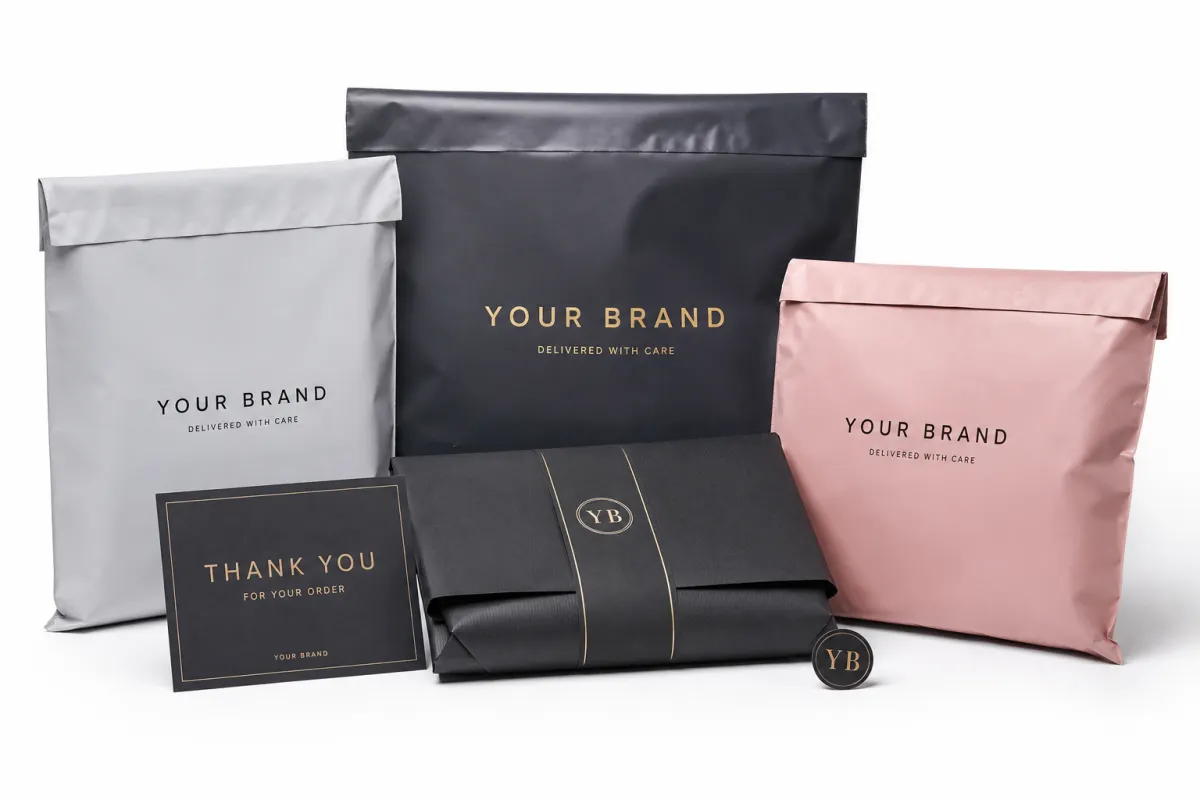
Branded shipping bags for retail do one thing exceptionally well: they turn a plain shipment into a branded touchpoint. That matters because the package is not resting under store lighting. It is moving through hubs, trucks, sorting centers, and front steps, which means it has to look good after handling, stacking, and the occasional drop. A 2023 survey from Dotcom Distribution found that 40% of consumers were more likely to make repeat purchases from brands that used premium packaging. The box is not the only thing selling the brand; the mailer is doing some of that work too.
In practical terms, these are lightweight mailers or poly bags printed with a logo, pattern, message, or product-specific artwork. They are used for apparel, accessories, swimwear, small textiles, and other soft goods. Some are plain one-color mailers with a logo. Others are fully printed retail shipping bags with custom artwork, return instructions, barcode space, or tamper-evident seals. For many brands, branded shipping bags for retail strike the cleanest balance between cost and presentation. They also work well as custom mailers when a brand wants a stronger visual identity without moving up to a box.
Three things usually drive the decision. First, brand recall improves because the customer sees the logo before the item is even opened. Second, packing gets easier because the bag is light, compact, and quick to close. Third, shipping cost can drop compared with boxes because the package adds less weight and often less volume. That last point matters when dimensional weight starts charging for empty air.
The experience gets tidier too. A good bag does not need to shout. It simply shows that someone considered the order beyond the label. For ecommerce shipping, that subtle difference can make the brand feel more polished and more dependable. Customers may not use packaging language, but they absolutely notice when the parcel feels random.
Branded shipping bags for retail are not a cure-all. They are a poor fit for brittle products, structured goods, expensive electronics, or anything with sharp edges that can puncture film. Products that need serious package protection usually belong in a box or padded system. Flexible goods with a simple shipping profile are where these bags earn their keep. Forcing them onto every SKU just creates damage, returns, and a stack of support emails no one wanted.
Packaging decisions work better when they start with product behavior rather than aesthetics. Brands that place branded shipping bags for retail where they actually belong tend to get cleaner operations and a stronger first impression. Brands that chase style first often pay twice: once for the bag and once for the mistake.
How are branded shipping bags for retail made and printed?
Most branded shipping bags for retail are made from co-extruded poly film. Multiple layers are combined to balance strength, opacity, sealability, and printability. Some versions use recycled-content film, which can be a useful choice when sustainability claims need a material backing. Others use virgin film when the application needs steadier seal strength or clearer print reproduction. There is no universal winner. There is only the right spec for the job.
Common construction includes a closure strip, often a permanent adhesive strip and sometimes a second seal line for returns. Many bags include tear lines or tamper-evident features as well. Those details sound minor until they show up in the packing line. If staff has to fight the bag on every shift, the packaging is costing money in labor as well as materials. I have watched teams lose more time to a sticky closure than to the actual packing process, which is kinda ridiculous until you see the labor report.
Printing is where the budget can stay disciplined or drift fast. Flexographic printing is common for larger runs because setup costs spread across more units. It fits stable artwork and higher quantities. Digital printing usually makes more sense for shorter runs or designs that change more often. Seasonal artwork, regional versions, and limited drops often fit digital better because it reduces waste and shortens setup time. The unit cost is usually higher, and the tradeoff is easy to see on a quote sheet.
Color count surprises buyers more often than it should. One or two spot colors can keep pricing manageable. Full coverage, gradients, and heavy ink density change the math quickly. Add white ink underlays on colored film and the proofing process gets tighter, the setup gets more involved, and the quote gets less cheerful. None of this is mysterious. It is just manufacturing reacting to complexity.
The production flow is straightforward, but every step affects the result:
- Artwork setup and file review.
- Digital proofing or plate preparation.
- Material sourcing and film selection.
- Printing and curing or finishing.
- Quality checks for color, seal, and registration.
- Packing, case labeling, and shipment.
That final step gets ignored too often. Buyers focus on print and forget that pallet count, carton stack, and clean labeling are part of the real deliverable. Branded shipping bags for retail should arrive ready for the packing line, not ready for a sorting project. If the shipment arrives in a way that adds receiving work, the efficiency story starts to unravel before the first bag is used.
For transit testing, standards help. The ISTA test methods are a useful reference for understanding how shipping packs handle vibration, compression, and drops. That does not replace a live pack-out trial, but it gives you a better frame than guessing from a render.
Design affects performance too. Seam placement changes how the bag carries weight. Finish changes how the print reads under light. A glossy bag can make color pop; a matte finish often looks more restrained and reduces glare on shipping labels. If the bag needs barcodes, return instructions, or compliance marks, make space for them early. Crowding that information into the leftover corner is how good designs turn into clutter.
Key factors that shape branded shipping bags for retail
Size is the first decision, and it is the one teams miss most often. A bag that is too large wastes film, looks loose, and lets product shift during transit. A bag that is too tight slows packing, puts stress on seams, and raises the odds of a split. The right fit should hold the product with only modest excess while still letting the packer insert it without wrestling the opening. In retail, seconds matter. In ecommerce shipping, tiny delays add up fast.
Material thickness matters just as much. Lightweight film can work for folded tees, socks, or thin accessories. Heavier gauges are better for bulkier apparel, shoe boxes wrapped in film, or bundles with edges that press hard against the bag. Many custom mailer programs land somewhere around 2.5 to 4 mil, but that is not a rule, just a common range. The real choice depends on product shape, handling intensity, seal design, and whether the shipment is going straight to a consumer or moving through a longer distribution chain. It also depends on how much package protection the item needs before the bag becomes the outer layer.
Branding choices should match the channel. Bags sent to retail customers can carry bolder logo placement because the goal is recognition at first glance. Bags that also need shipping labels, barcodes, or return information need more breathing room. A beautiful design that gets buried under a label is not beautiful for long. It is just expensive.
Sustainability claims need rigor. Recycled content, recyclable claims, and compostable language all need to match the material and the market where the bag is used. A recycled-content bag is not automatically curbside recyclable everywhere. A compostable bag may need industrial composting conditions rather than a home bin. If the team is going to make environmental claims, the spec sheet and local rules need to agree. The EPA recycling guidance is a useful reminder that "recyclable" is rarely as simple as a logo on a bag.
Buyers usually get clearer answers by asking blunt questions:
- Will the bag fit the top 80% of your order mix?
- Does the bag hold up in real transit packaging conditions?
- Can staff pack it without extra tape or backup packaging?
- Does the print remain readable after folds, labels, and handling?
- Does the spec support the brand without slowing order fulfillment?
That is why branded shipping bags for retail work best when chosen from the product outward, not from the artwork inward. Start with the goods, then the pack line, then the shipping environment, then the branding. Reverse the order and the business usually pays to prove a concept it never needed.
There is a larger operational point too. If the bag is part of a broader system, it should fit beside your other shipping materials. A brand may need custom packaging for premium SKUs, branded mailers for standard apparel, and Custom Shipping Boxes for fragile or rigid products. That mix is normal. It is healthier than trying to force one package type to cover every category.
Branded shipping bags for retail cost and pricing breakdown
The Cost of Branded shipping bags for retail comes down to a few predictable drivers: size, film gauge, print coverage, color count, closure style, quantity, and whether the job uses stock tooling or fully custom production. The more the bag is asked to do, the more it costs. That is not a trick. It is manufacturing, minimums, and material physics working together.
Low-volume orders usually carry higher per-unit pricing because setup costs have fewer pieces to ride on. Larger runs spread those costs across more bags, which can cut the unit price sharply. A 5,000-piece run may price very differently from a 25,000-piece run even if the artwork is unchanged. Buyers who think only in unit cost usually overpay. Volume changes the math, and the math does not care about the mood board.
Here is a practical comparison for branded shipping Bags for Retail:
| Option | Typical spec | Best use | Approx. unit cost | Tradeoff |
|---|---|---|---|---|
| Stock mailer + label | Unprinted poly mailer, 2.5-3 mil | Test runs, seasonal overflow, very low volume | $0.10-$0.18 | Lowest branding impact; looks generic |
| Semi-custom printed bag | 1-2 colors, limited coverage, standard closure | Core apparel orders and basic ecommerce shipping | $0.18-$0.30 | Good value, but artwork options are narrower |
| Fully custom mailer | Full coverage print, custom sizing, stronger seal options | Brand-forward retail shipping bags | $0.24-$0.45 | Better presence, higher setup and print cost |
| Premium recycled-content bag | Recycled film, custom print, upgraded finish | Brands with formal sustainability targets | $0.28-$0.55 | Stronger story, sometimes tighter supply and higher price |
Those numbers are directional rather than guaranteed. Order quantity, freight, artwork complexity, and factory capacity can move them up or down. They are still useful enough to prevent the classic remark that "custom should not cost that much" being said with confidence and no evidence.
Hidden costs are where budgets go off track. Freight is the obvious one, especially on cartons of transit packaging. Sampling can add up if multiple rounds are requested. Proof corrections take time, and time has a price. Storage matters too if the order covers an entire season at once. Then there are rush fees, which tend to appear the moment marketing decides the launch date changed and everyone else is expected to move like the calendar is optional.
Operations create costs as well. If a bag saves five seconds per pack, that matters at scale. If it needs extra tape, labels, or repacking, the savings disappear quickly. If it replaces a box and avoids dimensional weight charges, the cost story improves. If it does not, the bag is only half a solution. This is where branded shipping bags for retail should be judged against labor, freight, and returns, not just the supplier quote.
Bottom line: branded shipping bags for retail should be priced on landed cost and pack-line impact, not on unit price alone. A cheaper bag that tears, prints badly, or slows fulfillment is not cheaper. It is just cheaper for the supplier and more expensive for everyone else.
"If the bag saves money but creates rework, it did not save money. It just moved the pain somewhere less visible."
Step-by-step process and timeline for branded shipping bags for retail
Start with the job the bag has to do. That sounds obvious, and it is the step many teams skip. Before requesting quotes, define what the product is, how it is packed, how often it ships, whether returns matter, and how much visual impact is wanted at first touch. Branded shipping bags for retail are much easier to spec when the buying team understands the actual shipping profile instead of just the marketing brief.
The next move is a spec sheet. It should include bag size, film thickness, closure type, print area, color count, order quantity, delivery deadline, and any requirements for barcodes, return copy, or compliance marks. If the top three SKUs are known, list them. If the bag has to fit folded garments plus tissue plus an insert, say that. Good suppliers can work from partial information, but fewer gaps in the brief means fewer surprises later.
Then request quotes from at least two or three vendors and compare more than the unit price. Lead time, sample policy, freight assumptions, and repeat-run consistency all matter. If the brand is still testing, a semi-custom route may be smarter than a fully locked design. If the artwork is settled and the volume is real, moving to custom sooner can avoid paying for temporary choices twice. This is also the point where branded shipping bags for retail should be compared against other retail packaging formats, not just other mailer prices.
Proofing comes next. Do not rush it. A digital proof can catch layout errors, but it cannot tell you how the bag behaves in the hand. That is why physical samples matter. Check them in a real packing environment with the actual product inside. Open the bag, pack it, seal it, label it, and see whether it still looks good on the table. If it is awkward there, it will be awkward at scale.
A practical timeline for branded shipping bags for retail often looks like this:
- Quote and brief review: 1-3 business days if the spec is clear.
- Artwork proofing: 2-5 business days depending on revisions.
- Sample approval: 3-7 business days if physical samples are needed.
- Production: often 12-18 business days for straightforward custom runs.
- Freight and receiving: another 3-10 business days depending on distance.
Complex artwork, specialty finishes, or a recycled-content spec can stretch the schedule. So can quantity changes after approval. That last one causes more trouble than it should. If the order is tied to a launch, leave room for shipping and warehouse receiving. Production may finish on time and still miss the launch if the cartons are sitting on a truck somewhere. Branded shipping bags for retail only work as planned when the schedule includes the boring parts, too.
For context, browse how packaging choices show up in real brands through the Case Studies section. It is easier to make a sound packaging decision when you can see how other teams balanced print, cost, and fulfillment. If you need a broader view of formats, the Custom Packaging Products page is a practical place to compare options before locking the spec.
The final approval should always be a real packing test. One carton on a desk proves very little. Ten units through the actual line tell you much more. If a bag is part of repeat operations, that test is where problems surface early, before the first large order goes out and customer service starts learning about packaging by accident.
Common mistakes with branded shipping bags for retail
The classic mistake is wrong sizing. It sounds small until it reaches production. Oversized bags waste material and make the shipment feel loose. Undersized bags wrinkle, split seams, and slow packers down because every order becomes a small wrestling match. If the team has to baby the product into the bag, the bag is not helping. It is creating friction.
Another common issue is film that is too thin for the product. A light gauge might work for one folded shirt. It may fail on multi-piece bundles, heavier knits, or items with corners that press outward during shipping. The damage cost is not only the replacement item. It is the support ticket, the loss of trust, and the extra handling on the back end. Saving a fraction of a cent while creating claims is not a smart exchange.
Overdesign is another trap. Too many colors, tiny text, low contrast, or busy graphics can look good on screen and poor on a moving parcel. Once the bag folds, rubs, and picks up a shipping label, detail disappears quickly. A strong logo lockup and a clear visual hierarchy usually beat a crowded design. Clean art also tends to reproduce better, especially on flexible film where print registration needs room.
The approval problem shows up often too. Waiting too long to approve samples or lock quantities can trigger rush charges, freight headaches, and missed launch windows. Retail launches tend to cluster around holidays, seasonal collections, and promo calendars, so packaging delays ripple through the rest of the business. Packaging always looks simple until the deadline gets close. Then everyone learns how many things depend on it.
Some buyers also treat branded shipping bags for retail as a standalone decision. They are not. They need to work with labels, inserts, returns, and the rest of the shipping materials stack. If the bag is attractive but does not fit the fulfillment process, it does not belong in the program.
Here is a quick problem-and-fix list:
- Too much empty space: downsize the bag or adjust the fold spec.
- Repeated tearing: move up in film thickness or reinforce the seal area.
- Print looks dull: improve contrast or switch the finish.
- Packing is slow: simplify closure and reduce handling steps.
- Too many SKUs: consolidate sizes and reserve special versions for high-volume cases.
The easiest way to avoid these mistakes is to test with actual product, not assumptions. A bag should feel like part of the system, not like a decorative add-on that barely survives the first week. Branded shipping bags for retail earn their place when they improve both the customer-facing moment and the warehouse routine.
Expert tips for branded shipping bags for retail and next steps
Keep the design simple and recognizable. One strong logo placement usually does more than a busy layout filled with slogans, icons, and extra lines of copy. People remember a clear shape and a clear mark. They do not remember the fifth message on a moving mailer. For branded shipping bags for retail, visual confidence usually wins over visual noise.
If the bag should feel premium, focus on details customers can see or feel: tighter fit, cleaner closure, stronger opacity, and a finish that does not look cheap under office lighting. There is no need to cover every square inch. The package needs to look intentional from a few feet away and hold up when someone picks it up.
Testing on the actual line is non-negotiable. A sample in isolation can hide a lot of problems. Put the real product inside, add the insert, apply the label, seal the closure, and watch how long the cycle takes. If the bag slows order fulfillment, needs extra tape, or creates a repacking step, the spec is wrong. The point of branded shipping bags for retail is to make the process better, not prettier in theory.
It also helps to avoid too many package versions. One primary bag size should cover most orders. A second version only makes sense if the volume justifies it or the product mix is genuinely different. Otherwise, inventory gets messy, reorders get confusing, and the supply chain starts needing a spreadsheet just to stay upright. A packaging win can turn into a small administrative headache faster than people expect.
Use the right package type for the right SKU. Apparel and soft goods often work well with branded shipping bags for retail. Structured products may belong in a mailer box or a different format altogether. If you are comparing options, look at Custom Poly Mailers for lightweight shipments and Custom Shipping Boxes for fragile or rigid products. The answer is rarely "pick one and force everything into it." The answer is "match the package to the product."
If a practical action plan helps, this is the sequence I would use:
- Measure your top-selling products and folded dimensions.
- Pick a target bag size with a little clearance, not a lot.
- Request at least two material samples in different thicknesses.
- Compare landed cost, not just quoted unit cost.
- Test the bag on the actual packing line before placing the full order.
That sequence cuts through most of the noise. It also keeps the buying process tied to real production instead of renderings. A packaging spec has to survive contact with the warehouse. If it does not, it was never really ready. Branded shipping bags for retail should earn trust in testing, then repeat that result order after order.
What are branded shipping bags for retail used for?
They protect soft goods like apparel, accessories, and light retail bundles without the weight and bulk of a box. They also make the first physical brand touchpoint more memorable, which helps post-purchase perception and repeat recognition. In many operations, they simplify packing and reduce shipping cost when the product does not need rigid protection.
How much do branded shipping bags for retail usually cost?
Price depends on size, film thickness, print complexity, closure style, and order quantity. Custom printed low-volume orders cost more per unit because setup costs are spread across fewer bags. Always compare landed cost, not just unit price, because freight and sampling can change the real budget fast.
How long do branded shipping bags for retail take to produce?
Simple stock-based orders can move quickly, while fully custom runs need time for artwork approval and print setup. Sampling and proofing usually happen before production, and that step should not be rushed if you care about fit and color accuracy. Plan extra time for freight, especially if the bags are traveling across regions or need to arrive before a launch window.
Are branded shipping bags for retail strong enough for apparel orders?
Yes, for folded apparel, lightweight bundles, and many accessory orders if the material and seal are spec'd correctly. If the contents are heavy, sharp, or likely to snag, you need a stronger film, better closure, or a different package type. A quick drop test and packing-line trial will tell you more than a product sheet ever will.
What artwork works best on branded shipping bags for retail?
High-contrast logos, short copy, and simple layouts usually print cleaner and stay readable after handling. Leave room for labels, barcodes, and seams so the brand mark does not get cut off or buried in a fold. If you want a premium look, focus on one strong visual system instead of trying to cover every inch with graphics.
Branded shipping bags for retail work best when they are chosen like a production tool, not a mood board. Start with the product, verify the fit, check the print, and test the bag on the actual packing line. Done that way, branded shipping bags for retail can improve order fulfillment, sharpen the brand experience, and keep ecommerce shipping costs under control without turning the operation into a circus. The clear takeaway: spec the bag around the product, then prove it in the warehouse before you place the full order.


