Buyer Fit Snapshot
| Best fit | Custom Padded Mailers for Coffee Roasters projects where brand print, material claims, artwork control, MOQ, and repeat-order consistency need to be specified before quoting. |
|---|---|
| Quote inputs | Share finished size, material target, print colors, finish, packing count, annual reorder estimate, ship-to region, and any compliance wording. |
| Proofing check | Approve dieline scale, logo placement, barcode or warning zones, color tolerance, closure strength, and carton packing before bulk production. |
| Main risk | Vague material claims, crowded artwork, missing packing details, or unclear freight terms can make a low unit price expensive after revisions. |
Fast answer: Custom Padded Mailers for Coffee Roasters: Film, Print, MOQ, and Carton Packing should be specified like a repeatable production item. The safest quote records material, print method, finish, artwork proof, packing count, and reorder notes in one written spec.
Production checks before approval
Compare the actual filled-product size with the drawing, then confirm tolerance on folds, seals, hang holes, label areas, and retail display edges. Reserve space for logos, QR codes, warning copy, and material claims before decorative graphics fill the panel.
Quote comparison points
Review material grade, print process, finish, sampling route, tooling charges, carton quantity, and freight assumptions side by side. A quote is only useful when the supplier can repeat the same color, closure quality, and packing count on the next order.
If you are looking for a custom Padded Mailers for Coffee Roasters material thickness guide, the real question is blunt: how much structure does the mailer need before it stops being a weak point and starts doing its job? A coffee bag can arrive without a tear and still fail the trip if the wall flexes too much, the seal gets crushed, or the corners collapse inside the parcel. That is the part people miss when they judge packaging from a sample on a desk instead of from what happens in a sorting center.
Coffee is compact, dense, and easy to ship badly. Sounds simple until the parcel gets stacked under a heavier box, dragged across a belt, and left on a wet porch long enough to pick up a scar. For retail packaging and direct-to-consumer orders, the best mailer is not always the thickest one on the shelf. It is the one that matches bag weight, shipping lane, and brand presentation without wasting money on material the product never needed.
Custom Padded Mailers for Coffee Roasters Material Thickness Guide
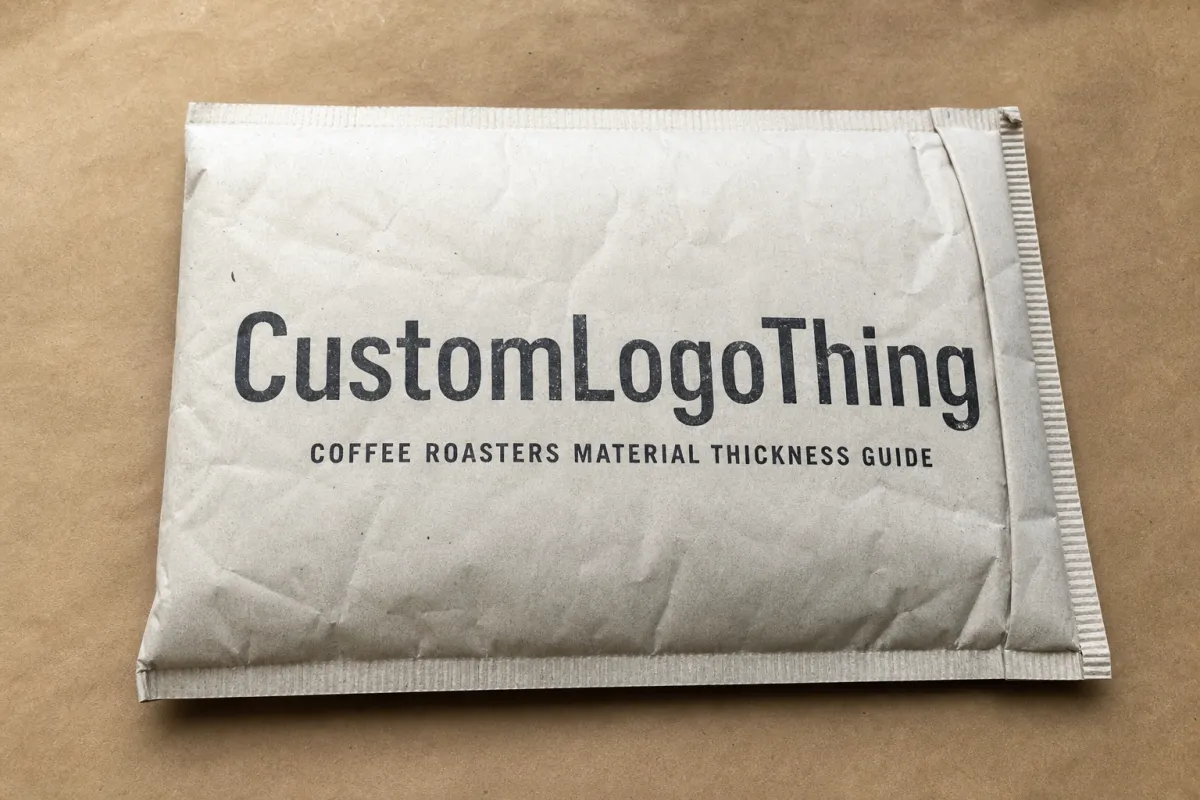
For most coffee roasters, the decision is not whether to use a mailer. It is whether the mailer has enough backbone to protect the bag without turning every order into a bulky, overpriced brick. A custom padded mailer should support the product, keep the seal area from folding in on itself, and still look sharp enough to carry the brand. If the exterior wrinkles badly or the closure gives out under pressure, the packaging starts fighting the brand instead of carrying it.
This guide focuses on the parts that actually move the needle: thickness, padding type, closure strength, and the outer film or paper face that takes the abuse. The goal is to help you choose between lighter builds for sample packs, mid-range builds for standard retail bags, and heavier options for subscription orders or bundled shipments. If your shipping profile is changing, or you are comparing custom packaging products across channels, this is the decision tree that keeps you from paying for protection you do not need.
Most roasters do best starting in the middle, then moving thicker only when the damage data says so. That is not flashy. It is how budgets stay intact. A useful starting point is to look at bag weight, shipping distance, and how much compression the mailer will face during fulfillment and carrier handling.
A mailer should protect the bag first and flatter the brand second. If it does neither, you bought a decorative expense.
One more thing. The right answer changes with the way the coffee is sold. A subscription box with one 12 oz bag is not the same as a wholesale sampler, and neither behaves like a lightweight retail order in a Custom Poly Mailers format. If you are shipping mixed kits, fragile add-ins, or larger bundles, you may need to move beyond mailers and into Custom Packaging Products that include a box structure. Sometimes custom printed boxes or plain corrugated cardboard is the better call. Less charming, maybe. Less expensive after a few rough deliveries? Usually, yes.
There is a practical limit here. Thickness helps with compression and abrasion, but it does not fix a bag that is too tall for the mailer, a closure that cannot hold, or a pack-out that leaves too much dead air. If a supplier pretends one spec solves every problem, that is marketing, not packaging engineering.
How Padded Mailers Protect Coffee During Shipping
Padded mailers work because they combine three things: an outer layer that resists tearing, an inner layer that absorbs impact, and a closure system that stays shut when the parcel gets squeezed. The outer film or paper face handles abrasion. The padding cushions the bag from sharp impacts and pressure points. The seams and seal keep the mailer from splitting when a belt, bin, or neighboring package pushes hard against it.
Coffee is a weird little product in shipping terms. It is light in volume, but heavy enough to stress a narrow envelope. A 12 oz bag does not sound like much until it sits upright in a thin mailer and starts pushing against the bottom edge and closure flap. Add valve bumps, gusset folds, and a bit of headspace, and the package can crush itself from the inside if the mailer is too soft. That is why wall strength matters more than most buyers expect.
The main threats are boring, which is exactly why they cause so much damage: compression from stacked parcels, drops onto hard floors, friction from conveyor systems, and humidity or drizzle during the last mile. A mailer that looks fine on a desk may fail after one rough distribution cycle. Better thickness lowers the odds of puncture and seam splitting, but too much thickness can make the package harder to fold, slower to pack, and more expensive to ship because of added bulk. Nobody gets a trophy for buying the heaviest option if it never pulls its weight.
For flat, single-bag coffee orders, padded mailers often beat cartons on cost and speed. That is especially true for starter kits, sample packs, and simple direct-to-consumer subscriptions where the goal is to keep the parcel compact and the unboxing clean. Once you add multiple bags, glass, accessories, or anything that needs rigid side protection, cartons start making more sense. At that point, corrugated cardboard stops being "extra packaging" and becomes the cheapest insurance policy in the room.
If you want a packaging decision that behaves in transit, start with the shipping method. Parcel networks are rough. Local handoff is gentler. International routes are a different beast. The mailer thickness should follow the lane, not your mood.
That also means not copying specs from another brand just because their packaging looks nice on Instagram. A mailer that works for a 4 oz sample may fail on a fully packed 16 oz bag with a valve and a gusset. Same product category. Different stress profile. Packaging does not care about brand comparisons.
Key Factors That Decide the Right Thickness
Weight and shape set the baseline. A 4 oz sample pouch, a standard 12 oz retail bag, and a two-bag bundle do not put the same pressure on the mailer walls. A flat sample usually needs modest padding and a lighter outer layer. A gusseted retail bag creates more corners, more seams, and more places for the envelope to wrinkle or crush. Once the bag starts behaving like a wedge, the mailer has to work harder.
Shipping distance changes the answer too. Local delivery with limited handling is not the same as a cross-country parcel moving through multiple sorting centers. Every extra transfer adds compression, friction, and the occasional drop. If your replacement rate climbs on longer lanes, thickness may not be the whole fix, but it is often part of it. I see roasters underspec their worst lane and over-spec their easiest one. That is backward.
Brand presentation matters, just not in the fake "premium" way people toss around. A thicker mailer can feel nicer, sure, but only if it still looks crisp, seals cleanly, and does not crease into a sad accordion before it reaches the customer. A clean print on a sensible material usually does more for package branding than a bulky build that arrives dented. If the mailer is supposed to act as retail packaging, the finish should support the print, not fight it.
Climate and storage conditions also deserve a spot in the decision. Coffee can travel through hot trucks, humid warehouses, and wet porches. A mailer with a weak closure or poor moisture resistance may fail even if the bag itself is fine. That is where material choice starts to matter. A kraft paper face can look great for branded packaging, but it still needs a structure underneath that holds up when the outer layer gets damp or scuffed. The same goes for paper-faced padded mailers with recycled content: good on paper, useless if the seams fold apart.
Here is a simple way to think about the range.
| Mailer Type | Typical Build | Best For | Typical Unit Cost at 5,000 | Notes |
|---|---|---|---|---|
| Light-duty padded mailer | About 2.0-2.5 mil outer film or light paper face with thin padding | Sample packs, flat 2-4 oz shipments, low-abuse lanes | $0.20-$0.34 | Good for saving money, but not ideal for heavy compression or rough transit |
| Mid-range padded mailer | About 2.5-3.5 mil outer film or 80-100 gsm paper face with medium padding | Standard 8-16 oz coffee bags, subscription orders, DTC retail packaging | $0.28-$0.48 | The usual sweet spot for most roasters; enough protection without the bulk penalty |
| Heavy-duty padded mailer | About 4.0-5.0 mil outer film or reinforced paper-faced build with stronger padding | Multi-bag bundles, longer shipping lanes, higher compression risk | $0.40-$0.70 | Worth it when failures are costly, but overkill for small single-bag orders |
Those numbers are not a promise. Print coverage, number of colors, closure style, custom sizing, and freight all move the total around. Still, the table gives you a practical frame. If a supplier cannot explain why a thicker spec costs more or where that extra cost goes, they are probably selling adjectives instead of product packaging.
One technical caveat: mil thickness tells you part of the story, not the whole thing. Two mailers with the same outer gauge can perform very differently if one has better padding recovery, stronger seams, or a better adhesive. That is why spec sheets matter, but samples matter more.
If you want a testing reference, the ISTA packaging testing standards are a good place to start. I would not treat them like magic, but they are useful for talking about compression, vibration, and drop performance without guessing. For paper-based options, the FSC certification system matters when you want cleaner fiber sourcing claims for kraft paper and similar materials. Buyers notice when "eco" is a real claim instead of a vague marketing sticker.
Production Steps, Timeline, and Lead Time
Most custom mailer projects follow the same basic flow: spec confirmation, material selection, artwork setup, proof approval, sample creation, bulk production, and final packing. It sounds simple. It is not. Timing usually breaks when someone changes the size after the proof is already moving, or when the artwork team decides that one more revision would be "small." Small revisions have a talent for eating days.
The fastest jobs are usually straightforward custom prints on standard structures. If the mailer shape is common, the thickness sits inside the supplier's normal range, and the graphics do not need special finishes, lead time often lands in the 12-20 business day range after proof approval, plus shipping. Once you add special films, paper-faced padded builds, custom sizing, or a thicker structure that needs more production control, four to six weeks is not unusual. That is not a scare tactic. It is just how the schedule behaves when the build stops being routine.
Timeline delays usually come from a short list of causes. Unclear dimensions force the factory to wait. Artwork changes after proofing reset the clock. Unusual padding requests or specialty closures can require extra sourcing. Samples that sit in someone else's inbox for a week do more damage than a material issue ever will. If you are launching a seasonal roast, a subscription refresh, or a new retail packaging program, lock the bag size early and approve the proof quickly. Otherwise, the packaging becomes the bottleneck, and that is a painfully expensive place to discover disorganization.
There is also a difference between "ready to print" and "ready to ship." You want both. A design that looks finished on screen can still fail if the seal area overlaps key artwork or if the closure interferes with the fold line. That is where packaging design and production reality meet. It is not glamorous, but it keeps the mailer from looking like it was assembled by someone who has never watched a parcel move through a line.
A practical scheduling rule: give yourself extra time before the moments that matter. Seasonal drops, wholesale launches, gift campaigns, and subscription rollouts all have a way of exposing packaging weaknesses. If the mailers are late, your whole fulfillment calendar starts wobbling. Good product packaging should support the launch, not threaten it.
If your supply chain is tight, build one extra week into the calendar for proofing and one extra buffer for transit. That cushion is not wasted time. It is the difference between launching on schedule and making your warehouse team improvise on a Friday afternoon. Nobody wants that show.
Cost, Pricing, MOQ, and Quote Basics
Pricing for Custom Padded Mailers is shaped by the same things that shape performance: thickness, padding type, seal style, print coverage, bag size, and volume. More material costs more. Better print coverage costs more. Reinforced seals cost more. Custom sizing costs more. None of that is surprising, but buyers still end up comparing two quotes that are not actually comparable.
MOQ matters because setup costs get spread across fewer or more units. A low minimum order quantity can help when you are testing a new line, changing product packaging, or trying a fresh branded packaging concept before committing to a larger run. The tradeoff is obvious: smaller runs usually carry a higher per-piece price. If someone quotes a very low MOQ and the unit price barely moves, check whether the print, thickness, or finishing is actually what you asked for. Cheap quotes sometimes hide a thinner build or a stripped-down spec.
The right way to compare quotes is to look at total landed cost, not just the number sitting next to unit price. That means item cost, setup fees, shipping, and any extra charges for finishes or custom structure. One supplier may quote a higher unit price but include tooling and packaging. Another may look cheaper until the freight bill shows up. Packaging buyers have learned this the hard way forever, which is why nobody gets excited about "base pricing" anymore.
For a coffee roaster, the real question is whether the premium version pays for itself in fewer damages, less customer service friction, and stronger presentation. If a thicker mailer reduces crushed corners by even a small amount on a high-volume route, it can pay back quickly. If your product already ships safely in a mid-range build, spending more on heavier material is just padded waste. There is no medal for overpackaging.
Here is a simple comparison you can use during quote review:
- Light build: Lowest material cost, lowest bulk, best only when the lane is gentle and the bag is flat.
- Mid-range build: Best balance for most coffee shipments, especially standard retail bags and subscription mailings.
- Heavy build: Good for rough routes or bundles, but easy to overspend on if the product does not need it.
When you request pricing, ask for at least two thickness options. That gives you a real tradeoff instead of a guess. Ask how the MOQ changes if you move up a size or add more print coverage, too. A good supplier should be able to explain the difference in plain language, not hide behind jargon and hope nobody notices.
Also ask for a sample packed with your actual coffee bag. The empty mailer is only half the story. A structure that feels fine in hand can behave differently once the bag fills the interior and loads the seal area. That single test often saves more money than an extended email thread ever will.
Common Mistakes Coffee Roasters Make With Mailers
The first mistake is guessing. Too many roasters choose thickness by feel instead of by actual product weight and shipping behavior. That works until the first damaged batch shows up. A good spec should be matched to the bag, the lane, and the handling pattern. Otherwise you are just paying for packaging intuition, which is usually expensive and not especially accurate.
The second mistake is obsessing over wall thickness while ignoring the closure and seam strength. A mailer with a decent body and a weak seal still fails. When that happens, the blame often lands on the material because it is the most visible part of the spec. In reality, the closure was the weak point all along. That is why I always look at the whole structure: outer layer, padding, seal, and fold performance under compression. A good wall with a bad seam is still a bad mailer.
The third mistake is buying the thickest option and calling it premium. Thick is not a strategy. It is a variable. If the extra material does not reduce complaints, protect the coffee, or improve the unboxing, then it is just more cost and more bulk. Sometimes the better move is a cleaner print on a sensible build, especially if your customers care more about the roast than the wrapper. Fancy packaging design can help, but only if it serves the product.
The fourth mistake is skipping real-world tests. Office squeezes do not count. A sample that survives on a desk can fail once it is stacked in a carton, rattled in transit, or left in a hot truck. Send test shipments through the same carriers and zones you actually use. If possible, test with a few bag weights and a few fill levels. A half-full bag and a fully packed bag do not behave the same way. The difference can be enough to change the mailer spec.
The fifth mistake is forgetting how the customer experiences the package. Oversized mailers can look sloppy. Underfilled mailers can wrinkle and make the brand feel cheap. Stiff packages that arrive with crushed corners can make even a good roast look neglected. In retail packaging, presentation is not separate from protection. They are welded together. A customer does not split those two ideas in their head, so neither should you.
If the mailer survives the sorting center but crushes the seal edge, the problem is not the bag. It is the spec.
One more issue shows up constantly: roasters try to force every channel into the same pack-out. That is usually lazy, and laziness is expensive. Your subscription order may deserve a different build than a wholesale sampler. Your DTC single bag may fit a padded mailer, while a bundled holiday order should probably move into custom printed boxes or corrugated cardboard. The channel should dictate the structure, not the other way around.
There is also a hidden mistake that shows up after the order is placed: nobody documents the approved spec. A year later, someone remembers the color but not the thickness, the seal type, or the exact dimensions. Then the reorder lands wrong and everyone acts surprised. Write it down. Packaging memory is worse than people think.
Expert Tips and Next Steps for Better Orders
Start with a sample test matrix. Do not ask for one "best" mailer and hope it covers every scenario. Compare two or three thickness levels with your actual coffee bag, filled to normal weight. If you use multiple bag sizes, test the smallest and the heaviest. Those two usually expose the weak point fast. It is not glamorous shopping, but it saves money and embarrassment.
Ask for carrier-relevant testing instead of vague marketing claims. Compression, tear resistance, seal integrity, and drop performance matter more than a line that says "premium protection." If a supplier can speak plainly about testing, you are in better shape. If not, you may be buying expensive packaging vocabulary. The ISTA testing framework is useful here because it gives you a common language for parcel abuse. You do not need to become a testing engineer. You do need to know whether the mailer can survive normal shipping stress.
Match thickness to the channel. Subscription parcels often need a slightly more forgiving build because they are packed in volume and handled repeatedly. Retail DTC orders may need a cleaner outer face because the box or mailer is the brand touchpoint. Wholesale samplers might need extra crush resistance if they get stacked with other materials. One spec for everything usually means one compromise for everything, and that is rarely the best answer.
Use branding to support function. A clean logo, a crisp print field, and a sensible material choice can do more than a loud graphic on a flimsy envelope. That is where branded packaging earns its keep. The best package branding feels intentional because the structure and the graphics are pulling in the same direction. If the outside is trying too hard, the product starts looking like an apology.
If your team is trying to standardize across formats, make a side-by-side list before you order anything:
- Bag weight and dimensions for each coffee SKU.
- Expected shipping lane and carrier mix.
- Damage rate by current pack-out.
- Target budget per shipment.
- Preferred finish, print coverage, and sustainability requirements.
That list sounds basic because it is basic. Basic is useful. It keeps people from arguing about "premium" while ignoring the actual failure point. If you are moving toward paper-based structures or kraft paper faces, check whether your sourcing claim needs FSC support before you print anything. That is a lot easier than rewriting your packaging copy after the fact.
Final practical step: request pricing for two thicknesses, one lighter and one mid-range. Run samples. Ship them through real orders. Compare damage, customer feedback, and fulfillment speed. If the heavier option does not produce a measurable improvement, do not buy it. If it does, you now have a reason instead of a hunch. That is the cleanest path to a better custom Padded Mailers for Coffee Roasters material thickness guide decision, and it is usually the difference between packaging that looks good and packaging that actually performs. Choose the spec that survives your worst lane, not the one that merely looks impressive in a mockup.
What thickness should custom padded mailers for coffee roasters use for 12 oz bags?
Start with a mid-range thickness that can handle corner crush and seal stress without making the mailer bulky. For many roasters, that means roughly a 2.5-3.5 mil outer layer or an equivalent paper-faced padded structure with enough padding to absorb compression. Test it with your actual retail bag, because headspace, valve placement, and gusset shape change the pressure points more than people expect. If the orders travel farther than you thought or the mailers get crushed in fulfillment, move up one step instead of assuming the cheapest option will hold.
Are padded mailers better than boxes for coffee samples?
Yes, when the shipment is flat, light, and moving through standard parcel handling without extra fragile items. That is exactly where a padded mailer saves space and money. No, if you are shipping bundles, grinders, glass, or multiple bags that need rigid side protection. In those cases, corrugated cardboard or other box formats do a better job because they resist stacking pressure. The better choice depends on weight, presentation, and whether the package needs to survive compression more than impact.
How do I compare pricing for custom padded mailers?
Compare unit price, setup fees, freight, and any finishing charges instead of staring at the headline number only. Ask for at least two thickness options so you can see the cost jump between a standard build and a reinforced one. If the supplier offers a lower MOQ, check whether the per-piece cost rises sharply, because small runs often cost more than roasters expect. Also confirm whether print coverage, custom sizing, or special closures are included in the quote, since those details change the real total fast.
What affects lead time for custom padded mailers?
Artwork approval speed, material availability, and whether the mailer is a standard structure or a special build. Extra finishes, custom sizing, and proof revisions can add days or weeks if they are not decided early. The fastest way to stay on schedule is to lock the spec before sample approval and avoid late changes. If a launch date matters, build a cushion into the calendar so shipping, transit, and rework do not pile up at the same time.
How do I know if my mailer is too thin?
Look for crushed corners, seam splitting, scuffed graphics, or packages that feel flimsy when stacked. Run real-world tests with carrier-style handling, not just a quick squeeze in the office. If damage reports show up in the same lanes or with the same product sizes, thickness is probably part of the problem. Thin mailers can work fine for the right product and route, but they fail fast once the load, distance, or handling gets more aggressive than expected.

