Buyer Fit Snapshot
| Best fit | Branded Padded Mailers for Coffee Roasters Thickness projects where brand print, material claims, artwork control, MOQ, and repeat-order consistency need to be specified before quoting. |
|---|---|
| Quote inputs | Share finished size, material target, print colors, finish, packing count, annual reorder estimate, ship-to region, and any compliance wording. |
| Proofing check | Approve dieline scale, logo placement, barcode or warning zones, color tolerance, closure strength, and carton packing before bulk production. |
| Main risk | Vague material claims, crowded artwork, missing packing details, or unclear freight terms can make a low unit price expensive after revisions. |
Fast answer: Branded Padded Mailers for Coffee Roasters Thickness: Film, Print, MOQ, and Carton Packing should be specified like a repeatable production item. The safest quote records material, print method, finish, artwork proof, packing count, and reorder notes in one written spec.
Production checks before approval
Compare the actual filled-product size with the drawing, then confirm tolerance on folds, seals, hang holes, label areas, and retail display edges. Reserve space for logos, QR codes, warning copy, and material claims before decorative graphics fill the panel.
Quote comparison points
Review material grade, print process, finish, sampling route, tooling charges, carton quantity, and freight assumptions side by side. A quote is only useful when the supplier can repeat the same color, closure quality, and packing count on the next order.
Branded Padded Mailers for Coffee Roasters Material Thickness Guide
A branded Padded Mailers for Coffee Roasters material thickness guide only helps if it stops the guessing. Coffee packaging looks straightforward until a parcel gets crushed under a stack of cartons, scraped in a conveyor lane, or pinned in the back of a delivery van. A mailer can feel premium in your hand and still fail in transit. The hand test is nice. The carrier is the real judge.
Coffee roasters ship more than one type of order, which is where thickness decisions get messy. A single-bag subscription, a sampler bundle, and a gift set with a mug do not ask the same thing from the outer mailer. The right build depends on the contents, the route, and the brand impression you want to leave behind. Picking the thickest option because it sounds safest is how budgets drift for no good reason.
Thickness is really a stack of choices. Outer film gauge. Padding density. Seam strength. Fold behavior. Surface finish. One weak point can drag the whole package down. A kraft-faced mailer with a 3/16 inch bubble layer behaves differently from a denser poly build, and both behave differently once a rigid insert or sharp-edged tin goes inside. The only shortcut that holds up is testing the actual packout under actual handling.
"A mailer that looks premium on a sample table can still be the weak link in shipping." That sentence tends to get attention after the first round of replacements.
The point is not to overbuild every shipment. It is to pick enough material thickness to protect the coffee bags, keep the print clean, and preserve the unboxing moment without creating freight drag, warehouse bulk, or ugly per-unit costs. The best spec is rarely the heaviest one. It is the one that fits the product, the route, and the margin at the same time.
Branded Padded Mailers for Coffee Roasters Material Thickness Guide
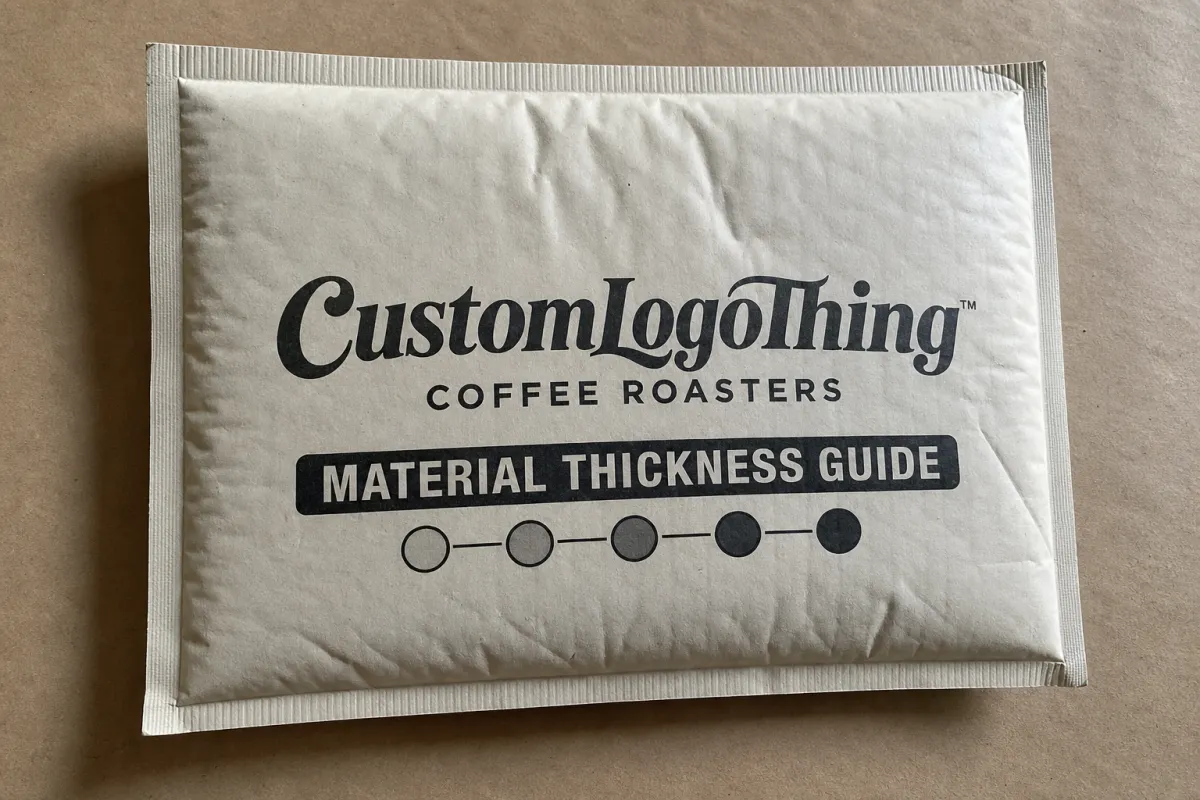
Thickness in padded mailers is not one clean measurement. Suppliers may talk about outer film gauge, paper caliper, bubble depth, padding density, or total wall thickness, depending on the construction. That is annoying, but it is also reality. If one spec sheet uses mils, another uses GSM, and a third uses bubble depth, compare the whole build rather than pretending the numbers mean the same thing.
That matters because coffee is often shipped in flexible formats. Valve bags, foil-lined pouches, and stand-up pouches all respond to pressure in different ways. A single 12 oz bag in a soft pouch behaves very differently from a two-bag bundle with a rigid insert. Add branded tissue, a thank-you card, or a sample pack, and the decision shifts again. The outer mailer has to protect the inner system, not fight it.
Coffee roasters also ship more package types than people outside the business expect. Subscription boxes, sampler kits, retail gift sets, wholesale replenishment orders, and event mailers all create different stress profiles. A mailer that works for a light monthly subscription may not survive a bundle with a mug or a metal tin. The outer package needs to match the contents, not the other way around.
Brand perception sits right next to protection. The outer mailer is often the first physical thing a customer touches. If it arrives torn, dented, or cheap-looking, the coffee has to work harder to recover the impression. If it lands clean and intact, the package quietly supports the idea that the roast inside was handled with care. That is not fluffy marketing language. It is basic customer psychology.
Function and appearance do not always move together. Function means resistance to puncture, crush, and seam failure. Appearance means print sharpness, color consistency, and how the mailer feels in the hand. A thicker structure can improve one and hurt the other if you do not test it. Fine type, small logos, and large color blocks all behave differently on heavier constructions. A digital proof will not show you that. It never does.
Structure matters too. A mailer made with recycled content can perform well if the padding and seams are tuned properly. A kraft paper mailer can look warm and artisanal, which is useful for roast-focused branding, but the paper face, adhesive, and inner layer all need to work together. If your brand promise leans on recycled materials or FSC certified fibers, ask for documentation. If the claim is about biodegradable packaging, ask harder. Outer shell, padding, and adhesive do not all behave the same way.
For a broader look at how different structures perform, our Case Studies page shows real buying tradeoffs, and Custom Packaging Products offers a wider comparison of print finish, structure, and protection. A mailer that photographs well is not automatically the right one for a parcel network that likes to beat things up.
How Thickness Affects Protection, Branding, and Unboxing
More material usually means more resistance to puncture and a bit more crush protection, especially at the edges and seams. That matters in sorting hubs, where parcels get stacked, pushed, and dropped more often than anyone likes to admit. It matters again on the last mile, where a package can spend hours under heavier boxes or jammed into a tote with no forgiveness at all.
Three failure modes show up often in coffee shipping. First, the corner tear, where a sharp inner edge or rigid insert works through a thin wall. Second, the seam split, which tends to appear when the mailer is overfilled or the bonding is weak. Third, crush damage, where the mailer survives but the coffee bag inside comes out bent, scuffed, or folded in a way that looks sloppy. Thicker material does not fix everything. It does buy more margin.
Print quality is the other side of the same decision. Thicker mailers can feel more substantial, but some constructions lose flexibility and wrinkle during folding. That can dull color, distort small type, or create registration issues near the edges. Bold logos and flat color blocks usually hold up better than fine script or detailed badges. Thin, elegant artwork on a heavy, stiff structure can look wrong fast. Packaging can be picky like that.
The unboxing moment is more direct than a lot of teams expect. Coffee buyers usually notice the outer package before they notice the aroma of the bag itself. A mailer that arrives crisp and squared gives a quality cue before the product even comes out. A bent, creased, or compressed mailer sends the opposite signal. The coffee inside can still be excellent. The first impression already did its job.
A thicker build is not just a vanity choice. It can support the brand story and reduce damage. It can also become dead weight. A premium-looking mailer that adds freight cost and warehouse bulk without lowering claims is bad math dressed up as good design. Protection, presentation, and shipping efficiency usually pull in different directions. The useful spec is the one that handles that tension honestly.
Lightweight subscription shipments often do fine with a midweight mailer, especially when the inner bag is soft and the route is short. Heavier multi-bag orders, or anything with hard accessories, usually justify more structure. A simple stack test helps when the choice is unclear: place the packed mailer under several pounds of evenly distributed weight for a few hours and check the seams, corners, and print face afterward. It is not transit testing, but it will expose lazy assumptions quickly.
For carrier-focused validation, look at transport test methods such as ISTA procedures or related ASTM distribution tests. Real shipping is harsher than a bench inspection. A mailer has to survive repeated handling, not just look fine in a photo.
Key Factors: Weight, Route Risk, and Inner Packaging
Weight usually starts the conversation, but it should not end it. A single 12 oz coffee bag is not heavy, yet the packaging around it can add stiffness, corners, and pressure points. Two to four bags bundled together can start behaving like a small box instead of a soft mailer shipment. Sampler sets are sneaky. Inserts, cards, and dividers create odd stress points that a simple bag never would.
Route risk comes next. Local ground delivery with low handling counts is a very different game from a long cross-country route with multiple hub transfers. More touchpoints mean more abuse. More time in a stack means more compression. If your orders cross several hubs, thickness matters more. If the route is short and the product is soft, paying for a heavier build every time may be waste with prettier branding.
Inner packaging often decides the answer before the outer mailer does. A coffee bag inside a small box or wrapped with a rigid insert may let you use a lighter padded mailer. A stand-up pouch with no box support flexes more and needs the outer package to do more work. Corrugated cardboard inserts can be surprisingly effective here. A slim insert that supports the edges often does more than another layer of padding slapped on the outside.
Operations and presentation overlap here, whether teams like it or not. Retail-ready shipments, wholesale replenishment, and subscription drops all carry different expectations. Wholesale buyers usually want consistency and cleanliness first. Direct-to-consumer coffee buyers may care more about the reveal. A kraft paper mailer can fit one channel better than a glossy poly build. A stronger poly structure may be the smarter move for a more utilitarian order. For a side-by-side look at another parcel format, our Custom Poly Mailers page gives a useful comparison point.
The table below gives a practical way to frame the options. These are planning ranges, not locked prices. Size, print coverage, and freight all move the number. What matters is the pattern.
| Build | Best For | Protection Level | Brand Feel | Typical Unit Cost |
|---|---|---|---|---|
| Lightweight padded mailer | Single bag subscriptions, short routes, soft inner pouches | Basic to moderate | Clean, simple, less substantial | $0.18-$0.28 at 5,000 units |
| Midweight kraft or poly padded mailer | One to two bags, mixed routes, sample packs | Moderate to strong | Balanced, polished, dependable | $0.26-$0.42 at 5,000 units |
| Premium-thickness build | Heavier bundles, harder inserts, gift sets, longer routes | Strong to very strong | More premium, more substantial in hand | $0.38-$0.65 at 5,000 units |
Those ranges matter because packaging economics hide in plain sight. A thicker mailer costs more per unit, yes. It also might save you from replacements, customer service time, and the mess that comes with a damaged order. For a premium coffee line, a few extra cents can be easier to justify than a reship and a frustrated customer. For a price-sensitive subscription, the same increase needs a cleaner business case.
Storage cost belongs in the calculation too. Thicker mailers take more space in the warehouse, and bulkier stock can slow pack-out if the fold pattern is awkward. Fulfillment teams notice that kind of thing immediately. Packaging is not just a marketing buy. It is an operations buy with brand consequences.
If sustainability is part of the pitch, do not treat every eco claim like the same thing. A mailer with post-consumer waste content is not the same as one that is fully recyclable or biodegradable. A structure made with recycled materials may still use adhesives or padding that limit disposal options. If the brand story depends on certified fiber content, ask for documentation and, where relevant, chain-of-custody proof for FSC certified paper components. The FSC site is a useful reference for that conversation.
Production Timeline: From Artwork Approval to Delivery
Production is where packaging plans either become real or fall apart. The process usually starts with spec confirmation, where size, thickness, material, and print details get locked. Then comes artwork setup and proofing, followed by sampling if needed, production, quality control, packing, and freight booking. Each step looks manageable on paper. Put them together and they decide whether your mailers arrive before launch or after the launch window has already closed.
Delays cluster in familiar places. Late dieline changes force artwork rebuilds. Unapproved color corrections add another proof round. Missing barcode placement or unclear shipping copy can stall production until somebody sorts it out. Thickness can slow the schedule too if the supplier has to source a different material or adjust the die-cut pattern for a heavier build.
Stock sizes move faster because the structure already exists. Custom sizing, special finishes, and thicker constructions usually add time. A straightforward custom padded mailer can take roughly 12-18 business days after final proof approval, while more customized or thicker builds may need three to five weeks before freight. That is not a universal rule. It is a planning range. Artwork complexity, sampling needs, and shipping method all push the timeline around.
Coffee brands feel those delays harder than some other categories. Seasonal blends, holiday gift packs, limited roast drops, and subscription refreshes all depend on inventory arriving on schedule. If the mailer is tied to a launch, it needs to be ordered as part of the launch plan, not after the beans are packed. Packaging is lead-time inventory, not an afterthought.
Here is the sequence that usually keeps things from going sideways:
- Confirm the mailer size, thickness target, and inner contents.
- Check whether the shipment is a single bag, bundle, or kit.
- Approve artwork layout and barcode placement.
- Request a physical sample, especially if the surface finish or padding changes.
- Test the mailer under real packout conditions.
- Release production only after the sample survives compression and seal checks.
- Book freight with enough buffer for inbound receiving and launch prep.
The last step gets ignored more than it should. A late freight booking can turn a clean production run into a rushed arrival. Finished mailers still need to move from the factory to your warehouse or fulfillment center. Time does not magically appear because the print is done.
If you want to see how packaging timelines play out in real buying decisions, our Case Studies page shows the tradeoffs brands usually make. For broader sourcing comparisons, Custom Packaging Products helps sort out what is stock, what is custom, and what is likely to carry a longer lead time.
Cost, Pricing, MOQ: What Drives Unit Cost
Price is rarely just a print quote. It is a bundle of decisions. Thickness changes raw material cost, machine setup, the die-cut, adhesive usage, and sometimes freight because bulkier mailers eat up more space. If a supplier gives you one number and skips the reasons behind it, ask for a breakdown. You want to know what part of the cost comes from the structure and what part comes from print.
MOQ, or minimum order quantity, usually shifts with three things: material thickness, customization level, and size. A simple stock mailer with light branding may come with a lower MOQ. A thicker mailer with full-color art, custom sizing, or special paper stock often pushes the minimum higher because setup time and waste are harder to spread across a tiny run. That is not punishment. It is production math.
The real buying question is whether the higher unit cost buys something measurable. Often it does. A thicker build can reduce damage claims, keep print quality intact, and support a stronger unboxing experience. For a coffee brand shipping limited-release beans at a healthy margin, a few extra cents per unit may be easier to absorb than the cost of a bad customer experience. For a subscription line that lives on price discipline, the same increase needs a tighter case.
Storage cost matters too, and buyers forget it too often. Thicker mailers take up more room in the warehouse, and more bulk can slow pack-out if the fold pattern is awkward. If the fulfillment team packs hundreds of orders a day, even a small change in handling can show up on the floor. Packaging is not just a branding decision. It is a workflow decision.
A quick pricing lens for coffee roasters
Think in scenarios, not abstract price points.
- Lightweight build: Lowest unit price, best for soft inner contents, but less forgiving on longer routes.
- Midweight build: Usually the best balance for most roasters shipping one to two bags, with enough margin for handling and a cleaner print face.
- Premium-thickness build: Higher cost, but better for bundles, hard inserts, and parcels that need a stronger first impression.
Requesting three quotes for the same artwork often makes the decision obvious: a lighter structure, a midweight option, and a premium-thickness build. Compare unit price, freight cube, estimated damage rate, and storage fit. A quote that looks cheap on paper can turn expensive once replacements and service calls start stacking up.
If the brand is deciding whether to spend more on the outer mailer or on the inner packaging, compare the whole system. A mailer made with kraft paper and recycled materials may support the brand story, while a denser poly build may lower damage more effectively. Both can be right. The better one depends on whether the priority is a paper-forward presentation or a tougher shipping shell. If the line expands beyond coffee into lighter parcel formats, Custom Poly Mailers can serve as a useful comparison for protection, Print, and Cost.
Small roasters often underestimate how much MOQ shapes the final spec. If the premium build requires a larger commitment than the business can carry, the team may end up tying cash into inventory it does not need. In that case, a slightly lighter mailer with stronger artwork is often the smarter move. A good supplier should help you weigh that tradeoff instead of pushing the heaviest option on every line.
Common Mistakes When Specifying Mailer Thickness
The first mistake is overbuying thickness because it feels safer. That is a very human move. Thicker sounds stronger. The problem is that extra bulk can raise freight costs, reduce storage density, and make the package slower to fold or seal. More material is not automatically better. It only helps if it fixes a real failure mode.
The second mistake is the opposite one: choosing a thin mailer because the quote is attractive and assuming the difference will not matter. It usually does. A few cents saved up front can disappear into reships, replacement product, support time, and bad reviews if the package fails under pressure. For high-margin coffee, that hidden cost is easy to miss because the bean value sits inside the bag, not on the packaging line.
A third mistake is ignoring the shape of the inner contents. A slim coffee bag behaves very differently from a tin, a boxed sampler, or an accessory bundle with hard corners. One sharp edge can change the whole plan. If the order is a flat bag, a lighter mailer may work. If it includes a grinder tool, mug, or rigid insert, the thickness question changes completely.
Branding errors show up too. Some teams assume all print finishes behave the same on every mailer. They do not. Certain thicker structures hold ink beautifully and feel premium. Others need testing because the surface can mute color, resist adhesion, or show fold marks. If the logo depends on fine type, metallic accents, or full-coverage panels, approve a physical sample before production.
Testing errors are common enough to be annoying. A sample can pass the visual check and still fail after compression, drop, or seal testing. If the packout matters, test the packout. Better yet, use the exact contents in the exact mailer and let the fulfillment team be blunt about it. They spot operational pain before the spreadsheet does.
Eco claims are another trap. A roaster may want biodegradable packaging, but the claim has to match the full structure and local disposal reality. A mailer with kraft paper and recycled materials can support a cleaner message, but adhesives, padding, and inks still matter. A package with post-consumer waste content is not the same as one that is fully compostable or curbside recyclable. Ask for documentation before print. It is much easier than explaining a claim after launch.
For a straightforward comparison of packaging styles and finish levels, the examples in Custom Packaging Products make the price jumps easier to spot. That is usually where the hidden cost is hiding.
Expert Tips and Next Steps for Coffee Roasters
The most reliable way to choose thickness is to test it with real orders. Not theory. Real shipments. That means the same roast-day packouts, the same inserts, and the same route class your customers actually see. A bench sample tells you how the mailer feels. A transit sample tells you whether it survives. Those are not the same thing, and pretending they are is how packaging gets signed off too early.
A simple comparison matrix helps. Keep it to one page. Score each option on product weight, route risk, damage sensitivity, branding goals, unit cost, and storage space. The point is not to make the process fancier. The point is to make the tradeoff visible. Once the whole team sees the numbers, the decision gets much easier.
Ask for two or three thickness levels in sample form. Fold them. Handle them. Seal them if needed. Compare how each one behaves around your actual coffee bag or bundle. Check the seam. Check the edges. Check the print. Then do a compression test. If the mailer still looks sharp after being stacked under heavier parcels, you are closer to the right spec.
One practical rule helps a lot: hard edges and long routes call for thicker mailers. Soft contents and short routes usually do fine with a midweight build. It is not universal wisdom. It is just a useful starting point that keeps buyers from choosing by instinct alone.
Thinking beyond the outer mailer helps too. If the coffee bag itself is strong and the branding is already doing heavy lifting, the mailer can focus on protection and first impression. If the bag is simple and the product story needs more visual support, the mailer may need to carry more of the brand work. Both approaches are valid. They just solve different problems.
Before placing a large order, confirm four things in writing:
- The exact size and thickness spec.
- The print method, color count, and finish.
- The MOQ and any price break at higher volumes.
- The lead time from proof approval to freight booking.
If the supplier can answer those clearly, you are in a better position to Buy with Confidence. If not, ask before artwork is finalized. Changing a quote is easier than changing a finished run.
For brands that want a stronger sourcing benchmark, reviewing our Case Studies is a good next step. If you are still mapping options, Custom Packaging Products gives a broader view of what can be customized. If the program extends into lighter parcel formats, Custom Poly Mailers offers a useful comparison point for protection, Print, and Cost.
The cleanest decision rule is simple: pick the lightest mailer that survives a real packout test on the worst route you ship. If it fails at the corners, the seams, or the print face, move up one tier and test again. That is the practical value of a branded Padded Mailers for Coffee roasters material thickness guide. It turns a vague packaging guess into a buying decision you can defend.
FAQ
What thickness should branded padded mailers for coffee roasters usually start with?
Start with a midweight option if you are shipping one or two coffee bags and want a balance of protection, print quality, and cost. Move thicker when the contents have hard edges, heavier bundles, or a longer shipping route with more handling. Use samples to test seam strength and crush resistance before you lock in a production spec.
Are thicker padded mailers always better for coffee shipments?
No. Thicker mailers protect better in some cases, but they also increase unit cost, freight weight, and storage bulk. If the inner coffee packaging is already rigid, a lighter mailer may be enough. The best choice is the one that matches product weight, route risk, and branding expectations.
How does thickness affect printing on branded padded mailers for coffee roasters?
Thickness can change how flat the surface stays during printing and folding, which affects color clarity and registration. Some thicker structures hold premium finishes well, while others need testing to avoid dull or uneven results. Always approve a physical proof if your logo relies on fine text or detailed artwork.
What MOQ should a small coffee roaster expect for custom padded mailers?
MOQ often depends on size, thickness, print colors, and whether the design is fully custom or based on a stock format. Thicker or more customized builds usually need a larger minimum than simple stock mailers. Ask for a quote across two MOQ levels so you can compare cash flow against per-unit savings.
How long does production usually take for custom coffee roaster mailers?
Production time typically depends on proof approval, sampling needs, print complexity, and freight method. Late artwork changes or thickness revisions are common causes of delay. Build in extra time before seasonal launches so inventory arrives before demand spikes.