Buyer Fit Snapshot
| Best fit | Custom Padded Mailers Price projects where brand print, material claims, artwork control, MOQ, and repeat-order consistency need to be specified before quoting. |
|---|---|
| Quote inputs | Share finished size, material target, print colors, finish, packing count, annual reorder estimate, ship-to region, and any compliance wording. |
| Proofing check | Approve dieline scale, logo placement, barcode or warning zones, color tolerance, closure strength, and carton packing before bulk production. |
| Main risk | Vague material claims, crowded artwork, missing packing details, or unclear freight terms can make a low unit price expensive after revisions. |
Fast answer: Custom Padded Mailers Price: What Impacts the Cost should be specified like a repeatable production item. The safest quote records material, print method, finish, artwork proof, packing count, and reorder notes in one written spec.
Production checks before approval
Compare the actual filled-product size with the drawing, then confirm tolerance on folds, seals, hang holes, label areas, and retail display edges. Reserve space for logos, QR codes, warning copy, and material claims before decorative graphics fill the panel.
Quote comparison points
Review material grade, print process, finish, sampling route, tooling charges, carton quantity, and freight assumptions side by side. A quote is only useful when the supplier can repeat the same color, closure quality, and packing count on the next order.
Custom Padded Mailers price is rarely the real cost a buyer is paying for. A mailer that looks cheap on the quote can get expensive fast once damaged orders start bouncing back, replacements get shipped, or customer service has to clean up the mess. From a packaging buyer's point of view, the number that matters is landed cost per shipped order, not the unit price sitting alone in a spreadsheet.
That difference matters more than teams like to admit. One weak outer seam, one adhesive strip that peels open in transit, one print finish that scuffs off in the truck, and the savings from the low quote start evaporating. A smart custom padded mailers price strategy looks at protection, print quality, order volume, freight, and storage together, because those variables move the economics more than a tiny unit-price gap ever will.
Brands shipping apparel, cosmetics, supplements, accessories, or small electronics do not buy mailers just to move product from point A to point B. The mailer is part of the product experience, part of the return-rate math, and part of package branding. That is why this breakdown stays focused on what actually shifts custom padded mailers price and what is just noise.
Custom Padded Mailers Price: Why a Cheaper Mailer Can Cost More
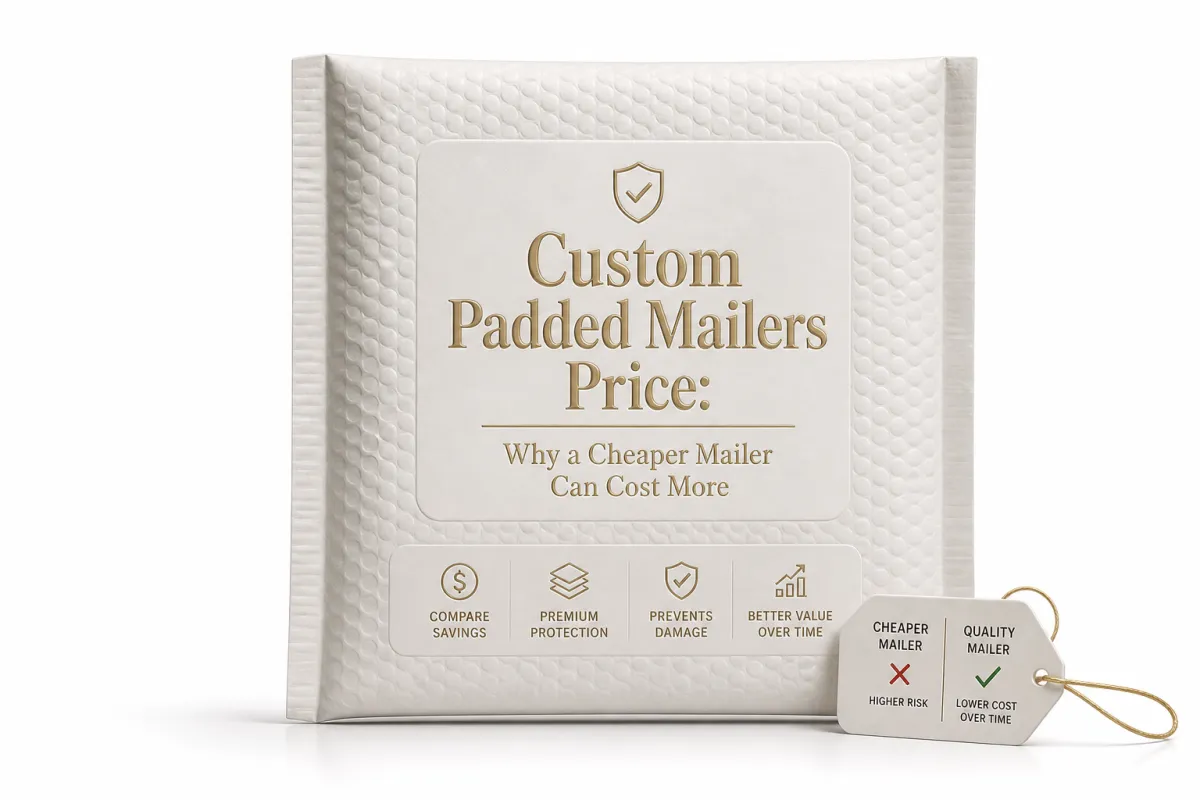
People compare custom padded mailers price the wrong way all the time. They pull one quote, maybe for a pilot run, and decide the lower number wins. Cute idea. In practice, the better question is simple: how much does each shipped order cost after damage, freight, storage, and reprints are counted?
One damaged shipment can erase the gap between two quotes. If the mailer is too thin, if the closure is weak, or if the print rubs off in transit, the brand pays for it later. That later bill shows up as return handling, replacement goods, customer service time, and a small dent in trust that never shows up neatly on the purchase order. A lower custom padded mailers price can look smart on paper and still lose money in the warehouse.
I've seen teams save a few cents per unit and then spend the next quarter firefighting preventable damage claims. That is not theory. That is just bad math with a nice-looking invoice.
Repeat volume changes the math too. A brand shipping 500 orders a month does not buy the same way as one shipping 50,000. The best custom padded mailers price for a launch test may be a terrible fit for a steady replenishment program. Buyers who plan around repeat shipping volume usually get cleaner pricing, less waste, and better inventory control.
"The cheapest mailer is not the cheapest decision if it nudges the damage rate up, even a little."
That is the part most packaging teams learn after a few production cycles. A mailer that saves two cents but causes an extra return every few hundred shipments is not saving anything. A solid custom padded mailers price review should compare unit cost against protection performance, not against another low number that ignores the mailer's actual job.
For brands building branded packaging into the shipping experience, the cost picture gets broader fast. A clean print panel, accurate color registration, and reliable adhesive behavior all shape how customers read the brand. That is why the best custom padded mailers price is usually the one that balances presentation with transit performance instead of pretending those two things never touch each other.
If you already use Custom Packaging Products across your shipping line, the mailer should fit the rest of the system instead of fighting it. A low-cost mailer that does not match the broader product packaging program can create inconsistency in opening experience, storage needs, and reorder planning. That inconsistency eats time, and time is not free. Pretty obvious, but people still miss it.
Product Details: What Custom Padded Mailers Actually Include
A custom padded mailer is a layered shipping solution built to protect lightweight products without the bulk of a box. The outer shell may be paper or poly, the middle layer is the padding, and the closure is usually peel-and-seal adhesive. Some versions add a tear strip, a tamper-evident seal, or a second closure flap. Each feature can nudge custom padded mailers price up or down depending on the spec.
The outer shell is the first big decision. Paper and kraft versions often feel better aligned with retail packaging and eco-focused positioning, while poly versions usually fight moisture and scuffing more effectively. If a product is sensitive to humidity or long transit routes, that shell choice matters. If the goal is presentation and a cleaner unboxing moment, the visual finish matters just as much as the protection.
The internal padding is where the mailer earns its keep. Some mailers use bubble, others use paper-based cushioning, and some use a foam-like insert. Clothing and soft goods often need less aggressive cushioning. Small electronics, batteries, or glass containers need padding that actually matches the risk of impact. A mailer with weak cushioning may pass a visual inspection and fail exactly where it counts: inside a trailer, on a conveyor, or in a delivery van.
Custom Printed Branding is another major piece. A stock mailer ships the product, sure. A custom version can carry the logo, brand colors, seasonal graphics, or inside messaging that shapes the opening experience. Packaging teams often compare custom padded mailers price against the more visible spend they might make on Custom Poly Mailers or custom printed boxes. The right format depends on what the product needs and how the customer should feel when the order lands.
Common use cases include apparel, small accessories, cosmetics, wellness items, supplements, and compact electronics. These are the product categories where low weight matters and crush resistance still matters. A padded mailer is not meant to replace a corrugated shipper for everything. For the right item, though, it can reduce dimensional weight, save storage space, and make fulfillment less annoying.
Use this filter: if the item needs moderate impact protection, clear brand presentation, and efficient shipping, a custom padded mailer may be the right answer. If it needs rigid crush resistance, separation between parts, or heavy stack protection, compare the quote against cartons instead of forcing the mailer to act like a box. That is how buyers keep custom padded mailers price tied to actual use instead of wishful thinking.
Finish matters too. Matte paper can feel premium and quiet. Glossy poly often reads as tougher but less natural. A recycled look can support sustainability messaging, but only if the material spec supports the claim. That is the difference between authentic package branding and a surface-level design choice that falls apart under scrutiny. Nobody wants the green story to turn into a credibility problem.
Specifications That Move the Needle on Performance
Once the structure is clear, the pricing conversation gets serious. Size, thickness, padding density, seam strength, and print coverage all affect custom padded mailers price because they change raw material usage and production complexity. Small spec changes can create big performance changes, especially at scale.
Size is the first lever. A mailer sized too large wastes material, increases dimensional weight, and creates more air in the carton. A mailer sized too small compresses the product, strains the seams, and raises the chance of a failed seal. Good sizing is not just about fit. It is about shipping economics. A better-fit mailer lowers freight waste and can improve fulfillment speed because packers are not wrestling oversized stock.
Thickness matters too. A heavier-gauge shell, stronger seam construction, or denser cushioning usually raises custom padded mailers price, but it can also lower the true cost per order by reducing damage and returns. In shipping, the cheapest material on the spec sheet is not always the most economical material in practice. Freight handlers, conveyor systems, and porch delivery all punish weak construction. Kind of rude, honestly, but there it is.
Material choice changes the trade-offs. Paper and kraft options usually appeal to brands that want a natural feel or a cleaner sustainability story. Poly options are often chosen for moisture resistance, tear resistance, and consistent print appearance. Hybrid structures sit in the middle. Each one affects the custom padded mailers price differently because resin content, coating, and converting steps are not the same.
Print coverage is another technical driver. A single-color logo on one panel is usually more efficient than a full-bleed design across the entire surface. Inside print, high-detail artwork, and multiple brand placements all add complexity. Buyers who want strong visual impact should expect the custom padded mailers price to reflect that choice. Printing is not a free upgrade. It is a real production variable.
Warehouse storage has a cost too. Mailers that are too bulky reduce pallet efficiency and eat shelf space. Mailers that are flat and compact store better, which matters if the team keeps several SKUs on hand. For many operations, storage cost hides in plain sight. It does not show up in the quote, but it absolutely affects total landed custom padded mailers price over the life of the order.
Compliance and sustainability claims should map directly to the material spec. If the mailer is made from FSC-certified fiber, say so only when the supply chain backs it up. If the design is meant to support transit performance testing, standards from ISTA help frame what protection should look like under real shipping conditions. That kind of standard-based thinking builds credibility and keeps purchasing decisions grounded.
For many buyers, the smartest comparison is not paper versus poly in the abstract. It is what each format does for the product, the brand, and the freight budget. A mailer that reduces damage by a modest margin can justify a higher custom padded mailers price if the brand ships fragile or premium items. If the product is low-risk and lightweight, a simpler spec may be enough. Simple is fine. Wasteful is not.
Custom Padded Mailers Price: Pricing, MOQ, and Volume Breaks
Here is the part most buyers ask for first: the custom padded mailers price logic. The quote usually depends on material grade, size, print method, order quantity, finishing, packaging format, and any setup or plate costs. Those variables combine differently on every project, which is why two mailers that look nearly identical can carry very different numbers.
MOQ, or minimum order quantity, is the biggest swing factor after materials. Lower quantities usually cost more per unit because setup time, print preparation, and production scheduling are spread across fewer pieces. That does not make a lower MOQ bad. It means the buyer is paying for flexibility and lower inventory risk. For a new product launch, that trade can be sensible. For a mature shipping program, it may be more expensive than it needs to be.
As a rough planning frame, a small custom run usually sits in a higher band, a mid-volume run can pull the price down, and a larger production order typically gets the sharpest unit cost. Once quantities move from a few thousand units into the five-figure range, many programs see a noticeable drop. The exact custom padded mailers price depends on size, print coverage, and the substrate, but the rule stays the same: the more units you absorb setup into, the lower the price per mailer tends to fall.
| Order Scenario | Typical Build | Indicative Price Band | What Usually Drives the Number |
|---|---|---|---|
| Sample or pilot run | Basic print, limited quantity, standard size | $0.80-$1.60 per unit | Setup spread across few pieces, proofing, and smaller production efficiency |
| Mid-volume production | Single- or two-color branding, standard material | $0.35-$0.75 per unit | Better absorption of setup costs and improved converting efficiency |
| Higher-volume repeat order | Standardized size, stable artwork, optimized pack format | $0.20-$0.45 per unit | Volume buying, repeat tooling, and lower waste per production cycle |
Those numbers are planning bands, not promises. A premium paper shell with full-bleed branding will land higher than a basic one-color format. A larger mailer may also cost more because of material usage and freight classification. Still, this table gives buyers a useful frame for evaluating custom padded mailers price without getting trapped by a single quote that lacks context.
Hidden costs deserve equal attention. Freight can change the landed number quickly, especially if the shipment is bulky or time-sensitive. Artwork revisions can add design time. Rush orders can increase production charges. Special packaging, like retail-ready bundles or carton labeling, can also add expense. If those items are not listed clearly, the quoted custom padded mailers price is only part of the story.
Ask for a quote that separates unit cost, setup, shipping, and any repeat-order savings. That gives you a clean basis for comparison. It also helps teams compare apples to apples across suppliers, which is where many purchasing mistakes happen. One supplier may look cheaper until freight gets added. Another may look higher but include tighter tolerances, better print quality, and lower waste.
Buyers who manage packaging design carefully often compare the mailer price against other formats in the line. If a product can ship in a padded mailer instead of a box, dimensional weight may fall. If the product needs a premium presentation, a hybrid approach may be better. Either way, custom padded mailers price should be reviewed alongside damage risk, packaging speed, and the rest of the shipping architecture.
For sourcing teams that want to stay organized, the most useful quote request includes finished size, artwork coverage, target quantity, ship-to ZIP code, and the product type being shipped. That short list usually produces a much tighter custom padded mailers price than a vague request for "best pricing." Specific information reduces guesswork. Guesswork gets expensive fast.
Process & Timeline: From Quote to Delivery
The order process is straightforward if the buyer shows up prepared. A typical custom padded mailers price project starts with inquiry, then spec review, then quote, then artwork confirmation, then proof or sample approval, followed by production and shipment. Each step matters because a delay in one stage usually pushes the whole timeline back.
Lead time depends on a few predictable variables. Straightforward artwork with standard sizing usually moves faster than a project with custom dimensions, heavy coverage, or special finishes. Material availability matters too. If the chosen substrate is in stock, the order may move more quickly. If a special paper or poly structure must be sourced, the schedule changes. When buyers understand those inputs, custom padded mailers price becomes easier to forecast because rush decisions are less likely.
Approval speed is a common bottleneck. A quote can be ready in a day, but production cannot begin until the proof is signed off. Sending clean files, accurate size targets, and realistic quantity goals from the start helps a lot. Better intake data means fewer revision loops. Fewer revision loops mean a more stable custom padded mailers price and a less chaotic schedule.
Standard lead times are usually more comfortable than rush orders. Rush production is possible in some cases, but it can raise the total price because it compresses scheduling and may require priority materials or expedited freight. If speed is the priority, say so early. Surprises late in the process are how budgets go sideways.
Before production begins, confirm the critical checkpoints:
- Dimensions: verify finished width, length, and flap style against the product sample.
- Artwork: approve colors, logo placement, and any inside print or special messaging.
- Closure: test peel-and-seal strength and make sure the adhesive suits the packing flow.
- Packaging format: confirm whether the mailers ship bulk-packed, carton-packed, or retail-ready.
- Ship-to details: double-check destination address, dock hours, and receiving requirements.
Those checks sound basic because they are basic. They still prevent some of the most expensive mistakes. A wrong dimension creates a wasteful fit. A missed color approval leads to rework. A missed shipping detail turns a decent custom padded mailers price into a delivery problem no one asked for.
Reliable quoting is not only about speed. It is about matching the mailer to the job. If a brand ships moisture-sensitive goods, the material recommendation should reflect that. If the customer wants stronger shelf presentation, the recommendation should reflect that too. A supplier that understands actual product packaging needs is worth more than one that only knows how to punch out a number.
Teams that already order branded packaging for other formats should treat this as part of the same system. The mailer, the carton, and the print standard all reinforce one another. A supplier that can coordinate mailer output with broader Custom Packaging Products sourcing makes the process easier to manage and usually cuts down on avoidable rework.
Why Choose Us and the Next Steps for Your Quote
Custom Logo Things is a strong fit for buyers who want facts, not sales noise. The value is in manufacturing control, consistent material sourcing, clear spec guidance, and responsive quoting that explains the numbers instead of hiding them. That matters because custom padded mailers price only helps if the buyer understands what is included and what is still open.
From a packaging buyer's perspective, the best supplier is the one that helps you balance protection, presentation, and total cost. Not the one that tosses out the lowest unit number and leaves the rest of the quote vague. A good partner should be able to explain why a certain shell, insert, or closure structure is worth more or less, and how that choice affects damage rates, freight, and brand perception.
There is also a practical sourcing advantage in working with a supplier that can align mailers with the rest of the shipping portfolio. If you are comparing padded mailers against cartons, printed sleeves, or other protective formats, you want a view of the whole system. That is where package branding gets stronger and waste gets lower. A mailer that trims pack time by even a few seconds can matter at scale. Multiply that by thousands of orders, and the savings become real.
If you need a tighter custom padded mailers price, send these four details first:
- Product dimensions and weight
- Target monthly or annual quantity
- Print needs, including logo coverage and color count
- Destination ZIP code for freight planning
If the product is new, fragile, or high value, ask for a sample or proof before full production. That is usually the smartest move. A sample confirms fit, seal strength, and print readability. It also lets the team test whether the mailer supports the brand experience without adding unnecessary bulk. For launches and premium items, that check is worth the time.
For brands focused on sustainability claims, ask for the exact material description and any certification support before you place the order. If the supplier says the paper is FSC certified, verify the chain-of-custody language. If the mailer is meant to support transit performance expectations, review the test basis and not just the sales language. A transparent custom padded mailers price quote should make those details easy to see. For additional reference on responsible fiber sourcing, visit FSC.
The right custom padded mailers price is the one that survives the full shipping cycle: quote, production, freight, unpacking, and customer use. If you want a quote that reflects real specs instead of vague averages, send the product details, branding needs, and quantity target now. The better move, though, is simpler: compare like-for-like specs, include freight, and choose the mailer that protects the product without overpaying for empty space.
What affects custom padded mailers price the most?
Size, material, print coverage, and order quantity usually have the biggest impact on custom padded mailers price. Setup costs matter more on smaller runs, while larger runs spread those costs over more units. Shipping weight and freight method can change the landed price more than buyers expect, especially on bulky or time-sensitive orders.
Is there a minimum order for custom padded mailers?
Most suppliers set an MOQ to cover setup, printing, and production efficiency. Lower MOQs are possible, but the unit price is usually higher because the fixed costs are spread across fewer pieces. The right MOQ depends on how fast you will use the mailers and how much storage space you have in the warehouse.
How long does a custom padded mailers order take?
Lead time depends on artwork approval, material availability, and production load. Straightforward orders move faster than projects with custom sizing or complex print coverage. Rush production is possible in some cases, but it usually increases the total price and can limit your material options.
Can I get a sample before placing a full order?
Yes, and it is smart when you are testing fit, closure strength, or print quality. A sample helps confirm whether the mailer protects the product without adding excess bulk. For new product launches, a sample can prevent expensive rework later and give the team a clearer read on the final custom padded mailers price.
How do I compare two custom padded mailers quotes fairly?
Match the size, material, print method, and MOQ before comparing unit prices. Check whether freight, setup, and proofing are included in the quote. A lower quote is not better if it raises damage rates or adds hidden charges, because the true custom padded mailers price is the one you pay after the order ships.
If you are ready to request pricing, send your specs now and compare custom padded mailers price on a true like-for-like basis. The brands that buy well are not the ones chasing the lowest quote; they are the ones choosing the mailer that protects the product, supports the brand, and keeps the total cost under control.

