Buyer Fit Snapshot
| Best fit | Custom Padded Mailers Pricing projects where brand print, material claims, artwork control, MOQ, and repeat-order consistency need to be specified before quoting. |
|---|---|
| Quote inputs | Share finished size, material target, print colors, finish, packing count, annual reorder estimate, ship-to region, and any compliance wording. |
| Proofing check | Approve dieline scale, logo placement, barcode or warning zones, color tolerance, closure strength, and carton packing before bulk production. |
| Main risk | Vague material claims, crowded artwork, missing packing details, or unclear freight terms can make a low unit price expensive after revisions. |
Fast answer: Custom Padded Mailers Pricing: What Affects the Cost should be specified like a repeatable production item. The safest quote records material, print method, finish, artwork proof, packing count, and reorder notes in one written spec.
Production checks before approval
Compare the actual filled-product size with the drawing, then confirm tolerance on folds, seals, hang holes, label areas, and retail display edges. Reserve space for logos, QR codes, warning copy, and material claims before decorative graphics fill the panel.
Quote comparison points
Review material grade, print process, finish, sampling route, tooling charges, carton quantity, and freight assumptions side by side. A quote is only useful when the supplier can repeat the same color, closure quality, and packing count on the next order.
Custom Padded Mailers pricing can look uneven at first glance. One mailer protects a 6-ounce item beautifully, then the quote shifts as soon as you change the print area, the closure style, or the finished size. Buyers often focus on the paper or film spec alone, then wonder why the final number is higher than expected, because custom padded mailers pricing comes from several moving parts rather than one tidy line item.
The material matters, but it is only one piece of the picture. Setup, converting, sample approval, freight, and the order quantity you choose all affect the final number. A packaging buyer shipping a few hundred orders a month will feel those differences differently than a brand sending tens of thousands of units through a fulfillment center, which is why Custom Padded Mailers pricing deserves to be treated as a supply-chain decision, not only a packaging purchase.
If your program sits beside branded packaging, retail packaging, or custom printed boxes, the mailer spec also needs to fit the larger package branding story. A clean, properly sized mailer can reduce damage, tighten the unboxing experience, and make the product packaging feel deliberate instead of improvised. That is one reason it helps to compare quotes using the same assumptions instead of treating the first number you receive as the whole answer.
For buyers who want a reliable way to judge the quote, the goal is straightforward: understand how custom padded mailers pricing is built, what pushes it up, what brings it down, and where savings can be found without weakening protection. If you are building a broader packaging mix, it can also help to review Custom Packaging Products alongside the mailer spec, because the right answer is sometimes a system rather than a single SKU.
“The cheapest quote is not always the lowest-cost choice. If the mailer is too large, too lightly built, or too hard to print cleanly, the extra spend shows up later in damage claims, heavier freight, or a weaker brand presentation.”
Custom padded mailers pricing: why the quote can surprise you
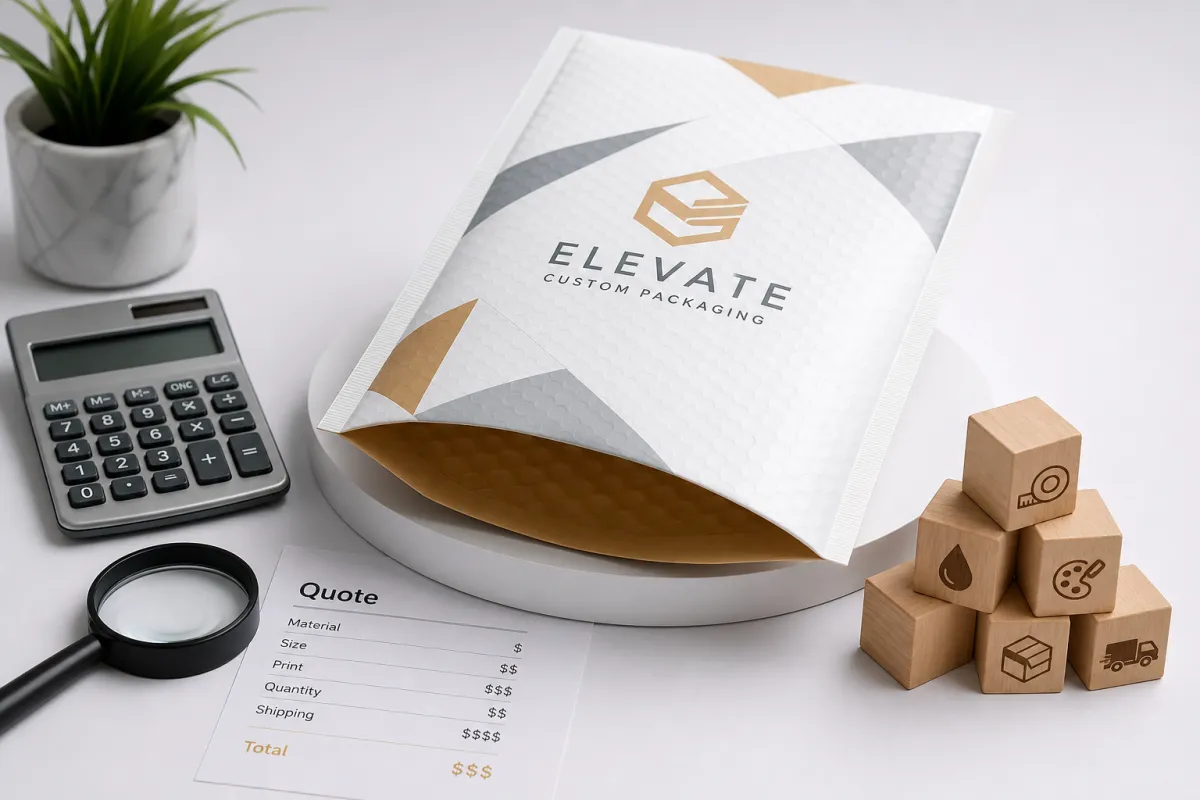
One of the most common surprises in custom padded mailers pricing is how quickly the unit cost changes when a buyer adjusts a detail that seems minor on paper. A one-color logo on a standard size mailer may look straightforward, yet the same structure with a wider print panel, a stronger closure, or a more protective liner can shift the price in ways that do not become obvious until the quote is broken down line by line.
That surprise happens because buyers often think in terms of the surface material only. In practice, the total number reflects the conversion work, the make-ready on the press or converting line, the amount of waste allowed during setup, and the freight required to bring finished goods into your warehouse or fulfillment center. Once those pieces are counted, custom padded mailers pricing becomes easier to understand, but it also becomes clear why two suppliers can quote very different numbers for what appears to be the same mailer.
The other common misunderstanding is that the packaging itself is the entire cost story. It is not. A mailer that saves 20 cents per unit but adds a few minutes of pack-out labor, or increases damage during transit, can cost more in the real world than a slightly more expensive mailer that runs cleanly and protects the product better. Buyers who manage monthly shipping volume know that a small difference in custom padded mailers pricing scales quickly.
From a packaging buyer’s point of view, the quote should be treated as a business tool. If you ship 5,000 pieces a month, even a 6-cent spread changes annual spend in a meaningful way. If the mailer also carries your branding, that same 6-cent spread may buy a better print result, a sharper customer impression, or a more reliable closure. That is why comparing custom padded mailers pricing only by unit price can be misleading.
Many teams undercut themselves by asking for “the cheapest custom mailer” instead of asking for the right build. The real conversation starts with the product dimensions, the fragility of the item, the desired look, and the shipping environment, then works backward into the quote so the custom padded mailers pricing reflects actual requirements instead of guesswork.
How custom padded mailers pricing is calculated
At the simplest level, custom padded mailers pricing is built from four buckets: raw material, manufacturing labor, print or branding setup, and freight. That formula sounds plain, yet each bucket hides a lot of detail. A paper-faced mailer with a bubble or fiber pad has different raw material costs than a poly-based build, and a mailer with full coverage art behaves differently on press than one with a single logo in one corner.
Think of the price as a chain rather than a single number. The raw material moves first. Then the converter adds labor to cut, fold, pad, seal, and finish the mailer. After that, the artwork work starts: plates, screens, digital prep, color matching, proofing, and any revision loops that happen before production begins. Finally, freight lands the product at your door. When those steps are all included, custom padded mailers pricing becomes easier to forecast.
- Material cost: paper stock, recycled content, poly film, padding layer, adhesive, tear strip, and any reinforcement.
- Converting cost: cutting, folding, sealing, laminating, and turning raw stock into a finished mailer.
- Print setup: plates, screens, digital file prep, proofs, and color control.
- Freight: outbound shipment to your warehouse, 3PL, or fulfillment center.
Minimum order quantity matters more than many buyers expect. A short run often carries a higher unit price because the fixed costs do not disappear; they are simply spread across fewer pieces. That is why custom padded mailers pricing on 250 units can look dramatically higher per mailer than a 5,000-piece order, even if the material spec is identical. The quote is not being inflated for no reason; it is reflecting how production economics actually work.
It also helps to separate quoted price from landed cost. The quoted price may include only the mailers themselves, while landed cost should also include freight, storage, receiving, and any sample or tooling charges. If you are comparing suppliers and one quote seems low, ask whether the number includes delivery to your dock or just ex-works product. A lot of confusion around custom padded mailers pricing disappears once everyone is talking about the same destination and the same packaging format.
Converting format can influence the price too. Some mailers are produced from roll-fed materials, others from sheets, and some are assembled from pre-made components. Roll-fed work can be efficient at scale, but the line setup may not make sense for a tiny run. Sheet-based or pre-made builds can be better for certain sizes and print demands, yet they can also raise the cost if the structure requires more hand work. In short, custom padded mailers pricing is not just about the material bill; it is also about how efficiently the product can be made.
For brands building a broader mailer program, this is also where it makes sense to compare adjacent formats. If your products vary a lot in size or weight, a mix of Custom Poly Mailers and padded paper mailers may outperform a one-size-fits-all approach. The right fit often reduces waste, improves pack speed, and makes custom padded mailers pricing easier to justify because each SKU is matched to a real shipping need.
Key factors that move the price up or down
Size is usually the first cost driver buyers underestimate. A mailer that looks only slightly larger on the outside can use noticeably more paper, padding, adhesive, and freight weight. That extra material adds up, and so does the extra space inside the carton. If the product fits snugly in a smaller mailer, custom padded mailers pricing often improves because the finished build uses less stock and the carton pack-out is more efficient.
Protection level is the next major lever. Thicker padding, bubble structures, reinforced seams, and extra inserts all improve transit performance, but each one increases the material bill and can slow production. A fragile cosmetic vial, a ceramic sample, or a metal accessory with sharp edges may justify the extra cost. A soft textile accessory probably does not. Good custom padded mailers pricing reflects product risk, not only visual preference.
Print complexity affects the quote more than most brands expect. A simple one-color logo with a controlled print area is much easier than a full wrap graphic with multiple ink colors, gradients, or specialty finishes. Artwork placement matters too. If the design needs precise registration near an edge or seal area, the converter may need extra setup and tighter tolerances. That is why custom padded mailers pricing can jump sharply when branding becomes more elaborate.
Closure and functionality also change the math. Peel-and-seal strips, tamper-evident features, tear-open notches, and gussets all improve usability, but they add components or extra process steps. In a fulfillment environment, those features may save labor and reduce complaints. In a low-volume program, they may simply add cost. The right answer depends on how the package is handled and how much convenience you need from the mailer. That tradeoff sits at the center of custom padded mailers pricing.
Material choice may be the most visible variable of all. Paper-based builds, recycled content, poly constructions, and hybrid designs all sit in different cost bands because their raw materials behave differently in sourcing and production. A kraft-faced, fiber-padded mailer may appeal to brands that want a natural look and easier recyclability messaging. A poly mailer may offer moisture resistance and lower weight. Each one changes custom padded mailers pricing for a reason tied to performance, not just aesthetics.
The final factor is order volume. Once you move from a short run into a repeating program, the pricing curve often starts to flatten. Larger runs let the manufacturer spread make-ready costs over more units, which usually lowers the per-piece number. That is why a buyer should never judge custom padded mailers pricing without looking at tiered quantities. A quote at 250, 1,000, and 5,000 pieces can tell a much better story than a single flat number.
Below are the kinds of tradeoffs that show up most often in real quoting conversations:
- Smaller size: lower material use, less freight weight, often better custom padded mailers pricing.
- More padding: stronger product protection, higher unit price, sometimes fewer returns.
- Simple print: easier setup, cleaner artwork approval, lower make-ready cost.
- Complex print: more branding impact, higher setup and proofing cost.
- Higher volume: better spread of fixed costs, usually better custom padded mailers pricing.
Cost and pricing tradeoffs by material, size, and print
People often ask for a “price comparison,” but the more useful comparison is a specification comparison. The same mailer can quote differently because the material is paper instead of poly, the size is a half-inch larger, or the artwork fills the entire face instead of sitting in one corner. That is why a good conversation about custom padded mailers pricing starts with product fit, not only a budget target.
Here is a practical way to think about the common builds. The ranges below are illustrative, not a promise, because market conditions, raw material supply, freight, and print coverage all move. Even so, this kind of table helps buyers see why a mailer that looks “almost the same” can quote in a very different band.
| Mailers spec | Best use | Typical unit range at 1,000 pcs | Typical unit range at 5,000 pcs | What pushes custom padded mailers pricing higher |
|---|---|---|---|---|
| Plain kraft padded mailer | Light goods, low-risk shipments | $0.32-$0.48 | $0.22-$0.34 | Thicker padding, custom sizing, freight |
| One-color branded mailer | Retail packaging, simple package branding | $0.42-$0.68 | $0.28-$0.45 | Extra print coverage, tighter registration, proof revisions |
| Recycled paper premium mailer | Sustainability-focused programs | $0.48-$0.78 | $0.34-$0.56 | Certified fiber, specialty board, custom insert features |
| Full-coverage custom mailer | High-visibility branded packaging | $0.58-$0.95 | $0.40-$0.72 | Multiple inks, higher waste allowance, longer setup time |
That table matters because it shows a pattern buyers sometimes miss: a slightly more premium material can still be the smarter choice if it allows the mailer to run smaller, print cleaner, or reduce damage. I have seen teams save money by tightening dimensions rather than chasing the lowest raw-material quote. In those cases, custom padded mailers pricing improved because the final package stopped carrying empty air.
It also pays to think about the whole shipping path. If the mailer is too loose around the product, you may need additional filler or an internal wrap. That adds labor and may undermine the visual effect you were trying to achieve. A well-sized mailer can reduce both waste and handling time, which means custom padded mailers pricing should be evaluated against the time your fulfillment team spends making the package shipment-ready.
There is a place for plain stock mailers too. If your product is low value, your design calendar is tight, or you are testing a new SKU, a simple unprinted build may be the right move. Once the item proves out, branding can be added with more confidence. That phased approach often gives better control over custom padded mailers pricing because you are not paying for artwork complexity before the packaging strategy is settled.
A branded program can be worth the added spend if the mailer is the first physical touchpoint a customer sees. That is especially true for e-commerce brands where the package arrives before the product is fully experienced. Clean art, consistent color, and the right substrate can support package branding in a way that plain packaging cannot. In that setting, custom padded mailers pricing is not just a cost question; it is a brand-experience question.
For some buyers, sustainability claims are also part of the tradeoff. If you want paper-based sourcing, FSC chain-of-custody references from FSC give you a real framework to discuss fiber origin instead of relying on vague language. If you are testing the mailer for transit performance, ISTA methods from ISTA provide a more disciplined way to discuss shipping risk. Those standards do not set custom padded mailers pricing by themselves, but they help you choose a spec that is defensible.
One more point that buyers appreciate once they have been burned by a weak quote: a cheaper print spec is not automatically cheaper overall. If the artwork is dull, inconsistent, or hard to read, the marketing team may push for revisions, and the brand may lose the effect it wanted from the mailer in the first place. Good packaging design is rarely about squeezing the lowest price out of a single component; it is about aligning product packaging, retail packaging, and shipping needs without creating avoidable friction. That is the kind of discipline that leads to better custom padded mailers pricing over time.
Process and timeline: from quote request to delivery
The quoting process matters because the quote quality depends on the quality of the information you send. A complete request for custom padded mailers pricing should include product dimensions, weight, desired padding level, closure type, print colors, art file format, delivery location, and target quantity. If any of those pieces are missing, the supplier has to fill in assumptions, and assumptions can distort the number more than most people realize.
A practical timeline usually starts with needs discovery. That is where the supplier asks what the product is, how it ships, where it goes, and how much visual branding matters. Next comes specification review, which is where the dimensions and material build get locked. After that, artwork is prepared and proofed. Only then should you compare custom padded mailers pricing in a meaningful way, because the design and the structure are finally fixed.
- Needs discovery: product dimensions, weight, fragility, and shipping method.
- Specification review: mailer size, padding type, closure, and material choice.
- Quote development: pricing by quantity break, freight, and setup.
- Artwork proofing: print layout, color check, bleed, and registration review.
- Sample approval: test fit, closure performance, and pack-out check.
- Production and shipment: converting, packing, and delivery to the receiving point.
What slows things down most? Missing dimensions, fuzzy artwork files, and an order quantity that keeps changing. If you are still deciding whether the mailer should protect a single SKU or a family of products, the quote will naturally move around until that decision is settled. This is another reason custom padded mailers pricing should be compared only after the spec is stable.
Lead time can change the price too. A rush order may require production priority, more expensive freight, or a compromise on material availability. None of that is mysterious; it is simply the cost of squeezing a schedule. If you can give the supplier enough time for proofs and sample approval, you usually gain more flexibility in custom padded mailers pricing and avoid paying for speed that does not actually improve the final package.
For launch planning, work backward from the date the product has to be in stock. If the campaign goes live on a fixed date, then sample approval should happen early enough to leave room for one round of adjustments. A common mistake is to start the mailer process after the product launch is already close. That creates unnecessary pressure and makes custom padded mailers pricing harder to control because the order turns into a time emergency instead of a planned purchase.
In a busy fulfillment environment, I also recommend documenting the pack-out method before placing the order. How many items go into one mailer? Is there a tissue wrap, insert card, or inner sleeve? Will the team need an adhesive strip or a tear-open feature? Once those details are clear, custom padded mailers pricing becomes easier to defend internally, because operations, marketing, and finance are all looking at the same assumptions.
Common mistakes that make custom padded mailers pricing misleading
The first mistake is comparing unit price alone. That sounds obvious, but it happens all the time. A quote that looks lower may exclude freight, sample charges, or tooling, and it may also assume a different carton pack-out method than the one you actually need. Once those differences are added back in, custom padded mailers pricing can look very different from the headline number that caught your attention.
The second mistake is choosing a size that is just a little too large. A half-inch of extra width or depth can mean more material, higher freight weight, and a looser pack-out that takes longer to close. Over thousands of shipments, that adds up quickly. Tight sizing usually improves custom padded mailers pricing and can also reduce the need for additional filler or internal support.
The third mistake is approving artwork before checking print coverage and setup implications. A simple design can become expensive if the print area is oversized, the colors require multiple passes, or the bleed reaches areas that complicate conversion. Buyers often focus on the visual mockup and forget that the press still has to run the job cleanly. That is a fast way to distort custom padded mailers pricing without meaning to.
The fourth mistake is ignoring protection requirements until damage shows up. If the mailer is too light for the product, returns and replacements can cost more than the upgraded packaging ever would have. This is where basic transit thinking matters. A better build might be a few cents higher, but it can prevent claims, relabeling, and customer frustration. In that sense, custom padded mailers pricing should be compared against the cost of avoidable failure, not only against a cheaper quote.
The fifth mistake is not asking what the quote assumes. Does the number include a standard closure? A specific paper grade? A particular minimum order quantity? Is the freight estimate based on one receiving dock or multiple ship-to points? If you do not ask, you may compare two quotes that are not truly comparable. That is the fastest way to make custom padded mailers pricing look unpredictable when the real problem is incomplete scope.
Here are the checks I would make before I let a quote move forward:
- Confirm the exact product dimensions and the maximum allowed finished mailer size.
- Check whether the mailer needs extra padding, a tear strip, or a tamper-evident closure.
- Review the print method, artwork coverage, and any color matching requirements.
- Ask for freight to the actual destination, not a generic estimate.
- Request quantity breaks so custom padded mailers pricing can be evaluated across realistic volume levels.
There is also a broader mistake that deserves attention. Some teams treat the mailer as a standalone purchase and never consider the rest of the packaging system. If the same brand uses inserts, cartons, or subscription kits, the mailer should feel like part of one family rather than a random add-on. That is where Custom Packaging Products can be useful in planning, because the best answer may be a coordinated set of formats rather than one isolated item. It can also keep custom padded mailers pricing aligned with the company’s larger packaging design choices.
Another practical point: if you are making sustainability claims, make sure the specification and the wording match. A recycled-content build is not automatically the same as a fully certified chain-of-custody program, and a paper-faced mailer is not automatically the same as a curbside-recyclable package in every market. Clear language builds trust. Vague language creates headaches. The same discipline applies to custom padded mailers pricing; precision always beats optimism.
Expert tips and next steps for comparing quotes
If you want a fair comparison, ask every supplier for the same spec in writing. That means same dimensions, same material stack, same print method, same destination, same quantity, and the same assumptions about samples or tooling. When the inputs match, custom padded mailers pricing becomes much easier to read. When the inputs differ, you are really comparing different products, even if the photos look similar.
I also recommend requesting a sample or prototype when the product is fragile, unusually shaped, or expensive to replace. A mailer that looks fine on a spreadsheet can still fail in the hand if the closure is awkward, the fit is sloppy, or the padding is not sufficient. A few extra days spent on sample approval can save far more time later. That is especially true when custom padded mailers pricing is tied to a launch, a seasonal drop, or a fulfillment changeover.
A simple landed-cost worksheet is worth the effort. It should include unit price, freight, expected storage cost, and any savings from reduced damage or faster pack-out. If you are comparing two builds and one is slightly more expensive but ships faster or protects better, the workbook should show that clearly. That way, custom padded mailers pricing is evaluated as part of total operating cost, not as a number floating by itself.
For brands building stronger package branding, the final decision should also consider the unboxing experience. The mailer opens first. It sets the tone. It frames the product. If that moment matters, then the extra spend on a cleaner print, better closure, or more refined substrate can be justified because it supports the brand story. That is true whether the packaging system leans toward retail packaging, subscription kits, or e-commerce shipping. The best custom padded mailers pricing reflects that larger objective.
Use a final checklist before you approve the order:
- Product dimensions fit the mailer without excessive empty space.
- Protection level matches fragility and transit risk.
- Artwork is final, proofed, and approved for the correct print area.
- Lead time fits the launch or replenishment schedule.
- The quote includes freight, setup, and any expected add-on charges.
For teams that want stronger technical confidence, pairing shipping tests with a clear material spec can make the decision easier to defend. A supplier that understands ISTA-style test thinking and can talk through the real transit path will usually give you a more honest answer than one focused only on the lowest line item. If a mailer is going to carry a product through a rough route, you want proof that the structure supports the shipment, not only a promise that the print looks good. That is the kind of thinking that keeps custom padded mailers pricing grounded in performance.
From a packaging buyer’s point of view, the best outcome is rarely the cheapest quote in isolation. It is the quote that fits the product, protects the shipment, supports the brand, and lands at a cost you can live with every month. If you are gonna compare suppliers, keep the spec fixed, the freight assumptions identical, and the performance target honest. That is usually what turns custom padded mailers pricing from a guessing exercise into a decision you can stand behind.
How does custom padded mailers pricing change with order quantity?
Higher quantities usually lower the per-unit cost because setup, proofing, and production overhead are spread across more pieces. Ask for tiered pricing at realistic breaks, such as 250, 500, 1,000, and 5,000 units, so you can see the curve clearly. A small order can make custom padded mailers pricing look expensive even when the base build is reasonable.
Are printed custom padded mailers pricing quotes much higher than plain ones?
Usually yes, because print setup, plate work, ink coverage, and proofing add cost, especially on shorter runs. A one-color logo is generally simpler than full-coverage artwork or multiple colors. If branding matters but the budget is tight, keep the artwork focused; that tends to keep custom padded mailers pricing under better control.
What size choices affect custom padded mailers pricing the most?
The biggest drivers are overall dimensions, how much empty space the mailer leaves around the product, and whether gussets or extra padding are needed. An oversized mailer uses more material and can increase shipping expense, while an undersized one can create damage risk. The best move is usually to choose the smallest size that safely fits the product and any needed inserts, because that keeps custom padded mailers pricing closer to the efficient end of the range.
How do lead times affect custom padded mailers pricing?
Rush schedules can increase cost because production may need to be prioritized or shifted around standard jobs, and faster freight options raise the total landed cost even if the unit price stays steady. Allowing enough time for proofs and samples usually gives you more flexibility. In practical terms, better planning often improves custom padded mailers pricing as much as any material change does.
What should I ask for in a custom padded mailers quote?
Ask for unit price, setup or tooling charges, freight, minimum order quantity, lead time, the exact material specification, and whether samples are included or billed separately. Confirm the closure type, print method, and the destination address used for the freight estimate. If you compare those details side by side, custom padded mailers pricing becomes much easier to judge fairly, and you can pick the build that matches both the product and the budget.

