Buyer Fit Snapshot
| Best fit | custom pallet boxes for industrial parts for packaging buyers comparing material specs, print proof, MOQ, unit cost, freight, and repeat-order risk where brand print, material, artwork control, and repeat-order consistency matter. |
|---|---|
| Quote inputs | Share finished size, material target, print colors, finish, packing count, annual reorder estimate, and delivery region. |
| Proofing check | Approve dieline scale, logo placement, barcode or warning zones, color tolerance, and any recyclable or compostable wording before bulk production. |
| Main risk | Vague material claims, crowded artwork, or missing packing details can create delays even when the unit price looks attractive. |
Fast answer: Custom Pallet Boxes for Industrial Parts: Fit and Cost should be specified like a repeatable production item. The safest quote includes material, print method, finish, artwork proof, carton packing, and reorder notes in one written spec.
What to confirm before approving the packaging proof
Check the product dimensions against the actual filled item, not only the sales mockup. Ask for tolerance on folds, seals, hang holes, label areas, and retail display edges. If the package carries a logo, QR code, warning copy, or legal claim, reserve that space before decorative graphics fill the panel.
How to compare quotes without losing quality
Compare board or film grade, print process, finish, sampling route, tooling charges, carton quantity, and freight assumptions side by side. A lower quote is only useful if the supplier can repeat the same color, closure quality, and packing count on the next order.
Custom Pallet Boxes for Industrial Parts: Fit and Cost
Custom Pallet Boxes for industrial parts can keep a shipment from turning into expensive scrap the moment a stock carton flexes on a pallet. That is not a theoretical risk. A machined housing with a chipped flange, a threaded shaft with bruised ends, or a painted assembly with rubbed corners can stop a line, trigger a claim, and eat up labor long before anyone opens the invoice. If one damaged part delays a technician, the box was never just a box.
These boxes are not oversized cartons with a new name. They are pallet-mounted enclosures designed around the part, the handling path, and the shipping environment. That distinction matters because industrial parts are rarely simple: they are heavy, irregular, oily, sharp-edged, nested, or all of the above. A stock size may look cheaper on paper, but the real cost grows fast if the team must add dunnage, repack the load, or accept a higher damage rate. Freight cube, stacking strength, labor time, and traceability all move with the packaging decision.
From a buyer's point of view, the appeal is straightforward. Less movement. Fewer touchpoints. More predictable handling.
Used well, custom pallet boxes for industrial parts do more than protect a part. They change the economics of shipping by matching the pack structure to the actual product footprint. That is where fit and cost intersect, and why a solid spec sheet often matters more than a low unit price.
Custom Pallet Boxes for Industrial Parts: Why Stock Packaging Fails
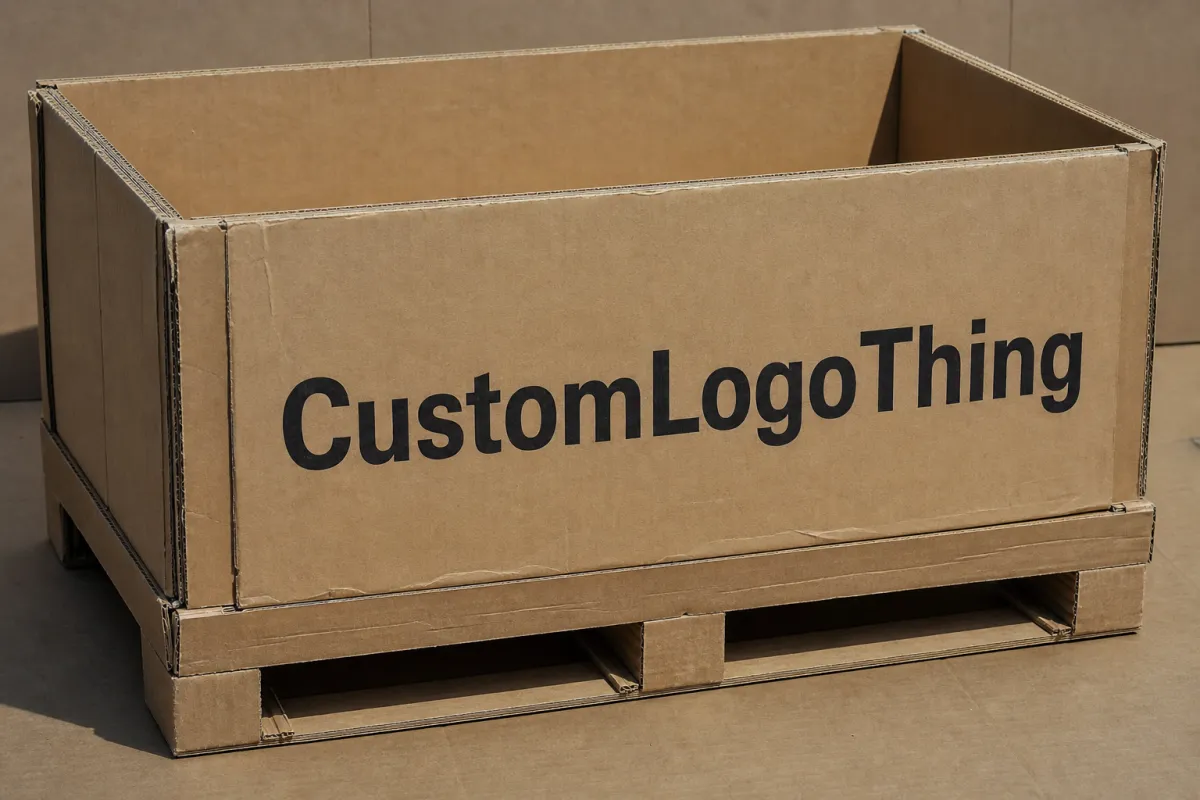
Stock packaging is built for averages. Industrial parts rarely behave like averages. A consumer carton assumes a near-rectangular load, moderate weight, and a distribution path with fairly predictable handling. Industrial parts do not stay that polite. A cast bracket may have protruding lugs. A machined ring may need corrosion protection. A stamped component may nest efficiently and still punch through a sidewall if the carton bows under compression. One part may weigh 8 pounds, another 80, and both may ship on the same pallet program.
The weak point is usually not the listed box strength. It is the mismatch between package geometry and load behavior. A wall that is too short forces closure boards to carry weight that should transfer through the pallet base. A footprint that is too large lets the part slide during vibration. A box that is too short invites operators to stack another unit on top, which crushes the contents. That is how a packaging spec turns into a line stop. It is also why industrial buyers revisit the same problem after a few claims: the carton looked acceptable in the plant, but it was not built for the freight environment.
Industrial parts create demands that differ from retail packaging or shelf-ready consumer goods. Parts may come off the machine with oil residue. They may have burrs, threaded surfaces, or finished faces that cannot rub against kraft board. They may need void fill, partitions, end caps, anti-corrosion bags, or foam blocks to keep contact points off sensitive surfaces. They may also move through more than one facility before installation, which means the package has to survive repeated openings, partial reclosings, and forklift moves from different sides.
There is a freight side to this as well. A stable pallet box reduces shifting, and a stable pallet usually means fewer surprises in trucking, warehousing, and staging. It can also improve stackability in ways that only become obvious when a trailer mixes freight from several customers. Better structure lowers touchpoints because a warehouse team does not need to rewrap, restack, or re-secure the load. That cuts labor and helps throughput. In practice, the cheapest box is often the one that does not create a second handling step.
For buyers who want a useful benchmark, the real question is not, "Can a stock box fit?" It is, "Can the package protect the part through the full route at the lowest total landed cost?" That is the right frame for custom pallet boxes for industrial parts, because a small gain in board cost can be wiped out by one damaged shipment. In a lot of shipping audits, one failure in fifty looks small until it lands on a critical order with a hard deadline.
A good industrial package is almost invisible in use. If the receiving team barely notices the load, but the part arrives clean, stable, and ready to move, the box did its job.
How Custom Pallet Boxes for Industrial Parts Work
At the simplest level, a custom pallet box has five functional parts: the pallet base, side panels, top closure, internal supports, and the handling features that make the unit usable in the warehouse. The exact construction changes with the product, but the logic stays the same. The package should transfer weight through the pallet, not ask the box walls to carry everything. That matters because wall compression, corner crush, and panel bowing are common failure points once load weight climbs or handling gets rough.
The pallet base is the anchor. It may be a standard stringer pallet, a block pallet, or a custom-sized base with entry points that suit forklifts and pallet jacks. From there, the side walls can be made from double-wall corrugated, triple-wall corrugated, plywood, composite panels, or hybrid combinations. For lighter or moderate loads, reinforced corrugated often performs well if the route is controlled. For heavier or more abrasive parts, plywood or a corrugated-plywood hybrid can be the better answer because it resists puncture and sidewall deformation more effectively. Reinforced corners and edge protectors add stability where the package tends to fail first.
Internal supports matter just as much as the outer shell. Blocking and bracing stop the load from moving. Inserts can isolate sharp edges, separate nested parts, or keep machined surfaces from touching. Foam has its place, but it is not always the right answer. In many programs, die-cut corrugated, molded pulp, or a simple wood brace does the job at a lower cost and with easier recycling. Moisture protection can be added with liners, poly bags, VCI film, desiccant, or laminated boards when the route includes humidity, sea freight, or long dwell times. That is a practical issue, not a theoretical one. A box that survives a three-day truck route may not be the box you want sitting in a dock queue for ten days.
Structure also needs to fit the handling system. The best custom pallet box is the one the warehouse can move without improvising. Forklift access should be obvious. Stack points should be predictable. Labels should be visible from the aisle. If the box is going to be reused, the closure method needs to be manageable for operators who open and reseal the unit more than once. A package that looks elegant on a drawing can become a bottleneck if it needs too much manual adjustment on the floor.
Performance changes with vibration, compression, humidity, and dwell time. That is why many buyers reference distribution test methods such as ISTA test sequences, and why packaging engineers often compare results against common lab protocols like ASTM-style compression and drop evaluations. If you want to see how distribution testing is organized, the International Safe Transit Association has useful background at ista.org. For fiber sourcing, sustainability claims, or chain-of-custody requirements, fsc.org is a useful reference point.
Seen this way, custom pallet boxes for industrial parts are not a single material choice. They are a structural system. The right answer depends on the part, the handling method, and the route, which is why packaging design should be treated as an operations decision, not only a graphics or branding decision.
Custom Pallet Box Cost and Pricing Factors
Unit price matters, but total landed cost matters more. A box that costs a few dollars less may still be the more expensive choice if it needs extra labor, causes higher freight charges, or increases claims. Industrial buyers usually get better answers when they compare the full package economics: packaging price, damage reduction, labor per pack, space efficiency, and disposal or return costs.
The biggest cost drivers are usually straightforward. Larger dimensions mean more board or wood. Heavier parts call for stronger board grades, thicker plywood, or more internal bracing. Print coverage adds cost if you want custom printed Boxes with Logos, part numbers, hazard warnings, or traceability labels. Inserts, foam, anti-corrosion materials, and moisture barriers all add material and assembly time. Pallet choice matters too. A custom block pallet or heat-treated export pallet can cost more than a standard base, but the added performance may be worth it if the route is harsh or the part is valuable. Order volume also changes the math because setup, cutting, and assembly costs spread more efficiently over larger runs.
Minimum order quantities can surprise first-time buyers. A short run of a custom pallet box often carries a higher unit cost because tooling, setup, and design work are spread across fewer boxes. That does not mean the project is uneconomical. It only means the pricing model differs from buying a stock carton off the shelf. A supplier may quote a design fee, sample fee, or one-time tooling expense separately. If the spec changes after the sample, another revision can add time and cost. The cleanest quotes usually come from buyers who provide exact dimensions, part weight, packing accessories, and a realistic shipping profile.
There is also a hidden cost in freight classification and cube efficiency. A cheaper spec can become expensive if the package ends up larger than needed, pushes the shipment into a less favorable freight class, or leaves too much dead air that increases dimensional weight. Extra dunnage may solve one problem and create another. That is why packaging design should be evaluated with the shipping lane in mind, not only the manufacturing cost. A pallet box that adds two inches on every side can look harmless until it changes the trailer count for a weekly run.
| Option | Typical Use | Illustrative Unit Cost | Strength Profile | Best Fit |
|---|---|---|---|---|
| Heavy-duty corrugated pallet box | Moderate-weight parts, controlled routes | $18-$38 | Good compression, lighter weight, recyclable | Parts that need enclosure and efficient pack-out |
| Plywood or hybrid pallet box | Heavier or sharper parts, mixed handling | $35-$75 | Better puncture resistance and sidewall durability | Industrial components with rougher transit conditions |
| Reusable returnable pallet box | Closed-loop supply chains and multi-trip use | $70-$140+ | Highest durability, higher upfront cost | Programs with predictable returns and reuse cycles |
The ranges above are illustrative, not a quote. A 24 x 20 x 18 inch box for a small machined part will price very differently from a 48 x 40 x 36 inch enclosure for a heavy assembly, and the print area, insert count, and pallet style can move the number quickly. Still, the table is useful because it shows the tradeoff. Corrugated is often the lowest upfront spend. Hybrid construction often offers the best balance of protection and cost. Reusable boxes can win over time if the parts loop back through the network and the box survives many cycles.
A packaging buyer should ask for an apples-to-apples quote package: board grade, wall count, pallet type, insert material, print coverage, assembly method, and any testing assumptions. If a supplier provides only a single number, the number is less useful than it looks. You want the spec behind the price.
Production Process and Timeline: From Spec to Shipment
The cleanest projects start with a part audit. That means exact dimensions, weight, center of gravity if it is awkward, and a note on what absolutely cannot touch the packaging. A machined face, polished surface, or delicate connector may require a specific spacer or non-abrasive liner. If the part has protrusions, the drawing should show them. If the part nests with others, the nesting pattern needs to be documented. The more complete the input, the faster the project moves.
Once the supplier has the data, the next step is the structural concept. That may be a simple dieline for a corrugated pallet box, a hybrid build with an insert map, or a more rigid palletized enclosure for export. A sample or mockup usually follows. This is where buyers can catch problems before the order is fully released. Are the fork openings accessible? Does the lid close without crushing the part? Does the load shift when the box is tilted? Small questions here prevent large problems later.
After sample approval, production begins. Standard lead times often fall in the 12-15 business day range after proof approval for straightforward designs, though complex builds, custom foam, or unusual raw materials can extend that window. If the order needs a print plate, special die cut, or imported board, add time. Rush jobs are possible, but only when the design is simple and the material is available. In practice, the part that slows the schedule is usually not the cutting. It is the back-and-forth over missing information.
Here is a practical timeline example for a moderately complex order:
- Day 1-2: Part measurements, photos, shipping profile, and spec review.
- Day 3-5: Concept drawing, material recommendation, and quote.
- Day 6-8: Sample build or structural mockup.
- Day 9-12: Evaluation, adjustments, and approval.
- Day 13-25: Production, finishing, and outbound shipment depending on volume.
That sequence can compress if the buyer is organized. It can stretch quickly if the part list is incomplete or if the packaging needs multiple revision cycles. A simple drawing with exact dimensions might move in a week. A highly customized enclosure with printed instructions, anti-corrosion packs, and multi-part inserts may need several rounds of review.
One useful habit is to test not only the box but the workflow. Can the operator pack the part in under the target time? Can the receiving side open it without a knife damaging the contents? Is the package easy to label, scan, and re-close? Those practical questions often make the difference between a good packaging spec and a truly usable one. A design that protects the part but slows the line by ninety seconds per unit may not survive procurement review.
If the timeline is tight, the fastest projects are the ones with complete part data, one decision-maker, and a clear answer on whether the package is single-use or returnable.
Step-by-Step Guide to Ordering the Right Box
Ordering custom pallet boxes for industrial parts gets much easier if you work in the right order. Start with the part, not the packaging catalog. The box should follow the product risk profile, the route, and the handling method. That sounds basic, but it is where many sourcing teams drift off course. They begin with a box style they already know, then spend the next two weeks modifying it to fit a part it never should have carried in the first place.
- Inventory the parts. Record length, width, height, weight, protrusions, finish sensitivity, and whether the part nests or stacks. Photograph the part next to a ruler or known reference.
- Define the shipping environment. Note pallet height limits, forklift handling, truck mode, humidity, storage duration, and whether the package returns to the sender. A load for a closed-loop plant route needs a different spec than a one-way export lane.
- Choose the protection strategy first. Decide whether the key risks are impact, compression, moisture, corrosion, dust, or scuffing. Then assign the materials: corrugated, plywood, foam, VCI, bagging, partitions, or corner blocks.
- Request a mockup and test it with the actual part. Empty samples tell only part of the story. Load the box with the real part and check movement, closure pressure, and any contact between surfaces. If possible, run a short vibration or transit simulation that resembles the actual lane.
- Confirm labels and handling instructions. Include barcodes, part numbers, orientation marks, or warning labels before production starts. If the box will sit in a warehouse, visibility matters. This is where product packaging overlaps with operations and package branding.
That order prevents a lot of waste. It also helps the buyer speak more precisely with suppliers. If you can say, "We need a hybrid pallet box for a 42-pound machined component with an oil-resistant liner, top-load stacking, and forklift access on two sides," the quote becomes much more reliable than a vague request for "a strong box."
For teams building a broader packaging program, it can help to compare the industrial line against other custom work you already buy. A supplier offering Custom Packaging Products may be able to match a pallet box program with custom printed boxes, inserts, labels, and secondary product packaging so the entire system is consistent. That matters when one plant is shipping a single finished part and another is shipping a set of components in the same family.
If you are balancing cost and presentation, remember that industrial packaging does not need to be plain. Clear labeling, durable print, and organized pack-out can make receiving faster. In some environments, branded packaging is not about marketing at all. It is about traceability, part identification, and reducing receiving errors. A good mark on the outside can save five minutes of searching on the inside.
Common Mistakes When Specifying Industrial Parts Packaging
The first mistake is underestimating weight distribution. A 40-pound part centered in the box behaves differently from a 40-pound part sitting off-center on an insert. Corners and edges take load differently from the middle. If the package is not designed around that, the box may pass a simple fit check and still fail in transit. This is especially true for long parts, awkward assemblies, or components with high center-of-gravity points.
The second mistake is measuring only the part and forgetting everything that travels with it. Sleeves, anti-corrosion packs, fasteners, protective caps, desiccant, service documents, and internal supports all consume space. If they are excluded from the first measurement, the box will be too tight. A tight box may look efficient on paper, but in practice it can lead to abrasion, crushed corners, or pack-out delays.
The third mistake is buying on unit price alone. A lower quote can hide weaker board, more manual labor, higher freight cube, or more claims. Packaging is one of those categories where the cheapest option often costs more after the shipment leaves the dock. A buyer who only compares board price may miss the effect on freight class or the labor time needed to assemble the unit. That is especially true for custom pallet boxes for industrial parts, where the package and the part are tightly linked.
The fourth mistake is skipping testing. A sample that looks fine on a workbench can still fail when loaded, stacked, or exposed to vibration. Testing does not need to be elaborate, but it should be real. Load the actual part. Stack the box. Tilt it. Move it with the equipment that will be used in production. If the box is meant to perform through a lane with long dwell times, let it sit under realistic conditions before signing off.
The fifth mistake is ignoring reuse and disposal. Some industrial programs are one-way. Others circulate between plants, contract assemblers, and repair facilities. If a box is going to be opened and reclosed several times, the closure and label strategy should support that. If it is a single-use pack, recyclability and disposal cost matter more. The right answer depends on the supply chain, not just the part.
These mistakes are common because they hide in the handoff between departments. Engineering knows the part. Operations knows the warehouse. Purchasing knows the price. The best packaging specs pull those viewpoints together before the order is released.
Expert Tips and Next Steps for Better Shipping Decisions
One of the most useful tools is a part-by-part matrix. Rank your SKUs by damage risk, weight, shipping distance, moisture exposure, and handling frequency. The highest-risk parts deserve the strongest box, the best inserts, and the most testing. Low-risk parts may stay in a simpler design. That keeps the spend focused where it actually protects margin.
Ask suppliers for a costed spec sheet. You want to see board grade, flute structure, pallet type, insert material, print coverage, assembly method, and any accessory costs in one place. If one option uses FSC-certified fiber and another does not, that should be visible in the quote. If one uses a reusable pallet base and another uses a single-use base, the difference should be spelled out. A transparent quote lets you compare performance and sustainability without guessing.
Build a pilot around one high-risk part. Track pack time, damage rate, and stack performance before you scale. A pilot also reveals whether the package helps or hurts throughput. If the new box saves five minutes per unit in packing and eliminates two claims a month, it may pay back faster than the initial quote suggests. If it protects the part but slows the line, you have a different problem to solve.
Use standards as a common language. ISTA testing gives you a framework for distribution risk, while FSC can support fiber sourcing requirements. That does not mean a certification solves everything. It does mean you can talk to suppliers and internal stakeholders with clearer criteria. In a category where packaging design touches operations, compliance, freight, and customer experience, that clarity matters.
For teams that want to tighten the spec before requesting quotes, start with three items: a dimensioned drawing of the part, photos of the current pack or failure point, and a target shipment date. Those three inputs usually move a project forward faster than a long email thread. If you need help building the brief, a packaging partner can often translate the part data into a workable carton, crate, or palletized enclosure without overshooting the budget.
The practical takeaway is straightforward. A better box is not always the strongest box, and it is not always the most expensive one either. It is the one that matches the part, the route, and the handling pattern closely enough to reduce waste. That is why custom pallet boxes for industrial parts keep showing up in serious packaging programs: they solve fit, lower damage, and make the shipment easier to move. When the spec is right, the cost conversation gets easier too, because the packaging starts paying its way in fewer claims, cleaner receiving, and steadier margins. The next action is simple: gather exact part dimensions, note the damage mode you are trying to eliminate, and ask for a quote that shows materials, pallet base, inserts, and testing assumptions line by line.
Frequently Asked Questions
What size should custom pallet boxes for industrial parts be?
Measure the maximum part footprint first, including protrusions, sleeves, dunnage, and any protective wraps. Then add only the clearance needed to keep the part from shifting or rubbing. The box should be sized around the pallet footprint and forklift access as well, not just the component itself.
Are custom pallet boxes better than crates for heavy industrial parts?
They are often better when you need full enclosure, dust protection, or more controlled pack-out. Crates can work well for rigid loads that do not need as much sidewall coverage. The better choice depends on the protection target, whether the package is reusable, how visible the load must be, and the freight cost you are trying to control.
What affects the price of custom pallet boxes for industrial parts?
The biggest drivers are dimensions, material grade, inserts, pallet type, print, and order volume. Complex die cuts, custom foam, or extra moisture protection can add material and labor cost. Sample revisions and testing can also affect the final quote, especially on smaller runs.
How long does production usually take for a custom pallet box order?
Timeline depends on whether a sample is required, how many revisions are needed, and which materials are available. Complete specs usually move faster because they reduce back-and-forth during approval. Rush projects are possible, but they work best when the design is straightforward and the supply chain is already lined up.
How do I test whether the box will protect my parts?
Run a real pack test with the actual parts, not just empty fill. Check for movement, corner crush, scuffing, and moisture exposure after vibration or transit simulation. If possible, compare the sample against a short pilot shipment before full rollout so you can see how it behaves in the lane.

