Buyer Fit Snapshot
| Best fit | Custom Paper Bags with Logo Order projects where brand print, material claims, artwork control, MOQ, and repeat-order consistency need to be specified before quoting. |
|---|---|
| Quote inputs | Share finished size, material target, print colors, finish, packing count, annual reorder estimate, ship-to region, and any compliance wording. |
| Proofing check | Approve dieline scale, logo placement, barcode or warning zones, color tolerance, closure strength, and carton packing before bulk production. |
| Main risk | Vague material claims, crowded artwork, missing packing details, or unclear freight terms can make a low unit price expensive after revisions. |
Fast answer: Custom Paper Bags with Logo Order: Film, Print, MOQ, and Carton Packing should be specified like a repeatable production item. The safest quote records material, print method, finish, artwork proof, packing count, and reorder notes in one written spec.
Production checks before approval
Compare the actual filled-product size with the drawing, then confirm tolerance on folds, seals, hang holes, label areas, and retail display edges. Reserve space for logos, QR codes, warning copy, and material claims before decorative graphics fill the panel.
Quote comparison points
Review material grade, print process, finish, sampling route, tooling charges, carton quantity, and freight assumptions side by side. A quote is only useful when the supplier can repeat the same color, closure quality, and packing count on the next order.
A custom paper Bags with Logo order works best when the bag is treated as part of the product, not as an afterthought. In retail, takeaway, and gifting, the bag is often seen and carried longer than the item inside. That makes it branded packaging whether you planned for it or not.
That is the real upside of a Custom Paper Bags with logo order. It does more than hold a purchase. It supports package branding, trims down the need for extra inserts or wraps, and keeps the presentation clean. The bag has a job to do. It has to hold weight, survive handling, and still look decent when the customer gets home. Simple idea. Not always simple execution.
Buyers usually end up asking the right questions first. Which paper stock prints sharply? Which handle style feels solid instead of flimsy? What should a custom paper bags with logo order cost at your quantity? How long does it take after artwork approval? Good questions. The kind that save time and bad surprises.
I have watched enough packaging programs go sideways to know where the trouble starts. Somebody approves the logo before checking the gusset width. Somebody else picks a pretty finish that hates fingerprints. Then everyone acts surprised when the bag does not match the use case. That part gets kinda old.
Why a custom paper bags with logo order pays off fast
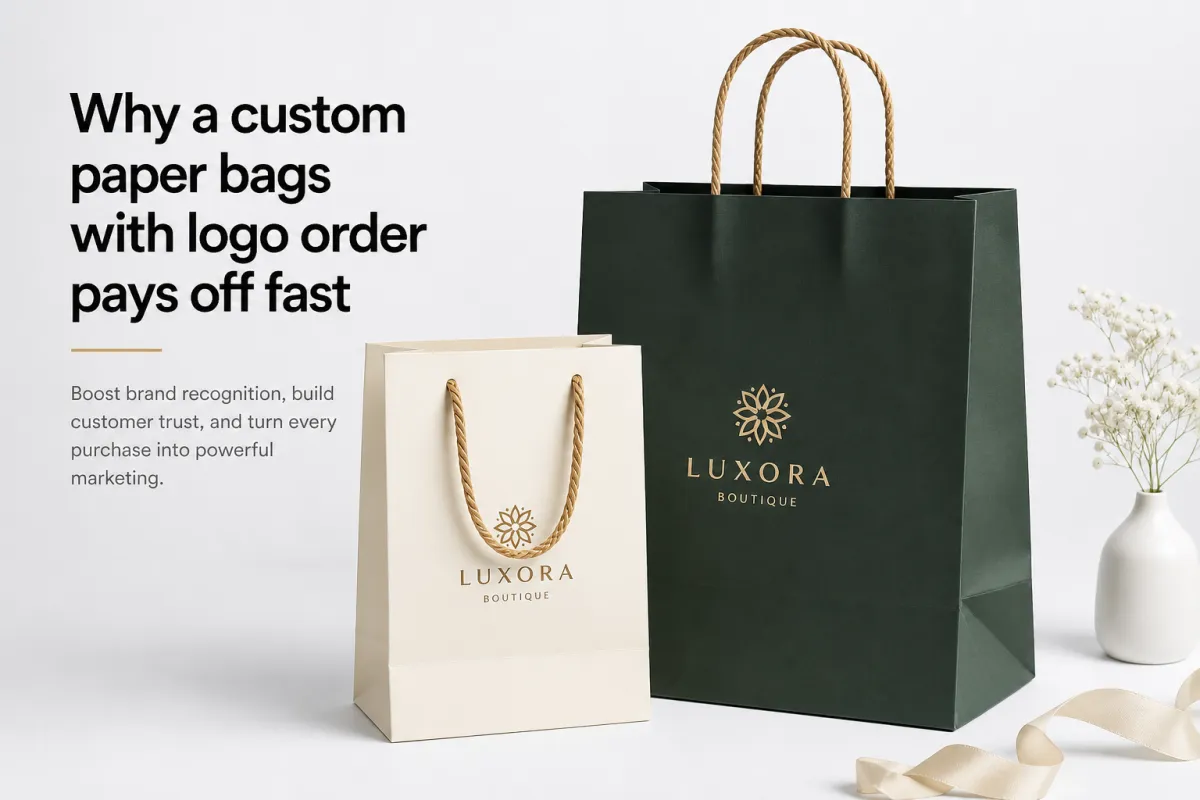
In retail and takeaway, the bag stays visible after the sale is done. A customer leaves the store, walks down the street, gets into a car, or carries lunch back to the office, and the bag keeps showing the brand. A custom paper bags with logo order turns a plain supply item into a repeated branding touchpoint.
That visibility matters because the bag sits inside the customer experience. At checkout, it frames the handoff. On the sidewalk, it puts the brand in front of strangers. For gifts and subscription-style purchases, it becomes part of the reveal. Clean print, straight handles, and a bag that keeps its shape all affect how the product feels before anyone opens it.
There is a cost angle too, and it gets ignored more than it should. A custom paper bags with logo order can reduce the need for extra branded labels, folded inserts, or outer wrap, especially for shops already using other package branding pieces. The bag carries part of the load. That can simplify the presentation and keep the packing line moving without much drama.
A bag that fits the product properly does more for brand perception than a louder print ever will.
I see buyers make the same mistake all the time: they start with artwork and forget construction. A bag that sags, handles that dig into the hand, or print that breaks at the fold will drag the brand down no matter how pretty the logo file was. A custom paper bags with logo order should be judged as a whole: size, stock, print quality, and how it behaves once it leaves the counter.
Keep that frame in mind while comparing options. The same thinking that helps with custom printed boxes applies here. Match the structure to the product, keep the graphics readable, and pick a finish that suits the use case instead of dressing it up for no reason.
Custom paper bags with logo order: material and print choices
The starting point for a custom paper bags with logo order is the paper itself. Kraft paper is the most familiar choice because it feels sturdy, looks natural, and usually prints cleanly enough for logos and simple graphics. Brown kraft gives a more earthy, practical look. White kraft gives better contrast and a sharper retail finish.
For many buyers, the tradeoff is simple. Brown kraft hides scuffs and fingerprints better, which is useful for food service and everyday carry. White kraft makes type, fine lines, and lighter brand colors stand out more clearly. If you want the bag to feel premium without getting fragile, white kraft or a heavier kraft stock can be a smart middle ground for a custom paper bags with logo order.
Coated paper changes the feel. It sharpens image detail and handles richer color fields, but the surface may feel less natural in the hand. That is not always a drawback. For boutiques, cosmetics, and higher-end retail packaging, a coated surface can make the logo look crisp and intentional. For cafes, farm shops, and eco-minded brands, uncoated kraft often feels more honest and more on-brand.
Handle choice matters just as much. Twisted paper handles are common because they are economical, recyclable, and sturdy enough for many standard uses. Flat paper handles feel less bulky and work well for lighter loads. Rope-style handles raise the perceived value and are often used for premium gift packaging or branded packaging that needs a more finished look. Die-cut handles create a cleaner silhouette and save space, though they are not always the best pick for heavier loads.
Print method is the other big decision. Simple spot-color printing is usually the cleanest and most cost-controlled option for a custom paper bags with logo order. It works well when the logo is strong and the message is short. CMYK printing gives more room for gradients and photo-like detail, but the result can be less predictable on some paper stocks. Pantone matching is the better path when brand color accuracy matters, especially for established labels that want each bag to match other product packaging materials.
Finishes should support the brand, not fight it. Matte looks calm and modern, gloss brings more brightness, and soft-touch or specialty coatings can create a luxury feel if the budget allows. A simple uncoated bag is still the right answer when the brand wants a tactile, earthier presentation. A custom paper bags with logo order does not need a complicated finish to look deliberate.
Logo placement affects readability more than most buyers expect. A front-panel logo usually gives the cleanest read. Side gusset printing can widen visibility, but it also raises the risk of awkward placement if the artwork is not prepared carefully. Negative space matters. Too much fill, too many elements, or a logo pushed too close to the folds can make even a good design feel crowded.
For buyers comparing formats, this table is a useful starting point. The price ranges are broad planning figures for a typical custom paper bags with logo order at around 5,000 pieces, and the final quote will depend on exact dimensions, print coverage, and shipping.
| Bag option | Typical feel and print result | Best use | Planning range per unit |
|---|---|---|---|
| Brown kraft, twisted paper handle, 1-color print | Natural look, good durability, solid logo contrast | Cafes, takeaway, casual retail | $0.18-$0.32 |
| White kraft, flat paper handle, 1-2 color print | Cleaner surface, brighter graphics, lighter hand feel | Boutiques, events, gift packaging | $0.22-$0.38 |
| Coated paper, rope handle, full-color print | Sharper image detail, more premium presentation | Luxury retail, promotions, high-value items | $0.45-$0.85 |
| Heavy kraft, reinforced handle, minimal print | More load-bearing strength, understated appearance | Heavier merchandise, repeated carry use | $0.28-$0.55 |
That table is not a quote sheet, but it does show how a custom paper bags with logo order is built. Add more material, finish, or print complexity, and the unit price climbs. Keep the structure simple and standardized, and production gets easier to manage.
Specifications that make the bag work in real use
Bag dimensions are not decoration. Width, gusset, and height need to match the product profile. If the bag is too tight, the top rolls over badly and the side panels buckle. If it is too large, the product shifts around and the package feels loose. A careful custom paper bags with logo order starts with measuring the item or bundle, then leaving room for loading and closure.
Paper weight comes next. Heavier paper improves stiffness and carry strength, but the right choice still depends on the load and handle construction. A 120-150 gsm stock can work for lighter retail goods. A 170-210 gsm stock is often better for more substantial merchandise. For heavier items, reinforced tops and a rigid base can matter as much as the paper itself. That is why a custom paper bags with logo order should never be chosen on print appearance alone.
Reinforcement details are where the bag proves itself. Handle patches, glued top turns, and base boards help the bag hold shape and resist tearing. If the bag will see repeated handling or carry slightly heavier products, those details can do more for customer satisfaction than a louder graphic. They help the bag stay upright at checkout, in transit, and on the way home.
Artwork prep is another place where buyers can avoid pain. Vector logos in AI, EPS, PDF, or SVG format are usually the cleanest starting point because they scale without fuzziness. For multi-color work, color references should be shared early, and if brand consistency is critical, Pantone targets should be confirmed before the proof moves forward. A custom paper bags with logo order only looks sharp if the files are ready for the print method being used.
Bleed and safe zone details matter too. A few millimeters can decide whether a logo sits comfortably on the panel or gets clipped by a fold, handle seam, or glue area. Smaller bags make that even more important because there is less room to place a full mark without crowding it. Good packaging design leaves breathing room so the bag reads clearly from a distance and still feels balanced up close.
Sustainability should be treated the same way: practically. Many buyers want recyclable paper, minimal coatings, and FSC-aligned sourcing where possible. Fair enough. The bag still needs to match local recycling guidance, because coatings, foils, laminations, and mixed materials can change how a bag is handled after use. For broader recycling context, the EPA provides useful public guidance at EPA recycling guidance, and FSC standards remain a strong reference point for responsible fiber sourcing at FSC.
Transit deserves attention too. If the bags will ship to multiple stores or sit folded in cartons for fulfillment, they need to survive distribution, not just display. Transit testing principles from organizations like ISTA help set expectations, especially for larger branded packaging programs that need consistent performance across locations.
That is where the spec stops being theoretical. A custom paper bags with logo order should fit the way the bag is carried, stacked, stored, and handed out. When those details are right, the whole order feels more professional and a lot less improvised.
Pricing and MOQ for a custom paper bags with logo order
Pricing for a custom paper bags with logo order comes down to a short list of variables: bag size, paper stock, handle type, print coverage, color count, finish, and total quantity. A larger bag uses more material. A heavier paper stock costs more. A rope handle costs more than a twisted paper handle. Full-wrap printing adds press work. Each choice moves the quote.
Quantity matters because setup costs have to be spread across the run. That is why unit pricing usually drops as the order gets larger. A small run may look easy on paper, but it still needs proofing, setup, and press time. Once those fixed steps are spread across more pieces, the per-bag price falls. That is standard for custom paper bags with logo order pricing and it is true for other forms of retail packaging and custom printed boxes too.
Buyers should ask about hidden or semi-hidden charges before they approve anything. Common line items include print plates, proofing, freight, rush scheduling, and special packing requests. None of those are unusual, but they do change the final number. A clear quote for a custom paper bags with logo order should spell out what is included and what is not, so the buyer can compare options without guessing. If a supplier cannot explain the quote in plain English, the number is probably hiding something.
Budget control is mostly common sense. Keep the size standard if you can. Print on one or two panels instead of all sides. Choose a stock that supports the load without overbuilding the bag. Use one strong logo treatment instead of stacking several effects on top of each other. Those choices keep the order efficient without making the bag feel cheap.
MOQ is tied to the exact spec, not just the idea of a bag. Some simple styles can start at lower quantities, while more complex construction or premium finishing may require more pieces to make the run efficient. A small custom paper bags with logo order is possible in many cases, but the buyer should expect a higher unit cost because setup and proofing are spread across fewer bags.
Below is a practical pricing view by quantity. These are planning ranges only, not fixed rates, but they help buyers budget before requesting a quote.
| Quantity | Typical unit cost trend | What usually happens |
|---|---|---|
| 250-500 pieces | Highest per-unit cost | Setup is spread over a small run, so pricing is less efficient |
| 1,000-2,500 pieces | Moderate per-unit cost | Better balance between flexibility and production efficiency |
| 5,000+ pieces | Lower per-unit cost | Most setups become more efficient and unit pricing improves |
| 10,000+ pieces | Lowest per-unit cost in many standard builds | Best for repeat programs, multi-store use, or seasonal campaigns |
For a more exact quote, send the exact dimensions, paper preference, handle style, print count, quantity, artwork status, and ship-to location. A custom paper bags with logo order quoted from complete information is much more reliable than a rough estimate built around partial details. Freight can change the delivered cost more than people expect, especially for larger cartons or long-distance shipments.
If your program spans multiple locations, it may also be worth asking about Wholesale Programs so the pricing and replenishment plan fit the real buying pattern. That is usually where repeat retail buyers save time as much as money.
Proofing, production, and timeline from order to delivery
The normal workflow for a custom paper bags with logo order is simple enough, but every step matters. First comes spec review. Then the quote is confirmed. After that, artwork is checked and a proof is prepared. The buyer approves the proof, production is scheduled, the bags are printed and finished, they are packed, and then they ship. Miss one step or delay one approval, and the schedule slips.
It helps to know the difference between an estimate and a proof. An estimate is still flexible. It reflects the current idea of the order, but details can change. A proof is much closer to locked. It shows how the artwork will sit on the bag, and once that proof is approved, the job moves into production with far less room for changes. For a custom paper bags with logo order, that distinction avoids a lot of confusion.
Timing depends on the setup, but a standard run often takes about 12-15 business days from proof approval to production completion, with shipping added after that. Simpler print work can move faster. Special colors, unusual dimensions, heavier construction, or custom finishing can extend the schedule. Rush jobs can happen in some cases, but they should be confirmed before the order is placed instead of assumed later.
The most common delays are boring, which is exactly why they are so annoying. Incomplete artwork files slow down proofing. Last-minute quantity changes can force a new schedule. Slow proof approval pushes the order to the back of the production queue. A custom paper bags with logo order moves faster when the buyer has a clear spec, a final logo file, and a quick approval process.
If speed matters, the path is pretty plain. Send print-ready artwork, confirm the dimensions and handle choice in one message, and reply to the proof as soon as it lands. That keeps the line moving and cuts down the odds of rework. Clean input makes a cleaner order. Shocking concept, I know.
For teams comparing broader product packaging needs, it helps to keep the same discipline across all print items, whether they are bags, cartons, or inserts. A consistent approval process makes package branding easier to manage across a campaign or a store network.
Why Custom Logo Things is a practical packaging partner
Custom Logo Things is built for buyers who want a steady, technical answer instead of a sales pitch that ignores the details. A custom paper bags with logo order should not be sold on decoration alone. It should be matched to the right paper stock, the right handle construction, the right print method, and the right delivery timeline. That is the kind of support a packaging buyer actually needs.
The value shows up in the basics: clearer communication during quoting, a more realistic view of proofing, and guidance that treats the bag as part of the overall retail packaging system. That matters when the order has to line up with other branded packaging items or with custom printed boxes already in the line. If the bag sits beside other product packaging, the finish and color story need to feel intentional, not random.
Repeat orders get easier when the specs are saved and the production standard stays consistent. That matters for brands with multiple stores, seasonal campaigns, or rotating promotions. A custom paper bags with logo order built from a stable spec is easier to reorder, easier to compare from batch to batch, and easier to keep aligned with the rest of the brand system.
The same practical thinking applies to Custom Packaging Products more broadly. If a buyer needs bags now and other packaging later, it is better to work from a spec-driven process than to rebuild the same decisions every time. That keeps the buyer focused on the finished result instead of chasing tiny corrections on each new run.
And if you want a refresher on ordering details, FAQ is a useful place to confirm the basics before a quote is submitted. That simple step can save a round of unnecessary back-and-forth.
My honest view is simple: the best packaging vendors do not just print what is sent. They catch the things that would cause trouble later, like weak handle choices, unclear folds, missing bleeds, or a bag size that looks fine on a screen but fails in the hand. A custom paper bags with logo order should feel predictable, and predictability is worth money.
When the details are handled well, the result is easy to see. The bag stands up. The logo reads clearly. The customer carries it with confidence. That is measurable value, not hype.
Next steps for your custom paper bags with logo order
If you are ready to move, start with a simple checklist. Measure the product or bundle. Choose the quantity. Decide on the paper stock and handle style. Gather the logo file. Then request a quote with those details in one message so the response reflects the real job, not a rough guess. A custom paper bags with logo order is easier to price accurately when the spec is complete from the start.
Next, decide what matters most. Is the goal lower cost, a premium look, higher carrying strength, or faster delivery? Not every bag can maximize every target at once. If the budget is tight, the simplest route is usually the most efficient. If presentation matters more, it may be worth spending a little more on better paper, sharper print, or a handle that feels more substantial in the hand.
Review the proof against the actual use case, not just against the artwork file. Ask whether the bag will be carried by hand for a few minutes or by commuters for much longer. Ask whether it will hold a single item or a bundled purchase. Ask whether the print needs to stand out in bright light, low light, or a busy store environment. Those questions make a custom paper bags with logo order more practical and less theoretical.
Before approval, confirm the ship-to address, the delivery window, packaging preferences, and the reorder expectation. If the bags will need to be stored for later use, carton labeling and pallet notes can matter. If the order is tied to a launch date, build in a small cushion so a delayed approval does not create stress at the end of the schedule.
The best time to place a custom paper bags with logo order is when the specs are settled and the proof makes sense in real use. Once those pieces line up, production can move with much less friction, and the finished bags are far more likely to support the brand the way they should.
For the cleanest result, lock the dimensions, stock, handle, print method, and delivery date before the artwork goes into proofing. That one habit keeps a custom paper bags with logo order from turning into a slow, expensive guessing game.
What details do I need for a custom paper bags with logo order?
Provide bag dimensions, quantity, paper style, handle type, and how the bags will be used. Send a print-ready logo file if possible, or confirm what file types you have so artwork can be reviewed. Share your target delivery date and ship-to location so the quote reflects timing and freight needs.
What is the minimum order for a custom paper bags with logo order?
Minimums depend on size, print method, and construction, so the most economical MOQ is tied to the exact spec. Smaller runs usually cost more per bag because setup and proofing are spread across fewer pieces. Standard sizes and simpler artwork generally make lower minimums easier to achieve.
How long does a custom paper bags with logo order usually take?
The timeline depends on proof approval, production queue, and shipping distance. Artwork revisions or special finishes can add time, while clean files and fast approval keep the order moving. Rush options may be available, but they should be confirmed before the order is placed.
Can I print on both sides of a custom paper bags with logo order?
Yes, many bag styles support front, back, and gusset printing when the construction allows it. Single-side printing is usually the lowest-cost option, while multiple print areas increase setup and production work. The right choice depends on how much visibility the logo needs during use.
Are custom paper bags with logo order options recyclable?
Many paper bags are recyclable, especially when they use minimal coatings and simple paper handles. Laminations, foil, heavy coatings, or mixed materials can change recycling compatibility. Check the bag build against local recycling guidance before you finalize the spec.
Can you match brand colors on a custom paper bags with logo order?
Yes, but the best method depends on the stock and print process. Pantone matching is usually the safest choice when color accuracy matters, while CMYK can work well for full-color artwork that does not need exact spot-color control. If brand color is non-negotiable, confirm the target before proof approval so there is no guesswork later.

