Buyer Fit Snapshot
| Best fit | eco friendly wine bags with logo for brands and gifts for packaging buyers comparing material specs, print proof, MOQ, unit cost, freight, and repeat-order risk where brand print, material, artwork control, and repeat-order consistency matter. |
|---|---|
| Quote inputs | Share finished size, material target, print colors, finish, packing count, annual reorder estimate, and delivery region. |
| Proofing check | Approve dieline scale, logo placement, barcode or warning zones, color tolerance, and any recyclable or compostable wording before bulk production. |
| Main risk | Vague material claims, crowded artwork, or missing packing details can create delays even when the unit price looks attractive. |
Fast answer: Eco Friendly Wine Bags with Logo for Brands and Gifts should be specified like a repeatable production item. The safest quote includes material, print method, finish, artwork proof, carton packing, and reorder notes in one written spec.
What to confirm before approving the packaging proof
Check the product dimensions against the actual filled item, not only the sales mockup. Ask for tolerance on folds, seals, hang holes, label areas, and retail display edges. If the package carries a logo, QR code, warning copy, or legal claim, reserve that space before decorative graphics fill the panel.
How to compare quotes without losing quality
Compare board or film grade, print process, finish, sampling route, tooling charges, carton quantity, and freight assumptions side by side. A lower quote is only useful if the supplier can repeat the same color, closure quality, and packing count on the next order.
Eco Friendly Wine Bags with Logo for Brands and Gifts do more work than most buyers realize. A wine bag is not just a carrier; it is the first tactile brand impression, and sometimes the only packaging customers keep after the bottle is gone. That is why eco friendly wine bags with logo matter so much: they can cut waste, elevate the gift, and still feel premium in the hand.
Shoppers notice packaging waste quickly. A thin plastic sleeve reads as disposable, while a well-made paper, cotton, or jute bag reads as deliberate. The gap is not subtle. In many cases, eco friendly wine Bags with Logo become the point where sustainability and presentation stop competing and start helping each other.
Wineries, tasting rooms, corporate gifts, hospitality programs, and retail promotions all ask the same thing from a bag: protect a bottle, carry a message, and stay within budget. That balancing act is what makes eco friendly wine bags with logo interesting from a packaging buyer's point of view. They are small, yes, but small packaging decisions still shape how a brand feels long before anyone opens the bottle.
I have seen buyers spend days debating a label finish and then approve the bag in two minutes. That is backwards. The bag is the handoff, and the handoff is where the customer forms a quick opinion. If the carrier feels flimsy, the whole gift feels a little cheaper. If it feels thoughtful, the bottle gets an easier entrance.
Eco Friendly Wine Bags with Logo: What They Are
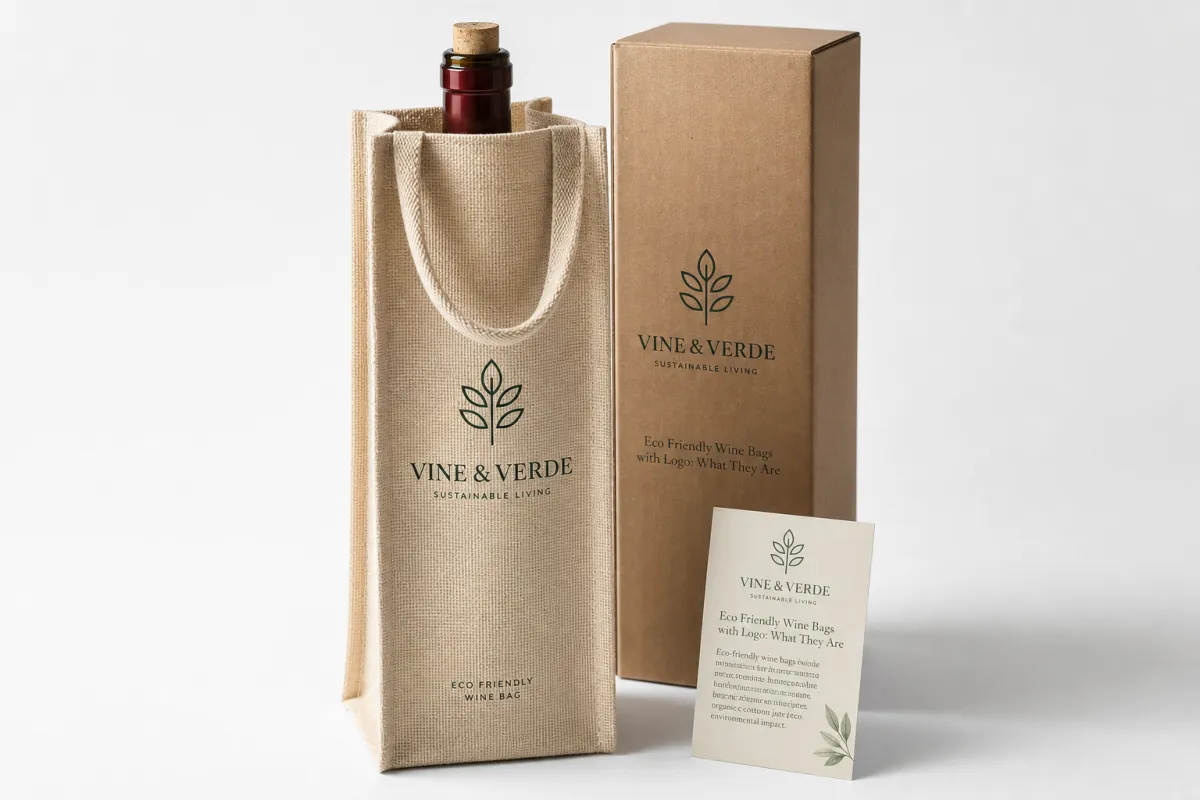
At the simplest level, eco friendly wine bags with logo are bottle carriers made from lower-impact materials and customized with brand artwork. The lower-impact part can mean recycled kraft paper, FSC-certified paperboard, cotton, jute, recycled nonwoven fabric, or other materials that reduce dependence on virgin plastic. The logo part can be a printed mark, a stitched patch, a woven label, a hang tag, or a discreet debossed mark. The best version depends on how the bag will be used and how often it will be seen.
There is a real difference between a bag that is merely recyclable and one that is built for reuse. A recyclable kraft carrier may be ideal for a tasting-room purchase or an event handout. A sewn cotton or jute bag makes more sense for a premium gifting program because the customer is more likely to keep it. That reuse matters. A reusable wine tote that survives five or ten more outings spreads its footprint across more moments, and that is where these carriers move beyond marketing language.
These bags show up in wineries, independent bottle shops, corporate holiday gifting, hotel welcome amenities, restaurant promotions, and membership programs. In those settings, presentation matters as much as protection. A bottle wrapped in branded packaging feels more complete, and eco friendly wine bags with logo help brands signal that they considered the full experience, not just the sale.
Here is the packaging truth most people miss: the bag can outlast the bottle moment. A gift recipient may pour the wine in an hour, but the bag can sit on a counter, travel to another event, or get reused for another bottle. That creates a useful branding window. Standard gift bags, plastic sleeves, and seasonal high-waste packaging usually disappear right away. Eco friendly wine bags with logo behave differently. They can stay visible longer, and that makes the branding value more durable.
“The strongest sustainable package is rarely the one with the loudest claim. It is the one that fits the product, holds up in real use, and still looks good after the first handoff.”
Sustainability claims need to be honest. A paper bag is not automatically better in every situation. A cotton bag is not automatically the greenest choice if it is never reused. Eco friendly wine bags with logo work best when the material, structure, and decoration method match the actual use case. That sounds obvious. In practice, it is where many buying decisions go wrong.
One buyer I worked with kept asking for the lightest possible paper option for a heavyweight bottle, and the samples kept failing at the handle. We switched to a slightly thicker stock and the complaints stopped. Not glamorous, but kind of the whole point. Packaging has to survive real hands, not just a spec sheet.
How Eco Friendly Wine Bags with Logo Work
The material choice sets the tone. Recycled kraft paper is common because it is familiar, light, and easy to print. FSC-certified paper can support a cleaner sourcing story if the fiber chain is documented properly. Cotton and jute carry more weight in the hand and usually feel more giftable. Recycled nonwoven sits in the middle for programs that want a fabric-like look without moving all the way into sewn custom construction. In most quotes, the material is the first line item to move the price up or down.
Branding methods also change the sustainability profile. One-color printing is usually the cleanest option from both a visual and production standpoint. Multi-color ink coverage can look strong, but it uses more ink and can complicate recycling on paper substrates if the coverage is heavy. Woven labels, stitched patches, and simple logo tags often create a more refined finish with less surface coverage than full-bleed graphics. Eco friendly wine bags with logo do not need to be loud to be memorable.
Construction details matter more than many buyers expect. Handle style, seam strength, gusset depth, closure method, and reinforcement all affect durability. A flat paper handle may be fine for a single bottle. A rope handle or reinforced die-cut handle is better for heavier glass or for retail environments where the bag may be carried longer. On fabric bags, stitched seams and corner reinforcement can add a few cents or more per unit, but they also help the bag survive repeated use. That is where value lives.
The lifecycle story should be simple enough to explain in one sentence. If the bag is short-term, choose the lightest workable structure. If it is meant to be reused, choose a stronger substrate and a cleaner decoration method. Sustainable packaging works best when footprint, function, and visual impact are balanced instead of pushed to extremes.
For paper-based programs, ask suppliers whether the substrate is certified through a system such as the FSC certification framework. For disposal guidance, the EPA recycling guidance is a better reference point than vague eco claims. A bag that is called sustainable in a sales deck still needs to make sense in the real waste stream.
There is also an important shipping distinction. Eco friendly wine bags with logo are packaging, but they are not always shipping packaging. If the bag is part of a wine club fulfillment pack or a multi-unit shipment, the outer shipper still needs proper protection. In those cases, transit testing such as ISTA 3A may matter for the overall pack, even if the bag itself is more about presentation than distribution.
Key Factors That Change Quality and Price
Pricing starts with material, but it does not end there. Bag size, bottle count, print coverage, handle type, stitching complexity, and finishing details all push the number up or down. A simple recycled kraft carrier with one-color printing is usually far less expensive than a sewn cotton bag with woven handles and a stitched logo patch. That difference is not cosmetic. It reflects the labor and setup behind each build.
Quantity matters a lot. On small runs, setup fees and artwork prep are spread across fewer units, so the price per bag rises quickly. Once a quote moves into larger volumes, the economics change. A supplier may charge a tooling or plate fee once, then the unit cost drops as the order size climbs. For eco friendly wine bags with logo, the sweet spot often appears when a buyer consolidates multiple events, channels, or gift programs into one production run.
Hidden costs are where budget plans wobble. Sampling, pre-production proofs, freight, storage, and artwork adjustments all affect the final landed cost. Specialty coatings, foil accents, or multi-step decoration add even more. If a quote looks unusually low, check what is missing. Sometimes it excludes shipping. Sometimes it assumes a thinner stock. Sometimes it does both.
From a practical buying angle, it helps to separate the quote into clear buckets: material, decoration, setup, and freight. That way, eco friendly wine bags with logo can be compared on more than just the headline unit price. A bag that costs a little more but survives reuse may be the better value, especially for corporate gifting or premium retail.
| Material / Build | Typical Decoration | Indicative Unit Cost at 5,000 Units | Best Fit |
|---|---|---|---|
| Recycled kraft paper | 1-color print | $0.18-$0.32 | Tasting rooms, retail add-ons, event handouts |
| FSC paperboard or heavier paper | 1-2 color print, simple die-cut detail | $0.22-$0.40 | Gift shops, seasonal bottle packaging, branded launches |
| Recycled nonwoven | Printed logo or woven label | $0.55-$1.20 | Reusable promotional programs, club gifts |
| Jute | Printed mark or stitched label | $0.95-$1.80 | Premium gifting, natural-look merchandising |
| Cotton | Screen print, woven tag, or patch | $1.15-$2.40 | Reusable retail bags, higher-end corporate gifts |
Those ranges are directional, not universal. A smaller order can run 20% to 40% higher per unit. A larger, simpler order can land lower. Print coverage, bottle size, and handle structure matter enough that two quotes from the same supplier can differ sharply. Eco friendly wine bags with logo should always be quoted with a consistent spec sheet so the comparison is fair.
Another detail is what the bag is expected to carry. A standard 750 ml bottle is the most common reference point, but some wineries also need split bottles, magnums, or oddly shaped bottles with taller shoulders. Eco friendly wine bags with logo should be sized to the actual glass profile, not to a vague idea of “wine bottle.” That one inch of difference can change seam stress, handle strain, and customer satisfaction.
Material quality also shapes the brand impression. A bag that feels thin or limp can make a premium bottle seem cheaper. A well-structured reusable bag can do the opposite. The hidden lesson is simple: these carriers are not just a cost line. They are part of the product positioning.
And yes, the market feels a little weird right now. Some buyers still want the lowest possible upfront price while asking for premium presentation and full sustainability claims. That combo is not impossible, but it is not free either. The real cost conversation has to include reuse, freight, and how long the bag stays in circulation.
Eco Friendly Wine Bags with Logo: Process and Timeline
The process usually starts with the bottle, not the bag. Confirm the exact bottle dimensions, the weight, the closure type, and whether the bag needs to hold one bottle or a set. Then decide how much reuse is expected. Once those basics are set, custom printed wine bags become much easier to specify because the supplier is designing to a real use case instead of a guess.
Artwork comes next, and this is where many schedules slip. A clean logo file in vector format moves faster than a low-resolution image pulled from a website header. Color limits also matter. If the design only needs one print color, approval is usually faster. If a buyer wants wraparound art, tonal gradients, or matched Pantone references, the proof stage takes longer. The best projects keep the layout simple and precise.
Typical timing depends on the build. A stock-style paper bag with custom print can often move through proofing and production faster than a sewn fabric bag with a patch, extra lining, or custom handle. For a straightforward order, 12 to 15 business days after proof approval is a reasonable planning estimate. For more involved construction, 20 business days or more is common. Peak periods can stretch that further. Good planning is usually cheaper than a rush fee.
Sampling deserves real attention. A digital proof can show color and layout, but it cannot tell you whether the handle feels right or whether the bag stands up properly on a counter. That is why a sample or pre-production prototype is valuable. It is the fastest way to catch issues such as weak seams, oversized logos, or a bottle fit that looks fine on paper but awkward in hand. Eco friendly wine bags with logo should be tested before volume production, not after it.
Rush orders are possible, but they rarely improve the economics. Faster timelines usually mean fewer revision rounds, tighter logistics, and a higher chance of compromise somewhere in the chain. If the bags are tied to a launch, trade event, tasting-room promotion, or holiday campaign, the safest move is to build in time for proofing, sample approval, and freight. That is especially true for larger custom runs where one delayed approval can push everything else.
A simple planning checklist can save a lot of pain:
- Confirm bottle dimensions and target bottle weight.
- Choose the material based on reuse, cost, and presentation.
- Upload vector artwork and define color limits early.
- Approve the proof only after checking logo size, handle placement, and bag depth.
- Request a sample if the bag is new, heavy, or part of a premium gift program.
- Build in freight time, especially for event dates that cannot move.
One more timing point is easy to miss. Eco friendly wine bags with logo may look like a small accessory, but they sit at the end of a chain that includes materials, decoration, inspection, and transport. Any one of those steps can become the bottleneck. The order that feels simple on a spreadsheet can still slip if the buyer waits too long to sign off on proof details.
Step-by-Step Guide to Ordering the Right Bag
Start with the use case. A retail shelf bag is not the same as a corporate gift bag, and neither one behaves like a wine club shipment accessory. Retail programs need fast recognition and consistent presentation. Gifting programs need a premium feel. Event giveaways need a price point that makes sense at volume. Eco friendly wine bags with logo work best when the use case is decided before the design brief is written.
Then match the bag to the bottle. A standard 750 ml bottle is the easy case, but many buyers need more than that. Split bottles, twin-bottle packs, and magnums all change the bag structure. A taller bottle needs more body depth or handle clearance. A heavier bottle needs stronger reinforcement. Branded bottle carriers should be specified with dimensions, not just a product name.
Artwork should be prepared as if it will be printed on a small, textured surface, because that is what will happen. Fine detail may disappear. Thin lines may break up. Multi-color logos can look busy on a narrow bag panel. A cleaner logo placement usually reads better, especially on smaller formats. Many of the strongest eco friendly wine bags with logo use a restrained front logo and leave the rest of the surface quiet.
Next, compare materials on the same checklist. Do not compare a low-cost paper bag with a sewn reusable bag and call them interchangeable. They are not. Ask for the same bottle size, the same print coverage, the same handle style, and the same freight assumptions. That is how the numbers become comparable on value, not just price.
If the order is new or important, request samples. A sample tells you more than a spec sheet ever will. It shows structure, color, handle feel, and how the bag behaves when loaded. If the supplier offers a prototype, use it. That single step can save a lot of expense later. For higher-volume programs, ask whether the bag has been tested for load performance and whether the packaging chain around it aligns with ISTA-style transit thinking.
Here is a practical order sequence that works in most cases:
- Define the bottle size, bottle count, and target use case.
- Choose the material and decoration method.
- Send artwork and request a proof with exact dimensions.
- Review sample or prototype, not just the PDF.
- Confirm the landed price, freight window, and production lead time.
- Approve only after checking handles, seams, logo placement, and fit.
That sequence sounds basic, but it prevents the most common buying mistake: treating all packaging options as if they were built for the same job. Eco friendly wine bags with logo are a branding tool, a carrier, and a cost item all at once. The order process has to respect all three roles.
Common Mistakes to Avoid With Branded Wine Bags
The biggest mistake is choosing a material that looks eco-friendly but fails in real use. A very thin paper bag may be recyclable, but if it tears under a heavy bottle, the customer experience is damaged and the sustainability story gets weaker, not stronger. A bag that fails once is usually less sustainable than a sturdier bag reused several times. That is why the bag should be tested against the actual load, not a marketing assumption.
Another common error is overdecorating the surface. Heavy ink coverage, foil, and layered embellishments can make the bag feel less natural and, depending on the substrate, harder to recycle or reuse. Clean branding often works better for sustainable packaging. It also tends to look more refined. A precise logo and good material choice do more for perceived value than a crowded design ever will.
Sizing mistakes are surprisingly expensive. A bag that fits one bottle style may fail on another bottle with a broader shoulder, a taller neck, or a thicker base. That is especially true for brands with multiple SKUs. If the same packaging is supposed to serve several bottle formats, test each one. Eco friendly wine bags with logo should be specified for the real product line, not the easiest bottle in the range.
Skipping sample approval is another avoidable problem. A proof might look perfect on screen and still produce a disappointing result in hand. Color can shift. Seams can sit unevenly. Handles can feel too narrow or too short. None of those issues is dramatic on a spreadsheet, yet all of them affect the final impression. The same level of checking that a label or carton gets should happen here too.
Timeline mistakes are just as common. Buyers often underestimate artwork approval, sample turnaround, and freight windows. A simple order can still miss an event date if one revision comes back late. The safest approach is to set the calendar early and then protect the approval window. These carriers are not difficult to manage, but they do require discipline.
Finally, do not assume every supplier defines “eco” the same way. Ask for the substrate source, the print method, the reuse expectation, and any relevant certification. If the material is paper, ask whether it is FSC-certified. If the claim is about recyclability, confirm the local disposal reality. Strong sourcing answers are better than broad claims. That is true for eco friendly wine bags with logo and for almost every sustainable packaging category.
How Do Eco Friendly Wine Bags with Logo Compare on Cost and Durability?
A smart starting point is a controlled test. Order one material, one bottle size, and one print treatment first. Then evaluate how it looks in retail lighting, on a gift table, and in the hand. That is much more useful than trying to launch three bag styles at once. The first format proves the point; the rest become easier to scale.
Minimalist branding often wins. A small, well-placed logo can feel more premium than a crowded layout, especially on natural materials like kraft, cotton, and jute. It also helps the packaging feel calmer. In sustainability work, calmer usually reads as more confident. Eco friendly wine bags with logo do not need to shout; they need to look considered.
Color coordination matters more than people think. If the bottle label is warm-toned, a natural kraft or jute base may feel coherent. If the brand identity is cooler and more modern, recycled white paper or a clean cotton bag may suit it better. The packaging should feel connected to the bottle, not pasted on top of it. The bag should support the label story, not compete with it.
Ask for proof of source and process. That means substrate origin, print method, handle construction, and any certification support. If a supplier cannot explain the sustainability claim in plain language, the claim is probably too soft to trust. Buyers do not need a lecture. They need evidence. Eco friendly wine bags with logo should come with enough documentation to make the claim feel real.
Before you place the order, compare three things side by side: the look, the feel, and the landed cost. It is easy to get trapped by one of those three and ignore the others. A bag that looks perfect but feels flimsy will disappoint. A bag that feels luxurious but blows the budget will be hard to repeat. A bag that sits in the middle may be the best commercial choice.
Here is the cleanest next-step path:
- Shortlist three styles that fit your bottle and brand.
- Request samples or prototypes for each one.
- Ask for pricing at two or three quantity tiers.
- Confirm artwork limits before finalizing the layout.
- Lock the timeline before the campaign or launch date becomes fixed.
That process keeps the buying decision grounded in real production detail instead of optimism. If the goal is stronger presentation, lower waste, and a Packaging Choice That feels more credible than a plastic sleeve, eco friendly wine bags with logo are a practical place to invest. The right version can support the bottle, support the brand, and support repeat use, which is a rare combination in packaging.
FAQ
What materials are best for eco friendly wine bags with logo?
Recycled kraft works well for lightweight, short-term gifting and lower-cost programs. Cotton, jute, and recycled fabric options are better when the bag is meant to be reused. The best choice depends on bottle weight, brand style, and whether the bag is expected to live beyond the first gift moment. The strongest result comes when material and use case match.
How much do eco friendly wine bags with logo usually cost?
Price depends on material, decoration, quantity, and whether the bag is single-use or reusable. Simple printed paper or kraft styles are usually the lowest cost, while sewn fabric bags cost more. For larger runs, the unit price drops as setup costs spread out. They should always be compared using the same spec sheet so the quote is fair.
How long does it take to produce branded wine bags?
Simple custom runs can move quickly after artwork approval, but sampling and revisions add time. Complex materials, special printing, or larger orders usually need a longer production window. A straightforward run may fit into a two-week production window after proof approval, while more involved builds often need longer. Planning is easier when the artwork is ready early.
Can eco friendly wine bags with logo hold heavier bottles?
Yes, if the bag is sized and reinforced for the bottle weight and handle stress. Always test seams, gussets, and handle construction before ordering at scale. Heavier bottles need more than a nice print; they need structural confidence. Load testing should match the same standard a buyer would use for any other bottle carrier.
What logo placement works best on sustainable wine bags?
Front-center placement is the most common and easiest to read in retail or gifting settings. For a cleaner premium look, some brands use a small logo on one side and keep the rest of the bag minimal. The best placement depends on how busy the bottle label already is and how visible the bag will be in hand. The simplest layout often looks the most deliberate.
For brands that want packaging to feel more credible without becoming wasteful, eco friendly wine bags with logo are a practical middle ground. They can be budget-conscious or premium, simple or detailed, recyclable or reusable. The key is choosing the right material, the right structure, and the right decoration method for the bottle and the occasion. That is the difference between a bag that merely carries wine and a carrier that actually carries the brand story forward.


