Buyer Fit Snapshot
| Best fit | Custom Paper Carrier Bags Bulk projects where brand print, material claims, artwork control, MOQ, and repeat-order consistency need to be specified before quoting. |
|---|---|
| Quote inputs | Share finished size, material target, print colors, finish, packing count, annual reorder estimate, ship-to region, and any compliance wording. |
| Proofing check | Approve dieline scale, logo placement, barcode or warning zones, color tolerance, closure strength, and carton packing before bulk production. |
| Main risk | Vague material claims, crowded artwork, missing packing details, or unclear freight terms can make a low unit price expensive after revisions. |
Fast answer: Custom Paper Carrier Bags Bulk: Film, Print, MOQ, and Carton Packing should be specified like a repeatable production item. The safest quote records material, print method, finish, artwork proof, packing count, and reorder notes in one written spec.
Production checks before approval
Compare the actual filled-product size with the drawing, then confirm tolerance on folds, seals, hang holes, label areas, and retail display edges. Reserve space for logos, QR codes, warning copy, and material claims before decorative graphics fill the panel.
Quote comparison points
Review material grade, print process, finish, sampling route, tooling charges, carton quantity, and freight assumptions side by side. A quote is only useful when the supplier can repeat the same color, closure quality, and packing count on the next order.
Custom Paper Carrier Bags Bulk: Practical Buying Guide
Custom paper carrier bags bulk are often the first packaging a customer carries into the street, onto a train, or straight into the back seat of a car. That means the bag is doing more than holding a product. It is carrying your logo, your standards, and, if the stock is flimsy, your mistakes too. Sounds harsh. It is still true.
Buying in bulk is not only about shaving the unit price. It is about reducing rework, avoiding reprints, keeping checkout staff happy, and making sure the bag survives the load it was actually meant to carry. I have seen buyers approve a beautiful sample, then watch the production run turn into a mess because nobody checked the handle strength or the paper weight. That is the part people forget until it bites them.
A strong bulk order keeps its shape, prints cleanly, and behaves the same way from one run to the next. A sample can look perfect and still kinda fall apart once it meets a hot lunch box or a heavy jar. That gap between sample and reality is where budgets go to die. The sections below break down the choices that matter: material, size, pricing, production timing, and the mistakes that turn a useful order into a headache.
Custom Paper Carrier Bags Bulk: Where Value Starts
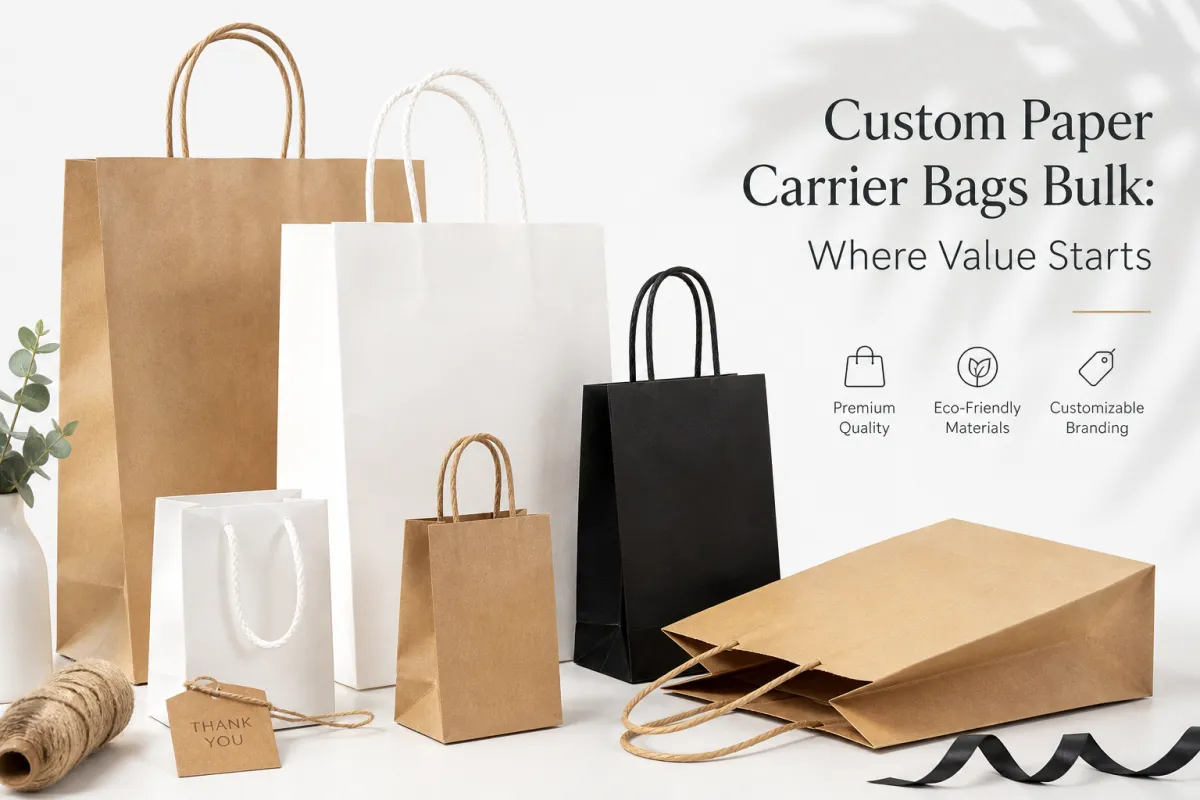
Value in custom paper carrier bags bulk starts with repeat performance. A one-off promo bag can survive on charm. A bulk order cannot. If your team is handing out 500, 2,000, or 10,000 bags a month, tiny differences in unit cost become real money. Tiny differences in quality do too. A low quote that later triggers replacements, complaints, or a reprint is not a bargain. It is paperwork with a smiley face on it.
Retailers notice this first because the bag leaves the store and goes public. Cafes and bakeries feel it too, especially when greasy containers, pastry boxes, and awkward takeaway stacks test the bag from the inside. Boutiques care about presentation. Event teams care about polish. Everyone wants the same basic result: a bag that supports the brand without forcing a packaging rethink every time stock changes.
The math is not subtle. If one bag costs $0.30 and another costs $0.24 across 5,000 units, the cheaper option saves $300 before freight and tax. If that lower-cost bag fails often enough to need 3% replacement, the savings shrink fast. A cheap bag that tears is expensive in disguise. Buyers see this after the first damaged order, not before.
"A paper carrier bag is part of the sale experience. It is also the last thing a customer notices before walking out the door, which is why bad bags stand out so fast."
Custom paper carrier bags bulk should be judged by outcome. Can the bag carry the load? Does the print stay readable after stacking, transit, and a few rough hands? Does the handle feel decent when the bag is full? Those questions matter more than a tiny shift in paper shade or a logo that is one millimeter off center. Good packaging often disappears into the background because it does its job without drama.
Bulk buying makes even more sense when the same format will be reordered again and again. Once the artwork, dimensions, and paper stock are locked, procurement gets simpler. The supplier repeats the job with fewer questions. The buyer compares each run against a known standard. Multi-site retailers and franchise groups especially benefit from one specification that holds across locations. If the bag will be used often, custom paper carrier bags bulk are the sensible option, not the flashy one.
Consistency matters in a way people underestimate. A first batch that matches the second batch keeps receiving smooth, reduces staff confusion, and stops brand drift before it starts. Once the bag becomes part of the customer experience, consistency is value. Plain and simple.
For teams ordering other retail packaging too, the same thinking applies to Custom Packaging Products and broader Wholesale Programs. Start with the use case. Choose the Right spec. Measure the result by total cost, not the first invoice line that looks convenient.
Product Details That Affect Performance
The first mistake buyers make is assuming every paper carrier bag behaves the same way. They do not. Twisted-handle bags, flat-handle bags, SOS block-bottom bags, and reinforced premium versions all solve different problems. A light load of brochures or apparel does not need the same structure as bottles, dense bakery goods, or stacked takeaway meals. Decoration is not a substitute for build quality. Never has been.
Twisted-handle bags usually feel more premium and work well for retail packaging. Flat-handle bags are common in foodservice and high-volume takeaway because they are cost-conscious and easy to run in quantity. SOS block-bottom bags stand upright, which helps packing speed and keeps items stable. Reinforced bags add strength where the load hits hardest, especially around the handle attachment and bottom fold. For custom paper carrier bags bulk, the right style is the one that fits the actual use, not the mockup that looked nice in a presentation deck.
Paper stock changes both appearance and performance. Kraft has a natural, sturdy feel and suits packaging that wants an honest, practical look. White kraft gives cleaner contrast for logos and tighter graphic detail. Recycled stock supports sustainability goals and may fit FSC-aligned sourcing where that matters. Laminated or coated finishes improve presentation and can reduce scuffing or moisture damage, though they usually add cost and make recycling more complicated. Foodservice buyers should ask whether the bottom panel or gussets need a light coating or water-resistant treatment.
Handle construction deserves more attention than it gets. A handle that feels fine on an empty bag can cut into the hand once the bag is full. Mouth width matters too. Too narrow, and staff waste time stuffing the bag while the top edge wrinkles and folds badly. A wider opening can improve speed and lower tear risk at the top fold. In fast checkout lines, that matters more than another decorative print option.
Print options range from one-color logos to full-wrap artwork. One-color printing is usually easier to control and often better for large bulk orders that need consistency. Two-color and multi-color jobs can lift the brand presence, but they also increase setup complexity and cost. On dark kraft, lighter inks need enough coverage to stay legible. On white stock, fine details tend to reproduce more cleanly. Artwork should be built for the chosen stock, not copied onto a generic template and hoped for the best.
Practical extras can be the difference between a useful bag and one that quietly annoys staff. Gussets add volume. Reinforced bases spread weight better. Coatings improve moisture resistance. Slightly taller dimensions can keep the top edge neat when contents are irregular. None of this is glamorous. All of it matters when the order lands on the packing table.
If the bags sit inside a premium retail launch, align the bag spec with the rest of the packaging so the visual language stays consistent across labels, inserts, and custom printed boxes. That is how package branding feels deliberate instead of stitched together from whatever was available that week.
One practical note: lighter paper is not automatically worse. A carefully selected 120gsm stock can work very well for apparel or lightweight gifts. Heavier stock brings stiffness and higher load tolerance, but it is not always necessary. The right choice depends on the product, the carry distance, and how often the bag is likely to be reused. That is how custom paper carrier bags bulk stop being guesswork and start being a spec.
Specifications That Make Bulk Orders Easier
Bulk orders move faster when the buyer sends a complete spec the first time. That sounds basic because it is basic, yet quote delays still begin with missing dimensions, vague artwork, or a note that says "same as last time." Similar is not a specification. For custom paper carrier bags bulk, precision saves time, prevents rework, and keeps the reorder on schedule.
Start with the essentials:
- Finished dimensions - width, gusset, and height in millimeters or inches.
- Paper GSM - the stock weight, usually the first number that affects stiffness and cost.
- Handle type - twisted, flat, rope, die-cut, or reinforced.
- Print colors - one-color, two-color, or full coverage, plus whether the artwork wraps around the sides.
- Finish - matte, gloss, uncoated, laminated, or coated for moisture resistance.
- Carton configuration - how many bags per carton, and whether the cartons need palletizing or retail-ready packing.
Dimensions should match the product being carried, not an older order that happened to be close enough. A bakery box, a folded garment, and a glass jar behave differently in a bag. A 10 mm width change can alter packing speed, top fold quality, and whether the load stays upright or slumps. Small numbers can have a surprisingly large effect in custom paper carrier bags bulk.
Paper weight matters in plain practical terms. A lighter stock reduces cost and can be perfectly fine for lightweight retail packaging. A heavier stock adds stiffness, resists creasing, and usually feels more premium. That premium feel matters if the bag is part of the perceived value of the sale. If the customer is likely to reuse the bag, stronger stock and handle construction are easier to justify.
Ask for tolerance ranges before production begins. A practical guide is that small paper bag dimensions often vary by around 2-3 mm, while larger formats can vary by about 5 mm depending on the production method. Print registration can shift by 1-2 mm on many runs, especially when artwork crosses folds or gussets. That is not automatically a defect. It only becomes a problem if the artwork hugs the edge or the design leaves no safe margin. Good packaging design leaves room for the real world.
A short internal checklist helps procurement teams reorder custom paper carrier bags bulk without rebuilding the brief every time:
- Confirm the product being carried and the heaviest expected load.
- Lock the finished dimensions and paper GSM.
- Choose the handle style based on carrying comfort and cost.
- Approve the print area, number of colors, and artwork placement.
- Specify carton pack counts, pallet needs, and any retail-ready requirements.
- Record the approved spec so the next reorder can be compared line by line.
That checklist looks plain because it is plain. It cuts the two biggest wastes: quote churn and order variation. If your team handles seasonal campaigns, product launches, or multi-location retail packaging, a fixed spec sheet is worth far more than another round of half-clear emails. It keeps custom paper carrier bags bulk repeatable.
For buyers who care about sustainability, ask for FSC-certified paper where available and check local recycling guidance. The Forest Stewardship Council explains certification standards clearly at fsc.org. That does not answer every sourcing question, but it gives procurement a credible starting point. If disposal or recovery matters to your brand, check the rules in the market where the bags will be used. Paper packaging is not magic. It still has to fit the local system.
Pricing and MOQ for Custom Paper Carrier Bags Bulk
Pricing for custom paper carrier bags bulk comes down to a handful of variables that move together fast: bag size, paper grade, handle style, print complexity, and order quantity. One-color printing on standard kraft is usually simpler than a full-wrap, multi-color job on white laminated stock. Larger bags cost more because they use more paper and often need stronger construction. Special finishes add setup and production steps. None of that is mysterious, but it does mean quotes need to be compared against the same spec.
MOQ, or minimum order quantity, is not an arbitrary number tossed into a quote to annoy people. It reflects production economics. Plates, setup time, waste allowance, and machine scheduling all shape it. Simpler jobs can have a modest MOQ. More complex custom paper carrier bags bulk orders, especially with heavy print coverage or specialty finishes, usually need a higher minimum because the factory has to cover the setup properly. If the price looks high at a small quantity, ask for the next tier. The jump may be smaller than expected.
| Option | Typical Quantity | Estimated Unit Range | Best Use | Notes |
|---|---|---|---|---|
| Standard kraft, one-color print | 5,000+ | $0.18-$0.28 | Retail handouts, cafes, lightweight takeaway | Lower setup cost, clean branding, good for high repeat volume |
| White kraft, two-color print | 5,000+ | $0.24-$0.38 | Boutiques, gift packaging, premium retail packaging | Better contrast for logos; cost rises with artwork coverage |
| Recycled stock with reinforced handle | 3,000-5,000+ | $0.28-$0.45 | Heavier items, sustainability-led programs | Good balance of strength and brand positioning |
| Laminated or coated premium bag | 3,000+ | $0.42-$0.75 | High-end launches, events, gift retail | Stronger visual impact; often higher freight and finishing cost |
Those ranges are directional, not universal. Freight, paper market conditions, packing configuration, and region all move the final number. Still, they give buyers a practical sense of what is realistic. If a quote lands far outside those ranges, ask why. There may be a valid reason, such as unusually thick stock, oversized dimensions, or a specialty finish. There may also be a simpler reason: a cost line slipped into the quote and nobody noticed.
Always compare total landed cost, not the unit price alone. Unit price, tooling or plate charges, sample fees, freight, duties if applicable, and rush production costs all belong in the same calculation. A low unit price can be swallowed by high setup charges. A generous MOQ can still be expensive if freight is inefficient. In custom paper carrier bags bulk, the sticker price is only one part of the bill.
Artwork changes can create a hidden MOQ problem. If the logo changes after sampling, or if the brand asks for a seasonal version at the last minute, the supplier may need to restart setup. That can push the order into a different price tier. Buyers who reorder regularly should treat the artwork file as part of the spec, not as a loose file sitting in an inbox somewhere.
For some brands, it helps to ask for two or three quote versions at once. One can be the lowest-cost functional bag. One can be the middle option with slightly heavier paper or a better handle. One can be the premium version. That comparison makes the tradeoff obvious. It also shows how custom paper carrier bags bulk can be adjusted to the real budget instead of guessed from a generic quote.
Process and Timeline: From Artwork to Delivery
The production workflow is predictable if the buyer is organized. It usually starts with the brief, then spec confirmation, artwork preparation, proof review, production, packing, and shipment. Each step is straightforward on paper. Delays usually show up because something in the brief is incomplete. A missing dieline, a low-resolution logo, or a last-minute change to dimensions can push the schedule back more than a machine issue ever will.
For custom paper carrier bags bulk, simple one-color jobs often move faster than multi-color print or specialty-finishing orders. A standard run may take around 12-15 business days after proof approval, but that depends on quantity, stock availability, and whether artwork changes are needed. More complex jobs take longer. If the bags are tied to a store opening, a product launch, or a seasonal campaign, build in time for production and transit. Tight schedules and paper bags do not get along.
Sample approval and final production approval are not the same thing. A sample confirms appearance, feel, and size. Final approval confirms that the approved spec is what goes into the full run. That distinction matters because custom paper carrier bags bulk can look perfect in a sample and still fail if the final order changes paper grade, handle type, or carton count. Reorder discipline keeps those surprises out of the supply chain.
Delays usually start in the same handful of places:
- Artwork arrives in a low-resolution format.
- The bag dimensions are copied from an older order and no longer fit the current product.
- The buyer wants to compare finishes after proofing has already begun.
- The approval loop drags because the right people were not included early.
- The order needs freight booked at the last minute.
That list is blunt because the problem is usually blunt. Most delays can be prevented. A buyer who sends the finished dimensions, logo artwork, paper preference, handle type, and target delivery window upfront usually gets a faster and clearer quote. The same discipline should apply to Custom Packaging Products and to sourcing through Wholesale Programs. Clean input at the start saves a mess at the end.
If the bags sit inside a distribution chain rather than a simple retail handout, transit testing may be worth discussing. The ISTA family of test procedures helps frame how packaging is evaluated for handling and movement. Their standards are publicly available at ista.org. Not every paper bag needs formal transit testing. The point is to know whether the order stays in-store or has to survive wider distribution and repeated handling.
One useful habit: lock artwork and dimensions before ordering samples meant for bulk sign-off. Otherwise the sample becomes a moving target and nobody wants that. In a busy procurement calendar, moving targets waste time and create doubt where none should exist. Custom paper carrier bags bulk work best when approval is narrow and the final spec is frozen early.
Why Choose Us for Large Paper Carrier Bag Orders
Buyers do not need packaging hype. They need a supplier that quotes clearly, explains the tradeoffs, and repeats the same result on the next run. That is the standard your packaging partner should be judged against. For custom paper carrier bags bulk, the real advantage is not a dramatic promise. It is a stable process: reliable material sourcing, consistent print control, and bags that arrive close to the approved spec.
Custom paper carrier bags bulk become easier to manage when the supplier understands how different sectors use them. Retailers care about presentation and brand alignment. Cafes care about grease, load, and speed at checkout. Bakeries need upright support and a stable base. Event teams want the bag to look polished without paying for a structure that only makes sense for daily takeaway. Packaging expertise matters because each use case pulls the spec in a different direction.
The quoting stage should do more than exchange numbers. A useful quote should name the bag size, paper stock, handle type, print method, minimum order, and lead time. It should also flag where the order is sensitive to change. Fine-line logos, heavier products, and premium presentation all need to be visible before production starts. That is not upselling. That is avoiding mistakes that somebody else will have to clean up later.
There is a difference between a supplier that ships bags and a supplier that understands package branding. The first gets the carton out the door. The second helps keep the bag, label, insert, and store experience aligned. That alignment is what buyers are actually paying for. A consistent brand feels more established, even when the materials are modest.
Consistency matters more than one-off perfection in custom paper carrier bags bulk. A bag that is good every time is more valuable than one that is excellent once and different the next. Procurement teams know that. They just do not always get a supplier who plans around it. Thoughtful ordering fixes a lot of that friction.
If sustainability is part of the brief, keep the conversation factual. FSC sourcing, recycled content, and right-sized packaging all help in different ways. None is magic. The real question is what the customer values, what the local recovery system accepts, and how the bag will be used. A sober answer beats a decorative claim every time, especially at bulk scale where every choice gets multiplied.
For buyers comparing broader retail packaging options, the same logic applies whether the item is a carrier bag, a display carton, or custom printed boxes. The goal is a repeatable spec that can survive reorder cycles. If custom paper carrier bags bulk are part of that system, manage them like any other production item: clear specs, clean approval points, and a cost model that includes the whole job.
Next Steps for Reordering at Scale
If you are preparing a bulk order now, start with the basics. Confirm the bag dimensions. Choose the paper stock. Define the handle style. Gather the logo artwork in a usable format. Then request quotes that compare at least two specification options so you can see how a small change in GSM or print coverage affects both price and performance. That comparison usually tells you more than one polished quote ever will.
For heavier products, foodservice use, or premium retail presentation, ask for a sample or proof before full production. A sample can expose issues that a PDF will hide: handle feel, stiffness, print visibility, and how the bag behaves under load. For custom paper carrier bags bulk, that step is cheap insurance. It is far easier to fix a problem before 10,000 bags are packed and shipped.
Then think beyond the current purchase. What is the likely monthly volume? How much storage space do you have? What delivery window makes sense for the next three purchase cycles? Those are not admin details. They are ordering assumptions. If they are wrong, the buyer ends up paying for rushed freight, emergency reprints, or storage problems. Good procurement starts with a forecast, not just artwork.
A simple rule helps: keep the approved spec sheet attached to every reorder. That sheet should list the finished size, paper GSM, handle type, print colors, finish, carton count, and the version of the artwork file. It removes ambiguity. It also makes custom paper carrier bags bulk easier to manage when a different staff member places the next order.
Finally, remember what the bag is doing. It is not just a cost center. It is part of the retail packaging experience, part of package branding, and part of the customer's carry-away impression. If the spec is right, the bag does its job quietly and reliably. That is the goal. Custom paper carrier bags bulk work best when spec, price, and timing are already aligned before production starts.
Frequently Asked Questions
What is the usual MOQ for custom paper carrier bags bulk orders?
MOQ depends on bag size, paper stock, and print method. Simpler jobs can start lower, while more complex custom paper carrier bags bulk orders usually need a higher minimum because setup and waste costs have to be covered. Ask whether the MOQ is based on cartons, printed units, or production sheets so you can compare quotes properly. If your volume sits close to the minimum, request pricing at the next tier too; sometimes the unit price drops enough to justify a slightly larger run.
How do I choose the right paper weight for bulk custom paper carrier bags?
Match GSM to the item weight and the bag's real use, not just the look you want. Lighter stocks suit apparel, brochures, and giveaway items. Heavier stocks are better for food containers, dense retail products, or any order that needs more stiffness. If the bag will be reused, choose a stronger stock and handle construction so failures stay low. That approach usually works best for custom paper carrier bags bulk because it balances durability against cost.
Can I get printed custom paper carrier bags in bulk with a low unit price?
Yes, but the lowest unit price usually comes from larger quantities and simpler print setups. One-color logos, standard sizes, and common paper stocks usually cost less than full coverage or specialty finishes. If you want the best price, ask for a quote that separates setup costs from unit costs. That makes it easier to see where the savings come from and whether a higher MOQ improves the economics of custom paper carrier bags bulk.
How long does production take for custom paper carrier bags bulk orders?
Timing depends on artwork readiness, approval speed, quantity, and finishing requirements. Simple jobs often move faster than multi-color prints or reinforced constructions. A typical range for custom paper carrier bags bulk may be around 12-15 business days after proof approval, but that changes with stock availability and freight needs. Build in extra time for proof review, transit, and receiving, especially if the bags support a store opening or a seasonal promotion.
What should I send for an accurate quote on bulk paper carrier bags?
Send the finished bag dimensions, estimated quantity, logo artwork, print colors, paper preference, and handle style. If you have a target budget, include it so the supplier can suggest the best tradeoff between paper weight and print coverage. Share where the bags will be used so the quote can reflect load needs, durability, and any food-safe considerations. The more complete the brief, the faster custom paper carrier bags bulk can move from quote to approval without unnecessary revisions.
If you're ready to order, lock one approved spec sheet first: finished size, paper GSM, handle type, print colors, finish, carton count, and artwork version. That single page will do more for cost control and reorder consistency than negotiating over pennies ever will.

