Buyer Fit Snapshot
| Best fit | Custom Paper Mailer Bags projects where brand print, material claims, artwork control, MOQ, and repeat-order consistency need to be specified before quoting. |
|---|---|
| Quote inputs | Share finished size, material target, print colors, finish, packing count, annual reorder estimate, ship-to region, and any compliance wording. |
| Proofing check | Approve dieline scale, logo placement, barcode or warning zones, color tolerance, closure strength, and carton packing before bulk production. |
| Main risk | Vague material claims, crowded artwork, missing packing details, or unclear freight terms can make a low unit price expensive after revisions. |
Fast answer: Custom Paper Mailer Bags: Film, Print, MOQ, and Carton Packing should be specified like a repeatable production item. The safest quote records material, print method, finish, artwork proof, packing count, and reorder notes in one written spec.
Production checks before approval
Compare the actual filled-product size with the drawing, then confirm tolerance on folds, seals, hang holes, label areas, and retail display edges. Reserve space for logos, QR codes, warning copy, and material claims before decorative graphics fill the panel.
Quote comparison points
Review material grade, print process, finish, sampling route, tooling charges, carton quantity, and freight assumptions side by side. A quote is only useful when the supplier can repeat the same color, closure quality, and packing count on the next order.
Custom Paper Mailer Bags: A Practical Business Guide
Custom Paper Mailer Bags look straightforward until you actually try to buy them. Then the quiet details show up fast. Paper grade. Seal strength. Print coverage. Tolerance on the folds. The whole thing gets very real, very quickly. A lightweight hoodie, a soft accessory, or a stack of inserts can arrive looking polished and still dodge the plastic-heavy feel customers spot immediately. That is the draw of custom paper mailer bags. They sit in a useful middle ground: cleaner than a plain mailer, less bulky than a box, and a lot more brand-friendly than a tired old envelope.
They are not a cure-all, though. Custom paper mailer bags work best when the product, the shipping lane, and the brand goal all point in the same direction. For some companies, they beat everything else on presentation and cost. For others, custom printed boxes or even Custom Poly Mailers make more sense. Packaging is not a vibes contest. Match the bag to the item, then let the branding do its job.
What Custom Paper Mailer Bags Are, and Why They Stand Out
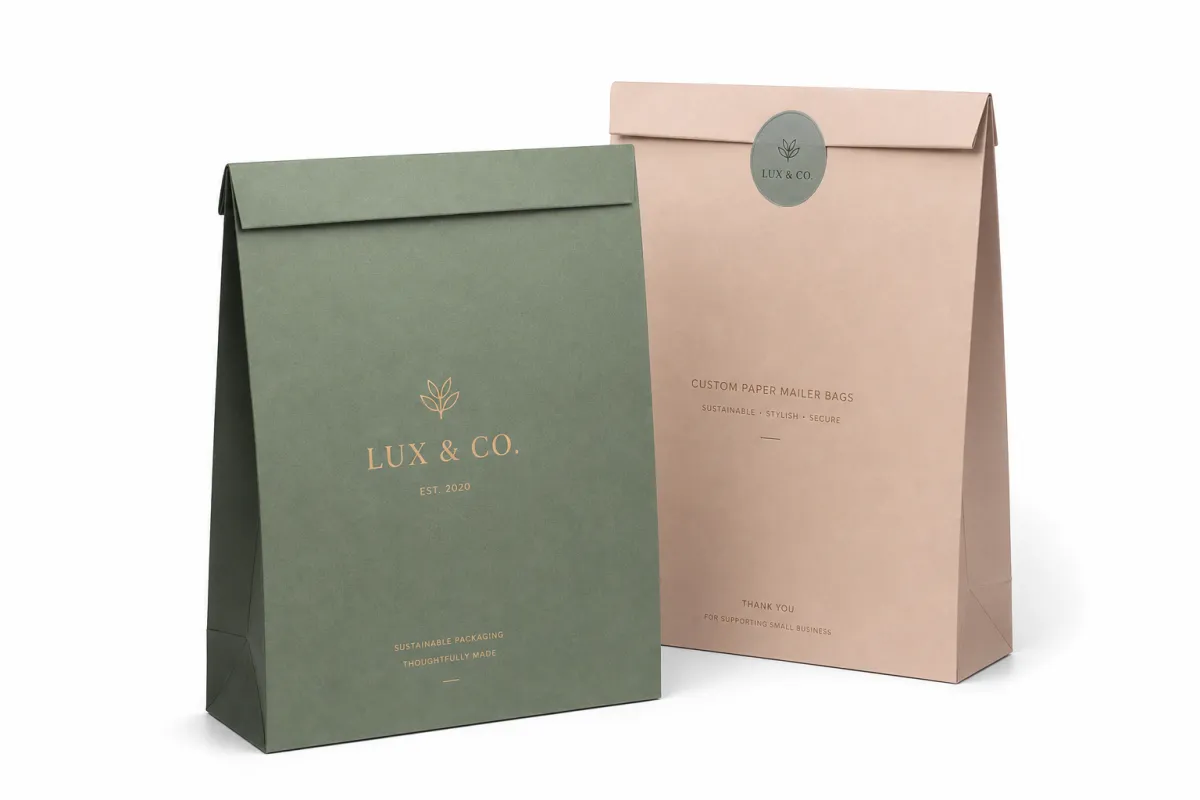
Custom paper mailer bags are paper-based shipping mailers built to carry products through fulfillment while showing off a brand's logo, color palette, messaging, or artwork. Some are flat. Some have gussets. Many use a peel-and-seal strip. A few include tear lines so customers can open them without rummaging for scissors. The job is not just to hold the product. The job is to present it with intent. That is why custom paper mailer bags have moved out of the supply closet and into the branding conversation.
Put them next to envelopes, poly mailers, and rigid boxes and the differences are obvious pretty fast. Envelopes are usually too light for real shipping abuse and too tied to documents to feel like product packaging. Poly mailers are cheap, flexible, and moisture resistant, but they can feel purely functional. Rigid boxes create a stronger premium cue, though they usually cost more, take more storage space, and ask for more labor at packout. Custom paper mailer bags land in the middle. That middle is useful. They fit apparel, soft goods, printed materials, lightweight accessories, and small retail kits without turning every shipment into a box project.
Buyers notice the details even if they never say them out loud. Texture matters. Seal quality matters. The bag needs to feel chosen, not random. That first touch can shape the customer's view before the product even appears. Packaging is one of the few parts of ecommerce that gets handled before the item inside does. Custom paper mailer bags are part of that experience, not decoration stapled on top.
They still have limits. A sharp edge can puncture a thin wall. A heavy garment can stress a weak seam. Wet dock environments can ruin a bag that was never built for moisture in the first place. Custom paper mailer bags work best when the product suits paper and the handling conditions are sane. Not glamorous. Just sane.
Brands usually choose custom paper mailer bags for three reasons: cleaner presentation, better fit for soft goods without wasted space, and a more deliberate look than the plain brown default. Some teams also use recycled content or FSC-certified paper to back up sustainability messaging. That only matters if the spec is real. Marketing copy does not strengthen a bag, no matter how enthusiastic the copywriter gets.
How Custom Paper Mailer Bags Work in the Shipping Process
The structure of custom paper mailer bags is pretty simple. The build usually includes a paper base, folds or gussets, a seal strip, and sometimes a tear line. Some versions are built for single-use shipping only. Others are made to survive repeated handling without splitting at the seams or fraying at the edges. Better construction means the bag behaves less like a wrapper and more like a real shipping container. That difference shows up fast once orders leave the building.
In a fulfillment line, custom paper mailer bags move through packing, sealing, labeling, sorting, and parcel transport. The bag is not judged by the product alone. It gets hit by conveyor friction, stack pressure, corner crush, and the general mess of a busy shipping network. A bag that looks perfect on a sample table can still fail after filling, sealing, and label placement. Good suppliers often reference transport testing methods such as ISTA procedures, and some buyers ask for ASTM D4169-style simulation to check compression, vibration, and drop performance.
Customization starts with the paper stock. Kraft paper gives a natural look. White or bleached paper makes graphics pop. Recycled-content stock supports a more explicit sustainability story. Coated paper can help when moisture resistance matters. Then comes the print strategy. Some brands want a single-color logo and nothing else. Others want full-coverage graphics, seasonal art, or patterns that make the mailer part of the unboxing moment. That is the point where custom paper mailer bags start competing with custom printed boxes on visual impact, even if the structure is simpler.
Fit is the part people get wrong most often. Too tight, and the closure strains, corners press hard, and the paper scuffs during handling. Too loose, and the product shifts, dents, and rattles around inside. Snug is good. Jammed is bad. Sloppy is bad. Most packaging mistakes come from that geometry, not from the artwork.
Custom paper mailer bags work best for soft or flexible products, flat items, and moderate weights. They are weaker around water, sharp edges, and shipments that need real puncture resistance. That does not make them weak. It makes them specific. Treat them like a universal fix and disappointment follows.
Test the packed product, not the spec sheet. A bag can look right on paper and still fail once a warehouse seal, a label, and real transit pressure get involved.
If your brand already uses custom printed Boxes for Premium orders, custom paper mailer bags can still handle a valuable lane. They often cover lower-cube, lower-weight SKUs that do not justify a box while keeping the brand look consistent. Many companies treat them as part of a system, not a standalone format. For a wider mix of options, Custom Packaging Products can help compare shipping formats across the catalog.
Custom Paper Mailer Bags: Cost, Pricing, and Budget Drivers
Cost is where the conversation gets serious. Custom paper mailer bags are often cheaper than rigid boxes, but the pricing range is wide enough that two quotes can look like different products. Paper grade, size, print coverage, adhesive type, closure style, and order quantity all push the number around. A plain kraft bag at volume is not the same thing as a full-coverage printed mailer with a reinforced seal and specialty finish. Freight, warehousing, and setup can also change the landed cost enough to flip the decision.
For planning, many buyers use a mid-size order of 5,000 pieces as a working benchmark. A simple unprinted build might land around $0.18 to $0.30 per unit. A single-color logo version might sit around $0.24 to $0.38. Full-coverage printing, specialty coatings, or heavier paper can push the range higher, often into the $0.32 to $0.55 zone. Premium builds can go beyond that. These are planning ranges, not promises, but they show how quickly size and surface treatment affect the bill.
| Option | Typical Use | Approx. Unit Price at 5,000 pcs | Main Tradeoff |
|---|---|---|---|
| Plain kraft custom paper mailer bags | Basic apparel, inserts, lightweight soft goods | $0.18-$0.30 | Lowest cost, least visual differentiation |
| One-color printed mailers | Brands wanting simple logo visibility | $0.24-$0.38 | Better branding, modest print setup impact |
| Full-coverage custom paper mailer bags | Premium unboxing and stronger package branding | $0.32-$0.55 | Higher print and setup cost, more design control |
| Coated or specialty finish mailers | Moisture-sensitive shipping lanes or premium retail packaging | $0.40-$0.70+ | Better performance or appearance, higher landed cost |
Unit price can trick people. A cheaper bag that is too large may drive up dimensional weight, waste dunnage, and packing time. A slightly pricier bag that fits right can lower total cost by cutting labor and reducing damage. Landed cost is the number that matters. I have seen buyers get hypnotized by a tiny unit-price difference and then lose the savings in freight and labor. Not exactly a proud moment.
Minimum order quantity creates another trap. Smaller brands chase the lowest per-unit price, then end up sitting on inventory they cannot use fast enough, or buying a size they already know will change next quarter. Paying a bit more for a tighter spec is often smarter than ordering a giant run that turns into dead stock. Custom paper mailer bags only stay economical when the inventory plan matches the sales plan.
Branding choices change the math too. Full-coverage print looks stronger, but every extra color, plate, or pass adds complexity. Custom sizing improves fit, but it also increases setup and can stretch lead time. Specialty finishes make the mailer feel closer to premium retail packaging, and the quote will reflect that polish immediately. Brands comparing custom paper mailer bags against custom printed boxes or poly mailers usually want one answer: how much visual lift do they get per order? Fair question. Price should answer it.
A simple framework cuts through quote noise:
- Lock the product weight, folded dimensions, and any inserts before asking for pricing.
- Request at least three tiers: entry, mid, and premium.
- Compare the same dimensions, closure style, and print coverage across each tier.
- Add freight, storage, and expected overage to get a true landed cost.
- Check whether a slightly larger run lowers unit price enough to justify the inventory risk.
That process is not exciting. It does prevent expensive mistakes. The real cost of custom paper mailer bags is often not the bag itself. It is the mismatch.
How to Choose the Right Custom Paper Mailer Bags
The product should drive the choice. Weight, thickness, shape, fragility, and edge profile say more about the right bag than any mockup ever will. A folded tee, a stack of stationery, and a boxed accessory can all ship in custom paper mailer bags, but each one needs a different safety margin. If the item has hard corners, zippers, metal hardware, or odd seams, the bag needs more room and probably stronger paper.
Sizing should be based on the packed product, not the product sitting alone on a desk. That sounds obvious. Teams still miss it all the time. Once tissue, inserts, poly sleeves, cards, or protective wrap enter the mix, the volume changes. A bag that fits the naked item can be too tight once the real packing sequence starts. I would rather see a little extra room than a fit so tight the packer has to wrestle the closure. Test the final packed dimensions before you approve the order.
Material choice matters just as much. Kraft paper gives a familiar, clean look and can handle moderate handling if the build is decent. Recycled-content paper helps with sustainability messaging, but the real strength depends on fiber mix, not the marketing line. Coated or barrier-treated constructions can help with moisture, though they may affect recycling claims and change how the bag feels in hand. If the material story matters, verify it. If you need chain-of-custody proof, check the source through FSC rather than trusting a sales deck.
Brand fit is the other half of the decision. Some brands want custom paper mailer bags to feel earthy and restrained. Others want them bold, graphic, and easy to spot in a stack of parcels. A third group wants the mailer to echo the same visual language used in custom printed boxes so the packaging system feels consistent across the line. That kind of consistency is not just pretty. It helps recognition and keeps package branding from looking stitched together.
These four questions usually narrow the field fast:
- Does the product need puncture resistance, moisture resistance, or mostly clean presentation?
- How much packing variation exists across the SKU set?
- Will the bag live in ecommerce shipping only, or also support retail packaging and shelf display?
- Should the mailer feel premium, minimal, playful, or environmentally explicit?
The answers point in different directions. A minimalist apparel brand may want a kraft finish, a small logo, and a clean adhesive strip. A subscription brand shipping higher-value items may need heavier stock, better print coverage, and a more protective closure. Custom paper mailer bags should be selected as a system component, not as a graphic exercise with postage attached.
One more caution. Sustainability claims need precision. A paper mailer is not automatically recyclable everywhere. Coatings, adhesive systems, mixed-material windows, and local municipal rules all affect disposal. If recyclability is part of the message, verify the actual build first, then write customer-facing copy that matches it. Vague claims create trust problems later, and packaging teams usually only get one clean shot at that.
For brands balancing several packaging formats, the best choice is often not the strongest mailer. It is the one that fits the SKU, the ship lane, and the brand promise without adding waste. That is the point where custom paper mailer bags stop being a commodity and start becoming a design decision.
Step-by-Step Ordering and Timeline for Custom Paper Mailer Bags
A clean ordering process saves time and avoids dumb surprises. The sequence usually starts with a brief, moves through artwork and proofing, then ends with production and freight. Custom paper mailer bags are straightforward once the specs are locked, but the first order always takes longer because there are more decisions to settle. Define the product clearly and the quote gets cleaner faster.
- Define the packed item. Share product samples, filled dimensions, target ship weight, and any inserts or wraps.
- Choose the bag structure. Decide whether the mailer should be flat, gusseted, reinforced, or moisture-aware.
- Set the print direction. Confirm logo placement, color count, and whether the brand wants inside printing or exterior-only graphics.
- Request samples or dummies. Test the actual fit, closure, and label area before approving full production.
- Approve artwork and proof. Check bleed, barcode space, safe zones, and print contrast.
- Plan production and transit. Leave room for manufacturing, inspection, and shipping.
Manufacturers usually need a few concrete inputs before they can quote cleanly: product dimensions, estimated annual usage, quantity by size, print files, preferred paper type, and delivery destination. The more precise the brief, the less guesswork enters pricing. Even a small size change can alter material use, carton count, and freight. Custom paper mailer bags are sensitive to those shifts.
Typical timelines vary by supplier and spec, but a first order often runs through quoting in a few business days, sampling in about 5 to 10 business days, production in roughly 12 to 20 business days after proof approval, and shipping transit after that. Simple artwork and an already-known size usually speed things up. New print effects or unusual paper grades add review time. Slow approvals, missing dielines, and late changes cause most delays.
That is why many packaging teams build a spec sheet once a bag is approved. A good spec sheet should include internal dimensions, paper grade, closure type, ink colors, label placement zone, approved supplier notes, and the SKU or product family it serves. After that, reorders get much cleaner. Nobody has to dig through old email chains or ask the one person who remembers which size was used last quarter.
Testing matters too. If the product is fragile, high value, or headed through rough networks, do a test run with actual parcels, not just tabletop fit checks. Standards such as ISTA 3A and ASTM D4169 are useful because they force teams to think about vibration, drop behavior, and compression instead of only appearance. Custom paper mailer bags that pass a desk test but fail transit are not a success story.
Build in buffer time for the first order. If a launch depends on the bags landing by a fixed date, leave room for a proof correction, paper substitution, or freight delay. Once the spec is stable, future runs become much easier. That is one reason experienced buyers treat custom paper mailer bags as a repeatable system rather than a one-off purchase.
Common Mistakes When Buying Custom Paper Mailer Bags
The biggest mistake is sizing to the ideal product dimensions instead of the actual packed dimensions. Tissue, inserts, cards, and protective wrap all change the shape. If the fit is too tight, the closure becomes awkward and the bag is more likely to split at the seam. If the fit is too loose, the product slides around and the presentation goes sideways. Custom paper mailer bags need real-world fit, not a neat little spreadsheet fantasy.
A second mistake is spending too much on graphics and too little on structure. Strong branding helps, but the bag still has to survive handling. Brands sometimes approve a beautiful full-coverage print and then under-spec the paper grade or closure. The result photographs well and disappoints in transit. A slightly simpler design with a stronger build often performs better and feels more premium in the hand anyway. Funny how that works.
Logistics gets ignored too often. Buyers focus on unit price and forget how the packaging will be stored, counted, picked, and shipped. Bulkier custom paper mailer bags can take more carton space, increase inbound freight, and eat into warehouse capacity. Bad carton efficiency shows up later as a margin leak. By then, nobody feels clever about it.
Sustainability claims can go wrong just as easily. A mailer may be paper-based and still include coatings or adhesive systems that affect disposal. If the brand says the package is recyclable without checking the build and the local recycling rules, the claim can backfire. Safer language is usually more honest: explain the material, explain any special treatment, and verify disposal guidance with the supplier. That matters even more when custom paper mailer bags are part of a larger environmental story.
Skipping samples is the last classic mistake. A spec sheet will not show how easy the bag is to seal, whether artwork lands too close to the edge, or whether a barcode reads cleanly after folding. One sample run often exposes the little problems that become expensive at scale. Weak closure tape. Smudged ink near a crease. A label area that is too small for the shipping team. All ordinary. All cheaper to catch early.
A tidy packaging spec can still fail on the packing line. The real test is the product, the hands that pack it, and the route it travels.
If the team needs a cleaner approval process, a short checklist helps:
- Confirm packed dimensions, not just product dimensions.
- Test with the actual insert stack and closure method.
- Inspect the first sample under warehouse lighting, not only in the design file.
- Check freight, carton count, and storage footprint before approving volume.
- Validate any environmental claim against the real material spec.
Custom paper mailer bags are not hard to buy once the process has some discipline. The problems usually come from assumptions, not from the format.
Expert Tips and Next Steps for Custom Paper Mailer Bags
Test two or three constructions before locking the final order. It is extra work, yes. It also saves time later because you can compare fit, sealing behavior, and print appearance side by side. In many product lines, custom paper mailer bags that look almost identical on a quote sheet behave very differently once packed. One feels sturdier. Another creases less. Another closes faster on the line. Those differences matter when volume shows up.
Standardizing sizes across related SKUs helps too. Brands often create too many packaging variations because each product seems unique during the buying cycle. Then inventory gets messy, reorder planning gets harder, and the team spends time hunting the right carton instead of shipping orders. If three SKUs can share one bag size safely, that is usually better than three nearly identical sizes. The savings show up in purchasing, storage, and staff training.
A clean spec sheet for each approved bag size is one of the best operational tools you can build. Include the paper type, dimensions, print file name, closure style, label zone, approved supplier, and linked product SKUs. Add notes about what changed between revisions. That record becomes useful six months later when someone needs a reorder and the original buyer is gone or buried in a different project. Custom paper mailer bags are easier to manage when the decision trail is visible.
Damage data should feed back into packaging decisions. If one product family has a repeat puncture issue, that is a signal to change the paper grade, add a protective insert, or revise the fit. If customers keep talking about the unboxing experience, that may justify a print upgrade or a cleaner opening strip. Packaging should not stay frozen. It should behave like a measurable part of operations, the same way returns, shipping speed, and conversion rate do.
For brands mapping a wider packaging system, think in tiers. Use custom paper mailer bags for lightweight, soft, and presentation-sensitive SKUs. Use custom printed boxes for items that need stronger structure or more premium staging. Keep poly mailers in reserve for product lines where moisture resistance or price pressure matters more than tactile presentation. That kind of segmentation makes the whole packaging program easier to run.
The next move is simple: audit your top-selling SKUs, request sample quotes, compare landed cost, and pilot custom paper mailer bags on one product line before expanding. That gets you real data instead of guesswork, and it usually shows quickly whether the format fits your operation. For a lot of brands, the answer is yes. For others, the answer is not yet.
Either way, custom paper mailer bags deserve a serious look because they sit at the intersection of shipping cost, product fit, and brand perception. A package that does all three jobs well is rare. That is exactly why custom paper mailer bags keep earning space in better packaging plans. If you want the shortest path to a smart decision, start with one SKU, one packed sample, and one real transit test. That is the part most teams skip, and it is usually the part that saves them later.
Frequently Asked Questions
Are custom paper mailer bags better than poly mailers for ecommerce shipping?
It depends on the product and the goal. Custom paper mailer bags usually win on presentation, tactile feel, and sustainability signaling, while poly mailers usually win on moisture resistance and lower unit cost. For apparel, printed goods, and soft accessories, paper often fits the job well. For wet climates, sharp edges, or rough handling routes, a stronger inner layer or a different format may be safer. Many brands compare both options before choosing one lane for each SKU.
How do I choose the right size for custom paper mailer bags?
Measure the packed product, not just the item itself. Include tissue, inserts, folded garments, and any protective wrap used in fulfillment. Leave enough room for an easy seal without so much empty space that the item shifts during transit. The best way to confirm the size is to test sample bags with the actual packing materials on your line. That small test catches most fit problems before a full order is placed.
What affects the price of custom paper mailer bags the most?
Material grade, dimensions, print coverage, and order volume usually drive the biggest price differences. After that, freight, setup fees, storage, and overage policy can change the real landed cost more than the unit price suggests. Custom sizing and specialty finishes can raise the quote, but they may still be worth it if they reduce damage, improve speed, or strengthen package branding. A cheap bag that creates packing problems is rarely cheap in the full budget view.
How long does it take to produce custom paper mailer bags?
Lead time depends on artwork approval, sampling, production queue, and shipping distance. First orders usually take longer because proofing and testing add steps. A common planning window is a few business days for quoting, roughly 5 to 10 business days for samples, and about 12 to 20 business days for production after approval, with freight on top. Reorders are faster once the spec is stable and the print file is already approved.
Are custom paper mailer bags recyclable?
Many are recyclable, but the answer depends on the paper type, coatings, adhesives, and local recycling rules. A plain kraft build is easier to explain to customers than a mailer with heavy coatings or mixed materials. If recyclability is a core claim, confirm the structure with the supplier and match the customer message to actual disposal behavior. That is the safest way to keep custom paper mailer bags aligned with both brand story and real-world end-of-life handling.
What should I do first if I want to try custom paper mailer bags?
Start with one product line, not the whole catalog. Choose the most representative SKU, collect the packed dimensions, and ask for samples in two or three constructions. Then compare fit, seal strength, print look, and landed cost against your current packaging. That is the cleanest way to see whether custom paper mailer bags are a good operational fit. If the sample performs well, expand from there with a spec sheet and reorder plan so the next run is faster and more predictable.

