If you are sourcing branded retail packaging at scale, a Custom PE Bags Factory private label program can look simple on paper and technical in practice. The bag may seem like a plain sleeve of plastic, yet the choices underneath it - film gauge, seal style, print method, and pack-out - decide whether the final piece feels deliberate or disposable.
That difference matters because PE bags do more than hold a product. They protect against dust and light moisture, support shelf presentation, and reduce packing labor without the weight or cost of rigid packaging. For many brands, they are the quiet workhorse in the box, the rack, or the shipping carton.
The economics are also hard to ignore. Compared with folding cartons, molded trays, or heavier outer packaging, polyethylene usually keeps material cost down and conversion speed up. That does not make it automatically better. It does mean small specification changes can have outsized effects on price, durability, and how the bag behaves during packing.
What a private-label PE bag program actually includes
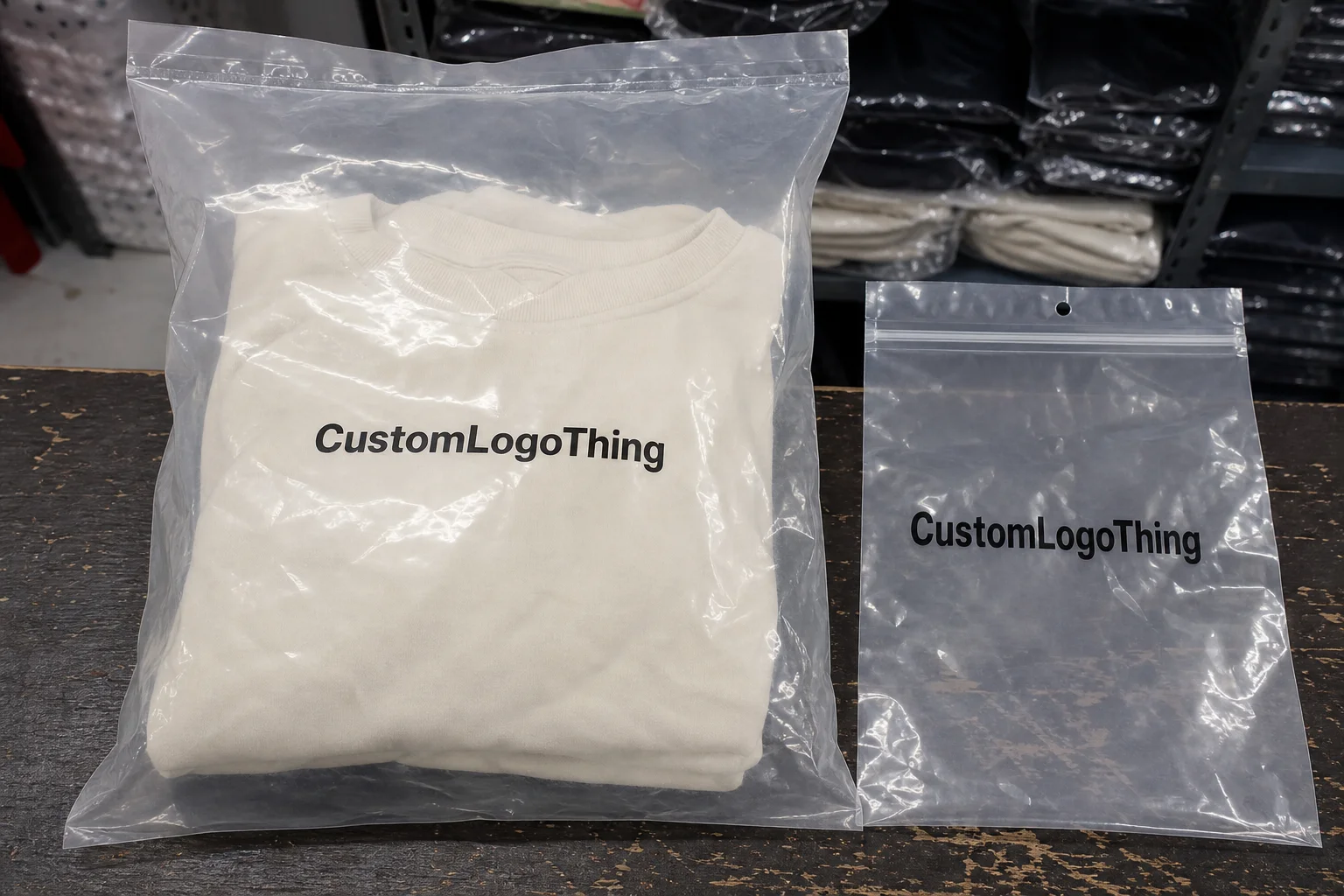
PE bags are made from polyethylene, usually low-density polyethylene (LDPE) or high-density polyethylene (HDPE). Both are light, flexible, and widely used in retail, shipping, and promotional packaging. Buyers sometimes compare them with Custom Packaging Products like folding cartons or even Custom Labels & Tags, but the purpose is different: PE bags are built for low unit cost, practical protection, and repeatable presentation.
Private label means the factory produces to your brand spec rather than shipping a generic stock bag. Your logo goes on the film, your colors are matched as closely as the print process allows, your dimensions and thickness are fixed, and the packing format is locked before production begins. The factory is not just printing a logo. It is building a repeatable packaging part that has to fit a product, a workflow, and a sales channel.
Many buyers assume branding starts with print. It does not. Most of the performance decision-making happens earlier, in the choices that are easier to overlook: width, length, seal geometry, whether the bag is flat or gusseted, whether it is wicketed or on a roll, and whether the film should feel soft or crisp in hand. A 2 mil bag with weak seals can fail sooner than a better-built 3 mil version, even if the artwork is identical.
That is why a Custom PE Bags Factory private label arrangement works best when the buyer treats the bag as a packaging system, not just printed film. For retail packaging, consistency matters almost as much as appearance. A bag that opens cleanly, stacks predictably, and arrives uniform across a shipment makes a product line feel controlled rather than improvised.
“The lowest quote is rarely the lowest landed cost once defects, freight, and repack time are included.”
How a custom PE bag production process works
The process usually starts with a brief: intended use, product weight, size, thickness, print coverage, pack count, and any compliance requirements. The best suppliers ask for actual item dimensions, not just the product category. A 10-inch folded tee and a 10-inch accessory do not need the same depth, closure allowance, or bag stiffness.
From there, the factory selects film and conversion method. Some jobs begin with extruded film, then move into printing and bag making. Others use printed rollstock that is converted into finished bags later. That difference affects more than logistics. Film consistency, ink adhesion, and registration control can change depending on where the material enters the process.
A practical production flow usually looks like this:
- Spec confirmation and artwork review
- Film recommendation and print method selection
- Digital proof or pre-production sample
- Final artwork approval
- Film extrusion or film sourcing
- Printing, slitting, and bag conversion
- Seal checks, count verification, and packing
- Cartoning, palletizing, and shipment
Good factories do not wait until the end to inspect quality. They check dimensions, seal integrity, print registration, and opacity before mass production begins. A tolerance of a few millimeters sounds minor until it affects a snug apparel bag, a closure flap, or shelf presentation. At scale, small errors become expensive because they repeat on every unit.
Sampling is usually where the real issues surface. A proof can reveal that the logo sits too close to the seal line, that the barcode is too small for reliable scanning, or that the film looks clearer on screen than it does in person. Catching that on a sample saves more than material. It avoids rework, schedule slips, and the awkward explanation that 60,000 bags are already packed.
If a supplier says the process is identical regardless of spec, that is a warning sign. A zipper closure, an adhesive flap, a wicketed bundle, and a simple open-top sleeve do not run the same way. The same is true for clear versus opaque film, single-color versus four-color artwork, and stock dimensions versus a custom die-cut format.
Key specs that shape appearance, strength, and compliance
For PE bags, a small set of specifications does most of the work. Film thickness, dimensions, closure style, gusset depth, handle type, and surface finish all affect how the bag performs and how it looks in use. Buyers often ask for a “stronger bag,” but the factory needs measurable targets: microns or mils, exact width and length, product weight, and the handling conditions it has to survive.
LDPE feels softer and has better clarity. It stretches more before tearing, which is useful for apparel and retail presentation. HDPE is crisper and often feels thinner while still offering acceptable strength for simpler carrier-style applications. The choice usually comes down to appearance, puncture risk, and the expected handling cycle. Soft goods often favor LDPE. Shorter, utility-focused runs can work well in HDPE.
Thickness matters more than many buyers expect. A small increase in gauge can change yield, shipping weight, and how the bag handles during packing. A thin film may save resin, but if it wrinkles badly, tears at the seal, or looks cheap under store lighting, the savings disappear quickly. There is a point where “lightweight” turns into “underbuilt.”
Printing adds another layer of decision-making. Spot colors generally give sharper brand consistency for logos and simple graphics. CMYK is better for gradients and complex artwork, but translucent film can make color management harder, especially if the background is not fully opaque. Ink adhesion matters as much as color. Poor substrate matching can lead to scuffing, smearing, or a dull finish that makes the packaging look older than it is.
Compliance is less visible, but it protects the brand from expensive mistakes. If the bag touches food, the resin and ink system must be suitable for the intended contact standard. If the packaging lands on retail shelves, the brand may need recycling guidance, warning statements, or country-specific labeling. For broader packaging references, the Flexible Packaging Association at packaging.org is a useful starting point, and the EPA’s plastics and recycling pages at epa.gov can help buyers understand disposal and material guidance.
Common PE bag specification choices
| Spec | Typical options | What it changes |
|---|---|---|
| Film type | LDPE, HDPE | Feel, clarity, stiffness, tear behavior |
| Thickness | 1.5-4 mil, sometimes higher | Strength, cost, hand feel |
| Print method | Flexographic, gravure, digital sample proof | Color consistency, setup cost, artwork flexibility |
| Format | Flat, gusseted, wicketed, roll stock | Fill speed, shelf presentation, storage efficiency |
| Closure | Open top, adhesive flap, zipper, heat seal | Resealability, tamper resistance, labor time |
One more practical point: if the packaging program includes sustainability claims, ask for the exact documentation behind them. Resin content, recyclability guidance, and any certification claims should be specific, not marketing language in a spreadsheet. If chain-of-custody matters, FSC is relevant for paper components in mixed packaging systems, and its standards are outlined at fsc.org. PE itself is a different material, but many retail programs combine plastic and paper, so the standards need to line up.
Buyers also underestimate how much printing changes the bag’s feel. Heavy ink coverage can stiffen the film or make it look cloudy. Very fine type may be legible in a mockup and weak on the actual bag. A clean spec sheet helps, but a physical sample is what tells the truth.
Cost, pricing, and MOQ: what changes your unit price
Pricing in a custom pe bags factory private label program is driven by a handful of variables that interact with one another. Resin price is the obvious one. Less obvious are size, thickness, print colors, surface coverage, tooling, packaging format, and freight. Change one, and several others often move with it.
For a simple retail run, plain unprinted PE bags usually sit at the lowest end of the price ladder. Once printing, closures, or custom sizes enter the picture, the cost shifts. A clear 2 mil LDPE sleeve is far cheaper to produce than a four-color printed bag with a custom carton label and individual polybagging. Add a zipper, gusset, or die-cut handle and the unit cost rises again. That pattern is predictable because each feature adds material, setup time, or conversion complexity.
MOQ has a bigger effect than many buyers expect. If a factory has to spread setup, plate, and changeover costs across 3,000 pieces instead of 20,000, the per-unit price climbs. That is not a negotiation tactic; it is production math. Lower minimums can make sense for launches, samples, and seasonal tests, but they almost always carry a premium.
At scale, a small change in film thickness can also move the bill. Thicker film increases resin use and can reduce the number of bags that fit in a carton. That affects freight, storage, and handling. In other words, a heavier spec does not just cost more at the machine. It can cost more all the way through the supply chain.
Here is a practical comparison buyers can use as a first filter:
| Order type | Typical cost behavior | Best use case |
|---|---|---|
| Plain PE bags | Lowest setup burden; lower unit cost | Internal packing, promotions, basic protection |
| One-color printed bags | Moderate setup; controlled branding cost | Retail branding, simple logo use |
| Multi-color printed bags | Higher setup and print control needs | Premium package branding, shelf presentation |
| Custom format with closures or gussets | Higher conversion complexity | Product-specific packaging performance |
If you want quotes that are actually comparable, collect the details before asking:
- Exact dimensions, including gusset depth if needed
- Target thickness or gauge
- Film type preference: LDPE or HDPE
- Print colors, artwork file format, and ink coverage level
- Expected annual volume and first order quantity
- Pack-out details: units per carton, cartons per pallet, and shipping destination
That level of detail shortens the quoting cycle and reduces surprise charges later. It also helps the factory decide whether your order belongs in a flexographic run, a simpler print setup, or a more customized conversion route. Vague briefs create vague pricing. Specific briefs usually get better answers.
One honest caveat: the cheapest quote can be a trap if it leaves out plates, proofing, carton changes, or freight assumptions. A quote that looks higher up front may still be cheaper once the bag arrives ready to use.
Lead time and production steps from approval to delivery
Most private-label PE bag programs move through a predictable sequence. Spec confirmation is fast if the buyer has clear data. Artwork prep is where delays often begin, especially when logos are low-resolution, colors are not defined, or barcode placement needs correction. Sampling can be quick too, but only when the design is straightforward.
A typical lead time from proof approval to shipment might fall in the 12-15 business day range for simpler jobs. More complex printing, special film sourcing, or larger volumes can extend that window. Seasonal load matters as well. A factory running several retail promotions at once will not move at the same speed as one handling a steady mix of standard orders.
The fastest steps are usually film approval and carton specification. The slowest are often artwork revisions, approval loops, and sourcing a nonstandard resin grade. If the project requires custom printed boxes for bundling or outer shipper packs, that can add a separate production lane that needs coordination.
Plan backward from the launch date, not forward from the purchase order date. If your retail rollout is tied to a store reset, build in buffer stock. Reorders are easier when you already know the target spec and have an approved master sample. A second run moves faster when the first run has already exposed the edge cases.
Brands that manage product packaging well usually keep two calendars in mind: the marketing calendar and the factory calendar. Those do not always align. A product launch may be fixed by a press date, but the bag still needs material booking, print scheduling, quality checks, and transit time. That gap is where projects slip.
QC at this stage should not be decorative. It should include dimensional checks, seal strength checks, print registration review, carton counts, and pallet labeling. If any one of those is ignored, the order can still leave the factory and still be wrong.
Common mistakes buyers make when sourcing private-label bags
The first mistake is approving artwork before confirming the print window. PE film has limits. Bleed, safe zones, barcode size, and fine type behave differently on translucent plastic than they do on coated paper. A logo that looks crisp on a PDF can shift or soften on film if the registration tolerance is tight.
The second mistake is under-specifying thickness. Buyers often ask for the lowest-cost bag, then discover it stretches too much, tears at the seam, or feels too flimsy for retail presentation. Sometimes the answer is not a heavier gauge. Sometimes it is changing the seal style or film type. That conversation has to happen early, before the quote gets treated like a finished decision.
The third mistake is focusing only on unit price. Freight, carton counts, pallet density, and storage efficiency can change landed cost substantially. A slightly more expensive bag that packs 20% more efficiently may be cheaper to receive, store, and distribute. That matters especially in multi-store retail programs where space is money.
The fourth mistake is vague use-case language. “For products” is not enough. A bag meant for folded apparel, a promotional giveaway, and a moisture-sensitive accessory each need different specs. Weak briefs tend to produce the wrong format, the wrong seal, or overengineered packaging that raises cost without improving performance.
The fifth mistake is skipping a real handling test. Compare the sample against the actual product and the actual packing motion. If the bag opens awkwardly, if the item rubs the print area, or if the closure slows the packer’s hands, the spec still needs work. That sounds basic. It is basic. It is also where many sourcing programs fail.
Another common blind spot is assuming the sample automatically predicts full production. It does not. Samples are useful, but full runs can reveal differences in film lot, print consistency, and seal behavior that only show up under volume pressure. Good factories recognize that and keep quality checks in the line, not only at the sample stage.
Expert tips for a smoother factory partnership and next steps
If you want a cleaner buying process, send a full spec sheet from the start. Include target use, dimensions, thickness, print files, carton pack, and any certifications or documentation needed. The more complete the brief, the fewer assumptions the factory has to make, and the fewer guesses end up priced into the order.
Ask for a sample set, not just a screen image. Then compare the sample against a real product and a real packing workflow. Digital proofs can hide things like ink gloss, opacity, or how the bag behaves once folded. A physical sample shows the actual feel, and feel is not a cosmetic detail in packaging. It affects speed, damage, and perception.
For repeat programs, build a reorder plan early. Forecast volume, safety stock, and preferred pack-out should be part of the conversation before the first run is finished. That is especially true if the bag is tied to seasonal merchandising or a fast-moving retail launch. A small delay on paper can become a stockout on the shelf.
It also helps to ask for two quote structures: one optimized for lower upfront cost, and another built for better presentation or stronger film. That comparison makes trade-offs visible. Sometimes the premium option is worth it because it reduces damage, repack, or customer complaints. Sometimes the basic one is enough, and paying more would only create a nicer-looking margin problem.
My short version: treat the factory like a production partner, not a printing vendor. A good custom pe bags factory private label program should help you Choose the Right material, the right thickness, the right format, and the right pack-out. That is how branded packaging becomes useful instead of merely decorative.
Before you place the order, finalize the spec, request two quote structures, approve a physical sample, and schedule production with a realistic buffer. That sequence is not glamorous, but it is the difference between packaging that supports the brand and packaging that creates noise in the supply chain.
For buyers who work across multiple product lines, the repeatable advantage is control. Once the bag spec is locked and the sample is approved, the next run becomes easier to forecast, easier to inspect, and easier to compare against prior production. That is where private label packaging stops being a one-off purchase and starts becoming a dependable system.
FAQ
What should I ask a custom PE bags factory before placing a private-label order?
Ask about MOQ, print method, available film grades, and whether they can match your target thickness and size. Confirm sample policy, lead time, packaging configuration, and whether artwork support is included. Ask how they handle print tolerance and whether they will measure the bag against your product dimensions before production.
How do I compare quotes from a private-label PE bag supplier?
Compare the full specification, not just unit price: size, gauge, print colors, carton count, and freight terms. Check whether setup fees, plates, proofing, or sampling charges are included. Two quotes that look similar on the first line can differ sharply once packing and shipping are added.
What is the best film type for branded PE bags?
LDPE is often chosen for a softer feel and clearer appearance, while HDPE is thinner, crisper, and more economical. The best choice depends on product weight, display goals, and how the bag will be handled in-store or in transit. For soft apparel and presentation-heavy retail, LDPE is common. For lighter-duty utility packaging, HDPE can be enough.
How long does private-label PE bag production usually take?
Timing depends on artwork approval, sampling, factory schedule, and the complexity of the bag design. Simple orders can move in roughly 12-15 business days after approval, while custom printing, special finishes, or larger volumes usually need more lead time. Peak seasons can stretch that further.
How can I reduce mistakes when working with a PE bag manufacturer?
Provide a clear spec sheet, approved artwork, and a real sample or reference bag whenever possible. Verify dimensions, closure type, print placement, and packaging count before full production begins. If the bag is for retail, test it in the actual packing workflow before you lock the order.


