Buyer Fit Snapshot
| Best fit | custom pizza boxes branding design more for packaging buyers comparing material specs, print proof, MOQ, unit cost, freight, and repeat-order risk where brand print, material, artwork control, and repeat-order consistency matter. |
|---|---|
| Quote inputs | Share finished size, material target, print colors, finish, packing count, annual reorder estimate, and delivery region. |
| Proofing check | Approve dieline scale, logo placement, barcode or warning zones, color tolerance, and any recyclable or compostable wording before bulk production. |
| Main risk | Vague material claims, crowded artwork, or missing packing details can create delays even when the unit price looks attractive. |
Fast answer: Custom Pizza Boxes Branding Design More: Dieline, Finish, Proof, and Buyer Review should be specified like a repeatable production item. The safest quote includes material, print method, finish, artwork proof, carton packing, and reorder notes in one written spec.
What to confirm before approving the packaging proof
Check the product dimensions against the actual filled item, not only the sales mockup. Ask for tolerance on folds, seals, hang holes, label areas, and retail display edges. If the package carries a logo, QR code, warning copy, or legal claim, reserve that space before decorative graphics fill the panel.
How to compare quotes without losing quality
Compare board or film grade, print process, finish, sampling route, tooling charges, carton quantity, and freight assumptions side by side. A lower quote is only useful if the supplier can repeat the same color, closure quality, and packing count on the next order.
Custom pizza boxes branding does more work than a lot of operators expect, and I have seen that play out in real service environments more than once. A driver leaves the shop, the box rides through traffic for twenty or thirty minutes, and by the time it reaches a doorstep it may have been seen by neighbors, roommates, front desk staff, coworkers, or anybody else who crosses the kitchen table. That carton is not just holding food. It is carrying a brand impression through the places where customers live, work, and share meals. Strong custom pizza boxes branding can shape expectations before the first slice is lifted.
Packaging buyers know the box is one of the few product containers that moves through public space and then lands right on the table. It communicates price point, tone, and care in a way menus and websites cannot quite match. A plain corrugated box tends to disappear into the background. A branded one can create recognition, invite photos, and make a restaurant feel more established without changing the dough, the sauce, or the service model.
For operators balancing margin and identity, the business case is pretty straightforward: custom pizza boxes branding is message control, not decoration. The right structure, graphics, and material choice can make a neighborhood shop feel more polished, help a higher-end concept support a premium ticket, and give multi-location operators a repeatable part of their visual system. That matters in delivery-heavy markets because the box is often the first physical touchpoint a customer sees and the last one they remember.
What Custom Pizza Boxes Branding Really Does
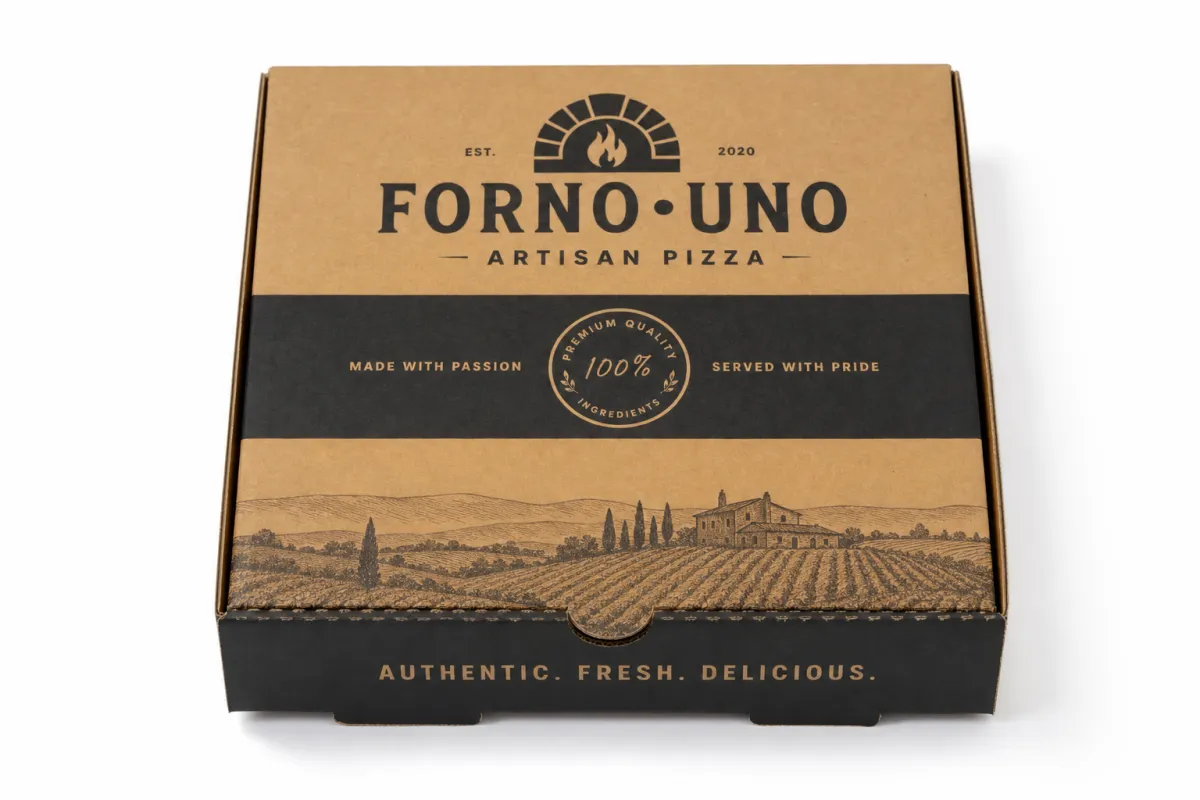
Custom pizza boxes branding turns a short delivery window into a brand display that keeps working after the order is placed. The box shows up in motion, on apartment counters, in office break rooms, at kitchen tables, and sometimes in social posts before the lid opens. In practical terms, it extends the brand's reach without another ad placement. The audience is already hungry, already engaged, and already focused on the meal.
That matters because customers do not separate packaging from product as neatly as businesses often assume. A box that looks considered tends to make the pizza inside feel better cared for. A box that feels generic can make the meal seem more commodity-like, even when the food is excellent. In that sense, custom pizza boxes branding acts as a signal of consistency, and consistency is one of the most reliable ways to earn repeat business.
There is a difference between printing a logo and building a packaging system. A logo is one signal. A real packaging system uses color, typography, iconography, structure, and copy to tell the same story on every order. That repetition is what gives branded packaging memory. One bold graphic can help, but disciplined repetition does the heavy lifting.
A plain box says "delivery complete." A branded box says "this was considered."
From a sales standpoint, the return is subtle and real. A well-designed box can make a shop look more premium, support a higher perceived value, and improve the unboxing experience without adding labor or ingredient cost. That is rare in food service, where most upgrades are expensive or difficult to execute. Custom pizza boxes branding gives operators a visible, repeatable, relatively affordable tool compared with most front-of-house changes.
The alternatives matter too. UnBranded Product Packaging can work if the business is purely transactional and built around price. Once the goal shifts toward a stronger identity, a slightly higher ticket, or more repeat visibility, the box starts doing strategic work. Operators who treat custom pizza boxes branding as a real brand asset usually get more value than those who see it as a box line item.
For teams comparing formats and packaging styles, Custom Packaging Products can help frame the broader choices around pizza boxes, carryout cartons, and related Retail Packaging Needs.
The smartest pizza brands often treat the box like a small billboard with strict limits. It is not the place for every slogan, every claim, and every promotion. It is the place for one clear story. That story may center on hand-stretched dough, local ingredients, late-night delivery, or family recipe roots. Whatever the message, custom pizza boxes branding works best when it can be understood in a few seconds.
How Custom Pizza Boxes Branding Works in Practice
Custom pizza boxes branding usually works in layers. The first layer is the structure itself: size, board type, venting, and fold style. The second layer is the exterior graphics, where most brands place the logo, key colors, and the main message. The third layer is the interior, which can hold a thank-you note, social handle, coupon code, or a campaign-specific line. A fourth layer is optional but increasingly useful: QR codes, seasonal artwork, or location-specific messaging that gives the packaging a second job after the meal is served.
Print method matters more than many first-time buyers expect. Flexographic printing is often the practical route for larger runs because it is efficient and works well with simple color setups. Litho-lam can suit projects that call for sharper image quality or a more refined presentation. Digital printing can make sense for smaller runs, test batches, or short promotional runs. Custom pizza boxes branding is not one production path; it is a set of choices shaped by volume, budget, and the amount of visual detail the operator actually needs.
The design has to respect the realities of the box. Fold lines interrupt artwork. Stacks hide side panels. Low light flattens color contrast. Delivery bags add heat and humidity. If a design only looks good on a flat mockup, it may fail once it leaves the studio. Good custom pizza boxes branding accounts for the fact that the lid will often be seen at an angle, in a hallway, while someone is holding a phone in one hand and the pizza in the other.
Hierarchy carries more weight than most people think. A logo should usually have one clear placement. A headline should be short enough to read instantly. Support copy should stay secondary instead of competing with the brand mark. Strong contrast helps. So does white space. Busy artwork may feel energetic on a screen, but on a warm, folded carton it often reads as clutter. Product packaging does its best work when clarity wins.
Operational details shape the final result too. Grease resistance, heat retention, and condensation can affect how print holds up. Stacked boxes may scuff. The bottom panel may rub. Staff may grab the box by the edges rather than the center. Small things like those determine whether the branded box arrives looking clean or looks worn before the customer opens it. Custom pizza boxes branding only pays off when the print survives the trip.
Sample review is where experienced buyers catch the problems a PDF cannot show. Type that looked legible on screen may be too small in real life. A color that seemed rich on a monitor may print flatter on corrugated board. A panel that felt roomy in a digital layout may seem cramped once the box is scored and folded. Anyone serious about package branding should treat proofing as the point where the real work begins.
Here is a simple way to think about the workflow:
- Define the box size, target audience, and ordering volume.
- Choose the print method based on budget and artwork complexity.
- Map the logo, message, and support graphics to the box layout.
- Review a dieline or mockup with folds and closures visible.
- Approve a sample and check the print in real light.
For brands that want to connect packaging with promotions, Custom Labels & Tags can add another layer for add-ons, seasonal offers, or limited-time campaigns. That helps when the box carries the core story and the label handles the changing detail.
Key Factors That Shape Custom Pizza Boxes Branding
Size is usually the first branding decision, and it matters for good reason. A 10-inch, 12-inch, or family-size box changes the canvas completely. The logo may need a different scale. A short line of copy may fit neatly on one size and feel crowded on another. Custom pizza boxes branding has to respect proportion, because a premium mark on a tiny lid can feel oversized, while the same mark on a large family box can feel underpowered if it is not given enough room.
Board choice matters just as much. Food-grade corrugated structures are the standard because they handle stacking, heat, and delivery better than lighter packaging. Some brands choose white-lined board for a cleaner print surface. Others prefer kraft or natural brown for a more rustic, artisanal look. Sustainability claims should stay careful and accurate. If a box is recyclable in typical local programs, say so clearly. If the finish or adhesive changes that outcome, it should be checked before launch. Good custom pizza boxes branding never stretches the truth of the material.
Visual hierarchy has an outsized effect on how the box is perceived. High-contrast color combinations usually perform better in dim delivery environments. Large type is safer than delicate script. White space gives the design breathing room and helps the logo stand out. A single focal point often beats a dense collage. In packaging, restraint frequently looks more premium. The job is not to fill every inch. The job is to direct the eye.
Different operators need different branding approaches. A neighborhood shop may want warmth, personality, and local familiarity. A premium pizzeria may want a minimal, design-led box that reinforces craft. A multi-location chain may need consistency, easy printing, and tight control across several sizes. Custom pizza boxes branding can support all three, but the visual language should match the store's position in the market. If it does not, the box feels disconnected from the food, the menu, and the service tone.
| Branding Approach | Typical Features | Best Fit | Relative Cost |
|---|---|---|---|
| Budget | One-color logo, standard box size, minimal copy | High-volume takeout, price-sensitive menus | Lowest setup and unit cost |
| Mid-Range | Two to three colors, stronger hierarchy, side panel messaging | Independent shops, local chains, growing brands | Moderate |
| Premium | Full-panel branding, inside-lid message, specialty finish | Upscale concepts, flagship locations, gifting | Highest |
The table captures the tension behind custom pizza boxes branding: every added visual feature changes cost, lead time, and print complexity. Most brands do not need the most expensive version. They need the version that fits customer expectations, delivery conditions, and margin structure. Strong branded packaging tends to be selective instead of maximal.
Technical constraints deserve attention too. If the box will travel far, the board may need stronger crush resistance. If cheese or steam is a recurring issue, venting and lining choices matter. If the brand wants a glossy finish, it should think through how that finish feels in hand and how it behaves when staff touch it. Custom pizza boxes branding works best when aesthetics and logistics are designed together instead of discussed in separate rooms.
For a grounded view of packaging performance, it helps to look at industry guidance rather than guess. The ISTA testing framework offers a useful way to think about distribution stress, while the EPA provides guidance on materials, waste, and recycling issues that affect packaging choices. Those sources do not design the box, but they keep custom pizza boxes branding tied to real conditions.
Here is the honest version: custom pizza boxes branding is not one decision. It is a chain of choices about message, structure, material, print, and handling. If one piece is off, the presentation weakens. If the pieces line up, the box can make the brand feel larger, steadier, and more deliberate than a plain carton ever could.
Custom Pizza Boxes Branding Cost and Pricing Factors
The most common pricing mistake is asking for a unit price before the print approach is defined. That usually creates confusion. A small run with multiple colors will almost always cost more per box than a larger run with simple artwork, because setup costs have to be spread over fewer units. Custom pizza boxes branding is especially sensitive to order quantity, print coverage, and whether the size uses a standard tool or a custom die. Those details matter more than many buyers expect when they compare quotes.
Setup and unit cost should be separated in every review. Setup may cover plates, tooling, proofing, or digital prep. Unit cost covers the box body, printing, finishing, and packout. If a buyer only looks at the per-box number, they can miss the fact that a modest design change may raise setup costs enough to skew the budget. That is why experienced packaging buyers ask for side-by-side pricing across plain, one-color, and full-brand versions.
Roughly speaking, a simple one-color logo approach usually sits in a lower-cost tier, while a full-panel, multi-color custom printed box program moves higher. Specialty finishing such as matte coating, soft-touch feel, or embossing raises cost again. In practical terms, custom pizza boxes branding can span from a stripped-back economical solution to a premium presentation that supports a higher average ticket. The exact number depends on quantity, board spec, and artwork coverage.
Here is a useful comparison of common approaches:
| Option | Design Features | Typical Cost Driver | Where It Works Best |
|---|---|---|---|
| One-color logo box | Simple mark, limited coverage | Lower setup, efficient production | Routine delivery orders, value menus |
| Full-panel branded box | Large print coverage, stronger visual impact | More ink, more prep, more attention to print control | Local recognition, premium positioning |
| Inside-lid print | Secondary message, QR code, social prompt | Additional print area and production steps | Social sharing, repeat-order campaigns |
| Premium finish | Matte, embossing, specialty texture | Material and finishing complexity | Flagship stores, gifting, high-end brand identity |
There are practical ways to control spend without weakening the brand. Simplify the palette. Standardize the box size across the menu where possible. Batch orders instead of placing several small rush runs. Reserve premium treatments for the boxes customers see most, such as large pies, best-selling menu items, or flagship locations. Custom pizza boxes branding does not need to be extravagant to be effective. It needs to be coherent.
Artwork efficiency can also change the budget. High coverage can look dramatic, but it may not be necessary if the logo, type, and color system are already strong. In some cases, a restrained layout with a single bold mark produces a more premium effect than a busy full-bleed design. That is especially true for brands balancing custom pizza boxes branding with margin discipline. The least expensive box is not always the best value, and the most ornate one is not automatically the smartest choice.
Material and sustainability claims can affect perceived value too. A box made from recycled content or FSC-certified material may support the brand story, but only if the supply chain documentation is in order. If a business makes environmental claims, it should verify them carefully and stay consistent with the material specification. For more context on responsible fiber sourcing, the FSC site is a practical reference point. That kind of discipline protects trust, which sits at the center of any branded packaging program.
One more practical note: quotes should be compared on the same basis. Same box size. Same print colors. Same board. Same finish. Same shipping terms. If those elements shift, the numbers are not truly comparable, and custom pizza boxes branding decisions get distorted by hidden differences. That sounds simple, yet it is where many packaging projects drift off course.
Step-by-Step Timeline for Custom Pizza Boxes Branding
A strong timeline starts with discovery, not artwork. Before anything is drawn, the team should define the audience, the role the box plays in the customer journey, the menu items it will support, the box sizes required, and the budget ceiling. That brief gives custom pizza boxes branding a real target. Without it, design becomes subjective too quickly and approvals drag.
Design development comes next. This is where logo placement, hierarchy, copy length, and the color system are translated onto a dieline. Mockups should show the box folded, stacked, and viewed from typical delivery angles. If the artwork only makes sense in a perfect front-on render, it probably needs more work. Strong custom pizza boxes branding survives a messy real-world view because the essentials are unmistakable.
Proofing is where many teams save money by spending a little more time. A digital proof can catch obvious layout issues, while a physical sample often reveals the problems that matter most: color shift, type size, line weight, and spacing around folds. It is common for a box to look clean on screen and crowded in hand. That is not a failure. It is proof that the sample stage is doing its job.
Approval and production scheduling follow. Lead times vary with print method, quantity, board availability, and whether the box requires a custom die. For many standard jobs, design and proofing may take a few days to a couple of weeks, and production can add more time depending on volume. From brief to delivery, a realistic project often runs long enough that anyone planning a menu launch should leave buffer room. Revisions, paper availability, shipping delays, and seasonal demand can all shift the schedule.
Typical project flow
- Brief and goal setting.
- Structural selection and dieline review.
- Artwork setup and initial proof.
- Sample review and print correction.
- Final approval, production, and delivery.
If a business is running a promotion or opening a new location, the safest move is to back-plan from the launch date and work backward with a contingency window. Custom pizza boxes branding is not the place to assume every step will happen instantly. Small delays can be absorbed. Bigger ones can derail a launch.
Operational coordination matters here too. Staff need to know where the boxes will be stored, how they will be folded, and whether a new size changes packing speed during rush periods. A stronger design that slows the line creates a hidden cost. Good packaging design supports the kitchen instead of getting in its way.
For teams that want to compare options before rollout, Case Studies can help show how other brands handle branded packaging, launch timing, and format changes. It is often easier to learn from what has already been tested than to guess at the finish line.
Common Mistakes in Custom Pizza Boxes Branding
The biggest mistake is treating the lid like a billboard and packing it with too much information. When a box tries to say everything, it usually says nothing clearly. The customer sees clutter instead of confidence. In custom pizza boxes branding, one strong message and one supporting proof point often outperform a dozen competing claims. That applies whether the message is about heritage, quality, speed, or local sourcing.
Another common problem is designing for a perfect mockup rather than a real delivery box. A greasy, warm, stacked carton behaves differently from a clean render. Colors can dull. Fine lines can disappear. Contrast can fail in low light. If the artwork was built only for a marketing deck, the final box may look underwhelming in the hand. Packaging buyers should insist on judging the sample in conditions close to the real customer experience.
Trendy design can backfire when it clashes with the rest of the brand. If the box feels playful but the restaurant interior is refined, or if the website is minimal but the carton is loud, the customer experiences a split identity. That weakens recognition. Custom pizza boxes branding should reinforce the store's overall tone instead of creating a separate personality that disappears after one campaign.
Operational mistakes can be just as costly as design mistakes. Choosing the wrong box size can waste board or compress the pizza. Ignoring supplier reliability can lead to shortages. Forgetting that staff need to assemble boxes quickly can create friction during peak service. A beautiful design that slows the team is not a win. It is a hidden expense. The best branded packaging programs fit the actual flow of the kitchen.
- Keep the main message visible from a distance.
- Use typography that stays readable when the box is handled quickly.
- Test the box with grease, heat, and stacking pressure before full rollout.
- Confirm that the brand tone matches the menu and the customer experience.
- Check supplier lead times before tying the box to a launch date.
There is also a habit of treating custom pizza boxes branding as a one-time project. That can work for some operators, but most brands benefit from periodic review. Menu changes, new locations, and updated promotions create openings to refine the box. The goal is not constant redesign. The goal is to keep the packaging aligned with the business as it grows.
The most expensive mistake is often not the print cost. It is the missed chance to make the box memorable. A bland carton may move product, but it does not build recall. In a crowded market, recall has value.
Expert Tips and Next Steps for Custom Pizza Boxes Branding
The strongest custom pizza boxes branding usually follows one simple rule: one dominant message, one supporting proof point. That might mean a logo paired with a short quality statement, or a brand mark paired with a single local-ingredient cue. If the box is asked to do too much, it becomes noisy. If it says too little, it blends in. The sweet spot is clear, fast, and easy to remember.
Design for the whole journey, not only the moment the box lands on the table. People see it in delivery, during the unboxing experience, while eating, while storing leftovers, and sometimes when they open the fridge the next day. A back panel or inside-lid line can work harder than the front. A second message can be a thank-you, a social prompt, or a reminder to reorder. Small additions like that give the brand another chance to stay in mind.
Testing a small pilot run is one of the best ways to tell whether the redesign is doing its job. Compare the new box against the current one. Watch for repeat orders, customer comments, social mentions, and staff feedback. Ask drivers whether the box holds up in transit. Ask the team whether assembly time changes. Custom pizza boxes branding should be measured with real signals, not only aesthetics. Otherwise it is just a pretty mockup, and that is kinda a waste of time and budget.
Here are a few practical next steps that work well in the field:
- Audit the current box and list what it communicates now.
- Request samples in the exact size and board you plan to use.
- Choose one pilot size or one location for the first run.
- Set a review date after launch to compare performance.
- Track a small set of outcomes for at least several weeks.
If the goal is to build stronger package branding without overcomplicating production, the smartest move is often to start modestly and refine from there. That could mean a cleaner logo layout now and inside-lid printing later. It could also mean a limited premium version for the highest-volume box size. The aim is to build a repeatable system, not a one-off stunt. Custom pizza boxes branding works best when it is consistent enough to become familiar and flexible enough to improve.
For teams planning a broader packaging rollout, the next logical step may be pairing the box program with related materials that keep the visual system unified. That is where Custom Packaging Products, Custom Labels & Tags, and coordinated sleeves or inserts can support the same identity across the order. The result is not only a better-looking carton. It is a more coherent retail packaging experience.
Practical takeaway: audit the current box, request a sample in the exact board and size you plan to run, and pilot one version before changing the whole program. Measure repeat orders, customer comments, and staff handling over a few weeks, then adjust one variable at a time. That is the cleanest way to find out whether custom pizza boxes branding is pulling its weight or just looking nice on a screen.
FAQ
What does custom pizza boxes branding usually include?
It usually includes the exterior logo, brand colors, typography, and a short message or tagline. Many brands also add inside-lid copy, QR codes, social handles, or seasonal artwork to extend the experience. Structural choices like box style, finish, and board type can also support the brand story, which is why custom pizza boxes branding often blends design and operations.
How much does custom pizza boxes branding cost per box?
Cost depends on order quantity, print colors, coverage area, board grade, and any specialty finishing. Small runs usually have higher unit costs because setup is spread across fewer boxes. Ask for quotes on plain, one-color, and full-brand versions so the tradeoffs are easy to compare, then judge custom pizza boxes branding against both budget and perceived value.
How long does custom pizza boxes branding take from idea to delivery?
Simple runs can move quickly, while premium multi-color projects usually take longer because of proofing and production steps. Most timelines are split between design approval, sample review, printing, and shipping. Build extra time for revisions if color matching or regulatory details matter, because custom pizza boxes branding tends to slow down when teams skip the sample stage.
Which materials work best for custom pizza boxes branding?
Food-grade corrugated board is the most common choice because it handles heat and stacking well. Choose materials that protect print quality without making the box slippery or hard to recycle. Match the board to pizza weight, delivery distance, and sustainability goals, because material choice affects both performance and the look of custom pizza boxes branding.
How do you know if custom pizza boxes branding is working?
Look for repeat orders, customer comments, social shares, and stronger presentation in delivery photos. Compare current packaging results with a pilot run so the impact is visible instead of anecdotal. Track a small set of metrics for at least a few weeks before changing the design again, and you will get a much clearer read on custom pizza boxes branding.


