Buyer Fit Snapshot
| Best fit | Custom Poly Bags Manufacturer projects where brand print, material claims, artwork control, MOQ, and repeat-order consistency need to be specified before quoting. |
|---|---|
| Quote inputs | Share finished size, material target, print colors, finish, packing count, annual reorder estimate, ship-to region, and any compliance wording. |
| Proofing check | Approve dieline scale, logo placement, barcode or warning zones, color tolerance, closure strength, and carton packing before bulk production. |
| Main risk | Vague material claims, crowded artwork, missing packing details, or unclear freight terms can make a low unit price expensive after revisions. |
Fast answer: Custom Poly Bags Manufacturer: Material, Print, Proofing, and Reorder Risk should be specified like a repeatable production item. The safest quote records material, print method, finish, artwork proof, packing count, and reorder notes in one written spec.
Production checks before approval
Compare the actual filled-product size with the drawing, then confirm tolerance on folds, seals, hang holes, label areas, and retail display edges. Reserve space for logos, QR codes, warning copy, and material claims before decorative graphics fill the panel.
Quote comparison points
Review material grade, print process, finish, sampling route, tooling charges, carton quantity, and freight assumptions side by side. A quote is only useful when the supplier can repeat the same color, closure quality, and packing count on the next order.
Custom Poly Bags Manufacturer: What to Know Before Ordering
Need a Custom Poly Bags manufacturer because stock bags keep showing up too loose, too short, or printed like somebody guessed at the artwork file? That is usually where the real cost starts. Film price is rarely the expensive part; the bag fails because the size, seal, closure, or print spec was off, and now you are paying for damage, rework, or packaging that looks careless on arrival.
I have seen buyers fixate on thickness and miss the bigger issue entirely. A bag can be “heavy” on paper and still perform badly if the width is wrong, the seal is weak, or the closure does not match the product. That kind of mistake is frustrating because it is avoidable, and once a full run is in motion, you are already spending money you will not get back.
What a Custom Poly Bags Manufacturer Really Does
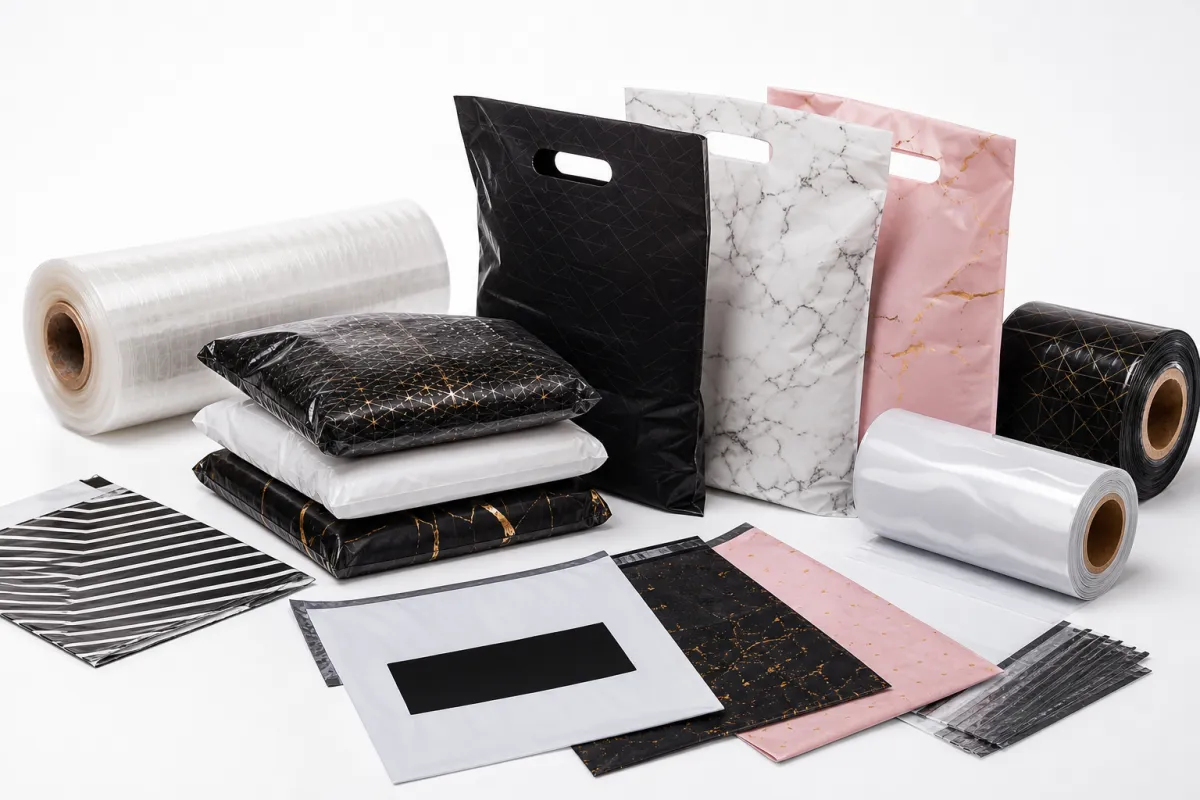
A Custom Poly Bags manufacturer does more than print a logo on plastic and call it finished. The work starts with fit. If a shirt, cable bundle, hardware kit, or promotional set moves around too much inside the bag, the package looks sloppy and the seals take more abuse in transit. If the bag is too tight, the product can crease, catch on the seal line, or puncture the film during packing. That is the part buyers miss when they compare quotes only by film thickness. Thickness matters, yes, but the wrong width or seal pattern can still wreck the run.
Custom poly bags show up in ecommerce apparel, accessories, industrial parts, warehouse protection, sampler kits, and secondary packaging. They are not the same as generic sacks or stock mailers. A stock bag gives you one size, one film, and one closure choice. A custom poly bags manufacturer can match exact dimensions, gusset depth, finish, print layout, and film type to the product. That matters for product packaging, retail packaging, and branded inserts that need to arrive clean and straight.
From a buyer's point of view, working with a custom poly bags manufacturer is about control. You get tighter control over dimensions, film clarity, seal strength, and the look of the print. That is why brand teams often use custom poly bags alongside Custom Packaging Products or pair them with Custom Poly Mailers for shipping. A reseller may be able to sell you bags, but the manufacturer is the one who can actually adjust the spec instead of shrugging at it.
Most mistakes start with the logo instead of the product. A smart custom poly bags manufacturer will ask for item dimensions, packed weight, storage conditions, and how the bag will be used. That is not paperwork for fun. It is how you avoid the expensive version of “close enough.” And yes, close enough is usually not close enough.
The cleanest orders are boring in the best way: exact measurements, clear artwork, one decision path, and no mystery around closure or film grade.
How a Custom Poly Bags Manufacturer Turns Specs Into Bags
A good custom poly bags manufacturer turns a rough idea into a usable production spec before anything gets made. The process usually starts with a quote request, then moves into file review, material selection, print method, production, and final inspection. If the request is vague, the quote is vague. If the spec is clean, the quote is useful. None of this is glamorous, but it saves a lot of annoying emails later.
Material choice is usually the first real decision. Blown film tends to give a softer feel and better puncture resistance, which helps on products with sharp corners or mixed shapes. Cast film usually has better clarity and more consistent gauge control, which is useful for retail packaging and display-driven branded packaging. Virgin resin gives more predictable performance and cleaner appearance. Recycled content can reduce material impact, but the feel, clarity, and odor profile can vary depending on the blend. A capable custom poly bags manufacturer will explain the tradeoffs instead of hiding behind generic “eco” language.
Printing comes next. A simple one-color logo usually holds register better and looks cleaner than a crowded layout stuffed with gradients, tiny text, and five different messages fighting for space. More colors, tighter artwork, and larger coverage all affect setup and cost. That is why a clean design often performs better than a busy one. Packaging design is not just about making a bag look good; it is about making the print readable, durable, and easy to run at scale.
Inspection matters too. A custom poly bags manufacturer will look at seal consistency, film gauge variation, puncture risk, ink adhesion, bag dimensions, and closure performance. If the bag is supposed to be heat-sealed, the seal line has to stay even. If it is a zip or adhesive closure, the closure needs to remain functional after repeated handling. If the job is for shipping, the bag should survive the kind of handling that happens in a real warehouse, not just on a perfect sample table. That is why ISTA testing standards matter, especially for product packaging that has to survive drops, vibration, and compression.
One thing buyers underestimate is how much the spec affects the final presentation. A bag that is too cloudy, too loose, or poorly aligned can make a strong product look cheap. A well-built bag can improve shelf presence without changing the product at all. That is why experienced teams think about package branding and not only the logo. The bag is part of the message.
In production reviews, I have watched a half-inch dimension error turn into a whole pallet of wrinkled packaging. Nobody meant to make a bad bag. The numbers were simply loose enough that the film could not behave the way the buyer imagined. That is why a disciplined spec sheet is worth more than a pretty mockup, even if the mockup looks great in a slide deck.
Key Factors That Change Performance, Appearance, and Cost
The biggest cost and performance swings usually come from material, thickness, size, closure, and print complexity. A custom poly bags manufacturer can build a bag that looks almost identical on paper and still quote it very differently because the underlying resin or print setup changed. Buyers who only compare the headline price usually miss the reason behind the price. That is how people end up with the wrong bag and then act surprised that the wrong bag does wrong-bag things.
Here is the practical version of the material decision:
- LDPE is flexible, soft, and common for general-purpose bags and mailers.
- LLDPE has better stretch and puncture resistance, which helps with heavier or sharper items.
- HDPE is crisp and less elastic, often chosen when a lighter, firmer hand is useful.
- Recycled blends can support sustainability goals, but clarity, odor, and uniformity may vary by source.
Thickness should be chosen based on what the bag actually has to survive, not on the strongest number in the catalog. A lighter gauge may work fine for folded apparel, tissue-wrapped goods, or secondary packaging that sits inside another carton. A heavier gauge is worth paying for when the product has corners, repeated handling, or a route that includes rough transit. Overbuying thickness is wasteful. Underbuying thickness is worse because the savings vanish the moment the first tear shows up on a customer complaint.
Dimensions and closure style change things faster than many people expect. Add a gusset and you improve capacity. Tighten the width and you improve presentation, but maybe lose packing speed. Add venting and you reduce trapped air for bulkier products. Choose a zip lock and you get resealability. Choose a heat seal and you get a cleaner tamper-evident finish. None of those choices are free. Each one affects fit, line speed, or shipping efficiency.
Print choices also shift cost and appearance. One-color printing is usually the simplest path to a sharp result. Full-color work can look excellent, but only if the design is built for the substrate and the print method. Inside printing, outside printing, and reverse print all create different visual effects and different production requirements. A custom poly bags manufacturer will usually tell you that a simpler design is easier to keep consistent across a run. That advice is boring. It is also correct.
Compliance and sustainability deserve a real look, not marketing fluff. If the bag touches food, ask about food-contact suitability. If you need tamper evidence, ask how the closure or seal supports that function. If you plan to make recyclability claims, check the resin type and the regional recycling rules before you promise anything to customers. The EPA recycling guidance is a useful reminder that local recycling access is messy and claims should match the actual end-of-life path, not the brochure version of it.
There is also a practical production detail that rarely gets enough attention: the bag edge and seal geometry. A narrow seal on a thin film may be fine for a lightweight apparel pack, but if the contents have corners or odd pressure points, the same seal can fail early. A good manufacturer will look at the product shape first and then decide whether the print layout, the seal width, or the resin blend needs to change. That’s where the real experience shows up, not in the sales pitch.
| Option | Typical Strength / Look | Best Use | Relative Cost |
|---|---|---|---|
| LDPE, 2-3 mil | Flexible, clear enough, moderate puncture resistance | Apparel, kits, light secondary packaging | Low to medium |
| LLDPE, 3-4 mil | More stretch and tear resistance | Heavier items, sharper edges, shipping bags | Medium |
| HDPE, 1.5-2 mil | Crisp, lighter, less elastic | High-count packing, low-drape retail packaging | Low |
| Recycled blend, 2-4 mil | Variable clarity and hand feel | Sustainability-driven projects, internal packaging | Medium to higher, depending on availability |
The table is only useful if the spec stays the same across quotes. A custom poly bags manufacturer can quote the same bag in two ways and make one look cheaper by quietly changing the film or the gauge. That is why packaging buyers should care about the details behind the number, not just the number itself.
Custom Poly Bags Manufacturer Pricing, MOQ, and Quote Basics
Pricing is driven by more than raw plastic. A custom poly bags manufacturer usually prices on size, material grade, thickness, print colors, order quantity, packaging format, and shipping destination. A larger bag needs more film. A thicker bag needs more resin. More colors need more setup. Fancy finishes and tight tolerances need more control. None of that is mysterious once you break it down, but it gets messy fast when buyers compare an expensive printed bag to a cheap unprinted one and pretend those are the same thing.
For context, a simple printed poly bag might land in the roughly $0.08-$0.20 per unit range at moderate volume, while a more complex printed bag with heavier gauge, tighter tolerances, or special closure features can move into the $0.18-$0.40 per unit range or more. Small orders often cost more per piece because setup and waste get spread across fewer bags. If you are buying 1,000 pieces instead of 10,000, the unit math changes fast. That is not a scam. That is basic production economics.
MOQ means minimum order quantity. Simple enough. The catch is that MOQ changes the whole buying decision. A startup testing a new SKU may not want to sit on 10,000 bags. A seasonal brand may want a smaller run to avoid leftovers after a product update. A larger operation may accept a bigger MOQ if the per-unit savings are worth the storage space. A good custom poly bags manufacturer will explain where the price curve starts to flatten instead of pretending every project needs the same volume.
A real quote should include exact dimensions, film type, thickness, print method, number of colors, closure style, lead time, and shipping terms. If those details are missing, the quote is not comparable. It is just a rough guess with a spreadsheet costume on. Ask for the same spec sheet from every supplier, then compare the numbers on equal terms.
Here is the cleaner way to compare bids:
- Lock the bag size and closure first.
- Choose the material and thickness before asking for pricing.
- Confirm print colors and artwork coverage.
- Ask whether the quote includes tooling, samples, freight, and taxes.
- Request the same incoterms or shipping terms from every supplier.
That last point matters more than most buyers think. A quote that excludes freight can look cheaper until the shipment is on the water or in a truck. A quote that hides tooling or setup fees can also look better than it really is. That is why a custom poly bags manufacturer should be compared on landed cost, not just unit price.
If the bag is part of a larger branded packaging program, ask whether the supplier can also support related items like custom printed boxes or other Custom Packaging Products. Coordinating several pieces through one packaging partner can simplify artwork management and reduce the odds of different materials fighting each other visually. Not always, but often enough to be worth asking.
One more practical note: if a quote comes back much lower than the others, check whether the supplier quietly changed the film grade, the closure type, or the print coverage. A low quote can be real, but it can also be a different product dressed up to look familiar. That’s the sort of detail that bites after approval, not before.
Custom Poly Bags Manufacturer Process, Timeline, and Lead Time
The typical process is straightforward, but only if the buyer sends useful information. A custom poly bags manufacturer usually follows this sequence: brief, quote, proof or sample, approval, production, quality check, packing, and shipment. The whole thing can move quickly if the artwork is ready and the spec is locked. It can also drag if the buyer keeps changing size, color, or closure after the proof stage. People do that, then act confused when the schedule slips. Production is not telepathy.
For timing, simple unprinted or stock-like jobs may move in a few business days once the order is confirmed. Custom printed runs often need 12-20 business days after proof approval, depending on the print method, quantity, and film availability. If the job needs a custom die, special ink matching, or a more exact finish, the timeline can stretch. Transit time is separate from production time. That sounds obvious, but it gets mixed up constantly, and the factory ends up blamed for a shipping lane.
Where do delays happen? Usually in the same predictable places: artwork changes, unclear specs, color matching, raw material shortages, and last-minute quantity changes. A custom poly bags manufacturer can work quickly when the file is clean and the decision maker answers fast. Slow approvals cost more than many buyers realize because the schedule does not wait politely while ten people debate logo placement.
There is a practical way to shorten lead time without cutting corners:
- Send exact dimensions instead of approximate guesses.
- Provide final artwork in vector format, ideally AI or PDF.
- Include Pantone references if color matters.
- Approve samples and proofs in one pass whenever possible.
- Avoid design edits after production starts.
That last one seems obvious until it happens. The best orders are the ones where the buyer and the custom poly bags manufacturer agree on the details before any resin gets processed. If your project is tied to a launch or season, build in extra time for proofing, rework, and freight. A brand release that depends on packaging should not be scheduled like a last-minute grocery run.
For companies that are ordering packaging across multiple formats, it helps to keep a single spec document for the whole family. That can include bags, mailers, inserts, or outer cartons. About Custom Logo Things can give you a feel for how a packaging partner thinks about the mix between branded packaging and production reality. Good planning saves more time than frantic follow-up emails ever will.
And if you are doing this for the first time, do not try to solve every variable in one step. Pick the product fit first, then the closure, then the print. That order keeps the project from turning into a guessing game. It also makes the supplier’s job a lot easier, which usually means better answers and fewer surprises.
Common Mistakes Buyers Make With Poly Bags
The first mistake is choosing thickness before the product. A custom poly bags manufacturer should hear about weight, shape, edge sharpness, storage conditions, and shipping method first. A 2 mil bag might be fine for folded garments, but not for a metal part with corners. A 4 mil bag may be overkill for light apparel and just adds cost. The film spec should solve the actual problem, not the imagined one in somebody’s head.
The second mistake is measuring badly or not measuring at all. A few millimeters off can turn a tidy pack into a wrinkled mess. If the product has a gusseted fold, an insert card, or a multi-piece bundle, measure the packed form, not just the bare item. A custom poly bags manufacturer can work with tight dimensions, but only if the numbers are real.
The third mistake is sloppy artwork. Missing Pantone references, tiny text, low-resolution logos, and vague placement notes all create avoidable print problems. Print files are not the place to improvise. They are the place to be annoyingly clear. If the artwork is going on multiple packaging pieces, keep the visual language aligned across the bag, the insert, and any custom printed boxes. That consistency helps package branding more than another decorative flourish nobody asked for.
The fourth mistake is chasing the lowest unit price and forgetting the rest of the bill. Freight, tariffs, tooling, setup fees, and packaging format all affect landed cost. A custom poly bags manufacturer can quote a low base price, but if the freight is ugly or the minimum is too high, the deal stops being attractive very quickly. Cheap on paper is not cheap when it lands in your warehouse.
The fifth mistake is skipping sample approval. A sample or production proof is not busywork. It is the checkpoint that catches dimension drift, color mismatch, seal issues, and print placement errors before the full order runs. Skipping it is fine right up until the first shipment arrives and looks “almost right,” which is industry code for wrong.
There is also a quieter mistake: ignoring how the bag will be used after opening. If customers need to reuse it, a zip closure or stronger film may matter more than the print. If the bag is only for internal sorting, cost and stackability matter more than a glossy finish. A practical custom poly bags manufacturer will ask those questions because the answer changes the spec.
Another one I see a lot is treating the mockup like the final product. A digital proof can hide weak text contrast, odd seal placement, or a logo that sits too close to the edge. The screen version is helpful, sure, but the physical sample is where the real problems show up. That is the moment when a buyer either saves the run or spends the next week explaining why they should have listened sooner.
Expert Tips and Next Steps for Better Orders
The easiest way to improve an order is to build one clean spec sheet and keep it updated. Put the exact bag dimensions, material, thickness, print colors, closure, quantity, and shipping address in one place. A custom poly bags manufacturer can move faster and quote more accurately when there is no scavenger hunt for details. That is not just convenient. It cuts the odds of a bad run.
If the order is high value, brand visible, or dimension-sensitive, ask for a physical sample or production proof. That is especially smart when the bag is part of a larger product packaging launch and needs to match other branded packaging assets. If the bag has to sit beside retail packaging, or inside a kit with inserts, cards, or custom printed boxes, the visual match matters more than people expect. One off-color bag can make the whole set feel off.
Compare suppliers on communication speed, sample quality, and the clarity of their answers. Price matters, sure. It always does. But a supplier who explains tradeoffs clearly is often easier to work with than one who answers every question with “yes” and then surprises you later. Ask whether the custom poly bags manufacturer can help with design placement, material suggestions, or compliance questions. A supplier who notices problems early is worth more than a supplier who only knows how to accept purchase orders.
Here is the practical next-step sequence:
- Measure the packed product, not just the item.
- Choose the material and thickness based on handling and shipping.
- Decide on print colors and artwork coverage.
- Estimate volume and confirm MOQ comfort.
- Request two matched quotes using the same spec sheet.
That last step matters because comparing different specs is how people get burned. If one custom poly bags manufacturer quotes a lighter film or different print setup, the lower price is not a fair comparison. Match the spec first, then compare the real numbers. Simple. Not glamorous. Effective.
For buyers building a broader packaging program, it can help to map bags, mailers, and outer packaging together before placing the order. A coherent packaging design makes the whole shipment feel intentional instead of assembled from whatever was cheapest that week. If you need a partner who understands that distinction, start with a clear brief and ask the supplier to walk you through the tradeoffs instead of just sending a quote and disappearing.
The cleanest takeaway is this: define the packed product first, choose the film and closure second, and only then ask a custom poly bags manufacturer to quote the job. That order protects your budget, improves the fit, and keeps the packaging from becoming the weak link in the process.
FAQ
What should I send a custom poly bags manufacturer for an accurate quote?
Send exact bag dimensions, material preference, thickness, print colors, and total quantity. If the item has odd edges, bulk, or a tricky fit, include a product photo or sample. Add your target deadline and shipping location so the quote reflects real lead time and freight. A custom poly bags manufacturer can quote much faster when the spec is complete.
How do custom poly bags manufacturer prices usually work?
Pricing usually depends on size, film type, thickness, print setup, and order volume. Lower quantities cost more per unit because setup and material waste are spread across fewer bags. A quote that ignores freight, taxes, or tooling is not a real comparison. A decent custom poly bags manufacturer will spell out those pieces instead of hiding them.
What is a normal lead time for custom poly bags?
Simple orders can move faster, but custom printing and proof approval usually add time. Production time and shipping time are separate, so ask for both numbers. Fast approvals and a complete spec sheet are the easiest ways to cut delays. A reliable custom poly bags manufacturer should be able to tell you where the clock is actually running.
What artwork files do custom poly bags manufacturers prefer?
Vector files like AI or PDF are usually the safest choice for clean print output. Include Pantone colors, bleed, and clear placement notes so there is less back-and-forth. Low-resolution files can work as references, but they are not ideal for final production. A good custom poly bags manufacturer will tell you if the file needs cleanup before press.
Are custom poly bags recyclable or eco-friendly?
It depends on the resin, thickness, additives, and local recycling rules. Mono-material options and recycled content can improve the sustainability profile, but claims should be checked carefully. Ask the supplier for material details instead of assuming every bag is curbside recyclable. If sustainability matters, a custom poly bags manufacturer should be able to explain the material instead of waving at it.
If you are ready to order, start with the product dimensions, pick the film that matches the job, and ask for two matched quotes from a custom poly bags manufacturer. That is the cleanest way to avoid waste, protect the product, and get packaging that actually supports the brand instead of fighting it.

