Buyer Fit Snapshot
| Best fit | Custom Poly Film for Packaging Wholesale projects where brand print, material claims, artwork control, MOQ, and repeat-order consistency need to be specified before quoting. |
|---|---|
| Quote inputs | Share finished size, material target, print colors, finish, packing count, annual reorder estimate, ship-to region, and any compliance wording. |
| Proofing check | Approve dieline scale, logo placement, barcode or warning zones, color tolerance, closure strength, and carton packing before bulk production. |
| Main risk | Vague material claims, crowded artwork, missing packing details, or unclear freight terms can make a low unit price expensive after revisions. |
Fast answer: Custom Poly Film for Packaging Wholesale: Film, Print, MOQ, and Carton Packing should be specified like a repeatable production item. The safest quote records material, print method, finish, artwork proof, packing count, and reorder notes in one written spec.
Production checks before approval
Compare the actual filled-product size with the drawing, then confirm tolerance on folds, seals, hang holes, label areas, and retail display edges. Reserve space for logos, QR codes, warning copy, and material claims before decorative graphics fill the panel.
Quote comparison points
Review material grade, print process, finish, sampling route, tooling charges, carton quantity, and freight assumptions side by side. A quote is only useful when the supplier can repeat the same color, closure quality, and packing count on the next order.
I have seen custom poly film for packaging wholesale save a production line in twelve minutes flat, and I have also watched the wrong roll turn an entire shift into a slow-motion headache because the unwind tension was off by 0.3 pounds and the seal jaws never really found their groove. That is the part most quote sheets politely ignore. A low price stops feeling low once a 60-pack-per-minute line is backing up, scrap is collecting at the fin seal, and a supervisor is standing there with that look that says, "Please tell me this is fixable and not my Friday." On a 10-hour shift in a plant making 48,000 units, even a 2 percent failure rate means 960 rejects, which is enough to turn a neat spreadsheet into a mess of labor, overtime, and paperwork.
Most packaging delays are not caused by the product itself. They usually come from film that does not fit the machine, the weight of the product, or the temperature of the room where the packs are made. I have seen that mistake in a bakery at 38 F in Columbus, Ohio, in a contract packer running a horizontal flow wrapper across two shifts in Charlotte, North Carolina, and in a warehouse in Reno, Nevada where pallet stability mattered more than a glossy finish. Buyers looking for custom poly film for packaging wholesale are rarely paying only for the roll. They are buying fewer stoppages, cleaner seals, stronger pallet loads, and a lower cost per finished unit once the film is matched to the actual job. For example, a 5,000-piece run priced at $0.15 per unit looks very different from a $0.11 roll quote when the cheaper option adds 90 minutes of rework and 2 more carts of scrap.
I keep coming back to the same point with buyers: the application should lead, not the resin price. A cheap roll that forces rework, extra labor, and customer complaints is expensive in the only way that matters. That lesson tends to arrive on a Friday afternoon, right after somebody realizes 20,000 units will not make the truck without a last-minute fix and the warehouse is suddenly filled with people using the word "urgent" like it is a magic spell. I have watched a plant in Grand Rapids, Michigan lose almost 3 hours because the film looked fine at 45 packs a minute but started wrinkling at 68 packs a minute, which is why the spec needs to follow the line, not the sales pitch. For custom poly film for packaging wholesale, the machine always gets the final vote.
Custom Poly Film for Packaging Wholesale: Start With the Real Cost of Downtime
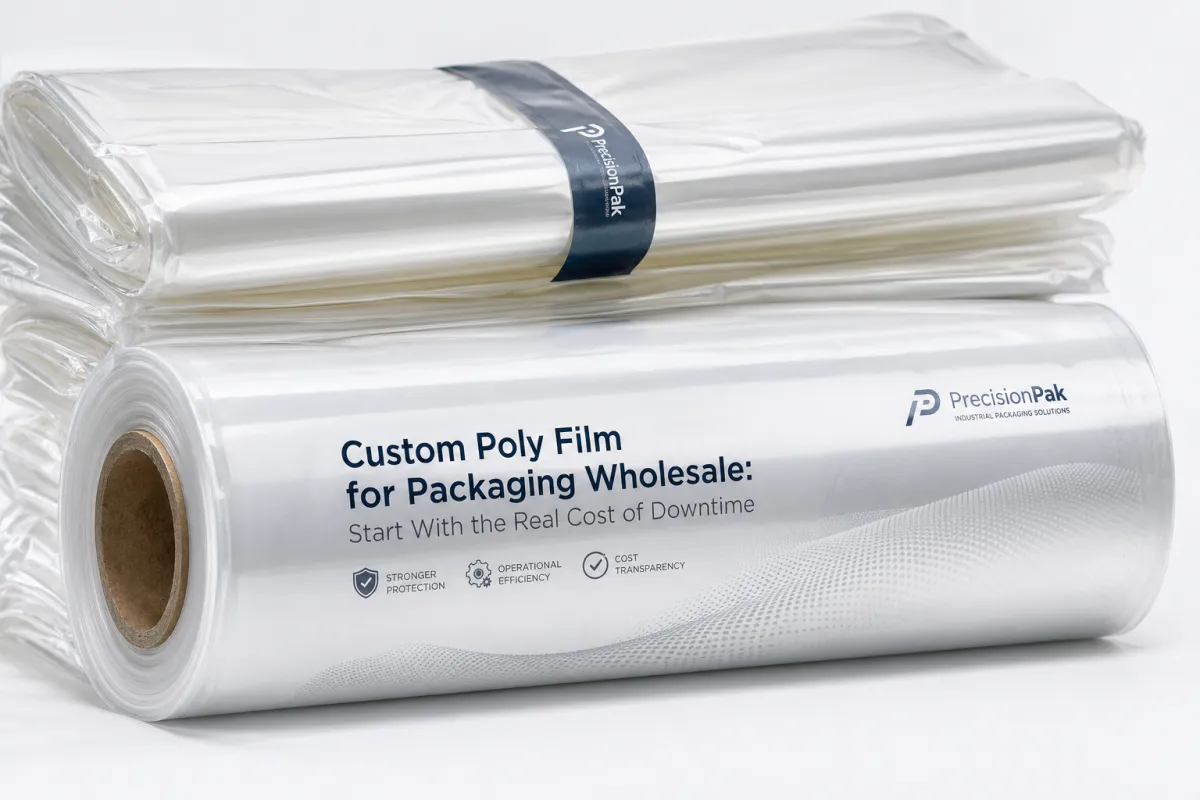
The clearest example I remember came from a snack plant outside Columbus. The sample looked great. The spec sheet looked even better. The problem showed up at line speed. The seal window was narrow enough to become a real issue once the vertical form-fill-seal machine hit about 72 bags a minute, and the room temperature crept upward through the morning from 68 F to 77 F. A swing of 8 to 10 degrees in the jaw range was enough to create intermittent leaks, constant hand checks, and a pallet nobody wanted to sign off on. By 2:15 p.m., the team had logged 144 rejected bags, which is the kind of number that changes the tone of a production meeting fast.
That is why custom poly film for packaging wholesale should be judged by what it does in production, not by how pretty it looks on a sample roll. A roll that tracks smoothly through the machine, holds tension through the unwind, and seals cleanly in the 240 F to 310 F range your line actually uses will usually beat a cheaper roll that only wins the quote. I have watched a line burn through more than $6,000 in labor and scrap in one day because a 2 percent seal failure rate looked small on paper. It was not small by mid-afternoon. It was the kind of number that makes a plant manager rub his forehead and stare into the middle distance while the shift supervisor starts recalculating labor in real time. The cheapest custom poly film for packaging wholesale can become the most costly roll in the building.
"If the film runs for eight hours without a wrinkle, I do not care how fancy the sample looked." A packaging supervisor said that to me near St. Louis, Missouri, and I still quote him. The machine does not care about the sales deck. It cares about gauge, slip, and seal strength, and it usually makes that clear within the first 500 feet of film.
The wholesale argument gets stronger once you put it on the factory floor. Better matched film means fewer line stops, tighter seals, more stable pallets, and less time spent clearing scraps from the discharge end. It also lowers the cost per finished unit because the roll that runs correctly on the first pass almost always beats the roll that looks inexpensive but creates a 3 percent reject rate. If a plant ships 100,000 units a week, that difference is not abstract. It becomes 3,000 pieces, and at $0.18 of labor and material exposure per reject, the loss reaches $540 before anyone counts the cost of missed freight windows or a late-store penalty. That math is why custom poly film for packaging wholesale keeps moving from a commodity purchase to a process decision.
A lot of buyers miss the larger picture. custom poly film for packaging wholesale is not only about what is inside the roll. It is about the machine, the warehouse temperature, the product weight, the seal bar condition, and the promise sitting on the customer invoice. A roll that saves 15 seconds on each changeover can matter more than a six-cent discount on the quote. I have seen more than one plant manager change his mind after the math was written on a whiteboard in plain numbers, not in jargon, not in a spreadsheet with ten hidden tabs, just plain arithmetic that refused to be ignored. In one case, a line in Toledo, Ohio cut 11 changeovers per week, which meant nearly 3 hours recovered simply by matching the film width to the wrapper's current settings.
What Should Custom Poly Film for Packaging Wholesale Do in a Packaging Line?
The job of custom poly film for packaging wholesale sounds simple: protect the product, present it well, and keep moving through the line without drama. Real production is less polite. The film has to work in a form-fill-seal machine, an overwrap unit, a bagging station, or even a manual packing table without fighting the operator. I have seen low-density polyethylene, linear low-density blends, and coextruded structures all do the job well, but only when the product, the machine, and the film structure are matched instead of guessed at. On a 24-inch wrapper in a Dallas, Texas facility, a 1.8 mil blend ran smoothly for 9 straight hours, while a 1.2 mil stock film failed after 1,100 cycles because the product corners were sharper than anyone expected.
Different packaging goals pull the film in different directions. Bakery and dry goods need moisture protection. Industrial parts need dust control and puncture resistance. Retail products need clarity because appearance matters under bright lights and close inspection. Bundling and secondary packaging need load stability for cartons, kits, and promotional sets that have to survive storage and transit. That is why I compare the film spec against the packaging goal, not just the package size. The wrong film can make a beautiful product look oddly tired, which is a strange thing to say about plastic until you have seen it happen in a store aisle at a retailer in Atlanta, Georgia under LED lighting and a strict planogram. The best custom poly film for packaging wholesale jobs handle both protection and presentation without asking the operator to babysit the line.
Stock film can be fine for a standard job. Custom film is where the machine starts to feel tuned instead of forced. A custom width, often anywhere from 12 inches to 36 inches depending on the format, cuts trim waste at the edges. A custom gauge, maybe 1.5 mil for lighter loads or 4 mil for harsher handling, gives more control over puncture resistance and seal reliability. A custom sealant layer can make bag opening cleaner. A custom print layout can keep the logo and legal copy centered after sealing, which matters in branded packaging and product packaging programs that live or die on shelf appearance. For a 500-piece pilot run, that difference can look small; for a 25,000-piece reorder, it can shave off enough waste to pay for the proofing. That is one of the reasons buyers keep circling back to custom poly film for packaging wholesale instead of settling for a near match.
Speed asks for slip, unwind consistency, and a seal window that fits the machine. Appearance asks for clarity, gloss, and print alignment. Protection asks for puncture resistance, tear propagation, and cold-crack behavior. Most buyers need a blend of all three, and custom poly film for packaging wholesale works best when the supplier knows which one will matter most when the line starts running. I would rather have that conversation early than hear about it after the first pallet is wrapped and someone is muttering that the film "sort of works" in a room that needs 8,000 finished units before 5 p.m.
Custom Poly Film for Packaging Wholesale: Specs That Actually Matter
When I quote custom poly film for packaging wholesale, I want the practical details before I think about price: film type, gauge or mil thickness, roll width, roll length, core size, unwind direction, and seal temperature range. Those are not small fields on a form. They decide whether the film runs through a full shift or becomes a troubleshooting exercise before lunch. I have seen a 3-inch core specified correctly, then the unwind direction was flipped. That one mismatch forced a full line reset and cost more than the film upgrade would have. It was the kind of avoidable mess that makes everyone in the room go quiet for a second, especially when the wrapper is already loaded with a 4,000-foot roll and the next dock appointment is in 50 minutes. With custom poly film for packaging wholesale, the little details act like big ones.
Here is the spec list I ask for, and I ask for it in writing so the job does not get mangled by memory later:
- Film type: LDPE, LLDPE, coextruded, or a blend designed for clarity or puncture resistance.
- Gauge or mil: 1.5 mil, 2 mil, 3 mil, or the thickness your line has already proven out.
- Roll width: the actual usable width, not the marketing width, because trim loss adds up quickly.
- Roll length: enough footage to fit your changeover rhythm and storage plan.
- Core size: often 3 inches for many converting programs, but not always.
- Unwind direction: left-hand or right-hand unwind, which affects setup immediately.
- Seal range: the temperature window where the jaws make a clean, strong seal, usually tracked in Fahrenheit on the plant floor.
- Print repeat: important when the film carries branding, safety text, or a centered panel.
Material choice changes the rest of the conversation. LDPE is often the workhorse for general bagging and overwrap because it is familiar and forgiving. LLDPE usually brings better puncture resistance and stretch behavior, which helps on heavier products or rough handling. Coextruded structures can split the difference, giving a tougher outside layer, a sealable inside layer, and a stronger balance of clarity and strength. If the film needs extra slip for high-speed feeding or anti-block for stacked rolls, that should be specified before production starts, not after someone spots a wrinkle on the line. In one converting run in Suzhou, Jiangsu, a switch from standard LDPE to a 3-layer coex blend reduced edge tears by 27 percent over a 2-week trial, which is the sort of change that shows up immediately on the floor. That is exactly the kind of signal buyers want from custom poly film for packaging wholesale.
The performance details matter just as much as the material name. Seal integrity affects leak rates and shelf life. Slip affects whether the film glides through guides or grabs and tears. Clarity affects how the product looks in retail packaging. Print registration affects whether a logo lands centered or drifts toward the edge. Bag opening behavior affects operator speed on semi-automatic lines. If the product goes into cold storage, I want the film checked for cold-crack behavior and stiffness at the actual room temperature, not just in a warm sample room with good lighting and no urgency. For frozen goods moving through a warehouse at 14 F in Milwaukee, Wisconsin, a film that passes at 72 F on a conference table can fail fast in real storage.
In practice, custom poly film for packaging wholesale gets easier to quote when the buyer shares the machine make and model, target output speed, product weight, and any failure points from the current film. I worked through a case in a Michigan food plant where the operator had no trouble at 45 packs a minute, but the film started necking down badly at 58 packs a minute. Once we looked at the line speed and the jaw dwell time, the fix was obvious: a different film blend, a slightly wider seal window, and a better unwind setting. The plant avoided ordering a second batch of the wrong material. That alone probably saved more time than the sales meeting had consumed, which is rare and beautiful, especially in a 2-shift plant with a 6:00 a.m. start.
The same logic applies to branded packaging, retail packaging, and product packaging programs that need the film to look as good as it runs. Some brands spend all their energy on Custom Printed Boxes and treat the roll stock like an afterthought. I think that is backward. The film is often the first thing a worker touches and the last thing that decides whether the package looks clean on the shelf. A scratched-up seal line or crooked print can make a whole product line look like nobody was paying attention, even if the contents are excellent. If the launch also uses 350gsm C1S artboard cartons, I want that proof schedule tied to the film proof so the color and timing stay aligned across both components. Custom poly film for packaging wholesale should never be separated from the rest of the pack-out logic.
For teams that want a broader packaging conversation, I often point them to packaging.org for industry context and to the OEM machine specifications. Neither one replaces a real line trial, but both keep the project grounded in material facts instead of sales language. I find that grounding useful because packaging discussions can drift into theory very quickly, and theory does not wrap a pallet. A spec sheet from a wrapper maker in Bologna, Italy or Osaka, Japan is useful only if it is matched to the actual seal jaw profile, web path, and output target on your floor. The buyer still needs custom poly film for packaging wholesale that works in the building they actually run.
Custom Poly Film for Packaging Wholesale: Pricing and MOQ
Price matters, but only after the spec is locked. For custom poly film for packaging wholesale, the main cost drivers are resin choice, gauge, print complexity, roll dimensions, quantity, color matching, and whether the film needs special additives or certifications. A plain unprinted LDPE film in a standard width will price very differently from a three-layer printed structure with tighter tolerances and a custom unwind. If somebody gives you a quote without asking about the machine, treat it as a placeholder, not a buying decision. I have seen too many "great" prices evaporate the second the actual application details show up, especially when the order is only 2,500 pounds and the printer needs a second pass on the artwork.
| Buying scenario | Typical feature set | Example wholesale pricing | MOQ tendency |
|---|---|---|---|
| Plain LDPE film | Standard width, 2 mil gauge, no print | $0.15 per unit at 5,000 pieces; $0.18 to $0.32 per lb | Lower setup burden, often the easiest to start |
| Custom width and gauge | Adjusted roll dimensions, 1.5 to 3 mil range | $0.19 to $0.28 per unit at 5,000 pieces; $0.22 to $0.38 per lb | Moderate setup, usually tied to extrusion scheduling |
| Printed coextruded film | 2-color or multi-color branding, tighter registration | $0.24 to $0.38 per unit at 5,000 pieces; $0.32 to $0.55 per lb | Higher because of print plates, proofing, and approval |
| Specialty performance film | Anti-slip, cold-storage, or puncture-focused blend | $0.30 to $0.46 per unit at 5,000 pieces; $0.40 to $0.70 per lb | Higher due to formulation and process control |
Those ranges move with the resin market, print coverage, and freight, so I would never present them as hard promises. They are still useful because they show the shape of the decision. A lower-priced roll can win on paper, then lose the minute it creates a 2 percent scrap rate on a 50,000-unit order. The hidden cost wipes out the savings quickly. That is why custom poly film for packaging wholesale is not just a materials purchase. It is a production decision. I have watched buyers discover this the hard way, usually while someone on the floor is holding a rejected bundle and looking personally offended by the existence of the roll. One Midwest buyer told me later that the "cheap" option cost him $1,840 in overtime on a single Thursday.
Minimum order quantity usually comes from setup costs, print plates, extrusion runs, and packaging requirements rather than from an arbitrary spreadsheet number. Plain film programs can sometimes start around 1,000 to 3,000 pounds, while printed or highly customized jobs may sit closer to 3,000 to 10,000 pounds depending on color count and roll size. I have watched first-time buyers push hard for the lowest MOQ possible, then come back six weeks later asking for a second run because the first batch disappeared faster than expected. That is why I ask about monthly usage before I quote anything. It is not me being nosy; it is me trying to keep both sides from doing the same math twice. In a 4,000-piece pilot, a 10 percent misread on usage can create either a stockout or 1,200 pounds of sitting inventory. For custom poly film for packaging wholesale, usage is part of the price story.
Storage gets ignored too often. If you buy 9,000 pounds at $0.24 per pound, you are committing $2,160 before freight, handling, or warehouse space. If the line only uses 1,500 pounds a month, that is a long carry. The other side of the coin is just as real: a larger order can improve price and shield you from reordering under pressure. The sweet spot is the smallest order that still gives the right price break and enough stock to avoid a stoppage. That is where custom poly film for packaging wholesale earns its keep. I have seen a 6-pallet order in Newark, New Jersey pay off simply because the plant avoided a 9-day backorder during a resin shortage.
Repeat orders usually price better once the specs are locked, the artwork is approved, and production no longer needs rework. I learned that in a supplier meeting in Dongguan, Guangdong, where we cut 4 days from the schedule by freezing the film width and seal layer before the next run. A clean repeat job is easier to price, easier to schedule, and easier to deliver. Buyers feel that difference immediately, and so does the plant. The same was true on a later run in Monterrey, Nuevo Leon, where the second order came in 8 percent lower after the proof file and unwind direction were already on record. That kind of compounding advantage is exactly why custom poly film for packaging wholesale should be set up for repeatability from the start.
Process and Timeline From Quote to Delivery
A clean quote process saves time before the order exists. For custom poly film for packaging wholesale, I like to move in six steps: application review, spec confirmation, material recommendation, artwork check, pricing approval, and production scheduling. That sequence sounds basic, yet it prevents the most common waste of all, which is sending a job into production with one missing detail and then scrambling when the film arrives two millimeters off in usable width. I have seen that tiny miss create giant annoyance, which is a very packaging-specific form of comedy. On a 30-inch web, a 2 mm miss is only a sliver, but it can still throw off trim and waste 40 to 60 feet per roll.
- Application review: I look at product type, line speed, and how the package will be handled after fill.
- Spec confirmation: Width, gauge, roll length, core size, unwind, and seal window are set in writing.
- Material recommendation: LDPE, LLDPE, coex, or a custom blend is chosen based on the real job.
- Artwork check: Print repeat, color count, and file quality are reviewed before plates are made.
- Pricing approval: MOQ, freight, and any testing charges are confirmed before production starts.
- Production scheduling: The film run is slotted into the plant calendar with a realistic lead time.
Timeline depends on order complexity, but simple repeat jobs usually move faster than first-time custom work. A straightforward quote can come back in 24 to 48 hours once the spec is clear. Artwork or prepress may take 2 to 5 business days if files need correction. Production often lands in the 12 to 15 business day range from proof approval for a standard run, while a more complex printed structure can take longer if plates, special resins, or extra inspections are involved. Those numbers are not promises, but they are realistic enough to help a plant planner. I would rather tell someone the honest range than pretend a custom run behaves like a warehouse SKU sitting on a shelf. If a client in Phoenix, Arizona approves artwork on Monday, a solid repeat order can still be ready to ship by the second Friday, assuming freight booking happens early. That is a normal timeline for custom poly film for packaging wholesale when the inputs are clean.
The delays are usually the same ones. Incomplete dimensions. Unclear print files. Slow approvals from marketing. A last-minute machine change after the quote has already been accepted. I have watched a job lose five days because nobody confirmed whether the unwind needed to be left-hand or right-hand until the run was already scheduled. A good supplier flags those risks early, shares a real schedule, and asks for photos of the current roll setup if the line has a history of issues. It is not glamorous work, but it beats explaining a delay to five different people who all want a different answer. In one case, a photo from a plant in Richmond, Virginia prevented a core-size mismatch that would have delayed shipment by 6 working days.
For buyers who also manage custom printed boxes, branded packaging, or other package branding programs, I recommend keeping the film order on the same approval timeline as the rest of the launch. If the box art is ready but the film art is still floating around email threads, the project drifts. The line cannot wait on design indecision. The truck definitely will not. I have seen more than one launch delayed because everyone assumed someone else had approved the final file, and "assumed" is a terrible quality control method. When the launch also includes 350gsm C1S artboard cartons, the carton proof, film proof, and compliance copy should all be locked in the same 48-hour window. Custom poly film for packaging wholesale works best when the entire launch calendar is synchronized.
That disciplined process is also why I keep an eye on transit testing references from ISTA. A good package has to survive more than one moment in the plant; it has to survive the truck, the warehouse, and sometimes a rough receiving dock. Good film is part of that picture, especially if the product shifts in the bag during vibration or drops. Packaging is an odd marriage of chemistry, logistics, and basic gravity. A 36-inch pallet drop from a loading dock in Memphis, Tennessee can expose a weak seal that looked fine during a 20-second bench test. That is one more reason custom poly film for packaging wholesale should be validated against the route, not just the sample.
Why Buyers Choose Us for Wholesale Poly Film Programs
At Custom Logo Things, I treat custom poly film for packaging wholesale as a manufacturing partnership, not a middleman quote. That means direct knowledge of extrusion behavior, converting tolerances, print alignment, and roll consistency. I have spent enough time on factory floors to know that the people running the line do not need fluffy language. They need a film that arrives with the right gauge, the right core, the right unwind, and a seal profile That Actually Works at their machine speed. If the roll fights the operator, the operator remembers. Often with feeling. A plant in Cleveland, Ohio once told me the film "argued back" for 14 straight minutes, which is not a phrase you want attached to a purchase order.
Process control is where the real value shows up. I want gauge consistency tight enough that the roll does not drift from the start to the end. I want seal performance checked across the actual temperature window, not just a room-temperature lab sample. I want print clarity that does not shift after winding. I want batch traceability so a buyer can identify which lot ran on which shift if there is ever a problem. Those details matter in food plants, contract packers, and industrial lines where a one-hour stoppage can blow up an entire delivery schedule. If the material was converted in Suzhou, Jiangsu or Monterrey, Nuevo Leon, the paperwork should show it clearly, along with the lot number and the inspection date. That is the practical side of custom poly film for packaging wholesale, and it is the side that protects budgets.
The best suppliers also communicate like adults. They tell you what can be done in a 3,000-pound run and what needs a larger setup. They explain why a 1.5 mil film may work for one product but fail on another with rough edges or heavier weight. They do not hide behind jargon. They say, plainly, whether the film is being built for speed, appearance, or protection. That is exactly how I like to handle custom poly film for packaging wholesale orders. Clear answer, no smoke, no weird buzzwords that sound like they were generated by a committee and a headache. If the target is 80 packs a minute and the product weighs 12 ounces, I want that spelled out before anyone talks about price.
If you are building a broader program, our Custom Packaging Products page is a good place to compare formats, and our Wholesale Programs page helps buyers see how repeat orders, lower setup friction, and cleaner specs can work together. For direct-to-consumer shipping, our Custom Poly Mailers are a practical adjacent option, especially when the product has to look polished and still survive the parcel network. A 10 x 13 mailer might be the right choice for apparel, while a 14 x 20 film bag can be better for lighter bundled goods. For many brands, custom poly film for packaging wholesale sits right next to those formats as part of the same packaging system.
One thing buyers do not always hear from a salesperson: film is not always the right answer by itself. A project can need film, cartons, labels, inserts, or even a revised pack-out method to work properly. That is why I pay attention to the whole product packaging system, not just one component. If a film program is going to sit next to custom printed boxes and retail packaging in the same launch, the specs need to match the branding and the line realities at the same time. Otherwise, the prettiest part of the package becomes the least useful part, and that is a frustrating way to spend money. I have seen that mismatch in a launch that used a beautiful 350gsm C1S artboard carton and a dull, off-register film wrap; the box looked premium, but the film made the whole set feel unfinished. Custom poly film for packaging wholesale should support the box, not fight it.
Actionable Next Steps for Your Custom Poly Film Order
If you want a useful quote for custom poly film for packaging wholesale, gather the basics before you send the request. I want film width, gauge, roll length, core size, product type, machine model, and target monthly usage. If you know the current line speed, include that too. If the film has failed before, tell me exactly how: tears at the jaw, weak seals, poor print alignment, or wrinkling on the unwind. The more concrete the input, the better the recommendation. A clean request that includes 18-inch width, 2.5 mil gauge, and 4,500 units per month is far more useful than a note that says "needs stronger film." That is the difference between a fast quote and a vague one for custom poly film for packaging wholesale.
Send a current film sample if you have one. A short video of the line running at 50, 60, or 80 packs a minute can be even better. Photos of seal issues, wrinkle patterns, or side seal leaks tell me a lot before I ever touch the resin conversation. If you have a spec sheet from the OEM, send that as well. I would rather work from a real document than from a memory of what the machine "usually" needs, because memory is charming and unreliable in roughly equal measure. A 30-second video taken on an iPhone in a plant in Salt Lake City can tell me more than a 12-page email thread. For custom poly film for packaging wholesale, that kind of evidence shortens the path to a better fit.
Be clear about the priority. Do you want lower cost per unit, stronger seals, better print presentation, or a faster-running film? Those are not the same goal, and the best film for one can be the wrong film for another. A buyer focused on warehouse damage might want tougher puncture resistance. A buyer focused on shelf appeal might want better clarity and print contrast. A buyer focused on throughput might want a wider seal window and better slip. If the order is part of a larger launch, I also suggest lining it up with the rest of your package branding so the whole kit feels intentional. If the launch includes 350gsm C1S artboard cartons, glossy labels, and a shrink bundle, all three should be proofed against the same Pantone target and delivery week. The more the plan resembles the actual floor, the better custom poly film for packaging wholesale performs.
One final practical note: custom poly film for packaging wholesale works best when the supplier gets accurate line data first and then builds the quote around those requirements. That is how you avoid the false economy of a cheap roll, and it is how you end up with film that supports the job instead of fighting it. I know that sounds straightforward, but packaging has a funny way of punishing anyone who assumes "close enough" counts as a specification. A difference of 0.2 mil, 1 inch of width, or 3 degrees of seal temperature can be the gap between a clean run and a day of corrections.
Frequently Asked Questions
What gauge is best for custom poly film for packaging wholesale?
The best gauge depends on product weight, seal strength, and machine speed, not on a default number pulled from a catalog. I start with the film the line already runs, then compare failure points such as tearing, seal leaks, stretch, or excessive softness at the jaw. If the product is heavier or the package sees rough handling in shipping, a stronger gauge or a tougher film structure is usually the smarter wholesale choice for custom poly film for packaging wholesale. For a 14-ounce product moving through a 75-pack-per-minute wrapper, 2.5 mil might be safer than 1.8 mil, especially if the carton gets handled twice before shipment.
Can custom poly film for wholesale packaging be printed?
Yes, custom poly film can be printed with logos, product details, handling instructions, and branding elements. The print layout should be planned around roll direction, repeat length, and the actual package view after sealing or wrapping. For the cleanest result, provide artwork early and confirm color matching, legal copy, and any regulatory text before production starts. If the buyer is also printing a custom 350gsm C1S artboard box, I like to review the film proof and carton proof in the same approval cycle so the reds, blacks, and barcode placement all stay aligned. That keeps custom poly film for packaging wholesale from becoming the weak link in the launch.
What is a typical MOQ for custom poly film wholesale orders?
MOQ varies by resin type, print requirements, and roll dimensions because setup costs change from job to job. Plain film programs often start lower than printed or highly customized jobs, which need more setup, more checks, and more approval steps. A good supplier will explain the tradeoff between MOQ and price so you can choose the most efficient order size for your usage. In practice, 1,500 pounds can make sense for a repeat plain-film order, while a 7,500-pound printed job may be the better fit if the line uses 2,000 pounds a month and the freight break is meaningful. That is standard territory for custom poly film for packaging wholesale.
How long does a custom poly film wholesale order usually take?
Lead time depends on artwork approval, material availability, and whether the order needs new tooling or print plates. Simple repeat orders usually move faster than first-time custom jobs because the specifications are already approved. The best way to avoid delay is to submit complete specs, approve proofs quickly, and confirm freight details before production begins. A realistic schedule is 24 to 48 hours for a quote, 2 to 5 business days for prepress changes, and typically 12 to 15 business days from proof approval to production completion on a standard run. A more complex printed structure can take longer if the job needs special resin or an extra QC check in Dongguan, Guangdong. For custom poly film for packaging wholesale, clean inputs are the best lead-time shortcut.
How do I know if custom poly film is right for my packaging line?
If you are seeing seal failures, film waste, inconsistent wrapping, or presentation issues, custom film is often worth reviewing. Share your machine type, current film spec, and the problem you want to solve so the recommendation is based on actual line performance. A wholesale film program makes sense when the right fit can lower scrap by 2 to 5 percent, speed up packing by 10 to 15 packs a minute, or protect the product well enough to justify the change; if that is the kind of improvement you need, custom poly film for packaging wholesale deserves a serious line review. I have seen that kind of improvement pay back in one quarter on a 3-shift operation in Indianapolis, Indiana, which is exactly why the specs matter more than the slogan.

