Buyer Fit Snapshot
| Best fit | Custom Poly Mailers for Clothing projects where brand print, material claims, artwork control, MOQ, and repeat-order consistency need to be specified before quoting. |
|---|---|
| Quote inputs | Share finished size, material target, print colors, finish, packing count, annual reorder estimate, ship-to region, and any compliance wording. |
| Proofing check | Approve dieline scale, logo placement, barcode or warning zones, color tolerance, closure strength, and carton packing before bulk production. |
| Main risk | Vague material claims, crowded artwork, missing packing details, or unclear freight terms can make a low unit price expensive after revisions. |
Fast answer: Custom Poly Mailers for Clothing: Film, Print, MOQ, and Carton Packing should be specified like a repeatable production item. The safest quote records material, print method, finish, artwork proof, packing count, and reorder notes in one written spec.
Production checks before approval
Compare the actual filled-product size with the drawing, then confirm tolerance on folds, seals, hang holes, label areas, and retail display edges. Reserve space for logos, QR codes, warning copy, and material claims before decorative graphics fill the panel.
Quote comparison points
Review material grade, print process, finish, sampling route, tooling charges, carton quantity, and freight assumptions side by side. A quote is only useful when the supplier can repeat the same color, closure quality, and packing count on the next order.
Custom Poly Mailers for clothing sit at a practical intersection that apparel teams feel every day, even if they do not name it that way: freight cost, pack-out speed, and brand presentation all get pulled into the same decision. The package has to do a real job, not just look nice in a mockup. Once order volume rises, the small details start adding up fast, and a mailer that fits a folded tee neatly can reduce void space, trim dimensional weight, and turn the outer package into part of the experience instead of a disposable afterthought.
From a packaging buyer's point of view, the real question is not whether Custom Poly Mailers for clothing look attractive on a sample table. The real question is whether they survive transit, keep fulfillment moving at a steady pace, and support a sensible total landed cost. For a brand shipping soft goods, that tradeoff can be sharper than it first appears: a well-sized mailer often outperforms a box on speed and freight, while a poor fit can cause returns, dented margins, and a customer experience that feels rushed instead of intentional. If you are building a broader packaging system, the wider assortment at Custom Packaging Products and the dedicated Custom Poly Mailers page can help you compare formats without guessing at what will work.
The part many teams miss is that Custom Poly Mailers for clothing are not only a print surface. They are a sizing decision, a film-strength decision, and a fulfillment workflow decision. Get those three pieces aligned and the package feels deliberate from the first touch. Miss them and the mailer starts getting in the way of the operation instead of supporting it. I have seen perfectly solid apparel arrive in a mailer that was just a little too big, and that extra slack made the whole thing feel less careful than it should have.
Why custom poly mailers for clothing can beat boxes
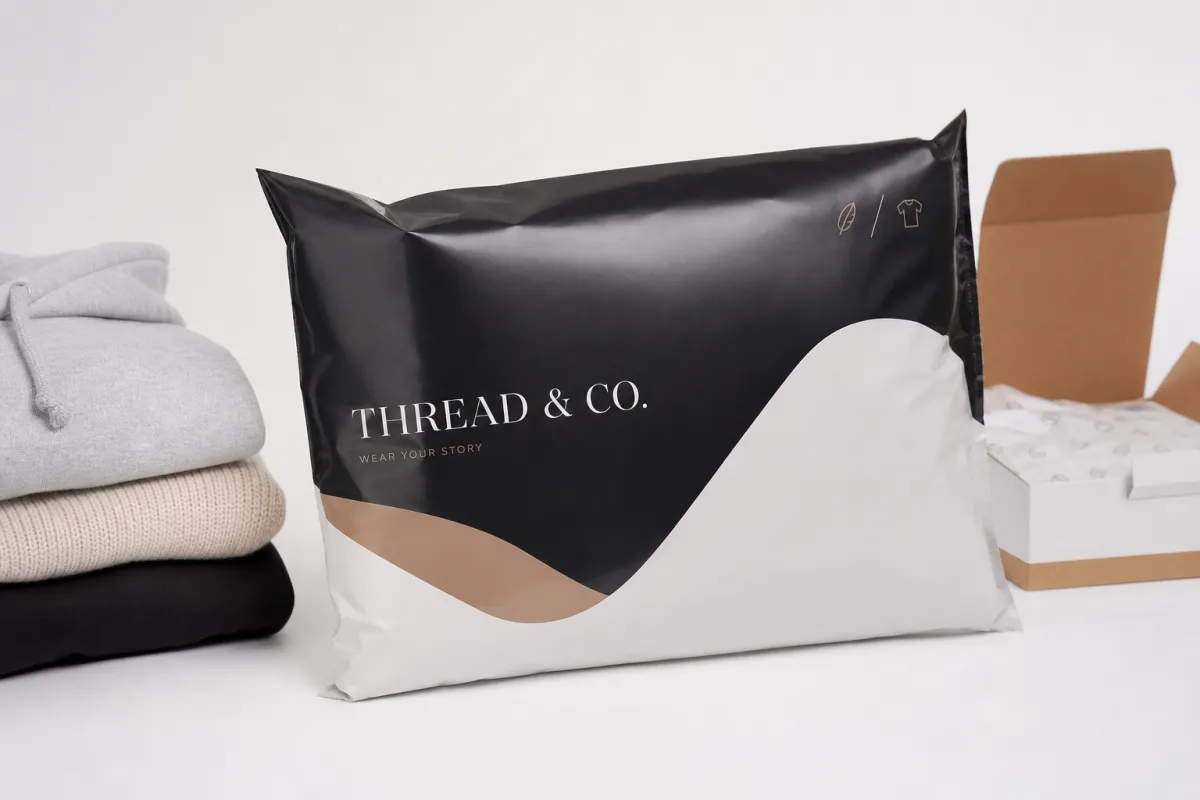
Soft-goods shipping has a quiet inefficiency problem. Many apparel orders leave the warehouse with more air than product, and that empty space turns into higher dimensional charges, more filler, and a less coherent unboxing experience. Custom Poly Mailers for clothing solve that problem in a practical way because the package collapses around the folded garment instead of protecting a rigid cube of unused volume.
For tees, socks, leggings, swimwear, and other flexible items, the mailer often wins on three fronts at once: lower material use, faster pack-out, and a cleaner branded presentation. A box can still make sense for premium kits or mixed SKU orders, but many brands ship everyday apparel in custom poly mailers for clothing because the package is doing less unnecessary work. That matters when margins are tight and shipping surcharges punish avoidable bulk.
There is also a labor angle that gets overlooked. A carton usually asks for tape, folding, assembly, and more handling steps. A mailer usually needs a garment fold, an insert if the brand uses one, and a peel-and-seal strip. Fewer touches per order can matter a great deal when volume spikes on a product launch or a promotion. In practice, the speed difference between boxes and custom poly mailers for clothing can be large enough to show up in labor planning, not just in a spreadsheet. If a fulfillment team is already moving fast, a mailer can shave off enough friction that the whole line feels calmer, which sounds small until you are doing it all day.
The best fit is usually straightforward: everyday e-commerce apparel, subscription apparel programs, influencer drops, sample shipments, promotional bundles, and wholesale-to-retail replenishment where speed matters more than shelf-ready structure. Custom poly mailers for clothing are also useful for return shipments, especially when a brand wants a consistent branded outer package on both outbound and return legs.
“If the product is soft, flat, and repeatable, a mailer usually deserves a serious look before anyone spends money on a heavier carton.”
That does not make boxes obsolete. It means the packaging choice should follow product behavior rather than habit. A rigid carton can improve giftability or protect accessories, but for the average folded apparel order, custom poly mailers for clothing often strike the better balance of cost, speed, and presentation.
How custom poly mailers for clothing work in shipping
At a mechanical level, a mailer is a narrow system built for efficiency. The body is usually a polyethylene film, the seams are heat-sealed, and the closure uses a peel-and-seal adhesive strip. That structure keeps the pack-out simple. Fold the garment, place it inside, remove the liner, press the flap down, and move on. For custom poly mailers for clothing, that simplicity is the whole point.
The protection is basic but useful. Poly film resists light moisture, dust, and abrasion better than a bare paper envelope, and the snug fit helps keep garments from shifting around. That compression matters because a packed shirt or pair of leggings that moves less inside the mailer tends to arrive looking more intentional. The package is not crush-proof, yet it is a smart barrier for the shipping conditions most apparel orders face.
Branding happens on the outer face of the film. Logos, repeat patterns, order messages, social handles, or a small thank-you note can all turn a plain shipping sleeve into branded packaging. In retail packaging terms, the mailer is the first physical touchpoint many customers see, so the print should feel aligned with the rest of the product packaging. Custom poly mailers for clothing do not need loud graphics to work; a strong color field and a sharp logo often outperform a cluttered layout.
There is a production benefit too. Mailers generally pack faster than cartons because the packer is not building a structure. That matters in warehouses where a few seconds per order add up quickly. If your team ships a few hundred orders a day, the difference between taping a box and sealing custom poly mailers for clothing can become very visible in labor minutes.
From a quality standpoint, there are three things to watch closely:
- Seal integrity so the adhesive closes cleanly and stays closed during transit.
- Film thickness so the mailer can handle the product mix without tearing.
- Print placement so branding stays clear after folding, stacking, and palletizing.
For a broader packaging view, ISTA at ista.org shares practical guidance on transit testing and shipping performance, and the U.S. EPA at epa.gov offers useful waste-reduction guidance. Those references matter because good packaging design gets measured in the real world, not just on a mockup screen.
Once you understand the mechanics, custom poly mailers for clothing stop looking like a low-effort option and start looking like a high-fit option. The trick is matching the film, size, and artwork to the order profile instead of forcing the product into a generic shipping format.
Key factors when choosing custom poly mailers for clothing
Most of the mistakes I see with custom poly mailers for clothing start with size. Too small, and the garment gets jammed in or the seal sits under tension. Too large, and the package looks loose, wastes material, and can raise shipping cost. The goal is a snug flat pack that closes easily without stretching the film or creating a bubble in the middle.
A practical approach starts with the folded dimensions of your core SKUs. Measure a folded tee, a hoodie, a legging set, and any bundle combinations that ship often. Then choose a mailer size that gives a little working room without turning the mailer into a pouch. For brands shipping mixed apparel assortments, custom poly mailers for clothing should be selected against the worst-case common order, not the easiest single item.
Film strength and product mix
Film thickness is often discussed in mils or gauge, and the right spec depends on what is inside the mailer. Lightweight tees may ship well in thinner film, while jeans, heavy knits, or orders with hard corners can justify a sturdier build. If the product mix includes sharper accessories, better seam strength matters more than a glossy printed finish. In real terms, custom poly mailers for clothing should be matched to the heaviest likely shipment, not the average order if the average hides occasional problems.
There is no prize for using the thinnest film available. A failure in transit is far more expensive than a slightly heavier mailer. Ask for tear resistance data, puncture behavior, and adhesive performance under handling. If the supplier can share test references or sample results, even better. That kind of documentation helps separate a nice-looking proposal from a package that actually survives shipping.
Print strategy and brand clarity
Print coverage changes both cost and perception. A one-color logo on a neutral base can feel sharp and premium. A full-wrap print can look bold, but it may raise setup complexity and make color matching harder. For many apparel brands, the best package branding is memorable rather than loud. Custom poly mailers for clothing can carry strong visual identity with surprisingly few ink passes if the layout is disciplined.
That is especially true for startup labels and DTC brands that want branded packaging without drifting into expensive custom printed boxes too early. Mailers let a brand build recognition quickly, then refine the visual language later. A repeat pattern, a logo lockup, or a subtle all-over brand mark can be enough to make the parcel feel intentional.
Sustainability tradeoffs
Poly mailers are often criticized on environmental grounds, but the conversation becomes more useful once it gets specific. Right-sizing usually cuts waste more effectively than adding decorative features. A smaller, lighter mailer can reduce material use and shipping space at the same time. Some suppliers offer recycled-content films or recyclable options depending on local infrastructure. The honest answer is that sustainability depends on the actual material, the route, and the disposal stream.
The U.S. EPA offers practical guidance on waste reduction and packaging choices at epa.gov. That broader view matters because environmental performance is not one single metric. It is material weight, transport efficiency, and end-of-life behavior working together. For custom poly mailers for clothing, a smaller package with fewer grams of plastic can be a smarter environmental decision than a larger decorative format that impresses on day one and wastes space every day after.
Use this quick checklist before ordering:
- Confirm folded garment dimensions for the most common SKUs.
- Check closure margin so the adhesive seal is not stressed.
- Match film thickness to product weight and sharpness.
- Decide how much of the surface should carry artwork.
- Compare recycled-content or recyclable options where available.
Good custom poly mailers for clothing should feel almost boring in operation. That is a compliment. The ideal mailer disappears into the workflow, protects the product, and still carries enough identity to make the customer remember the brand.
Custom poly mailers for clothing process, timeline, and lead time
The ordering process works better when the brand does a little homework first. Before asking for pricing on custom poly mailers for clothing, gather the key variables: garment dimensions, average order weight, print artwork, color references, and any packing constraints. If your operation uses tissue paper, inserts, or a barcode label, include that too. A supplier can only spec the right mailer when the pack-out is clear.
Proofing usually comes next. Most vendors prepare a digital mockup that shows logo placement, print boundaries, and overall size. That proof is useful, but it is not the same as seeing the mailer in hand. A logo can look centered on a screen and sit too close to the fold once the film is sewn and sealed. For that reason, many teams ask for a physical sample before moving to production on custom poly mailers for clothing.
Sample review is worth the extra time. A mailer can behave differently when folded, stacked, shipped, or filled. The film may feel thinner than expected. The flap may close better than expected. The print may shift a few millimeters. Those details matter because they affect how the package feels at pack-out and how the final parcel survives transit. A sample also gives the warehouse team a chance to say, in plain language, whether the thing is actually gonna work on the line, which is better than discovering the problem after a full run arrives.
After approval, the job moves into print production, then quality checks, then bundling and cartonization for freight. Depending on the supplier, the film may be printed, cured or dried, slit, cut, sealed, and packed into shipping cartons. Larger or more complex orders take longer. If you add double-sided print, specialty finishes, or multiple sizes in one order, the lead time usually stretches.
For typical planning, simple reorders can move faster than first-time custom work. First orders often take longer because proof approval, sample review, and packaging coordination add steps. Many apparel buyers treat custom poly mailers for clothing as a two-part timeline: production time and shipping time. That distinction helps avoid surprises. A six-day production promise does not mean the warehouse will see cartons in six days.
A realistic workflow looks like this:
- Discovery: gather specs and usage data.
- Proof: review digital artwork and sizing.
- Sample: validate fit and feel.
- Production: print, cure, inspect, and pack.
- Freight: ship cartons to the distribution point.
If the timeline matters because a product launch is fixed, build buffer time into the order window. For custom poly mailers for clothing, the safest calendar assumption is often longer than the most optimistic quote. That is not pessimism. It is simply how packaging production behaves once artwork, freight, and inventory planning all enter the same equation.
Custom poly mailers for clothing cost, pricing, MOQ, and quote strategy
Price is where a lot of packaging conversations get distorted. A quote for custom poly mailers for clothing can look inexpensive until the buyer notices the hidden variables: size, film thickness, number of colors, print coverage, quantity, freight, and setup charges. The right comparison is not the lowest number on the page. It is the lowest total cost for the same spec.
As a working range, small to mid-volume apparel runs often land somewhere around $0.09-$0.30 per unit, depending on size, print complexity, and order quantity. That is a broad range by design because a one-color 5,000-piece reorder and a full-coverage first run are not the same product. For many buyers, custom poly mailers for clothing become materially cheaper at higher quantities, but only if storage and cash flow can support the buy.
MOQ matters because it affects both unit price and inventory exposure. A higher minimum order quantity can lower the per-unit cost, but it also ties up space and capital. If your brand ships in bursts, overbuying mailers can create dead stock. If your order pace is stable, a larger MOQ can make sense and improve consistency. The right decision depends on sell-through, not just discount math.
There are also cost drivers that are easy to miss:
- Setup or plate fees for print preparation.
- Freight charges from the manufacturer or converter.
- Rush fees if the timeline is compressed.
- Special finishes such as matte, glossy, or metallic accents.
- Spoilage risk if the order is larger than demand.
Ask for quotes on identical specs. Same size. Same thickness. Same print sides. Same quantity. If one vendor prices 10 x 13 mailers and another prices 12 x 15, the comparison becomes misleading fast. That sounds obvious, yet it is one of the most common mistakes in packaging purchasing. Custom poly mailers for clothing only compare cleanly when the measurement basis is disciplined.
| Mailer option | Typical use case | Approx. unit price at 5,000 pcs | Notes |
|---|---|---|---|
| Plain poly mailer | Low-cost fulfillment, non-branded shipments | $0.09-$0.14 | Fast to source, but no package branding |
| Single-color custom mailer | Core apparel orders, steady branding | $0.14-$0.22 | Good balance of cost and identity for custom poly mailers for clothing |
| Full-coverage printed mailer | Launches, campaigns, strong visual branding | $0.18-$0.30 | Higher print cost, more visual impact |
| Recycled-content custom mailer | Brands with stronger sustainability messaging | $0.16-$0.28 | Material claim depends on supplier documentation |
| Premium heavy-gauge mailer | Denim, knits, multi-item bundles | $0.20-$0.32 | Better durability, usually higher freight weight |
Look at landed cost, not just factory cost. A cheaper quote can become expensive once freight, reprints, and order delays get added. That is especially true for custom poly mailers for clothing, because a weak print or flimsy film can force a second buy much sooner than planned. The cheapest package on paper is not always the cheapest package in operation.
A practical quote request should include the following:
- Mailer size and flat dimensions.
- Film thickness or gauge target.
- Print location and color count.
- Quantity by SKU.
- Ship-to location and freight preference.
Handled this way, custom poly mailers for clothing become a controlled purchase instead of a guess. That alone can prevent a lot of expensive revision cycles.
Common mistakes with custom poly mailers for clothing
The first mistake is ordering the wrong size. A mailer that is too tight can stress the seal and slow down packing. A mailer that is too large can make the order look sloppy and increase shipping cost. I see this often with brands that scale up from tees to heavier items without revisiting the spec. Custom poly mailers for clothing should evolve with the product mix, not stay frozen after the first run.
The second mistake is trusting a mockup too much. Artwork that looks balanced on screen can shift in production. Logos near the fold line may become harder to read. Small type can disappear when the film curves around the folded garment. The fix is simple but often skipped: review an actual sample and check the print where the customer will see it.
The third mistake is ignoring product mix changes. A mailer that is perfect for T-shirts may fail once hoodies, sweaters, denim, or bundled accessories enter the catalog. If the brand starts shipping thicker items without adjusting film thickness, custom poly mailers for clothing can begin to tear at the edges or under seal tension. That is a packaging failure, but it is also a forecasting failure.
The fourth mistake is spending money on visual complexity that does not improve the buyer experience. A busy graphic can look energetic in a design review and still do very little on the porch. What usually matters more is a sharp logo, clean color control, and a package that feels deliberate. In branded packaging, restraint often reads more expensive than clutter.
“A mailer should make the order easier to ship and easier to recognize. If it only does one of those, the spec probably needs another pass.”
The fifth mistake is skipping transit testing. If the warehouse ships through humid routes, long zones, or rough carriers, the mailer should be tested under realistic handling. Simple drop tests, compression checks, and seal checks can reveal problems before the order reaches customers. For custom poly mailers for clothing, a short validation cycle is far cheaper than a replacement run.
Another missed issue is over-ordering because the price break looks attractive. Inventory can look cheap until it sits for months. Packaging has a shelf life in the sense that the business can outgrow the design, the logo can change, or the SKU mix can shift. The goal is not to buy forever. It is to buy enough.
One more practical warning: never let the artwork area conflict with the seal area. The flap has to close cleanly. If a design lands too close to the edge, the result can feel unfinished or, worse, interfere with adhesion. That kind of mistake is frustrating because it is avoidable with one careful proof review.
Expert tips and next steps for custom poly mailers for clothing
If you want a smarter order, start with a small test matrix. Compare two or three sizes, two film strengths, and one or two print directions. That gives you real data without locking into a large purchase too early. For many teams, custom poly mailers for clothing improve noticeably after the second round because the first round exposes the hidden fit issues.
Build a packaging spec sheet and keep it current. List the garment types, folded dimensions, average weights, adhesive requirements, and approved artwork placements. Add notes for inserts, stickers, or returns processing if those matter to the operation. That one document can save a lot of back-and-forth between procurement, marketing, and fulfillment.
A pilot batch is worth more than a polished presentation deck. Run a few real orders through the chosen mailer and watch what happens. How fast does pack-out move? Does the seal hold when the parcel is tossed into a tote? Do customers comment on the feel of the package? Those answers tell you more than a static proof. Custom poly mailers for clothing should be judged under live conditions whenever possible.
Reorder planning deserves real attention too. Set a trigger based on sell-through and lead time, not gut feeling. If your current stock covers six weeks and the next production cycle takes three, the reorder point needs to land well before the warehouse is nearly empty. Emergency packaging buys are where margins disappear.
For brands balancing multiple formats, it helps to think of the mailer as part of a packaging system rather than a one-off item. Maybe premium bundles still need custom printed boxes, but the core clothing line can run in mailers. Maybe part of the assortment needs a sturdier carton, while most of the line benefits from lighter film. That kind of split is normal. Good package branding does not require one format for everything.
Use this decision checklist before placing the order:
- Does the mailer fit the most common folded garment without strain?
- Does the film strength match the heaviest likely shipment?
- Does the print support the brand without adding unnecessary cost?
- Does the unit price make sense once freight and setup are included?
- Does the production timeline fit the sales calendar?
There is a useful mental test here. If the packaging looks good but slows the warehouse down, it is not solved. If it packs quickly but feels flimsy, it is not solved either. The best custom poly mailers for clothing sit in the middle: efficient, clean, and sturdy enough for the route they are expected to survive.
Choosing custom poly mailers for clothing with fewer surprises
The strongest decisions usually come from a few boring facts: garment size, ship weight, print count, lead time, and storage capacity. That is not glamorous, but it is how good packaging performs. Once those variables are clear, custom poly mailers for clothing become much easier to spec, price, and reorder with confidence.
What separates a good apparel mailer from an expensive mistake is not the artwork alone. It is the fit, the film, the print placement, and the ability to keep the operation moving without extra labor or avoidable damage. Brands that get those details right usually see better pack-out speed, more consistent presentation, and fewer surprises in shipping. In that sense, custom poly mailers for clothing are less a design accessory and more a working part of the fulfillment strategy.
For companies building a broader packaging program, the next step is simple: compare the mailer against the rest of the system, confirm the total landed cost, and order only what the business can use with confidence. If the spec is clean, the mailer will do its job quietly. And for custom poly mailers for clothing, quiet competence is often the best kind of branding. The brands that get this right usually do not talk about packaging much after launch, because it stops being a problem and starts acting like one of the dependable parts of the operation.
FAQs
What size custom poly mailers for clothing should I choose?
Measure the folded garment first, then add just enough room for a flat pack that closes without stretching the seam. The smallest size that still seals easily is usually the best choice because oversizing can raise shipping cost and make the parcel look loose. For custom poly mailers for clothing, fit should be judged against the items you ship most often, not the rare oversized order.
Are custom poly mailers for clothing better than boxes for soft apparel?
For most soft goods, yes. Mailers are usually lighter, faster to pack, and less expensive to ship than boxes because they avoid a lot of empty volume. Boxes still make sense for rigid accessories, premium kits, or presentation-driven orders, but custom poly mailers for clothing win more often than many apparel teams expect.
How long does it take to produce custom poly mailers for clothing?
First-time orders usually take longer because artwork proofing, sample review, and final approval add steps before production starts. Reorders are typically faster, though turnaround still depends on quantity, print complexity, and freight timing. If the launch date is fixed, build buffer time into the plan for custom poly mailers for clothing.
What affects the cost of custom poly mailers for clothing the most?
The biggest drivers are size, thickness, print coverage, quantity, setup fees, and freight. Higher MOQ usually lowers the unit price, but only if the order fits your storage space and sales pace. That is why quotes for custom poly mailers for clothing should always be compared on the same spec.
How can I make custom poly mailers for clothing more sustainable?
Start by right-sizing the mailer so you avoid using extra material and shipping unnecessary air. Then look for recycled-content or recyclable options where they are available and credible. A simpler print can also reduce ink use and waste. For custom poly mailers for clothing, the cleanest sustainability gains often come from fit and weight reduction rather than decorative changes.
For apparel brands that want packaging to do more than just move a product, custom poly mailers for clothing are a practical place to focus. Start with folded dimensions, confirm the seal margin, test the film under real handling, and compare quotes only when the specs match line for line. That sequence keeps the decision grounded and makes the final mailer feel like part of the business, not a guess.

