Buyer Fit Snapshot
| Best fit | Custom Poly Mailers for Cosmetics projects where brand print, material claims, artwork control, MOQ, and repeat-order consistency need to be specified before quoting. |
|---|---|
| Quote inputs | Share finished size, material target, print colors, finish, packing count, annual reorder estimate, ship-to region, and any compliance wording. |
| Proofing check | Approve dieline scale, logo placement, barcode or warning zones, color tolerance, closure strength, and carton packing before bulk production. |
| Main risk | Vague material claims, crowded artwork, missing packing details, or unclear freight terms can make a low unit price expensive after revisions. |
Fast answer: Custom Poly Mailers for Cosmetics: Fit, Finish, Value should be specified like a repeatable production item. The safest quote records material, print method, finish, artwork proof, packing count, and reorder notes in one written spec.
Production checks before approval
Compare the actual filled-product size with the drawing, then confirm tolerance on folds, seals, hang holes, label areas, and retail display edges. Reserve space for logos, QR codes, warning copy, and material claims before decorative graphics fill the panel.
Quote comparison points
Review material grade, print process, finish, sampling route, tooling charges, carton quantity, and freight assumptions side by side. A quote is only useful when the supplier can repeat the same color, closure quality, and packing count on the next order.
Custom Poly Mailers for cosmetics carry more weight than their size suggests. A lip gloss set, balm trio, or sample bundle can land on a customer’s doorstep in perfect condition and still feel plain if it arrives in a generic bag chosen only because it was cheap and easy to source. A well-made mailer changes that first touch. It protects the order, keeps the outside neat through transit, and gives the brand a visual cue that feels deliberate the moment the seal is broken. That is why custom poly mailers for cosmetics have become such a practical piece of branded packaging: they do the shipping job and the storytelling job at the same time, without asking the package to become something it is not.
For packaging teams, the appeal is easy to explain. Custom Poly Mailers for cosmetics are light, moisture resistant, and often economical for direct-to-consumer orders, especially beside custom printed boxes or heavier retail packaging formats. They are not the right answer for every product, and I would be careful about pretending they are, but they fit a wide range of beauty shipments with surprising ease, especially when the contents are slim, non-breakable, or already packed in an inner carton. The real work is in Choosing the Right size, film thickness, print structure, and supplier support so the finished mailer looks polished without driving up cost or complicating fulfillment.
Beauty packaging has to do two jobs at once. It needs to survive parcel handling, conveyor belts, stacking, and wet weather, then it has to support package branding in a category where customers notice details fast. A good mailer can handle both, provided the spec matches the product mix and the way the team actually packs orders. Custom Poly Mailers for cosmetics may look simple, but the stronger decisions usually come from understanding closure style, print method, fit, and landed cost together rather than treating them as separate choices. That kind of thinking sounds basic, yet it is where a lot of projects either stay clean or drift into expensive guesswork.
Why Custom Poly Mailers for Cosmetics Stand Out
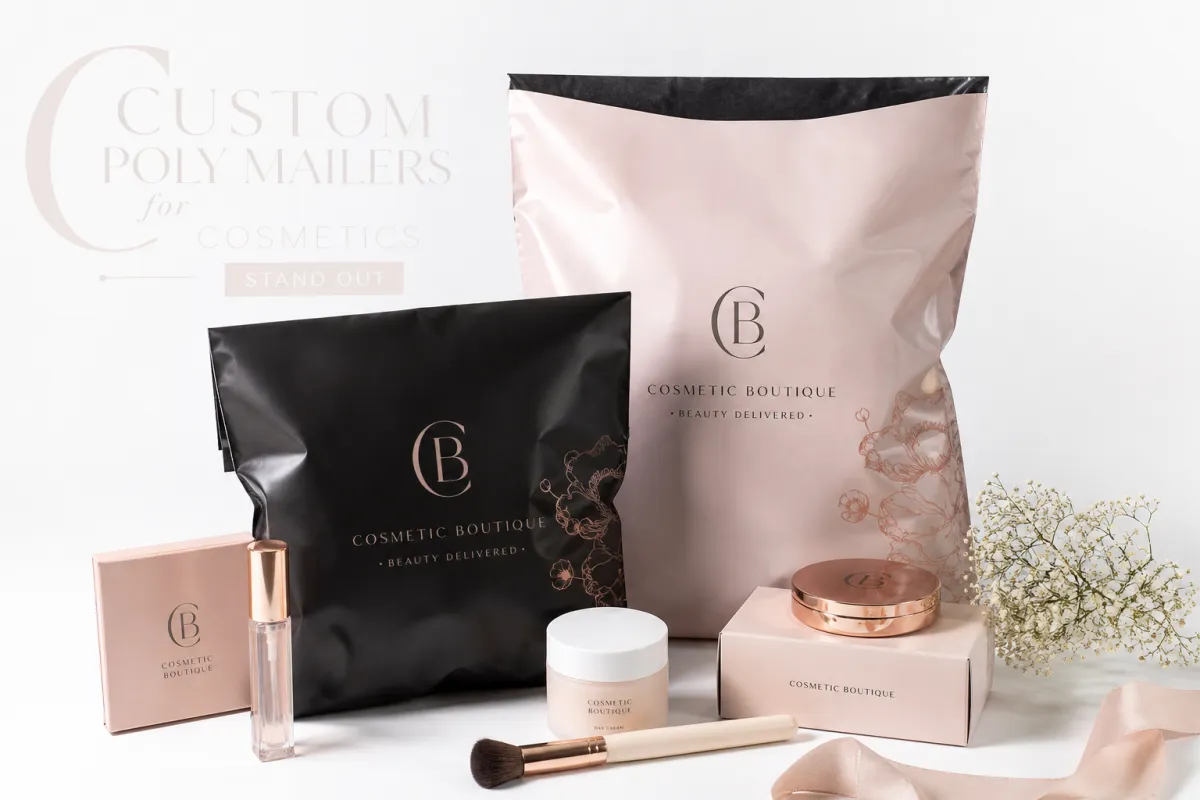
Custom poly mailers for cosmetics stand out because they solve a very specific shipping problem. Many beauty items are compact and light, yet they still need a clean presentation and enough protection to arrive without scuffs, moisture damage, or crushed corners. A mascara tube does not need the same structure as a glass serum bottle, but both benefit from packaging that feels intentional. In practice, custom poly mailers for cosmetics are a strong fit for lip products, sheet-mask bundles, sample sachets, accessory kits, refill pouches, and small non-fragile items that do not need a rigid carton.
The format earns its place quickly. A plain shipping bag can move a product from warehouse to doorstep, but it does almost nothing for perceived value. Custom poly mailers for cosmetics let a brand add color, logo placement, and concise messaging without much added weight. Compared with padded mailers, they are often lighter and cleaner-looking for non-fragile goods. Compared with cartons, they are usually quicker to pack and cheaper to ship. The tradeoff is clear: if the item needs crush resistance, corner protection, or more internal fill, a mailer may fall short. Even so, for many beauty shipments, custom poly mailers for cosmetics offer a strong balance of cost and presentation.
One of the easiest things to miss is how much the outer shipper shapes the customer’s first impression. The product can be excellent, yet the experience still feels flat if it arrives in a bland gray sleeve. A custom printed mailer fixes that immediately. Even a simple one-color logo on a matte film can make the order feel aligned with the website, the email campaign, and the rest of the packaging design. That visual continuity is a big part of why custom poly mailers for cosmetics are so common in DTC beauty: they bridge the gap between brand promise and parcel.
Moisture resistance matters more than many people expect. Beauty orders move through warehouses, delivery vans, porches, and sorting centers where rain, condensation, and damp surfaces are normal parts of the route. A properly sealed mailer keeps the outer package from soaking up water the way paper-based alternatives can. For many custom poly mailers for cosmetics, that resistance to moisture is one of the strongest reasons to choose the format, especially for products that do not need the rigidity of a box. I have seen otherwise solid packaging plans get tripped up by nothing more dramatic than a wet porch, which is why this detail is never just a detail.
The cheapest mailer is rarely the one with the lowest quote; it is the one that arrives clean, seals properly, and avoids a reshipment.
For deeper context on packaging structures and performance, the resources at Packaging.org are useful if you are comparing flexible mailers with other shipper types. If your team wants a more disciplined approach to transit testing, ISTA is worth a look because distribution tests can show whether a package spec really holds up in the shipping lane.
How Custom Poly Mailers for Cosmetics Work
At the simplest level, custom poly mailers for cosmetics are made from polyethylene film, usually in a single layer or a co-extruded structure that combines different film properties. In many runs, buyers choose between LDPE, LLDPE blends, or multi-layer films that improve tear resistance and print quality. The material choice affects more than strength. It changes how the mailer feels in hand, how crisp the print appears, and how likely the bag is to puncture if a sharp carton edge or applicator tube presses against it.
Thickness is one of the first specs most people ask about, and for good reason. In the market, custom poly mailers for cosmetics are often offered in ranges such as 2.5 mil, 3 mil, and 4 mil. That number affects the entire experience. A lighter film can reduce cost and shipping weight, but it may feel flimsy if the contents have a hard edge or if the package will be handled roughly. A thicker film can improve puncture resistance and give the bag a more premium hand feel, though it adds cost. For many cosmetic shipments, 3 mil is a practical middle ground, while 4 mil starts to make sense for higher-value kits or orders with sharper contents.
The closure system matters almost as much as the film. Most custom poly mailers for cosmetics use a pressure-sensitive adhesive strip with a release liner, so the packer can close the mailer quickly and securely. A good seal should resist reopening during transit without turning the line into a fight. Tamper-evident performance is especially helpful in beauty, where small items sometimes pass through several hands before final delivery. If the seal has been disturbed, that should be easy to see at a glance.
Printing is where the package starts acting like part of the brand. Artwork can be applied to the outside surface, and depending on the construction, the design may sit beneath a protective film layer or directly on a printable outer layer. In either case, print coverage, ink density, and color matching shape the final result. Clean custom poly mailers for cosmetics usually avoid overcrowding the surface. A strong logo, a single accent color, and enough negative space often look better than a bag packed with competing elements. Premium beauty brands usually benefit from restraint because it reads as confidence, not emptiness.
The limits matter too. Custom poly mailers for cosmetics are not a cure-all. They are usually a good match for light-to-moderate weight items, but not ideal for fragile glass, liquid-heavy bottles without secondary containment, or products that can crack under impact. If the product can leak, crumble, or be crushed, the mailer may need an inner sleeve, a rigid insert, or a box. A good packaging buyer does not ask whether the bag can ship anything. The better question is which cosmetic SKUs are truly mailer-friendly and which ones need more protection. That answer changes more often than teams expect, especially as assortments evolve.
For current guidance on packaging sustainability language and recycling basics, the EPA’s resource at EPA recycling information is a useful reference point. That matters if your team is evaluating recycled-content claims or trying to avoid broad environmental language that sounds appealing but cannot be supported.
Key Factors for Choosing Custom Poly Mailers for Cosmetics
Size comes first. Custom poly mailers for cosmetics should be large enough to close easily, but not so large that the product slides around and the package looks loose. The right size starts with the product dimensions, then adds any secondary packaging, tissue, inserts, or sample cards. If you ship a kit with a pouch, a folding carton, and a card insert, measure the assembled pack rather than the bare product. A mailer that is one inch too large in each direction can make the order feel sloppy and can also raise freight cost across a large shipment.
Material and thickness should match the real handling environment, not just the catalog image. A 2.5 mil bag may be enough for light sample sets or refill pouches that sit flat, while a 4 mil mailer may be the better call for heavier bundles or orders with sharper corners. Think about the journey, not just the warehouse. Will the package move through automated sortation? Will it sit in hot trucks? Will the contents shift during transit? Those questions change the answer. Custom poly mailers for cosmetics work best when the spec is based on actual use rather than a guess.
Brand presentation is the part buyers can feel immediately, even when they cannot always describe it. Color, logo placement, finish, and messaging all matter. A glossy white mailer with a large full-bleed print creates a different mood than a matte black bag with a small centered mark. Neither is automatically better. The right choice depends on the brand voice, the product line, and the customer you are trying to reach. If the brand is quiet and ingredient-focused, too much artwork can fight the story. If the brand is energetic and youth-driven, a bare bag can feel underdressed. Good custom poly mailers for cosmetics should match the visual language of the website, email banners, and inserts.
Sustainability deserves a careful, honest conversation. Buyers sometimes assume every plastic mailer is recyclable everywhere, and that is not true. Recycled-content films may be available, and some suppliers can provide better material documentation, but local recycling acceptance varies widely. It is smarter to ask for exact material details and use claims that can be defended. If your brand wants to make environmental progress, the stronger gains may come from choosing the right size, reducing overpackaging, and avoiding unnecessary extras rather than relying on a vague “eco-friendly” claim. For custom poly mailers for cosmetics, clarity beats glossy green language.
Cost and supplier capability are the other two big levers. A supplier that can proof artwork accurately, keep color consistent, and handle repeat replenishment without constant corrections is usually more valuable than the lowest quote. With custom poly mailers for cosmetics, a few cents per unit can matter, but so can a supplier who knows how to flag a seam placement issue or suggest a better print layout before production begins. The best vendors treat the packaging like part of the product, not just a commodity bag. That attitude saves time, and a lot of quiet headaches, once production actually starts.
| Mailer Option | Typical Spec | Common Cosmetic Use | Typical Price Range at 5,000 Units | What It Gives You |
|---|---|---|---|---|
| Standard Custom Print | 2.5 mil, one- or two-color print, single seal | Sample kits, light tubes, small accessories | $0.18-$0.28 per unit | Lowest weight and good branding for simple orders |
| Midweight Premium | 3 mil, full-color or higher-coverage print, stronger adhesive | Core DTC orders, bundled beauty items | $0.24-$0.38 per unit | Better hand feel and more forgiving handling |
| High-Protection Style | 4 mil, opaque film, tear strip or dual seal | Heavier kits, sharper accessories, higher-value shipments | $0.32-$0.52 per unit | Strong puncture resistance and more premium presentation |
| Recycled-Content Variant | 3 mil recycled-content blend, custom print | Brands with documented sustainability goals | $0.30-$0.48 per unit | Material story that may support sourcing goals, depending on claims |
Those numbers are starting points, not fixed market rules. Freight, print coverage, plate or setup charges, and order quantity can move landed cost enough to change the decision. That is why custom poly mailers for cosmetics should always be judged on a delivered basis, not by the headline unit price alone. A lower unit quote can become the more expensive choice if the supplier adds heavy freight, charges for repeat proofs, or cannot hold a consistent color standard over time.
Buyers comparing supplier options often do well to browse broader product families on Custom Packaging Products and then narrow down to Custom Poly Mailers once the material and print direction are clear. That order keeps the conversation practical: decide what the packaging needs to do first, then decide how it should look and what it should cost.
Custom Poly Mailers for Cosmetics: Pricing and Timeline
Pricing for custom poly mailers for cosmetics usually comes from a mix of film material, print setup, bag size, and quantity. The material itself is one part of the cost, while the print structure can be just as important. A simple one-color logo on a standard bag is usually more economical than a full-coverage design with multiple tones, gradients, or detailed registration requirements. If the bag uses a special closure, tear strip, or dual adhesive strip, those features also add cost. Freight should never be ignored, because lightweight packaging can still become expensive if it ships in a rushed or partial order.
Order volume has a major effect on unit pricing. Very small runs usually carry a higher price per bag because the supplier still has to pay for setup, proofing, and production changeover. Once quantities rise, the unit cost tends to drop, sometimes noticeably. That is why custom poly mailers for cosmetics often make the most financial sense at replenishment volumes rather than tiny test runs. If a brand knows it will use the same size and print for several months, ordering enough to cover a real sales cycle usually lowers the landed cost per shipped order.
A realistic timeline often begins with artwork submission and proof review. If the files are clean and the layout is straightforward, proofing can move quickly. If there are color-matching requests, fine text, multiple revision rounds, or a need to verify exact placement, the front end takes longer. After approval, production for custom poly mailers for cosmetics often lands in the range of 12 to 15 business days for standard jobs, although more complex runs may take longer. Shipping time gets added on top. For launches or seasonal promotions, that gap matters because packaging is often one of the last items to arrive before product can move out the door.
Here is how the schedule usually breaks down in practice:
- Artwork prep: 1-3 days if the files are ready, longer if the layout needs cleanup or resized dielines.
- Proof review: 1-5 days depending on how many stakeholders need to sign off.
- Production: often 12-15 business days after approval for standard custom poly mailers for cosmetics.
- Freight: anywhere from a few days to a few weeks, depending on origin, routing, and service level.
The quote should always separate the unit price from the delivered cost. That sounds basic, but it prevents a lot of confusion later. A supplier may look inexpensive on paper and then add freight, handling, or proof charges that change the real number. Good buyers ask for the same format from every vendor: unit price, setup cost, shipping cost, estimated lead time, and any likely revision charges. For custom poly mailers for cosmetics, that side-by-side view is usually the only fair way to compare quotes.
Revision scope matters too. If a design is still fluid, the project can slow down. Some teams are still deciding how much branding to place on the mailer versus the carton, or whether the bag should use a full-bleed graphic or a cleaner minimal mark. Others are balancing multiple sizes, such as a smaller mailer for single items and a larger one for bundles. In those cases, custom poly mailers for cosmetics are best managed as a packaging program, not a one-off purchase. That makes it easier to standardize the print format, align inventory, and reduce the risk of last-minute changes.
One practical tip: ask whether the supplier can quote the same design across multiple sizes. A good packaging partner should be able to tell you whether a 6 x 9 inch bag and a 10 x 14 inch bag can share a visual system or whether the artwork needs separate adjustments. That kind of planning matters for custom poly mailers for cosmetics because the package should look like part of the same brand family, even if the SKU assortment changes. It keeps the line looking intentional instead of stitched together from whatever happened to be available that month.
Step-by-Step: Ordering Custom Poly Mailers for Cosmetics
The cleanest way to order custom poly mailers for cosmetics is to treat the process like a short specification project. That keeps the quote accurate and lowers the chance that the sample you approve turns into a production run that does not fit the actual order flow. The first step is to audit the product mix. Measure the product, the inner carton or sleeve if one is used, any inserts, and the amount of free space around the item. A mailer built around the smallest SKU often fails the larger one, while a bag built for the biggest SKU can look sloppy on the smallest. The right size should support the main shipping pattern, not just a single outlier.
Next, choose the performance spec. Decide whether the package needs a lighter film for low-cost sample sets or a heavier film for more valuable beauty items. Think about closure style too. A standard single seal may be enough for routine DTC orders, but a tear strip or second adhesive strip can improve both security and customer convenience. At this stage, custom poly mailers for cosmetics should be matched to the product rather than to an abstract idea of “premium.”
Then move to artwork. Strong packaging design depends on clean files, correct bleed, and safe areas that keep important elements away from seams and the seal zone. A logo that sits too close to the edge may disappear into a fold or become distorted near the adhesive strip. Readability matters more than decoration. If you want a QR code, return message, or short brand line, keep it legible from arm’s length. Custom poly mailers for cosmetics usually look best when the design is purposeful and not crowded with too many competing messages.
Proofing is where a lot of preventable mistakes get caught. Review the digital proof for logo size, placement, contrast, and the actual dimensions of the bag. If the design includes barcodes or shipping labels, check whether those sit on a flat enough area to scan cleanly. If the closure area is near the artwork, confirm that the print will not interfere with the seal. A physical sample is even better, especially for custom poly mailers for cosmetics with unusual colors or high-coverage print. It is easier to catch a color shift or seam issue in a sample than in a 5,000-unit production lot.
Once the proof is approved, confirm the production schedule and think ahead about inventory. Packaging should not become the bottleneck that slows a launch. If you know a promotion will spike orders, plan the packaging arrival before demand spikes. That means keeping some buffer stock on hand, especially if the mailers are custom printed and not easy to replace quickly. With custom poly mailers for cosmetics, a late shipment can be just as disruptive as a product shortage.
When the cartons arrive, inspect the first delivery carefully. Check quantity, print consistency, seal quality, and bag dimensions against the approved sample. Open a few cartons and verify that the film is not scratched, the artwork is aligned, and the adhesive strip releases and reseals as intended. If the order is going into immediate use, test a handful in real packing conditions with the actual cosmetic SKUs. That final quality check is not busywork; it is the fastest way to confirm that the custom poly mailers for cosmetics will perform the way the paperwork promised.
Think of it as a simple control loop: measure, spec, proof, approve, receive, test. That sequence keeps the project grounded and helps the mailer do its job without creating avoidable surprises. In my experience, the teams that skip one of those steps are the ones that end up doing emergency reorders later, usually for reasons that were easy to spot from the start.
Common Mistakes with Custom Poly Mailers for Cosmetics
One of the most common mistakes is choosing a mailer that is simply too large. Oversized custom poly mailers for cosmetics waste material, look loose in the customer’s hands, and can make the package feel less premium even if the product inside is fine. The extra space can also encourage shifting, which raises the chance of scuffing or corner damage. A snug, properly sized mailer usually looks better and can be more efficient to pack.
Another common problem is favoring appearance over function. A beautiful mockup is not enough if the film punctures easily or the seal does not hold. Custom poly mailers for cosmetics should be evaluated for strength, opacity, and closure performance, not just color and logo placement. If the item has sharp edges, heavy components, or multiple pieces inside, the bag needs to handle those realities. A design that looks great but fails in transit is not a good deal, no matter how polished the sample board looked.
Artwork contrast gets overlooked more often than it should. Dark logos on glossy black film can disappear in certain light, and light-colored marks on clear or reflective surfaces can feel faint. Busy designs can also reduce legibility, especially if the mailer is handled quickly at packing stations or viewed under warehouse lighting. For custom poly mailers for cosmetics, contrast should be checked against the actual film finish, not only on screen. A good proof can still mislead if the surface texture changes how the artwork reads.
Skipping sample testing is a mistake that costs time later. A lightweight sample pouch may behave very differently from a glass vial, a rigid compact, or a bundle of mixed items. If a product leaks, shifts, or bends under pressure, the mailer needs to be tested with that exact SKU, not a placeholder. Many of the headaches that show up after launch could be avoided if the brand had run a real packing test first. Custom poly mailers for cosmetics are efficient, but they still need validation.
The last mistake is making sustainability claims that do not hold up. Not every poly mailer is recyclable in every local system, and “eco-friendly” without context is usually too vague to be useful. If the brand wants to talk about recycled content, recycled content should be documented. If the brand wants to discuss recyclability, the statement should match the actual structure and the destination market. Honest language is better than vague language. For custom poly mailers for cosmetics, trust travels farther than hype.
There is also a hidden error that shows up in busy operations: treating all cosmetic SKUs as if they need the same protection level. That is rarely true. A sample card set, a foam pad, and a glass bottle do not behave the same way in shipment. The more the SKU mix varies, the more important it becomes to segment the packaging spec. Some custom poly mailers for cosmetics can handle the job on their own; others need an inner carton or extra cushioning. Good packaging buyers respect those differences instead of trying to force one answer across the whole line.
Expert Tips for Better Custom Poly Mailers for Cosmetics
Start by building a visual system, not just a bag. The strongest custom poly mailers for cosmetics look like part of a larger family that includes labels, tissue, inserts, and any outer cartons the brand uses. That does not mean every surface has to be busy. Often the better result is a restrained one: one strong logo mark, a controlled color palette, and a little room for the package to breathe. Consistency is what makes the shipment feel intentional, and it tends to age better as the brand grows.
Test one mailer under real conditions before buying at scale. Pack the actual cosmetics, close the seal, and then simulate the handling the package will see: stacking, a short drop, heat, and humidity if those are likely in your route. That kind of practical check is especially useful for custom poly mailers for cosmetics because the product mix is often varied. A mailer that looks fine on a desk may behave differently once the warehouse and carrier network get involved. That is one of those little things people forget until the first complaint comes in.
Reserve a little room for operations. If the brand needs a return instruction, a QR code for reorder flow, or a batch identifier, plan for that from the start. A crowded face panel leaves no space for practical details. Good custom poly mailers for cosmetics can support marketing and operations at the same time, but only if the layout is planned with that in mind. I like to think of the bag as a tiny piece of retail packaging that has to stay useful after the customer opens it.
Compare cost per shipped order, not just bag price. A mailer that costs a few cents less can become expensive if it increases damage, slows packing, or forces you to add inserts to compensate. The real number is the total cost of getting one order out the door in good condition. That includes material, freight, labor, and returns risk. Custom poly mailers for cosmetics should be judged on that whole picture, because unit price alone leaves out too much.
Stay close to the production sample. If the supplier offers a blank sample or a printed proof, keep it in the buying folder and compare future orders against it. Over time, that sample becomes a useful benchmark for color, opacity, and seal strength. It sounds simple, but it helps a lot when multiple people handle purchasing. Custom poly mailers for cosmetics are easier to replenish when the approved standard is visible and easy to reference.
One final tip: ask the supplier how they would protect the artwork if the bag sees abrasion in transit. That question often reveals how much they understand the application. If the answer is thoughtful, the supplier likely understands custom poly mailers for cosmetics as a performance package, not just a printed film. If the answer is vague, it is a pretty good sign you will need to do more of the thinking yourself.
Put simply, the best next step is to measure one SKU, review the current shipping method, and request samples or quotes for custom poly mailers for cosmetics that match the product, the route, and the brand story. Start with the item that ships most often, not the prettiest exception, and you will usually get a spec that actually holds up once orders start moving.
What size should custom poly mailers for cosmetics be?
Measure the product plus any box, insert, or tissue so the mailer closes flat without forcing the seal. Leave enough room for a smooth fit, but avoid excess slack that makes the package look oversized or unprofessional. If you ship more than one SKU, sample the most common sizes before locking the final dimensions, because the best custom poly mailers for cosmetics are the ones that fit the real mix, not just the smallest item in the lineup.
Are custom poly mailers for cosmetics safe for fragile makeup?
They work well for many non-fragile items, but breakable compacts, glass, and liquid-heavy products may need extra cushioning or a box. Test the exact product, not just a placeholder, because weight and shape change how much protection is required. Use inserts or inner packaging when the item needs protection from pressure, impact, or leakage, since custom poly mailers for cosmetics are strongest when the product itself is a good fit for a flexible shipper.
How much do custom poly mailers for cosmetics usually cost?
Price depends most on quantity, film thickness, print complexity, and any custom features such as tear strips or special closures. Ask for both unit cost and delivered cost so freight and setup charges do not surprise you later. Larger orders usually lower the cost per mailer, while very short runs tend to carry a higher unit price, so the best quote for custom poly mailers for cosmetics is the one you can compare on the same landed-cost basis.
How long do custom poly mailers for cosmetics take to produce?
The schedule usually includes artwork prep, proof approval, production, and shipping, so the full timeline is longer than the print run alone. Complex artwork, revision rounds, or special color matching can add time before production begins. Plan ahead for launches and seasonal spikes so packaging arrives before inventory is ready to ship. For many standard custom poly mailers for cosmetics, production often lands around 12 to 15 business days after approval, but exact timing depends on the supplier and the job details.
Are custom poly mailers for cosmetics recyclable?
It depends on the exact material and the recycling options available in the destination market. Avoid broad claims unless you can verify them for the specific mailer construction and local recycling stream. If recyclability matters to your brand, ask for clear material details and disposal language before ordering, because honest guidance is more useful than a broad claim that sounds good but cannot be backed up. That same discipline applies to custom poly mailers for cosmetics as a whole: the more specific the spec, the more trustworthy the packaging story.

