Custom Pom Pom Beanies for youth sports teams do a lot of work for a fairly small item. They warm ears on cold sidelines, unify mixed-age rosters, and show up in group photos long after the scoreboard is forgotten. That is why they are popular. The smarter question is not whether a team should order them, but whether the hat will still look good after a season of backpacks, bleachers, and repetitive washing.
That is where the real buying decision starts. A cheap beanie can leave the warehouse looking fine and arrive at the end of the season with a floppy pom, stretched cuff, and logo that no longer sits straight. A better one keeps its shape, reads clearly from the stands, and feels comfortable enough that kids actually wear it outside the game. The difference is usually not dramatic in a quote, but it is dramatic in use.
For booster clubs, coaches, and parents, the goal is practical polish. You want a design that feels special without becoming fussy, a cost that fits the budget without cutting corners on warmth, and a production plan that does not fall apart because three people approved three different versions of the same proof.
Custom pom pom beanies for youth sports teams: why they punch above their weight
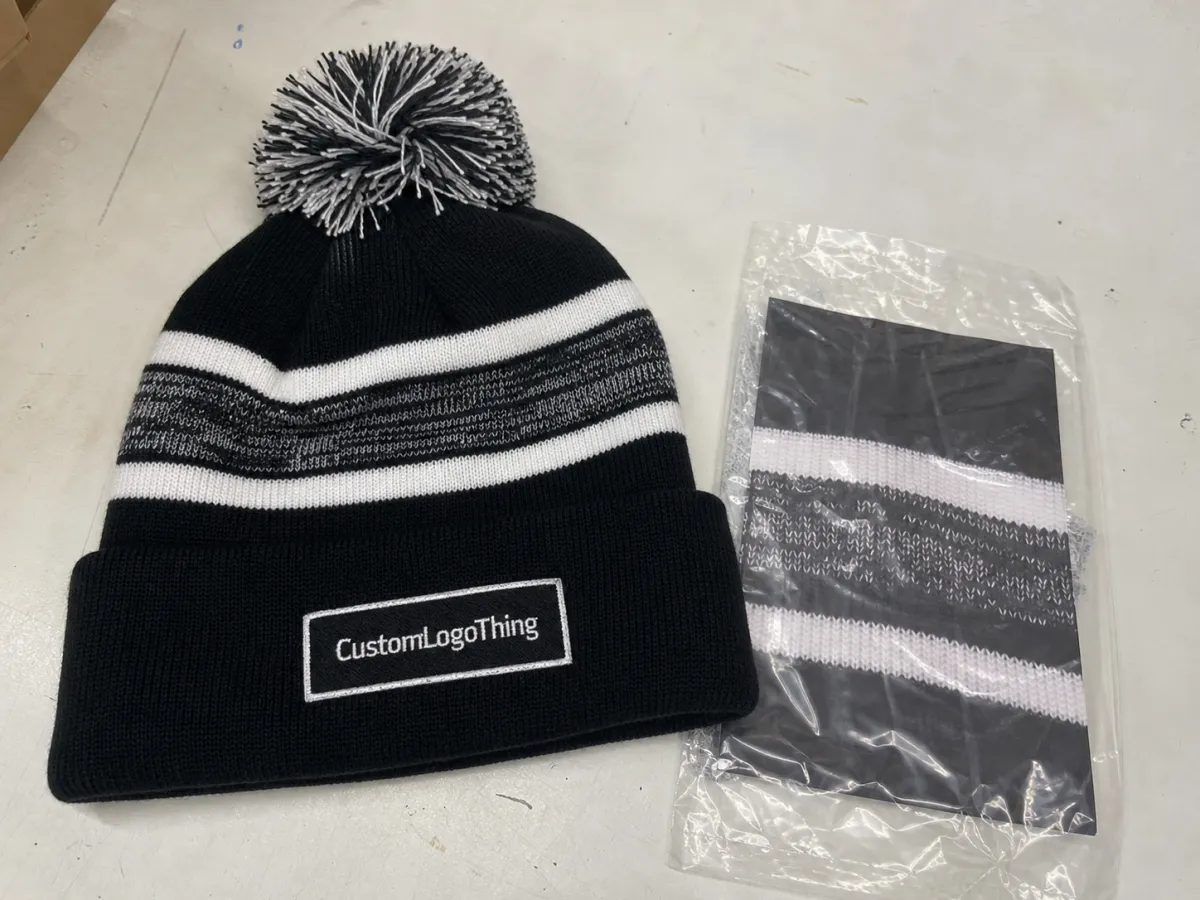
The appeal is easy to understand once you compare them with other team gear. Hoodies are expensive. T-shirts are seasonal. Jackets solve a bigger weather problem, but they are a larger budget commitment and much harder to size correctly. A pom beanie sits in the useful middle. It is visible, giftable, and inexpensive enough that teams can order them for whole rosters without treating the purchase like a capital project.
They also photograph well. That matters more than people admit. A row of kids in matching hats instantly looks organized, even if the socks, pants, and gloves are all over the map. In youth sports, visual consistency often does more branding work than a more expensive item with too much detail. A beanie with a clear logo and clean color contrast can read from 20 feet away, which is useful on sidelines and in bleacher shots.
The hat only succeeds, though, if it survives the way kids use it. That means repeated on-and-off wear, being shoved into equipment bags, and being handed to younger siblings between games. A soft hand feel helps. So does a cuff that keeps the logo centered and a pom that is attached securely enough to avoid becoming a loose novelty by midseason. Small failures here are obvious. If the cuff twists or the pom droops, the whole item looks cheaper than it was.
There is another reason these hats work: they create a team identity without forcing every family into a big apparel commitment. A knit beanie feels like gear, not merchandise. That distinction matters. Families are far more likely to buy something useful for a cold-weather season than a decorative item that will never leave the drawer.
How the process and timeline work from mockup to delivery
Most orders follow the same path: choose the style, confirm colors, send artwork, review a digital proof, approve production, then wait for the finished batch. The order sounds simple because, on paper, it is. The friction appears in the details. A youth logo that looks crisp on a flat screen can become muddy on a knit cuff. A color that feels “close enough” in email can be visibly wrong once woven into acrylic yarn. Production only gets more expensive when people treat those differences casually.
A realistic timeline for a straightforward order is usually 2 to 4 weeks after art approval. That range changes with season, quantity, and decoration type. Custom knit programs, heavier order volumes, and detailed patch work can push the schedule further out. Rush options exist, but they are not magic. They tend to narrow your decoration choices, reduce flexibility on color matching, and add cost. Faster production almost always means fewer degrees of freedom.
One practical habit saves a lot of time: lock the proof before anyone starts talking about final quantities, late additions, or “maybe we should move the logo an inch lower.” Those conversations should happen before production, not after. A one-inch move on a beanie is not cosmetic. It changes how the logo sits on the cuff and whether the design reads cleanly when worn.
The cheapest mistake is the one caught in proofing. Once 100 or 200 hats are already in production, every correction becomes a scheduling problem, not a design fix.
Good suppliers will also ask for the art in a usable format, usually vector if the design is being embroidered or converted into a patch. That request is not busywork. Sharp edges, clear letterforms, and simplified color areas all translate better into thread and knit. If the file is a low-resolution screenshot pulled from a social post, expect delays while someone redraws it. That is normal. It is also avoidable.
For teams distributing the hats as part of a welcome kit or tournament package, packaging should be planned at the same time as the product. Soft goods travel better in the right box than they do loose in a carton with other items. If the pom shape matters, and it usually does, ask how the pieces will be stacked, packed, and protected so they do not arrive flattened.
What drives cost, pricing, and unit value
Four things control the price more than anything else: quantity, decoration method, yarn choice, and knit complexity. A small order of 24 hats will almost always cost more per unit than a run of 100 because setup charges have to be spread over fewer pieces. That is true whether the decoration is embroidery, a woven patch, or a fully custom knit pattern. The math is less glamorous than the marketing copy, but it is the math that decides the invoice.
For many teams, the first quote looks higher than expected because it includes setup items that are easy to overlook: digitizing, patch tooling, sample production, and freight. Those charges do not appear in every line item, but they shape the landed cost. Ask for the full delivered price, not just the hat price. A $7.25 unit that becomes $10.10 after setup and shipping is a different purchase than a $9.00 unit with almost no extras.
In practical terms, this is how prices often land:
| Style | Typical decoration | Best for | Typical unit range | Notes |
|---|---|---|---|---|
| Basic acrylic cuff beanie | Embroidery | Small team orders, simple logos | $6-$10 | Usually the most budget-friendly choice; good for readable branding and quick reorders. |
| Custom knit beanie with pom | Knit-in graphics | Team colors, simple emblems | $8-$14 | Strong visual impact, but it favors bold art over fine lines and tiny text. |
| Premium blend beanie | Patch or embroidery | Gift sets, higher-end clubs | $10-$18 | Often softer in hand and more refined in finish, though the price climbs faster. |
| Detailed logo beanie | Woven or embroidered patch | Mascots, multi-color artwork | $9-$16 | Good choice when the logo needs more definition than thread alone can provide. |
Setup fees are where many buyers underestimate the true first-order cost. Digitizing for embroidery may be modest for a clean logo, but more detailed art can push that charge higher. Patch tooling and knit program setup vary too. On a small run, a $75 setup fee can add several dollars per hat. On a larger run, the same fee barely moves the needle. That is why quantity breaks matter so much.
There is a point where a slightly larger order becomes more efficient than a small one. Moving from 25 to 50 pieces can reduce the unit cost enough to justify extra hats for coaches, managers, or late additions. Sometimes it does not. The only reliable way to know is to compare quotes across a few breaks instead of assuming a bigger order is automatically a better deal.
What should not be compared by price alone is the value of the finished item. A lower quote that produces a thin, itchy hat with a weak pom and sloppy decoration is expensive in a different way. Teams remember poor quality. They also remember the item that gets worn all winter.
Materials, fit, and decoration choices that hold up on the sidelines
Acrylic remains the default for a reason. It is inexpensive, warm enough for typical sideline use, and predictable in production. Many reliable team beanies are made from 100% acrylic or an acrylic-heavy blend because the fiber takes color well and holds shape better than some softer natural options. Wool blends can feel warmer and more premium, but they usually cost more and can be less forgiving for younger wearers if the yarn is rough.
Fit matters just as much as the material. Cuffed beanies are usually the safest choice for youth teams because they create a clean decoration zone and tolerate a wider range of head sizes. The cuff gives the logo a visible anchor point, which helps in both photos and real-world wear. Slouch styles can look casual and modern, but they are less dependable when the goal is a logo that stays centered and easy to read.
Decoration should follow the artwork rather than the trend of the season. Embroidery works well for initials, simplified mascots, and short team names. It is durable and familiar, though it can struggle with very fine detail or tiny lettering. Woven patches and embroidered patches are stronger choices when the design includes small lines, multiple colors, or crisp edges. Knit-in graphics are best when the art is bold and simple enough to translate into yarn without losing definition.
Youth use creates constraints that adult apparel buyers sometimes overlook. Scratchy fabric gets ignored. Oversized poms can fall into a child’s line of sight and make the hat less wearable. Tiny hardware, loose yarn ends, or a cuff that rolls awkwardly all reduce the odds that the beanie will stay in rotation. If the item is uncomfortable, it becomes a photo prop instead of a piece of team gear.
There is also a shipping and storage angle. Soft goods compress easily. If the beanies are packed too tightly, the pom can lose shape and the cuff can crease in a way that makes the hat look worn before anyone has touched it. Ask how the cartons will be packed and whether the hats are folded to protect decoration placement. The best production spec in the world will not help if the box turns the final product into a flattened stack.
For teams that care about presentation as much as the hat itself, the broader branded package matters. A tidy insert, a folded presentation card, or a simple box can lift the perceived value without changing the garment. That does not mean every order needs extra packaging. It means the delivery method should match the purpose. A fundraiser giveaway, senior-night bundle, and end-of-season handout do not need the same presentation.
Step-by-step ordering plan for coaches, parents, and boosters
The cleanest orders start with one document and one decision maker. Confirm quantity, size range, deadline, and budget before seeking quotes. Youth team orders often get delayed because the real need is larger than the first estimate. Coaches want extras. Parents ask for one more. Managers need a spare. It is far easier to plan for that from the start than to patch the order later.
- Lock the quantity and any extra pieces first.
- Pick the base style: cuffed or uncuffed, knit or patch, standard pom or oversized pom.
- Send the logo file in the best format available.
- Review the proof together and resolve color, spelling, and placement before approval.
- Build in a delivery cushion so the hats arrive before the first hard deadline.
The reason this process works is that it removes guesswork. Quantity changes late in the process can alter pricing. Artwork changes can shift setup charges. Even a small color adjustment can require a revised proof, which means time. A disciplined approval chain is not bureaucracy for its own sake. It is how small-budget projects avoid large-budget mistakes.
For booster clubs handling fundraising inventory or tournament handouts, a small overrun is usually wise. Ten to 15 percent extra is often enough to cover replacements and late additions without creating dead stock. It is not glamorous to order more than the bare minimum. It is, however, cheaper than trying to reproduce the same hat months later when the supplier has moved on to a different production run or dye lot.
One more practical note: if you are combining hats with other team items, it helps to keep the packing and labeling plan simple. Mixed-size orders can become a sorting problem very quickly. Clear labels and grouped cartons make distribution faster and reduce the chances that the right player gets the wrong size.
Common mistakes that cause delays or disappointing hats
The first mistake is waiting too long. Cold-weather merchandise always gets squeezed into a narrow season, and teams usually order later than they think they will. By the time the first cold snap hits, suppliers are already handling other rushed jobs. If the hats matter for photos, travel days, or championship weekends, the safe move is to start well before the weather turns.
Weak artwork is another problem. A logo full of fine lines, tiny text, or gradients will not always translate to knit or thread. Simplification is not a downgrade. On a small beanie, it is often the only way to keep the mark readable. In production, clean shapes outperform clever detail more often than not.
Fit mistakes are common too. Assuming one style works for every player, coach, and parent can lead to frustration once the hats are distributed. Some groups need a stretchier cuff. Others need a lower-profile fit for older kids. If the order spans age groups, ask for measurement guidance instead of guessing.
Another frequent error is treating the sample as optional. It is tempting to skip it when the proof looks close enough. That is exactly when problems slip through: a pom that feels too small, a cuff that swallows the logo, a knit density that looks thinner than expected. A sample is not a luxury when the order includes multiple sizes or a brand-sensitive color.
Finally, do not ignore shipping details. A beanie can be perfect and still disappoint if it arrives later than the event or packed in a way that crushes the pom. Production and delivery are part of the product. Teams that plan only for decoration and forget transit usually pay for it in stress.
Expert tips for better-looking team beanies and fewer reorders
Use contrast that survives winter light. Gray on white, navy on black, and pale text on muted backgrounds all disappear faster than people expect. A logo that looks acceptable on a backlit monitor can become hard to read in overcast daylight. The bleachers do not forgive low contrast.
Keep the graphic simple unless the art genuinely needs complexity. One strong logo placement on the cuff is often enough. Overcrowding the beanie with too many elements makes the hat look busy and can reduce readability once the fabric stretches. The better-looking orders usually feel restrained, not empty.
Pick the decoration method based on the art, not the budget alone. A simple school initial may look best in embroidery. A mascot with shading and small features may need a patch to hold its shape. Knit-in art is strongest when the logo is bold enough to survive translation into yarn. If the design depends on tiny details, thread and knit may flatten it more than expected.
Ask about quality-control checks before approving the run. Good suppliers will typically verify stitch density, patch placement, color matching against approved references, and pom attachment. For knit styles, watch for consistent tension across pieces. A loose gauge can make the beanie feel flimsy, while an over-tight knit can reduce stretch and comfort. Neither issue is visible in a proof. Both matter in hand.
If the budget allows, order a modest overrun. A 10 to 15 percent buffer is enough to cover size swaps, replacements, and the inevitable request that arrives after distribution day. Extra pieces are rarely wasted in youth sports. They become insurance against human behavior, which is the one variable no production schedule can fully control.
Next steps: gather specs, compare quotes, and lock the order
A useful spec sheet does not need to be fancy. It needs to be complete: quantity, team colors, logo file, target delivery date, preferred decoration, and who signs off on the proof. That single sheet removes most of the back-and-forth that stretches a simple order into a slow one. It also prevents one person from assuming the beanie is navy while another orders royal.
Ask for quotes at several quantity breaks. A 25-piece order, a 50-piece order, and a 100-piece order can tell a very different story on unit price. Sometimes the larger run earns a better number. Sometimes the cost gap is too small to justify extra inventory. Either way, you learn where the real value sits instead of guessing.
Before paying a deposit, confirm the delivery window and the approval deadline. The gap between “production time” and “in your hands” can matter more than buyers expect. If the hats are tied to photos, travel, or a seasonal event, the arrival date should be treated as part of the spec, not a casual estimate.
Done well, Custom Pom Pom Beanies for youth sports teams are a practical branding item with a long useful life. They work because they are visible without being expensive, warm without being bulky, and flexible enough for players, siblings, and adults. The best orders are the boring ones: clear art, stable colors, realistic timing, and a hat that gets worn through the season instead of forgotten in a gear bag.
How much do custom pom pom beanies for youth sports teams usually cost?
Most orders land somewhere between $6 and $18 per hat depending on quantity, material, and decoration method. Basic acrylic beanies with simple embroidery sit at the lower end, while premium blends, detailed patches, and fully custom knit patterns move the price upward. The first order usually costs more than reorders because setup fees are spread across fewer units.
What decoration method works best for youth team pom pom beanies?
Embroidery is the simplest answer for clean initials and straightforward logos. Woven or embroidered patches are better when the design has fine detail or multiple colors. Knit-in graphics work well for bold artwork that does not rely on tiny text. The right choice is the one that keeps the logo readable after wear and washing, not the one that looks most impressive on a flat proof.
How long does production usually take?
A straightforward order often takes 2 to 4 weeks after artwork approval. Custom knit runs, larger quantities, and busy winter seasons can push that longer. Rush service may be available, but it usually comes with fewer options and a higher cost. The best way to protect the schedule is to approve the proof quickly and avoid last-minute design changes.
What minimum order quantity should a youth sports team expect?
Small runs are possible, but the unit price usually improves as quantities increase. Many suppliers offer better pricing at 25, 50, and 100 pieces, so it helps to compare those breaks before deciding. If the order is very small, expect less flexibility on decoration and a higher cost per hat because setup charges have less room to spread out.
How do I choose the right fit for kids and adults?
A stretch-friendly cuffed beanie is usually the safest option for mixed-age groups. It gives more flexibility on fit and a cleaner area for decoration. If the group includes players, coaches, and parents, ask for size guidance or a sample before placing the full order. A one-size-fits-most style is often easier than trying to split the order into narrow age brackets.

