Custom Pom Pom Beanies bulk order is one of those product requests that sounds simple until the spec sheet arrives. Then the real variables show up: knit gauge, cuff height, pom construction, embroidery limits, packaging, and the date the goods actually need to be in hand. That is where good winter merchandise gets decided.
A pom pom beanie is not just a cold-weather accessory. It is a wearable billboard that people keep using after the event is over. Unlike a flat promo item, it gets seen in transit, in group photos, at practices, on campus, and at weekend errands. The impression count usually runs higher than buyers expect because a hat is visible from a distance and still useful after the season changes.
For schools, teams, retailers, and corporate buyers, that visibility matters. A knit cap with a good fit and clean branding feels more like apparel than giveaway swag, and that changes how people treat it. If the piece feels premium enough to wear again, it keeps working long after the original handoff.
Why custom pom pom beanies bulk order works for cold-weather branding
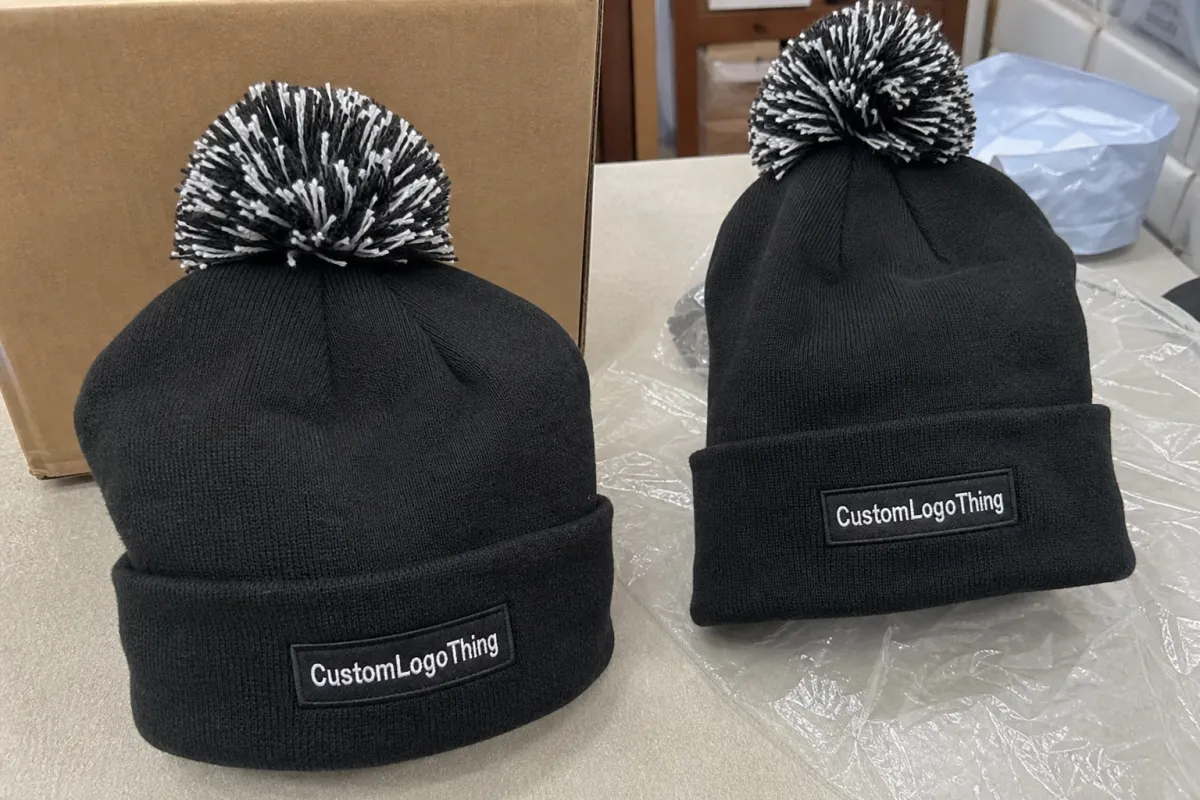
A custom Pom Pom Beanies bulk order performs well because it solves two jobs at once. It warms the wearer and keeps the logo in circulation. That sounds obvious, but many seasonal items fail one of those jobs. They are either practical and forgettable, or decorative and never worn. A good beanie sits in the middle.
Bulk orders also fit the way winter programs are usually built. A campus event may need 200 units in a single delivery. A team store may need a run in common sizes and core colors. A holiday drop may need a small amount of premium packaging around a product that already carries most of the value. Beanies work across those use cases because the format is familiar and the sizing problem is mostly solved.
There is another reason buyers like them: the numbers usually make sense. At lower quantities, setup and decoration can push the unit price into the premium zone. Once the order moves into the several-hundred range, the cost per piece often drops enough that the pom detail feels like a feature rather than an extra line item. That is a useful place to be when the budget is fixed but the audience is broad.
Winter merchandise earns attention in a different way than summer promo goods. If people actually wear it, the item keeps selling the brand without any extra effort.
One practical advantage is distribution. Most knit caps are one size fits most, which reduces sorting, exchange requests, and leftover inventory. That helps with event planning, but it also helps with packaging. Fewer size variables mean simpler pack-out, cleaner cartons, and fewer mistakes at the end of production.
Buyers who care about presentation usually see this format as a hybrid between apparel and packaging. A beanie can go out loose in a polybag, tucked into a labeled sleeve, or paired with a card insert and tissue. The packaging does not need to be elaborate, but it should match the position of the item. A retail-style presentation gives the product more perceived value than a plain bulk shipment.
That is why a custom pom pom Beanies Bulk Order is often more efficient than building a winter kit from several smaller products. One item can carry the logo, solve the seasonal need, and still feel giftable.
Choose the right knit, cuff, and pom style for the job
Material choice affects price, feel, and how the cap behaves after wear. Acrylic is still the workhorse. It is affordable, easy to dye in strong colors, and predictable in bulk production. Acrylic-wool blends cost more, but they usually feel warmer and less synthetic in hand. That can matter for retail or client gifts, where the buyer is judging the product before the wearer ever puts it on.
Gauge is the next decision. A tighter knit gives a smoother surface and better structure. A looser knit feels softer but can distort decoration and reduce the crispness of the logo area. Heavy-gauge styles tend to look more substantial and resist collapse better in display, though they are not always the best choice if the order needs a flexible, easy-fit cap for a wide audience.
The cuff is more than a style detail. It creates the most stable decoration zone and usually gives the logo a cleaner reading surface. Uncuffed beanies look sleeker, but they leave less room for branding and can hide small marks in the fold. If the program depends on clear logo visibility, cuffed styles usually outperform fashion-first silhouettes.
The pom changes the tone immediately. A single yarn pom feels classic and familiar. A striped or two-tone pom brings more movement and works well for fan gear. An oversized pom creates a playful profile, but it can also make the beanie harder to store and more expensive to ship because of extra volume. For a broad campaign, a moderate-size pom is usually the safer choice.
Color choice deserves more attention than many buyers give it. Black, navy, gray, and forest green remain reliable because they pair easily with most wardrobes. High-contrast colorways photograph better and can help the branding pop in a crowd, but they also narrow the wear window if the audience is conservative. The right answer depends on whether the order is meant to move inventory, build recognition, or feel like a premium gift.
For most bulk programs, the sweet spot is simple: a sturdy acrylic body, a cuff that supports decoration, and a pom style that does not overwhelm the logo. That combination gives the best balance of cost and wearability.
Decoration choices that hold up on knit caps
Knit surfaces are forgiving in some ways and difficult in others. They stretch, bend, and move with the wearer. That means decoration has to survive motion without cracking, fraying, or looking distorted from a few feet away. Embroidery remains the most common choice because it is durable and relatively cost-effective.
Embroidery works best when the artwork is clean. Thick letterforms, simplified shapes, and limited thread colors translate well. Hairline text and highly detailed crests usually do not. On a textured cap, the smallest elements can disappear into the knit, especially if the stitch count is pushed too low or the logo is scaled down to fit a narrow cuff.
Patch decoration is the main alternative when a logo needs sharper edges or smaller detail. Woven patches handle fine lines well. Faux leather or genuine leather patches give a more elevated, retail-forward finish and pair well with minimalist branding. Sewn labels are best when the branding is secondary or intentionally understated.
| Decoration method | Best for | Typical cost impact | Notes |
|---|---|---|---|
| Embroidery | Most team orders and standard branding | About $0.60-$1.50 per unit, depending on stitch count | Durable and familiar; works best with simplified artwork |
| Woven patch | Detailed logos and sharper edges | About $0.90-$1.80 per unit | Good for fine text and clean color separation |
| Leather patch | Premium retail or gift programs | About $1.20-$2.25 per unit | High perceived value; works best with minimal logos |
| Sewn label | Secondary branding or subtle marks | About $0.35-$0.85 per unit | Best for low-profile decoration, not primary logos |
Placement affects the result as much as decoration type. Front center gives the strongest visibility. Cuff placement usually produces the cleanest read because the surface is flatter. Side placement can feel more retail-oriented, but it may reduce immediate brand recognition if the logo is small.
Proof review matters here. Thread colors should be checked against the artwork, and placement should be measured rather than guessed. If the logo includes multiple colors, ask for a mockup that shows contrast on the actual knit color, not just on a white background. Knitwear can look surprisingly different once the stitches are in motion.
For packaging-heavy programs, the decoration choice should be matched to the presentation. A basic embroidered cap can ship in a simple polybag, while a leather-patch beanie may deserve a labeled sleeve or insert card. That small change can make the item feel intentional instead of assembled at the last minute.
Buyers who need a product that survives repeated wear should lean toward embroidery or patches rather than decorative methods that sit only on the surface. The better the decoration is matched to the textile, the longer the item stays in rotation.
Cost, pricing tiers, MOQ, and unit-cost drivers
Pricing for a Custom Pom Pom Beanies bulk order usually comes down to quantity, knit type, decoration method, setup complexity, and pack-out. The logo matters, but it rarely matters more than the production path. A simple embroidered mark on a stock acrylic beanie will price very differently from a custom knit with a woven patch, sewn label, and specialty packaging.
MOQ changes the economics fast. Simpler stock styles often allow lower minimums, while custom yarn combinations, special poms, and multi-color builds can push the floor higher. If a program is likely to repeat next season, ordering slightly more than the immediate need often makes sense because the unit cost can drop enough to justify the extra inventory.
Typical buyer questions usually boil down to the same hidden costs:
- Sampling or mockup fees
- Setup charges for embroidery or patch production
- Freight, duty, or split-shipment costs
- Hang tags, sleeves, polybags, or carton labeling
- Rush charges if the schedule is compressed
That list is where a quote either stays honest or gets misleading. A low base price can look strong until freight and finishing are added. Comparing delivered cost is more useful than comparing a unit price that leaves out half the job. If one supplier quotes a lightweight cap and another quotes a heavier retail-style build, the difference is not an apples-to-apples comparison.
As a rough market range, a straightforward acrylic beanie with one-color embroidery often lands in the lower-to-mid price bands, while heavier knits, patch decoration, and premium labels move upward quickly. The jump is not always dramatic on a single piece, but across 300 or 500 units, even a small difference per unit changes the total by a meaningful amount. That is why buyers should request price breaks at several quantities instead of only one.
The best value is often the middle tier: a solid acrylic or acrylic-blend cap, one decoration position, standard packaging, and a clear production spec. It is not the cheapest route, but it usually delivers the best mix of durability, appearance, and budget control.
Process, lead time, and production steps from proof to delivery
The order flow should be predictable: request quote, submit artwork, review proof, approve sample or digital mockup, produce, inspect, pack, and ship. The process sounds routine because it is routine. Problems usually begin when one step is skipped or assumed.
Lead time depends on quantity, season, and decoration type. A straightforward embroidered run on stock beanies moves faster than a custom knit with multiple yarn colors or a complex patch build. In peak cold-weather season, even a normal order can slow down because suppliers, decorators, and freight schedules are all under more pressure than usual.
Rush production is possible in some cases, but the artwork has to be ready. Delays usually come from slow proof approval, unclear color references, or a buyer who keeps revising the spec after production planning has already started. The schedule is only as strong as the slowest approval.
A practical timeline should be built backward from the delivery date. Allow time for proofing, sample review if needed, production, quality control, transit, and receiving. If the order has to land at multiple locations or through multiple handoffs, add a buffer. Winter shipping does not reward optimism.
Quality control should focus on the details that are hardest to fix later: logo placement, stitch consistency, pom attachment, cuff shape, and carton count. Beanies are not difficult to inspect, but they do require care. If a pom is attached loosely or a logo sits too high on the cuff, the problem is obvious once the item is worn. It is much better to catch that before freight leaves the facility.
Packaging checks belong in the same review. Confirm whether the goods will ship loose, individually bagged, or packed with inserts. Ask how cartons will be labeled if the order is divided by color or destination. These are small details, but they determine whether receiving takes ten minutes or half a day.
How to size the order mix for teams, retail, or giveaways
Order mix should match use, not preference alone. Team programs generally need consistency, so a single colorway or a tightly controlled palette usually works best. Retail programs can handle more variation, but they also need deeper stock because sell-through is less predictable. Giveaway programs sit in the middle and benefit from enough volume to cover the event without leaving a mountain of leftovers.
Color strategy is a major inventory decision. Neutral colors are easier to wear and often move faster outside the event window. Brighter colors can attract attention and photograph better, especially in stadium or campus settings, but they can be harder to resell later. If the beanie is meant to keep moving after the season, think like the end user rather than the event planner.
Plan for overage. Some extra units absorb damage, misprints, late additions, and last-minute replacements. On larger runs, that buffer can prevent a second production cycle, which is often more expensive than the original order. For orders going to multiple locations, overage also makes redistribution easier when counts change at the last minute.
Pack-out matters more than most buyers expect. Individual bagging keeps items clean and simple to hand out. Case packing reduces labor if the buyer wants to manage distribution internally. Location-sorted cartons are useful when the order has to be split by store, branch, team, or campus destination. These choices affect labor, shipping efficiency, and receiving accuracy.
For teams, the safest mix is usually a single decoration position, a manageable color set, and a style that holds up in crowd photos. For retail, shelf presentation matters almost as much as the product itself. For giveaways, the handoff is the whole moment. A strong order mix respects the job the beanie has to do.
What to verify before approving a bulk beanie quote
Before signing off, confirm the details that can change either the price or the finished result. Quantity by color. Decoration type. Logo placement. Artwork file format. Delivery address. If any one of those items is vague, the quote is incomplete even if the price looks attractive.
Ask whether the quoted price includes sampling, freight, duty, and packaging. Those costs can change the total fast. A quote that appears cheaper by a few cents per unit may end up costing more once the actual delivery route and finishing work are added. Final landed cost is the number that matters.
Proofing deserves close attention. Check spelling, logo scale, thread color, pom color, and placement measurements. If there is a packaging note, read that too. Knit items are not easy to rework once decoration has been applied, so errors are expensive to correct after the fact.
It also helps to confirm the exact build being quoted. If the supplier priced a basic acrylic cap but the order needs a heavier knit or a premium patch, ask for a revised quote before approval. A low quote on the wrong spec is not a bargain. It is a future problem.
One approval contact is usually enough. Too many reviewers slow the process and create inconsistent feedback. A single point of contact keeps the proof cycle cleaner and reduces the chance of conflicting changes reaching production.
Next steps to place the order and keep the schedule on track
Send the complete spec package at the start: logo files, quantity, color preference, decoration method, packaging needs, and delivery deadline. The first quote is most useful when it reflects the real job instead of a placeholder version of it. If the beanies need to coordinate with other branded items, include that information early so the pack-out and carton plan can be built around the full program.
Keep the approval chain short. One person should review the proof, and one backup should be available if the primary contact is out. That is usually enough. More people do not improve the result; they usually just add delay.
Before production starts, confirm the mockup, verify the shipping window, and document any reorder expectations. If the caps are tied to an event or seasonal release, give the schedule room to breathe. Even a well-run order can pick up friction if it is launched too close to the required date.
A Custom Pom Pom Beanies bulk order works best when the spec is tight, the decoration is appropriate for knitwear, and the packaging is chosen with the end use in mind. The product only looks simple. In practice, the details decide whether the order arrives as useful winter gear or as inventory that needs extra handling before it can be used.
What is the usual MOQ for a custom pom pom beanies bulk order?
MOQ depends on the knit style and decoration method. Stock acrylic beanies with standard embroidery often allow lower minimums, while custom-knit builds, specialty yarns, or multiple colorways usually require higher quantities. Ask for pricing at several breakpoints so you can see where the per-unit cost improves enough to justify a larger run.
How long does custom pom pom beanie bulk production usually take?
Lead time depends on season, order size, artwork approval, and decoration complexity. Simple embroidery on a stock style can move faster than a custom knit or patch program. Build the schedule backward from the delivery date and include transit time, especially during peak winter shipping periods.
Which decoration method lasts longest on pom pom beanies in bulk?
Embroidery is usually the most durable choice because the stitches hold up well on knit surfaces. Patches are a strong option when the logo has small details or needs sharper edges than thread can provide. The best choice depends on the artwork and how often the cap will be worn.
Can I mix colors or sizes in one bulk pom pom beanie order?
Yes, many orders can be split by color, but minimums per color or style may affect pricing and production planning. One-size knit caps reduce size complexity, but color splits still need to be confirmed before the quote is approved so the final numbers are accurate.
What artwork do you need to quote custom pom pom beanies bulk orders?
Vector artwork is the safest starting point because it keeps edges clean for embroidery and patch production. Include any PMS color references, logo placement notes, and alternate versions if the mark has a long and short format. That gives the supplier enough detail to build a quote that matches the actual finished product for your custom pom pom beanies bulk order.

