Buyer Fit Snapshot
| Best fit | Custom Pouch Packaging Supplier projects where brand print, material claims, artwork control, MOQ, and repeat-order consistency need to be specified before quoting. |
|---|---|
| Quote inputs | Share finished size, material target, print colors, finish, packing count, annual reorder estimate, ship-to region, and any compliance wording. |
| Proofing check | Approve dieline scale, logo placement, barcode or warning zones, color tolerance, closure strength, and carton packing before bulk production. |
| Main risk | Vague material claims, crowded artwork, missing packing details, or unclear freight terms can make a low unit price expensive after revisions. |
Fast answer: Custom Pouch Packaging Supplier: Film, Print, MOQ, and Carton Packing should be specified like a repeatable production item. The safest quote records material, print method, finish, artwork proof, packing count, and reorder notes in one written spec.
Production checks before approval
Compare the actual filled-product size with the drawing, then confirm tolerance on folds, seals, hang holes, label areas, and retail display edges. Reserve space for logos, QR codes, warning copy, and material claims before decorative graphics fill the panel.
Quote comparison points
Review material grade, print process, finish, sampling route, tooling charges, carton quantity, and freight assumptions side by side. A quote is only useful when the supplier can repeat the same color, closure quality, and packing count on the next order.
Choose the wrong Custom Pouch Packaging supplier and you can end up with a pouch that looks excellent on a mockup, then leaks, splits, or opens too easily once it hits the filling line. That is not a design flaw. It is a production issue wearing attractive graphics.
Plenty of buyers assume pouch sourcing is straightforward because flexible packaging feels simpler than rigid cartons or glass jars. It rarely is. A capable Custom Pouch Packaging supplier is translating product behavior, shelf-life needs, and brand presentation into a structure that can handle filling, shipping, retail handling, and daily use without falling apart.
Pouches are not just soft bags with print on them. They bring together film construction, seal performance, barrier properties, print accuracy, and branding decisions that influence both cost and sell-through. A strong custom pouch packaging supplier understands how those pieces interact and does not turn every question into a sales pitch.
Here is the practical angle: this guide explains how a custom pouch packaging supplier works, what to compare before you approve a quote, how pricing and MOQ really behave, and where pouch projects most often go off track. If you are reviewing quotes for branded packaging, retail packaging, or a launch tied to a tight deadline, those are the details that matter.
If you need broader sourcing support too, you can review Custom Packaging Products to see how pouches fit alongside other packaging formats.
Custom Pouch Packaging Supplier: Why the Right Partner Changes Everything
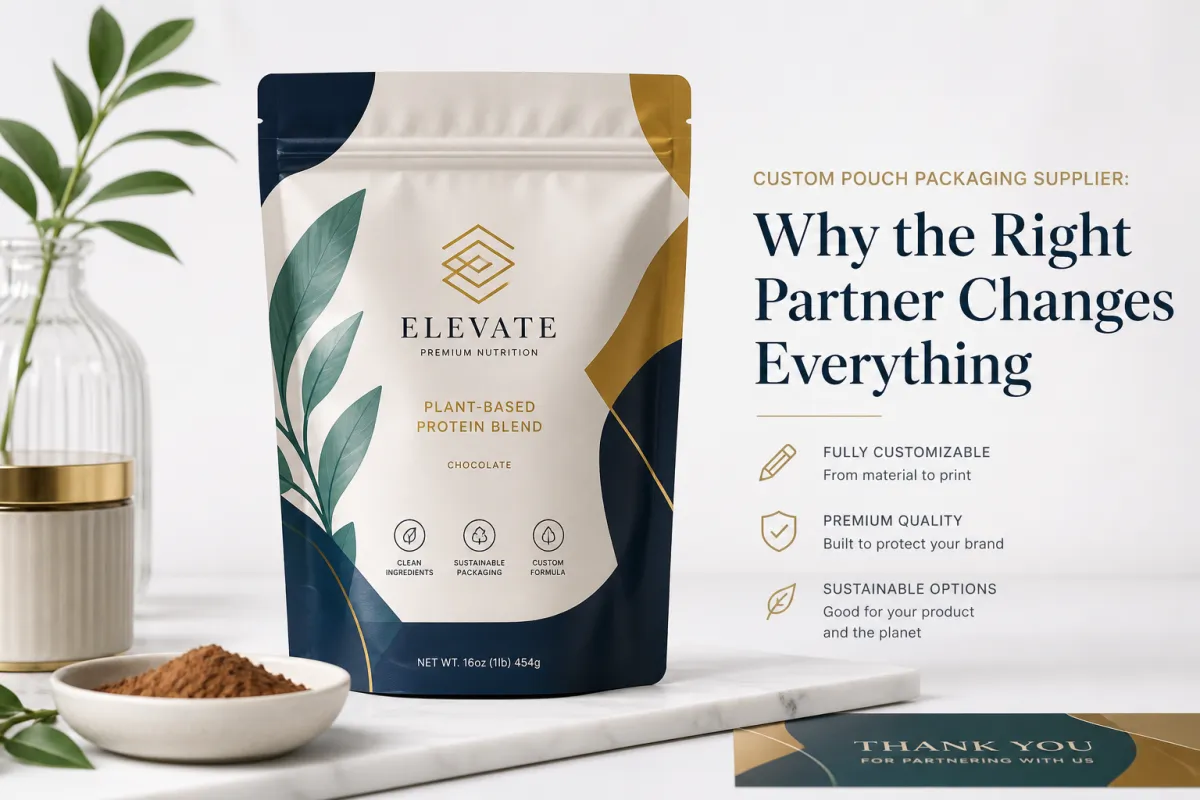
A custom pouch packaging supplier does much more than print artwork onto film. The real job is turning product specs, brand goals, and performance requirements into a pouch that can be filled, sealed, shipped, and opened as intended. That means selecting the right laminate, closure, seal area, and finish so the package works in the real world, not only in a presentation file.
I have seen a pouch pass a design review, then curl at the seal once the filler warmed the film by just a few degrees. That kind of failure is annoying because it looks small from the outside. In production, though, small is often where the expensive problems start.
A mistake buyers make again and again is treating a pouch like a small bag with graphics. That shortcut causes problems. A pouch can fail in several ways even when the artwork looks polished. The zipper can feel flimsy. The film can puncture at a corner. The barrier may be too weak for moisture-sensitive products. The seal can run inconsistently if the fill line gets too hot. A dependable custom pouch packaging supplier catches those risks early.
From the buyer’s side, the real challenge is balancing shelf appeal, product protection, and production reliability at the same time. That balance is why a seasoned custom pouch packaging supplier matters. You are not only buying a printed pouch. You are buying process discipline, material judgment, and a steady hand on the details that can quietly ruin a launch.
Category knowledge matters too. Flexible packaging covers snacks, coffee, supplements, cosmetics, pet treats, dry goods, and more, and each of those behaves differently. Coffee needs aroma retention and freshness control. Protein powders need resealability and puncture resistance. Cosmetics often need clean graphics and a premium finish. A custom pouch packaging supplier that works from a generic template is guessing with your launch budget.
That guessing shows up quickly. A buyer asks for the lowest price, then learns the pouch thickness was cut too far or the zipper style was not suited to repeated openings. The result is waste, delays, and another round of rework. A better move is to ask the custom pouch packaging supplier to explain the build before you compare the numbers.
“A pouch that photographs well but fails on line is not premium packaging. It is expensive trouble.”
If you want to sanity-check the technical side, look for suppliers who can talk about seal strength, barrier layers, puncture resistance, and transit testing. Industry references such as ISTA help frame how packaging is evaluated in shipping environments, while packaging industry resources are useful for learning the language of materials and construction. A serious custom pouch packaging supplier should be comfortable with that vocabulary.
Consistency deserves attention as well. The first sample may look excellent, yet if color shifts on the next run or the seal profile changes with a different film lot, the brand experience gets shaky. A dependable custom pouch packaging supplier is part technical partner, part quality checkpoint, and part guardrail for the details that are easy to miss until it is too late.
How a Custom Pouch Packaging Supplier Process and Timeline Works
The workflow starts with a proper brief. A good custom pouch packaging supplier should ask what the product is, how it behaves, how much it weighs, how long it needs to stay stable, and where it will be sold. That sounds basic, yet it is surprising how often teams skip straight to artwork. Packaging is not decoration first. It is a product system.
Once the brief is in place, pouch style selection comes next. Stand-up pouches, flat pouches, side-gusset pouches, spouted pouches, and specialty formats each serve a different purpose. A custom pouch packaging supplier usually narrows the options based on fill method, shelf display, and storage goals. A light dry good may fit a simpler format, while a heavier product may need a gusseted structure with better load distribution.
Material guidance follows, and this is where the supplier should stop sounding vague and start sounding useful. If your product is sensitive to oxygen, grease, or moisture, the laminate needs a barrier layer that actually matches the risk. If the pouch may take abuse in transit, puncture resistance matters. I cannot tell you one universal film stack that works for every product, because there is not one. A trustworthy custom pouch packaging supplier will recommend a build that fits the product instead of forcing a one-size-fits-all answer.
Artwork prep is where delays often begin. Most teams underestimate dielines, bleed, color management, and copy approval. If your files are not ready, the custom pouch packaging supplier pauses while layout problems get fixed. If the art is ready but the claims or legal copy are still changing, time slips away anyway. Fast projects are usually fast because the buyer is organized, not because the supplier can bend time.
Sampling is the next checkpoint. Depending on the complexity, you may see digital proofs, printed samples, or production-like prototypes. A good custom pouch packaging supplier will use this stage to confirm size, zipper feel, seal placement, panel alignment, and overall appearance. If the pouch is heading to retail, this is the moment to check how it reads on shelf from a few feet away.
Production begins after approval. On simple jobs, a custom pouch packaging supplier can sometimes turn a project in a few weeks once artwork is finalized, especially when stock components are used and the print path is straightforward. Fully custom structures, specialty finishes, compliance reviews, or multi-step sampling can stretch the schedule. In many cases the real bottleneck is not manufacturing itself but slow approvals, material sourcing, or a late-stage artwork change.
In practice, timeline drivers usually look like this:
- Artwork readiness: final files move much faster than drafts with missing copy.
- Material availability: common laminates are easier to source than niche barrier films.
- Print method: shorter runs and variable print methods may move differently than long-run gravure-style setups.
- Sample cycles: one approval round is faster than three rounds of small tweaks.
- Structural complexity: zippers, valves, spouts, or child-resistant features add time.
That is why smart buyers build in margin. A custom pouch packaging supplier can move quickly, but not if the schedule is treated like a guess. If your launch date is fixed, give yourself extra time for proofing and testing. Packaging deadlines reward planning, not optimism.
For launch planning, I like to think in ranges. Simple pouch jobs may run around 10-15 business days after proof approval, while custom builds with special hardware or added quality checks can take longer, sometimes several weeks more. If a custom pouch packaging supplier promises a miracle turnaround without asking detailed questions, that is not confidence. It is usually a warning sign with polished wording.
Key Factors to Compare Before You Choose a Custom Pouch Packaging Supplier
Not every quote is talking about the same thing. That is the first problem. A custom pouch packaging supplier might quote a film that looks similar on paper but behaves differently in sealing, shelf life, or handling. If you compare only unit price, you are comparing labels, not packaging.
Material construction is the first detail to review. Ask about laminate layers, thickness, sealant layer, barrier level, and whether the material is intended for food contact or another regulated use. A pouch for a dry snack does not need the same barrier strategy as a supplement powder or a cosmetic formula. A capable custom pouch packaging supplier should explain the stack-up in plain language.
Print quality matters just as much. CMYK printing can look beautiful, but it needs tight color control. Spot colors help with brand consistency. Matte, gloss, soft-touch, and metallic effects all change how the pouch reads on shelf. A good custom pouch packaging supplier should be able to explain how they keep color drift under control across runs, not just how strong the first sample looked.
Functionality features are where many buyers get surprised. Zippers come in different styles and strengths. Tear notches need correct placement. Hang holes matter for some retail packaging displays. Spouts, degassing valves, and child-resistant closures add cost and complexity. The right custom pouch packaging supplier will tell you which features truly help the product and which ones are only expensive decoration.
Supplier capability is the final filter, and it is often the most useful one. Watch how they communicate. Do they answer technical questions directly? Do they send clean sample pouches? Do they ask follow-up questions about product weight, filling temperature, or shelf life? A strong custom pouch packaging supplier behaves like a packaging partner, not a quote machine.
There are also standards and testing references worth understanding. For shipping and distribution, ISTA methods help evaluate how packaging behaves in transit. For sustainable sourcing, FSC matters if paper components or responsible sourcing claims are part of your packaging design. A thoughtful custom pouch packaging supplier should know when these frameworks apply and when they do not.
Here is a practical comparison buyers can use before choosing a custom pouch packaging supplier:
| Option | Typical Use | Approx. Unit Cost at 5,000 Units | Strengths | Tradeoffs |
|---|---|---|---|---|
| Basic printed stand-up pouch | Dry goods, snacks, samples | $0.16-$0.28 | Lower cost, strong shelf presence, simpler production | May have limited barrier or fewer premium finishes |
| Barrier pouch with zipper | Coffee, supplements, moisture-sensitive products | $0.24-$0.45 | Better protection, repeat-open convenience, stronger perceived value | More material cost, more setup detail |
| Spouted pouch or specialty pouch | Liquids, sauces, personal care | $0.38-$0.80+ | High utility, differentiated format, good consumer experience | Tooling, fitting, and fill validation can increase cost and lead time |
If two quotes vary widely, check whether they are actually the same spec. A thicker laminate, better zipper, higher barrier, and special finish can all push cost up. That does not mean the expensive option is always right. It means the custom pouch packaging supplier who can explain the difference is worth listening to.
Custom Pouch Packaging Supplier Pricing, MOQ, and Quote Basics
Pricing starts with structure. A custom pouch packaging supplier is pricing the pouch size, film complexity, print coverage, closure type, finish, and order quantity. If the pouch requires plates, tooling, or special setup, those charges may appear separately. That is normal. What is not normal is a quote that hides half the numbers until you are already emotionally invested in the project.
The biggest cost driver is usually the material stack. Barrier films, thicker laminates, and premium finishes cost more than simpler structures. Add-ons like matte varnish, metallic accents, laser scoring, or custom windows can shift the price quickly. A custom pouch packaging supplier should be able to explain which elements add real value and which ones are mainly visual extras.
MOQ, or minimum order quantity, is where a lot of buyers get stuck. Lower MOQs reduce inventory risk, which helps when you are testing a new SKU. Lower quantities, though, often cost more per unit. Larger runs usually improve pricing, although they require more cash up front and more storage space. A good custom pouch packaging supplier will help you choose an MOQ that fits your launch risk rather than pushing the biggest possible order.
Here is the practical version: if you are a small brand, ordering 1,000 pieces may look safer than 10,000. Sometimes it is. If the unit cost difference is dramatic, though, the small run can quietly damage your margin. A smart custom pouch packaging supplier will show you the price breakpoints so you can decide whether the savings justify the inventory exposure.
A proper quote should include at least the following:
- Unit price at the quoted quantity
- Setup or plate fees, if any
- Sample or proof costs
- Lead time for production and shipping
- Extras such as revisions, compliance checks, or special finishing
That last item matters more than people think. A custom pouch packaging supplier may quote a clean base price, then add charges for art revisions, accelerated shipping, or upgraded hardware. None of that is unusual. The issue is clarity. If the quote is vague, you cannot compare it fairly.
Use this rule: compare only like with like. Same pouch size. Same material stack. Same closure. Same finish. Same quantity. Same shipping assumption. Otherwise, the lower number may only reflect thinner film or weaker hardware hidden behind a bargain look. A disciplined custom pouch packaging supplier will be transparent enough that you can see exactly where the money goes.
For buyers working within a budget, the best question is not “What is the cheapest pouch?” It is “What is the least expensive pouch that still protects the product and represents the brand properly?” That is a much better question for a custom pouch packaging supplier because it keeps the discussion focused on value instead of false savings.
There are cases where premium features are worth the spend. If the product is high margin, the pouch is part of the retail packaging experience, or shelf life is critical, paying more for a better structure can be the right choice. A competent custom pouch packaging supplier helps you spend where it matters and trim where it does not.
Step-by-Step Guide to Working With a Custom Pouch Packaging Supplier
Step 1: Define the product and the packaging goal. Before you ask a custom pouch packaging supplier for a quote, write down the product type, fill weight, shelf-life target, closure preference, and channel. Retail shelf? Ecommerce shipping? Subscription box? Those answers change the structure.
For example, a pouch intended for shelf display may need stronger visual impact and a different opening format than a pouch built mainly for shipping. A custom pouch packaging supplier can make better recommendations when the use case is clear. “We need something nice” is not a brief. It is a sign the brief still needs work.
Step 2: Ask for a recommendation, not a random catalog dump. Some buyers request ten unrelated pouch options and then wonder why the process drags. A better move is to ask the custom pouch packaging supplier to explain the top two or three structures that fit the product. That keeps the conversation focused on fit, not noise.
If you are comparing formats across other packaging needs, it helps to review your broader mix of Custom Packaging Products so your pouch choice does not fight your box, label, or shipper strategy.
Step 3: Review dielines and proofs carefully. This is where small mistakes become large ones. Confirm logo placement, barcode sizing, legal text, seal zones, and the direction of the artwork on each panel. A custom pouch packaging supplier can only print what you approve. If the proof is sloppy, the finished pouch will be, too.
Step 4: Check the sample against the actual product. Do not just stare at the empty pouch. Fill it. Seal it. Handle it. Put it in a shipping carton. Drop-test it if needed, or at least use the standards that fit your use case. If distribution is rough, ask the custom pouch packaging supplier whether transit testing aligned with ISTA methods makes sense. That can save you from a lot of quiet failures later.
Step 5: Lock down receiving and fill standards. The production pouch can still fail if your receiving team, filler, or co-packer is not aligned on how the package should behave. Set seal-temperature expectations, carton pack counts, handling instructions, and inspection points. A good custom pouch packaging supplier should help you document the basics so launch day does not become a salvage operation.
One thing I tell buyers often: the smoother the process, the less dramatic it looks from the outside. That is because the custom pouch packaging supplier did the technical work early. The packaging may look simple on shelf, but simple is usually what disciplined execution looks like.
Common Mistakes When Hiring a Custom Pouch Packaging Supplier
The first mistake is the easiest one to spot, and people still make it: choosing only on price. A custom pouch packaging supplier can quote a low number by trimming film thickness, simplifying hardware, or limiting print options. Then the buyer discovers the pouch does not feel right, does not seal consistently, or does not match the brand expectation. Cheap packaging can become expensive very quickly.
The second mistake is skipping samples because the artwork looked fine on screen. Screen previews are not production pouches. Color shifts happen. Film texture matters. Seals feel different in hand. A real sample from a custom pouch packaging supplier shows you the details a mockup cannot.
The third mistake is ignoring product requirements. Food, supplements, cosmetics, and other sensitive categories may need specific barrier performance, clean materials, or claim discipline. If the supplier does not ask enough questions, that is a problem. A serious custom pouch packaging supplier should be thinking about function before unit cost.
The fourth mistake is assuming lead time is flexible. It often is not. Artwork changes, sample revisions, material sourcing, and approvals all take time. If you wait too long, rush fees appear. A custom pouch packaging supplier can help you move quickly, but they cannot compress sourcing, production, and approvals into a mood board.
The fifth mistake is failing to compare the right details. Two quotes can look similar at first glance and still be completely different underneath. One may include a better zipper, a heavier laminate, or a higher barrier film. Another may be bare-bones. If the buyer does not force the specs into alignment, the lower quote from the custom pouch packaging supplier is only lower on paper.
Another common issue: buyers over-specify without thinking through the result. They ask for every premium finish available, then wonder why the margin shrinks. More gloss, more foil, more layers, more hardware, more cost. That is not a surprise. The right custom pouch packaging supplier will tell you where upgrades matter and where they are only theater.
Here is the blunt version. Good packaging is not about packing a pouch with features until it looks impressive in a spreadsheet. It is about matching the build to the product and the channel. A good custom pouch packaging supplier makes that easier. A bad one makes it sound easy while quietly setting you up for a reprint.
Expert Tips and Next Steps for Shortlisting a Custom Pouch Packaging Supplier
Keep your shortlist tight. Three suppliers is usually enough to compare specs, sample quality, communication, and pricing without drowning in options. A custom pouch packaging supplier that answers clearly and sends organized materials is often worth more than a cheaper quote with a messy back-and-forth.
Ask for two versions of the quote: the build you actually want and a leaner alternative. That reveals where the cost pressure lives. Maybe the zipper is carrying more weight than expected. Maybe the finish matters less than the barrier. Maybe the print coverage is driving cost harder than the size. A practical custom pouch packaging supplier should be able to walk you through that tradeoff without taking offense.
Request proof of category experience. A supplier that knows snack pouches is not automatically strong on supplements, cosmetics, or pet products. Different products have different handling and shelf-life demands. If the custom pouch packaging supplier understands your category, the odds of a cleaner launch go up. Simple as that.
Use standards as a filter, not a slogan. If the product has transit risk, ask about distribution testing. If sustainability claims are part of the brief, ask what can be supported with credible documentation. If recycled or certified fiber is part of the build, verify whether FSC-related claims apply. A trustworthy custom pouch packaging supplier will not dodge those questions.
“The cheapest pouch quote is often the one with the most expensive lesson attached.”
Before you decide, set a decision date, request final samples, and compare every quote on the same spec sheet. Then choose the custom pouch packaging supplier that fits your budget, quality bar, and launch timing. If you want packaging that supports the product instead of fighting it, this is not the place to guess.
For teams building out broader branded packaging, reviewing Custom Packaging Products can help you coordinate pouches with other formats instead of treating each item like a separate crisis. That is usually the cleaner way to buy.
Start with a clear product brief, insist on apples-to-apples quotes, and make the supplier explain the material stack before you think about price. If a custom pouch packaging supplier can do that well, you are probably looking at a partner worth keeping. If they cannot, keep moving.
What should I ask a custom pouch packaging supplier before I request a quote?
Ask what pouch structures they recommend for your product and why. Confirm MOQ, sampling process, lead time, and whether tooling or plates are needed. A good custom pouch packaging supplier should also break out unit cost, setup fees, shipping, and revision charges so the quote is readable instead of mysterious.
How do I know if a custom pouch packaging supplier is quoting the right material?
Match the material to the product’s needs: barrier, puncture resistance, resealability, and shelf life. Ask for the film spec in writing, not a vague “premium laminate” label. If a custom pouch packaging supplier cannot explain the structure, they are probably selling a price instead of a packaging solution.
What is a normal MOQ for custom pouch packaging supplier orders?
There is no single number because MOQ shifts by pouch size, print method, structure, and add-ons. Lower MOQs usually cost more per unit, while higher runs bring the unit price down. The right MOQ is the one that fits your cash flow, storage space, and launch risk. A custom pouch packaging supplier should be able to show those tradeoffs clearly.
How long does a custom pouch packaging supplier usually need to produce an order?
Simple jobs can move quickly once artwork is approved, while custom structures, special finishes, and extra checks take longer. Sampling, proofing, and material availability are usually the biggest timeline bottlenecks. If you need a specific launch date, build in margin instead of expecting a custom pouch packaging supplier to pull a miracle out of thin air.
How can I compare two custom pouch packaging supplier quotes fairly?
Use the same pouch size, material stack, closure, finish, and quantity for both quotes. Check whether shipping, samples, setup, and revision fees are included. If one quote looks much cheaper, inspect the spec sheet first. A custom pouch packaging supplier can only be compared fairly when the build is actually the same.

