Buyer Fit Snapshot
| Best fit | Custom Pouch Packaging for Logistics projects where brand print, material claims, artwork control, MOQ, and repeat-order consistency need to be specified before quoting. |
|---|---|
| Quote inputs | Share finished size, material target, print colors, finish, packing count, annual reorder estimate, ship-to region, and any compliance wording. |
| Proofing check | Approve dieline scale, logo placement, barcode or warning zones, color tolerance, closure strength, and carton packing before bulk production. |
| Main risk | Vague material claims, crowded artwork, missing packing details, or unclear freight terms can make a low unit price expensive after revisions. |
Fast answer: Custom Pouch Packaging for Logistics: Film, Print, MOQ, and Carton Packing should be specified like a repeatable production item. The safest quote records material, print method, finish, artwork proof, packing count, and reorder notes in one written spec.
Production checks before approval
Compare the actual filled-product size with the drawing, then confirm tolerance on folds, seals, hang holes, label areas, and retail display edges. Reserve space for logos, QR codes, warning copy, and material claims before decorative graphics fill the panel.
Quote comparison points
Review material grade, print process, finish, sampling route, tooling charges, carton quantity, and freight assumptions side by side. A quote is only useful when the supplier can repeat the same color, closure quality, and packing count on the next order.
Custom Pouch Packaging for Logistics: A Practical Guide
Custom Pouch Packaging for logistics is one of those choices that looks tiny in a deck and expensive in a warehouse. I've watched teams approve a pouch because the artwork looked clean, then spend the next month chasing crushed seals, smudged barcodes, and pallets that did not want to stay put. The product was fine. The pack was the problem.
That gap between “looks good” and “moves well” is where packaging budgets quietly bleed out. A team picks a stock pouch because the dimensions are close enough, then discovers the fill line slows down, the label lands on a seam, or the air inside the pouch eats cube space across an entire pallet. Custom pouch packaging for logistics fixes that by treating the pouch as a transport decision, not just a design one. The payoff usually shows up as fewer damage claims, cleaner warehouse handling, better freight density, and less rework.
This piece covers what custom pouch packaging for logistics actually solves, how it behaves in transit, which specs move cost, how to budget without guessing, and how to avoid the mistakes that turn a “simple pouch” into a headache. If you're comparing packaging options for a launch or trying to fix a shipping problem without rebuilding the whole line, start here. No fluff. Just the stuff that matters.
What Custom Pouch Packaging for Logistics Really Solves
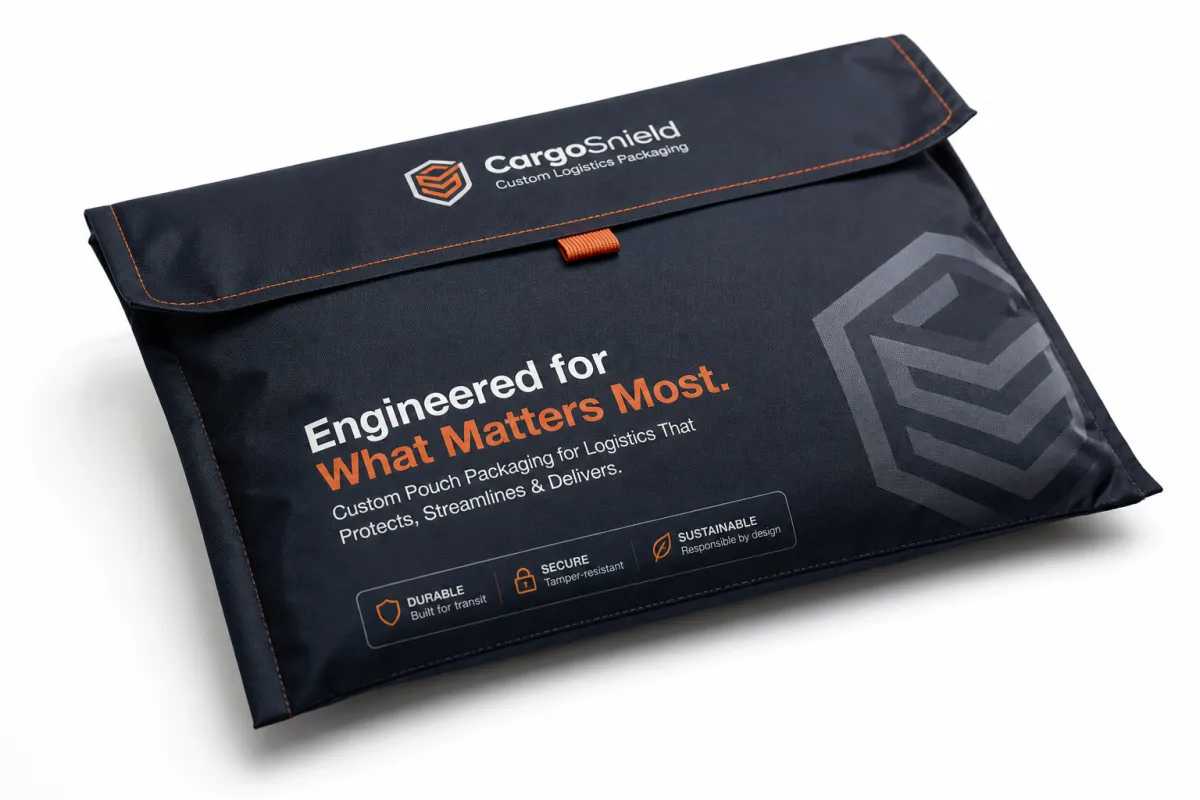
The easiest way to understand custom pouch packaging for logistics is to picture a product that clears every production check, then falls apart after it leaves the building. The fill looks clean. The seal passes a quick pull test. The artwork is sharp. Then the pouch hits stack pressure, vibration, humidity, or a carrier that does not baby freight. Two days later, the customer opens a carton and finds scuffed film, stressed seams, or a barcode that refuses to scan. The product was fine. The packaging spec was not.
That is the real job of custom pouch packaging for logistics: match the pouch to the route. A pouch built for handling, stacking, puncture resistance, and readable variable data usually does better than a generic format that only cared about shelf appeal. The spec has to answer four questions at once: Can it survive the trip? Can workers pack it quickly? Can scanners read it at every checkpoint? Can the customer receive it without repacking or complaints?
From a packaging buyer's side, custom pouch packaging for logistics is not just a container. It affects labor time, because a pouch with the wrong mouth opening slows fill speed. It affects cube efficiency, because a few extra millimeters in width can reduce pallet density more than people expect. It affects damage rates, because a film that is fine for retail packaging may be too soft for a rough carrier network. And it affects customer satisfaction, because the first visible sign of quality is often the condition of the package, not the product inside.
Stock pouches still have a place. They are fast to source and useful for early-stage product packaging. But stock sizes often force ugly compromises: empty headspace, weak seals near the edge, awkward label placement, or a format that makes the warehouse use more cartons than it should. Custom pouch packaging for logistics removes a lot of that nonsense by matching the pouch to the product dimensions, filling method, and shipping profile.
Here is the part teams miss. Better logistics packaging is not always heavier packaging. It is packaging that uses the right film structure, the right seal geometry, and the right footprint for the actual move. That may mean a stronger laminate. It may also mean a smaller pouch, a different gusset, or a barcode panel that stays flat enough for scanning. Custom pouch packaging for logistics makes those trade-offs explicit instead of accidental.
A pouch that looks perfect on a shelf can still be the wrong choice for a pallet.
For teams building broader package branding systems, that split matters. You might keep premium retail packaging for the shelf, use custom printed boxes for display kits, and reserve custom pouch packaging for logistics for the transport layer that protects the SKU between sites. That separation usually helps cost control, because the outer and inner packs each do the job they were actually built for.
How Custom Pouch Packaging for Logistics Works in Transit
To see how custom pouch packaging for logistics performs, follow the product through the chain. It starts with filling and sealing, where the pouch has to open consistently and close with enough seal width to hold under stress. It moves into cartoning or case packing, where the pouch shape decides how many units fit cleanly and whether workers can pack without wrestling the material. Then it reaches palletizing, where footprint, compressibility, and surface friction influence stack stability. After that come warehousing, line-haul shipping, cross-dock handling, and final delivery. Each stage brings a different kind of abuse.
Compression is one of the most overlooked issues in custom pouch packaging for logistics. A pouch that flexes too much can bulge between carton flaps, then get crushed by the next layer. Vibration is another quiet problem. Over long truck routes, vibration can fatigue seals and shift internal product, especially if the pouch has inconsistent fill volume. Abrasion matters too. A glossy film may print beautifully, but if pallet wrap pulls tight or cartoned pouches rub against neighboring packs, the scuffing can make the package look tired before it reaches the customer.
Barrier performance is the other half of the story. If the product is moisture-sensitive, oxygen-sensitive, odor-sensitive, or contamination-sensitive, custom pouch packaging for logistics needs the right film structure, not just the right shape. Laminates such as PET/PE, PET/AL/PE, or PE with EVOH barrier layers get used for different reasons. The choice depends on shelf life, exposure conditions, and whether the product is food, personal care, industrial, or chemical. There is no universal film that wins every route. If someone says there is, they are selling you a shortcut, not a solution.
Transit testing is where theory stops pretending. Many teams use procedures inspired by ISTA protocols to simulate distribution hazards before they commit to volume. The ISTA organization publishes test methods that help packaging teams think beyond the bench and into the shipping lane. That matters for custom pouch packaging for logistics, because a pouch that survives a quick drop test may still fail after compression, vibration, and temperature swings all hit at once.
Labeling and traceability in the supply chain
Custom pouch packaging for logistics also has to act like a data carrier. Barcode readability, batch coding, QR placement, and traceability marks can matter just as much as material strength. If the pouch uses a curved surface or a glossy film that reflects badly under a scanner, the warehouse may spend time rescanning, relabeling, or manually entering data. That is labor cost, not a tiny annoyance.
In a mixed handling environment, the best logistics pouch keeps the print in a quiet zone away from seams and folds. Variable data should sit on a flat panel with enough contrast to read after minor scuffing. If the label has to survive cold storage, moisture, or repeated touch points, the print system needs to match those conditions. Custom pouch packaging for logistics should be designed around the data path as much as the product path.
Consider the practical difference between a generic pouch and a logistics-tuned pouch. The generic version may use a standard width, a narrow seal, and a label applied wherever there is space. The logistics-tuned version may be 10-15 mm narrower, use an 8-10 mm top seal, place the barcode on a flat front panel, and reduce headspace so the pouch sits tighter in the case. Those small changes can improve pallet density, reduce movement, and cut the chance of shipping damage. That is why custom pouch packaging for logistics tends to look modest on a spec sheet but significant in operations.
Retail packaging often prioritizes visual hierarchy, while custom pouch packaging for logistics prioritizes survivability and repeatability. The two are not fighting each other. They just answer different questions. A decent packaging design team knows where each one starts and stops.
Key Factors That Affect Performance and Cost
If you strip custom pouch packaging for logistics down to the economics, six variables do most of the work: material structure, pouch size, seal geometry, closure type, print complexity, and testing requirements. Each one changes both performance and cost. The trap is assuming the cheapest version of each item creates the cheapest overall package. It usually does not.
Material choice is usually the biggest decision. Mono-material films can support recyclability goals and simplify end-of-life messaging, while laminated structures often deliver better barrier and puncture resistance. Recycled-content options may fit sustainability targets, but they still need to be checked against seal performance and product compatibility. A logistics buyer should ask for actual film specs, not marketing fluff. For custom pouch packaging for logistics, a 3 mil structure may be enough on one route and too fragile on another. The product, route, and handling pattern all need to line up.
Pouch size is not cosmetic. A pouch that is 8% larger than necessary may seem harmless until you see the extra cartons, the extra pallet layers, and the extra air freight cost caused by wasted cube. A pouch that is too tight can stress the seal line or slow filling at the line. Seal width matters too. A 6 mm seal may work in low-risk conditions, while 8-10 mm often feels safer when the route is rough or the product is prone to pressure changes. For custom pouch packaging for logistics, geometry is part of the durability plan.
Closure style changes the equation as well. Zippers help resealability, but they add cost and are not necessary for every logistics-use pouch. Tear notches support opening control. Spouts, fitments, or easy-open features create new handling steps and may make sense for consumer-facing product packaging, but they are not always ideal for bulk logistics. The best spec is not the most feature-packed one. It is the one that fits the motion of the supply chain.
What usually drives the quote up
The pricing on custom pouch packaging for logistics often rises because of print coverage, special finishes, and tooling. Full-coverage graphics, metallic inks, matte varnishes, and multiple spot colors all add complexity. So do variable data requirements, especially when the design needs a lot code, batch code, or compliance text in a tight area. If the supplier uses flexographic or gravure printing, cylinder or plate charges can matter. Digital printing may cut setup cost for shorter runs, but the per-unit cost can climb as volume goes up.
Testing adds cost, but skipping it usually costs more. Seal strength tests, drop tests, vibration tests, and compression checks all help prove whether custom pouch packaging for logistics will hold up on the route it is meant to serve. A supplier may send a polished sample, but a sample is not a shipment. Real logistics conditions are messier than a controlled demo. They always are.
Procurement teams should keep asking the same question: does this feature protect the product, improve throughput, or cut freight waste? If the answer is no, it may just be decorative cost. That mindset keeps custom pouch packaging for logistics from drifting into over-specification.
| Option | Typical Unit Price | Tooling / Setup | Best For | Trade-Off |
|---|---|---|---|---|
| Stock pouch | $0.10-$0.20 | Usually none | Small trials, basic product packaging | Limited fit, more wasted space |
| Basic custom printed pouch | $0.18-$0.32 | $250-$600 plate/cylinder or digital setup | Branding and moderate volume | May still need logistics tuning |
| Logistics-tuned custom pouch | $0.24-$0.48 | $400-$1,200 depending on print method and structure | Higher damage risk, tighter cube targets | Higher upfront spend, better shipping control |
That table is not a universal price sheet. It is a working range for quoting conversations. Final numbers depend on film structure, order quantity, print coverage, closure type, and lead time. Still, it shows why custom pouch packaging for logistics should be priced as a supply-chain asset, not just as a packaging purchase. If the pouch cuts breakage, lowers repacking, or improves pallet density by even a few points, the extra unit cost can pay for itself quickly.
For teams comparing suppliers, a good starting point is to request both unit price and landed cost. That means freight, warehousing impact, scrap rates, and any damage claims should be part of the discussion. You can also review Custom Packaging Products to compare structures and see where a logistics-specific pouch fits beside other packaging options. In many cases, custom pouch packaging for logistics sits between low-cost stock formats and fully bespoke retail packaging systems.
Custom Pouch Packaging for Logistics Pricing and Budgeting
Budgeting for custom pouch packaging for logistics works best when the team stops staring at unit price alone. The question is not “What does one pouch cost?” The better question is “What does a damaged shipment cost, what does a slow fill line cost, and what does wasted cube cost over a full year?” Those numbers are usually much larger than the packaging line item.
A disciplined quote should separate five buckets: material cost, print cost, tooling, minimum order quantity, and testing or quality control. If the supplier offers a narrow seal upgrade, a different laminate, or a more durable closure, each item should be priced separately. That makes it easier to see whether custom pouch packaging for logistics is expensive because of real protection needs or because the design is carrying extra fluff nobody asked for.
Short-run economics are different from long-run economics. A smaller order may have a higher unit price, but it reduces inventory risk and lets the team test the pouch against real shipping conditions. A larger order usually lowers unit cost, but only if the spec is stable. If the product is still changing, locking into high volumes can backfire. The most efficient custom pouch packaging for logistics program usually grows in phases: sample, pilot, controlled rollout, then scale.
MOQ pressure is real. Some converters will quote a practical minimum because their print method or film sourcing demands it. That can be fine if the pouch is going to move in volume. But if the product is still proving itself, it may be smarter to keep the first run tight and spend a bit more per unit. That is not waste. It is risk control. The cheapest mistake in packaging is usually the one that shows up after 20,000 units ship.
How to budget without guesswork
Use a simple framework. First, define the shipping conditions: parcel, LTL, palletized freight, humid storage, temperature swings, or cross-border handling. Second, list the protection requirements: puncture resistance, seal reliability, barrier level, barcode readability, and fill speed. Third, ask the supplier to quote one version that meets those requirements and one that is stripped down. With two quotes in hand, the value of custom pouch packaging for logistics becomes easier to see.
Then compare those quotes against total landed cost. If a pouch saves one repack labor minute per carton, or prevents even a modest number of claims each month, the effective savings can beat the unit price difference. That is why logistics teams should talk to customer service and warehouse supervisors before they approve the final design. They see the hidden cost points that procurement spreadsheets usually miss.
One practical tip: ask for the supplier's revision policy. If artwork changes, if the barcode moves, or if the pouch dimensions shift after sampling, retooling fees can appear fast. A clean spec sheet saves money later. So does version control. Custom pouch packaging for logistics works best when the pack brief is treated like an operational document, not a creative one-off.
If you want to keep the discussion grounded, ask for actual examples of film gauge, seal width, and timeline. For instance, a simple digital-print pouch might be ready in 12-15 business days after proof approval, while a laminated, higher-barrier program can take 20-30 business days or more depending on complexity. Those numbers are not promises. They are the kind of ranges that help buyers plan without pretending production runs on good vibes.
For teams building out broader packaging procurement, it can help to compare pouch spend against other product packaging lines such as mailers, cartons, or Custom Packaging Products that support multi-format fulfillment. Often, the real savings come from Choosing the Right pack style for each channel rather than forcing one design to do every job. That is especially true for custom pouch packaging for logistics, where the channel usually matters more than the artwork.
Step-by-Step Process and Timeline for Custom Pouch Packaging
A successful custom pouch packaging for logistics project usually starts with a requirements audit, not with artwork. Measure the product dimensions, note the fill weight, record the shipping route, and document the handling environment. Is the product palletized or parcel-shipped? Does it sit in hot warehouses or refrigerated storage? Is it shipped once or moved several times internally before final delivery? Those facts shape the spec more than the design trend of the month.
Next comes structure selection. The team should decide on film type, pouch size, seal width, closure, and any print or label zones before asking for samples. This is the point where people often make a packaging design mistake: they start with brand color and end with route behavior. With custom pouch packaging for logistics, the order should run the other way. Pick the logistics requirements first, then fit the branded packaging around them.
Sampling and prototyping should be treated as testable steps, not ceremonial ones. Ask for a physical sample, then test it under the same conditions the finished pouches will face. That means stacking, drop handling, vibration, temperature exposure, and barcode checks. If the product has a specific compliance rule or contact sensitivity, include that in the test brief. Seal strength and peel behavior checks can help reveal problems before production starts. The point is not to make the sample perfect. The point is to learn what breaks first.
For many teams, the timeline from brief to first production run falls in the 3-6 week range, depending on approvals and complexity. Simple programs move faster. Complex ones move slower, especially if the artwork needs multiple revisions, the structure uses a specialty barrier film, or the supplier has to align print plates, cylinders, or digital proofs. Custom pouch packaging for logistics should include time for internal sign-off, because rushed approvals are a classic way to turn a good design into a headache.
A realistic launch sequence
- Define the product, route, and performance targets.
- Request structural options and sample candidates.
- Review print layout, barcode placement, and fill method.
- Run lab and real-world tests.
- Perform a pilot shipment with warehouse feedback.
- Lock the spec and document revision control.
- Scale once the data matches the target.
The pilot shipment matters more than most teams expect. A pouch can look fine in a meeting and still slow down the packing line because the opening is awkward or the film sticks in cold conditions. Warehouse staff usually catch the practical issues first: slippery surfaces, weak zipper feel, poor tear behavior, or labels that peel in humidity. Custom pouch packaging for logistics gets a lot stronger once those issues are fixed before launch.
Build a handoff checklist before full production. Include final dimensions, approved artwork, barcode location, seal width, acceptable tolerances, packaging count per case, and the target pallet pattern. If the supplier and the warehouse both work from the same document, the risk of small errors drops fast. That is especially useful when a company runs multiple SKUs and wants one consistent logistics format across different product packaging lines.
For companies that already have a procurement rhythm, it can be useful to review our Custom Packaging Products alongside the new pouch spec. That comparison often exposes gaps between what looks tidy on a spreadsheet and what performs in the shipping lane. In practice, custom pouch packaging for logistics should be introduced as a controlled change, not a guess.
Common Mistakes With Custom Pouch Packaging for Logistics
The most common mistake with custom pouch packaging for logistics is designing for shelf appeal and forgetting that the package will be stacked, handled, loaded, unloaded, and scanned. A pouch that looks polished in retail packaging can still fail if the seal is too close to the edge or the film is too soft for the route. Visual appeal matters, but it should never be the only design criterion.
Oversizing is a quiet killer. A pouch that is too large wastes material and freight cube, and it may move inside the case enough to scuff the print or stress the closure. Undersizing is just as bad. It can stretch the film, slow the packer, and create a seal that looks fine but is working too hard under pressure. Custom pouch packaging for logistics works best when the tolerances are clear and the fill target is realistic.
Another mistake is hiding critical information in the artwork. If the barcode crosses a fold, lands too close to a seam, or sits on a glossy curve, scan rates can drop. Batch codes and handling instructions can disappear in a busy print field. Then the warehouse has to compensate with secondary labels, which adds labor and another chance for error. For custom pouch packaging for logistics, data placement is operational, not decorative.
Skipping real-world testing is probably the most expensive error of all. Supplier samples are useful, but they do not replicate the full distribution environment. A pouch may pass a hand test and still fail after a pallet sits in a humid warehouse for two days, then rides in a vibrating trailer. That is why the best custom pouch packaging for logistics programs use a small pilot shipment and inspect the results before scaling.
A sample that survives a meeting is not the same as a pack that survives a route.
There is also a total landed cost blind spot. Buyers sometimes focus on the unit cost and ignore the freight, claims, rework, and labor hidden around it. If a slightly higher-spec pouch reduces damages by a few points or improves pallet density, the total system cost may fall. That is the kind of math that matters in custom pouch packaging for logistics. The right spec is rarely the lowest sticker price.
Here is a simple troubleshooting rule: if the pouch fails, do not blame the film first. Look at the product, the route, the fill weight, the seal width, the pallet pattern, and the storage conditions together. Most failures happen because the spec, the product, and the logistics lane were never fully aligned. That is the real lesson behind custom pouch packaging for logistics.
Expert Tips and Next Steps for Custom Pouch Packaging for Logistics
The best advice for custom pouch packaging for logistics is simple: ask for evidence, not promises. Request material specs, transit-test data, and examples from shipping environments that resemble your own. If a supplier cannot explain seal width, barrier choice, or the reason for a specific film structure, that is a warning sign. A good converter should connect the spec to the route in plain language.
Build a scorecard before you choose a final design. Weight the factors that actually matter to your operation: damage reduction, cube efficiency, fill speed, barcode readability, print quality, and lead time. Not every metric needs equal weight. For a parcel-heavy product, scan accuracy may matter more. For a pallet-heavy product, compression resistance and freight density may matter more. That is the practical side of custom pouch packaging for logistics.
I usually tell teams to test one variable at a time. Change size while holding material constant. Change seal width while keeping artwork fixed. Change barrier structure only after the first two variables are understood. That method makes it much easier to identify the real cause of a failure. It also keeps conversations with suppliers more focused, which saves time and cuts revision loops. Custom pouch packaging for logistics gets better faster when the team avoids changing five things at once.
Cross-functional review is not optional. Packaging, operations, procurement, and customer service all see different parts of the problem. Operations knows whether the pouch slows the line. Procurement sees the unit cost and MOQ. Customer service sees the damage claims. Packaging sees the structural trade-offs. Put those views together before locking the spec, and custom pouch packaging for logistics usually lands closer to the real need.
One more practical note: if the supplier gives you a pretty sample but dodges questions about seal geometry, print placement, or barcode durability, slow down. That is where a lot of projects go sideways. The best vendors are not the loudest ones. They are the ones who can explain why a 2 mm change in seal width matters and what it does to handling. That kind of detail is boring in a sales call and valuable in a warehouse.
Use this short checklist before launch:
- Define the product dimensions, fill weight, and route conditions.
- Confirm barrier, seal, and puncture targets for the actual shipping lane.
- Review barcode placement and variable data requirements.
- Request samples and run a pilot shipment.
- Compare unit price with total landed cost.
- Lock revision control before full production.
If you want to keep comparing packaging options, review Custom Packaging Products and map them against your logistics priorities. That comparison is often revealing. A format that looks ideal for retail packaging may not be the smartest choice for transit, while a modest-looking pouch can outperform more elaborate alternatives once it is tuned for handling. That is the quiet advantage of custom pouch packaging for logistics: it puts performance where the shipment actually needs it.
My closing view is straightforward. custom pouch packaging for logistics is not about making the package fancier. It is about making the package smarter. If the material, dimensions, seal, print, and testing all match the route, the pouch becomes part of the shipping system instead of a weak point in it. The next move is simple: write the route conditions down, test the pouch in a real pilot, and do not scale until the data says it is ready. That is how you keep the pack from costing you twice.
How do I choose the right material for custom pouch packaging for logistics?
Match the film to the product's sensitivity, transit distance, and handling risk. For custom pouch packaging for logistics, puncture resistance, seal reliability, and barrier performance usually matter more than cosmetic finishes. Ask for samples, run them through the same handling conditions your shipments face, and confirm that the material supports labeling and compliance needs before you lock the spec.
What affects the price of custom pouch packaging for logistics the most?
Material structure, print complexity, order volume, and tooling usually drive the biggest swings. Special seals, closures, and testing requirements can also lift cost. With custom pouch packaging for logistics, freight savings and damage reduction should be part of the pricing conversation, not just the unit price. Minimum order quantities can change the effective cost per pouch more than buyers expect.
How long does a custom pouch packaging for logistics project usually take?
Simple projects can move quickly if artwork and specifications are already approved. Sampling, revisions, and testing usually take the longest, especially when the team wants to verify performance in real shipping conditions. For custom pouch packaging for logistics, production lead time depends on volume, printing method, and supplier capacity, so build extra time for approvals and pilot shipments.
What should I test before using custom pouch packaging for logistics at scale?
Test seal strength, puncture resistance, print durability, and barcode readability. Run mock shipments that include stacking, vibration, drops, and temperature changes. With custom pouch packaging for logistics, it also helps to check whether the pouch holds up after warehousing and repeated handling, and whether packing staff can fill and seal it efficiently without adding labor friction.
What is the most common mistake with custom pouch packaging for logistics?
Designing for appearance first and logistics second is the most common failure. Buyers often choose a spec that looks good but ships poorly, then discover the issue only after damage claims or repacking costs appear. The best fix for custom pouch packaging for logistics is to define shipping conditions before finalizing the pouch design, then test the pack in real conditions before scaling.

