Buyer Fit Snapshot
| Best fit | custom pouches with logo branding for packaging buyers comparing material specs, print proof, MOQ, unit cost, freight, and repeat-order risk where brand print, material, artwork control, and repeat-order consistency matter. |
|---|---|
| Quote inputs | Share finished size, material target, print colors, finish, packing count, annual reorder estimate, and delivery region. |
| Proofing check | Approve dieline scale, logo placement, barcode or warning zones, color tolerance, and any recyclable or compostable wording before bulk production. |
| Main risk | Vague material claims, crowded artwork, or missing packing details can create delays even when the unit price looks attractive. |
Fast answer: Custom Pouches with Logo Branding: Film, Closure, Print, and Fulfillment should be specified like a repeatable production item. The safest quote includes material, print method, finish, artwork proof, carton packing, and reorder notes in one written spec.
What to confirm before approving the packaging proof
Check the product dimensions against the actual filled item, not only the sales mockup. Ask for tolerance on folds, seals, hang holes, label areas, and retail display edges. If the package carries a logo, QR code, warning copy, or legal claim, reserve that space before decorative graphics fill the panel.
How to compare quotes without losing quality
Compare board or film grade, print process, finish, sampling route, tooling charges, carton quantity, and freight assumptions side by side. A lower quote is only useful if the supplier can repeat the same color, closure quality, and packing count on the next order.
The first thing a shopper touches is often the pouch, not the product inside it. That is why Custom Pouches With Logo carry so much weight: they have to protect the contents, sell the brand, and hold up through shipping and stocking before anyone even opens them. If the pouch feels thin or the printing looks off, people notice faster than most teams expect.
Packaging design is never just decoration. A pouch that reads poorly, tears early, or arrives scuffed leaves the brand paying for the same mistake more than once. I have seen launches stall over packaging issues that looked minor in a file review and turned into a headache once the finished pouches hit the warehouse.
Custom Pouches With Logo: What They Are and Why They Sell
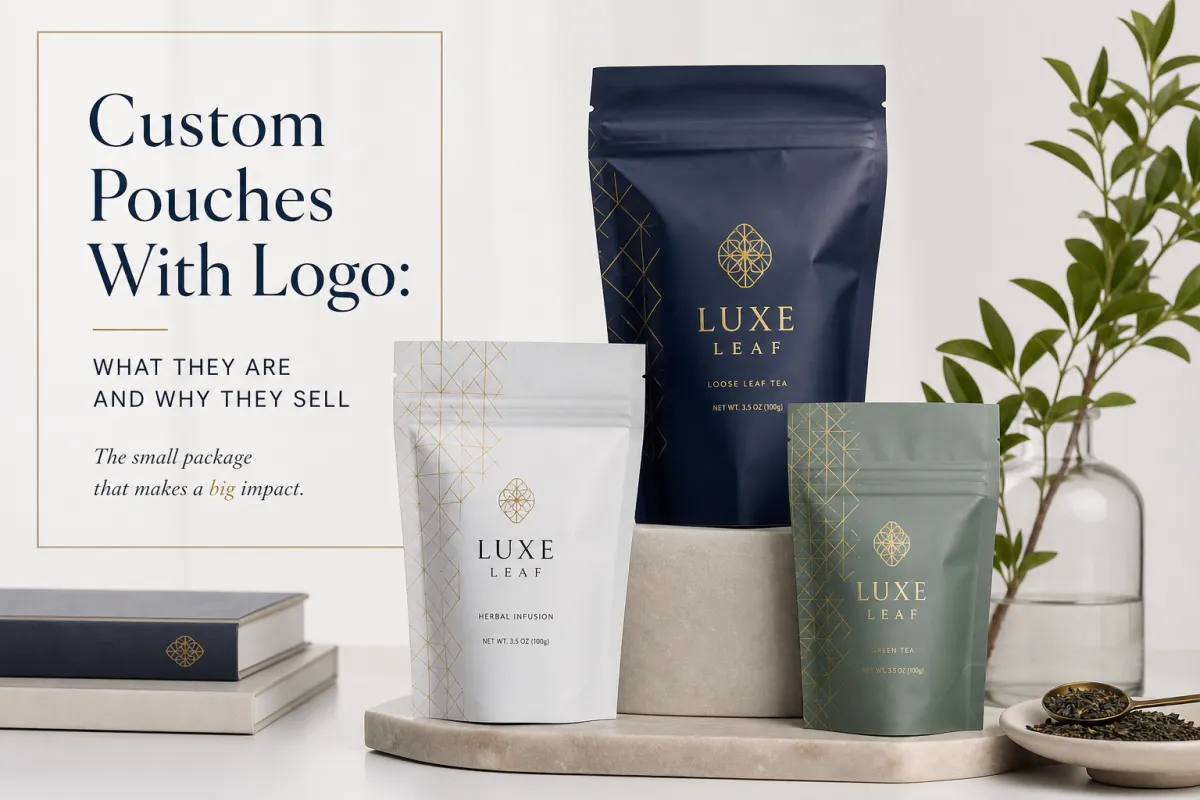
Custom pouches with logo are flexible branded packages made to hold a product, protect it, and present it in a way that feels ready for retail. They bring structure, graphics, and finish into one package instead of treating each part as an afterthought, which is why they often outperform plain stock bags once a brand starts competing for shelf attention.
That matters because the pouch is doing several jobs at once. It serves as product packaging, a sales surface, and a shipping-friendly container all in one format. For snacks, coffee, supplements, cosmetics, powders, or samples, custom pouches with logo usually take up less shelf space than rigid containers while still giving the brand plenty of room for claims, icons, instructions, and the visual hierarchy Retail Packaging Needs to stand out in a crowded aisle.
Buyers like the format for another reason: it is practical. A stand-up pouch ships flatter than a box, weighs less than a jar, and often stacks better in storage and back-room inventory. That can lower freight and cut down on damage. It also gives brands a way to move beyond generic stock bags without jumping straight into expensive rigid formats or custom printed boxes.
The plain version is easy to understand. If the pouch looks cheap, the product feels cheaper. If the pouch feels deliberate, the product usually earns a stronger first impression. Custom pouches with logo are not magic, yet they do a lot of work when the artwork, structure, and material are chosen with care. Honestly, that basic truth is kinda the whole ballgame.
"A pouch is not just a wrapper with a zipper. It is the first salesperson the customer meets."
That is also why this format performs well across categories. A coffee roaster needs aroma protection and a premium look. A supplement brand needs barrier protection and clear labeling. A cosmetic line wants shelf presence and a finish that feels considered rather than bargain-bin. In all three cases, custom pouches with logo can create strong visual impact without demanding a bulky footprint.
- Snacks: barrier films help keep crunch, aroma, and flavor in better shape.
- Coffee and tea: one-way valves, foil layers, and resealability matter to freshness.
- Supplements: clean layouts and tamper-aware structures help build trust.
- Cosmetics and samples: the pouch can feel premium without adding much shipping weight.
That is the real appeal. Custom pouches with logo are not just a branding exercise. They are a practical packaging choice that affects price, shelf appeal, freshness, and how easily the product moves through the supply chain. If those four pieces do not line up, the brand usually feels the strain sooner rather than later.
In other words, the pouch has to earn its keep. It needs to protect the product, support the sales story, and stay affordable enough that the margin still makes sense after printing, freight, and storage are all tallied up.
How Custom Pouches With Logo Are Designed and Printed
The strongest custom pouches with logo start with structure, not a mockup. A designer can make nearly anything look polished on a screen. A production file has to survive seal zones, zipper space, fill levels, and the natural curve of the pouch once it is standing on shelf. That difference separates packaging that photographs well from packaging that actually works.
The process usually begins with a dieline. That flat template shows where the front panel, back panel, gussets, seals, and tear notch will sit. Once the dieline is approved, artwork is placed with careful attention to safe zones. The logo should not sit too close to a heat seal. Small type should stay clear of the bottom edge. A window should not cover key claims unless the goal is to create a readability problem, which somehow still happens far too often.
- Concept: define the product, audience, and shelf position.
- Dieline setup: confirm the pouch shape and printable areas.
- Artwork prep: clean up logos, barcodes, copy, and regulatory text.
- Proofing: check size, color, and layout on the actual template.
- Printing: output the design using the right print method.
- Lamination and conversion: build the film structure and form the pouch.
- Inspection and shipment: verify seals, registration, and finished count.
Print method matters more than most first-time buyers expect. Digital printing often fits short runs, fast artwork changes, and brands that want to test a design before committing to larger quantities. Flexographic printing usually makes more sense as volume grows and the design settles. Rotogravure is often used for larger runs where unit cost needs to stay low and the brand can justify cylinder or tooling costs. Custom pouches with logo can be printed through any of these routes, yet each path changes the economics.
| Print method | Best for | Typical MOQ | Relative unit cost | Practical note |
|---|---|---|---|---|
| Digital | Short runs, SKU testing, frequent artwork updates | 250-2,000 pieces | Higher | Good for speed and flexibility, not the lowest cost per pouch. |
| Flexographic | Mid-size and larger production runs | 5,000+ pieces | Medium | Works well when the art is locked and the volume is steady. |
| Rotogravure | Large national or multi-SKU programs | 10,000+ pieces | Lower at scale | Better economics over time, but setup is more involved. |
Finishes change how the pouch feels in hand and how it reads under retail lighting. Matte looks quiet and modern. Gloss feels brighter and more reflective. Soft-touch lamination gives a premium feel, though it can cost more and show scuffs differently than a standard finish. Clear windows help shoppers see the product, while metallic accents can give custom pouches with logo more shelf presence without turning the whole package into a mirror.
Spot UV can highlight a logo or pattern, but it works best with restraint. Use it to guide the eye, not to compete with every other element. The same idea applies to foil and high-contrast inks. Good packaging design does not throw every effect at one pouch and hope the result feels premium.
If you are comparing pouch structures and closure options, it helps to look at the product family as a whole. Our Custom Packaging Products page is a practical place to compare formats before committing to one style.
One more detail people miss: print registration and seal placement are not abstract technical points. They decide whether the logo sits cleanly on the front panel or gets clipped by a gusset. When a design is built properly, custom pouches with logo look intentional from every angle. When it is not, the pouch feels slightly off, and shoppers notice that even if they cannot explain why.
Cost and Pricing for Custom Pouches With Logo
Pricing for custom pouches with logo comes down to a handful of variables that sound ordinary until they show up in a quote. Size, material structure, barrier level, print coverage, number of colors, finish, zipper style, tear notch, and quantity all matter. Change one of those variables and the price can move more than a first-time buyer expects.
The main economic rule is simple: unit price usually drops as order size rises. That sounds great until the brand realizes it has tied up cash in inventory that may sit in a warehouse for months. Lower unit cost is helpful. Sitting on 40,000 pouches that no longer match the label copy is not. Custom pouches with logo need to be priced with production cost and inventory risk at the same time.
| Order size | Typical unit price range | What usually happens | Best fit |
|---|---|---|---|
| Sample / very small run | $0.70-$1.80 | Higher setup cost per piece, fast testing, less waste | Product launch, market test, artwork validation |
| Small batch | $0.28-$0.75 | More reasonable per-unit pricing, still some flexibility | Growing brands, limited editions, seasonal drops |
| Bulk production | $0.12-$0.38 | Lowest unit cost, but more inventory commitment | Stable SKU, repeat orders, national distribution |
Those ranges are not a promise. They are a realistic way to think about the market for a standard pouch size, assuming normal print coverage and common finishes. A complex structure with a zipper, matte film, foil barrier, and a custom shape will sit higher than a plain pouch with a simple one-color print. A basic digital sample run will also cost more per piece than a large flexo order. That is normal.
Hidden items matter too. Artwork cleanup can cost time or money if the source file is messy. Plates or cylinders may apply on traditional print methods. Freight can be significant for bulky runs. Revision charges can appear if the client changes copy after proof approval. A custom window or unusual shape may require tooling, and that is the point where the quote starts to resemble a small car payment.
- Artwork prep: logo cleanup, barcode checks, and file corrections.
- Setup charges: plates, cylinders, or digital prep fees.
- Samples: pre-production pouches, color checks, and function tests.
- Freight: domestic or international shipping, often overlooked.
- Tooling: special shapes, tear features, or non-standard structures.
From a buying perspective, the right quote should separate each line item so you can compare apples to apples. A lower unit price with a high setup fee may be worse than a slightly higher quote with no surprise charges. If you are comparing custom pouches with logo against custom printed boxes, the pouch often wins on freight and storage, while the box can still make sense for fragile or premium products. That tradeoff is not philosophical. It is math.
Brands testing a new idea should ask for low-MOQ options first. Brands that already know the SKU will repeat should ask what the pricing looks like at the next production tier. The goal is not to chase the cheapest quote. The goal is to find the price point where custom pouches with logo support the margin instead of eating it.
Process and Timeline: From Brief to Finished Pouches
A realistic timeline keeps everyone calmer. Custom pouches with logo do not appear overnight unless the project is tiny, the art is ready, and the supplier has the right material on hand. Most delays come from avoidable issues: missing files, slow proof approvals, indecision about structure, or a launch date that was chosen before production was understood.
A typical flow runs from discovery and quote, to artwork cleanup, proof approval, production scheduling, printing, conversion, inspection, packing, and delivery. On a simple digital order, the total time from approved proof to shipment can land around 7-12 business days. On a larger flexo or gravure job, 15-25 business days is common, and busy seasons can stretch that further. Shipping time sits on top of that.
Proof approval is the bottleneck many buyers underestimate. If the brand waits three days to answer a simple question about the window size or zipper location, the schedule moves. The machine does not care that the launch is set for Friday. Custom pouches with logo stay on schedule only when the design decisions are actually made.
"The schedule is usually fine until someone tries to approve artwork by committee."
Working backward from the launch date helps more than guessing forward from the order date. If a trade show is six weeks away, the pouch order should not be treated like a casual errand. If a seasonal product needs to land before a holiday, leave room for proofs, a sample review, and at least one round of corrections. A healthy buffer keeps the brand from shipping boxes of perfectly printed packaging too late to matter.
- Week 1: brief, quote, and structural choice.
- Week 2: artwork cleanup and proofing.
- Week 3-4: production and conversion.
- Week 4-5: inspection, packing, and shipping.
Fast timelines are possible, but they depend on a clean file, a locked quantity, and a standard material already in stock. If you want custom pouches with logo with special finishes, special barriers, or an unusual size, expect the process to take longer. That is not a delay. That is the actual work.
What matters most is deciding early. A rushed art team can burn a week just debating whether the logo should move three millimeters, and that tiny delay can push the entire run out of the production window.
Key Factors That Make or Break Custom Pouches With Logo
Material choice is the first real decision. For food and supplements, barrier films matter because they protect against moisture, oxygen, and odor transfer. For earthy or natural brands, a kraft look can work well, but only if the interior structure still protects the product. Clear windows help sell what is inside. Heavier premium structures can make custom pouches with logo feel more substantial, which helps when the packaging itself needs to signal value.
Structure matters just as much. A flat pouch is simple and efficient. A stand-up pouch gives better shelf presence. Side-gusset bags work well for volume and often suit coffee or dry goods. Quad-seal styles can feel more rigid and premium, though they may cost more. The right shape depends on fill weight, how the product will sit on shelf, and whether the brand wants a compact presentation or a more visible one. In practice, custom pouches with logo perform best when the shape fits the product instead of forcing the product to match a trendy format.
Brand consistency is where good package branding starts to separate itself from generic packaging. The logo needs to be large enough to read from a few feet away, but not so large that it crowds everything else. Typography needs enough contrast to hold up under store lighting. Color has to stay controlled across print runs, because a navy logo that turns slightly green on one batch makes the whole line feel less trustworthy. That sounds picky until two pouches sit side by side on the same shelf and one of them simply feels off.
Compliance and protection are not optional extras. Food-safe construction, heat-seal integrity, tamper-evident features, and resealability all matter depending on the product. If the pouch will go through rough transport, ask about transit testing. The ISTA standards are a useful reference point for packaging that needs to survive drop, vibration, and compression events. For paper-based components or secondary materials, the FSC framework is worth checking if sustainability claims are part of the brand story.
It helps to think beyond the pouch itself. If the product is fragile, messy, or high value, a pouch may need a supporting shipper, secondary label, or a different retail presentation. That is where the comparison with custom printed boxes becomes useful. Boxes can provide more rigid structure and better stacking, while pouches usually win on weight and material efficiency. Neither is automatically better. The product makes that call.
For technical buyers, it is worth asking what film data the supplier can provide. Some will reference ASTM methods for things like tensile properties or seal strength. That is a better conversation than generic adjectives like "premium" or "high quality." Those words are cheap. Data is not. And when custom pouches with logo are protecting real inventory, data matters more than moodboard language.
A practical way to judge a pouch is simple: hold it, fill it, and ship it. A sample that looks great on a desk can still fail when the product settles, the zipper jams, or the pouch slumps under its own weight. That physical check is where a lot of mistakes show up.
Common Mistakes When Ordering Custom Pouches With Logo
The easiest mistake is designing for the mockup instead of the real pouch. A flat artwork comp can look perfect and still fail once the pouch is formed. Logos end up too low. Text gets clipped by a seal. Patterns stretch across gussets in a way nobody intended. Custom pouches with logo should always be judged on the actual dieline, not on a generic rectangle someone rushed together.
Another common mistake is choosing the cheapest material first and hoping the product survives later. Pretty packaging is not helpful if the contents stale, leak, break, or shift in transit. A thin film with weak barrier performance may save a few cents but cost far more in returns and reputation. That is especially true for food, supplements, and any product sensitive to oxygen or moisture. A brand can always sell a simpler design. It cannot sell spoiled product for very long.
People also overload the front panel. They cram in claims, legal copy, flavor notes, icons, social handles, and half a manifesto. The result is busy, not premium. Good custom pouches with logo usually have a clear hierarchy: brand first, product second, support claims third. Everything else should earn its place. If every sentence is loud, none of them are.
Skipping samples is another expensive habit. Screens lie. Lighting lies. Paper proofs lie a little less, yet they still do not tell the whole story. The handfeel of a matte pouch, the behavior of a zipper, the way a metallic accent catches light, and the way the pouch stands after filling all need a physical check. For that reason, a pre-production sample is not a luxury. It is basic risk control.
- Wrong scale: artwork looks good online and wrong on the formed pouch.
- Poor structure choice: the pouch shape does not fit the product weight or use case.
- Too much copy: the front panel becomes cluttered and hard to scan.
- No sample review: color, texture, and zipper performance go unchecked.
There is also a quiet mistake people make with timelines: they assume reordering is always identical. It is not. If a formula changes, a regulatory line changes, or a logo file gets updated, the old pouch may no longer be fit for purpose. That is why custom pouches with logo should be treated as part of a controlled packaging system, not a one-time file that gets ignored after the first order.
And one more, because it shows up all the time: a team approves the art, then forgets to confirm the fill weight. The pouch arrives, the product sits too loose, and the whole presentation looks tired. That is a fixable problem, but only if someone catches it before production starts.
Expert Tips and Next Steps for Better Custom Pouches With Logo
Start with the product's real needs, not the pretty part. Shelf life, shipping conditions, fill weight, and retail environment should decide the pouch structure first. Once those basics are set, the design can do its job without fighting physics. That is how custom pouches with logo become a sales tool instead of a design trophy.
Ask for two or three material and finish options before you commit. A matte film, a soft-touch version, and a gloss version can look similar on a screen but feel very different in hand and on shelf. The price spread can be modest or meaningful, depending on the structure. Comparing options early is smarter than ordering one version and wishing for another later.
Review a printed sample if at all possible. Check zipper function. Inspect seal quality. Look at the logo from arm's length and again from a few feet away. Fill the pouch with the actual product and see whether it still stands, wrinkles, or sags in a way that hurts the presentation. If it does, fix it now. That is the cheap moment.
If the product is still being tested, start with a lower MOQ and learn from the first run. If the line is stable and repeatable, compare larger quantities and ask how pricing changes at each tier. For brands comparing custom pouches with logo against other retail packaging formats, a side-by-side look at material, freight, storage, and shelf appeal usually makes the tradeoff obvious.
If you need a broader starting point, our Custom Packaging Products page can help you compare formats before you lock the brief. Then gather the artwork, confirm dimensions, define quantity, ask for a quote and sample set, and compare lead times. That is the cleanest path to getting custom pouches with logo on schedule without paying for last-minute panic.
Done right, custom pouches with logo do exactly what packaging should do: they protect the product, make the brand look intentional, and help the item sell before anyone has a reason to second-guess it. That is not flashy. It is just good packaging.
The practical takeaway is straightforward: lock the structure, verify the dieline, review a real sample, and confirm the timeline before you place the order. If those four pieces are solid, the pouch usually behaves the way it should and the rest of the launch has a much better shot at staying on track.
How much do custom pouches with logo usually cost?
Pricing depends on size, material, print coverage, finish, and quantity, so there is no honest one-price answer. Small runs cost more per pouch, while larger orders usually lower the unit price but increase your inventory commitment. Ask for a quote that separates setup, materials, printing, and shipping so you can compare offers fairly.
What is the minimum order for custom pouches with logo?
Minimums vary by print method and supplier; digital runs can be much smaller than traditional large-scale production. If you are testing a new product, ask for a sample run or a low-MOQ option before placing a bigger order. The right minimum is the one that balances budget, storage space, and launch risk.
How long does it take to produce custom pouches with logo?
Timeline depends on artwork readiness, proof approval, production method, and whether the supplier has the right materials on hand. Simple jobs move faster; special finishes, custom structures, or busy production schedules add time. Build in buffer time so you are not approving artwork the week you need the finished pouches.
What material is best for custom pouches with logo for food products?
For most food items, choose a barrier structure that protects freshness, blocks moisture or oxygen as needed, and seals reliably. Kraft-style looks can work, but only if the internal layer still gives the product real protection. The best choice depends on what the food needs, not just what looks nice in a mockup.
Can I order custom pouches with logo in a small run first?
Yes, and that is often the smart move when you are testing demand, updating branding, or launching a new SKU. Small runs cost more per unit, but they reduce waste and let you catch design or usability problems early. Use the first run to verify color, zipper feel, size, and shelf performance before you scale custom pouches with logo.

