Buyer Fit Snapshot
| Best fit | Custom Presentation Boxes Wholesale for Premium Brands projects where brand print, material claims, artwork control, MOQ, and repeat-order consistency need to be specified before quoting. |
|---|---|
| Quote inputs | Share finished size, material target, print colors, finish, packing count, annual reorder estimate, ship-to region, and any compliance wording. |
| Proofing check | Approve dieline scale, logo placement, barcode or warning zones, color tolerance, closure strength, and carton packing before bulk production. |
| Main risk | Vague material claims, crowded artwork, missing packing details, or unclear freight terms can make a low unit price expensive after revisions. |
Fast answer: Custom Presentation Boxes Wholesale for Premium Brands should be specified like a repeatable production item. The safest quote records material, print method, finish, artwork proof, packing count, and reorder notes in one written spec.
Production checks before approval
Compare the actual filled-product size with the drawing, then confirm tolerance on folds, seals, hang holes, label areas, and retail display edges. Reserve space for logos, QR codes, warning copy, and material claims before decorative graphics fill the panel.
Quote comparison points
Review material grade, print process, finish, sampling route, tooling charges, carton quantity, and freight assumptions side by side. A quote is only useful when the supplier can repeat the same color, closure quality, and packing count on the next order.
Buying Custom Presentation Boxes wholesale is not a decorative purchase. It changes how a product is judged before the product has a chance to speak for itself. Buyers notice stiffness, closure, weight, and the way a lid lifts. That first impression can do more work than a paragraph of copy. A rigid box with a fitted insert and a clean wrap often signals care, price, and control in a way plain cartons rarely match.
From a packaging buyer's point of view, the attraction is practical as much as visual. Better presentation can improve the unboxing moment, keep shelf displays cleaner, and reduce damage in transit. The economics matter too. Wholesale custom packaging usually lowers unit cost as volume rises, keeps branding consistent across repeat runs, and gives teams more control over color, fit, and finish from one production round to the next. Brands watching margin and image at the same time tend to pay attention to that combination.
I have seen teams spend weeks polishing product photography and then send the item out in a box that looked borrowed from a warehouse aisle. The mismatch is harsher than people expect. In a market where a large share of buyers form a quality judgment in the first few seconds, the packaging is not background noise. It is part of the pitch.
Custom presentation Boxes Wholesale for Premium Brands works best when the box is treated as part of the product, not an accessory bolted on later. The structure protects what is inside. The surface finish helps justify the price outside. That is the commercial logic, and it is often cleaner than the language used to sell packaging.
How Do Custom Presentation Boxes Wholesale Increase Perceived Value?
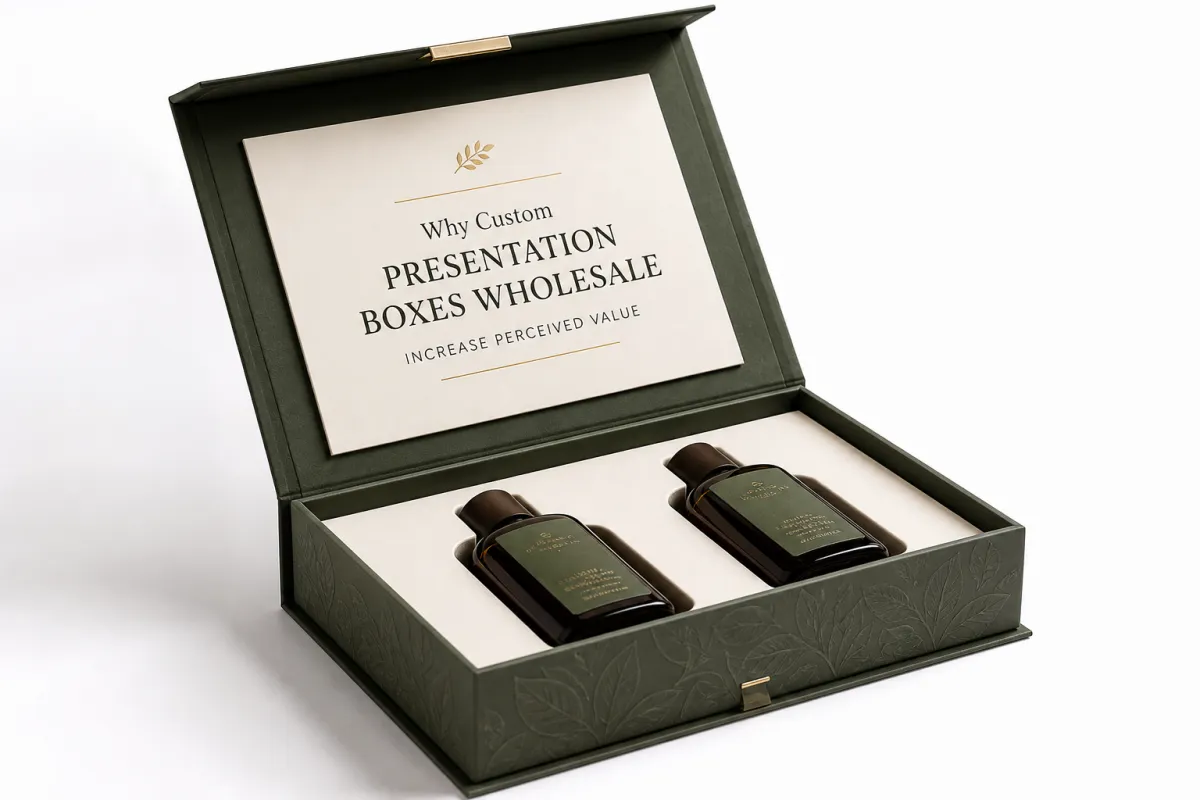
Packaging changes judgment. Retail psychology has been saying that for years, but the effect shows up in very ordinary buying behavior. A product enclosed in a rigid, well-made box is typically read as more valuable than the same item placed in a plain mailer or folding carton, even before the contents are visible. Cosmetics, electronics accessories, jewelry, awards, and branded kits all benefit from that bias. Custom presentation boxes wholesale gives brands a way to buy that effect at scale without paying boutique prices for every unit.
The first few seconds matter more than most teams like to admit. Premium buyers often decide whether a brand feels credible almost immediately, and packaging does a large share of the talking. A crisp lid reveal, a snug insert, and a controlled print finish create the sense that the product was planned instead of assembled. That is why custom presentation boxes wholesale shows up so often in launches, PR mailers, influencer sets, and retail-ready bundles. A box that looks engineered is easier to price like a premium item.
There is a small but meaningful comparison here. Two products can share the same materials, the same formulation, and the same retail price tag, but the one in a well-built presentation box often gets treated like the safer bet. It is a little unfair, kinda, but it is real. Buyers interpret fit and finish as clues about what else was handled carefully. That is why packaging can shape conversion long before the product is tested.
Repeatability is another quiet advantage. A 5,000-unit run of wholesale presentation boxes can hold color, cut accuracy, and insert fit more consistently than a chain of small emergency orders from different vendors. That consistency protects brand image over time. It also reduces the odds of one carton batch arriving with a loose lid, a crushed corner, or a logo printed slightly off-register. Those flaws seem minor in isolation. Over a season, they chip away at perceived quality.
Damage claims and bad first impressions carry real cost. A product may survive shipping and still feel diminished if the box is scuffed, warped, or poorly aligned. In wholesale programs, that affects more than returns. It changes retailer confidence, client retention, and the willingness of a sales team to position the offer at a higher price point. Custom presentation boxes wholesale is, in that sense, a margin decision wearing design clothing.
For brands comparing packaging options, the real question is not whether the box should look premium. The better question is how much value the box has to carry, and how much structure the product deserves. Packaging becomes a commercial tool when that question is answered honestly. The right specification can support a higher resale price, a cleaner launch, or a more memorable gifting moment without burning cash on flourishes that do little for the brand.
Most teams land on custom presentation boxes wholesale after one of three pressures builds up: the product line is moving upmarket, a retail client asks for more polished packaging, or the team is tired of forcing generic cartons to look special. Each path leads to the same conclusion. The box is part of the offer.
Styles and Use Cases for Premium Presentation Boxes
Buyers usually compare structure before finish, and that is the right order. Shape determines how the product opens, how it sits inside, and how much protection it gets from the carton itself. In custom presentation boxes wholesale, the common formats include rigid two-piece boxes, magnetic closure boxes, drawer-style boxes, folding presentation boxes, and book-style boxes. Each format changes the customer experience and the cost profile.
Rigid two-piece boxes remain a standard choice for premium programs because they feel substantial, stack efficiently, and offer a clean surface for branding on the lid. They show up often in luxury cosmetics, specialty confectionery, awards, and executive gift sets. The board is usually grayboard or chipboard wrapped in a printed paper sheet, which gives the box more heft than a folding carton. That physical weight helps the product feel more expensive before anyone opens it.
Magnetic closure boxes fit corporate onboarding kits, high-end electronics accessories, and event gifting where the closing action matters. A magnet does not sound like much on paper. In practice, it changes the pace of the reveal. The lid closes with a controlled snap, and that small ritual strengthens the sense of value. Drawer-style formats work especially well for multi-item kits because the tray slides out in a measured way. Book-style boxes are useful for media kits, VIP invitations, and product launches that should unfold in stages instead of all at once.
Use case matters just as much as structure. Jewelry brands often need foam or velvet-lined inserts to keep pieces from shifting. Beauty brands may need paperboard dividers for multiple SKUs. Electronics accessory packs often benefit from molded pulp or die-cut inserts that lock charging cables, adapters, and accessories into position. Corporate kits may need compartments for notebooks, drinkware, and printed materials. In wholesale presentation packaging, the insert is not an afterthought. It controls fit, and fit controls how expensive the box feels when it is opened.
The opening experience changes with the format. A lift-off lid delivers a quick, tidy reveal. A magnetic flap slows the moment down and adds a little ceremony. A drawer box builds anticipation because the contents stay hidden until the tray slides forward. That sequencing can help in retail packaging and branded gifting, where anticipation makes the product feel larger than it is. Simple products often gain value from a better reveal.
Branding surfaces deserve the same care as structure. Lid panels are obvious, but the inside lid, side walls, edge wraps, and interior tray can all carry printed details. Some brands keep the outside restrained and use the inside for a stronger statement. Others do the opposite. Foil, embossing, debossing, and soft-touch lamination can be reserved for the logo area instead of covering every panel. That keeps the design sharper and usually protects the budget.
Brands with multiple product lines benefit from matching structure to category. A launch kit may need one style, while a subscription pack or seasonal gift pack may need another. A good supplier should help tie the box type to the use case, not only to the lowest quote. A box that feels too light drags the brand down. A box that is too elaborate drains margin without improving the customer experience.
For broader packaging support, it helps to review Custom Packaging Products and the options inside Wholesale Programs before locking in the structure. That keeps the conversation focused on what the product actually needs rather than what happens to be sitting in stock.
Materials, Print, and Finishes for Custom Presentation Boxes
Material choice shapes both perception and performance. In custom presentation boxes wholesale, rigid board is the most common premium option, usually paired with a wrapped printed sheet. Rigid board stays square, accepts upscale finishing well, and feels stable in the hand. SBS or coated paperboard can still work for lighter or cost-sensitive programs, especially when the design needs to look refined without extra weight. Textured papers, specialty wraps, and laminated surfaces move the box deeper into luxury packaging territory.
Print method matters almost as much as the substrate. Offset printing is usually preferred for larger custom presentation boxes wholesale runs because it delivers strong color control and handles volume efficiently. Digital printing fits shorter runs, prototype programs, and highly personalized packs. The right method depends on quantity, artwork complexity, and how exact the color match needs to be. If the brand depends on color consistency across several product lines, the print plan should be checked before the structure is finalized.
Finishes are where many teams overspend or underspend. Gloss coatings create energy and contrast. Matte coatings pull the design toward restraint. Soft-touch lamination adds a tactile finish that reads as luxury, though it wears differently from a harder coating. Foil stamping, embossing, and debossing make logos feel more permanent and more deliberate. Spot UV can add contrast, but it needs discipline. Too much shine can flatten the premium effect instead of strengthening it.
Durability tradeoffs matter too. A deep black wrap with a soft-touch finish may look expensive, but it can show scuffs in a rough fulfillment environment. A high-gloss surface may resist handling marks better, while fingerprints become more visible. Moisture is another variable. If the box will move through humid storage or long transit cycles, the wrap and adhesive system should be chosen with that route in mind. Custom presentation boxes wholesale should be tested against the real journey, not only against a sample on a table.
Category alignment makes the finish decision easier. Luxury retail packaging usually benefits from subdued textures, precise edges, and restrained decoration. Event and gifting packaging can support bolder contrast, larger foil areas, and more expressive graphics because the use case is celebratory. A corporate kit often needs the reverse: clean lines, controlled color, and enough visual strength to look expensive without becoming loud. The difference between product Packaging That Sells and packaging that merely decorates is often that small adjustment in tone.
For teams sorting through options, the comparison below is a practical starting point:
| Box Type | Typical Feel | Common Finish | Best Use Case | Typical Wholesale Cost Range |
|---|---|---|---|---|
| Rigid two-piece | Classic premium | Matte, foil, emboss | Beauty, gifts, awards | $1.10-$3.40 per unit at mid-volume |
| Magnetic closure | High-end and formal | Soft-touch, foil, spot UV | Corporate kits, launches | $1.60-$4.80 per unit at mid-volume |
| Drawer style | Interactive reveal | Printed wrap, satin lamination | Multi-item sets, accessories | $1.25-$4.10 per unit at mid-volume |
| Folding presentation | Lightweight premium | Offset print, matte coating | Cost-aware retail programs | $0.45-$1.40 per unit at mid-volume |
The figures above are directional, not promises. Size, insert complexity, and print coverage can move pricing quickly. A 2-piece rigid box with limited ink may sit near the low end, while a magnetic box with custom foam and layered finishing can climb much higher. That pattern is normal. The point of custom presentation boxes wholesale is to choose the combination that supports the product instead of paying for features that add little commercial value.
Buyers with sustainability targets can also use material choice to support brand positioning. FSC-certified paper sources are available in many programs, and buyers can review options through FSC. If a project needs to address recyclability, reduced material use, or packaging waste, the structure should be designed with end-of-life in mind, not just first impression. The U.S. EPA has helpful background on packaging and waste reduction at EPA.
Specifications to Confirm Before Ordering
The fastest route to wasted money on custom presentation boxes wholesale is quoting an incomplete spec. A supplier can only price what is known. Dimensions, structure, material, print coverage, insert style, and shipping assumptions need to be defined early. Without that, two quotes can look similar while hiding very different realities.
Start with dimensions. Internal product size matters more than exterior size because the box has to fit the item with the correct clearance. If the package includes accessories, each cavity needs its own measurement. Wall thickness matters because rigid boards, wrap materials, and inserts all affect the final size. Lid depth matters too. A shallow lid can look elegant, but it may expose too much of the tray if the product rides high. A deeper lid solves that, though it uses more material and shifts the visual proportion.
Structural details deserve the same attention. Magnets, ribbons, windows, and multi-compartment inserts all change labor and material cost. They also affect how the box behaves in the warehouse. A ribbon pull may improve the reveal. It may also create a snag point if the fulfillment line is rough. In wholesale presentation packaging, elegance and operational practicality should be checked together.
Artwork specifications are another common failure point. Buyers should confirm bleed, safe zones, logo placement, and color targets before proofing begins. If the box needs print on the lid, inside panel, spine, or tray walls, each panel should be called out clearly. A solid dieline should show where artwork lands and where it should not. That sounds basic. It still causes delays when a logo arrives in the wrong format or the art ignores a fold line.
Performance expectations should be named upfront as well. Does the box need to survive retail handling only, or must it pass e-commerce fulfillment conditions too? Is it shipping inside a master carton, or is it serving as the outer shipper? Does the product need extra protection against breakage, moisture, or vibration? Delicate items may need transit testing. Industry groups such as ISTA publish resources that help frame that conversation; see ISTA for packaging test references many teams use when validating shipment performance.
Buyer rule: the quote should match the final use case, not the sample that looks nicest on a desk. If the spec sheet is vague, the landed cost usually rises later.
A pre-production checklist can save more time than a rush order ever will. Confirm the following before approving custom presentation boxes wholesale:
- Internal product dimensions and accessory clearances
- Box style, closure type, and insert type
- Board thickness and wrap material
- Print method, color targets, and finish selection
- Bleed, safe zone, and artwork file format
- MOQ, sample cost, and freight assumptions
- Packaging purpose: retail, gifting, PR, or transit protection
Teams that follow that list usually compare quotes with much less noise. Teams that skip it often spend the first production round solving problems that should have been prevented at the quoting stage. That is true whether the project is branded packaging for a launch, retail packaging for a shelf program, or custom printed boxes for a direct-to-client kit.
Pricing, MOQ, and Volume Breaks
Price is the moment premium packaging becomes a real business decision. In custom presentation boxes wholesale, the bill is shaped by a handful of variables: size, board thickness, print coverage, finish choice, insert complexity, and whether the structure needs special tooling. Once a buyer understands those drivers, it becomes much easier to separate a fair quote from a vague one. It also becomes easier to budget for landed cost instead of only staring at the unit price.
MOQ, or minimum order quantity, matters because setup costs are spread across the run. A higher minimum usually reduces unit cost, but it can increase inventory risk if the brand is still testing the market. Smaller teams often start with one box size and one finish before expanding. Custom presentation boxes wholesale can make sense at lower volumes too, though the per-unit cost is usually less forgiving. If a rigid magnetic box is only being ordered in a short run, setup will weigh more heavily in the final price.
Volume breaks work in a simple way. The larger the run, the more the setup cost gets diluted. The question is where the curve starts to flatten. On a simple folding presentation box, the price reduction may be modest after a certain point. On a more complex rigid structure with custom inserts, the savings can be far more visible. Tooling, hand assembly, and specialty finishing carry fixed costs. In a larger order, those fixed costs hurt less per unit.
One way to understand the spread is to compare a basic configuration with an upgraded one:
| Configuration | Typical Components | Approx. Unit Cost at 5,000 pcs | Price Impact |
|---|---|---|---|
| Basic premium | Rigid box, printed wrap, paperboard insert | $0.95-$1.85 | Strong value, controlled budget |
| Mid-tier premium | Rigid box, soft-touch finish, foil logo, die-cut insert | $1.55-$3.20 | Balanced for launches and gifting |
| High-touch luxury | Magnetic closure, specialty wrap, emboss, foam insert | $2.90-$5.80 | High perceived value, higher margin pressure |
Those numbers are directional, yet they do show where money tends to go. A foam insert may be essential for fragile items. A foil logo may be the right lift for a brand that needs more presence. A full soft-touch wrap across every panel may not be necessary if the front panel already carries the visual weight. Good custom presentation boxes wholesale pricing is not about buying everything. It is about buying the features that support revenue.
Buyers should also budget for samples, freight, and contingency stock. Sample fees are usually modest relative to the full order, but they matter because they reduce risk. Freight can add a meaningful amount, especially on bulky rigid boxes. Contingency stock is wise for retail or corporate gifting programs because a small overrun or a damaged pallet can derail a launch. The quoted box price is only part of the landing cost. The rest shows up in transit, storage, and handling.
For a real-world comparison, imagine two orders of custom presentation boxes wholesale. One is a 1,000-piece short run with complex finishing and a custom insert. The other is a 10,000-piece run with simpler print and standard board. The larger order almost always wins on unit price, but the total cash outlay is higher. Finance teams care about unit economics. Packaging teams care about inventory exposure. Both views are correct, and both should be in the room.
If a quote seems unusually low, ask what is missing. Often the answer is insert cost, sample cost, freight, color correction, or tooling. Those omissions do not automatically make the quote dishonest. They do make it incomplete. In wholesale packaging, incomplete quotes are a problem because they hide the actual decision.
From Proof to Delivery: The Production Process
The production path for custom presentation boxes wholesale is usually predictable, which helps. A clear workflow keeps the job on schedule and gives the buyer useful control points. The standard sequence is request specs, confirm structure, approve dieline, review proof, produce, inspect, pack, and ship. Delays usually show up at the approval stage rather than during the actual run.
Lead time depends on complexity, but a realistic production window for many custom presentation boxes wholesale projects is often 12-15 business days after proof approval for straightforward jobs, with more complex structures taking longer. If custom inserts, specialty wraps, or multi-step finishing are involved, the schedule may stretch. Sampling can add a few days or more depending on revisions. The quickest way to shorten the process is not to push harder. It is to finish the artwork and dimensions before the order is placed.
Structural samples and final production samples are not the same thing. A structural sample checks fit, fold behavior, closure strength, and insert alignment. A final production sample checks color, finish, and assembly quality at the actual material specification. Both matter. A beautiful box that does not fit the product is useless. A perfect fit with the wrong color still damages brand consistency. In custom presentation boxes wholesale, sample discipline pays for itself quickly.
Launch timing should be planned backward from the date the packaging has to be in use. For product launches, that means counting from retail availability or campaign send-out dates. For holiday gifting, the cutoff is not the ship date; it is the date the boxes must be in hand for packing. For retail resets, the packaging should arrive before the inventory transfer begins. Packaging can miss a launch window just as easily as product can.
Communication affects the schedule more than most buyers expect. Fast feedback on dielines, proofs, and sample revisions shortens the timeline far more effectively than asking for a rush. That is why project management matters so much in custom presentation boxes wholesale. A supplier can only move as fast as the next decision. If the brand takes three days to approve artwork, the production clock keeps moving.
Quality control should not wait for the final inspection. It should happen across the process. A solid supplier will inspect board cuts, print alignment, finish consistency, and insert fit before shipping. Buyers should ask how cartons are packed for transit, how labels are applied, and whether master cartons are counted and taped consistently. Those details seem small until the shipment reaches a warehouse and has to be received quickly.
For teams handling multiple product lines, repeatability is a major advantage. Once one structure is approved, future orders become more efficient because the dieline, artwork setup, and production history already exist. That is one of the strongest benefits of custom presentation boxes wholesale. The second order often runs better than the first because the learning curve has already been paid for.
Why Choose Us
Brands usually do not need more packaging language. They need fewer surprises. That is where Custom Logo Things aims to stand out. The value sits in clear quoting, practical structure guidance, and packaging that fits the price point the brand is trying to protect. Custom presentation boxes wholesale should make the product feel more credible, not merely more decorated.
Technical clarity is one reason teams return. A good packaging partner should help a buyer Choose the Right board, the right insert, and the right finish based on actual use instead of visual preference alone. If a lighter spec works, it should be recommended. If a stronger build is needed for shipping or retail handling, that should be said plainly. Custom presentation boxes wholesale works best when the supplier thinks like a packaging buyer, not only like a printer.
Repeatability matters just as much. Premium brands often need the same look across seasonal launches, client kits, and line extensions. Consistent build quality protects package branding over time. A box that looks excellent once and inconsistent the next time is not a premium asset. It is a risk. Reliable wholesale production reduces that risk by standardizing structure and finishing.
Artwork review is another place where support pays off. Many delays come from avoidable issues like low-resolution files, incorrect dimensions, or logos placed too close to a fold. A supplier that catches those problems early saves time and money. That matters in custom presentation boxes wholesale because the order often has more moving parts than standard retail packaging. Multiple panels, inserts, and specialty closures create more places for misalignment to appear.
Cost discipline matters too. Overbuilt packaging can hurt margin just as underbuilt packaging can hurt product protection. Teams sometimes order magnetic boxes with heavy finishing when a well-designed rigid two-piece structure would deliver the same result. Other times they choose a light carton that cannot support the product's value. Experience helps prevent both mistakes. That is part of the service value here: a candid recommendation instead of a one-size-fits-all answer.
If the next step is still open, the best move is straightforward. Gather the dimensions, quantity, insert details, and finish goals. Then request a quote tied to the actual use case. That is how custom presentation boxes wholesale moves from a broad idea into a procurement decision. It is also how brands keep packaging aligned with margin instead of letting the budget drift on assumptions.
For buyers comparing options across a broader lineup, it helps to revisit Custom Packaging Products and the structure of Wholesale Programs before locking the final spec. A better packaging decision usually begins with a better brief.
Custom presentation boxes wholesale is worth pursuing when the box has a real job to do: protect the contents, elevate the reveal, and support the price the brand wants to charge. If those three things are in place, the packaging is doing commercial work, not just cosmetic work. The practical takeaway is simple: lock the dimensions, route, and finish priorities first, then quote the box around that reality instead of guessing your way into a prettier but weaker spec.
Frequently Asked Questions
What is the typical MOQ for custom presentation boxes wholesale?
MOQ usually depends on the structure, print method, and finishing complexity. A rigid magnetic box often needs a higher minimum than a simple folding format because it uses more labor and more assembly time. In many custom presentation boxes wholesale programs, the quote should separate tooling, setup, and unit pricing so the buyer can see where the volume break starts. Smaller brands can lower risk by starting with one size and one finish before expanding the line.
How long does production usually take for custom presentation boxes wholesale?
Production time depends on proof approval, sampling, material availability, and whether the box includes custom inserts or specialty finishes. For many custom presentation boxes wholesale orders, the schedule can be around 12-15 business days after final proof approval for straightforward builds, with more complex projects taking longer. Fast approvals shorten the timeline more than almost any other factor. Rush timing may be possible, but buyers should confirm whether it changes finish options or freight method.
Which materials work best for premium presentation boxes in wholesale orders?
Rigid board is the most common choice for premium presentation boxes because it holds shape and supports luxury finishing. Paperboard can still work well for lighter products or cost-sensitive programs, especially if the design needs strong print impact without added weight. The right material depends on product weight, shipping method, and the image the brand wants to project. In wholesale presentation packaging, the material should match both the product and the route it will travel.
Can custom presentation boxes wholesale include inserts and specialty finishes?
Yes. Most custom presentation boxes wholesale programs can include foam, paperboard, or molded inserts to keep products from shifting. Common upgrades include foil stamping, embossing, debossing, soft-touch lamination, and spot UV. The best finish choice depends on how much visual emphasis the brand wants and how the box will be handled. If the box is going through retail shelves, shipping cartons, or repeated client use, durability should be part of the finish discussion.
How do I compare quotes for custom presentation boxes wholesale?
Compare the same box size, material, insert style, finish, quantity, and shipping assumptions across every quote. Watch for hidden costs such as tooling, sample fees, color matching, and freight, because those can change the real landed price. A useful comparison is unit cost at the actual order quantity, not just the lowest advertised base price. If two custom presentation boxes wholesale quotes look similar but one includes more detail, the cheaper one may not be cheaper at all.

