Buyer Fit Snapshot
| Best fit | Custom Pressure Sensitive Labels projects where brand print, material claims, artwork control, MOQ, and repeat-order consistency need to be specified before quoting. |
|---|---|
| Quote inputs | Share finished size, material target, print colors, finish, packing count, annual reorder estimate, ship-to region, and any compliance wording. |
| Proofing check | Approve dieline scale, logo placement, barcode or warning zones, color tolerance, closure strength, and carton packing before bulk production. |
| Main risk | Vague material claims, crowded artwork, missing packing details, or unclear freight terms can make a low unit price expensive after revisions. |
Fast answer: Custom Pressure Sensitive Labels: Material, Adhesive, Artwork, and MOQ should be specified like a repeatable production item. The safest quote records material, print method, finish, artwork proof, packing count, and reorder notes in one written spec.
Production checks before approval
Compare the actual filled-product size with the drawing, then confirm tolerance on folds, seals, hang holes, label areas, and retail display edges. Reserve space for logos, QR codes, warning copy, and material claims before decorative graphics fill the panel.
Quote comparison points
Review material grade, print process, finish, sampling route, tooling charges, carton quantity, and freight assumptions side by side. A quote is only useful when the supplier can repeat the same color, closure quality, and packing count on the next order.
Custom pressure sensitive Labels: A Practical guide starts with a simple packaging truth I have seen hold up across plenty of product launches: the label usually does more work than people give it credit for. A clean, well-spec'd label can make a plain container look retail-ready in a single pass, and a weak one can make otherwise solid packaging feel unfinished, even if the print file looked perfect on screen.
Custom pressure sensitive labels stay useful because they solve a very real production problem. Brands need decoration that applies quickly, looks consistent, and survives the trip from press to pack-out to shelf. That matters on jars, bottles, cartons, pouches, mailers, and shipping systems that need to move fast without looking rushed. Pairing labels with Custom Labels & Tags or broader Custom Packaging Products usually gives a cleaner result than treating each piece as if it lives on its own island.
The useful thing about custom pressure sensitive labels is not just appearance. The useful thing is fit. Surface, environment, handling, and application method all shape whether the label stays put and still looks sharp after the package has been stored, shipped, touched, chilled, or handled a few too many times. Miss one of those variables and the issue often shows up later, usually in the least convenient place possible.
I have watched more than one strong packaging concept get undercut by a label that was chosen too early and specified too loosely. That kind of miss is kinda frustrating because it is usually avoidable. If the label is treated as part of the package system instead of a decorative afterthought, the final result tends to hold together much better.
What Custom Pressure Sensitive Labels Actually Are
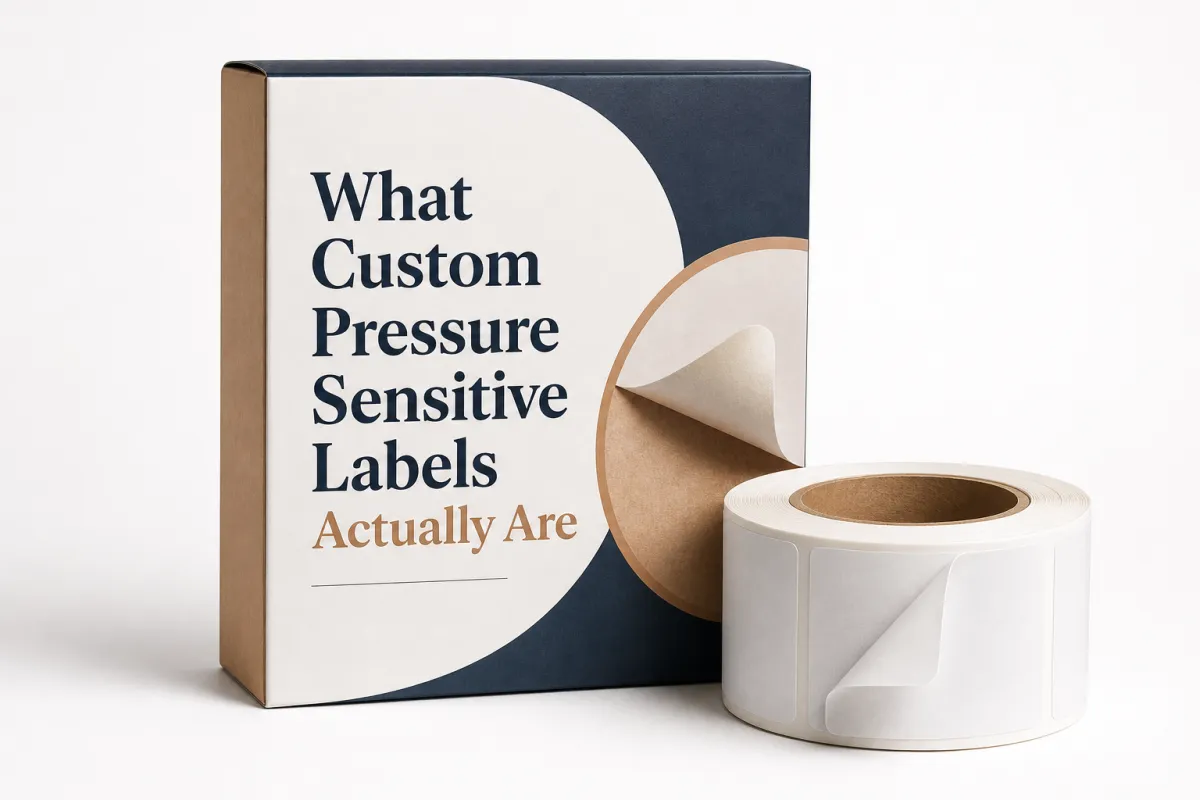
Custom pressure sensitive labels are labels that bond through pressure rather than heat, moisture, or a wet adhesive process. The construction is straightforward: printable face stock on top, adhesive in the middle, and a release liner on the back. Peel the liner, place the label, press it down, and the adhesive begins forming the bond.
That simple build gives custom pressure sensitive labels a lot of range. They are common on product jars, beverage bottles, pouches, health and beauty packaging, shipping boxes, candle jars, and just about any branded package that needs fast decoration without extra setup. A small run of custom printed boxes may only need a logo label on the flap, while a cosmetics line might call for clear film, white ink, and a matte finish. Same label family, very different behavior.
What makes them custom is the specification. Size, shape, material, adhesive strength, finish, and print method all shape the result. Labels can be square, round, oval, wraparound, or die-cut to match the artwork. They can ship on sheets for hand application or on rolls for automated application. They can use paper, BOPP, vinyl, clear film, or specialty stocks, and each choice changes how the label handles friction, moisture, and storage conditions.
Labels are often treated as decoration, but that leaves out most of the story. They are part of package branding, part of the customer’s first impression, and part of the durability plan. A neat label can make simple packaging feel retail-ready. A weak one can make a good design feel cheap in a hurry. That is why custom pressure sensitive labels deserve a real spec discussion before artwork goes to print.
If the label looks right on screen but fails on the package, the problem is usually the material, the adhesive, or both.
For buyers, the biggest advantage is control. Exact dimensions, exact finish, and an adhesive matched to the actual surface make custom pressure sensitive labels a practical choice for short promotional runs, long-term SKU launches, and seasonal packaging without adding a paste station or changing the package construction.
How Custom Pressure Sensitive Labels Work on Packaged Goods
Custom pressure sensitive labels work because the adhesive is already in place before the label ever reaches the product. There is no drying stage, no mixing, and no water-based setup. The liner protects the adhesive until application, and pressure activates the bond.
The application process usually comes down to four steps. Peel the liner. Align the label. Apply steady pressure from the center outward. Give the adhesive time to reach full bond strength. That last step gets skipped more often than it should. A label may feel lightly attached right away and still reach its strongest hold after a few hours or a full day, depending on the adhesive and the surface.
Hand application and machine application are not the same thing, and the difference matters. Small runs can be applied by hand if the label size is manageable and placement tolerance is forgiving. Larger runs bring roll direction, spacing, and orientation into the picture because those details affect speed, waste, and consistency. If the label is going through an applicator, the roll spec has to be right from the start or the line starts fighting the material instead of moving with it.
Adhesion is more than stickiness. Surface energy, temperature, dwell time, and package material all affect how custom pressure sensitive labels perform. A smooth PET bottle does not behave like a textured kraft mailer. Powder-coated metal does not act like coated paperboard. Cold storage, transit vibration, and repeated customer handling all change the picture, which is why the application environment should be understood before the order is placed, not after the first test run.
The appeal is practical. Custom pressure sensitive labels let you add branding without changing the package itself. No extra machinery, no wet cleanup, no complicated adhesive setup. For brands moving from small runs into retail packaging, that flexibility is usually the reason labels stay in the mix.
There is also a timing benefit. Pressure-applied labels can move from proof to production without the delays that come with wet systems. A straightforward label job can often be proofed, printed, and shipped on a tighter schedule than many other decoration methods, which is one reason custom pressure sensitive labels show up so often in fast-moving packaging programs.
Key Factors That Change Label Performance
Face stock is usually the first decision that changes everything else. Paper is often the least expensive option and works well in dry, indoor settings. BOPP is a stronger fit when moisture resistance and everyday durability matter. Vinyl handles rougher handling better. Specialty stocks make sense when texture, appearance, or a premium feel matters as much as function, which happens more often than people expect.
Adhesive choice matters just as much. Permanent adhesive is the standard for long-term hold. Removable adhesive works for temporary promotions, loaner equipment, or short-term applications. Freezer-grade adhesive is built for cold storage. Aggressive adhesive helps on difficult or low-energy surfaces where ordinary material would fail. Choosing adhesive on price alone usually means paying for the same job twice, and then some.
Finish changes the look and the wear resistance at the same time. Gloss gives sharp contrast and a brighter retail feel. Matte creates a softer, quieter appearance that suits some packaging systems better. Clear labels can create a no-label look that works well on glass and premium product packaging. Lamination adds protection against abrasion and helps when moisture or handling is part of normal use.
Environmental stress is where labels usually get tested the hard way. Condensation. Oil. UV exposure. Friction. Cold storage. Curved containers. Textured cartons. If a package sees more than one of those conditions, custom pressure sensitive labels need to be built for that reality, not for a clean test sample sitting in a perfect room.
Design specs affect performance too. Tiny text can disappear once a label is scaled down. Barcodes need contrast and quiet zones that remain readable. Bleed has to be planned so trimming does not cut into key artwork or legal text. Die lines have to match the shape precisely. If the product ships before it reaches the shelf, the label should stay put through transit and handling without lifting at the corners.
Shipping conditions are easier to judge when you use an actual testing framework instead of guesswork. ISTA methods are a useful reference point for package testing, especially when the label is part of the primary shipper or outer carton. You can check ISTA for a transit-testing framework rather than relying on hope. If paper sourcing matters to the brand, FSC certification is worth checking when fiber origin and documentation are part of the buying decision.
Most label problems start with the same mistake: the look gets chosen first and the material comes later. That order almost always creates friction. Surface, environment, handling, then finish is the better sequence. Once those pieces are settled, custom pressure sensitive labels can be tuned for the appearance the brand wants.
- Paper: best for dry indoor use, short runs, and lower-cost applications.
- BOPP: best for moisture resistance, everyday product packaging, and general durability.
- Vinyl: better for rougher handling, flexibility, and longer life.
- Specialty stocks: useful when branding, texture, or premium appearance takes priority.
One more practical point: if the package has curved walls, recessed panels, or a textured finish, sample testing matters even more. A label that appears fine on a flat proof can behave differently once it has to conform to real geometry. The label can be technically correct and still look off if it is asked to do too much on a bad surface.
Custom Pressure Sensitive Labels Cost and Pricing Basics
Pricing for custom pressure sensitive labels comes down to a few familiar variables: size, quantity, face stock, adhesive type, finish, die-cut complexity, color count, and format. Sheets are often easier for small hand-applied jobs. Rolls usually make more sense at volume, especially when the job will run through an applicator.
Smaller orders usually carry a higher unit cost because setup gets divided across fewer labels. Larger quantities bring the unit price down, although the drop may be modest if the design calls for specialty material or a complex die. That is why it helps to ask for more than one quantity break. A quote at 1,000 pieces gives a snapshot. Quotes at 1,000, 5,000, and 10,000 pieces show where the real value sits.
There are hidden cost points too. White ink underprint can add cost. Foil can add more. Rush schedules often change the math. Odd shapes require tooling. Extra proofing, color matching, and variable data all take time. Custom pressure sensitive labels do not get expensive because they are labels; they get expensive when the specification grows more detailed.
A practical comparison helps when planning a budget. The ranges below are not universal, because honest print pricing depends on the full spec, but they are useful for planning a standard job at moderate volume.
| Label Option | Best Fit | Typical Unit Range at 5,000 Pieces | What You Are Paying For |
|---|---|---|---|
| Paper, permanent adhesive | Dry cartons, short shelf life products, basic branded packaging | $0.04-$0.09 | Low material cost and easy printing |
| BOPP, permanent adhesive | Beverage bottles, jars, health and beauty packaging | $0.07-$0.16 | Moisture resistance and stronger wear performance |
| Vinyl, aggressive adhesive | Tough surfaces, long-wear applications, higher-handling products | $0.12-$0.24 | Durability and better long-term adhesion |
| Specialty stock with finish | Premium retail packaging, high-visibility product launches | $0.18-$0.35 | Texture, appearance, lamination, or specialty ink systems |
Those numbers move with coverage, color count, and shape. A full-bleed design with a complex die and matte lamination will not cost the same as a simple one-color rectangle. Even so, the table gives a realistic starting point for budget planning instead of a rough guess pulled from nowhere.
Spend for durability where the package needs durability. If the label faces cold storage, condensation, or abrasion, choose the better stock. Do not put premium material on a dry corrugated box that gets tossed immediately. That kind of spending looks smart in a spreadsheet and silly in the real world. Good custom pressure sensitive labels match the job rather than the ego behind the job.
Ask sharper quoting questions and you will usually get better answers:
- What is included in the quote, and what is not?
- Are tooling, setup, or proof fees separate?
- How does the unit price change at 1,000, 5,000, and 10,000 pieces?
- Does the price include roll format, sheet format, or both?
- Are there extra charges for finish, special ink, or rush production?
If the answer feels vague, ask again. A clear spec usually gets a clear quote, and a clear quote makes it easier to compare options without guessing where the money is going.
Process and Timeline for Ordering Custom Pressure Sensitive Labels
The cleanest ordering process starts with the use case, not the artwork. Package surface, environment, application method, and quantity should come first. Stock and adhesive come next. Artwork comes after that. Proof approval sits near the end. That sequence sounds obvious, yet a lot of delays show up because the order gets reversed.
A standard job usually moves through six steps: request, material selection, artwork prep, proofing, production, inspection, and shipping. Straightforward custom pressure sensitive labels with standard materials can move quickly. A custom die, specialty finish, or variable data setup adds time because the production path becomes less predictable.
Lead times vary, but a realistic range helps with planning. A simple digital label order may turn around in a few business days after proof approval. More customized runs often land in the 12 to 15 business day range. Jobs that need unusual materials, specialty finishes, or complex roll requirements can take longer. The real bottleneck is often approval time, not press time.
Late artwork changes slow everything down. Missing die lines do the same thing. Fuzzy color references cause more back-and-forth than people expect. Files that were never built correctly for print can stall a schedule that looked fine on paper. If custom pressure sensitive labels are part of a product launch, the timeline should follow the approval window as closely as the production window, because the launch date does not care where the delay came from.
Before you approve the proof, confirm exactly what you are reviewing. Ask whether the proof is digital, physical, or both. Ask how the color is being matched. Ask whether the price assumes rolls or sheets. Ask when the order actually enters the queue. Those questions are basic, and they prevent a lot of unpleasant surprises.
For brands building package branding across several components, the label order should be coordinated with cartons, inserts, and any Custom Packaging Products already in motion. One weak link can make the whole presentation feel inconsistent. Custom pressure sensitive labels work best as part of a complete packaging system, not as a loose item floating on its own.
A careful proof saves a bad run. A rushed proof rarely saves anything at all.
If the label needs to match a broader product packaging rollout, work backward from launch date. Leave room for artwork cleanup, proof edits, and one more look at adhesive choice. That matters even more for custom pressure sensitive labels used on retail packaging, where a small issue with color or finish can become obvious under store lighting.
I also like to build in a small buffer for the first production run, especially if the label will be applied by hand. The first batch often reveals the real-world stuff that does not show up in a mockup: how fast the liner releases, whether the label wants to bridge a curve, and whether operators can place it consistently without slowing the line. That sort of check is cheap compared with reprinting a full order.
Common Mistakes to Avoid With Pressure Sensitive Labels
The first mistake is choosing adhesive by price alone. Cheap adhesive sounds fine until condensation starts working on the corners. The label lifts, the customer notices, and the package looks tired before it has sold. Custom pressure sensitive labels need to be selected for actual conditions, not for the lowest line item on the quote.
The second mistake is ignoring the surface. Labels behave differently on glass, coated cardboard, plastic, powder-coated metal, and textured pouches. A label that holds perfectly on a jar may fail on a flexible mailer. A label that stays put on a smooth bottle may struggle on a recycled carton with a rough finish. Surface mismatch causes more failures than people expect.
The third mistake is skipping test applications. A label can look excellent in layout software and still fail a few hours after it touches the real package. Test samples on the actual substrate. Leave them in the same conditions the finished product will face. If the package is refrigerated, chill it. If the package is handled repeatedly, handle it. That sounds tedious because it is tedious. It also works.
The fourth mistake is design clutter. Too much small copy. Too little contrast. Barcode areas pushed too close to folds. Important legal text squeezed into corners. Those choices hurt readability and make the packaging feel crowded instead of clear. A good label reads cleanly and gives the rest of the package room to breathe.
The fifth mistake is ignoring production details. Roll direction matters. Spacing matters. Application speed matters. Ordering the wrong quantity matters. If the label will go through a machine, the technical spec is part of the job, not a bonus detail. Custom pressure sensitive labels have to fit the workflow or the packaging team ends up carrying the burden later.
- Do: test on the actual surface before full production.
- Do: confirm the adhesive for temperature and handling.
- Do: check roll direction and spacing for applicators.
- Do not: assume paper stock will behave like BOPP.
- Do not: trust a screen proof alone for final color or finish.
There is no hidden trick here. Most label failures come from missing the boring details. Those boring details are exactly what custom pressure sensitive labels are built around. If the spec is clear, the label usually behaves. If the spec is vague, the label tends to remind everyone about it later.
Expert Tips and Next Steps for Better Label Orders
The best decision framework is still the simplest one: match the label to the surface, the environment, and the handling. Start there. After that, decide how much the finish matters. That is the order I would use for custom pressure sensitive labels if the goal were to avoid expensive surprises. Everything else sits on top of the real performance decision.
If the spec is uncertain, order samples or a short test run. Check adhesion after shipping. Check color under the lighting where the product will actually sit. Check whether the corners stay down after 24 hours and again after a few days. That small amount of testing can keep a full production run from turning into a costly lesson.
Use this checklist before requesting a quote:
- Dimensions: exact width, height, and any bleed requirement.
- Shape: rectangle, circle, oval, wraparound, or die-cut custom shape.
- Substrate: paper, BOPP, vinyl, clear film, or specialty stock.
- Adhesive: permanent, removable, freezer-grade, or aggressive.
- Finish: gloss, matte, clear, laminate, or soft-touch look.
- Format: sheets or rolls, plus core size if automated.
- Application: hand-applied or machine-applied.
- Environment: dry, refrigerated, outdoor, oily, or high-friction.
That list looks plain because it is plain. It is also the difference between a clean order and a messy one. A complete spec makes custom pressure sensitive labels easier to quote correctly, and it shortens proofing because fewer details are left open to interpretation.
For brands that care about consistent package branding, labels should stay tied to the larger system. When cartons, inserts, and labels use the same visual language, the product feels more polished without forcing the build cost into an uncomfortable place. That kind of consistency matters on crowded shelves, where buyers make decisions in a few seconds and remember the brands that looked thought through.
The most practical advice is to choose your priority before asking for a quote. Lowest cost? Strongest durability? Fastest turnaround? Most premium look? Two of those can usually be achieved together, sometimes three, but rarely all four without compromise. Once the priority is clear, custom pressure sensitive labels become much easier to specify and much less likely to disappoint.
Then gather the artwork, measure the package, document the surface, and request pricing from a supplier that can explain material and adhesive choices without hiding behind jargon. If the sample performs, move ahead. If it does not, adjust the spec before buying full production. That is the cleanest way to buy custom pressure sensitive labels, and it is the approach I would use for almost any product packaging order.
Custom pressure sensitive labels work best when they are treated as a functional packaging component, not just a printed sticker. Choose the Right stock, match the adhesive to the surface, test the sample, and the label will do its job without drama. Which is exactly the point.
If you want the shortest path to a better label order, use this sequence: define the surface, define the environment, define the application method, then choose stock and adhesive. Do that before you lock the artwork, and you will avoid most of the problems that turn a simple label job into a messy one.
What are custom pressure sensitive labels made of?
They usually include three layers: printable face stock, adhesive, and a release liner. The face stock can be paper, BOPP, vinyl, or a specialty material depending on the application. The adhesive is selected for the surface and the environment, which is why custom pressure sensitive labels can perform very differently from one product to the next.
Are custom pressure sensitive labels waterproof?
Some are, but not all. The material and finish matter as much as the adhesive. BOPP or vinyl with the right ink system or lamination performs much better in moisture than plain paper. If the label will see condensation, cold storage, or repeated wiping, test it before you place a full production order.
How much do custom pressure sensitive labels cost?
Cost depends on size, quantity, stock, adhesive, finish, and whether the shape needs a custom die. Smaller runs usually cost more per label because setup is spread across fewer pieces. Ask for price breaks at multiple quantities so you can see where the unit cost actually changes.
How long does it take to produce custom pressure sensitive labels?
Simple jobs can move quickly, while specialty materials, custom shapes, and complex finishing add time. Artwork approval is often the biggest delay, not the press time itself. Get the lead time in business days, and confirm whether it starts after proof approval or after payment.
What do I need before I order custom pressure sensitive labels?
Have the label dimensions, shape, application surface, and expected environment ready. Know the quantity, whether you want rolls or sheets, and any finish or durability requirements. Send print-ready artwork when possible, or be ready to approve a proof quickly so the order does not stall.

