Buyer Fit Snapshot
| Best fit | Custom Price Tags for Packaging projects where brand print, material claims, artwork control, MOQ, and repeat-order consistency need to be specified before quoting. |
|---|---|
| Quote inputs | Share finished size, material target, print colors, finish, packing count, annual reorder estimate, ship-to region, and any compliance wording. |
| Proofing check | Approve dieline scale, logo placement, barcode or warning zones, color tolerance, closure strength, and carton packing before bulk production. |
| Main risk | Vague material claims, crowded artwork, missing packing details, or unclear freight terms can make a low unit price expensive after revisions. |
Fast answer: Custom Price Tags for Packaging: Specs, Pricing, MOQ should be specified like a repeatable production item. The safest quote records material, print method, finish, artwork proof, packing count, and reorder notes in one written spec.
Production checks before approval
Compare the actual filled-product size with the drawing, then confirm tolerance on folds, seals, hang holes, label areas, and retail display edges. Reserve space for logos, QR codes, warning copy, and material claims before decorative graphics fill the panel.
Quote comparison points
Review material grade, print process, finish, sampling route, tooling charges, carton quantity, and freight assumptions side by side. A quote is only useful when the supplier can repeat the same color, closure quality, and packing count on the next order.
Custom price tags for packaging are tiny, but they do a lot of heavy lifting. Shoppers do not sit there and study every corner of a package. They glance, judge, and decide whether the price feels fair for what they are seeing. If the tag looks flimsy, crooked, or off-brand, the whole presentation takes a hit. Harsh? Sure. Accurate? Also yes.
A premium carton with a bad sticker looks unfinished. A clean, well-made tag tells the buyer the product was handled with care from the start. That matters in retail packaging, gift sets, subscription boxes, wholesale displays, and shelf-ready branded packaging. The tag is part of the package story, not some random extra that got attached at the last minute.
Good custom price tags for packaging also help the operations side. They cut pricing mistakes, keep SKUs aligned, and make reorders less of a mess. If you sell across more than one channel, they save staff time every day. Nothing flashy. Just the kind of thing that keeps a launch from going sideways.
The right tag is not decoration first. It needs to be clear, durable, and sized for the actual pack. The goal is simple: make the price easy to read, make the brand feel intentional, and make production repeatable. That is the real value of custom price tags for packaging.
Custom Price Tags for Packaging That Sell Faster
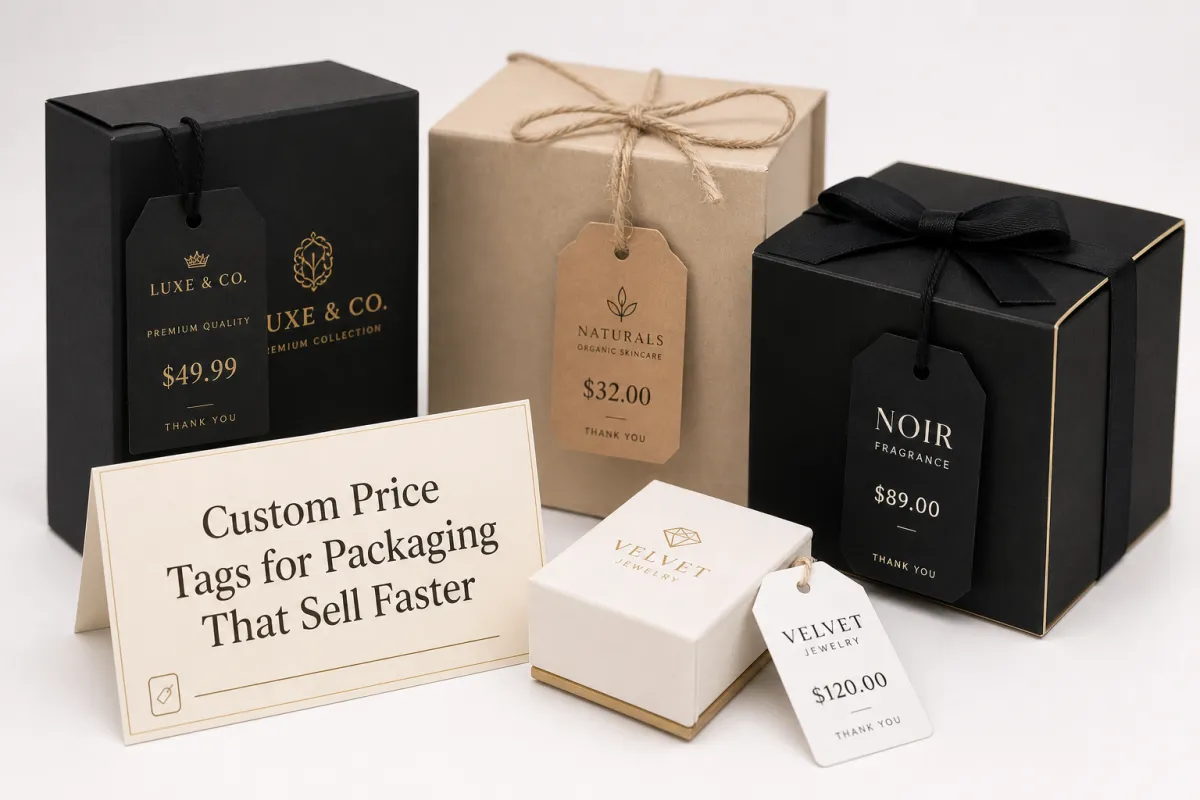
Most shoppers do not read a package deeply. They scan the price, check the product, and decide whether the presentation matches the number. Custom price tags for packaging sit right in that split second. If the tag feels polished and balanced, the package feels credible. If it looks improvised, the sale starts slipping away before anyone says a word.
A weak tag can drag down an otherwise strong design. I see this a lot with custom printed boxes and nicer product packaging: the box is rigid, the print is sharp, the finishes are solid, then the price tag shows up as a thin paper square with a font that seems to have given up. That mismatch hurts. Buyers notice presentation gaps faster than brands think they do.
Custom price tags for packaging matter across more than one sales channel. Retail needs fast shelf clarity. DTC needs a tidy unboxing moment. Gift packaging needs a price display that does not kill the premium feel. Wholesale needs tags that can handle shipping, scanning, and quick inventory checks. One tag type does not fit every job, which is why packaging design should start with how the item is sold, not just how it looks in a mockup.
There is also a practical side. Standardized custom price tags for packaging cut down on manual errors. Staff can price the right SKU faster. Reorders are simpler because the format is already approved. When the same rules apply across a line, package branding stays consistent and the team spends less time fixing avoidable mistakes.
If the tag looks improvised, the brand looks improvised. That is how fast perception works.
That is why I always tell buyers to treat custom price tags for packaging like a sales tool, not a leftover accessory. The best version supports shelf clarity, protects the brand look, and keeps the operation moving without extra drama.
Product Details: Tag Formats, Materials, and Finish Options
There are several ways to build custom price tags for packaging, and the best choice depends on how the pack is displayed, how often it is handled, and how premium the finish needs to feel. A hanging tag works well for apparel and gift items. An adhesive price label is faster for high-volume retail. Folded cards and inserted price cards make more sense for box-based presentations where the tag needs to sit cleanly with the packaging instead of swinging off the side like it missed the memo.
The material choice matters as much as the format. Coated paper gives sharp print and crisp edges. Kraft stock gives a natural, earthy look that fits handmade or eco-minded brands. Premium cardstock feels stiffer and more substantial, which is useful when the tag needs to project quality. Synthetic stock costs more, but it holds up better to moisture, friction, and repeated handling. If your custom price tags for packaging will move through warehouses, coolers, or busy retail floors, that extra resistance can be worth it.
Finish options change the tone. Matte keeps the price easy to read and avoids glare under store lights. Gloss boosts color and makes the tag pop. Soft-touch gives a smoother, more upscale feel, though it can add cost and sometimes shows scuffing differently. Foil can work for small accents, but restraint matters. Too much shine and the tag starts competing with the product. That is not smart package branding. That is visual noise with a budget.
Attachment style affects performance too. Hole punches work for string, ribbon, twine, or plastic fasteners. Perforation helps if the tag needs to tear cleanly from a sheet. Adhesive backing helps for flat cartons or sleeves. Die-cut shapes can support a stronger visual identity, but custom dies raise setup costs. If the packaging is already doing heavy visual work, the tag should support it, not fight for attention like it is auditioning for the main role.
| Format | Best Use | Material Notes | Typical Tradeoff |
|---|---|---|---|
| Hang Tag | Apparel, gifts, accessories | Cardstock, coated paper, kraft | Needs attachment hardware and can snag |
| Adhesive Price Label | Retail packaging, cartons, jars | Coated label stock, synthetic label stock | Fast to apply, but less premium in feel |
| Folded Card | Luxury sets, bundles, countertop displays | Thicker cardstock, soft-touch, matte | Takes more space and more folding work |
| Inserted Price Card | Boxes, sleeves, trays, mailers | Rigid card, coated or uncoated stock | Depends on the insert slot staying visible |
| Swing Tag | Fashion, seasonal items, retail displays | Heavy paperboard, laminated options | Looks polished, but costs more to finish |
If the brand needs one tag system that can move across multiple packaging styles, custom price tags for packaging should be chosen with the pack structure in mind. A luxury rigid box, a kraft mailer, and a clear retail sleeve each need a different level of stiffness, attachment, and finish. If you need matching print across other elements too, see Custom Packaging Products and keep the whole line consistent from carton to tag.
For paper sourcing, FSC-certified stock is a sensible option when traceability matters. The chain-of-custody standard is not a marketing sticker; it is a real sourcing framework that tracks responsible forest materials through the supply chain. You can review it at FSC. That matters for brands that want the paper story to match the rest of the packaging design.
Specifications for Custom Price Tags for Packaging
Before anyone quotes custom price tags for packaging, they need a real spec sheet. Not a vague idea. Real numbers. Start with size, shape, material thickness, print sides, and attachment method. If those five things are not defined, quotes will drift, revisions will multiply, and the final tag will probably arrive close to what you wanted, which is not the same thing as correct.
The useful specs usually include product name, price, SKU, barcode, QR code, discount copy, and any required compliance notes. For apparel, you may need size and fiber details. For packaged goods, you may need space for batch or lot info. For food-adjacent items, you may need room for legal markings. Custom price tags for packaging should carry the information a buyer or staff member actually needs, not a wall of decorative text nobody can read.
Readability is not optional. Contrast has to stay high. The price should not fight with illustration. Barcode zones need quiet margins. Small type needs enough stroke weight to survive print and handling. If a code will be scanned at the Point of Sale, test it at final size. A barcode that looks fine on a screen can fail in real life once it is printed on a smaller tag. Print files love to act innocent. They are not.
Size decisions depend on the product. Smaller tags suit cosmetics, jewelry, and accessories where the pack is compact and the tag has limited real estate. Larger tags suit apparel, multi-item sets, and cartons that need the price visible from a distance. For custom price tags for packaging, the most common mistake is trying to cram a large price structure onto a tag that should have stayed simple. Bigger is not always better. Sometimes it is just louder.
Durability matters too, especially if the item will move through a warehouse, sit on a damp shelf, or get handled repeatedly by shoppers. A paper tag with a matte coat can be enough for dry indoor retail. A synthetic tag or laminated card can make more sense for humid storage, cooler temperatures, or loose-packed shipping. That is not overkill. That is matching the tag to the environment.
For transit-heavy lines, I like to think about handling the same way I think about packaging tests: does the item stay legible after repeated contact, pressure, and movement? ISTA publishes widely used transit test thinking for package performance, and it is worth checking the framework at ISTA. Custom price tags for packaging are not full shipping cartons, but they still live in a world of abrasion, compression, and friction.
Use this checklist Before You Order:
- Dimensions: final width, height, and any folded size.
- Stock: coated paper, kraft, premium cardstock, or synthetic.
- Thickness: enough stiffness for the display, not so much that it feels bulky.
- Print: one-sided or two-sided, single color or full color.
- Data: static artwork or variable data like SKU, barcode, or QR code.
- Attachment: hole punch, adhesive, perforation, string, or insert fit.
Strong specs keep custom price tags for packaging easy to quote, easy to produce, and easy to reorder. Weak specs do the opposite. That is usually where budget and timeline problems begin.
Custom Price Tags for Packaging: Pricing and MOQ
Pricing for custom price tags for packaging depends on the same things that drive most print work: stock choice, size, finish complexity, color count, die cutting, quantity, variable data, and turnaround speed. If the design is simple and the quantity is modest, digital printing often makes the most sense. If the run is larger and the artwork is stable, offset or a higher-volume production method can lower the unit cost.
The main buying mistake is asking only for a unit price. That number can look attractive while the setup fees, die charges, and rush costs quietly push the total higher than expected. A better quote breaks out the real pieces: setup, plates or dies if needed, sample cost, freight, and any special finishing. Custom price tags for packaging should be judged on landed cost, not a single line item pulled out of context.
Here is a practical range to use as a buying reference. These are not promises. They are the kind of numbers that make sense for common production runs, assuming the artwork is straightforward and the specs are normal.
| Run Type | MOQ Range | Typical Unit Price | Best For |
|---|---|---|---|
| Simple digital tags | 100-1,000 pcs | $0.18-$0.60 | Testing a design, small launches, short seasonal runs |
| Standard cardstock tags | 500-5,000 pcs | $0.10-$0.32 | Retail packaging, recurring SKUs, multi-location use |
| Kraft or natural stock tags | 500-3,000 pcs | $0.12-$0.38 | Natural branding, eco-leaning product packaging |
| Premium finish tags | 1,000-10,000 pcs | $0.22-$0.75 | Soft-touch, foil, special textures, stronger shelf presence |
| Synthetic or moisture-resistant tags | 1,000-5,000 pcs | $0.28-$0.90 | High handling, humidity, cold storage, loose shipping |
MOQ is not random. It moves with setup cost and production complexity. Simple tags with one size and one print layout can start low, sometimes around a few hundred pieces. Once you add foil, specialty dies, multiple SKUs, or variable data, the minimum usually rises because the make-ready work has to be spread across more units. That is normal. Nobody is running a custom line for free.
If you want to lower cost without making the tag look cheap, keep the format disciplined. Use one standard size. Reduce the number of finishes. Group SKUs where possible. Avoid unnecessary die cuts. Keep the art clean enough that the printer does not have to wrestle the file. For custom price tags for packaging, expensive does not always mean better. Often it just means the spec was overbuilt.
A useful quote should include these items:
- Unit price by quantity tier.
- Setup or prepress fee.
- Any die, plate, or tooling cost.
- Sample or proof charge, if any.
- Freight estimate and delivery terms.
- Rush surcharge, if the date is tight.
That is the cleanest way to compare custom price tags for packaging across suppliers. If one quote is cheaper but hides the setup cost, it is not really cheaper. It is just better at hiding the bill.
Process and Timeline From Quote to Delivery
The workflow for custom price tags for packaging should be straightforward. Send the specs. Review the quote. Approve artwork. Check the proof. Produce samples if needed. Run the job. Inspect quality. Ship. When that sequence breaks, the schedule usually slips in ways that are predictable and avoidable.
Typical timing depends on print method and finish. Simple digital runs can move fast after artwork approval, sometimes within a week or a little more if the schedule is light. Larger offset runs usually need more time for setup and finishing. Specialty details like foil, custom cutting, or extra inspection add steps. If the tags are tied to a launch, plan with some breathing room. Fast does not help if the tags arrive after the packaging is already on the line.
Most delays come from the same few problems: missing dimensions, low-resolution artwork, barcode files that are not ready for production, quantity changes after the quote, and approvals that sit untouched while the shipping window closes. None of this is mysterious. It is just the usual friction that shows up when the order was not specified tightly enough.
Custom price tags for packaging also benefit from proofing discipline. A digital proof tells you where the text lives, how the layout balances, and whether the code is positioned properly. A hard sample tells you more about texture, stiffness, and attachment feel. If the order is important, both can be worth it. One proof review is cheap. Reprinting a bad run is not.
Here is the clean version of the timeline:
- Day 1-2: send specs and get a quote.
- Day 2-4: review artwork and receive proof files.
- Day 4-7: approve proof or request corrections.
- Day 7-15: production, finishing, and inspection.
- Day 15+: shipping, depending on freight method and destination.
That range is not flashy, but it is honest. If a supplier claims every order is instantly ready, something important is probably being skipped. For custom price tags for packaging, skipping the boring steps is how you end up with printing errors that get expensive fast.
From a buyer's point of view, the safest plan is to lock the artwork, confirm the stock, and approve one final sample before the production run starts. The more stable the specs, the smoother the production. That is true for product packaging, branded packaging, and the tag itself.
Why Choose Us for Custom Price Tags for Packaging
The right supplier should make custom price tags for packaging easier, not harder. That starts with consistent color, clean cutting, and finishing that stays true from proof to production. It also means fewer surprises. If a tag is supposed to be stiff, it should arrive stiff. If it is supposed to read clearly under store lighting, it should not come out with glare, muddy print, or weak contrast.
Packaging-specific experience matters because tags do not live alone. They have to work with cartons, sleeves, pouches, inserts, and retail display fixtures. A supplier who understands packaging design will think about visibility, attachment, scanability, and shelf behavior instead of treating the tag like a random print piece. That difference shows up quickly once the product hits the floor.
Good support also saves money. Practical guidance on stock choice can stop a buyer from overpaying for a finish that adds no real value. Clear barcode checks prevent failed scans. Fast quoting keeps launch planning moving. Reorder consistency matters too, because no one wants a second run that looks noticeably different from the first. Custom price tags for packaging should feel repeatable, not experimental.
When the packaging line includes multiple elements, the tag should stay in step with the rest of the system. If you need a stronger match across Custom Labels & Tags, cards, or inserts, that is usually the cleaner path than piecing together unrelated print pieces from different vendors. The tighter the visual system, the stronger the package branding.
For buyers who want a practical way to source the full set, I would start with the specific item list and then compare the tag against the rest of the packaging stack. If the design also needs inserts, sleeves, or supporting print, browse Custom Packaging Products and keep the specs aligned from the start. That is how you avoid a tag that looks polished while the rest of the pack looks disconnected.
In short, custom price tags for packaging are worth doing properly because they affect both sales and operations. A good supplier gives you better print control, fewer back-and-forth revisions, and a tag that does its job without turning the order into a mess.
What to Prepare Before You Request a Quote
If you want a useful quote for custom price tags for packaging, send real inputs. Not a mood board and a hope. The cleaner the brief, the easier it is to compare cost, quality, and turnaround without wasting time on revisions that should never have been needed.
At minimum, prepare dimensions, quantity, SKU count, artwork files, material preference, finish preference, attachment method, and your target delivery date. If you already know the priority, say so. Lowest unit cost, premium appearance, and fastest turnaround do not all peak at the same time. Pick the main objective first. That keeps the quote honest.
If the brand is still deciding between a premium look, a natural look, or a more retail-focused presentation, ask for two or three sample directions. That is a smarter move than locking into one style before you can see how the stock and finish behave. Custom price tags for packaging are small, but small print choices change the whole feel of the pack.
The cleanest next step is simple: send one spec sheet, request a proof, confirm the MOQ, and lock the reorder plan before production starts. That gives everyone fewer reasons to guess. It also keeps the tag aligned with the rest of the packaging system instead of turning it into a last-minute patch.
When the details are set, custom price tags for packaging become a straightforward buy, not a guessing game. That is exactly how it should be.
What materials work best for custom price tags for packaging?
Coated cardstock works well when you want sharp print and a clean retail look. Kraft stock fits natural or handmade brands, but it usually gives a softer finish. Synthetic stock is the safer choice for moisture, scuffing, or cold-chain handling. Add lamination or a protective finish if the tags will be touched often or shipped loose. For many buyers, the right choice is simply the one that matches the environment instead of fighting it.
What is the usual MOQ for custom price tags for packaging?
Smaller digital runs can start low, which helps test a design before committing to volume. Offset or specialty finishing usually makes more sense at higher quantities because setup costs spread out better. Variable data, multiple SKUs, and custom die cuts can raise the minimum order. The real answer depends on size, stock, print method, and finish, so ask for a quote by spec.
Can custom price tags for packaging include barcodes or QR codes?
Yes, as long as the code is sized correctly and printed with enough contrast. Use vector artwork or clean high-resolution files so the scan area stays sharp at final size. Leave quiet space around the code because crowded layouts cause scan failures. Always test at production size before approving a full run. That one check saves more trouble than people expect.
How long does it take to produce custom price tags for packaging?
Simple digital orders can move quickly after artwork approval and proof sign-off. Larger offset orders usually take longer because setup, printing, and finishing add steps. Special finishes, die cutting, or sample approval can extend the timeline. Shipping time is separate, so build in margin if the tags must arrive before a launch or rebrand.
How can I lower the cost of custom price tags for packaging?
Use one standard size instead of several custom dimensions. Reduce finish complexity by skipping foil, embossing, or multi-step coatings unless they add real value. Order higher quantities when you already know the design will repeat. Keep the layout efficient so you are not paying for space, ink, or setup that does not improve the tag. That is usually the fastest path to a better unit price without making the tag look cheap.
Final takeaway: if you are ordering custom price tags for packaging, lock the size, stock, finish, and barcode rules before you ask for pricing. One clear spec sheet will save you more time, money, and rework than a stack of vague approvals ever will.

