Buyer Fit Snapshot
| Best fit | Custom Printed Cardboard Dividers Bulk projects where brand print, material claims, artwork control, MOQ, and repeat-order consistency need to be specified before quoting. |
|---|---|
| Quote inputs | Share finished size, material target, print colors, finish, packing count, annual reorder estimate, ship-to region, and any compliance wording. |
| Proofing check | Approve dieline scale, logo placement, barcode or warning zones, color tolerance, closure strength, and carton packing before bulk production. |
| Main risk | Vague material claims, crowded artwork, missing packing details, or unclear freight terms can make a low unit price expensive after revisions. |
Fast answer: Custom Printed Cardboard Dividers Bulk: Specs & Pricing should be specified like a repeatable production item. The safest quote records material, print method, finish, artwork proof, packing count, and reorder notes in one written spec.
Production checks before approval
Compare the actual filled-product size with the drawing, then confirm tolerance on folds, seals, hang holes, label areas, and retail display edges. Reserve space for logos, QR codes, warning copy, and material claims before decorative graphics fill the panel.
Quote comparison points
Review material grade, print process, finish, sampling route, tooling charges, carton quantity, and freight assumptions side by side. A quote is only useful when the supplier can repeat the same color, closure quality, and packing count on the next order.
Custom Printed Cardboard Dividers Bulk: Specs & Pricing
Custom printed cardboard dividers bulk orders are not glamorous. Fine. They are the unglamorous part that keeps products from clacking together, cracking, denting, and showing up like a box of bad decisions. Most shipping damage starts inside the carton, not with the outer shipper failing. A loose insert can turn a good box into a refund. That is why custom printed cardboard dividers bulk buying usually beats off-the-shelf inserts once volume gets past a few hundred sets.
From a packaging buyer’s seat, the logic is straightforward. Custom printed cardboard dividers bulk runs cut damage claims, speed pack-out, and keep multi-item orders from rattling around on the trip out. They also make the carton look like somebody thought the whole thing through. Wild concept, I know. If the product ships in retail packaging, subscription boxes, or branded kits, the divider is part of the experience, not just a spacer. That is where custom printed cardboard dividers bulk becomes both a cost decision and a package branding decision.
The use cases are not mysterious. Glass bottles need separation. Cosmetics need upright cells. Candles need pressure control so edges do not scuff in transit. Supplements need repeatable compartments. Hardware kits need pieces that stay put instead of migrating like they are late for a meeting. Subscription boxes with mixed SKUs need a layout that still holds together after a conveyor belt has had its say. If the product is fragile, slippery, dense, or shaped like it was designed by committee, custom printed cardboard dividers bulk often costs less than replacing broken goods later.
Blunt version: a divider that fits well is cheaper than a claim. A divider that prints cleanly looks better than a plain brown grid. A divider that folds the same way every time makes the line move faster. That is the job.
Why custom printed cardboard dividers bulk orders save fragile shipments
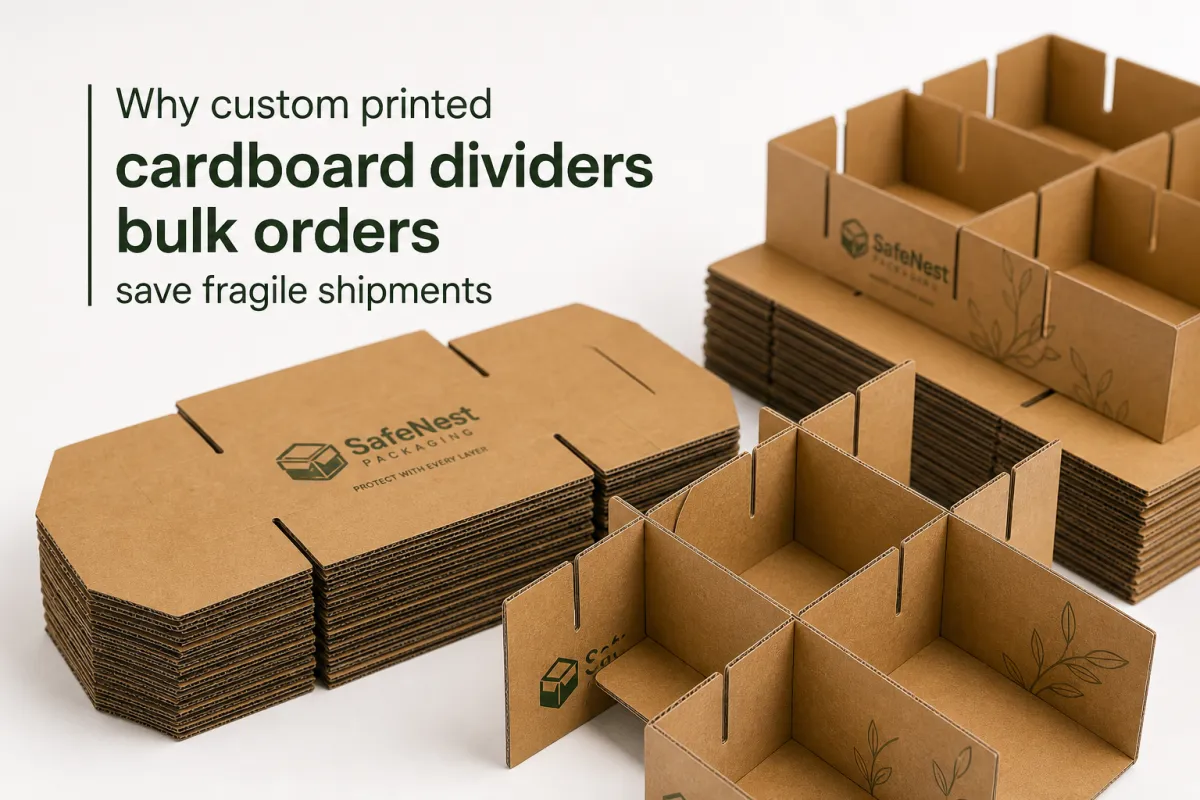
Custom printed cardboard dividers bulk programs solve one expensive problem: movement inside the shipper. Boxes fail in a dozen boring ways, but divider-related damage usually starts with an item sliding, tipping, or smacking its neighbor. The outer carton can arrive intact and still deliver cracked glass, dented tins, broken caps, or corners that look like they lost a fight in an alley. That is why custom printed cardboard dividers bulk orders are common in product packaging for fragile and semi-fragile goods.
Bulk ordering matters because the savings stack up. Once the divider layout is locked, setup costs get spread over more units and the price per piece drops. Fewer damage claims. Fewer repacks. Less time burning up the packing floor’s patience. A fulfillment team does not need a TED Talk for this. If the line stops fixing bad inserts, it ships more cartons. That is the whole point of custom printed cardboard dividers bulk.
The common scenarios are easy to spot:
- Glass bottles need pressure separation so necks and shoulders do not grind together.
- Cosmetics need cells that keep pumps, jars, and droppers upright.
- Candles need dividers that stop rubbing and edge scuffing.
- Supplements and nutraceutical kits need stable cells for bottles, tubs, and sachets.
- Hardware kits need countable compartments so parts stay organized.
- Subscription boxes need a layout that keeps mixed SKUs from turning into a pile of regret by the time the parcel hits the customer.
The right divider also improves presentation. A clean, branded insert makes the box feel intentional instead of improvised. Customers notice that. They may not say it out loud, but they notice. A simple print on the top edge or outer panel can reinforce the brand color, product name, or handling direction without making the insert look like a billboard. For many buyers, that balance is exactly why custom printed cardboard dividers bulk gets approved.
If the product can move, it will. If it can rattle, it will. A divider that looks “close enough” on a flat sample can still fail after vibration, stacking, and one ugly drop onto a warehouse floor.
There is a shipping-efficiency angle too. Well-fitted custom printed cardboard dividers bulk inserts cut down on void fill, reduce carton weight, and make pack-out more repeatable. Nothing flashy. Just better packaging design. That same logic matches the testing habits used in transport standards. If the program needs more validation, ask for drop and vibration checks aligned with ISTA methods or similar transit testing expectations.
One thing buyers miss: a divider is not only a protection part. It is also a handling part. It tells the packer exactly where each item goes, which cuts mistakes on mixed-SKU jobs. At scale, that matters almost as much as board strength. That is why custom printed cardboard dividers bulk keeps showing up in serious fulfillment programs instead of living only in presentation packaging.
I’ve seen teams treat the insert like an afterthought, then spend three months explaining why a 2-cent savings turned into a much bigger loss. That math is rude, but it is also accurate.
What custom printed cardboard dividers bulk actually include
Custom printed cardboard dividers bulk is a broad category, so buyers need to sort the formats before they compare quotes. The main types are slotted inserts, cross dividers, lane dividers, and die-cut partitions. All of them separate items. They just do it in different ways.
Common divider types
Slotted inserts are the simplest. They usually use intersecting panels with slots cut into them, so the pieces slide together into a grid. That works well for bottles, jars, and compact boxes where the cell count stays uniform. Cross dividers are similar, but the layout is more modular and often easier to adapt to square cartons. Lane dividers create long channels instead of equal cells, which suits tubes, pens, tools, and rectangular packs. Die-cut partitions are the most customized option and usually make sense when the product shape is awkward or the brand wants a cleaner finish.
In custom printed cardboard dividers bulk programs, the print can go on the top edge, the inside panel, the outer face, or all three if the budget allows it. A single-color mark is common for utility jobs: product names, orientation arrows, lot information, packing instructions. Full-color branding makes more sense when the divider is visible during unboxing and supports the rest of the retail packaging story. Not every insert needs a fireworks show. Sometimes one clean color does the job better and costs less.
The divider still has to do the actual work. It must hold products upright, separate pressure points, speed up packing, and make the box look organized instead of thrown together in a hurry. That is why custom printed cardboard dividers bulk should be designed as part of the full package branding system, not as an afterthought. If the carton is part of a larger rollout, it often helps to coordinate divider print with Custom Packaging Products or matched Custom Shipping Boxes so the inside and outside of the box tell the same story.
There is a real difference between a divider that only works and one that works at scale. Functional means it protects the goods. Easy to use means the packer can insert it in seconds, without hunting for orientation or forcing tabs into bad positions. Good custom printed cardboard dividers bulk programs do both. Design earns its keep there, not just material.
For buyers repeating the same SKU mix every week, the divider layout should be standardized around the carton and the product set. For buyers with lots of SKU combinations, a modular grid with a few shared sizes usually beats a pile of one-off variations. That is how custom printed cardboard dividers bulk orders stay manageable without turning the warehouse into a puzzle drawer.
Cardboard divider specifications: size, board grade, and fit
Custom printed cardboard dividers bulk orders live or die on fit. Too loose and the product shifts. Too tight and the packer fights the insert while the board buckles during assembly. Buyers need exact measurements, not rough guesses and a shrug.
Start with the inside carton dimensions: length, width, and height. Then list the product dimensions for each item, including caps, closures, handles, or anything else that changes the footprint. After that, count the compartments. A 6-cell layout and a 12-cell layout may fit the same carton, but they need very different slot spacing and board thickness. Without those details, custom printed cardboard dividers bulk quotes are just educated guessing with a spreadsheet.
Board choice matters just as much. For lighter products, paperboard or SBS-style stock around 18pt to 24pt can work well. For medium-weight items, corrugated options such as E-flute or B-flute usually make more sense. For heavier glass, metal, or dense consumer goods, a thicker corrugated divider with better crush resistance is worth the extra cost. If the product has a sharp edge or a high center of gravity, light stock will not magically behave like rigid board. It will fail exactly the way you’d expect.
Here is a practical range that helps buyers think clearly about custom printed cardboard dividers bulk specs:
- Lightweight fills: 18pt-24pt paperboard, usually for small cosmetics, samples, or lightweight retail packs.
- Midweight products: E-flute or similar micro-corrugated stock, often a good balance of stiffness and print quality.
- Heavier or fragile items: B-flute or equivalent corrugated divider stock, especially where drop resistance matters.
- High-friction or long-haul shipments: thicker material and tighter tolerances, sometimes with a sample pack-out test before production.
Tolerance is where a lot of projects go sideways. You want enough clearance for easy packing, but not so much that the items can wander around. For many divider jobs, a small clearance of around 1 to 2 mm on the product footprint is enough, though exact targets depend on board thickness, slot design, and how stiff the product itself is. Fragile glass or polished surfaces usually need a tighter fit and no hard contact between surfaces during transport. Soft-touch or coated products may do better with a slightly looser but still controlled fit that protects the finish. Custom printed cardboard dividers bulk should never be guessed from a photo and optimism.
If the job is sensitive, ask for a sample fold test. That shows whether the board cuts cleanly, whether the slot depth works, and whether the cells keep their shape after assembly. It also exposes the annoying little problems that always show up somewhere: a slot that needs a trim, a panel that springs back, a printed area that shifts more than the proof suggested. Better to catch that on one sample than on 8,000 sets.
For responsible sourcing, ask about FSC-certified board where available. It will not rescue a bad design, but it does help when the brand wants recyclable packaging and cleaner procurement language. Plenty of buyers care about that now, and they should. If sustainability is part of the brief, ask for documentation instead of vague claims. The standard should be clear, not decorative. FSC information is available at FSC.
In plain terms, custom printed cardboard dividers bulk is less about “cardboard” and more about dimensions, board grade, cut accuracy, and how the insert behaves under pressure. That is the gap between a cheap insert and a useful one.
Custom printed cardboard dividers bulk pricing and MOQ
Custom printed cardboard dividers bulk pricing changes fast because several variables hit the quote at once. Board grade. Divider complexity. Print coverage. Number of cells. Cut style. Tooling. Pack height. Freight. There is no magic number that fits every project, which is why the best quote is usually the one that breaks pricing into parts instead of hiding everything under one line and hoping nobody notices.
MOQ depends on board type, divider complexity, and print method, not just the final quantity. A simple slotted divider may start at a lower minimum than a full-color die-cut insert with tight registration. Some buyers can order a few hundred sets if the tooling is already standard. Others need 1,000 to 5,000 sets before the economics start behaving. That is normal. Bulk is where custom printed cardboard dividers bulk stops feeling expensive and starts making sense.
Tooling and setup drive a lot of the cost. A die charge can be modest on a simple run and annoying on a complex one. Setup costs usually land somewhere around $120 to $600 depending on cut complexity and how many changes are needed. Print setup can add more if the artwork needs extra passes or special registration. Once those costs are spread over more units, the per-unit price falls. That is why buyers should ask for quotes at two or three run sizes, not just one.
Below is a practical comparison for custom printed cardboard dividers bulk pricing at common volume tiers. These are working ranges, not promises, because freight, ink coverage, and material availability can shift the numbers.
| Divider type | Typical use | Material | Print option | 1,000 sets | 5,000 sets | 10,000 sets |
|---|---|---|---|---|---|---|
| Slotted paperboard insert | Light cosmetics, samples, small retail kits | 18pt-24pt SBS or similar | 1-color edge print or simple branding | $0.42-$0.68 | $0.18-$0.31 | $0.12-$0.22 |
| Cross divider | Bottles, jars, uniform cartons | E-flute corrugated | 1-2 color utility print | $0.55-$0.88 | $0.24-$0.40 | $0.16-$0.28 |
| Lane divider | Tubes, tools, rectangular products | B-flute or heavier board | Brand panel or handling marks | $0.60-$0.95 | $0.28-$0.46 | $0.18-$0.33 |
| Die-cut partition | Fragile items, premium packaging, custom shapes | Corrugated or heavy paperboard | Full-panel branding possible | $0.72-$1.10 | $0.30-$0.55 | $0.20-$0.38 |
Those numbers show the basic pattern. Bigger runs drop the unit cost, but only after setup stops dominating the quote. If a supplier gives you a low unit price and a giant tooling charge, run the math across the real order size. The cheapest quote on paper is not always the cheapest landed cost. That is especially true for custom printed cardboard dividers bulk orders that ship internationally or need multiple cartons per master case.
Buyers should compare three things before signing anything:
- The divider unit price at the target quantity.
- The setup, tooling, and print charges.
- The delivered cost after freight and any import charges.
That last one gets ignored all the time, and then somebody acts shocked when freight eats the margin. A clean comparison should show the real landed cost per packed box, not a sticker price that only looks cheap in an inbox. That is how custom printed cardboard dividers bulk turns into a planning tool instead of a guessing game.
If you’re comparing offers, ask for price breaks at two or three run sizes. A decent supplier can show the difference between 1,000, 5,000, and 10,000 sets without making you chase numbers through email for a week. If the price barely moves across those tiers, something is off. Volume should reward you.
One practical warning: a quote that ignores freight, export packing, or a second print pass is not “cheap.” It is unfinished. That kind of quote can blow up fast once the order gets real.
Custom printed cardboard dividers bulk process and timeline
Custom printed cardboard dividers bulk production follows a pretty simple path if the buyer sends real dimensions and usable artwork. The process should look like this:
- Request a quote with carton dimensions, product dimensions, quantity, print needs, and board preference.
- Review the dieline and confirm the compartment layout.
- Approve the proof, including print position and any handling marks.
- Run a sample if the fit is tight or the product is fragile.
- Move to production after the sample is approved.
- Pack and ship, with freight handled as a separate line item when needed.
Simple layouts move faster. A standard slotted insert with one-color print can often move through proofing and production quickly after approval. Custom sizes, mixed board stocks, or multiple artwork revisions add days before the press even starts. That part is normal. The real delay is usually not the cutting machine. It is the back-and-forth caused by missing dimensions or artwork that was never built for the insert shape in the first place. Put plainly, custom printed cardboard dividers bulk gets slow when the brief is sloppy.
A practical timeline often looks like this:
- Quote and layout review: 1-3 business days if dimensions are complete.
- Proof approval: 1-2 business days for a clean standard job, longer if edits are needed.
- Sample and adjustments: 3-7 business days when a fold test is requested.
- Production: often 7-15 business days after final approval for simpler runs, longer for complex die-cut or print-heavy jobs.
- Shipping: add the freight window separately, which can be 3-5 business days domestically or longer for consolidated freight.
Do not mix up production time and delivery time. A supplier saying the order is “done” does not mean it is sitting on your dock. It means the pieces are manufactured. Freight still exists. It still has opinions. A launch date built from the factory completion date is how teams end up staring at an empty warehouse and pretending that was the plan. Custom printed cardboard dividers bulk planning works better when those two clocks stay separate.
If the job needs stronger validation, ask whether the divider concept has been checked against a transit standard or internal pack-out test. ISTA-style drop and vibration testing is useful for shipping decisions, especially if the item is glass, metal, or a premium retail SKU with little room for returns. There is no prize for skipping the test and learning the hard way. That is how damage claims get their budget.
Good order management also means locking artwork only after the dieline is correct. Too many teams rush the brand file first and deal with the insert geometry later. That flips the order of reality. The carton decides the divider, not the other way around. For custom printed cardboard dividers bulk, fit comes first, then print, then production.
Why buyers choose us for custom printed cardboard dividers bulk
Custom printed cardboard dividers bulk orders work best when the supplier understands structure and print at the same time. That sounds obvious. Plenty of vendors still miss one side of the equation. Some are print shops that barely think about fit. Some are packaging shops that treat branding like decoration. Better results come from tighter control over board sourcing, cutting accuracy, print registration, and final inspection. Fewer surprises. Fewer excuses. Fewer “close enough” answers.
Experience matters because divider work is not just about making a grid. It is about making a grid that folds correctly, holds dimension after assembly, and survives the packing floor without becoming a daily annoyance. A better supplier helps the buyer choose between paperboard and corrugated, explains whether the insert should be tight or forgiving, and points out where overengineering will waste money. That is worth more than a nice-looking quote sheet. Good custom printed cardboard dividers bulk guidance saves revisions, and revisions are where schedules go to die.
Consistency matters at scale. If every divider set folds the same way, packers move faster. If the cells align, the product sits correctly. If the print lands in the same place on every batch, the line does not have to stop and sort out odd-looking inserts. That predictability is part of the value. It is also why repeat buyers often roll the insert program into broader Custom Printed Boxes and branded packaging rollouts instead of treating it as a one-off part.
There is a procurement angle too. Buyers who need recurring replenishment can use a supplier relationship to keep specifications stable across batches, which reduces the risk of silent changes in board thickness or slot depth. If a brand manages multiple SKUs, that stability helps the whole packaging design system behave better. Nobody wants a divider that fits last month and misses this month because somebody swapped board without saying so.
As packaging programs grow, many buyers consolidate inserts, shipper boxes, and volume orders through the same source. That makes sense if the supplier can handle it. It also makes reordering easier. If you’re building a full packaging stack, the pages for Custom Packaging Products and Wholesale Programs are usually where repeat buyers start comparing volume options, especially when the divider order ties to seasonal launches or recurring subscription kits.
Put simply, custom printed cardboard dividers bulk should be treated like a production part, not a decorative accessory. If the divider is part of a bigger brand system, the supplier should be able to match the structure to the visual look without wasting stock or creating a fit issue that shows up after the first shipment leaves the dock.
One honest note: not every project needs the fanciest insert. Sometimes a simple, well-cut, one-color divider is the right answer. Sometimes a heavier corrugated version is the only sensible choice. The job is to match the material to the product weight and the route the carton will take. That is how good custom printed cardboard dividers bulk buying works in the real world.
Next steps for custom printed cardboard dividers bulk orders
If you want a quote that is actually useful, prep the spec sheet before you ask for pricing. For custom printed cardboard dividers bulk, the minimum information should include carton inside dimensions, product dimensions, target quantity, number of compartments, print requirements, board preference, and the ship date you actually need. If a team sends only a photo and a hope, the reply will be slow and vague. That is not a mystery. That is how bad briefs behave.
Here is the clean decision path:
- Request two or three price breaks so you can see the real bulk savings.
- Confirm the dieline before artwork is locked.
- Approve one sample if the products are fragile, heavy, or oddly shaped.
- Check the landed cost, not just the unit price.
- Move to production only after fit and print position are right.
If you’re still choosing between insert types, start with the product itself. Glass and dense items usually need stronger structure. Lightweight retail kits can often use paperboard. Mixed-SKU boxes may need lane dividers or a hybrid layout. That is why custom printed cardboard dividers bulk should be spec-led, not price-led. Price matters, but fit and pack-out efficiency matter more once the cartons start moving.
A useful rule: if the divider saves one damaged box out of a small batch, it may already pay for itself. In larger runs, the return gets even clearer because the packing process becomes more predictable and the customer sees a cleaner presentation. That is where custom printed cardboard dividers bulk earns its place inside a broader product packaging strategy.
Send the measurements. Compare the options. Ask for the sample if the fit is tight. Then move forward with the custom printed cardboard dividers bulk run that matches the carton and the budget, not the one that just looks cheap on a spreadsheet.
FAQ
What is the MOQ for custom printed cardboard dividers bulk orders?
MOQ usually depends on board type, divider complexity, and print method, not just the total quantity. A simple layout can sometimes start lower, while a custom die-cut build or heavier printed insert may need a larger run before the unit price makes sense. Ask for a quote at your target quantity and the next price break so you can see the real difference for custom printed cardboard dividers bulk.
How do I size custom printed cardboard divider inserts for my box?
Measure the inside carton dimensions first, then the product dimensions and the exact number of cells needed. Leave only the clearance required for easy packing; too much gap defeats the purpose of the divider. If the fit is tight or the product is fragile, request a sample fold test before you place a full custom printed cardboard dividers bulk order.
Are printed cardboard dividers strong enough for shipping?
Yes, if the board grade matches the product weight and the fit is tight enough to stop movement. For heavier or more fragile items, thicker corrugated stock is usually the smarter choice. If the route is rough or the product is high value, test one packed sample before ordering custom printed cardboard dividers bulk in volume.
How long does custom printed cardboard dividers bulk production take?
Simple jobs can move quickly after proof approval, while custom sizes and sample revisions add time. Production is often faster than the freight leg, so always add shipping time on top of manufacturing time. That way your launch date is based on delivery, not factory completion, which is the only number that actually matters for custom printed cardboard dividers bulk.
What affects the price of custom cardboard dividers with printing?
Board grade, print coverage, cut complexity, cell count, and tooling all push the price up or down. Bulk pricing improves as quantity rises, but the biggest savings usually show up after setup costs are spread across more units. That is why comparing multiple volume tiers is smarter than staring at one unit price for custom printed cardboard dividers bulk.

