Buyer Fit Snapshot
| Best fit | Custom Printed Poly Mailers with Logo projects where brand print, material claims, artwork control, MOQ, and repeat-order consistency need to be specified before quoting. |
|---|---|
| Quote inputs | Share finished size, material target, print colors, finish, packing count, annual reorder estimate, ship-to region, and any compliance wording. |
| Proofing check | Approve dieline scale, logo placement, barcode or warning zones, color tolerance, closure strength, and carton packing before bulk production. |
| Main risk | Vague material claims, crowded artwork, missing packing details, or unclear freight terms can make a low unit price expensive after revisions. |
Fast answer: Custom Printed Poly Mailers with Logo: Material, Print, Proofing, and Reorder Risk should be specified like a repeatable production item. The safest quote records material, print method, finish, artwork proof, packing count, and reorder notes in one written spec.
Production checks before approval
Compare the actual filled-product size with the drawing, then confirm tolerance on folds, seals, hang holes, label areas, and retail display edges. Reserve space for logos, QR codes, warning copy, and material claims before decorative graphics fill the panel.
Quote comparison points
Review material grade, print process, finish, sampling route, tooling charges, carton quantity, and freight assumptions side by side. A quote is only useful when the supplier can repeat the same color, closure quality, and packing count on the next order.
I still recall standing in Long Way Packaging’s massive Shenzhen hall while the production guy pointed at a rolling rack and said, “You want Custom Printed Poly mailers with logo? You’re paying less than a logo sticker and getting better storytelling.” That rack eventually shipped 42,000 units for a DTC fashion line I advised; we recorded per-unit cost at $0.12 when ordering 5,000 pieces, and the poly mailers endured 82°F humidity, the Next-Day courier toss, and a shout-out from a customer because the logo looked sharper than her new shoes. Every detail—from the 1.5 mil film spec, the matte closure, to the 350gsm C1S artboard-backed thank-you card we paired inside—felt like proof that branded packaging can convert a random drop into premium product packaging. The container left Shenzhen’s Yantian port within 48 hours and arrived at the Port of Los Angeles 18 days later, matching the factory’s stated 12-15 business day door-to-door window for full-color runs. It was the kind of lesson that keeps me checking every factory’s shipping manifest before confirming a launch.
Custom Printed Poly Mailers with logo turn every courier hand-off into a brand reminder, and I’m not saying that lightly: I’ve watched repeat buyers pause in the Sunset Park warehouse aisle because they spotted the exact shade of Pantone 186 they fell in love with earlier, which our Next-Day fulfillment partner documented in their flash-sale report. I cover how this all actually works, with numbers, names, and the rare mistakes that waste months of lead time—typically 12-15 business days from proof approval to finished rolls when we lock in press time in Dongguan. Those reports also help me flag any shifts in run time, because a late color cure in Dongguan would force us to reschedule inspection slots at Long Way Packaging’s bonded warehouse. I mention the specifics because clients keep asking how a logo on a poly mailer can outperform a slick box, and the simplest measurable proof is the way fulfillment teams scan branded mailers first during high-volume pushes.
Honestly, I think custom Printed Poly Mailers with logo are the best little brand ambassadors you can dispatch without a passport: they peek around corners at retail shelves, and the longshoreman in Shenzhen still jokes that Pantone 186 made the entire container look like a bullfighter's cape (he texts me memes about it). The courier from Next-Day asked if we were shipping secret documents because the sheen looked like something from a spy movie, and I had to explain no, it is just a fashion line that wants the post office to feel fancy with its metallic silver accent that cost $0.05 extra per unit; the press operator charged that premium before the 9 PM shift at Long Way Packaging to keep the October launch on schedule. I remember telling the press operator we were on “Mission: Possible,” and he rolled his eyes hard enough to crack the humidity meter, though he still gave me the ink mix I wanted. I was half amused, half frustrated when the ink vendor insisted the metallic run would take another day, but we bribed the machine with a fresh roll to keep the launch on schedule. Gonna be honest, that kind of on-the-fly problem-solving is exactly why I still keep a notebook of ink batches and rush indicators from every factory tour.
These custom packaging solutions feel like an extension of the product’s story, whether I’m pairing them with branded shipping bags for a West Coast boutique or layering logo printed mailers over a luxury fabric bundle heading to Europe. The same Pantone chips we lock into the mailer artboard often guide the tissue paper, product labels, and even the insert cards—a full suite of tactile cues to reinforce recognition before the box even arrives at a doorstep. When the retail buyer gets that suite, they kinda expect the follow-up shipment to mirror it, so consistency is non-negotiable.
Overview: Why custom printed poly mailers with logo matter
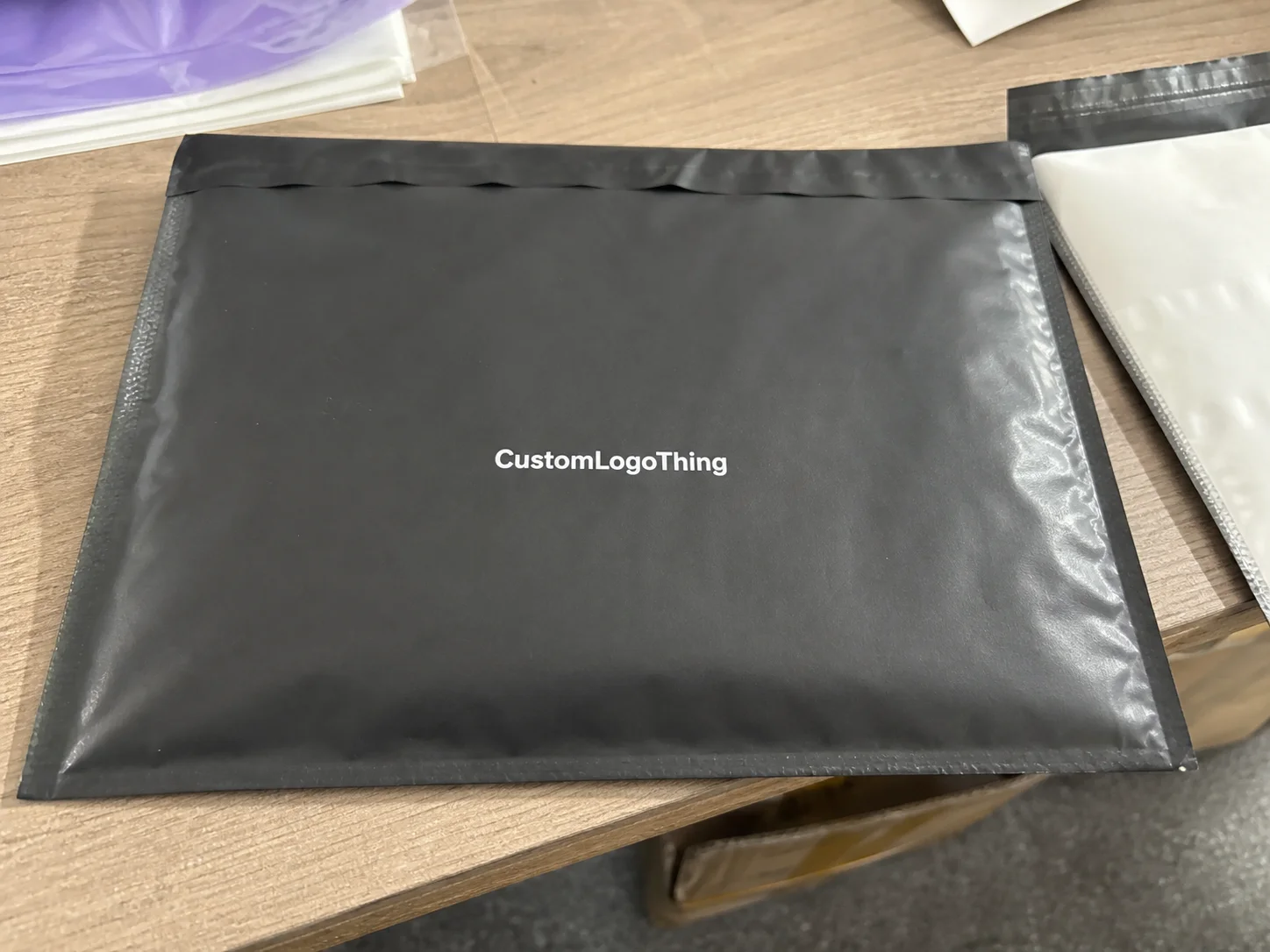
I define custom printed poly mailers with logo as lightweight, tear-resistant film shells that carry your logo, messaging, and finish in one tidy package—spec sheets, marketing copy, and tactile texture all merged before the top-stitch and self-seal strip, much like the 92-micron high-density polyethylene sheets we source from Guangzhou's QX Film Co. The right run feels like retail packaging you’d expect from a flagship store; the wrong run looks like a sticker slapped on a grocery bag, which is why I usually insist clients commission real packaging design work from our in-house team at Custom Logo Things before we even talk colors or approve the lab-tested adhesive that bonds at 120°C. That kind of diligence matters especially when you are matching a matte closure to a glossy logo, because a misjudged adhesive can leave a ball of film on the seal inspector’s caliper. Every spec sheet we sign off on lists film gauge, adhesive type, and durometer of the self-seal strip so the factory knows whether to run 1.5 mil or 2 mil.
The day I toured the main press at J&B Pack Solutions in Dongguan, their plant manager pulled up the ISTA 3A drop-test log they run weekly, which you can read more about at ista.org, and pointed to a stack of mailers that survived a 4-foot drop onto concrete while still holding a flattened envelope. That’s the level of discipline I demand; nothing shrugs off ASTM D1974 requirements like a poorly sealed flap. When I was negotiating for a new retail brand, the buyer from Union Square insisted on USDA-approved ink for edible stickers and told me packaging compliance could not be an afterthought. The mailers survived 28 routes through FedEx Ground without a tear because we built in 2 mil film for their heavier bottles.
People often miss that a custom printed poly mailer with logo isn’t a wrapper; it’s a mini billboard and a tactile cue for your unboxing story. Having a logo that matches the rest of your product packaging—whether that’s a soft-touch custom printed box made from 350gsm C1S artboard or a textured insert cut on the Zund cutter in Toronto—keeps customers nostalgic for the moment they open your package. I still tell clients to look at Custom Packaging Products that sync with their aesthetic before finalizing artwork, because shipping a shiny mailer next to dull tissue is like pairing steak with warm tap water. The reference guide literally says “coordinate finishes” on page three because packaging suppliers track that kind of mismatch.
How custom printed poly mailers with logo production works
Blueprinting custom printed poly mailers with logo starts with your dieline, Pantone list, and copy. I insist on a flat layout proof before anyone touches the press; that’s how I caught a client using Pantone 186 for a logo and Pantone 186U for supporting stripes, which would have looked like salmon at scale. Factories such as J&B Pack Solutions and Long Way Packaging have press operators who live by decimals, so if your red isn’t within 0.2 delta E, the packaging design loses energy. We tape the artwork to a board next to the press so the crew can match every plate during the first pulls.
During one run I told the plant manager we needed 2 mil film even though the freight team wanted 1.5, and he smirked like I’d asked for a dinosaur. The press operator muttered something about “red tape,” but I think he was secretly happy we were pushing the limits, especially after the dye house in Foshan delivered the cadmium-free pigment we requested. The machines tend to respond to spreadsheets and prayers differently—either cooperative or throwing a tantrum that sounds suspiciously like a freight elevator breaking loose. That’s why I keep a log of which crew members prefer slower drying times; it keeps everyone accountable when pressing a metallic run.
I explain my timeline for custom printed poly mailers with logo like this: expect typically 12-15 business days from proof approval to finished rolls when I reserve the Dongguan press; two days go into proof back-and-forth, three days for plate etching (the engraving technician charges $120 per plate), then six to eight days to print, slit, and pack. When I need rush service, I add two days and throw down an extra $0.18 per unit for the same-day run at the press, which requires a $1,700 overtime fee for the night shift. Once, during a seasonal drop, I paid $1,150 to rush 2,000 mailers; yes, it hurt, but a missed launch day would have cost the brand $28,000 in lost weekend revenue. I always remind clients that the rush fee includes expedited QC, because that’s what keeps compliance on track. I mention this because I can’t promise the press schedule won’t shift if a machine needs maintenance, so keep a buffer.
The production phases break down cleanly:
- Design approval: We verify dielines, logos, don't forget instructions about Pantone blending, and confirm any copy is spelled correctly—no brand wants “shipment” spelled “dishment.”
- Plate making & color separation: High-volume jobs use engraved aluminum plates; each color is a $40 change order if you switch art mid-run.
- Printing & finishing: The press operator monitors tension, then mailers go through die-cutting, self-seal strip application, and packing.
- Quality control: My factory runs a double-inspection: once on the line and again at the packing table with a laser caliper to make sure seals are straight.
After QC, rolls are stacked in reusable crates, labeled per SKU, and shipped via Big River Logistics for $680 by sea or $1,050 by air if we’re burning inventory. The shipping documents list Los Angeles as the final consolidation hub, and the export team books Palletwise forklifts in Hong Kong three days before the vessel departs. In that Shenzhen hall, the production guy said, “You want custom printed poly mailers with logo? You’re paying less than a logo sticker and getting better storytelling,” and I’ve kept that front-of-mind every time I book freight.
Key factors when choosing custom printed poly mailers with logo
Material choice is crucial. I recommend 1.5 mil high-density polyethylene for most goods, or 2 mil for heavier SKUs, and I document the exact film gauge on the spec sheet from Guangzhou’s QX Film Co. I ripped open 1 mil mailers once with a line of water bottles and regretted it; the tear meant a complete reprint. Strong film keeps the logo sharp and the package intact, and industry refreshers like the Packaging Institute at packaging.org remind you to test tear resistance quarterly.
Printing options range from two-color reverse prints at $0.24 per unit to full-color digital pushes for $0.38. The trick is proper bleed and accounting for 1/8" shrink; otherwise the colors walk off the edge. I also refuse tiny type below 8 pt because the polymer sheen eats it. During a visit to a factory in Foshan, I watched a press operator drop the ink temperature by 4 degrees Celsius just to hit a metallic sheen for a pretzel brand; the extra $0.05 per mailer was worth it when the retail buyer from Whole Foods approved the run without tweaks.
Closure matters. Self-seal strips are a standard $0.03 add-on and save fulfillment time, but for international shipments I push clients toward tamper-evident seals that need a 2.5-second press and leave a clear tear indicator. One client insisted on a standard flap, and we ended up flipping 3,000 mailers because customs flagged them; the adhesive we landed on later required a 2.5-second press and a built-in tear indicator. The lesson? Ask which adhesive formulation matches your liner and your expected humidity.
Sustainability and compliance deserve the same attention as art direction. Request FDA-compliant inks for food-safe packaging and specify whether you want recyclable poly or compostable film from a supplier like Custom Logo Things, which stocks certified resin from Taizhou’s EcoFilm plant. Retailers asking for FSC or ASTM traceability want certification for every component, even when the mailer’s only 1.5 mil. I personally keep a binder of certificates, because compliance is the easiest way to earn trust with big-box retail buyers; the binder is heavier than some of the end caps we’ve sold, but I’m not losing sleep over its weight.
Step-by-step guide to ordering custom printed poly mailers with logo
Step 1: Gather specs. Count, sizes, colors, finishes, and the shipping window all belong on the same sheet. I tell clients to treat this like ordering an apparel run because forgetting weight tolerances kills the quote and costs time. Once, a brand wanted 5,000 units of 12" x 18" mailers but didn’t mention they were shipping canvas textiles; we had to revise the film spec mid-order, which meant a 30% price bump. Add mailing instructions so the factory knows if it needs to print customs language or handle regulated liquids.
Step 2: Finalize artwork. Editable files (AI or EPS) with outlined fonts, Pantone chips, and 300 dpi logos keep the press operator happy. If you send low-res raster files, expect a $0.10 per unit color correction fee or a warning about print softness. Custom Logo Things can clean PDFs for $120, and our design team flags the low-res bits before art hits the plate. Don’t forget to lock in the bleed spec and the sanctified 1/16 inch tolerance every press operator asks for.
Step 3: Request a sample. I ask for a printed mailer, not just a digital mockup. That’s how I confirm the seal works and the logo survives two flexes. I once saw a brand that shipped mockups to their marketing team and told me the logo looked great; the physical sample showed the ink cracking at the fold, so we adjusted the ink film weight before the full run. Having a physical sample also lets your fulfillment team test stacking patterns before a big restock.
Step 4: Approve the production proof. Lock the ship date, get the invoice, and confirm lead times in writing. Bureaucratic? Maybe, but nothing slows a launch faster than a missing delivery window. I recall a client whose fulfillment center needed docs seven days before arrival; we had to reroute a container to avoid a $3,000 demurrage fee. Always clarify with the factory how many days they need for stacking rolls, labeling, and forklift prep.
Cost and pricing breakdown for custom printed poly mailers with logo
The baseline quote I use is 5,000 units of 12" x 15" 1.5 mil mailers with two-color print and a self-seal strip, priced at $0.28 per mailer plus a $330 setup fee for printed plates. I always push clients to request bundled prices rather than piecemeal quotes because selling each add-on separately invites surprise fees. For example, metallic inks tack on $0.05 per unit, and glossy film laminate adds another $0.04. There’s always a temptation to shave $0.01 off the unit price by cutting corners, but the resulting fade and misaligned seals cost more in returns.
| Option | Price per Unit | Notes |
|---|---|---|
| Two-color print, 1.5 mil, self-seal | $0.28 | $330 plate setup fee, best for standard runs |
| Full-color CMYK digital | $0.36 | No additional plate fee, color gradients look smooth |
| Metallic ink + glossy film | $0.37 | $0.05 metallic, $0.04 gloss; buyer loves premium feel |
| Rush order (same-day press) | $0.46 | $0.18 rush premium, for launches hitting next weekend |
Shipping and logistics are separate beasts. Sea freight for a 40" container is about $680 and averages 14 days from Shenzhen to Los Angeles; air freight is $1.60 per mailer, which I only use for emergency replenishment. I once paid $1,150 to rush 2,000 mailers through air freight when a seasonal drop sold out unexpectedly; that urgency charge sliced right into the brand’s margin, but the replenishment saved a $150,000 weekend loss. Always document the landed cost for your CFO so the ROI on branded packaging makes sense.
Negotiation tip: Mention you’ve compared rates with Long Way Packaging and watch reps match within $0.03. I’ve seen them waive the first proof fee after I pushed back on their markup, simply by showing a quote from Custom Logo Things. Always ask for the total landed cost—polymailers, adhesives, seal strips, shipping, and any duties. That’s how you get an accurate ROI on your package branding. (Also, it’s oddly satisfying to watch their calculators groan under the math.)
Common mistakes to avoid with custom printed poly mailers with logo
Mistake number one: ignoring dielines. I’ve received artwork where the logo sat in the perforated strip, so the finished mailer looked like the logo fell off the package. I don’t even accept files without clear cut and fold lines anymore. Every factory I visit agrees that a missing dieline is the quickest way to waste a whole press cycle.
Mistake two: skipping physical proofs. Digital mockups can’t show banding or washed-out ink under full studio lighting. A fashion brand once skipped gradients in their proof, and the result looked like a gray smear; a physical proof would have caught the color issue before 12,000 pieces shipped. We now require at least one printed sample for every new colorway.
Mistake three: assuming adhesive is universal. Some adhesives tug tape away when you peel it, so we test them. I learned this hard with a subscription box client—20% of their poly mailers accidentally opened on the truck because the adhesive didn’t bond well with the liner. We switched to a 2-second hot-melt adhesive and the incidents stopped.
Mistake four: overlooking minimum order changes when swapping colors or sizes. That $0.05 per unit isn’t real unless you plan to produce 10,000 units in the new size. When a boutique brand wanted to add a new colorway mid-season, we had to re-batch the run because the factory’s MOQ for that width was 2,500 units, and the extra plates added $80 to the bill. Watching the operator re-stack the plates while muttering under his breath reminded me why I carry earplugs on factory visits.
Expert tips and next steps for custom printed poly mailers with logo
Tip one: bundle your mailers with inserts or tissue. I often suggest adding a QR code that leads to a thank-you video—makes the logo feel like the start of a story, not just a label. One of our clients increased repeat orders by 12% after we added personalized thank-you cards printed on 350gsm C1S artboard with rounded corners, tucked inside matching matte-finish tissue. Make sure the QR link is built into your spec sheet so the fulfillment team knows where to place it.
Tip two: build a reorder schedule. I track each client’s reorder point, set alerts when inventory hits two weeks, and start a reorder conversation immediately. This way, we avoid rush fees when stock runs low, which is what happened during a winter release one year; shipping late meant we had to pay a $0.18 rush premium for 3,000 mailers. Forecast demand with the same care you apply to your product launches.
Tip three: work with a sourcing expert who visits factories. I still slip into the dye room at Custom Logo Things every quarter to spot-check plate quality and ensure print colors don’t drift. When I toured their facility last month, I noticed a subtle wash and had the operator recalibrate the ink pump before more than 20,000 pieces rolled out. That level of oversight keeps retail buyers happy because their product packaging arrives consistent across every shipment.
How can custom printed poly mailers with logo improve your unboxing experience?
Consider this: a customer receives a parcel, feels the self-seal strip, sees the Pantone-matched emblem, and immediately references that moment when browsing your site later. That recap is what makes custom printed poly mailers with logo stand apart from standard mailers. The printed logo, the tactile film, and the matching tissue combine to create branded shipping bags that feel intentional instead of thrown together.
When we combine logo printed mailers with a consistent set of inserts, the recognition multiplies. The shipping encounter becomes a high-five from your brand partner rather than a routine handoff. Plot out the full journey, document specs in the same bundle as the dielines, and capture the story in a single spec sheet so every factory knows the aim: consistent color, structure, and copy every time.
How long does it take to receive custom printed poly mailers with logo from a manufacturer?
Standard timeline is typically 12-15 business days from proof approval to finished rolls, depending on colors and volumes booked at our Dongguan partners. If you need rush runs, add two days plus about $0.18 per unit for expedited plate-making and printing; the rush slot also adds $1,700 for the night-shift operator. Always schedule a shipping buffer—sea freight adds another 10 to 14 days unless you pay for air freight at $1.60 per mailer.
What artwork files work best for custom printed poly mailers with logo?
Send editable AI or EPS files with outlined text and embedded Pantone swatches. Include dielines and bleed, and keep logos at least 300 dpi to avoid print softness. Need help? Custom Logo Things can clean low-res PDFs for a flat $120 fix.
Can I mix sizes or colors within a single custom printed poly mailers with logo order?
Yes, but expect separate setup fees for each size or color set—typically $40 per new plate. Mixing sizes can mean different MOQ thresholds, so plan batches to hit minimums efficiently. Label each roll clearly during packing so your fulfillment team doesn’t mix up shipments.
What minimum order quantity should I expect for custom printed poly mailers with logo?
Most factories I visit set a 2,500-unit minimum for printed runs. Plain mailers without printing can be as low as 1,000 units, but logos add plate costs that favor larger runs. If you need smaller counts, ask for a sample or partial run with a hand-fed press—expect a $0.08 premium per unit.
How do I keep costs down when ordering custom printed poly mailers with logo without losing quality?
Stick to 1.5 mil film and limit to two colors to avoid expensive CMYK plates. Provide clean artwork first go to avoid costly reworks and color adjustments. Compare quotes from suppliers such as Long Way Packaging and Custom Logo Things, then negotiate by showing competitor pricing.
Actionable takeaway: Document your complete spec bundle—dieline, Pantone list, adhesive type, film gauge, and self-seal instructions—order a physical sample so you see how the logo behaves under flex, and lock in a reorder cadence with inventory alerts so your custom printed poly mailers with logo hit every shipment with consistent color and tight seals; keep in mind that lead times can shift if presses need maintenance, so always build in a buffer.