Buyer Fit Snapshot
| Best fit | Custom Printed Shipping Labels Order projects where brand print, material claims, artwork control, MOQ, and repeat-order consistency need to be specified before quoting. |
|---|---|
| Quote inputs | Share finished size, material target, print colors, finish, packing count, annual reorder estimate, ship-to region, and any compliance wording. |
| Proofing check | Approve dieline scale, logo placement, barcode or warning zones, color tolerance, closure strength, and carton packing before bulk production. |
| Main risk | Vague material claims, crowded artwork, missing packing details, or unclear freight terms can make a low unit price expensive after revisions. |
Fast answer: Custom Printed Shipping Labels Order: Print Tolerance, Proofing, and Reorder Cost should be specified like a repeatable production item. The safest quote records material, print method, finish, artwork proof, packing count, and reorder notes in one written spec.
Production checks before approval
Compare the actual filled-product size with the drawing, then confirm tolerance on folds, seals, hang holes, label areas, and retail display edges. Reserve space for logos, QR codes, warning copy, and material claims before decorative graphics fill the panel.
Quote comparison points
Review material grade, print process, finish, sampling route, tooling charges, carton quantity, and freight assumptions side by side. A quote is only useful when the supplier can repeat the same color, closure quality, and packing count on the next order.
I still remember a cold-storage run in a New Jersey distribution center where a Custom Printed Shipping labels order looked perfect on the press sheet, then started peeling off corrugated cases after just a few hours in a 38°F room with condensation on the pallet wrap. The artwork was fine. The color was fine. The barcode scanned on the first carton. But the adhesive choice was wrong for the environment, and that one mistake turned into a pallet rework that cost more than the original label job. Classic “looks great on paper, falls apart in the real world” nonsense. That’s why I tell buyers that a Custom Printed Shipping Labels order is never just about the logo; it’s about the liner stock, the adhesive chemistry, the carton surface, and the actual shipping conditions your team lives with every day. In that case, the supplier had used a standard permanent acrylic meant for dry warehouse storage, not a freezer-grade adhesive rated for 20°F to 45°F application windows.
I’ve seen buyers lose money because they ordered labels that looked sharp in a mockup and failed in the warehouse. A proper custom printed shipping labels order can speed up order fulfillment, cut handwriting, tighten package branding, and keep cartons moving through receiving, sortation, and last-mile handoff with fewer surprises. If you’re comparing options for branded packaging, product packaging, or plain ecommerce shipping labels, the right spec chosen once usually saves time, reprints, and irritation later. Which, frankly, is the whole point. Honestly, I think the cheap option is often the expensive one wearing a fake mustache. On one project for a Dallas-area 3PL, moving from handwritten carton marks to printed 4" x 6" roll labels cut packing-table corrections from three per hour to one per shift, and that was on a 2,800-piece weekly program.
Why a Custom Printed Shipping Labels Order Pays Off
A well-planned custom printed shipping labels order does more than decorate a box. It helps your receiving team sort product faster, gives fulfillment staff one less thing to write by hand, and makes pallets easier to identify when they move from dock to staging, from staging to carrier pickup, and from carrier pickup to customer delivery. I’ve watched a mid-size apparel brand in Charlotte cut misrouted parcels because every carton had the same bold ship-to label format, the same zone color, and the same placement on the top right panel. That gave warehouse staff a visual rhythm plain white labels never offered, and it took them from 14 misroutes a week to 5 within the first month.
The operational benefit is real. A branded label can reduce manual handwriting across corrugated shipper boxes, poly mailers, pouches, and outer cartons, which means fewer legibility errors and cleaner scans. In one client meeting at a fulfillment house outside Atlanta, the supervisor told me his team was losing 20 to 30 minutes per shift just trying to sort plain cartons with mismatched handwritten markings. Once they moved to a consistent custom printed shipping labels order, the dock crew could identify lanes faster, the packing station looked cleaner, and the whole order fulfillment line felt more controlled. Their target was 1,500 outbound parcels per day, and the new labels shaved roughly 12 minutes off each peak shift without changing headcount.
There is also a brand side to this. Packaging design is not only about the front of a retail box on a shelf; it extends to the shipping surface that customers see first when a parcel lands on a porch or in a mailroom. Good package branding on a label reinforces the logo, color system, and message you already built into Custom Labels & Tags, Custom Poly Mailers, and Custom Shipping Boxes. That consistency matters because the shipment is often the first physical touchpoint after checkout. I’ve seen brands in Los Angeles pay $0.15 per unit for 5,000 pieces and still come out ahead because the label matched the box print instead of looking like an afterthought from a bargain bin.
“We thought the label was just a shipping step,” one operations manager told me, “but once we standardized it, our whole packing station became easier to train.”
The other reason a custom printed shipping labels order pays off is simple: fewer reprints. If you order the right face stock, adhesive, and size for your carton texture and storage environment, you avoid the costly cycle of testing, failing, and reordering. I’ve seen buyers try to save a few cents on the wrong paper stock, only to burn that savings in labor when labels curl at the corners, smear during handling, or lift in cold rooms. That is not a theory. I’ve handled the failed rolls myself, and I’ve seen the production line stop while someone hand-tapes labels back onto cases. Nothing like watching a team fight a label that should have been boring. On a 10,000-unit reorder from a Chicago warehouse, the difference between 60# paper and 2.0 mil polypropylene came down to 6 cents per unit, but the wrong spec would have triggered a second application pass on every carton.
If your operation is built around ecommerce shipping, a custom printed shipping labels order should fit the pace of the line, not slow it down. That means the label needs to feed correctly from a dispenser, align with your scanner window, and stay readable through the journey. The better the match between the label and the environment, the fewer exceptions your team has to handle, and the smoother the entire shipment flow becomes. On a good run, production should ship within 12-15 business days from proof approval for standard paper rolls, and closer to 15-18 business days if you choose synthetic film with PMS color matching.
Custom Printed Shipping Labels Order: Product Types and Uses
When buyers start a custom printed shipping labels order, the first question I ask is simple: how will the labels be used day to day? The answer usually points to one of four formats. Roll labels are the workhorse in most packing rooms because they feed well into dispensers and thermal applicators. Sheet labels are handy for lower-volume teams that print or apply them in batches. Fanfold labels work well in certain automatic systems and high-volume fulfillment environments. Individually cut labels are less common, but they can make sense for special handling or hand-application programs. For a 4,000-parcel-per-shift facility in Ohio, roll labels are usually the least annoying option, and that matters more than the marketing brochure wants to admit.
The print method matters just as much. For a custom printed shipping labels order, buyers usually choose between direct thermal and thermal transfer, although pressure-sensitive printed labels can also be the right call for branding-heavy programs. Direct thermal is practical for short-life shipping use because it does not need ribbon, but the print can fade under heat, UV exposure, or rough handling. Thermal transfer uses ribbon and gives you better durability, which I prefer for labels that may face moisture, friction, or a longer transit path. For some brands, especially in beauty, food and beverage, and subscription boxes, pressure-sensitive printed labels offer the best combination of visual quality and application speed. A typical thermal transfer setup might use a 4.0" x 6.0" label with a resin ribbon, which is the kind of unglamorous detail that saves people from label fade later.
In a cosmetics packing facility I visited in Southern California, the team was applying glossy roll labels to both cartons and poly mailers, and the difference in appearance was obvious the second you walked the floor. The labels didn’t just show a logo; they tied the shipping pack to the same visual language used on product packaging and retail packaging inside the box. That kind of consistency helps a custom printed shipping labels order do more than identify a parcel. It supports the whole brand presentation. Their standard label was a 2" x 3" gloss paper stock with a 50# glassine liner, and the clean edge cut made the station look far more organized than the old blank stock.
Finish options also deserve real attention. Matte gives a cleaner, less reflective look and can be easier to scan under bright warehouse lighting. Gloss adds visual pop for branded packaging, though it can show scratches more easily. Clear labels are useful when you want the carton or mailer surface to show through. Paper labels are the budget-friendly choice for dry, standard shipping conditions. Synthetic film labels, including polypropylene and polyester, hold up better when moisture, abrasion, or temperature swings are part of the route. If your cartons travel through humidity in Miami or cold docks in Minneapolis, I’d pick film over paper unless you enjoy reprints for sport.
Application speed is another practical factor. A custom printed shipping labels order built in roll format can keep a manual packing line moving with fewer pauses, especially when the label dispenser is tuned to the roll core and winding direction. Fanfold stock can help in automated applicators, while sheet labels may be slower if your team has to peel and place each one by hand. That may not matter in a small shop sending 40 parcels a day, but it matters a lot in a warehouse shipping 4,000 cartons a shift. On one facility audit in Phoenix, switching to 3" core rolls cut dispenser reloads from six per day to two, which sounds tiny until you’re standing at the packing line at 4:30 p.m.
| Label Format | Best For | Typical Strength | Tradeoff |
|---|---|---|---|
| Roll labels | Manual dispensers, thermal printers, medium to high volume | Fast application, easy storage | Less convenient for flat desk printing |
| Sheet labels | Small runs, office use, low-volume packing | Simple handling, good for mixed jobs | Slower on busy packing lines |
| Fanfold labels | Automated applicators, long production runs | Efficient feeding, fewer roll changes | Needs equipment compatibility |
| Individually cut labels | Special handling, hand-applied programs | Flexible use case | Not ideal for speed |
Across ecommerce shipping, wholesale, food and beverage, beauty, and subscription boxes, the right format depends on how the package is handled after it leaves your table or line. A chilled food shipper might need a freezer-grade adhesive and synthetic face stock. A subscription box company may value a smooth matte look and strong package branding. A wholesale distributor may care most about scan performance, placement consistency, and how quickly labels can be dispensed from a bench. In Houston, for example, a beverage client I worked with used 4" x 8" labels because their service text and handling icons needed more vertical space than a tiny 4" x 6" could comfortably hold.
If you also order Custom Packaging Products, it helps to think of the label as one part of the full packaging system rather than a separate item. That’s how I’ve seen the strongest programs run: box, mailer, label, insert, and tape all working together, with one visual standard and one application rhythm on the line. A 350gsm C1S artboard insert inside a branded box does not belong next to a label that looks like it came from a different planet.
Specifications for Custom Printed Shipping Labels Order
The best custom printed shipping labels order starts with a clean specification sheet. I tell buyers to define the dimensions, shape, corner radius, face stock, adhesive, liner, and print method before asking for pricing. If those details are missing, the quote is usually based on assumptions, and assumptions are where costly mistakes begin. A label that is 4" x 6" on paper is not the same as a 4" x 6" on polypropylene with a stronger adhesive and a thicker liner. If the spec is loose, the quote is too. Shocking, I know.
Material choice should match the environment. Paper is usually the right fit for standard dry parcels and short transit times. Polypropylene resists moisture better and works well when cartons may sit in humid staging areas or pass through a refrigerated dock. Polyester offers stronger abrasion resistance and is worth considering when labels face scraping, rubbing, or repeated handling. For cold chain shipping, freezer-grade adhesives are often the difference between labels that stay put and labels that fail during condensation or freeze-thaw cycling. In practical terms, a permanent acrylic adhesive may be fine from 50°F to 90°F, while a freezer adhesive is better when the label has to bond around 20°F during application and still survive the trip.
I saw that firsthand at a beverage client where cases were stored in a cooler before outbound pickup. The label spec looked ordinary on paper, but the adhesive was not designed for low-temperature application. The result was edge lift within hours. Once they changed to a cold-chain adhesive and switched to a synthetic face stock, the problem disappeared. That is why a custom printed shipping labels order should be matched to the full route, not just the pretty mockup. Their final spec ended up as 2.7 mil polypropylene with a freezer-grade permanent adhesive, and the rework stopped almost immediately.
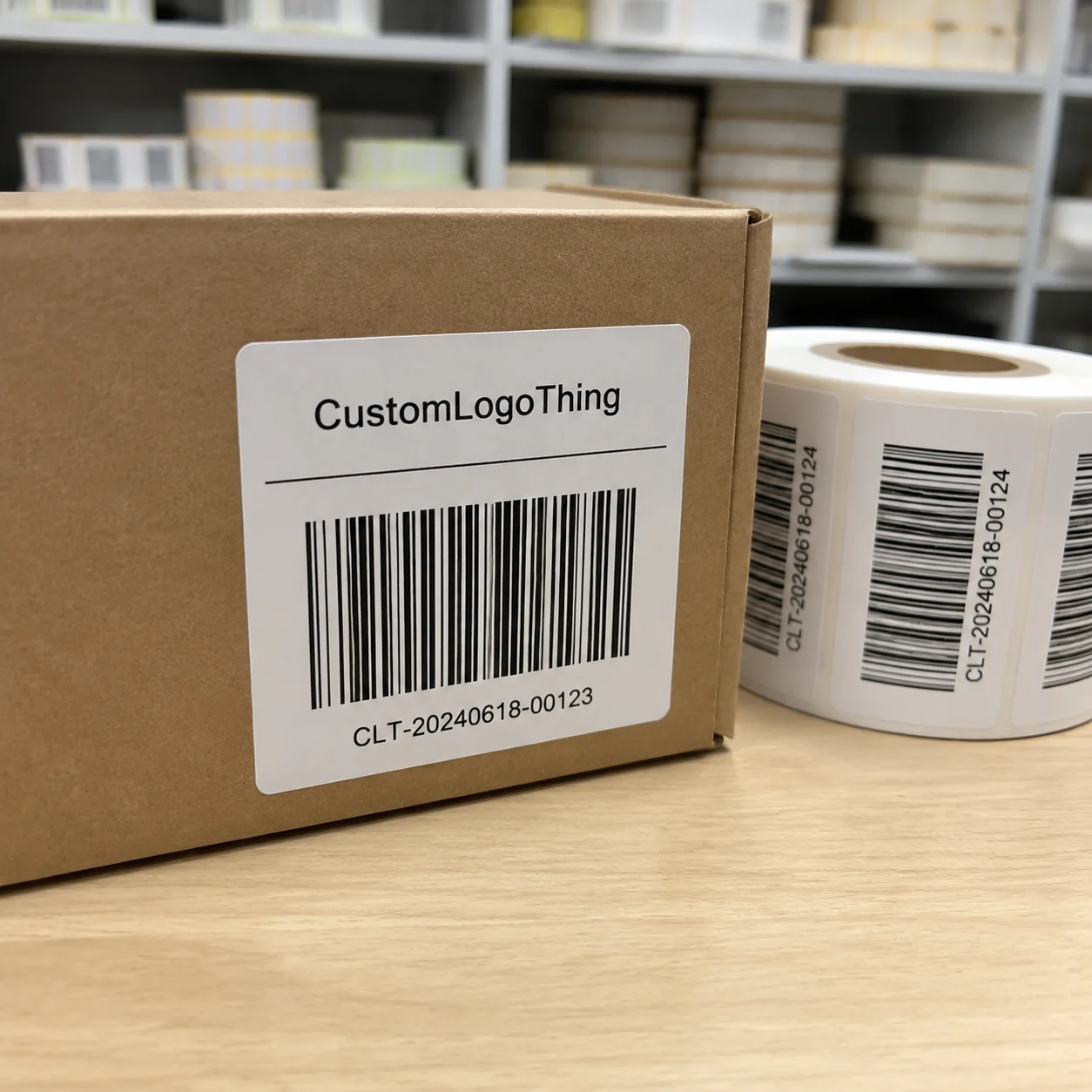
Print details matter too. For a branded program, buyers often want PMS color matching so the label fits the rest of the packaging design. For operational programs, variable data may be the priority, especially if every label needs a unique address, lot code, QR code, or sequential number. Barcodes need enough quiet zone around them, proper contrast, and a print method that will not smear in transit. If your warehouse uses scanning at multiple points, that scan reliability should be written into the spec from the start. I’ve seen a perfectly attractive label fail because the black logo sat too close to the barcode and confused the scanner at the Indianapolis hub.
Compatibility with USPS, UPS, FedEx, and marketplace workflows is usually about layout discipline more than carrier approval promises. I am careful here because each shipping platform has its own formatting expectations, and the label has to leave room for the postage block, tracking barcode, return address, and any required service text. A good custom printed shipping labels order should be designed around the actual shipping software file, not around a generic template pulled from a web search. If your software exports a 4.125" x 6.0" art area, don’t force a 4" x 6" concept into it and hope nobody notices.
- Dimensions: 4" x 6", 4" x 8", 2" x 3", or custom die-cut size
- Shape: rectangle, rounded corners, oval, or specialty die-cut
- Face stock: paper, polypropylene, polyester, or clear film
- Adhesive: permanent, removable, freezer-grade, or high-tack
- Liner: glassine, kraft, or polyester-backed, depending on application method
- Print data: logo, address fields, barcode, QR code, sequential number, warning text
- Artwork: vector logo, PMS references, and final copy approval
If you want a simple shortcut, build a one-page spec checklist before requesting a quote. Put the label size, intended surface, storage temperature, shipping method, and artwork file type in one place. That small bit of discipline helps the production team avoid guesswork, which is exactly how you keep a custom printed shipping labels order from drifting into rounds of revision. I’ve seen a 30-minute spec call save a 3-day production delay in a warehouse program out of Newark, and nobody complained about that.
For buyers who need to understand broader packaging choices, our FAQ page is a useful starting point, especially if you are comparing labels against box printing, mailer printing, or other parts of the shipping system. If you are also sorting out carton specs, a label conversation often pairs naturally with a box spec that uses 350gsm C1S artboard for retail inserts or a 24 pt SBS for heavier display pieces.
Pricing and MOQ for Custom Printed Shipping Labels Order
Pricing for a custom printed shipping labels order usually comes down to size, material, adhesive performance, number of colors, finishing, roll direction, and total quantity. A larger label uses more face stock and liner. A synthetic film costs more than paper. A special adhesive costs more than a standard one. And if you need tight PMS matching or a multi-color printed design, the print setup gets more involved. None of that is mysterious; it just reflects the actual time and materials going into the run. A 4" x 6" paper label on standard permanent adhesive may land near $0.15 per unit for 5,000 pieces, while a polypropylene version with freezer adhesive and two-color printing will cost more because the material and production steps are heavier.
I’ve sat through enough quoting calls to know that buyers often focus on unit price too early. The better question is total landed cost for the job, including waste, reprints, and application time. A slightly cheaper custom printed shipping labels order can become expensive if the labels jam in the dispenser, the liner tears unevenly, or the adhesive fails and staff has to re-label cartons after packing. That labor cost is real, and on a busy line it accumulates fast. On one account in Pittsburgh, a 2-cent savings per label disappeared the first time the team had to relabel 1,200 cartons after a corner curl issue.
Higher quantities usually lower the per-label cost because setup and press change charges are spread over more pieces. Short runs, especially trial programs, can carry higher setup costs on a per-label basis. Digital printing is often the practical route for lower quantities and design testing, while flexographic production tends to make more sense for large, repeating programs. If you only need 500 labels for a seasonal promotion, the economics will look different from a warehouse buying 50,000 labels for recurring ecommerce shipping. A 500-piece digital test might run $0.42 to $0.65 per unit, while a 10,000-piece repeat order could fall closer to $0.11 to $0.18 depending on stock and finish.
Here is a practical way I explain pricing to buyers, without pretending every quote should be identical. A small test run may be worth paying more per label if you are validating size, adhesion, and barcode readability. A replenishment order for an established line should be more cost-efficient once the spec is locked. And a warehouse-scale custom printed shipping labels order should prioritize consistency, supply continuity, and print repeatability over one-time bargain hunting. If the job needs PMS 186 red and black text on a 3" x 5" roll, I would rather quote the right thing once than negotiate my way into a headache.
| Order Type | Typical Quantity | What Drives Cost | Best Use |
|---|---|---|---|
| Test run | 250 to 1,000 pieces | Setup, proofing, and small-volume production | New artwork, new adhesive, new surface test |
| Seasonal replenishment | 1,000 to 10,000 pieces | Quantity, print colors, and finish choice | Holiday peaks, limited campaigns, promotions |
| Warehouse program | 10,000+ pieces | Material selection, repeat consistency, logistics | Steady ecommerce shipping and order fulfillment |
MOQ, or minimum order quantity, varies by production method. Digital lines can usually support smaller runs because the setup is lighter. Flexographic jobs often require more volume to justify the plate and press time. I always tell buyers to ask where the minimum comes from. Is it raw material sheet size, press setup, die cutting, or packaging labor? That answer tells you a lot about how flexible the program can be if demand shifts. In Shenzhen and Dongguan, for example, a digital label quote might start at 250 pieces, while a flexo line may not make sense until 5,000 or 10,000 pieces are on the table.
There are ways to control cost without flattening the design. Standardize one or two label sizes across the business instead of creating a new die for every department. Keep the finish simple unless the label truly needs gloss or clear film. Reduce unnecessary color counts. Bundle artwork revisions into one proof cycle, because multiple small changes can easily cost more time than the print itself. A disciplined custom printed shipping labels order should protect both brand quality and margin. I’ve watched a brand in New Jersey save nearly $600 across three orders just by dropping one unneeded spot color and standardizing on a single 4" x 6" size.
For buyers balancing labels with other print items such as boxes and mailers, it often helps to compare the full package mix instead of one SKU at a time. A label may look cheap until you compare it against the cost of changing the box print, the mailer print, and the insert strategy all at once. That is where a supplier who understands Custom Printed Boxes, retail packaging, and shipping labels together can save time in the quote stage. If your insert is a 350gsm C1S artboard card and the label is a glossy film, you want both materials to feel like they came from the same plan, not random Tuesday decisions.
How the Custom Printed Shipping Labels Order Process Works
A well-run custom printed shipping labels order usually follows a clear path: inquiry, spec review, artwork submission, digital proof, material approval, production, finishing, and shipment. That is the normal sequence whether the job is a small digital run or a larger production order. The jobs that go sideways usually skip one of those steps or rush through the proof without checking the details that matter most. If your team approves art at 2 p.m. on a Friday and notices the barcode issue at 9 a.m. Monday, well, congratulations on buying a delay.
Timeline depends on print method, material availability, and proof approval speed. If the artwork is print-ready, the barcode files are final, and the dieline is approved, production moves faster. If the logo file arrives as a low-resolution JPG, the Pantone references are missing, or the shipping software output keeps changing, the schedule slows down. In my experience, most delays happen before press time, not on the press itself. The press isn’t the problem half the time; the paperwork is. Standard runs typically finish in 12-15 business days from proof approval, while Custom Die Cuts or synthetic materials may take 15-20 business days depending on stock arrival in the plant.
One supplier negotiation still sticks with me. A client wanted a fast custom printed shipping labels order for a trade show shipment, but the first proof showed a barcode too close to the edge and a return address that would be blocked by a poly mailer flap. We fixed it in one revision, but only because we spotted the issue early. If that job had gone straight to production, the cartons would have shipped with a layout problem that no one wanted to discover at the dock. The event was in Las Vegas, the deadline was four business days away, and the corrected proof saved the day.
Quality control checkpoints matter at every stage. In a proper factory environment, the team should verify print registration, adhesive performance, die-cut accuracy, and barcode readability. If the label is part of regulated product packaging, additional checks may include lot coding or traceability marks. For most shipping programs, a simple scan test and a visual inspection of the roll direction can prevent a lot of headaches later. I’ve stood on floors in Guangzhou and Ho Chi Minh City where one misaligned rewind created a whole pallet of unusable rolls. No one enjoyed that meeting.
- Inquiry: provide label size, use case, and estimated quantity.
- Spec review: confirm material, adhesive, finish, and print method.
- Artwork submission: send vector files, barcode data, and brand colors.
- Digital proof: review copy placement, bleed, and scan areas.
- Production: print, cut, rewind, or sheet as specified.
- Inspection: check registration, adhesion, and count accuracy.
- Shipment: pack rolls or sheets securely for receiving.
When the first production shipment arrives, the receiving team should inspect a sample from the top, middle, and bottom of the box. Count the rolls or sheets, verify the core size, and test a few labels on the real carton surface, not just on a desk. I’ve seen labels look perfect on kraft paper and then behave differently on a coated mailer or a rough recycled shipper. That first receiving check is a small step, but it protects the entire custom printed shipping labels order. If the spec says 1" core and 3,000 labels per carton, then the carton had better match that count, not “close enough” in the way people use when they’re trying to escape blame.
Here’s a simple handoff note I give warehouse teams: keep one approved sample roll, one proof copy, and one spec sheet in the packing area. That way, if the next reorder looks even slightly off, the team has a benchmark. This is especially useful in order fulfillment centers where multiple shifts touch the same packaging materials and where consistency matters more than anybody admits during the rush. I’ve seen a Kansas City operation stop a reorder mistake in under ten minutes because they had one labeled sample sitting next to the printer.
Why Custom Logo Things Is a Smart Source for Labels
Custom Logo Things is a strong place to start a custom printed shipping labels order because the conversation can stay grounded in real production details instead of vague marketing language. From a factory-floor perspective, that matters. A supplier who understands how labels behave on corrugate, flexible packaging, and coated cartons can recommend a material that fits the job instead of simply quoting the cheapest stock and hoping for the best. I’d rather talk to the person who knows the difference between 60# paper and 2.5 mil BOPP than someone selling adjectives.
I respect suppliers that ask the right questions early. What is the carton surface? Is the label going onto kraft board, glossy paperboard, or a poly mailer? Will the shipment sit in ambient storage, a cold room, or a humid dock? Are you pairing the label with other branded packaging items like Custom Packaging Products or custom printed boxes? Those answers change the recommendation, and they change it fast. A label for a 12" x 9" mailer in Miami does not need the same spec as a label for a frozen seafood shipper leaving Seattle.
In one instance, I watched a packaging team save an entire reorder cycle because the supplier caught a mismatch between the customer’s shipping software layout and the proposed label size. The artwork was good, but the scanning zone was too tight for the system they used. That kind of practical review is exactly what you want from a partner handling a custom printed shipping labels order. It keeps the job from being treated like a commodity when the details clearly matter. The team in that example was using a 4.25" x 6.75" export file, but the proposed label was only 4" x 6", so the quiet zone would have been cramped from day one.
Repeat-order consistency is another area where a good manufacturer earns trust. If the first run uses a specific liner, adhesive, and color profile, the reorder should match it as closely as production allows. In my experience, the best suppliers document specs clearly so the second and third runs don’t wander. That is especially helpful for brands building package branding across multiple SKUs, multiple warehouses, or multiple fulfillment partners. I’ve seen manufacturers in Shenzhen lock this down with a one-page spec sheet, a signed proof, and a saved sample from lot one.
“The label spec should read like a production note, not a guess,” I often tell buyers. “If the team can’t build from it, it isn’t finished.”
Custom Logo Things also fits buyers who want honest guidance rather than hype. Some jobs need premium synthetic stock. Some do not. Some need complex finish work. Some are better kept simple. A fact-driven quote that explains tradeoffs is worth more than a polished promise that ignores your environment. That kind of transparency is what I look for, and it is what separates a real packaging partner from a generic print vendor. If a supplier can tell you why a 2.3 mil matte polypropylene label is better than a bargain paper sheet for your 1,200-carton weekly route, you’re talking to the right person.
If your business is also reviewing branded packaging choices beyond labels, it helps to think about the full system: the mailer, the box, the insert, the tape, and the label all telling the same story. When those pieces align, the customer experience feels cleaner and the operation usually runs smoother too. That is true whether your box insert is a simple one-color card or a 350gsm C1S artboard piece printed in Pittsburgh and packed in Nashville.
What should you do after a custom printed shipping labels order is placed?
Once you place a custom printed shipping labels order, the work does not stop. It just gets more practical. Confirm the label size, adhesive, finish, roll direction, quantity, and application surface as soon as the order is underway. Those five or six details are the ones that usually cause trouble if they are left fuzzy. I also recommend confirming whether the label will be applied by hand, by dispenser, or by machine, because that changes the winding and packaging requirements. A roll wound face-out for one printer can be a total nuisance for another, and nobody wants to discover that at 6 a.m. on a Monday.
Before requesting a quote, gather your logo files, brand colors, barcode requirements, and shipping software specifications. If you have a vector file, send it. If you have a PMS reference, include it. If your barcode needs a specific quiet zone, say so. The more concrete the inputs, the less time you spend on proof corrections. That is especially true for buyers who need a custom printed shipping labels order to work across multiple packing stations or multiple shifts. A clean AI or EPS file beats a fuzzy PNG every single time, and I have seen the difference cost two days in production.
If the labels will face moisture, refrigeration, or rough handling, ask for a sample kit or a material recommendation before you approve production. A small material test on the actual carton or mailer is often worth more than a stack of assumptions. I’ve seen teams learn in ten minutes on a real pallet what they would never have discovered by staring at a PDF proof on a laptop screen. On a Brooklyn beverage launch, a quick adhesive test on a recycled corrugated box saved the team from ordering 8,000 labels with the wrong tack level.
When the proof arrives, review every line. Check the small text. Check the barcode. Check the return address. Check the bleed. Check the legal copy if there is any. On shipping labels, the tiny things are the things that fail first. A proof should be treated like a production tool, not a formality. That is the mindset that protects the final custom printed shipping labels order from expensive corrections later. If the proof says 1/8" bleed and the file has none, stop and fix it. That tiny gap turns into a very visible problem once the blades start cutting.
One last practical note: ask for a final sample photo or a press-side confirmation if the supplier offers it. Even a simple image of the first approved roll can be useful when a receiving team is trying to match the inbound shipment to the proof they signed off on. Small controls like that can save a lot of back-and-forth after the pallet lands. I’ve had clients in Miami and Denver compare a phone photo to the delivered cartons and catch a carton count issue before the labels ever hit the line.
The best custom printed shipping labels order is the one matched to the exact shipping environment, timeline, and budget you actually have, not the one that just looks good in a mockup. If you get the spec right, the labels support your packaging design, strengthen package branding, and make ecommerce shipping easier to manage from the first carton to the last. So the practical takeaway is this: define the carton surface, temperature range, application method, and barcode layout before you approve art, because that one step prevents most label failures before they start.
What do I need to place a custom printed shipping labels order?
Have your target label size, material preference, adhesive type, artwork files, and quantity ready before you request pricing. If you need variable data, include barcode requirements and the file format your shipping system exports, because that affects layout, scan quality, and proof approval. For a clean start, send the intended carton surface too, whether it is a matte corrugate box, a coated mailer, or a poly bag from a facility in Atlanta, Columbus, or Reno.
Can I order custom printed shipping labels in a small quantity?
Yes, small runs are often possible, especially with digital printing, but the per-label cost is usually higher than at volume. Short runs work well for testing a new design, checking adhesion on a new carton surface, or supporting a limited product line. A 500-piece test order might cost $0.42 to $0.65 per label depending on stock and finish, while a larger 5,000-piece run can drop much lower once setup is spread out.
Which material is best for a custom printed shipping labels order?
Paper works well for standard dry shipments, while polypropylene or polyester is better for moisture, abrasion, or cold-chain use. The best choice depends on the carton surface, the storage conditions, and how much handling the parcel will see in transit. If your shipment goes through a humid dock in Houston or a refrigerated room in Chicago, synthetic film and a stronger adhesive are usually worth the extra cents.
How long does a custom printed shipping labels order usually take?
Timeline depends on proof approval, material availability, and print method, but clear artwork and final specs help move production faster. Most delays come from artwork revisions, missing details, or barcode corrections rather than the press run itself. Standard production is typically 12-15 business days from proof approval, and specialty materials or custom die cuts may run 15-20 business days.
Will custom printed shipping labels work with my fulfillment software?
They can, as long as the label layout leaves room for the required shipping data, barcodes, and scan-safe contrast. Share your software requirements early so the production team can build the label around your workflow instead of guessing. If your file exports a 4.25" x 6.75" area or requires a specific barcode quiet zone, say it up front so the label can match the system from day one.