Buyer Fit Snapshot
| Best fit | Custom Product Mailers with Inserts projects where brand print, material claims, artwork control, MOQ, and repeat-order consistency need to be specified before quoting. |
|---|---|
| Quote inputs | Share finished size, material target, print colors, finish, packing count, annual reorder estimate, ship-to region, and any compliance wording. |
| Proofing check | Approve dieline scale, logo placement, barcode or warning zones, color tolerance, closure strength, and carton packing before bulk production. |
| Main risk | Vague material claims, crowded artwork, missing packing details, or unclear freight terms can make a low unit price expensive after revisions. |
Fast answer: Custom Product Mailers with Inserts: Film, Print, MOQ, and Carton Packing should be specified like a repeatable production item. The safest quote records material, print method, finish, artwork proof, packing count, and reorder notes in one written spec.
Production checks before approval
Compare the actual filled-product size with the drawing, then confirm tolerance on folds, seals, hang holes, label areas, and retail display edges. Reserve space for logos, QR codes, warning copy, and material claims before decorative graphics fill the panel.
Quote comparison points
Review material grade, print process, finish, sampling route, tooling charges, carton quantity, and freight assumptions side by side. A quote is only useful when the supplier can repeat the same color, closure quality, and packing count on the next order.
Custom Product Mailers With Inserts: Design and Fit Guide
Custom product mailers with inserts solve a problem that shows up the second a box starts rattling in transit: the product may survive, but the brand already looks sloppy. People notice movement fast. They notice a cheap opening experience even faster. A serum, gadget, candle, or sample kit can look polished on the outside and still feel undercooked if everything slides around inside. That is the real job of custom product mailers with inserts: fit, protection, presentation, and packing speed all pulling in the same direction.
The format keeps showing up in ecommerce, subscription kits, launch mailers, and Packaging for Smaller fragile goods for a reason. The mailer gives the shell. The insert gives the hold. Together, custom product mailers with inserts create a structure that supports branded packaging without turning pack-out into a daily wrestling match. If you want packaging that feels deliberate instead of improvised, the insert usually carries more weight than the artwork does. No offense to the artwork.
A broader packaging plan still matters. It helps to compare this format with Custom Packaging Products and lighter options such as Custom Poly Mailers. Those can fit the job just fine in the right situation. They just do not solve the same fit problem. A generic box with loose fill can keep a shipment from breaking. It rarely presents the product well. Custom product mailers with inserts do both, which is why buyers often think of them as a packaging system rather than two separate pieces.
A premium product in a loose box still feels unfinished. Customers notice movement first, then branding, then value.
What Custom Product Mailers With Inserts Actually Are
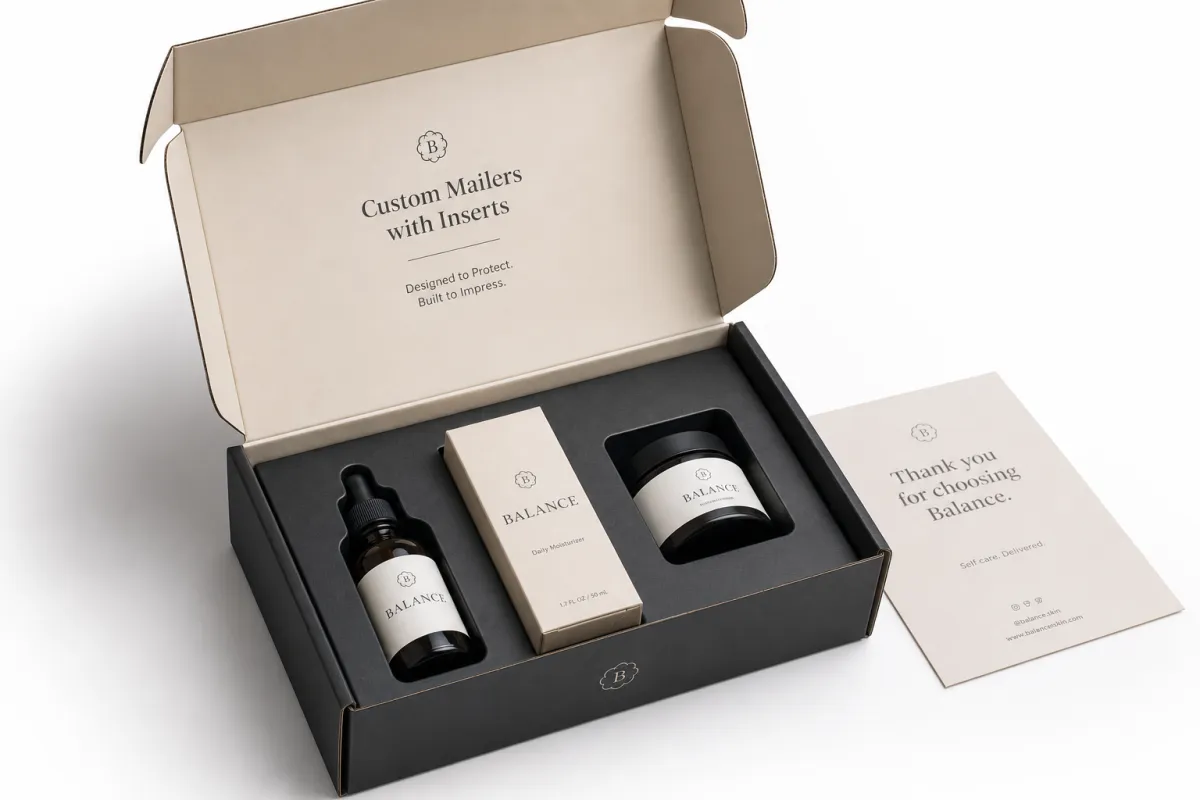
At the simplest level, custom product mailers with inserts pair an outer mailer with an interior component shaped to the item or kit. The mailer is the shell. The insert is the restraint. That insert might be die-cut paperboard, corrugated board, molded pulp, or a specialty structure built to hold one item or several items in a fixed layout. The point is not just to stop movement. It is to make the opening sequence feel planned instead of accidental.
That difference matters more than many buyers expect. A standard shipping carton can carry weight, but it does not automatically create a clean presentation. Loose fill can keep a bottle from breaking, yet it often leaves the customer staring at crumpled paper or air pillows instead of a product story. Custom product mailers with inserts let the pack-out become part of the brand experience, which is why they show up so often in retail packaging, PR kits, cosmetics, electronics accessories, and seasonal launch boxes.
They also fit products that are light but easy to damage: glass droppers, compact devices, sample jars, small tools, face masks, and bundled accessories. If the item has a repeatable footprint, a custom fit usually pays off quickly. If the product mix changes every few weeks, the insert can still work, but the packaging design needs more flexibility. Structural planning matters more than decoration in those cases.
From a packaging buyer's point of view, repeatability is the real win. Once custom product mailers with inserts are dialed in, pack-out gets easier. The team knows where each item goes, which side faces up, and how much pressure is safe. That cuts down on mistakes and shortens training time for seasonal staff. It also keeps batches consistent, which matters when branded packaging has to look polished every single time.
I have seen a gorgeous launch box get dinged by one small thing: the insert was cut just loose enough that the product could slide a few millimeters. That was enough. The customer opened it, shook the box once, and the whole thing felt cheap. That is the kind of detail people remember, even if they do not know why.
Two things show up again and again:
- Loose-fill can move, especially through vibration, sorting, and stacking on the way to the customer.
- A well-cut insert can reduce waste because the packer uses less guesswork and fewer extra dunnage materials.
If the product is fragile, design the mailer and insert as one system, not as a box with a last-minute add-on. That mindset separates ordinary product packaging from custom product mailers with inserts that actually hold up under shipping pressure.
How Custom Product Mailers With Inserts Protect the Product
Protection starts with movement. Custom product mailers with inserts keep the item in a fixed position so the outer mailer can do its job without the product knocking into the walls. The insert reduces vibration, centers the contents, and spreads impact forces more evenly. That sounds basic because it is. It is also the difference between a package that arrives quiet and one that arrives with scuffs, corner dents, or a broken seal.
Think about the four common travel hazards: drop, shake, compression, and stacking. A mailer with a solid insert handles each one in a different way. During a drop, the insert absorbs some of the first movement and keeps the item from slamming into a wall. During shake, it limits side-to-side bounce. Under compression, the outer board and insert work together so the product is not carrying the full load. During stacking, the structure resists flex so the item stays protected.
Geometry matters just as much as material. A bottle needs different support than a compact device. A jar with a lid needs different clearance than a sample tube. Multi-item kits need separation between parts so they do not rub or collide. With custom product mailers with inserts, those shapes can be designed directly instead of being left to chance.
The practical version looks like this:
- Glass and ceramics need tight lateral control and enough top clearance to avoid lid stress.
- Electronics accessories need anti-scuff spacing and a layout that prevents cord tangling.
- Cosmetics and skincare benefit from upright placement so labels stay visible and caps stay secure.
- Multi-product kits need pockets or partitions that preserve the unboxing sequence.
There is a throughput upside too. A well-designed insert makes fulfillment faster because the packer is not deciding where each item goes. That matters at 500 orders a day. It matters even more at 5,000. In many operations, the best custom product mailers with inserts reduce both damage and labor, which is a pretty decent combination in product packaging.
If you want to check the shipping profile, testing against recognized methods such as ISTA protocols or EPA recycling guidance can help frame the conversation. Heavier or more fragile sets may also benefit from ASTM-style transit thinking in the brief. Not every package needs a formal lab program, but the better the test plan, the fewer ugly surprises later. That matters even more for custom product mailers with inserts built for premium product packaging, where a small failure looks much bigger than it should.
Custom product mailers with inserts also help cut visible wear. Less product-on-board contact means fewer rubbed corners and fewer label scuffs. That matters for branded packaging because tiny marks change the impression of value. A customer may not know the board grade, but they know whether the package felt calm in hand or noisy and overworked.
And yes, the inner structure matters even on the second order. The first run gets all the attention. The reorders are where weak design gets exposed. If the insert slows the line, wrinkles easily, or needs a tiny ritual to assemble, somebody in fulfillment is going to mutter about it by week two. Probably more than once.
Key Factors That Shape the Best Mailer-and-Insert Fit
The best custom product mailers with inserts start with product dimensions, not artwork. Measure width, depth, height, weight, and any protrusions that change the true footprint: pump heads, caps, handles, cords, labels, or awkward lids. Then decide how much tolerance the package actually needs. Too tight, and the packer struggles or damages the item. Too loose, and the insert stops doing its job. A few millimeters can separate a clean fit from a rattling one.
Material choice comes next. For the outer mailer, common options include E-flute or B-flute corrugated, heavier paperboard wraps, or rigid-style structures for premium launches. For the insert, paperboard die-cuts are efficient, molded pulp can work beautifully for sustainability-forward programs, and foam alternatives still show up where the product has unusual vulnerability. The right answer depends on fragility, shipping distance, branding expectations, and cost. Custom product mailers with inserts are not single-material packages; they are material systems.
Branding choices shape the structure too. Some brands want the inside to look as polished as the outside, which pushes toward inside print, custom reveal panels, or printed compartments. Others care more about efficient pack-out and a clean exterior. That is a packaging design decision, not a style preference. In retail packaging and subscription boxes, the opening sequence is part of the brand. In heavier product packaging, protection usually wins. Most programs land somewhere in the middle, which is probably the right place for most sane people.
Sustainability deserves a straight answer. Recycled content, curbside recyclability, FSC-certified paperboard, and reduced material use all sound good. None of it matters much if the package arrives damaged. A lighter board that fails in transit can create more waste than a slightly heavier structure that protects the product. That tradeoff is why custom product mailers with inserts should be judged on both recovery and performance. If you are trying to support a recycled-content strategy, look at material recovery and not just the marketing language. The FSC framework can be a useful reference point for responsibly sourced paperboard, but it does not magically make a weak structure better.
Product count and fill pattern matter more than many teams realize. A single item in a fitted cavity is simple. A three-piece kit with a booklet, accessory, and sample vial is not. The layout affects how fast the order can be packed, whether the contents sit evenly, and how the customer reads the unboxing moment. In other words, custom product mailers with inserts need to be designed around fulfillment speed as much as aesthetics.
Ask these questions before approving a structure:
- Will the product ship by parcel, LTL, or international route?
- Does the insert need to lock one item or several items?
- Is the goal damage reduction, presentation, or both?
- Will the same pack-out run for three months or a full season?
- Does the brand want a matte, natural, or high-contrast printed finish?
Those answers change the design more than most artwork revisions do. Once they are clear, custom product mailers with inserts become much easier to spec the first time.
What Custom Product Mailers With Inserts Cost
Pricing usually comes down to a handful of drivers: size, board grade, insert complexity, print coverage, finishing, and quantity. Custom product mailers with inserts that use simple die-cut paperboard and limited print can stay efficient at scale. A structure with multiple pockets, tight tolerances, specialty coatings, or heavy exterior coverage moves into a different cost bracket fast. If you are comparing quotes, make sure the structure is actually comparable before you judge the numbers.
There are also hidden costs that catch buyers off guard. Dieline development, prototype rounds, freight, storage, and the time spent signing off on revisions all add up. Some projects also need custom tooling or multiple sample cycles because the product is not final when the box brief starts. That happens a lot with cosmetics launches, electronics accessories, and seasonal kits. Custom product mailers with inserts are often cheapest when the product spec is locked early, not when the order is rushed.
The table below gives a practical comparison. These are broad planning ranges, not promises. Still, they help when you need to estimate how custom product mailers with inserts fit into a packaging budget.
| Option | Typical Use | Approximate Unit Cost | Notes |
|---|---|---|---|
| Paperboard mailer with simple insert | Light kits, small beauty items, sample sets | $0.55-$1.20 at 5,000 units | Efficient for clean presentation and moderate protection |
| Corrugated mailer with die-cut insert | Fragile accessories, glass, electronics add-ons | $0.80-$1.75 at 5,000 units | Stronger crush resistance, better for parcel shipping |
| Premium rigid-style mailer with specialty insert | Launch kits, PR boxes, high-value presentation packs | $1.50-$3.50 at 5,000 units | Higher perceived value, more finishing options |
| Low-volume prototype run | Testing, pilot launches, limited editions | $2.50-$8.00 per unit | Setup costs are spread across fewer pieces |
Now for the part buyers often skip: savings on the back end. A better fit can reduce breakage, lower returns, and cut repacking labor. If a custom insert saves even 30 seconds per order at scale, the labor savings can be meaningful. If it prevents even a small percentage of damage claims, the payback can arrive faster than the packaging team expected. That is why custom product mailers with inserts should be costed as a total system, not a piece price alone.
Here is the simple mental framework: quote the mailer, quote the insert, add setup and freight, then estimate damage avoided and packing time saved. That comparison is usually more honest than chasing the cheapest unit number. For brands investing in premium product packaging or custom printed boxes, the real question is not "What is the lowest price?" It is "What price buys the best fit with the fewest downstream headaches?"
The Process and Timeline for Ordering Mailers With Inserts
The ordering process for custom product mailers with inserts usually moves through six steps: discovery, product measurement, structural design, prototype review, revisions, production approval, and delivery. The exact order can change a little, but the logic stays the same. First you define what needs to be protected and how it should feel. Then you translate that into dimensions, material choices, and finishing. Skip a step and the problem usually shows up later, which is always the expensive moment.
Most delays start with incomplete information. If the product dimensions are approximate, the insert will be approximate. If the artwork is not final, the proof round stretches out. If the product mix keeps changing, the insert layout keeps changing too. Custom product mailers with inserts move faster when the team can provide final product specs, shipping method, target quantity, and brand assets at the start.
A realistic timeline often looks like this:
- Discovery and sizing: 1-3 business days if product specs are clear.
- Structural design and dieline work: 2-5 business days for straightforward jobs.
- Prototype or sample production: 5-10 business days, sometimes longer for complex inserts.
- Revision and sign-off: 3-7 business days depending on internal approval speed.
- Production and delivery: often 10-20 business days after final approval, depending on quantity and finishing.
That schedule is not fixed. A simple paperboard structure can move faster. A multi-compartment kit with specialty print or unusual dimensions can take longer. The outline is still useful because it separates design time from sample time and production time. Too many teams assume everything should happen in one stretch, and custom product mailers with inserts do not really work that way.
Pilot runs earn their keep here. If the package will launch at scale, a short pre-production run can expose issues that drawings hide: finger holes too small, pockets too tight, lids too loose, or assembly steps that slow the line. A pilot is especially helpful for custom product mailers with inserts that must hold multiple components in a fixed sequence. It is a lot cheaper to fix pocket depth on a sample than to fix 50,000 finished units.
To speed the whole process, prepare a short spec sheet with these items:
- Final product dimensions and weight.
- Photo or drawing of the product, including labels and protrusions.
- Ship profile: local parcel, national parcel, or international.
- Desired insert material and presentation level.
- Artwork files and brand color targets.
- Quantity range and target launch date.
That kind of briefing makes custom product mailers with inserts easier to quote and easier to approve. It also cuts down the back-and-forth that slows packaging design teams and frustrates operations managers.
If your packaging partner cannot explain why a certain board grade, cavity depth, or closure style is being recommended, keep asking. The reason should be practical, not decorative. "It looks nicer" is not a strategy. "It reduces scuffing and speeds pack-out" is.
Common Mistakes That Make Mailers Underperform
The first mistake is designing around the box before the product. It sounds obvious, but it happens constantly. A team falls in love with a beautiful mailer format, then tries to force the product to fit afterward. With custom product mailers with inserts, that approach usually creates awkward clearance, wasted space, or a structure that looks great on screen and falls apart in the warehouse.
The second mistake is tolerances that are too loose. A loose insert can still look premium in a render, but in real transit it allows rattling, edge wear, and scuffing. That noise matters. Customers often read noise as cheapness before they read the logo or the copy. The fix is not always tighter in every dimension; sometimes it is smarter restraint points, better fold geometry, or a slightly higher-grade board. The rule still stands: custom product mailers with inserts have to hold the product, not just surround it.
The third mistake is choosing materials by appearance only. A soft-touch finish or attractive print can help, but if the board lacks enough crush resistance or rigidity, the package may fail on route. A mailer that has to travel a long distance, stack in a fulfillment center, or sit in humid storage needs more than a pretty face. Honest packaging design matters. Custom product mailers with inserts should be judged on function first, then feel, then finish.
The fourth mistake is overcomplicating the insert. Some inserts look clever in a mockup and turn into a headache on the packing line. If the assembly has too many folds, too many alignment points, or too much orientation logic, warehouse teams slow down. Labor cost rises. Errors rise with it. Good product packaging should help people work faster, not make every unit feel like a puzzle. For that reason, many of the best custom product mailers with inserts are simpler than the first concept sketch. Fancy is not always smart.
The fifth mistake is skipping actual transit testing. A prototype on a desk is not a transit-tested package. Real shipping adds vibration, compression, temperature swings, and handling variation. If the product is valuable or fragile, test the structure in a way that reflects reality. ISTA 3A and similar methods are useful references for parcel shipping profiles. The point is not to imitate a lab for show. The point is to catch the problem before customers do. That is a much cheaper lesson when custom product mailers with inserts are still in development.
One more issue deserves attention: teams sometimes underestimate how much the insert affects branding. The insert is part of package branding. It controls the reveal, the alignment, and the visual spacing around the item. If that reveal feels cramped or sloppy, the outer print does not save it. The same logic applies to custom printed boxes and retail packaging more broadly. Finish and fit work together. Pretending otherwise just creates prettier problems.
There is also a boring but expensive mistake: forgetting the people who have to pack the thing 2,000 times. If the insert needs a precise fold order or a weird hand motion to load the product, fulfillment will find a way to make that pain very visible. Usually with a sigh. Sometimes with a sharpie note on the worktable. That feedback is useful, actually.
Expert Tips and Next Steps Before You Order
Ask for physical samples. Not renderings. Not screenshots. Physical samples. With custom product mailers with inserts, the hand feel, board stiffness, pocket depth, and opening sequence are part of the evaluation. A digital proof can confirm artwork placement, but it cannot tell you whether the lid snaps too tightly or whether the insert fights the packer on the fifth order of the morning.
Test the package with the actual product, the actual packing team, and a shipping profile that resembles the real orders. Use the real product count, the real accessories, and the real closure method. A prototype that passes in a clean office environment may behave differently after it is packed 300 times in a row. For custom product mailers with inserts, that repeatability check is often the most valuable one. I would rather learn about a bad fit on a table than in a returns report.
Before you request quotes, write a short spec sheet. Keep it practical:
- Product dimensions, weight, and fragile areas.
- Insert style: die-cut, molded pulp, corrugated, or another structure.
- Target protection level: presentation first, protection first, or balanced.
- Branding priorities: exterior print, interior print, or both.
- Expected quantity and target launch window.
That one-page brief helps vendors quote more accurately and helps your internal team compare options on equal terms. It also keeps the conversation focused on what matters. With custom product mailers with inserts, the winning answer is rarely the fanciest answer. It is the one that fits the product, speeds fulfillment, and gives the customer a clear sense that the brand knows exactly what it is doing.
If you are weighing options, compare the insert structure against alternative product packaging formats and ask where the risk really sits. Some products belong in lighter mailers. Some deserve stronger corrugate. Some should move to a different custom printed boxes approach entirely. But if your item needs a fixed position, cleaner presentation, and repeatable pack-out quality, custom product mailers with inserts are often the smartest place to start. Build from a clear product brief, not from guesswork. That is the part that saves money and headaches later.
FAQ
Are custom product mailers with inserts better than loose-fill packaging?
Yes, when the product needs fixed positioning, cleaner presentation, or repeatable pack-out quality. Loose-fill can protect some items, but it often shifts during transit and makes unboxing messy. Custom product mailers with inserts usually perform better for kits, premium products, and fragile items with consistent dimensions because the item stays where it was designed to stay.
How do I size inserts for custom product mailers with inserts?
Measure the product itself, then add or subtract only enough tolerance to hold it securely without forcing it. Account for any lids, cables, handles, labels, or surface finishes that change the true footprint. A physical sample is the best answer, because even well-measured custom product mailers with inserts can behave differently once the packing team starts using them at speed.
What affects the price of custom product mailers with inserts the most?
Size and material choice usually have the biggest impact, followed by print coverage and insert complexity. Order quantity matters because setup and tooling costs get spread across more units at higher volumes. Shipping, storage, and prototype revisions can also move the final cost more than buyers expect, which is why custom product mailers with inserts should be quoted as a full system rather than a single piece price.
Can custom product mailers with inserts work for fragile products?
Yes, if the insert is designed to control movement and protect the fragile zones of the product. They are especially useful for glass, ceramics, cosmetics, electronics accessories, and sample kits. For very fragile items, combine the insert with a strong mailer board grade and transit testing. In that situation, custom product mailers with inserts are usually stronger than loose-fill because the protection is built around the item, not added around it.
How long does it take to produce custom product mailers with inserts?
The timeline depends on design complexity, prototype rounds, and current production capacity. A simple project moves faster when product dimensions, artwork, and quantity targets are finalized early. Complex inserts or multi-component kits usually need extra time for sampling and approval, which is why custom product mailers with inserts work best when the brief is locked before production starts.
What should I prioritize first: protection or presentation?
Start with protection, then shape the presentation around it. A gorgeous mailer that damages the product is just expensive disappointment in a pretty wrapper. For most brands, the best custom product mailers with inserts protect the item first and still leave room for a clean reveal and decent branding.
Do custom product mailers with inserts always need special inserts?
Not always. Some products fit cleanly in a simple paperboard divider or a basic corrugated tray. The point is not to make the structure fancy. The point is to stop movement and make packing repeatable. If a simpler insert does the job, good. That is usually the better answer.
Final takeaway: start with the product, not the box. Measure the item, define the shipping profile, choose the insert material that matches the risk, then sample it physically before you approve production. If that process is followed, custom product mailers with inserts do more than protect the shipment. They make the product look intentional from the first lift to the last unboxing.

