Buyer Fit Snapshot
| Best fit | Recyclable Packaging for Small Business projects where brand print, material claims, artwork control, MOQ, and repeat-order consistency need to be specified before quoting. |
|---|---|
| Quote inputs | Share finished size, material target, print colors, finish, packing count, annual reorder estimate, ship-to region, and any compliance wording. |
| Proofing check | Approve dieline scale, logo placement, barcode or warning zones, color tolerance, closure strength, and carton packing before bulk production. |
| Main risk | Vague material claims, crowded artwork, missing packing details, or unclear freight terms can make a low unit price expensive after revisions. |
Fast answer: Recyclable Packaging for Small Business: Production Review should be specified like a repeatable production item. The safest quote records material, print method, finish, artwork proof, packing count, and reorder notes in one written spec.
Production checks before approval
Compare the actual filled-product size with the drawing, then confirm tolerance on folds, seals, hang holes, label areas, and retail display edges. Reserve space for logos, QR codes, warning copy, and material claims before decorative graphics fill the panel.
Quote comparison points
Review material grade, print process, finish, sampling route, tooling charges, carton quantity, and freight assumptions side by side. A quote is only useful when the supplier can repeat the same color, closure quality, and packing count on the next order.
Recyclable Packaging for Small business sounds simple until you actually try to buy it. Then the material names start blending together, the claims get fuzzy, and one sneaky plastic layer can wreck the whole story. A box is not recyclable because it looks clean on a mockup. A package is recyclable when real recycling systems can collect it, sort it, and turn it into something else. That is the standard. Not the mood board.
For a bakery, skincare brand, or candle shop, recyclable packaging for small business is usually a product decision first and a branding decision second. The right structure protects what you sell, cuts waste, and still leaves room for strong package branding. The wrong one adds trash and somehow costs more. Packaging loves a dramatic entrance like that.
Here is the part people skip: recyclable packaging for small business is not one material choice. It is a chain of small calls. Material selection, adhesive type, ink coverage, label stock, tape, liner, and even how the package opens all affect the outcome. Packaging is annoyingly detailed. Also pretty predictable once you know where the traps are.
For brands building branded packaging or retail packaging, the goal is not to chase the prettiest render. The goal is to choose product packaging that customers can dispose of correctly and that still survives shipping. That is the useful version of sustainability. Less glossy. More honest. Better for the business.
Recyclable packaging for small business: what it really means
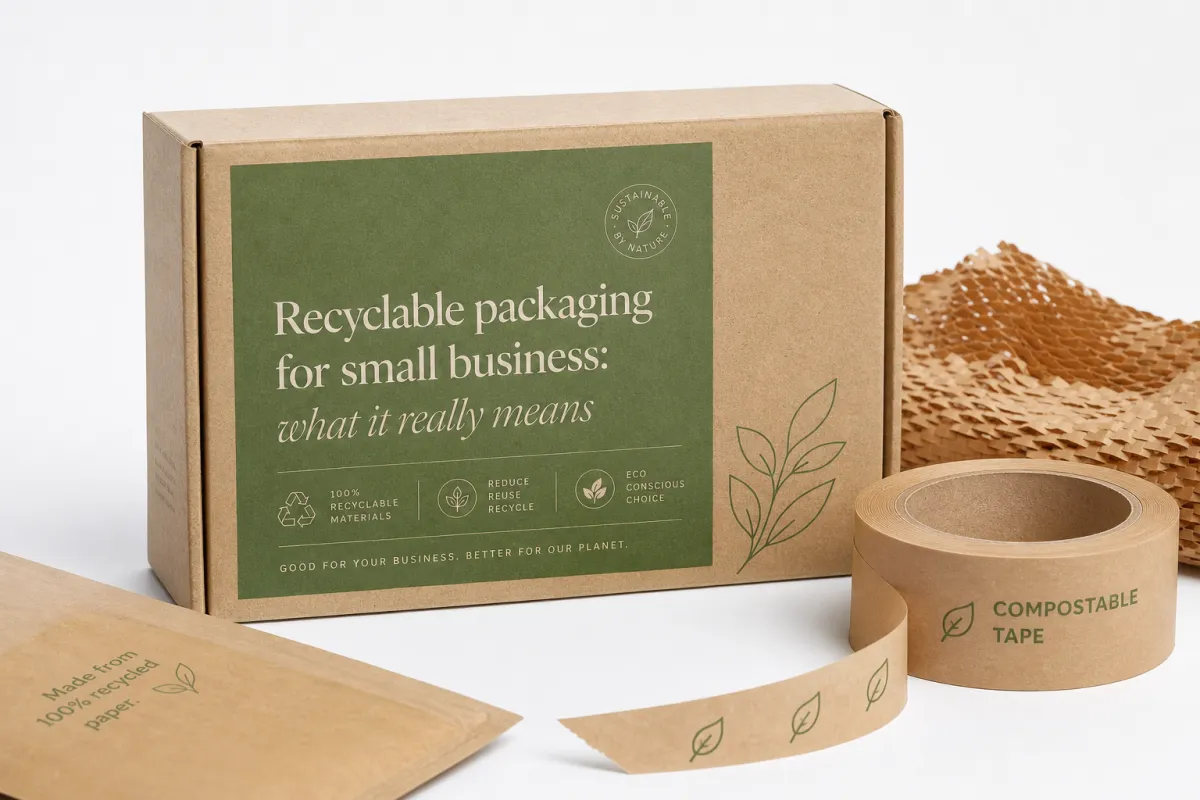
Recyclable packaging for small business means packaging that can enter an existing recycling stream and be processed into new material. That definition matters because marketing copy gets slippery fast. “Eco,” “green,” and “sustainable” are not disposal instructions. They are decoration unless the package has a real recovery path.
The difference is simple. Recyclable means the material can be collected and reprocessed. Recycled-content means some of it already came from recovered material. Compostable means it is designed for composting, not curbside recycling. Reusable means it can go through more than one use cycle before it gets tossed. Those words are not interchangeable, even if a sales brochure pretends they are. Mixing them up is how brands end up making claims they cannot support.
A basic example helps. A candle brand might replace a mixed plastic mailer and foil-lined insert with a single kraft corrugated box, paper void fill, and paper tape. That usually makes recyclable packaging for small business easier to defend because the package moves closer to a one-material system. Customers do not need a detective kit to figure out what goes where. Nice, rare, and kind of refreshing.
That does not mean every “all-paper” package is perfect. Heavy wax coatings, plastic windows, and stubborn adhesives can still interfere with recovery. Recyclable packaging for small business is less about buzzwords and more about whether the package stays intact on the shelf, ships safely, and fits the recycling rules where your customers actually live.
A package should not require a customer to read a chemistry lesson before tossing it in the bin. If it needs a decoder ring, the design is already too complicated.
From a buyer’s point of view, the best standard is blunt: if a package has one clear substrate, minimal contamination, and no strange add-ons, it is easier to defend as recyclable packaging for small business. If it is a mashup of paper, plastic, foil, foam, and decorative coatings, you are selling a story instead of a recovery path.
Claims matter. A lot. If the outer box is recyclable but the liner is not, the whole shipper may not be recyclable in practical terms. If the tape cannot be separated, customers get confused. If the label covers too much surface area or uses a messy adhesive, the package can still be a problem. Recyclable packaging for small business only works when the full structure gets looked at, not just the part that photographs well.
- Recyclable: the package can be collected and processed through existing recycling systems.
- Recycled-content: the package includes recovered fiber, resin, or metal from a previous use cycle.
- Compostable: the package is intended for composting, not standard curbside recycling.
- Reusable: the package is built for repeated use before disposal.
If you want a fast credibility check, ask whether the package still makes sense after the logo is removed. That sounds blunt because it is. Strong recyclable packaging for small business does not need a marketing layer to explain away a bad structure.
How recyclable packaging works in the real world
Recyclable packaging for small business only matters if it survives the real recycling chain. First, the customer disposes of the package. Then collection picks it up. Sorting systems separate it by material. Bales get formed. Reprocessors turn that material into feedstock for new products. If one step falls apart, the whole “recyclable” promise gets weaker.
Paperboard and corrugated cardboard are common wins because most regions already know what to do with them. PET and HDPE are also widely collected in many municipalities, while aluminum and glass have long-established recovery routes. The catch is that collection rules vary by city and region, so recyclable packaging for small business in one market may be ignored in another. Annoying? Absolutely. Real? Also yes.
That is where structure starts to matter more than people expect. A paper box with a plastic window may still be accepted in some systems, but not all. Metallized film, heavy lamination, and mixed substrates can make sorting harder. A package can look clean and premium and still be a headache for recovery. Fancy does not equal recyclable. Shocking, I know.
Adhesives, labels, liners, and coatings also matter. A glossy coating can change how fiber gets processed. A stubborn label can contaminate the stream. A pressure-sensitive liner can create another disposal step that customers skip. For recyclable packaging for small business, the small stuff is not small at all.
For basic recycling guidance, the EPA’s recycling resources at EPA recycling guidance are a practical starting point. If your packaging ships fragile products, transit testing matters too, and the ISTA testing framework is useful for thinking about drops, vibration, and compression Before You Order thousands of units.
A skincare brand using glass jars, for example, may choose a simple corrugated shipper with molded paper inserts instead of foam. That keeps recyclable packaging for small business aligned with actual shipping conditions. The jar survives, the insert is easier to recycle, and the package does not rely on a pile of mixed materials to look premium.
Here is the practical truth: recyclable packaging for small business is not controlled by the claim printed on the box. It is controlled by the weakest part of the structure. That weak point might be a film window, a laminated finish, a hidden liner, or a tape choice nobody bothered to question.
Recyclable packaging for small business cost, pricing, and tradeoffs
Let’s talk money, since people like to pretend sustainability is free. It is not. Recyclable packaging for small business can be affordable, but the price depends on material, print method, quantity, and how custom the structure gets. Standard kraft mailers and corrugated boxes are usually the easiest place to start. Odd shapes and premium finishes are where budgets start acting up.
At low to mid volumes, a plain corrugated mailer might land around $0.45-$1.20 per unit, depending on size and board grade. A Custom Printed Kraft box may sit around $0.70-$1.80 per unit for smaller runs, with better pricing as quantities rise. Paper-based inserts often add only a small amount if the die line is simple. That is why recyclable packaging for small business often starts with standard box families instead of fully custom structures.
Compare that with a highly printed multi-part package, and the cost climbs fast. Special coatings, foil, embossing, window patches, and low-order runs all push pricing upward. If you are buying recyclable packaging for small business, the cheapest quote on paper may not be the cheapest result once freight, damage, and setup charges hit the invoice.
| Option | Typical unit range | Best for | Main tradeoff |
|---|---|---|---|
| Kraft mailer | $0.45-$1.10 | Light e-commerce items, apparel, accessories | Basic look unless print is handled well |
| Corrugated box | $0.60-$1.80 | Fragile goods, subscription shipping, retail fulfillment | More board weight can raise freight costs |
| Paperboard carton | $0.18-$0.65 | Cosmetics, candle sleeves, lightweight retail packaging | Less crush protection without a shipper |
| PET container | $0.25-$0.90 | Clear display, food service, some refill programs | Recycling acceptance varies by location |
The table helps, but the tradeoffs matter more than the sticker. Lighter packages lower shipping costs. Stronger packages reduce damage. Better-fit packaging reduces void fill and dimensional weight. Recyclable packaging for small business works best when the material choice cuts one cost without creating three new ones.
There are also hidden savings. Standardizing box sizes can reduce storage headaches. Keeping your material palette narrow lowers procurement complexity. Using one recyclable substrate across several SKUs can reduce art setup and make package branding more consistent. That is the quiet side of packaging design nobody brags about, even though it saves real money.
For example, a small skincare line may use one paperboard carton size family across three products, then adjust only the inserts. That keeps recyclable packaging for small business manageable without forcing a custom dieline for every serum bottle. Simple usually wins because simple is easier to buy, easier to pack, and easier to explain.
Do not fall for false savings either. Cheap packaging that fails in transit costs more in replacements, refunds, and customer complaints. A non-recyclable component can also force a redesign later, which means paying twice. Recyclable packaging for small business is cheaper long term only if it survives the trip and the customer’s disposal step.
One more practical note: if your supplier can stock standard sizes, you may avoid tooling fees and long lead times. Custom tooling and low minimums are where budget plans go to die. If you need help narrowing options, browse Custom Packaging Products and compare stock-friendly structures before you ask for a fancy one-off.
Step-by-step process and timeline for switching packaging
Switching to recyclable packaging for small business is rarely a one-day decision. A realistic timeline starts with a packaging audit, then sample requests, then pack-out testing, then a small pilot run. If you try to skip straight to full production, you are betting the business on a guess. That is a terrible hobby.
Week one should be an audit. List every component: box, mailer, insert, tape, label, liner, seal, tissue, void fill, and any decorative element. If you do not map every piece, something will sneak in and wreck the recyclability story. This is where many brands discover that their “paper” package still contains a plastic patch or a laminated sticker no one wanted to talk about.
Week two is for supplier briefs. Be specific. Include product weight, dimensions, shipping method, expected storage conditions, print coverage, and the exact recycling outcome you want. A good brief helps suppliers quote recyclable packaging for small business options without guessing. Guessing is expensive, and it produces samples that are useful mostly as desk clutter.
Week three should be sample review. Ask for material specs, thickness, board grade, resin type, coating details, and closure method. Look for packaging that meets the protection needs first and the recycling goal second. If you are shipping glass or fragile food items, test for compression and corner crush. If your product hates moisture, check how the finish behaves after a damp transit day.
Week four is test time. Run a pack-out, then do actual shipping tests. Drop, shake, stack, and expose the package to the conditions your customers create without trying to. For fragile shipments, an ISTA-style drop and vibration check or an ASTM D4169-type protocol is worth the effort. Recyclable packaging for small business should not collapse the first time a courier tosses it onto a van floor.
After that, launch a small pilot. A limited batch tells you more than opinions ever will. Watch damage rates, customer feedback, storage impact, and assembly speed. A package that takes twice as long to pack can quietly eat labor budget. Recyclable packaging for small business has to work on the packing table, not just in a mockup file.
Here is a practical 6-step sequence:
- Audit every component in the current pack.
- Set the recycling target and protection target together.
- Request samples with exact material specs.
- Test pack-out, transit, and opening experience.
- Run a pilot with a small order volume.
- Review damage, cost, and disposal clarity before scaling.
The timeline is usually a few weeks for stock-based changes and longer for custom structures. If the design involves new tooling, print approvals, or custom inserts, plan for more back-and-forth. Recyclable packaging for small business rewards patience. Rushed packaging usually rewards nobody.
Common mistakes small businesses make with recyclable packaging
The biggest mistake is claiming a package is recyclable without checking the full structure. A box body may be fine, but the label, liner, seal, or coating can change the result. That is how recyclable packaging for small business turns into a customer complaint instead of a selling point. The claim has to cover the whole package, not just the prettiest part of it.
Another common error is overcomplicating the package. I see brands mix paper, plastic, foil, foam, magnets, ribbons, and metallic print, then ask why recycling feels awkward. Because it is awkward. A simple one-material or low-mix structure usually performs better. Recyclable packaging for small business is easier to defend when the design stays disciplined.
Oversizing is another budget leak. A box that is too large needs more filler, takes up more freight space, and invites damage because the product shifts around. That is bad for shipping and bad for waste reduction. If the goal is recyclable packaging for small business, a sloppy size choice can erase the benefit pretty fast.
Skipping customer instructions causes trouble too. People want to do the right thing, but they do not want homework. Tell them whether to flatten the box, remove the label, or separate the insert. A single line of guidance can improve disposal behavior more than a page of eco-copy. That matters a lot for recyclable packaging for small business.
And yes, protection still matters. A package that looks sustainable but fails in transit is not a win. Damaged product means replacement shipping, more material use, and a worse customer experience. The smarter version of recyclable packaging for small business balances protection with simplicity instead of pretending those two goals are fighting each other.
If your packaging saves the bin but loses the product, you have not solved anything. You have just moved the waste upstream.
Finally, a lot of small brands under-document their claims. They do not keep supplier sheets, material specs, or test notes. Then someone asks for proof and everyone starts searching old emails like it is a crime scene. Good records make recyclable packaging for small business easier to support and easier to repeat.
Expert tips for better recyclable packaging decisions
Start inside-out. Protect the product first, then simplify the material mix until the package is still recyclable and still affordable. That order matters. Recyclable packaging for small business fails when the design starts with the label and ends with the product getting smashed.
Use clear disposal language on the package. “Flatten and recycle curbside” is useful. “Eco-conscious packaging solution” is not. Customers need instructions they can act on in five seconds. That is especially true for recyclable packaging for small business with inserts, sleeves, or layered components.
Ask suppliers for the actual material breakdown. Resin codes, board grade, coating details, and adhesive information should not be mysteries. If a supplier cannot explain the structure, that is not a sign of flexibility. It is a sign that recyclable packaging for small business may be more claim than reality.
Standardize dielines and artwork where possible. One proven structure can support multiple products with minor size changes. That keeps package branding consistent, lowers design churn, and makes replenishment easier. Good packaging design is not always flashy. Often it is disciplined and quiet.
Premium does not require glitter. Smart typography, strong proportion, and a restrained print palette can make custom printed boxes feel elevated without adding a pile of coatings or mixed finishes. In practice, buyers notice clean structure more than gimmicks. That is good news for recyclable packaging for small business.
If you want a simple way to think about it, use this rule: every decorative choice should justify itself in protection, branding, or customer clarity. If it does none of those things, cut it. That kind of editing makes recyclable packaging for small business cleaner, cheaper, and easier to scale.
One more thing: choose packaging partners who speak in specs, not slogans. You want board weights, print methods, MOQ ranges, and lead times. You want someone who can explain why a structure will or will not work. That is how recyclable packaging for small business moves from theory to production.
If you are comparing box styles, start with Custom Packaging Products and filter by substrate and structure before you chase special finishes. That is a more sensible path than falling in love with a render that will be annoying to manufacture.
Next steps: build a practical recyclable packaging plan
Do not try to fix every package at once. Start with one product line or one shipping lane and prove the concept there. The easiest win is usually the smartest entry point. That is how recyclable packaging for small business stays manageable instead of turning into a sprawling redesign project.
Use a three-part checklist: audit current materials, request sample specs, and test one recyclable alternative against your current setup. Keep the first test simple. A small, controlled change gives you better data than a giant roll-out with ten moving parts. recyclable packaging for small business works best when decisions are based on actual performance.
Write down an internal definition of what counts as recyclable. Not a fuzzy marketing line. A real internal standard. Include material type, coating limits, label rules, and any customer disposal instructions. That kind of clarity keeps the team aligned and keeps your claims clean. It also makes recyclable packaging for small business easier to repeat across SKUs.
Before launch, prepare the customer-facing details: icons, copy, and simple disposal guidance. Do not wait for complaints. If you want people to recycle the package, tell them what to do in a sentence or two. That is a better use of space than a paragraph of branding poetry. With recyclable packaging for small business, clarity beats cleverness every time.
After rollout, give yourself a 30-day review window. Check damage rates, shipping cost, pack time, and customer feedback. If the new structure cuts waste but increases breakage, it is not an upgrade. If it reduces complaints and keeps the product safe, that is real progress. recyclable packaging for small business should improve the whole system, not just one line on a sustainability page.
Here is the practical version: choose a structure that your customers can understand, your warehouse can assemble, and your recycling stream can handle. That is the sweet spot. Anything else is packaging theater. If you need help moving from concept to production, start with a focused shortlist of custom printed boxes and compare them against your current product packaging before you place a full order.
Done right, recyclable packaging for small business reduces waste, supports stronger branding, and keeps the business from paying for expensive mistakes later. That is the whole point. Not the marketing line. The result.
FAQ
Is recyclable packaging for a small business always more expensive?
Not always. Simple corrugated boxes, kraft mailers, and paper-based inserts can be very competitive, especially in standard sizes and moderate quantities. Costs rise when you add custom shapes, premium printing, specialty coatings, or low minimums that block volume pricing. For many brands, recyclable packaging for small business is less about paying more and more about choosing a cleaner structure.
What materials are best for recyclable packaging for small business?
Paperboard, corrugated cardboard, PET, HDPE, aluminum, and glass are common options if the package design stays simple and local recycling accepts them. The “best” material depends on product weight, moisture exposure, shipping distance, shelf display, and whether you need retail packaging or mail-order protection. recyclable packaging for small business is always a fit question, not a trendy-material question.
How do I know if my packaging is actually recyclable?
Check the full package, not just the main substrate. Labels, films, coatings, adhesives, and inserts can change the result. Ask suppliers for material specs and test the package against the recycling rules in the markets where your customers live. If the package only looks recyclable in a render, recyclable packaging for small business is not done yet.
How long does it take to switch to recyclable packaging?
A basic switch can take a few weeks if you use stock materials and already know your size and shipping method. Custom packaging takes longer because you need samples, fit tests, print approval, and a pilot run before full production. Good recyclable packaging for small business takes time because bad packaging takes even more time later.
What is the biggest mistake with recyclable packaging for small business?
The biggest mistake is making a recyclable claim without checking the entire structure, which creates confusion and greenwashing. A close second is choosing packaging that looks sustainable but fails during shipping, leading to damaged products and extra waste. That is where recyclable packaging for small business either proves itself or turns into an expensive lesson.


