Buyer Fit Snapshot
| Best fit | Custom Pyramid Box Packaging projects where brand print, material claims, artwork control, MOQ, and repeat-order consistency need to be specified before quoting. |
|---|---|
| Quote inputs | Share finished size, material target, print colors, finish, packing count, annual reorder estimate, ship-to region, and any compliance wording. |
| Proofing check | Approve dieline scale, logo placement, barcode or warning zones, color tolerance, closure strength, and carton packing before bulk production. |
| Main risk | Vague material claims, crowded artwork, missing packing details, or unclear freight terms can make a low unit price expensive after revisions. |
Fast answer: Custom Pyramid Box Packaging: Design, Cost, and Process should be specified like a repeatable production item. The safest quote records material, print method, finish, artwork proof, packing count, and reorder notes in one written spec.
Production checks before approval
Compare the actual filled-product size with the drawing, then confirm tolerance on folds, seals, hang holes, label areas, and retail display edges. Reserve space for logos, QR codes, warning copy, and material claims before decorative graphics fill the panel.
Quote comparison points
Review material grade, print process, finish, sampling route, tooling charges, carton quantity, and freight assumptions side by side. A quote is only useful when the supplier can repeat the same color, closure quality, and packing count on the next order.
Custom Pyramid Box Packaging: Design, Cost, and Process
Custom pyramid box packaging changes the first impression before a product is even picked up. A square carton can do its job quietly, but a pyramid shape creates a pause, a little curiosity, and a more deliberate sense of presentation. That is a big part of the appeal. The form feels special without drifting so far from standard converting methods that production turns into a circus.
From a buyer’s side, custom pyramid box packaging is more than a visual decision. It affects the dieline, the folding sequence, the insert, the way the box travels inside a shipper, and the amount of labor needed to go from flat sheet to finished pack. Those details decide whether the project feels polished or becomes a headache once the order moves into production. Pretty samples can hide a lot of trouble if the structure is not thought through early.
For brands comparing branded packaging formats, pyramid cartons often sit in a useful middle ground. They carry more presence than a plain tuck box and usually cost less to produce than a rigid presentation case. If you are weighing other structural options as well, the Custom Packaging Products catalog is a practical place to compare board types, closure styles, and finishing options side by side. It is a bit more useful than staring at mockups and hoping the answer jumps out.
What Is Custom Pyramid Box Packaging?
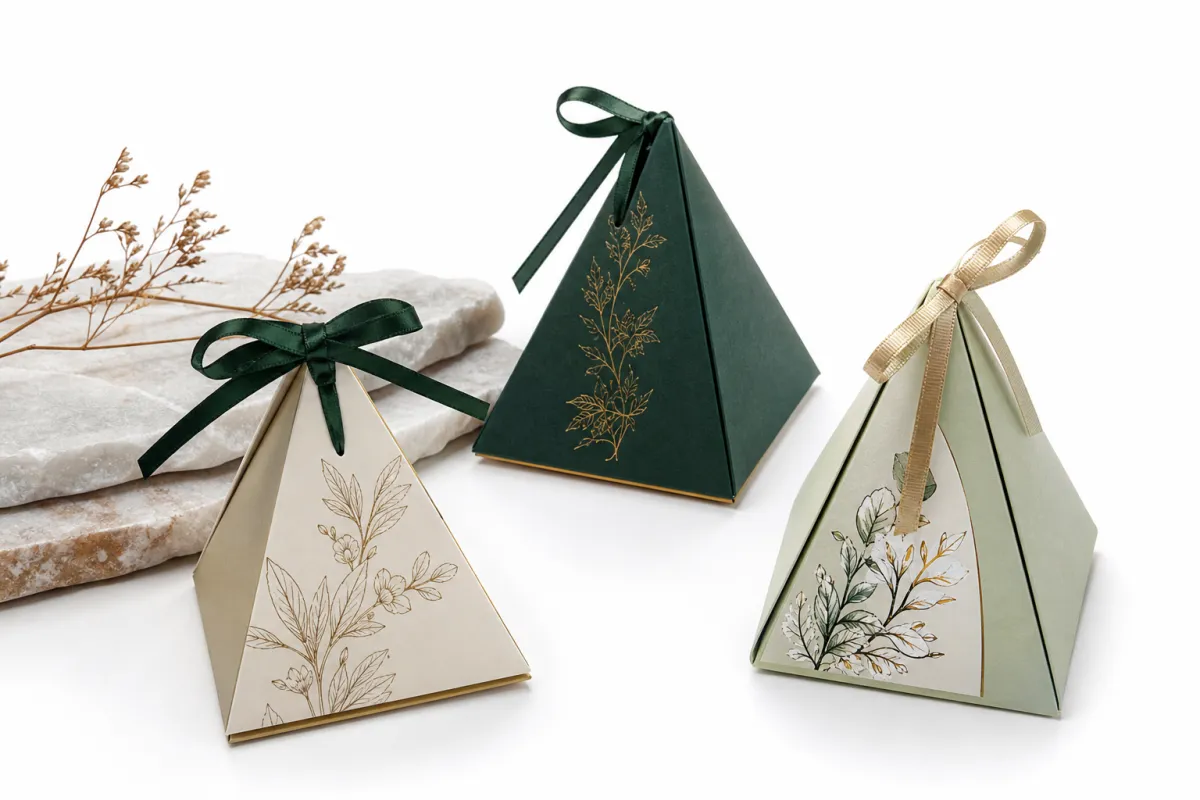
Custom pyramid box packaging is a carton built around a triangular, tetrahedral, or faceted profile rather than a standard rectangular shell. From a distance it may look simple, but the geometry changes how the box stands, folds, opens, and carries weight. A square carton tends to disappear into the background. A pyramid box creates shape as part of the message, and the eye notices the difference immediately.
That makes the format useful for product packaging that needs a stronger emotional cue. Candles, tea samplers, chocolates, fragrance testers, and small gift sets can all feel more considered once they are placed in a carton that looks intentional. In retail packaging, shape communicates before copy does. A pyramid says presentation faster than a flat mailer ever could.
Custom pyramid box packaging also brings a practical advantage that is easy to overlook. The unusual geometry can be used to control the reveal. Some versions open from a point closure at the top. Others use a base tuck or flap. The opening process becomes a small ritual, and that matters for promotional packaging, seasonal gifting, and display-ready retail sets where the unboxing moment supports the product story.
The catch is real. Unusual geometry changes how the carton folds, how it fills, and how it survives shipping. A layout that looks elegant on screen can wobble on the packing line if the board is too light or the base is too narrow. A mockup may look beautiful and still need an insert, a glue point, or a wider footprint before it can protect the contents properly. That is why custom pyramid box packaging sits at the overlap of packaging design and structure engineering.
In day-to-day use, strong pyramid packaging has to do three things at once:
- protect the product during handling and transit,
- support the brand story visually, and
- stay efficient enough to produce at scale without creating avoidable labor.
That balance matters more than many teams expect. I have seen projects where the concept art looked flawless, yet the production version failed because the supplier never received enough information about product weight, fill method, or shelf use. Custom pyramid box packaging rewards clear planning and punishes vague direction. If the brief is fuzzy, the box is gonna show it.
The shape can also carry premium value without relying on heavy decoration. A clean paperboard stock, a crisp crease, and a well-placed logo often do more than a long list of effects. That is useful for brands building package branding that feels deliberate rather than crowded. The form already brings visual interest. The artwork should support that form, not compete with it.
How Custom Pyramid Box Packaging Works From Dieline to Fill
Custom pyramid box packaging starts well before printing. It begins with the structure. The carton usually includes angled panels, glue tabs, a closure style, and a base that determines whether the box stands cleanly or shifts under load. Some versions are closer to a tetrahedron, while others are more faceted and easier to display. The right geometry depends on the product, the opening method, and whether the carton needs to ship flat.
The dieline is the point where the idea becomes something a converter can actually run. For custom pyramid box packaging, a precise dieline matters even more than it does for a straight-sided carton because every angle affects the folded result. A logo placed a few millimeters too high can land on a crease. A pattern that looked balanced on a monitor can split awkwardly across seams. Proofing should always happen on the structural file itself, not just on a decorative artwork layer.
Artwork placement deserves more attention than it usually gets. On custom pyramid box packaging, the front face may not be the largest face, and the point may dominate what the customer sees first. That means logo hierarchy, product claims, and decorative elements need to be mapped to the assembled shape. If the brand mark needs to read quickly, it has to sit where the eye naturally lands after the box is built. Otherwise the structure does half the talking and the graphic does the other half, and they can end up arguing with each other.
Assembly method is another variable that can shift both cost and performance. Some pyramid cartons are pre-glued and shipped flat. Others arrive fully flat and are folded by hand on the packing line. Higher volumes may justify machine-assisted folding or semi-automated assembly, depending on the geometry and the supplier’s equipment. The more complex the fold, the more likely custom pyramid box packaging will need a sample build and a brief assembly trial before the full run begins.
The fill process matters just as much as the carton itself. A rigid perfume vial, a nested tea assortment, and a tissue-wrapped gift set behave very differently inside the same shell. If the product shifts even slightly, the box can feel flimsy the moment it is opened. Inserts, tissue pads, molded cushions, and simple paperboard cradles often enter the conversation early for exactly that reason. In custom pyramid box packaging, internal fit is part of the experience, not a side issue.
The most dependable way to think about the build is simple: structure first, artwork second, fill method third. When those three pieces line up, the box becomes easier to produce and easier to live with. Reverse that order, and the design may look strong on a screen while creating problems on the floor.
A pyramid box works best when the structure supports the story instead of trying to hide it.
If the order needs to survive parcel handling, ask the supplier how the pack has been tested. Many teams reference ISTA methods to check shipping durability under real handling conditions. If paper sourcing is part of your procurement policy, FSC certification can matter when the board stock needs traceability. Standards do not make the box complicated; they keep avoidable mistakes from turning into claims, returns, or reprints. That kind of discipline pays for itself.
Custom Pyramid Box Packaging Cost, Pricing, and MOQ
Custom pyramid box packaging usually costs more than a standard folding carton because the dieline is more complex, the waste pattern can be less efficient, and the assembly tends to require more care. That does not make it expensive in absolute terms. It means the pricing has more moving parts. Board choice, print coverage, finishing, insert design, and pack-out labor all find their way into the final quote.
The biggest cost driver is often the relationship between material and labor. A simple kraft structure with one-color printing can stay relatively modest, while a carton with foil, embossing, soft-touch lamination, and a custom insert moves into a very different budget band. In custom pyramid box packaging, each premium detail adds work at one of three stages: prepress, converting, or finishing. Sometimes all three stages pick up extra time.
MOQ matters too. Suppliers often price custom pyramid box packaging differently from rectangular cartons because the die-cutting is more specialized and the assembly can be slower. Many buyers see a higher first quote and assume the supplier is padding the number, yet the real issue is usually setup spread across fewer units. A small run can make the unit price look high even when the total project cost is still reasonable.
The cleanest way to avoid surprises is to ask for pricing at several quantities. A quote for 500 pieces tells one story. A quote for 2,000 or 5,000 tells another. If the unit cost drops sharply at the next tier, a slightly larger order may save real money. If the savings are marginal, tighter inventory may be the better decision. Custom pyramid box packaging is one of those categories where total spend matters more than the headline unit figure.
| Build Option | Typical Use | Approx. Unit Price at 1,000 | Approx. Unit Price at 5,000 | Cost Impact |
|---|---|---|---|---|
| Kraft board, one-color print | Samples, eco-forward gifts | $0.90-$1.60 | $0.40-$0.85 | Low finishing cost, simple production |
| C1S board, CMYK print, matte aqueous | Retail gifting and seasonal sets | $1.10-$2.20 | $0.45-$1.05 | Balanced look and cost |
| Soft-touch lamination, foil, or embossing | Premium presentation packs | $1.80-$3.20 | $0.75-$1.60 | Higher setup and finishing time |
| Pre-glued or pre-assembled pack-out | Speed at the packing line | + $0.15-$0.45 | + $0.08-$0.25 | Labor cost moves from your team to the supplier |
Those ranges are directional, not a promise. A small detail can move the number quickly. A window cutout, a printed interior, a reinforced bottom, or a custom insert can shift the quote more than many buyers expect. That is especially true in custom pyramid box packaging, where the geometry already requires extra planning from the start.
A useful budgeting habit is to request at least three quantity levels and ask the supplier to split unit cost from setup cost. Compare total spend, not just the per-box number. It also helps to confirm whether the quote assumes flat shipment or pre-assembled delivery, because freight, storage, and labor can change in ways that are easy to miss in a unit price. A quote that looks cheap can get kinda expensive once those pieces are added back in.
If you are sourcing other formats for the same program, comparing them through Custom Packaging Products can show where a pyramid box earns its premium and where a simpler carton may be enough. That comparison usually gives better answers than chasing the lowest-looking quote.
Process and Timeline
Custom pyramid box packaging usually moves through the same broad stages as other custom printed boxes, yet the structure adds a bit more risk at each point. A realistic process looks like this: brief, dieline, artwork proof, sample, approval, production, and shipment. The sequence is straightforward. The tricky part lives in the handoff between each stage.
The brief should include the product dimensions, product weight, how the item will be inserted, and how the box will be displayed or shipped. If the supplier has to guess whether the project is meant for retail packaging or transit packaging, the first dieline is likely to miss the mark. In custom pyramid box packaging, that can mean a second structural revision before any artwork review begins.
The proof stage is where schedules often slip. Color matching, logo placement, and fold-line alignment all need close attention, especially if the artwork includes fine text or a pattern that needs to wrap across angled panels. This is a good point to request a structural sample, a digital proof, or both. For custom pyramid box packaging, a quick approval only helps if the structure has already been tested against the actual product.
Lead time has three separate parts: design time, production time, and freight time. Buyers sometimes speak about those stages as though they are one block, but they are not. A design team may approve artwork quickly while production still needs 10 to 20 business days after final sign-off. Freight can add several more days depending on distance, carrier choice, and customs. If the order supports a launch, seasonal program, or trade event, the schedule needs room to breathe.
Typical timing shifts by material and finishing, but a practical frame looks like this:
- Dieline and layout: often 1-3 business days for a clear brief.
- Sample or prototype: often 5-7 business days, sometimes longer for complex folds.
- Production: often 10-20 business days after approval.
- Freight: depends on route, volume, and whether the order is domestic or international.
Custom pyramid box packaging can also need extra time if the supplier has to order custom tooling, if the board stock is temporarily unavailable, or if the finishing includes specialty coatings that run on a separate line. None of that is unusual. It just means the buyer should stop treating every carton as if it behaves like a basic mailer.
My practical advice is to work backward from the launch date. Add a buffer for revisions, another buffer for sampling, and a separate buffer for freight. That may sound cautious, yet it prevents the classic mistake: a beautiful box arriving after the campaign has already started.
Step-by-Step Design Guide
Designing custom pyramid box packaging works best when the team treats it like a sequence rather than a brainstorming session. The shape is too specific for guesswork. If the box needs to look good and hold up in real use, start with the product, then move to structure, then artwork, then sampling. That order saves time and reduces rework.
- Measure the product first. Record the exact dimensions, weight, and any fragile points. A product with a tall cap, a pointed lid, or a soft exterior may need more internal clearance than the spec sheet suggests.
- Decide how the item will sit inside the box. Will it rest directly on the board, sit in a paperboard insert, or be wrapped with tissue? In custom pyramid box packaging, that choice changes the internal angles and the perceived quality of the opening experience.
- Select the board and finish. Lightweight gifts may work on 300gsm to 400gsm paperboard. Heavier items may need a thicker stock or a reinforced insert. Soft-touch lamination feels premium, while matte aqueous keeps cost and recyclability simpler.
- Map the artwork. Place the logo, product name, barcode, and legal copy according to the actual folded faces. If the artwork is built for a square box, it usually needs adjustment before it can live on custom pyramid box packaging.
- Ask for a structural sample. A sample shows whether the closure holds, whether the pack feels balanced, and whether the product shifts. Digital proofs are useful, but a physical sample catches problems faster.
- Confirm the pack-out method. Flat shipping, pre-gluing, hand folding, and destination assembly all affect cost and labor. The same box can feel easy or frustrating depending on how it is shipped.
There is also a branding choice hidden inside the design work. Do you want the top face to carry the main logo, or should the front-most face do that job? In custom pyramid box packaging, the answer depends on shelf presentation and opening behavior. A box meant for retail shelving should read clearly from a short distance. A box meant for gifting can afford to be a little more theatrical.
For most brands, the smartest route is to keep the visual hierarchy simple. Let one face carry the main message. Use the remaining faces for supportive branding, ingredient callouts, or pattern work. Too much text on a pyramid carton can make the structure feel crowded, and clutter weakens the point of the shape in the first place.
If sustainability is part of the brief, ask for FSC-certified board where available and keep the finishing choices practical. Not every job needs foil, and not every premium look has to rely on heavy lamination. A well-printed paperboard structure can still deliver strong retail packaging results without loading on unnecessary effects. That is especially true for custom pyramid box packaging, where the geometry already does much of the visual work.
At this stage, a vendor comparison sheet pays for itself quickly. Include the quote, MOQ, lead time, board spec, print method, finish, and whether the supplier can deliver flat or pre-assembled. That makes it easier to compare custom pyramid box packaging proposals on facts rather than sales language.
Common Mistakes With Custom Pyramid Box Packaging
The first mistake is designing for appearance and forgetting fit. A pyramid shape is attractive, so it is easy to get carried away with mockups. If the product sits too loosely, though, the box feels cheap. If the closure is too tight, the opening experience becomes frustrating. Custom pyramid box packaging only works when the form and the contents are in balance.
The second mistake is ignoring print-safe areas. Angled faces make seams and folds more visible, especially on strong colors or repeated patterns. A logo that crosses a fold can look distorted once the carton is assembled. In custom pyramid box packaging, even a few millimeters matter. The artwork should be built around the structure rather than forced onto it.
The third mistake is piling on too many finishes. Foil, spot UV, embossing, soft-touch lamination, and windows can all look appealing in isolation. Put together, they can push the cost and lead time past the point where the project still makes sense. One strong effect usually beats four average ones. That is not caution for its own sake; it is discipline.
The fourth mistake is skipping shipping tests. Unusual geometry can create weak points in transit, especially if the box will ride inside a larger master carton with other products. Corners can scuff. Points can crush. Inserts can drift out of place. If the box is going through parcel networks, a basic transit test is cheap insurance. It costs far less than reprinting a large batch of custom pyramid box packaging because the first run arrived dented.
The fifth mistake is vague direction to the supplier. “Make it premium” is not a production spec. Neither is “make it sturdy.” Better instructions include product weight, desired opening style, shelf environment, and whether the box will be handled by customers or assembly staff. Clear briefs produce better results. That holds true for custom printed boxes in general, but it matters even more here because the structure leaves less room for guessing.
There is a sixth mistake that comes up often: choosing a quantity without checking the economics at nearby tiers. A buyer may request 800 boxes because that matches the forecast, then discover that 1,000 pieces gives a much better unit price with very little downside. The reverse happens too, where a higher quantity creates slow-moving inventory. Custom pyramid box packaging should be evaluated like a small manufacturing program, not a one-line stationery buy.
If the sample looks right but the production instructions are still fuzzy, the sample has not solved the problem yet.
That is the real test. A good sample should make the next step obvious. If it does not, the process needs another round before production starts.
Expert Tips and Next Steps for Custom Pyramid Box Packaging
Start by letting the shape do some of the branding work. Custom pyramid box packaging already feels distinctive, so the artwork does not need to fight for attention. Put the main logo on the most visible face and keep the remaining faces calmer. That usually reads cleaner in retail packaging and helps the box stand out on a shelf without feeling overdesigned.
Choose one strong finish instead of stacking several. A matte board with a foil logo can look sharper than a carton covered in multiple decorative effects. A soft-touch exterior can be enough on its own if the brand wants a refined feel. In custom pyramid box packaging, restraint often reads as more expensive than decoration.
Ask the supplier for a material recommendation based on weight, shipping method, and display environment. A box for lightweight tea sachets has different demands from a gift set with glass components. That sounds obvious, but buyers sometimes send the same brief to every format and expect the structure to adjust on its own. It will not. Custom pyramid box packaging performs better when the board spec is matched to the actual use case.
Do not approve a run without checking the fold behavior. Watch how the structure closes, whether the glue holds, and whether the product sits centered once packed. Small alignment problems turn into larger quality issues once they repeat across hundreds or thousands of units. A few minutes on the sample table can save hours of rework later.
Build a vendor comparison sheet with these columns:
- quote by quantity,
- MOQ,
- lead time,
- board spec,
- finish options,
- flat or assembled delivery, and
- sample approval process.
That sheet helps because custom pyramid box packaging quotes can look similar on the surface while hiding very different assumptions underneath. One supplier may include basic proofing and flat shipment. Another may include assembly but exclude insert work. A side-by-side comparison prevents false savings.
If you want a stronger starting point, browse Custom Packaging Products to compare structural options before you lock in the pyramid format. Sometimes the pyramid is the right answer. Other times, a related carton shape gives you better budget control or simpler fulfillment.
Here is the fastest path from idea to production:
- measure the product and define the use case,
- request the dieline and structure mockup,
- review the artwork on the folded file,
- approve a sample,
- confirm the pack-out and shipping plan, and
- move custom pyramid box packaging into production with a little buffer in the schedule.
That sequence sounds basic because it is basic. The difference is that the details are not optional. A few extra minutes on the brief can save a lot of cost later, especially if the box is part of a launch, a gift campaign, or a retail reset. When the plan is solid, custom pyramid box packaging becomes a practical tool instead of a risky flourish.
FAQ
What products work best with custom pyramid box packaging?
Custom pyramid box packaging works well for lightweight premium items such as candles, cosmetics, chocolates, tea, gift sets, and promotional samples. It is especially effective when the packaging needs to make the first impression before the product is opened. If the item is heavy, irregular, or fragile, ask for an insert or a structural test before approving the design. That extra check is boring, sure, but it can save you from avoidable damage.
How much does custom pyramid box packaging usually cost?
Price depends on board stock, print method, finishing, assembly level, and quantity. Small runs usually cost more per unit because die setup and proofing are spread across fewer boxes. For that reason, it helps to request quotes at multiple volume levels so you can compare total project cost, not just the unit Price for Custom pyramid box packaging. Two quotes with the same headline number can still behave very differently once labor and freight are added.
What material is best for custom pyramid box packaging?
Paperboard is the most common choice because it prints well and folds cleanly. Kraft stock gives a natural look, while coated board and specialty paper stocks create a more polished finish. Heavier products may need thicker board or an internal insert to keep custom pyramid box packaging stable and presentable. If the box will be handled a lot, ask the supplier whether the chosen stock will hold creases without cracking.
What is the typical lead time for custom pyramid box packaging?
Lead time depends on proofing, sampling, production, and freight, so each stage should be confirmed separately. Simple structures can move faster, while custom finishes or tooling can extend the schedule. Build extra time into seasonal or event-driven orders so a late proof does not delay custom pyramid box packaging at the wrong moment. A little buffer is usually cheaper than paying for rush freight.
Can custom pyramid box packaging ship flat?
Yes, many pyramid boxes can ship flat to reduce storage space and freight cost. Flat shipment usually requires an easy-fold construction or pre-applied glue points for quick assembly. If speed at the packing line matters, ask for samples that prove the box folds cleanly and holds its shape after repeated handling. The sample should also show whether the closure gets looser after a few openings.
Custom pyramid box packaging is not the right answer for every product, but it is a strong choice when visual impact matters and the team is willing to plan the structure properly. The shape earns attention, while the real value comes from the details: accurate dielines, sensible board selection, realistic pricing, and a timeline that includes proofing and testing. If you are moving ahead, start with the product weight, the opening style, and the shipping method, then approve a physical sample before artwork is locked. That is the cleanest path to a box that looks premium and still behaves well in production.

