Buyer Fit Snapshot
| Best fit | Custom Recycled Paper Pouches Wholesale projects where brand print, material claims, artwork control, MOQ, and repeat-order consistency need to be specified before quoting. |
|---|---|
| Quote inputs | Share finished size, material target, print colors, finish, packing count, annual reorder estimate, ship-to region, and any compliance wording. |
| Proofing check | Approve dieline scale, logo placement, barcode or warning zones, color tolerance, closure strength, and carton packing before bulk production. |
| Main risk | Vague material claims, crowded artwork, missing packing details, or unclear freight terms can make a low unit price expensive after revisions. |
Fast answer: Custom Recycled Paper Pouches Wholesale: Pricing, Specs should be specified like a repeatable production item. The safest quote records material, print method, finish, artwork proof, packing count, and reorder notes in one written spec.
Production checks before approval
Compare the actual filled-product size with the drawing, then confirm tolerance on folds, seals, hang holes, label areas, and retail display edges. Reserve space for logos, QR codes, warning copy, and material claims before decorative graphics fill the panel.
Quote comparison points
Review material grade, print process, finish, sampling route, tooling charges, carton quantity, and freight assumptions side by side. A quote is only useful when the supplier can repeat the same color, closure quality, and packing count on the next order.
Buyers comparing Custom Recycled Paper pouches wholesale usually start with the same question: does the package feel credible the moment someone touches it, and does it still make commercial sense after the first order lands? That is the real test. The pouch has to protect the product, carry the brand message, and hold up across reorders without creating surprises in cost or lead time. For food, wellness, and specialty retail brands, custom recycled paper pouches wholesale has become a practical buying category because it does more than look earth-conscious on a mockup. It has to perform in the warehouse, on shelf, and in the customer’s hands.
The appeal is easy to understand from a packaging buyer’s perspective. A well-built pouch can sharpen shelf presence, support a recycled-content story, and keep the unit cost within a range that planning teams can actually use. A poorly chosen one can do the opposite. It can add freight weight, compromise barrier performance, or require a full restart because the printed finish did not match the approved proof. I have seen that kind of mismatch create a lot of unnecessary back-and-forth, and it is never pretty. That is why Custom Recycled Paper pouches wholesale is less about surface styling and more about packaging economics, supply control, and the kind of consistency that keeps a product line moving.
Brands launching a new SKU usually need something specific rather than something flashy. Packaging has to fit the product, reinforce the positioning, and arrive in quantities that line up with forecasted demand instead of wishful thinking. That gap is where custom recycled paper pouches wholesale earns its place. It gives teams a way to keep the brand story intact while still working inside real-world production limits, which is the part people sometimes skip over in the rush to get artwork approved.
custom recycled paper pouches wholesale: why buyers switch
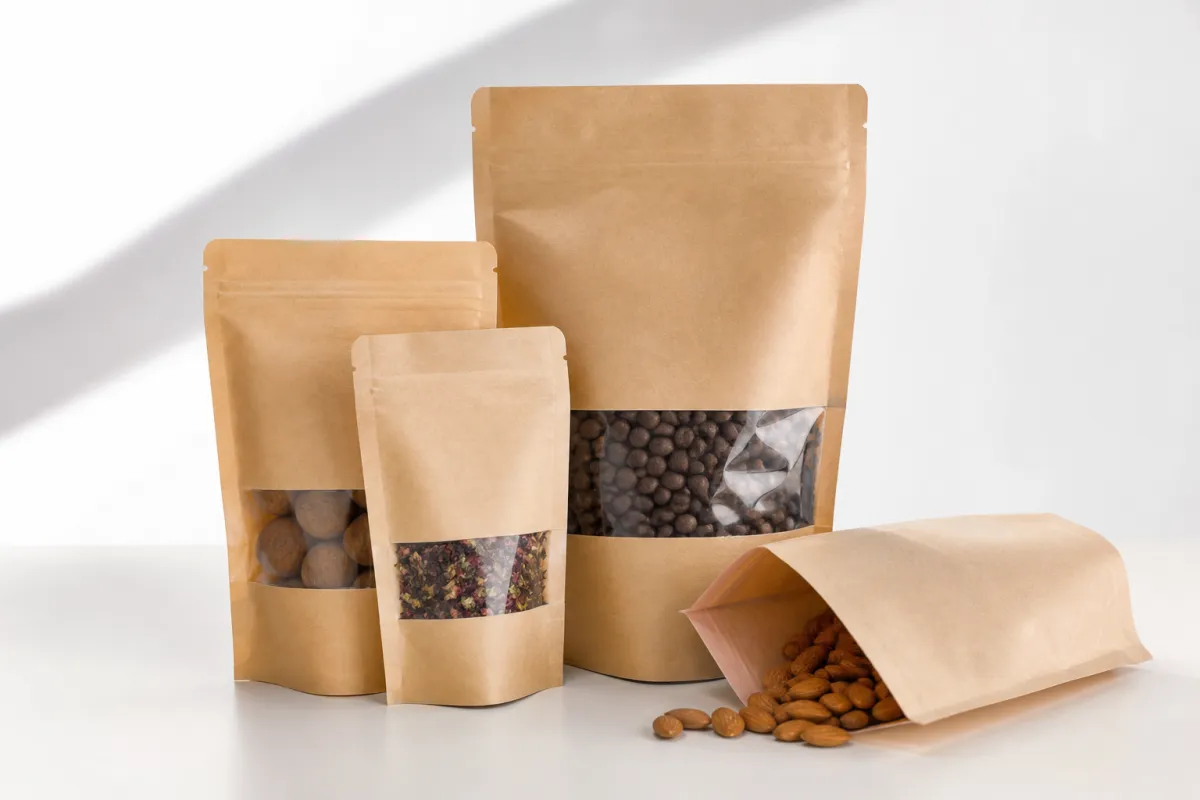
Many brands move toward custom recycled paper pouches wholesale because the material reads differently the second it reaches the shelf. A paper-facing pouch feels more aligned with dry foods, tea, supplements, salts, granola, and other shelf-stable products that benefit from a calmer, more grounded presentation. It softens the plastic-first feel that can come with glossy film-heavy formats, and it gives the brand a visual language that feels closer to the ingredients inside.
The decision is not abstract. Packaging changes how a shopper judges the product before reading the back panel, and that matters in retail aisles where attention is short and comparisons are constant. A matte paper face, a tidy seal line, and a stand-up profile can make a product appear more premium without changing the formula inside. For brands weighing custom printed boxes against pouches or rigid canisters, that perception can be the difference between a sample order and a pass from the buyer.
Custom recycled paper pouches wholesale also supports sustainability messaging in a more believable way, provided the claim is handled with care. A recycled paper outer layer does not automatically make the whole pouch curbside recyclable. Multi-layer barrier film, zippers, and metalized layers can change what the package actually is and what it can honestly claim. Clear documentation matters here. If the brand wants to reference recycled content or FSC-certified paper, the material spec has to match the physical build, not the mood of the marketing copy. That point sounds basic, but it is exactly where a lot of packaging claims go sideways.
A recycled-paper pouch often gets judged before the formula does. That is not a branding exaggeration. It is a buying reality.
Most procurement teams are really looking for a repeatable wholesale structure that supports launch math. A new SKU forecast at 5,000 to 10,000 units needs packaging that can be ordered with confidence, not guessed at one quarter at a time. Custom recycled paper pouches wholesale gives brands a way to balance presentation, inventory planning, and order rhythm without drifting into custom one-off territory every time the product line grows.
Consistency is another reason buyers switch. A supplier that keeps the paper tone, seal behavior, and print finish stable across runs is far easier to manage than one that treats every reorder like a new experiment. Small changes in paper shade or coating sheen can make a fresh shipment look wrong beside the original run. Once a product starts scaling, that kind of repeatability matters more than a tiny savings on the first order.
Most buyers comparing custom recycled paper pouches wholesale with other product packaging formats are asking the same three questions at once: will it protect the product, will it fit the brand, and will it still make sense at volume? The strongest purchasing decisions answer all three without forcing a compromise that shows up later.
custom recycled paper pouches wholesale product details
The basic structure behind custom recycled paper pouches wholesale usually starts with an outer recycled paper layer and an inner performance layer that handles the practical work. The paper is the visible face of the package. The inner layer controls moisture resistance, oxygen management, aroma retention, and heat seal behavior. That split is important because paper alone cannot do the full job for most commercial products that need shelf stability.
Buyers should start with the product itself. A dry snack may only need moderate moisture protection. Coffee and tea usually need stronger aroma control. Powders and nutritional blends may need better puncture resistance and more reliable sealing. The right build for custom recycled paper pouches wholesale should follow the product’s needs first, then the visual direction. If you reverse that order, the package might look right and still fail in daily use, which is a headache nobody needs.
Common format choices include stand-up pouches, flat pouches, side-gusset pouches, and resealable zipper pouches. Each one serves a different retail purpose. Stand-up pouches are easy to merchandise and tend to photograph well. Flat pouches fit samples, refills, and smaller portions. Gusseted styles create more internal room for bulk dry goods. If the package hangs from a peg or hook, a hang hole can matter more than a decorative finish. A tear notch may not be dramatic, but it improves the first-open experience and helps the package feel finished instead of improvised.
For many brands, the question is not whether custom recycled paper pouches wholesale can include features like windows or zippers. It can. The real question is what those features do to cost, performance, and the way the package reads on shelf. A clear window improves product visibility, yet it cuts into the paper-first look. A zipper gives resealability, but it adds components and can complicate sustainability messaging. A degassing valve is useful for coffee, though it adds another part and another review point. Every feature changes the balance, so the spec sheet has to be honest about what matters most.
If the product sits in food, wellness, or specialty retail, compliance and supplier discipline matter just as much as appearance. A supplier should be able to explain the material source, the print method, the barrier options, and how the pouch fits the category. That is the point where custom recycled paper pouches wholesale becomes a procurement decision instead of a design exercise.
Brands also compare suppliers on how they document sustainability claims. If the pouch uses FSC-certified paper or FSC-controlled material, the supplier should be able to point to the exact paperwork available for the job. For background on responsible sourcing language and chain-of-custody standards, the FSC site is a useful reference. It does not replace product-specific documentation, but it gives buyers a clear sense of how the terminology works.
Finally, consider how custom recycled paper pouches wholesale fits with the rest of the product family. Buyers rarely see a single pouch in isolation. They see a shelf system. Pouches, labels, cartons, and inserts all contribute to package branding. A cohesive visual language across pouches and Custom Packaging Products such as cartons or sleeves often looks stronger than a design that only works on its own.
specifications that affect performance and branding
Specifications are the point where custom recycled paper pouches wholesale either becomes a clean decision or turns into an endless revision loop. The list looks simple on paper: dimensions, gusset depth, paper weight, barrier level, seal construction, closure style, print area, and any extras such as a window or valve. Each one changes how the pouch performs, how it looks, and what the final cost ends up being.
Size is the first filter. A pouch that is too small can pinch the fill, distort the graphics, and put stress on the seal. A pouch that is too large can make the contents look underfilled and waste material. Width, height, and gusset depth should follow the product’s net weight and density. That is why custom recycled paper pouches wholesale should be specified from the fill side first, not the artwork side.
Paper weight and stiffness shape both perception and handling. A heavier paper face can feel more premium, yet it can also raise cost and change the way the pouch folds or sits. Matte finishes usually feel calmer and more natural. Light texture can give a brand a grounded, ingredient-led tone, while a smoother coated paper may work better for sharp graphics and high-contrast typography. Packaging design is not only about color; it is also about how light moves across the surface in a retail setting.
Barrier level is the technical detail that often gets overlooked. Simple dry goods may only need moderate moisture protection. Coffee, tea, powders, and products that break down when exposed to air need a stronger barrier layer. Many buyers assume all paper pouches behave the same way. They do not. Custom recycled paper pouches wholesale can be built to different protection levels, and that choice affects both shelf life and pricing.
Seal type deserves as much attention as the print layout. Heat seals need to survive shipping, handling, and small variations in fill volume. Weak seals lead to leakage, returns, and complaints that rarely show up during the first proof review. Testing matters here. For transit performance, many teams refer to ISTA methods, and the ISTA site is a straightforward place to understand the testing framework. If the product is moving through retail distribution, that kind of validation is basic risk control, not an optional extra.
Here is a practical way to compare the most common builds for custom recycled paper pouches wholesale:
| Option | Best for | Typical wholesale unit price at 5,000 pcs | Feature notes | MOQ reality |
|---|---|---|---|---|
| Recycled paper + basic barrier liner | Dry snacks, tea, low-moisture items | $0.18-$0.26 | Clean paper look, standard seal, limited extras | Often 3,000-5,000 pcs |
| Recycled paper + zipper + moderate barrier | Granola, supplements, refill packs | $0.24-$0.38 | Resealable, better shelf performance, stronger retail utility | Usually 5,000 pcs+ |
| Recycled paper + window cutout | Premium retail, visible product formats | $0.22-$0.34 | Shows contents, but reduces paper-first look | Usually 5,000 pcs+ |
| Recycled paper + high barrier + valve | Coffee, aroma-sensitive products | $0.32-$0.52 | More components, better protection, longer approval cycle | Often 5,000-10,000 pcs |
The table is a guide, not a quote. In custom recycled paper pouches wholesale, the final price depends on print coverage, format, bag size, accessory count, and the number of setup steps needed before production starts. A small pouch with a one-color logo is not the same job as a full-bleed design with a zipper, window, and special seal pattern. That distinction sounds obvious, but it gets blurred more often than it should.
That is why the best spec sheet is direct. It should state the product weight, whether the pouch needs to stand upright, whether the consumer will reseal it, and whether shelf visibility matters more than a fully paper-covered face. The tighter the brief, the cleaner the result.
custom recycled paper pouches wholesale pricing and MOQ
Pricing for custom recycled paper pouches wholesale usually falls into five buckets: material build, print complexity, finishing, tooling, and freight. That seems tidy, but each bucket can shift landed cost in its own way. A larger pouch uses more paper and more barrier film. Detailed print can demand more press time. A zipper, window, or valve adds components. Freight can matter more than the unit quote if the job is heavy or split across multiple cartons.
The most common mistake is focusing on the lowest unit number and stopping there. A buyer may see one quote at 10,000 pieces and assume it is the best deal. Freight, plates, sample charges, and packaging of the finished goods get added later, and the landed cost tells a different story. For custom recycled paper pouches wholesale, the only fair comparison is landed cost at the same spec.
MOQ is usually tied to production economics rather than a random threshold. A supplier needs enough volume to absorb setup, plate preparation, and press time. Smaller runs are possible, but they are rarely cheap. If you request 1,000 pieces, the job may still be workable, yet the unit cost will usually sit far above a 5,000-piece order. With custom recycled paper pouches wholesale, the useful middle ground often sits between the smallest test run and the first full replenishment order.
Requesting pricing at several volumes makes the shape of the order much easier to read. Five tiers usually tell the story quickly:
- Test quantity for launch validation.
- Small production run for a pilot or one region.
- Standard wholesale run for a first full order.
- Reorder quantity for an established SKU.
- High-volume run for stable annual demand.
That structure shows where unit cost drops most efficiently. Sometimes the biggest savings happen earlier than expected. Sometimes they do not. In some builds, the price break from 5,000 to 10,000 units is meaningful; in others, savings flatten because the material or accessory cost carries most of the burden. That is why the quote should show volume tiers clearly for custom recycled paper pouches wholesale.
These questions help expose the hidden variables:
- What is the unit price at 3,000, 5,000, and 10,000 pieces?
- Are tooling, plates, or die charges separate?
- Does the quote include proofing and final artwork checks?
- What are the shipping terms, and where is freight added?
- Are sample costs credited back on production?
A clear answer to those questions saves time and prevents confusion later. A supplier that lays out the assumptions plainly is easier to work with than one that offers a single number and leaves the rest to chance. In wholesale buying, clarity is part of the product.
There is also a branding cost to choosing the wrong spec just because it is cheap. If the barrier is too weak, the package may fail before the product does. If the artwork is too busy, the paper face can lose the natural look that made the format appealing in the first place. Custom recycled paper pouches wholesale should be priced around performance and brand fit, not just the lowest quote on the page.
One useful reference point: if the job includes a zipper, a window, or a valve, expect those features to add meaningful cost. Depending on build and quantity, accessory additions can add roughly $0.03-$0.08 per unit, sometimes more on smaller runs. That is not a reason to avoid them. It is a reason to ask for the line item before approving the structure.
For brands managing multiple SKUs, custom recycled paper pouches wholesale can still be efficient if the artwork system is built with discipline. Reusing a base dieline across flavors or variants lowers revision risk and keeps the wholesale process cleaner. That is one reason experienced buyers prefer predictable formats. It turns packaging into a repeatable operating decision instead of a fresh custom project every time.
process and lead time for custom recycled paper pouches wholesale
The buying process for custom recycled paper pouches wholesale should feel orderly if the supplier is organized. It usually moves through eight steps: inquiry, specification review, quote, artwork prep, proof approval, sample confirmation, production, quality check, and shipment. If any of those steps is vague, delays tend to show up later, usually after the launch date has already been locked in.
Step one is the inquiry. A useful inquiry includes dimensions, product type, expected fill weight, closure preference, print coverage, quantity, and deadline. If the supplier has to chase those details, the quote will take longer and may come back with assumptions that do not fit the job. The cleaner the brief, the easier custom recycled paper pouches wholesale becomes.
Step two is proofing, and this is where time often slips away. Artwork files may need dieline adjustments, color checks, barcode placement review, or claim-language edits. A brand with multiple stakeholders can stretch the approval chain fast. One round of revision is normal. Three rounds usually mean the brief was not specific enough at the start. That is one of those things people only learn after a painful reorder, and nobody enjoys learning it twice.
Lead time depends on complexity. Simple builds can move faster. Custom print, special finishes, and structural changes add review time before production even starts. A straightforward custom recycled paper pouches wholesale order may move from proof approval to production in roughly 12-15 business days, while a more complex build can stretch to 18-25 business days or more. Transit time sits on top of that and depends on destination and shipping method.
These questions prevent most schedule problems before they start:
- What is the final pouch size?
- Will the pouch need a zipper, window, or valve?
- What product is going inside?
- Do you already have final artwork files?
- Is the delivery date fixed by launch or restock?
Sample approval deserves real attention. If the sample does not match the intended barrier, seal feel, or print finish, stop and correct it before full production. That is far cheaper than discovering the mismatch after thousands of units have already been packed. In custom recycled paper pouches wholesale, samples are not a formality. They are the last low-cost checkpoint before the order becomes expensive.
Documentation should stay with the job as well. Keep notes on dimensions, approved artwork, material spec, and carton count. When the reorder comes back months later, the team should not be reconstructing the order from memory. That is one of the quiet advantages of a disciplined wholesale program: the second order gets easier because the first one was documented properly.
Brands shipping through broader distribution should also think about transit testing. If the pouch is moving through palletized freight, parcel handling, or warehouse transfer points, asking about ISTA-based validation is a smart move. It is not a fancy upgrade. It is how good packaging avoids expensive damage. For custom recycled paper pouches wholesale, that discipline keeps product packaging aligned with the logistics it will actually face.
why choose Custom Logo Things for custom recycled paper pouches wholesale
Custom Logo Things is a fit for buyers who care about consistency. That may sound modest, but in packaging it is a real advantage. With custom recycled paper pouches wholesale, the difference between a smooth program and a frustrating one is rarely the loudest pitch. It is whether the supplier can hold the spec, answer technical questions quickly, and keep the approval flow clean from the first order through the reorder.
Our Wholesale Programs are built for brands that need repeatable pricing logic rather than vague assurances. That matters when your team is juggling launch budgets, retail calendar pressure, and inventory planning. A useful wholesale program should make it easy to compare size, barrier level, print coverage, and quantity tiers without forcing you to rebuild the quote every time. That is the operational side of custom recycled paper pouches wholesale.
Buyers usually value control above everything else. They want clear dielines, fewer artwork errors, transparent sample steps, and a supplier that explains tradeoffs before they become problems. If a requested structure will raise cost or extend lead time, that should be said early. Not every pouch can be built the same way, and not every sustainability request fits every performance target. Straight answers matter more than polished sales language.
Custom recycled paper pouches wholesale also benefits from process discipline. Quality checks should be documented. Print references should be confirmed in writing. Material specs should be tied to the approved set, not just discussed during a call. That is how the final order stays close to the sample. It is also how package branding stays steady across repeat production.
For buyers managing broader branded packaging systems, consistency across formats matters. A pouch line that coordinates with cartons, inserts, and labels can make the whole product family feel more organized. If you need adjacent formats as part of the same rollout, our Custom Packaging Products page is a useful place to see how the pouch spec fits into a larger packaging design system.
There is also a trust factor in how a supplier talks about sustainability. The most credible answer is not “everything is recyclable” or “everything is green.” The credible answer is: here is the paper content, here is the barrier layer, here is what can be documented, and here is what the structure can and cannot claim. That kind of specificity is especially useful for custom recycled paper pouches wholesale, where the line between marketing language and material truth needs to stay clean.
The value is not hype. It is predictability. If the pouch looks right, performs right, and reorders right, the packaging program is doing its job. That is the standard I would want on my own desk, and frankly, it is the only standard that matters once the first shipment is in motion.
next steps to order custom recycled paper pouches wholesale
If you are moving from comparison to quote, keep the next step simple. For custom recycled paper pouches wholesale, the fastest path is to define the packaging brief before asking for pricing.
- Confirm pouch dimensions and fill weight.
- Choose the closure, barrier level, and any window or valve option.
- Decide how much of the surface will be printed.
- Gather artwork files, logo files, and any brand color references.
- Set the target quantity and delivery deadline.
From there, compare suppliers on equal terms. Ask for identical specs, not loosely similar ones. Check sample quality. Compare landed cost, not just the unit number. Verify whether the supplier can repeat the same spec on the next order without shifting paper stock or seal behavior. That is how custom recycled paper pouches wholesale becomes a reliable supply decision instead of a one-time procurement win.
If you need a structured starting point, send product details, artwork, target quantity, and any barrier requirement with the inquiry. A good quote will show the pricing logic clearly enough that you can compare options without guessing. For brands that want stronger shelf presence and a cleaner wholesale path, custom recycled paper pouches wholesale is often the most direct route to a premium-looking package that still makes financial sense.
The most useful takeaway is pretty simple: lock the product specs first, then price the pouch against the actual use case. Do that, and custom recycled paper pouches wholesale stops being a guessing game and starts acting like a dependable part of the packaging program.
Frequently Asked Questions
What is the minimum order for custom recycled paper pouches wholesale?
MOQ usually depends on pouch size, print method, and material build rather than one fixed number. Smaller runs are possible, but unit cost often rises because setup and press time are spread across fewer pouches. Ask for volume tiers so you can compare a test order with a repeat production run and see where the pricing actually lands.
Are custom recycled paper pouches wholesale suitable for coffee, tea, or snacks?
Yes for many dry goods, but the right barrier layer depends on moisture, aroma, and shelf-life needs. Coffee may need added protection such as a stronger barrier or a valve option depending on the product. Match the pouch to the item, not just the sustainability story, so performance stays consistent and nobody gets surprised later.
How is pricing calculated for custom recycled paper pouches wholesale?
Pricing usually reflects size, print complexity, material structure, closures, and total quantity. Shipping, sampling, tooling, and any special finishing can also affect the final landed cost. Request a quote at several order volumes to see where unit cost drops most efficiently, because the first number you see is rarely the whole story.
Can I add a zipper, window, or degassing valve to recycled paper pouches?
In many cases, yes, but the structure must support the accessory without weakening the package. Each added feature can change Pricing and Lead Time, so confirm the tradeoff before approving artwork. If recyclability is a priority, ask how each add-on affects the package's sustainability positioning and whether the claim still holds up in plain language.
What do I need to request a quote for custom recycled paper pouches wholesale?
Provide pouch dimensions, quantity, product type, print colors, closure style, and target deadline. Share artwork files or brand references so the supplier can check print coverage and production fit. If you need a specific barrier or compliance requirement, list that up front to avoid quote revisions and save yourself a second round of email churn.

