Buyer Fit Snapshot
| Best fit | Custom Recycled Paperboard Boxes Quote projects where brand print, material claims, artwork control, MOQ, and repeat-order consistency need to be specified before quoting. |
|---|---|
| Quote inputs | Share finished size, material target, print colors, finish, packing count, annual reorder estimate, ship-to region, and any compliance wording. |
| Proofing check | Approve dieline scale, logo placement, barcode or warning zones, color tolerance, closure strength, and carton packing before bulk production. |
| Main risk | Vague material claims, crowded artwork, missing packing details, or unclear freight terms can make a low unit price expensive after revisions. |
Fast answer: Custom Recycled Paperboard Boxes Quote: Board, Finish, Dieline, and Unit Cost should be specified like a repeatable production item. The safest quote records material, print method, finish, artwork proof, packing count, and reorder notes in one written spec.
Production checks before approval
Compare the actual filled-product size with the drawing, then confirm tolerance on folds, seals, hang holes, label areas, and retail display edges. Reserve space for logos, QR codes, warning copy, and material claims before decorative graphics fill the panel.
Quote comparison points
Review material grade, print process, finish, sampling route, tooling charges, carton quantity, and freight assumptions side by side. A quote is only useful when the supplier can repeat the same color, closure quality, and packing count on the next order.
Custom Recycled Paperboard Boxes Quote: Pricing Basics
Getting a Custom Recycled Paperboard boxes quote should feel concrete, not fuzzy. Pricing works best when the product, the print, and the way the box will actually be used are clear from the start. Shelf display, carton packing, parcel shipping, and hand assembly each push the cost in different directions. Ignore that, and the quote turns into guesswork dressed up as a number.
Recycled paperboard earns its place for sustainability, sure. That part is easy to sell. The better reason to use it is simpler: the right board can give you clean graphics, solid fold performance, and a package that looks deliberate without paying for more material than you need. A solid custom recycled paperboard boxes quote starts with the item inside the carton, not with a random set of outer dimensions and a hope for the best. I have watched too many projects get priced from the outside in, and that usually gets expensive in a hurry.
For brands building branded packaging, the value of a sharp quote is easy to see. Fewer surprises. Fewer rounds of revisions. Less time spent cleaning up avoidable mistakes. A quote tied to real manufacturing conditions tells you what the box will cost, why it costs that much, and which choices are driving the price. That is the kind of clarity buyers actually need, even if nobody says it out loud.
Custom Recycled Paperboard Boxes Quote: What Buyers Need To Know First
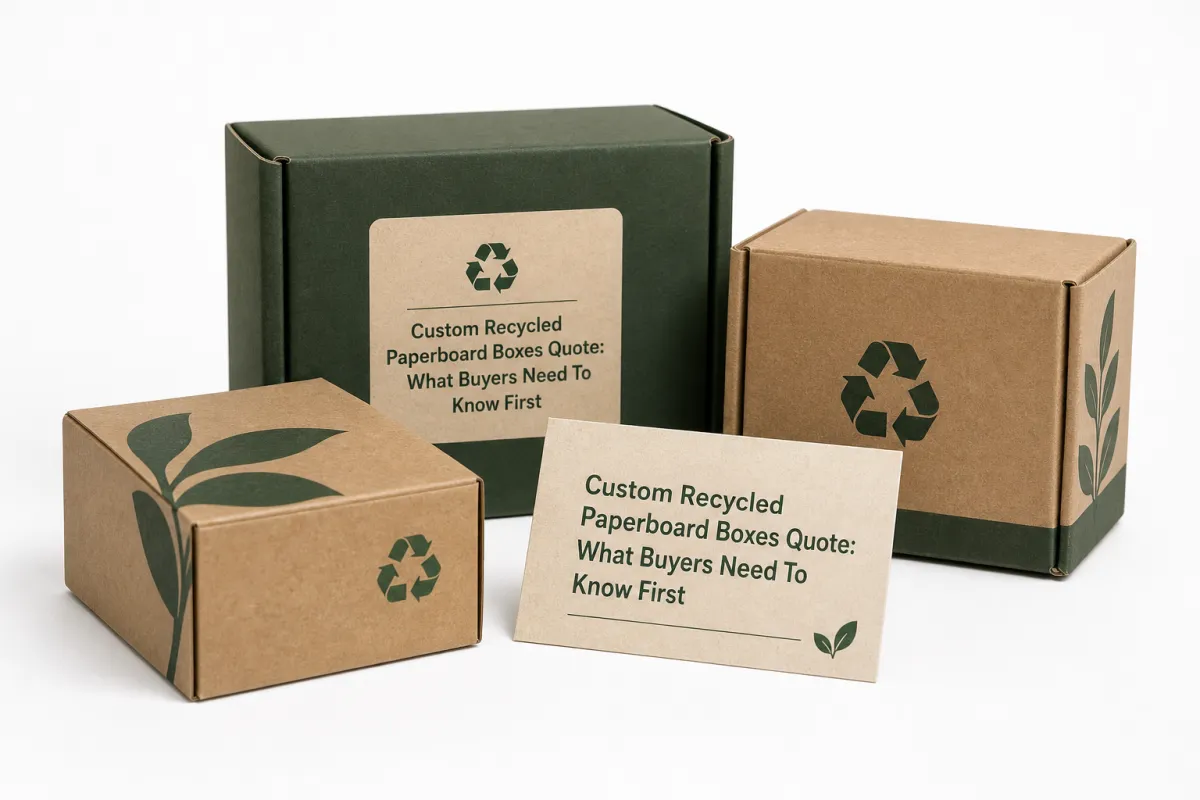
A useful custom recycled paperboard boxes quote starts with a practical question: what job does the box have to do? A candle carton, a cosmetic kit, and a lightweight accessory all live in the same paperboard family, but they do not need the same caliper, the same closure, or the same amount of decoration. The box has to fit the product, protect it, and present it well. Those three things shape the quote before unit price ever enters the room.
Buyers often lead with outer dimensions only. That is not enough. The product itself changes the whole picture because fit affects both protection and presentation. A snug cavity can hold an item in place without extra inserts. A loose fit may need a chipboard insert, a folded support, or a different dieline. For a true custom recycled paperboard boxes quote, the supplier should ask about product weight, fragility, shipping method, and whether the line is manual, semi-automated, or handled by a contract packer. That is not nitpicking. It is how you avoid a box that looks good on a screen and awkward in the factory.
The biggest pricing drivers usually include:
- Box style: tuck-end carton, sleeve, display carton, mailer-style box, or custom die-cut structure.
- Board grade: recycled paperboard thickness, caliper, and stiffness target.
- Print coverage: simple branding, spot color work, or full-coverage graphics.
- Finishing: aqueous coating, matte or gloss coating, soft-touch, embossing, debossing, or window patching.
- Quantity: first-run volume and how likely repeat orders are.
- Extras: inserts, tear strips, special die-cuts, barcode zones, or regulatory copy.
That list is where the real quote conversation starts. A buyer asking for a custom recycled paperboard boxes quote is not just buying paperboard. They are buying a set of production choices. Small changes in structure or finish can move the price more than people expect, especially when the order is small and setup gets spread across fewer cartons. I know that sounds obvious. It still gets missed all the time.
Good pricing should explain itself. If the board has to support a heavier product, if the print area is large, or if a specialty cut is needed for shelf visibility, the quote should show that logic plainly. That makes comparison easier and keeps you from choosing the cheapest line item only to discover the box does not hold up. Cheap packaging has a way of becoming expensive later. Annoyingly consistent, that pattern.
A useful quote starts with the product, then the structure, then the print. If those three pieces are clear, the pricing usually makes sense.
For anyone comparing custom printed boxes across vendors, that first conversation matters more than most people admit. The right quote should feel grounded in production reality, not padded with guesswork and not stripped so bare that the box cannot do its job.
The same rule applies whether the package is going into retail packaging, subscription fulfillment, or a mixed e-commerce channel. The goal is not just to make a box. It is to make a package that fits, looks clean, and holds up through manufacturing and shipping. That is the standard behind every custom recycled paperboard boxes quote.
Product Details: Box Styles, Constructions, And Print Options
Once the product is defined, the next step in a custom recycled paperboard boxes quote is choosing the box style. Structure changes the cost, the look, and the way the package behaves in handling. A simple tuck-end carton is efficient and common for light goods. A sleeve pack can create a more layered presentation. Mailer-style boxes work well when the product has to ship straight to the customer. Custom die-cut retail boxes make sense when the shelf display or product reveal matters as much as the item itself.
Single-wall recycled paperboard is often enough for lightweight products, retail inserts, and items that do not face much stacking pressure. Heavier or awkwardly shaped products usually need a stronger board or a support insert. I have seen buyers chase a lower quote by choosing a lighter board, only to pay for it later in damage, returns, or rework. That is a bad bargain, and it is usually avoidable if someone asks one more question early.
Print method matters just as much. Digital printing usually fits short runs, test launches, and multiple SKUs with smaller quantities. Offset printing tends to make more sense at larger volumes, especially when the artwork carries more coverage, tighter color control, or a more polished retail look. A custom recycled paperboard boxes quote should spell out that difference so you can compare not just price, but the production path behind it. Two quotes can land near each other on paper and still be built on totally different economics.
Here is a practical comparison of common packaging options and the way they usually show up in pricing discussions:
| Box Option | Best Use | Typical Unit Range | Cost Drivers |
|---|---|---|---|
| Tuck-end carton | Light retail goods, cosmetics, supplements, accessories | $0.18-$0.32 at 5,000 units | Board grade, print coverage, simple die line |
| Display carton | Shelf presentation, countertop retail, bundled sets | $0.24-$0.45 at 5,000 units | Window patching, specialty die cuts, coating |
| Mailer-style box | E-commerce shipping, direct-to-consumer kits | $0.30-$0.60 at 5,000 units | Structural strength, print area, closure design |
| Custom die-cut retail box | Premium presentation, product reveal, unusual product shapes | $0.35-$0.75 at 5,000 units | Tooling, inserts, finishing, higher make-ready time |
Those numbers are not a promise. They are a practical frame for a custom recycled paperboard boxes quote, especially when you are comparing board weights, print complexity, and structural features. A carton with a single-color logo is a very different job from a full-coverage box with metallic ink, soft-touch coating, and a precision window cut. Same category. Very different workload.
Finishing changes the feel of the package, but it also changes the budget. Aqueous coating is often a sensible choice because it adds protection without pushing cost too far. Matte and gloss coatings create different visual effects. Soft-touch can make a package feel more premium. Embossing and debossing can strengthen package branding, though they only make financial sense when the art and order size support them. Window patching keeps the product visible, but the patch and die cut add steps to the quote.
For brands building product packaging around launch timelines, the real question is balance. A highly decorated box can look excellent, but if the run is small and the margin is tight, a simpler finish may produce a better overall result. The best custom recycled paperboard boxes quote is the one that lines up appearance, protection, and budget without forcing the package to do too much. Fancy is nice. Functional pays the bills.
The construction should also make sense on the line. If the carton folds poorly or the insert is annoying to load, that cost shows up later in labor. So when you request a custom recycled paperboard boxes quote, ask about foldability, glue points, and whether the build works for manual packing or semi-automated lines. A smart structure saves labor, and labor savings matter just as much as material savings. Sometimes more, honestly.
Specifications That Matter Before You Request A Quote
If you want an accurate custom recycled paperboard boxes quote, send the technical details early. A complete spec sheet gives you a better price and a better comparison across suppliers. At minimum, the supplier should know exact dimensions, product weight, target board strength, print sides, and any special features like lock bottoms, inserts, tear strips, or hang tabs. Without those inputs, the quote is only a rough estimate, and rough estimates are fine for ballparking but lousy for purchasing.
Product compatibility is one of the biggest issues buyers miss. A box for a candle does not face the same risk as a box for a lightweight accessory. Cosmetics may need a clean shelf face and enough rigidity to hold a premium look. Food-adjacent items bring labeling rules and contamination concerns. Supplements often need clear copy placement and barcode legibility. Electronics accessories may need more crush resistance or a tighter fit. A thoughtful custom recycled paperboard boxes quote accounts for all of that instead of pretending every SKU lives in the same universe.
Artwork and compliance details matter more than many first-time buyers expect. If the barcode has to live on a specific panel, that affects the layout. If there is legal copy, an ingredient list, or recycled-content messaging, that should be part of the quote discussion from the start. If you need multiple SKUs or size versions, say so early. Versioned artwork can change plate counts, proofing time, and setup costs. It can also create avoidable headaches if someone decides to "fix it later." Later usually costs more.
For brands that care about certified sourcing, the conversation may also include FSC chain-of-custody or recycled-content claims. The Forest Stewardship Council has clear documentation around certified materials, and it is worth reviewing if that is part of your retail story: FSC-certified sourcing information. That does not automatically move the box cost much, but it can affect material selection and the paperwork tied to your custom recycled paperboard boxes quote. One honest caveat: FSC certification is not the same thing as recycled content, so those claims should be described carefully and separately.
Shipping and handling details belong in the request too. A box headed to retail stores has different needs than a carton shipped by parcel courier. Master carton count, pallet configuration, and cube efficiency all shape the final construction. If the boxes have to be packed into outer shippers, that can change units per shipper and freight cost. The quote should cover the whole packaging system, not just the carton face.
Here is a simple checklist that helps keep the request clean and complete:
- Exact product dimensions and any tolerance limits.
- Product weight and whether the item is fragile, liquid, or heat-sensitive.
- Box style preference and whether the package will be retail-facing or shipping-facing.
- Print specs including colors, coverage, and any special effects.
- Artwork status such as final files, draft concepts, or placeholder copy.
- Quantity by SKU and whether future reorders are likely.
- Shipment destination and any timing constraints.
The better the specification, the more reliable the custom recycled paperboard boxes quote. That holds true whether you are buying one SKU or a family of custom printed boxes with shared structure and different graphics. Clear inputs cut back-and-forth and shorten the path to a usable price.
If you are comparing multiple vendors, ask each supplier to quote the exact same spec. Otherwise, one quote may include a heavier board, a different finish, or a different die cut, and the numbers will not line up. A disciplined request protects your budget and gives you a cleaner read on which supplier actually understands the job. That alone can save a lot of bad follow-up emails.
Custom Recycled Paperboard Boxes Quote: Pricing, MOQ, And Cost Drivers
Pricing is where the custom recycled paperboard boxes quote becomes real, and it is also where confusion likes to show up. Cost usually comes from board grade, printed area, number of colors, finishing steps, tooling, and quantity. If the job uses a standard die line, pricing stays more predictable. If it needs a fully custom structure, the quote has to cover extra setup, drawing time, and possible tooling expense.
Minimum order quantity, or MOQ, is often the first surprise for buyers new to paperboard packaging. Lower quantities almost always push up the unit price because make-ready time, plates, proofing, and operator setup get spread across fewer boxes. If you need 1,000 units, the unit cost can be materially higher than at 5,000 or 10,000. A sensible custom recycled paperboard boxes quote should show that relationship instead of pretending every quantity has the same economics.
Digital and offset printing behave differently. Digital can be more efficient for shorter runs and versioned artwork because it avoids some plate costs. Offset can become more economical as quantities rise and coverage gets heavier. That is why two quotes for the same custom recycled paperboard boxes quote request can look very different even when the box size stays the same. The equipment path matters, and so does the artwork.
Freight should show up in the breakdown too. Too many buyers compare box pricing without looking at shipping, and that creates a false win. A slightly higher unit price with better pallet efficiency or a tighter flat-pack layout can cost less landed. The same goes for samples and rush fees. A clean quote should list the unit price, tooling or setup, proofing, freight, and any accelerated timeline charge so the full picture is visible.
For a realistic budgeting frame, these are the kinds of ranges many buyers see when the specs are straightforward:
- Low-coverage cartons with simple structure and moderate quantity can fall near the bottom of the range.
- Retail-ready cartons with coatings, multiple colors, or inserts usually land in the middle.
- Custom die-cut packaging with windows, premium finishes, or specialty assembly typically sits at the higher end.
There are a few ways to reduce cost without weakening the package. Simplify the structure. Cut back on printed coverage, especially if the back panel or interior does not need full decoration. Standardize across a product family so one dieline can serve multiple SKUs with minor artwork changes. That is usually smarter than quoting every version as a totally separate job.
When a brand asks for a custom recycled paperboard boxes quote, I usually look for three kinds of savings:
- Material savings from choosing the right board strength instead of overspecifying it.
- Production savings from avoiding unnecessary special finishes or overly complex cuts.
- Inventory savings from consolidating versions and reducing slow-moving stock.
The trick is not to strip the box down so far that it feels cheap or fails in transit. Fragile items need support. Shelf-facing packages need presence. Cut too hard and the savings disappear in damage, returns, or extra labor. A good supplier will help you find the point where the structure still works and the quote still stays competitive. That is the real value of a thoughtful custom recycled paperboard boxes quote.
If you want to see how that thinking carries across more packaging formats, our Custom Packaging Products page is a useful starting point. The same financial rules usually apply across custom printed boxes, folding cartons, and related retail packaging formats: the more you ask the box to do, the more the quote should reflect that work.
For a more formal look at transit durability, some buyers also check test methods and distribution standards. ISTA publishes widely used packaging test protocols for transport risk, and it is a useful reference when the package has to move through e-commerce channels or rough handling environments: ISTA transport testing standards. That kind of testing may not be needed for every custom recycled paperboard boxes quote, but it belongs in the conversation when damage risk matters.
From Quote To Production: Process, Samples, And Timeline
A reliable custom recycled paperboard boxes quote should be the beginning of the process, not the finish line. Once pricing is aligned, the work usually moves through spec confirmation, artwork review, proofing, sampling, approval, and then production. When each stage is handled cleanly, the job moves. When one piece is missing, delays stack up fast.
The process usually starts with the inquiry. The buyer sends dimensions, quantity, artwork status, and intended use. The supplier reviews the structure, checks the print method, and sends the quote. If the job is straightforward, that quote may be followed by a proof. If the design is more complex, the team may recommend a structural dummy or a flat sample before full print production. That early stage is where a strong custom recycled paperboard boxes quote pays off, because it forces the job to be defined properly rather than guessed at.
Timeline stretches when the design still needs revision or when product fit is not settled. Color matching can add time, especially if a brand wants the same shade across several product lines. Artwork corrections add time too, particularly if barcodes, legal copy, or logo placement need changes. A job that looks simple on paper can run long if the inputs are not finalized before the quote turns into a production order.
Samples are one of the best risk-control tools in packaging. A flat proof checks layout and copy. A structural dummy checks fold performance and cavity size. A production sample checks the combined effect of board, print, and finish. Those steps can sound slow, but they are usually faster than fixing a full run of boxes that do not fit or do not present well. A disciplined custom recycled paperboard boxes quote should leave room for the right sample stage when the project needs it.
There are also practical ways to shorten lead time without making bad choices:
- Submit final artwork early, not halfway through the design process.
- Confirm product dimensions before the quote is issued.
- Avoid last-minute content changes after proof approval.
- Choose a board and finish package that fits standard production flow.
- Keep the first run focused if speed matters more than elaborate finishing.
That last point matters. Buyers sometimes ask for the most complex package possible and then want the shortest turnaround. Those goals clash. A simpler custom recycled paperboard boxes quote can often move faster because it avoids specialty tooling, unusual coating combinations, or repeated proof cycles. Speed is usually a design decision as much as a factory decision.
The best schedules also respect how the boxes will be used. If the carton is going to a contract packer, the assembly method should be checked early. If the box is for e-commerce, the compression and crush demands may be different than retail shelf packaging. If the package will move through multiple channels, the quote should reflect the hardest use case, not the easiest one.
That is why the timeline gets clearer once the quote is treated as part of packaging design. The right custom recycled paperboard boxes quote is not only about price. It is also about whether the project can move from file to finished cartons without wasted motion. Nobody wants to babysit avoidable delays.
Why Choose Our Recycled Paperboard Program
Our approach to every custom recycled paperboard boxes quote is built on manufacturing judgment. The point is to Choose the Right recycled content, the right board strength, and the right print method for the product instead of forcing one packaging style to fit every job. That matters because the best packaging choices are not abstract. They are grounded in how the item is packed, shipped, displayed, and reordered over time.
Consistency across runs is a major advantage for buyers managing more than one SKU. When a carton has to fit a production line, a pallet build, and a retail shelf plan, even small variations can create problems. A box that drifts in size or finish from one order to the next can slow down pack-out or create presentation issues. A dependable custom recycled paperboard boxes quote should lead to a package that repeats cleanly, not one that changes personality every time you reorder.
Practical sustainability belongs in the conversation too. Recycled paperboard can support efficient material use, recyclable construction where appropriate, and right-sized packaging that reduces waste in shipping and storage. That is the kind of sustainability that holds up because it comes from less excess material and better planning, not slogans. Buyers looking for custom printed boxes often find the strongest environmental gains in smarter structure, not in extra layers or more decoration.
Clear communication helps just as much. Packaging quotes should make it obvious what is included, what is optional, and what changes the total. If a finish adds cost, say so. If a board upgrade improves crush resistance, explain why. If the MOQ changes with the print method, bring it up early. That kind of honesty saves time and builds trust. It also keeps the quote from turning into a moving target, which is nobody’s favorite activity.
We also pay close attention to package branding. The package has to support the product’s position in the market. Sometimes that means a minimal carton with crisp typography and one strong brand color. Other times it means a richer display box with more structure and a stronger shelf statement. The quote should respect those different goals instead of assuming every brand wants the same look.
Here is the kind of decision-making that usually helps buyers get the most from a custom recycled paperboard boxes quote:
- Choose the board for the product, not for an abstract idea of premium weight.
- Match the print method to the run size and the artwork complexity.
- Keep the structure efficient so the box can fold, ship, and pack without friction.
- Use finishes intentionally when they improve shelf presence or protection.
- Design for repeatability if the box will be reordered through the year.
From a buyer’s perspective, that kind of guidance is worth more than a fast price alone. A low number on a quote is not a win if the box needs redesign, replacement, or extra labor later. A well-prepared custom recycled paperboard boxes quote supports the full package lifecycle: design, production, fulfillment, and reorder.
That is why many brands prefer to talk through the structure before they place the order. They want confidence that the carton will perform as a piece of product packaging, not just as a printed shell. If that is your priority too, the quote conversation should be detailed, technical, and honest about tradeoffs.
Most importantly, the program should make buying simpler. Whether the job is straightforward or highly customized, the best custom recycled paperboard boxes quote is the one that helps you make the right call without wasted back-and-forth.
Next Steps To Request Your Custom Recycled Paperboard Boxes Quote
If you are ready to request a custom recycled paperboard boxes quote, gather the basics first. Exact product dimensions, target quantity, product weight, artwork files, finish preferences, ship-to location, and any compliance or retail requirements will help the quote land much closer to reality. If the package needs to work for shelf display, subscription shipping, or protective transit packaging, say that too. The use case matters.
It often helps to ask for two or three versions of the same custom recycled paperboard boxes quote. A cost-focused version might use simpler printing and a more standard structure. A presentation-focused version might add coating or a window feature. A lead-time-focused version might trim complexity to keep the schedule moving. That side-by-side view helps because it shows how each choice changes the economics and the look.
Do not send the request before confirming what the package needs to do. If the box is meant for a retail shelf, the print face and front panel matter more. If it is shipping to a consumer, the closure and crush resistance matter more. If it is part of a contract-packaging workflow, assembly speed may matter as much as the printed look. The best custom recycled paperboard boxes quote is the one that reflects the actual use case.
A practical request usually leads to a practical result. Clear specs create a clearer conversation, and a clearer conversation leads to a better price, a better structure, and fewer delays. That is true whether you are buying one carton style or several related sizes for a broader custom printed boxes program.
If you want help shaping the right structure, our team can review the details and walk you through the options. Reach out through our Contact Us page, and include as much of the spec sheet as you have. The more complete the request, the stronger the custom recycled paperboard boxes quote will be.
One more practical note: do not judge the final choice on price alone. Compare the line items, check the board choice, confirm the print method, and make sure the finish and quantity fit the plan. A good custom recycled paperboard boxes quote is the start of a package that looks right, runs right, and supports the brand without wasting material or time.
For buyers who want packaging that performs honestly and presents well, that is the standard worth aiming for. Send the specs, compare the options, and use the quote discussion to lock in the best structure, quantity, and timeline for your custom recycled paperboard boxes quote.
How do I get a custom recycled paperboard boxes quote quickly?
Send exact dimensions, target quantity, artwork files, and product weight so the custom recycled paperboard boxes quote can be based on a real build rather than a rough estimate. Include finish preferences, shipping destination, and whether you need samples or a rush timeline, because those details change both Pricing and Lead time.
What information do you need for an accurate custom recycled paperboard boxes quote?
The most important inputs are box size, construction style, print coverage, board preference, and any inserts or special closures. It also helps to know how the package will be used, because retail display, mailer use, and product protection each need different specs for a reliable custom recycled paperboard boxes quote.
What is the usual MOQ for custom recycled paperboard boxes quotes?
MOQ depends on size, print method, and tooling, but lower quantities usually mean a higher unit cost because setup is spread across fewer boxes. If you need several SKUs, ask whether the order can be grouped or standardized to improve efficiency without changing the fit, especially when planning a custom recycled paperboard boxes quote.
Can custom recycled paperboard boxes be printed and finished for retail shelves?
Yes, recycled paperboard can be printed cleanly and finished with coatings, embossing, or window features when the construction supports it. The key is choosing a board and finish combination that matches your product weight, shelf life, and display expectations so the custom recycled paperboard boxes quote reflects the actual retail goal.
How long does it take from quote approval to finished boxes?
Timeline usually depends on artwork approval, sample approval, and whether the job needs custom tooling or color matching. If the specs are ready at the start, production can move faster than if the box structure or artwork still needs revision, which is why a complete custom recycled paperboard boxes quote request matters.

